
Price Elasticity Calculator
Calculate price elasticity of demand using the midpoint method. Understand how your customers respond to price changes.
Enter Your Data
Enter price and quantity data to calculate elasticity
Industry Benchmarks: Price Elasticity
Elasticity is typically negative (price up → demand down). More negative values mean higher price sensitivity. Necessities tend to be inelastic; luxuries are elastic.
| Industry | Low | Average | High |
|---|---|---|---|
| Luxury Goods | -2.5% | -2% | -1.5% |
| Consumer Electronics | -2% | -1.5% | -1.2% |
| Groceries (Staples) | -0.5% | -0.3% | -0.2% |
| Gasoline | -0.4% | -0.2% | -0.1% |
| Restaurant Meals | -2.5% | -1.8% | -1.5% |
| B2B Industrial | -1.5% | -0.9% | -0.5% |
How to Use the Price Elasticity Calculator
Step-by-Step Instructions
- Enter the original price (P1) and original quantity sold (Q1)
- Enter the new price (P2) and new quantity sold (Q2)
- Click Calculate to see the price elasticity coefficient
- Interpret: |E| > 1 is elastic, |E| < 1 is inelastic, |E| = 1 is unit elastic
Formulas Used
Price Elasticity (Midpoint Method)
E = ((Q2-Q1)/((Q2+Q1)/2)) / ((P2-P1)/((P2+P1)/2))The midpoint method gives the same elasticity regardless of direction of price change.
Percentage Change Method
E = (% Change in Quantity) / (% Change in Price)Simplified version showing elasticity as ratio of percentage changes.
Frequently Asked Questions: Price Elasticity Calculator
Related Resources
More Calculators
Explore our other free pricing tools
Pricing Guides
Learn more about pricing optimization

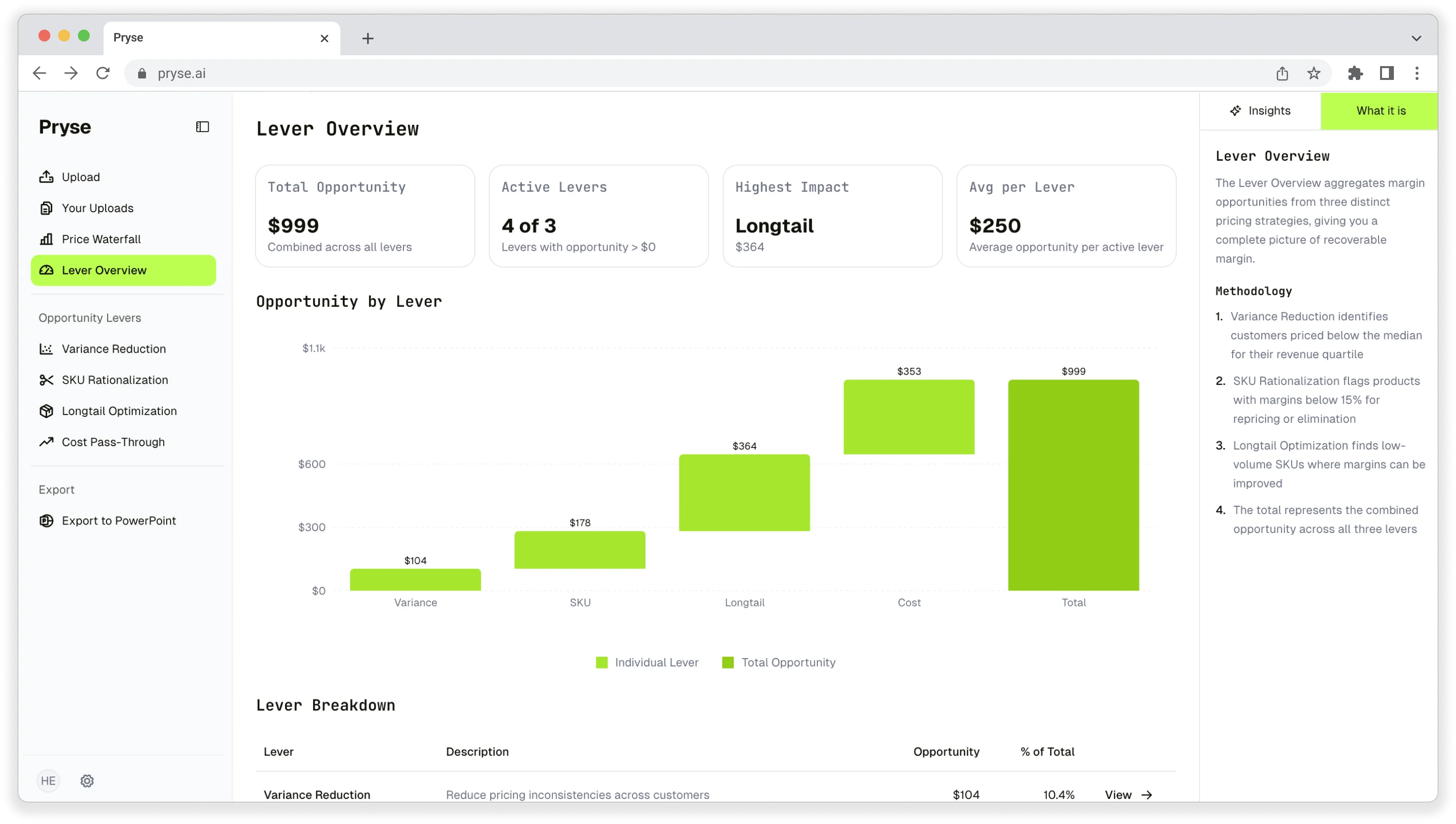
Want to analyze your entire product catalog?
Pryse automatically identifies margin leakage across thousands of SKUs. Upload your data and find hidden profit in 24 hours.
One-time $1,499 diagnostic. No subscription required.