 Pryse
PryseWholesale vs Retail Price Formula: How to Calculate Both Correctly
Learn the exact formulas to calculate wholesale and retail prices. Understand markup vs margin, typical pricing multiples, and avoid common pricing mistakes.
Wholesale price formulas calculate what you charge resellers based on your costs and target profit margin. Retail price formulas determine what consumers pay based on wholesale cost plus retailer markup. The math differs because wholesalers and retailers operate with different cost structures, margins, and volume assumptions.
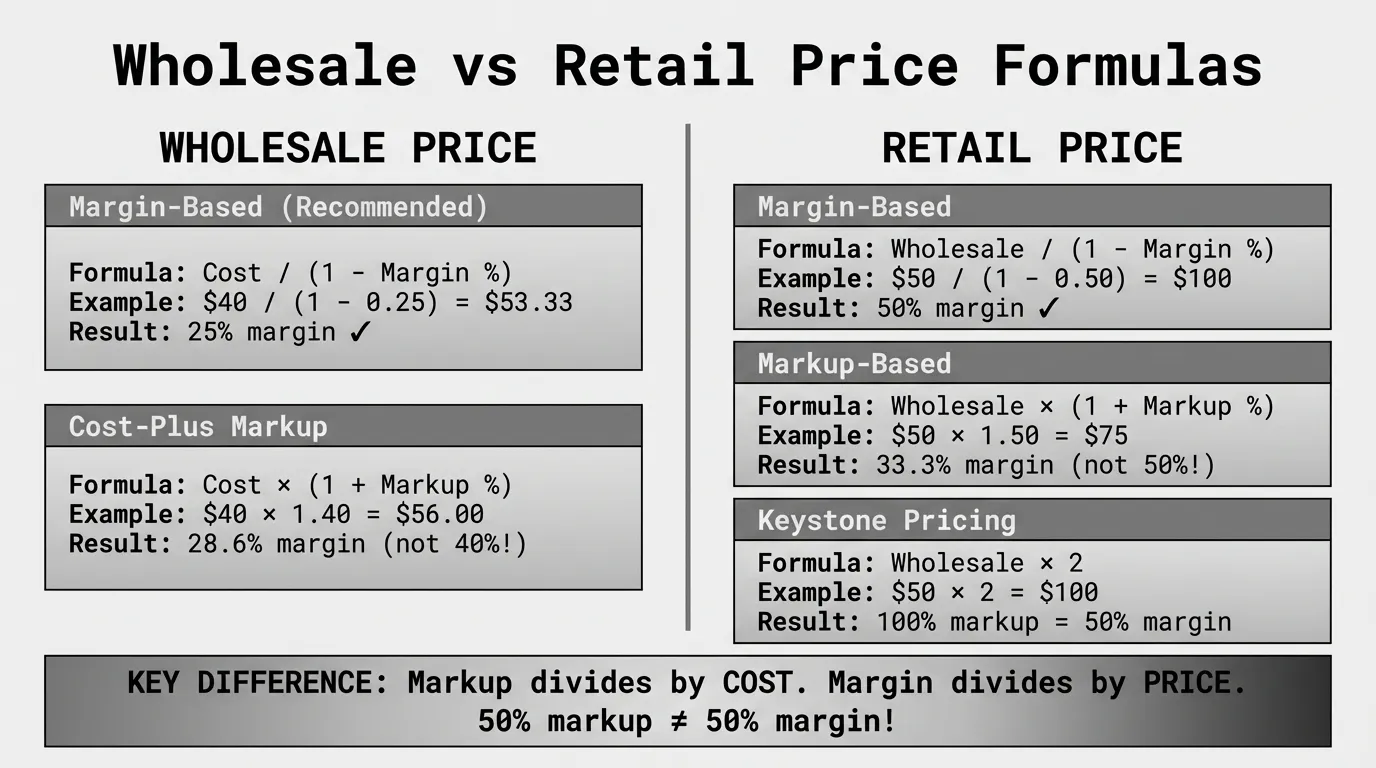
The core distinction: wholesalers typically work from cost to price using margin-based formulas, while retailers work from wholesale price to retail price using markup percentages. According to Shopify's 2025 wholesale pricing guide, businesses typically aim for 15-50% profit margins for wholesale products, while retailers add 35-65% markup when reselling wholesale items to consumers.
The formula choice matters. Using markup when you should use margin creates pricing errors that compound across thousands of SKUs. A 50% markup produces only 33.3% margin, not 50%. Confusing these two concepts is one of the most common wholesale pricing mistakes.
Wholesale Price Formulas
Wholesalers set prices to cover costs and achieve target profit margins.
Margin-Based Formula (Recommended)
Wholesale Price = Cost / (1 - Profit Margin)
Where:
- Cost = Total cost per unit (COGS + allocated overhead)
- Profit Margin = Target profit as percentage of price (expressed as decimal)
Example: Your product costs $40 and you want 25% gross margin.
Wholesale Price = $40 / (1 - 0.25) = $40 / 0.75 = $53.33
Verification:
- Wholesale price: $53.33
- Cost: $40.00
- Gross profit: $13.33
- Gross margin: $13.33 / $53.33 = 25% ✓
This formula maintains consistent margins as costs fluctuate. When supplier costs increase from $40 to $44, the formula automatically adjusts wholesale price to $58.67 to preserve the 25% margin.
Cost-Plus Markup Formula (Alternative)
Wholesale Price = Cost × (1 + Markup %)
Example: Your product costs $40 and you want a 40% markup.
Wholesale Price = $40 × 1.40 = $56.00
At $56.00 wholesale price:
- Cost: $40.00
- Gross profit: $16.00
- Gross margin: $16.00 / $56.00 = 28.6%
Notice: A 40% markup produces 28.6% margin, not 40%. The markup percentage and margin percentage are different measures.
According to Orders in Seconds' margin vs markup calculator, the main difference when calculating margin vs markup is that margin calculations are based on selling price, while markup calculations are based on cost.
Which Wholesale Formula to Use
Use margin-based when:
- You need consistent gross margin percentages for financial planning
- Costs fluctuate frequently
- You're managing a large catalog with varying cost structures
- You report financials using margin metrics
Use cost-plus markup when:
- You're in a stable cost environment
- Industry pricing is markup-driven
- You price based on competitive positioning rather than margin targets
- Your team thinks in markup percentages
Most distribution and wholesale businesses use margin-based formulas because they maintain stable profitability regardless of cost changes.
Retail Price Formulas
Retailers calculate selling prices by adding markup to wholesale costs.
Margin-Based Retail Formula
Retail Price = Wholesale Price / (1 - Retail Margin %)
Example: You purchase at $50 wholesale and want a 50% retail margin.
Retail Price = $50 / (1 - 0.50) = $50 / 0.50 = $100
At $100 retail price:
- Wholesale cost: $50
- Gross profit: $50
- Gross margin: 50%
Markup-Based Retail Formula
Retail Price = Wholesale Price × (1 + Markup %)
Example: You purchase at $50 wholesale and want a 50% markup.
Retail Price = $50 × 1.50 = $75
At $75 retail price:
- Wholesale cost: $50
- Gross profit: $25
- Gross margin: $25 / $75 = 33.3%
The same 50% number produces $100 retail using margin-based pricing but only $75 using markup-based pricing. The formulas are not interchangeable.
Keystone Pricing (Retail Standard)
Keystone pricing is the retail industry's simplest formula: double the wholesale price.
Retail Price = Wholesale Price × 2
Example: A product purchased at $50 wholesale retails at $100.
Keystone pricing represents:
- 100% markup over wholesale cost
- 50% gross margin for the retailer
- 2x pricing multiple
According to ShirtMax's retail pricing guide, keystone pricing is a simple and fairly common pricing method. All you have to do is take the price you paid for your product and double it to come up with a retail price.
Keystone works when:
- Your wholesale cost represents roughly 50% of market value
- Competitors use similar multiples
- Operating costs justify a 50% margin
Keystone fails when:
- Market pricing demands higher or lower multiples
- Competition uses different margin structures
- Category positioning requires premium or value pricing
Markup vs Margin: The Math Behind the Difference
Markup and margin use different denominators, which creates different percentages from identical dollar amounts.
The Formulas
Markup:
Markup % = (Price - Cost) / Cost × 100
Margin:
Margin % = (Price - Cost) / Price × 100
The difference: markup divides profit by cost, margin divides profit by price.
Why They Produce Different Numbers
Example: A product costs $60 and sells for $100.
Markup calculation:
Markup = ($100 - $60) / $60 × 100 = $40 / $60 = 66.7%
Margin calculation:
Margin = ($100 - $60) / $100 × 100 = $40 / $100 = 40%
Same dollar profit ($40), different percentages (66.7% markup vs 40% margin).
According to Linnworks' markup vs margin guide, markup measures your profit as a percentage of the cost, while margin calculates how much of the selling price is profit.
Converting Between Markup and Margin
Convert markup to margin:
Margin = Markup / (1 + Markup)
Example: 50% markup = 0.50 / (1 + 0.50) = 0.50 / 1.50 = 33.3% margin
Convert margin to markup:
Markup = Margin / (1 - Margin)
Example: 40% margin = 0.40 / (1 - 0.40) = 0.40 / 0.60 = 66.7% markup
Common Markup/Margin Equivalents
| Markup | Margin |
|---|---|
| 25% | 20% |
| 33% | 25% |
| 50% | 33.3% |
| 66.7% | 40% |
| 100% | 50% |
| 150% | 60% |
| 200% | 66.7% |
Notice: A 100% markup (doubling your cost) produces only a 50% margin, not 100%.
Wholesale to Retail Pricing Multiples
The relationship between wholesale and retail prices varies by industry, product category, and market positioning.
Typical Pricing Multiples
The wholesale price stays much lower than the retail price and usually follows a 2 to 2.5x markup relationship. According to Exporteers' distributor margin guide, retailers might price a product between $80 to $100 in their stores if sold at $40 wholesale.
| Industry | Typical Retail Markup | Pricing Multiple | Source |
|---|---|---|---|
| Grocery/Food | 15% | 1.15x | WiseBread |
| Electronics | 8-10% | 1.08-1.10x | WiseBread |
| Automobiles | 5-10% | 1.05-1.10x | WiseBread |
| Furniture | 42-43% | 1.42-1.43x | WiseBread |
| Jeans (mid-level) | 115% | 2.15x | WiseBread |
| Clothing (general) | 50-100% | 1.50-2.00x | Finale Inventory |
| Restaurants (food) | 60% | 1.60x | Jobber Academy |
| Restaurants (beverages) | 500% | 6.00x | Jobber Academy |
Standard Wholesale-to-Retail Flow
A typical three-tier pricing structure:
| Tier | Price | Markup from Previous | Margin |
|---|---|---|---|
| Manufacturer Cost | $20 | — | — |
| Wholesale Price | $50 | 150% | 60% |
| Retail Price (Keystone) | $100 | 100% | 50% |
| Retail Price (Standard) | $125 | 150% | 60% |
The manufacturer produces at $20 cost and sells to wholesalers at $50 (2.5x cost, 60% margin). The wholesaler sells to retailers at $50. Retailers mark up to $100-125 depending on their positioning and costs.
A widely accepted guideline from Wholesale Suite is to set your wholesale price at around 50% of the retail price, which ensures a healthy return on investment while acknowledging the different cost structures associated with each market.
Common Formula Mistakes to Avoid
1. Confusing Markup and Margin Percentages
Mistake: Applying a 40% markup and expecting 40% margin.
Reality: A 40% markup produces only 28.6% margin.
Fix: Use the margin-based formula when margin targets matter.
2. Using Gross Markup on Net Cost
Mistake: Calculating markup on product cost alone, ignoring allocated overhead.
Example:
- Product cost: $40
- Overhead allocation: $8
- Wholesale price using 25% margin on product cost only: $53.33
- Actual margin including overhead: ($53.33 - $48) / $53.33 = 10%
Fix: Calculate wholesale price using total cost (product + overhead):
Wholesale Price = ($40 + $8) / (1 - 0.25) = $48 / 0.75 = $64
3. Rounding Pricing Multiples
Mistake: Using 2x as a wholesale-to-retail multiple when the math requires 2.25x.
Example:
- Wholesale price: $44.50
- Target retail margin: 55%
- Required retail price: $44.50 / (1 - 0.55) = $98.89
- Pricing multiple: $98.89 / $44.50 = 2.22x
Fix: Calculate the actual multiple needed, don't default to 2x.
4. Ignoring Cost-to-Serve Differences
Mistake: Using identical margin targets for all customers regardless of cost-to-serve.
Reality: Selling 100 units to one retailer costs less than selling 100 individual units to consumers. The wholesale margin doesn't need to match retail margins because the cost structures differ.
Fix: Set wholesale margins based on wholesale cost structures. Set retail margins based on retail cost structures. They're different businesses with different economics.
5. Forgetting to Update Formulas When Costs Change
Mistake: Setting prices once and never adjusting when supplier costs increase.
Fix: Recalculate wholesale prices quarterly or when costs shift by more than 5%. Use the margin-based formula so price adjustments maintain target margins.
Practical Examples: Wholesale and Retail Pricing
Example 1: Industrial Distributor Pricing
Scenario: You distribute industrial fasteners. Product cost from manufacturer is $32/box. Overhead allocation is $6/box. You want 28% wholesale margin. Your retailers use keystone pricing.
Calculate wholesale price:
Wholesale Price = ($32 + $6) / (1 - 0.28) = $38 / 0.72 = $52.78
Retailer calculates retail price (keystone):
Retail Price = $52.78 × 2 = $105.56
Result:
- Your wholesale margin: 28%
- Retailer's retail margin: 50%
- Consumer pays 3.3x manufacturer cost
Example 2: Fashion Retailer Markup
Scenario: You purchase clothing wholesale at $45/unit. Industry standard retail markup is 100% (keystone). You want to understand your margin.
Calculate retail price:
Retail Price = $45 × 2 = $90
Calculate your margin:
Margin = ($90 - $45) / $90 × 100 = 50%
Result:
- 100% markup = 50% margin
- Gross profit per unit: $45
- Need to sell 100 units to generate $4,500 gross profit
Example 3: Converting Margin Target to Markup
Scenario: Your finance team sets a 35% gross margin target for all wholesale products. You need to communicate this as a markup percentage to your pricing manager who thinks in markup terms.
Convert margin to markup:
Markup = 0.35 / (1 - 0.35) = 0.35 / 0.65 = 53.8%
Result:
- 35% margin target = 53.8% markup
- For a $50 cost product: $50 × 1.538 = $76.90 wholesale price
- Verification: ($76.90 - $50) / $76.90 = 35% ✓
When to Use Each Formula
Use wholesale margin-based formula when:
- Managing a large product catalog with varying costs
- Costs fluctuate due to supplier pricing or commodity volatility
- Financial planning requires consistent gross margin percentages
- You need to maintain profitability targets across cost changes
Use wholesale markup formula when:
- Industry standards are expressed in markup terms
- Competitive pricing is markup-driven
- Costs are stable and rarely change
- Your team is trained to think in markup percentages
Use retail margin-based formula when:
- You operate with specific margin targets by category
- You want consistent profitability percentages
- You analyze performance using margin metrics
Use retail markup formula when:
- Industry benchmarks are expressed as markup percentages
- You price competitively based on observed market multiples
- Keystone pricing or other simple multiples align with market expectations
For a complete overview of wholesale pricing strategy, including cost allocation and margin targets by industry, see our guide to wholesale pricing.
For tools to calculate these formulas automatically, see our wholesale price calculator and wholesale pricing calculator.
Sources
- Shopify: How to Calculate Wholesale Pricing (2025)
- Indeed: How to Calculate Wholesale to Retail Markup
- Orders in Seconds: Margin vs Markup Calculator
- Linnworks: Markup vs Margin Explained
- WiseBread: Retail Markup on Common Items
- ShirtMax: How to Calculate Retail Price from Wholesale
- Exporteers: Distributor Margins by Industry
- Finale Inventory: How to Calculate Markup Percentage
- Wholesale Suite: Wholesale Price Guide
- Jobber Academy: How to Calculate Markup
Last updated: February 24, 2026
Frequently Asked Questions
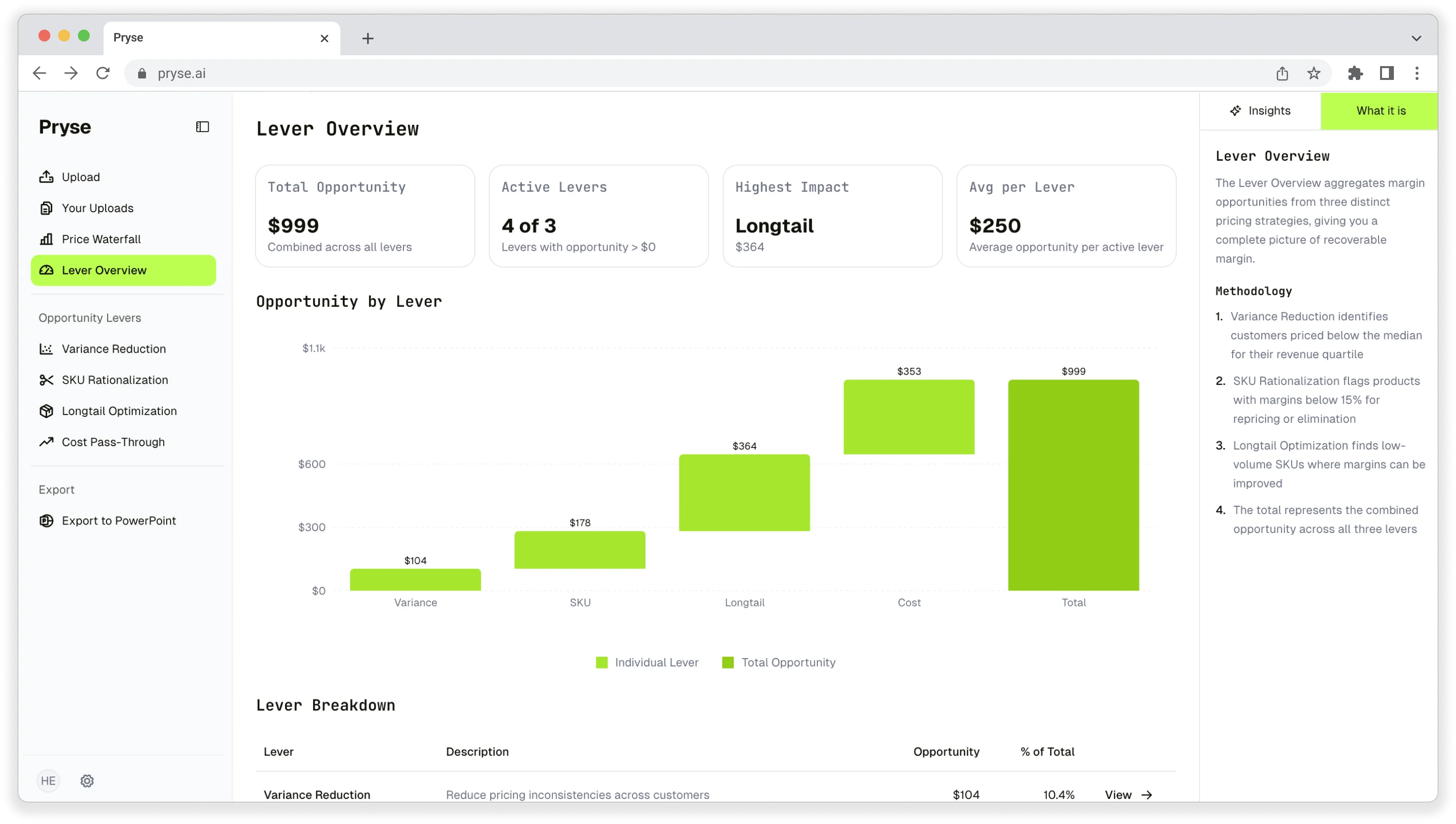
Want to analyze your entire product catalog?
Pryse automatically identifies margin leakage across thousands of SKUs. Upload your data and find hidden profit in 24 hours.
One-time $1,499 diagnostic. No subscription required.