 Pryse
PryseWhat is Wholesale Pricing? Definition, Formulas, and Strategies
Wholesale pricing is the price charged to retailers who purchase products in bulk. Learn the definition, formulas, margin benchmarks, and strategies for wholesale pricing.
Wholesale pricing is the discounted price a wholesaler or distributor charges to retailers who purchase products in bulk for resale. Unlike retail pricing aimed at end consumers, wholesale prices are intentionally lower because the business model revolves around volume sales, not individual transactions.
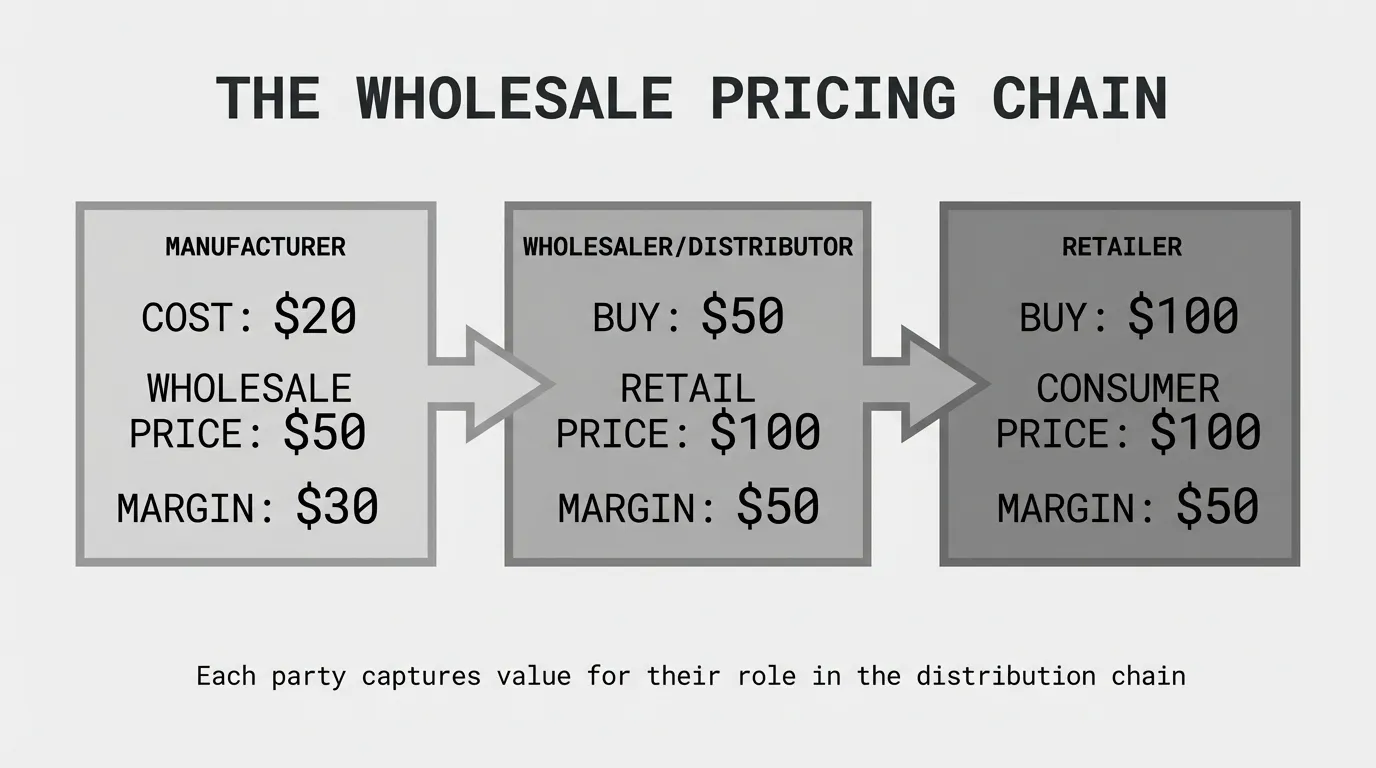
The math is straightforward: wholesalers trade higher profit-per-unit for higher volume-per-sale. Instead of spending marketing dollars to find 100 individual customers, you find one retail partner who buys 100 units at once. Lower price, higher volume, lower customer acquisition costs.
Wholesale profit margins typically run 15-50%, with most distributors operating at 20-30% gross margin. According to the National Association of Wholesaler-Distributors, the average gross margin for wholesalers across industries was 25% in 2024. But that average conceals significant variation: food distributors run 12-20% while industrial MRO distributors achieve 28-38%.
The Wholesale Pricing Definition
Wholesale pricing is the price charged when selling products in bulk to retailers, resellers, or other businesses who will sell to end consumers. The wholesale price sits between the manufacturer's cost and the retail price consumers pay.
The defining characteristic is volume. Wholesalers sell cases, pallets, or bulk quantities. Retailers buy at wholesale prices and then mark up for individual sale. That markup covers the retailer's operating costs (rent, staff, marketing) and provides their profit margin.
A common pricing structure follows this pattern:
- Manufacturer cost: $20
- Wholesale price: $50 (2.5x cost)
- Retail price: $100 (2x wholesale)
The manufacturer earns $30 gross profit per unit. The wholesaler earns $50 gross profit per unit sold to retailers. The retailer earns $50 gross profit per unit sold to consumers. Each party captures value for their role in the distribution chain.
For a complete breakdown of how distribution pricing works across industries, see our guide to distribution pricing.
How Wholesale Pricing Works
The wholesale pricing model depends on three parties: manufacturers who produce goods, wholesalers who aggregate and distribute, and retailers who sell to end consumers.
The Distribution Chain
Manufacturers produce products and sell to wholesalers at a price that covers production costs plus a profit margin. They optimize for production efficiency and volume, not customer relationships.
Wholesalers purchase in bulk from manufacturers and break down those bulk shipments into smaller quantities for retailers. They maintain inventory, handle logistics, provide credit terms, and manage relationships with hundreds or thousands of retail accounts.
Retailers purchase from wholesalers at wholesale prices and sell individual units to consumers at retail prices. Their markup covers storefront costs, staff wages, local marketing, and the customer acquisition and service costs that wholesalers don't bear.
Each party adds value and captures a margin that reflects their role.
Why Wholesale Exists
Wholesalers solve an economic problem: most manufacturers don't want to sell 20 units each to 5,000 small retailers. The transaction costs would destroy any profit. And most retailers don't want to order full container loads directly from factories in China.
Wholesalers aggregate demand, carry inventory risk, provide credit terms, and handle logistics. That service has value, which the wholesale margin compensates.
Wholesale vs Retail Pricing
The difference between wholesale and retail pricing comes down to who's buying and what service they receive.
Who Pays Wholesale Prices
- Retailers purchasing for resale
- E-commerce sellers sourcing inventory
- Business buyers making bulk purchases
- Resellers and value-added resellers
- Other distributors in multi-tier channels
Wholesale buyers provide business credentials (tax ID, resale certificate) and purchase in minimum quantities. Single-unit purchases typically don't qualify for wholesale pricing.
Who Pays Retail Prices
- End consumers buying for personal use
- Businesses purchasing for internal consumption (not resale)
- Anyone buying in single-unit quantities
The Price Difference
Retail prices typically run 2-3x wholesale prices. A product with a $50 wholesale price might retail at $100-150 depending on the industry, competitive dynamics, and retailer margins.
The retail markup covers:
- Store rent and utilities
- Retail staff wages
- Point-of-sale systems and operations
- Local advertising and promotions
- Customer service and returns
- Inventory shrinkage and obsolescence
- Credit card processing fees
Wholesalers avoid most of these costs. They operate warehouses (cheaper than retail space), sell in bulk (fewer transactions to process), and don't market to consumers (no advertising spend).
For benchmark data on typical margins across distribution sectors, see our analysis of distributor margins by industry.
How to Calculate Wholesale Price
Wholesale pricing starts with understanding your costs, then adding a margin that covers overhead and provides profit.
The Basic Formula
Wholesale Price = Cost of Goods + Labor + Overhead + Profit Margin
Where:
- Cost of Goods = Direct material costs to acquire or produce the product
- Labor = Direct labor costs associated with the product
- Overhead = Indirect costs allocated to the product (warehouse, admin, utilities)
- Profit Margin = Target profit as a percentage of costs or percentage of price
Common Calculation Methods
Cost-Plus Pricing
The most common method: start with your costs and add a target markup.
Wholesale Price = Total Cost × (1 + Markup Percentage)
Example: Your total cost per unit is $30. You want a 40% markup.
Wholesale Price = $30 × 1.40 = $42
Retail Price Working Backwards
If you know the target retail price, work backwards using the typical wholesale-to-retail multiple.
Wholesale Price = Target Retail Price × 0.40 to 0.60
Example: The product needs to retail at $100 to be competitive.
Wholesale Price = $100 × 0.50 = $50
This assumes retailers will double the price (keystone pricing). If your costs at that wholesale price exceed $35-40, the margin might be too thin and you need to reconsider positioning or costs.
Market-Based Pricing
Check competitive wholesale prices for similar products and price within that range based on your value proposition.
- Premium positioning: Price at the high end of the market range
- Competitive positioning: Price at the market average
- Penetration positioning: Price below market to gain share
What to Include in Costs
When calculating wholesale prices, include:
Direct Costs:
- Product purchase cost or manufacturing cost
- Inbound freight from suppliers
- Customs and duties (for imports)
- Quality inspection and testing
Overhead Costs (allocated per unit):
- Warehouse rent and utilities
- Inventory carrying costs (typically 20-30% annually)
- Staff salaries (purchasing, warehouse, admin)
- Technology and systems
- Insurance and property taxes
Variable Costs:
- Pick, pack, and ship labor
- Packaging materials
- Outbound freight
- Credit card processing or payment terms cost
- Returns and allowances
Many wholesalers fail to properly allocate overhead, which leads to underpricing. A product might cost $30 in direct costs, but when you add $8 of overhead allocation and $2 of variable fulfillment costs, your true cost is $40, not $30.
For a detailed look at how to analyze costs and margins by product, see our guide to margin analysis.
Typical Wholesale Profit Margins
Wholesale profit margins vary significantly by industry, product characteristics, and business model.
General Wholesale Margin Benchmarks
According to multiple industry sources, wholesale gross margins typically fall within these ranges:
- General wholesale distribution: 15-50%
- Most common range: 20-30%
- Industry average (NAW 2024): 25%
The wide range reflects the diversity of wholesale business models. A food distributor moving commodity products on thin margins operates differently from a specialty fastener distributor providing technical services.
Margin Benchmarks by Industry
Different distribution sectors achieve different margins based on product complexity, service requirements, and competitive dynamics:
| Industry | Gross Margin | Key Drivers |
|---|---|---|
| Industrial MRO | 28-38% | Technical expertise, breadth of offering |
| Auto Parts | 28-40% | Speed of delivery, inventory depth |
| Fasteners/Hardware | 30-42% | Application engineering, kitting services |
| Electrical | 22-32% | Product mix (commodity vs. automation) |
| HVAC | 23-30% | Brand authorization, technical support |
| Plumbing/Building | 24-32% | Project vs. stock business |
| Food/Beverage | 12-20% | Perishability, commodity competition |
These benchmarks come from industry association data including the National Association of Electrical Distributors (NAED), Heating, Air-conditioning & Refrigeration Distributors International (HARDI), and the Industrial Supply Association.
Markup vs. Gross Margin
Wholesalers often confuse markup and gross margin. They're related but calculate differently.
Markup is the percentage added to cost:
Markup = (Price - Cost) / Cost × 100
Gross Margin is the percentage of price:
Gross Margin = (Price - Cost) / Price × 100
Example: You buy a product for $50 and sell it for $75.
- Markup = ($75 - $50) / $50 = 50%
- Gross Margin = ($75 - $50) / $75 = 33.3%
A 50% markup yields only 33% gross margin. A 100% markup yields 50% gross margin. This matters when setting prices: if your target is "30% gross margin" but you calculate a 30% markup, you're actually achieving only 23% gross margin.
For tools to convert between markup and margin, see our markup to margin calculator.
What Determines Your Margin
Several factors determine where you fall within the industry range:
Product Characteristics
- Commoditized products with many suppliers: Lower margins (15-20%)
- Specialized products with few suppliers: Higher margins (30-45%)
- Private label or exclusive distribution: Higher margins (35-50%)
Services Provided
- Basic fulfillment only: Lower margins
- Technical support and application engineering: Higher margins
- Value-added services (kitting, VMI, system design): Higher margins
Customer Mix
- Large national accounts with leverage: Lower margins (10-20%)
- Small local accounts with less negotiating power: Higher margins (25-40%)
- Direct consumers (if you sell retail as well): Highest margins (40-60%)
Competitive Position
- Commodity price competition: Lower margins
- Differentiated service or expertise: Higher margins
- Exclusive territory or limited competition: Higher margins
Wholesale Pricing Strategies
Wholesalers use different pricing strategies depending on their market position, customer base, and business objectives.
Cost-Plus Pricing
The most common wholesale pricing method: calculate total costs and add a standard markup percentage.
How it works: Every product receives the same markup (or markup by category). A product costing $40 with a 30% markup sells for $52. Simple, consistent, defensible.
When to use it:
- Commodity products where market prices are stable
- Large catalogs where individual price management is impractical
- Industries with transparent cost structures
Limitations:
- Ignores what customers will actually pay (value)
- Ignores competitive pricing
- Same margin for all products regardless of strategic importance
For a detailed breakdown of cost-plus pricing, see our guide to cost-plus pricing.
Value-Based Pricing
Price based on the value delivered to customers rather than cost-plus formulas.
How it works: A specialty component that prevents downtime might cost you $15 but save a customer $500 in production losses. Value-based pricing captures a portion of that $500 savings instead of simply marking up from $15.
When to use it:
- Products with clear, measurable value to customers
- Technical products requiring application expertise
- Differentiated offerings with few substitutes
Limitations:
- Requires understanding customer economics
- Harder to defend without documented value
- May vary significantly between customer segments
Learn more about value-based pricing strategies and how to implement them.
Tiered Volume Pricing
Offer progressive discounts based on purchase volume.
Example structure:
- 1-10 units: List price ($50)
- 11-50 units: 5% discount ($47.50)
- 51-100 units: 10% discount ($45)
- 101+ units: 15% discount ($42.50)
When to use it:
- To incentivize larger orders and reduce transaction costs
- When larger volumes provide real economies of scale
- To compete with direct-to-factory pricing on large orders
Implementation keys:
- Breakpoints should align with actual cost improvements (order processing costs, freight optimization)
- Don't give away margin unnecessarily on volume that would happen anyway
- Monitor customer behavior at breakpoints (some will game the system)
Competitive Pricing
Set prices based on what competitors charge rather than cost or value.
How it works: Monitor competitor pricing and position yourself at parity, premium (+10-15%), or discount (-5-10%) based on your service level and value proposition.
When to use it:
- Commodity products where customers actively price-shop
- Transparent markets where pricing is easily compared
- When entering new markets where you need to establish position
Limitations:
- Can lead to race-to-bottom dynamics
- Assumes competitors have good pricing (often they don't)
- Ignores your unique cost structure and value delivery
For more on competitive pricing approaches, see our guide to competitive pricing.
Customer-Specific Pricing
Negotiate custom pricing with individual customers based on volume, relationship, and strategic value.
How it works: Your list price is $50, but:
- Customer A (large volume, easy to serve): $42
- Customer B (medium volume, complex orders): $47
- Customer C (small volume, new customer): $50
When to use it:
- Large customers who negotiate aggressively
- When cost-to-serve varies significantly between customers
- Strategic accounts worth winning at lower margins
Risks:
- Pricing becomes inconsistent and hard to manage
- Margin erosion as discounts spread beyond justified accounts
- Robinson-Patman Act concerns (price discrimination must be cost-justified)
The key is having clear criteria for when discounts are justified and tracking customer profitability, not just revenue. For analysis methods, see our post on customer profitability analysis.
Common Wholesale Pricing Mistakes
Even experienced wholesalers make pricing mistakes that destroy margin and profitability.
Mistake 1: Not Updating for Cost Changes
Material costs increase but wholesale prices don't adjust for 6-12 months. This lag compresses margins and can quickly make products unprofitable.
The fix: Establish a systematic process for reviewing and adjusting prices when supplier costs change. Don't wait for annual price reviews.
Mistake 2: Same Markup for Everything
Applying a flat 30% markup to every product ignores market dynamics and customer value. Commodity products might only support 15% margins while specialty products could sustain 45%.
The fix: Segment products by competitiveness, strategic importance, and value. Apply different markup targets by segment.
Mistake 3: Racing to the Bottom on Price
Competing solely on price attracts price-sensitive customers who will leave for a 2% better deal elsewhere. It's a losing game.
The fix: Differentiate on service, technical support, inventory availability, credit terms, or specialized capabilities. Price is only one element of value.
Mistake 4: Not Tracking Landed Costs
Wholesalers often track product cost but ignore freight, duties, storage, and financing costs. A product might cost $30 to buy but $38 to get into sellable inventory.
The fix: Calculate fully-loaded costs including all acquisition, transport, and carrying costs. Price from landed costs, not invoice costs.
Mistake 5: Inconsistent Pricing Across Customers
Customer A gets 25% off list because they asked. Customer B pays full price because they didn't. Over time this creates margin leakage and customer friction when they discover the discrepancies.
The fix: Establish clear discount policies based on objective criteria (volume tiers, contract terms, payment terms). Document exceptions. For strategies to address this, see our guide on how to improve profit margins.
Wholesale Pricing in Practice
How do real wholesalers actually set prices day-to-day?
Starting Point: Cost Analysis
Most wholesalers begin with a detailed cost analysis:
- Direct product cost from supplier invoices
- Freight costs allocated per unit (inbound freight / units received)
- Overhead allocation based on warehouse space, handling time, and inventory turns
- Financing costs for carrying inventory (inventory value × borrowing rate × days held / 365)
Total landed cost = $30 product + $2 freight + $5 overhead + $1 financing = $38 per unit
Target Margin Setting
With landed costs known, apply target margins by product category:
- Commodity products: 20% gross margin → Price at $47.50
- Standard products: 28% gross margin → Price at $52.78
- Specialty products: 35% gross margin → Price at $58.46
These targets reflect competitive pricing in each category while maintaining overall profitability.
Competitive Validation
Check prices against 2-3 key competitors:
- If your price is 10%+ above competition without clear value differentiation, you may lose volume
- If your price is 10%+ below competition, you might be leaving margin on the table
- Within ±5% of competition is typically the acceptable range for standard products
Customer-Specific Adjustments
Apply discounts for:
- Volume commitments (typically 5-15% for contracted volumes)
- Payment terms (2% net 10, full price net 30)
- Strategic accounts (negotiated based on relationship value)
- New customer acquisition (introductory discounts for trial periods)
Ongoing Management
Pricing isn't set-and-forget:
- Quarterly reviews of cost changes and competitive position
- Annual price increases to offset inflation (typically 2-5% depending on industry)
- SKU-level analysis to identify margin outliers requiring correction
- Customer profitability reviews to address unprofitable relationships
The Bottom Line on Wholesale Pricing
Wholesale pricing balances three forces: your costs determine the floor, customer value perceptions set the ceiling, and competitive prices anchor expectations.
Most wholesalers operate in the 20-30% gross margin range, though industry, product mix, and value-added services create significant variation. The National Association of Wholesaler-Distributors reports an average gross margin of 25% across wholesale industries, but top-performing distributors often achieve 30-35% through disciplined pricing and value differentiation.
The formula itself is straightforward: cost plus overhead plus profit. The challenge comes in accurate cost allocation, systematic price management, and consistent enforcement. Wholesalers who treat pricing as an ongoing process rather than an annual event typically capture 3-5 points more margin than those using static pricing models.
According to research by McKinsey & Company, 73% of B2B companies struggle with pricing optimization, and Harvard Business Review research shows that even a 1% improvement in pricing can translate to 8-11% increases in operating profits. For most wholesalers, improving pricing execution represents the highest-ROI opportunity available.
For a complete framework on wholesale pricing strategies and how to set up your pricing structure, see our complete guide to wholesale pricing.
Sources
Last updated: February 24, 2026
Frequently Asked Questions
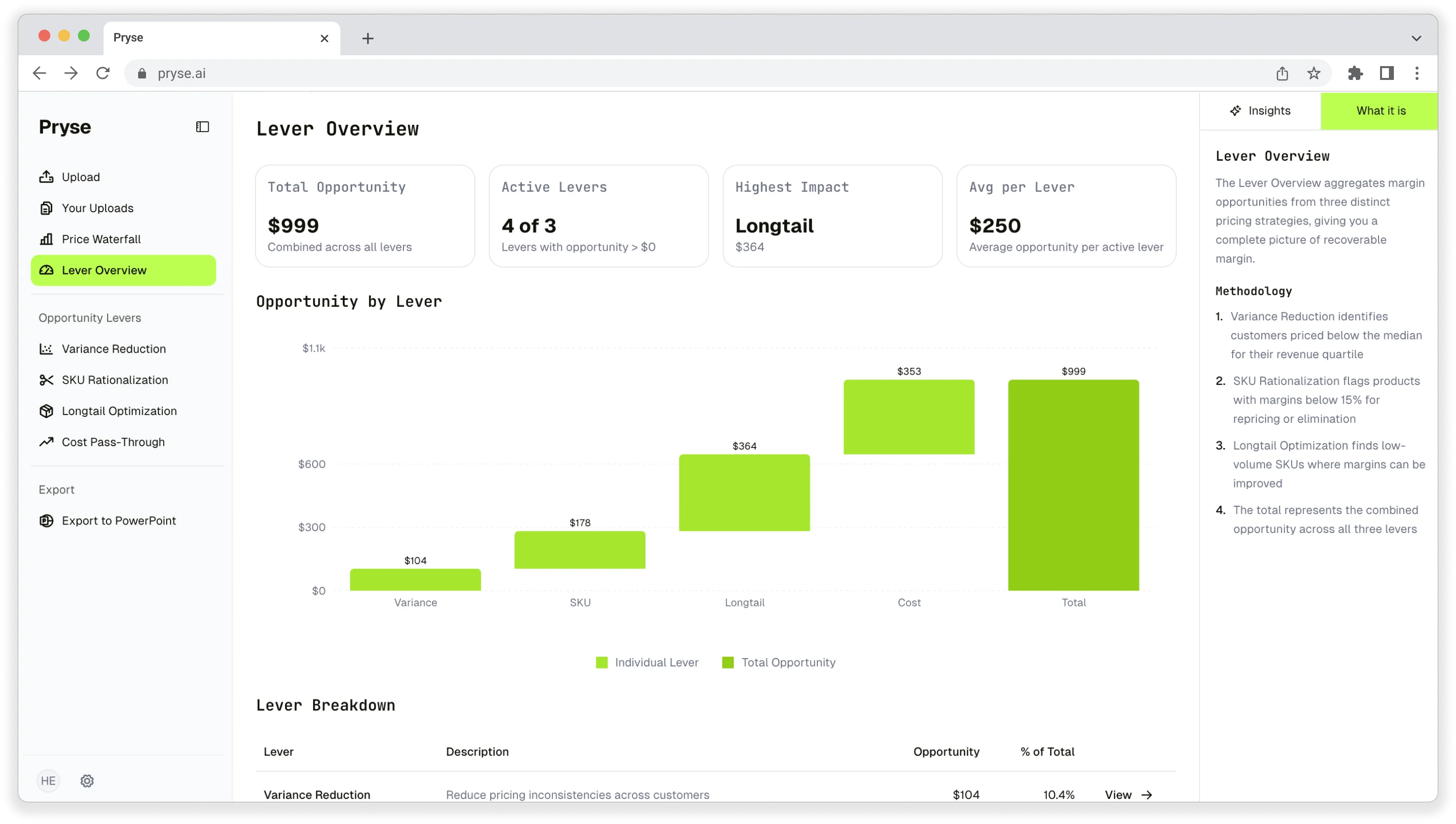
Want to analyze your entire product catalog?
Pryse automatically identifies margin leakage across thousands of SKUs. Upload your data and find hidden profit in 24 hours.
One-time $1,499 diagnostic. No subscription required.