 Pryse
PryseWholesale Price vs Retail Price: Key Differences Explained
Wholesale price is what retailers pay to buy in bulk. Retail price is what consumers pay per unit. Learn the key differences, markup formulas, and pricing strategies.
Wholesale price is the discounted bulk price charged to retailers and resellers who purchase products for resale. Retail price is the final price charged to end consumers who purchase individual units for personal use. The core difference comes down to buyer type, purchase volume, and who bears the customer-facing costs.
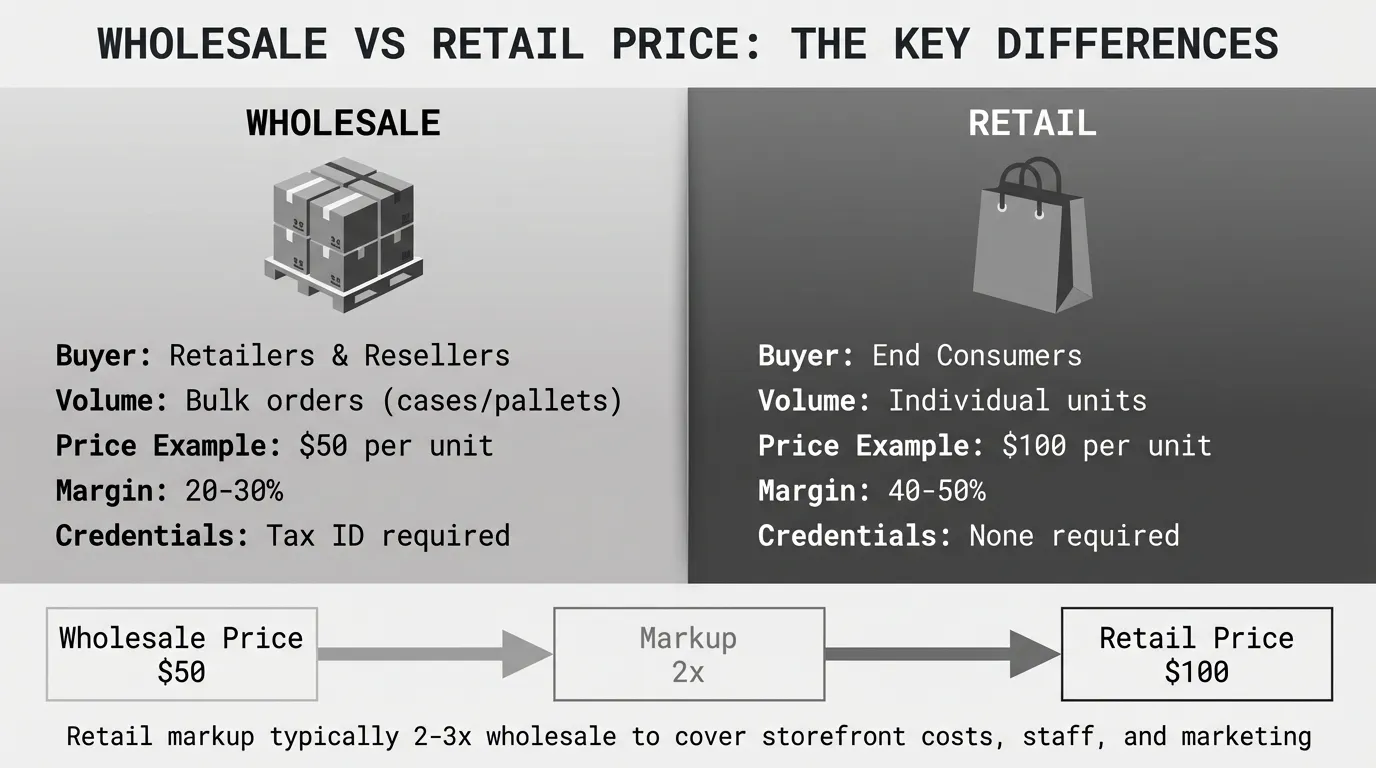
The math is straightforward: retailers purchase at wholesale prices, then mark up to cover their operating costs (rent, staff, marketing) plus profit. Wholesale buyers avoid these costs by purchasing in bulk and leaving consumer sales to retailers. Lower per-unit price, higher volume, no consumer-facing infrastructure.
According to industry benchmarks, retail markups on wholesale prices typically range from 50-100%, with the most common approach being keystone pricing (doubling the wholesale price). A product with a $50 wholesale price would retail at $100 under keystone pricing, giving the retailer a 50% gross margin.
The Core Difference: Who's Buying
The fundamental distinction between wholesale and retail pricing is the buyer's intent and the transaction structure.
Wholesale buyers:
- Retailers purchasing inventory for resale
- E-commerce sellers sourcing products
- Other distributors in multi-tier channels
- Resellers and value-added resellers
- Any business buying in bulk for commercial resale
Wholesale transactions require business credentials (tax ID, resale certificate) and typically involve minimum order quantities. You're not buying a single unit; you're buying cases, pallets, or bulk quantities.
Retail buyers:
- End consumers purchasing for personal use
- Businesses buying for internal consumption (not resale)
- Anyone purchasing in single-unit quantities
- Buyers without resale credentials
Retail transactions have no minimum quantities and require no business documentation. Walk into a store, buy one unit, pay retail price.
The distinction matters legally and operationally. Wholesalers can offer lower prices to legitimate resellers without violating price discrimination laws because the cost-to-serve differs materially. Selling 100 units to one retail account costs less than selling 100 individual units to consumers.
For a complete breakdown of wholesale pricing structures, see our guide to what is wholesale pricing.
Price Structure Comparison
The price difference between wholesale and retail reflects the different roles and costs in the distribution chain.
Typical Price Multiples
| Pricing Tier | Example Price | Multiple from Wholesale | Gross Margin |
|---|---|---|---|
| Manufacturer Cost | $20 | — | — |
| Wholesale Price | $50 | — | 60% |
| Retail Price (Keystone) | $100 | 2.0x | 50% |
| Retail Price (Standard) | $125 | 2.5x | 60% |
| Retail Price (Premium) | $150 | 3.0x | 67% |
The manufacturer produces at $20 cost and sells to wholesalers at $50 (2.5x cost). The wholesaler sells to retailers at $50. Retailers mark up to $100-150 depending on their costs and positioning.
What the Retail Markup Covers
The difference between wholesale and retail prices funds the retailer's operations:
Fixed Costs:
- Retail space rent (far more expensive than warehouse space)
- Storefront utilities and maintenance
- Point-of-sale systems and retail technology
- Store displays and merchandising
Variable Costs:
- Retail staff wages and training
- Individual transaction processing costs
- Credit card processing fees (2-3% of sales)
- Inventory shrinkage (theft, damage, spoilage)
- Customer returns and warranty service
Marketing Costs:
- Local advertising and promotions
- Social media and digital marketing
- Loyalty programs and customer acquisition
- In-store events and demonstrations
Service Costs:
- Customer service and support
- Product advice and consultation
- Extended hours and convenience
- Delivery or fulfillment services
Wholesalers avoid most of these costs. They operate from warehouses, not storefronts. They sell to 100 retail accounts, not 10,000 individual consumers. No advertising to consumers, no credit card fees for consumer transactions, minimal customer service overhead.
The retail markup compensates for these additional costs and the retailer's lower sales velocity per transaction. A wholesaler might sell 1,000 units per month across 10 accounts. A retailer might sell the same 1,000 units across 1,000 individual transactions.
Retail Markup Formulas
Retailers use several methods to calculate retail prices from wholesale costs.
Keystone Pricing (2x Markup)
Keystone pricing is the simplest retail pricing strategy: double the wholesale price.
Retail Price = Wholesale Price × 2
Example: Wholesale price is $50.
Retail Price = $50 × 2 = $100
This produces a 100% markup and 50% gross margin for the retailer. According to 42signals' guide to keystone pricing, keystone pricing remains common because it's simple to calculate and provides adequate margin coverage for most retail operations.
When keystone pricing works:
- Standard consumer products with predictable costs
- Stable, moderate competition
- Products requiring modest retail service
- Retailers with typical operating cost structures (40-45% of revenue)
When keystone pricing fails:
- High-competition commodity products (margins too thin)
- Premium luxury products (leaving margin on the table)
- Products requiring extensive retail support
- Markets with aggressive price competition
Standard Retail Markup (30-65%)
Many retailers apply variable markups based on product category, competition, and strategic importance.
Retail Price = Wholesale Price × (1 + Markup Percentage)
Example: Wholesale price is $50, target markup is 50%.
Retail Price = $50 × 1.50 = $75
According to Qogita's 2026 wholesale pricing research, retailers typically apply markups between 35% and 65% when reselling wholesale items, with the specific percentage reflecting competitive intensity and service requirements.
Markup by retail category:
- Commodity products with high competition: 30-40%
- Standard consumer products: 50-60%
- Specialty products requiring expertise: 70-100%
- Premium or luxury positioning: 100%+
Working from Target Margin
Some retailers start with desired gross margin and calculate the required price.
Retail Price = Wholesale Price / (1 - Target Margin)
Example: Wholesale price is $50, target is 40% gross margin.
Retail Price = $50 / (1 - 0.40) = $50 / 0.60 = $83.33
This approach ensures the retailer achieves their target profitability regardless of wholesale price fluctuations.
For tools to calculate these conversions, see our markup to margin calculator.
Retail Markup by Industry
Retail markups vary dramatically across industries based on product characteristics, competition, and operating costs.
High-Markup Industries
According to Wisebread's retail markup analysis and SMC Fashion's pricing research, these industries achieve the highest retail markups:
| Industry | Typical Markup | Markup Range | Retail Margin |
|---|---|---|---|
| Eyewear | 500-1,000% | Up to 10x wholesale | 83-90% |
| Fashion footwear (boutique) | 300-500% | 4-6x wholesale | 75-83% |
| Fashion apparel | 120-160% | 2.2-2.6x wholesale | 55-62% |
| Jewelry | 100-300% | 2-4x wholesale | 50-75% |
| Cosmetics | 60-80% | 1.6-1.8x wholesale | 38-44% |
Why high markups work:
- Strong brand value and differentiation
- Low price sensitivity for premium products
- High perceived value relative to cost
- Specialty retail expertise required
- Limited direct price comparison
Mid-Markup Industries
| Industry | Typical Markup | Markup Range | Retail Margin |
|---|---|---|---|
| Furniture | 42-43% | 1.4x wholesale | 30% |
| Athletic shoes (standard) | 100% | 2x wholesale | 50% |
| Home goods | 50-100% | 1.5-2x wholesale | 33-50% |
| Sporting goods | 40-50% | 1.4-1.5x wholesale | 29-33% |
| Books | 40-50% | 1.4-1.5x wholesale | 29-33% |
Low-Markup Industries
According to Wisebread's markup data, these commodity and high-competition categories operate on thin retail margins:
| Industry | Typical Markup | Markup Range | Retail Margin |
|---|---|---|---|
| Automobiles | 5-10% | 1.05-1.1x wholesale | 5-9% |
| Electronics (phones) | 8-10% | 1.08-1.1x wholesale | 7-9% |
| Consumer electronics | 10-20% | 1.1-1.2x wholesale | 9-17% |
| Groceries | 15-30% | 1.15-1.3x wholesale | 13-23% |
Why low markups prevail:
- Transparent pricing and easy comparison
- High price sensitivity
- Commodity products with minimal differentiation
- Intense retail competition
- Manufacturer-advertised pricing (MAP) restrictions
How Wholesale Pricing Works
Wholesalers set prices based on a different set of economics than retailers.
Wholesale Pricing Drivers
Volume economics: Wholesalers optimize for bulk transactions. Selling 500 units to one retail account costs less per unit than selling 500 individual units to consumers. Lower transaction costs enable lower per-unit prices.
Operating cost structure: Wholesale operations run from warehouses, not retail locations. Commercial warehouse rent runs $5-15/sq ft annually; retail space costs $20-100/sq ft or more. Lower overhead enables lower prices.
Marketing costs: Wholesalers market to hundreds of retail accounts, not millions of consumers. A sales team calling on retail buyers costs far less than consumer advertising campaigns. Lower customer acquisition costs enable lower prices.
Service model: Wholesalers provide different services than retailers: bulk logistics, inventory holding, credit terms, and account management. No fitting rooms, no gift wrapping, no consumer hand-holding.
Typical Wholesale Margins
The National Association of Wholesaler-Distributors reports average wholesale gross margins of 25% across industries in 2024. According to PROS' distributor pricing research, the average wholesale or distributor markup is 20%, though some reach 40% depending on value-added services.
Wholesale margin ranges by sector:
- Food and beverage: 12-20%
- Electrical distribution: 22-32%
- HVAC distribution: 23-30%
- Plumbing and building materials: 24-32%
- Industrial MRO: 28-38%
- Auto parts: 28-40%
- Specialty fasteners: 30-42%
The variation reflects product complexity, service requirements, and competitive dynamics in each sector.
For detailed margin benchmarks across distribution sectors, see our analysis of distributor margins by industry.
Who Sets Which Price
Understanding who controls pricing at each level clarifies how the wholesale-retail system works.
Manufacturers Set Wholesale Prices
Manufacturers determine the wholesale price they charge distributors and wholesalers. This price reflects:
- Manufacturing costs (materials, labor, overhead)
- Target profit margins (typically 2-3x direct costs)
- Competitive positioning
- Distribution channel strategy
Manufacturers often use cost-plus pricing, calculating total production costs and applying a standard markup. For products costing $20 to manufacture, a manufacturer might set wholesale pricing at $50-60, yielding 60-67% gross margins.
Wholesalers Set Retail Wholesale Prices
Wholesalers purchase from manufacturers, then set their own wholesale prices when selling to retailers. This price must:
- Cover acquisition costs from manufacturers
- Include allocated overhead (warehouse, staff, logistics)
- Provide sufficient profit margin
- Remain competitive with other wholesale sources
A wholesaler purchasing at $50 from manufacturers might sell to retailers at $55-65, capturing 9-23% gross margins depending on services provided.
Retailers Set Final Retail Prices
Retailers have the most pricing flexibility. They determine the final consumer price based on:
- Wholesale acquisition cost
- Target gross margins
- Competitive retail pricing
- Local market conditions
- Brand positioning (value, standard, premium)
The retailer purchasing at $60 wholesale might price at $100-150 retail depending on positioning and competition.
Pricing Control and MAP
Some manufacturers attempt to control retail pricing through Minimum Advertised Price (MAP) policies, which specify the lowest price retailers can advertise. MAP doesn't prevent retailers from selling below that price, but retailers can't advertise prices below MAP without losing manufacturer support.
MAP policies protect brand positioning and retailer margins, but they also reduce pricing flexibility and can create tension between manufacturers and retailers.
Wholesale vs Retail: Business Model Comparison
The pricing difference reflects fundamentally different business models.
Wholesale Business Model
Revenue model: High volume, lower margin
- Sell 1,000 units at $50 wholesale = $50,000 revenue, $12,500 gross profit (25% margin)
Customer acquisition:
- B2B sales to 100-500 retail accounts
- Direct sales force or inside sales teams
- Trade shows and industry networking
- Customer acquisition cost: $500-2,000 per account
Operations:
- Warehouse facilities
- Bulk shipping and logistics
- Inventory financing
- Credit terms and accounts receivable management
Success metrics:
- Volume throughput
- Inventory turns (6-12 turns/year)
- Gross margin dollars per square foot
- Customer lifetime value
Retail Business Model
Revenue model: Lower volume, higher margin
- Sell 1,000 units at $100 retail = $100,000 revenue, $40,000 gross profit (40% margin)
Customer acquisition:
- Consumer marketing to thousands or millions
- Advertising, social media, local promotions
- Storefront location and foot traffic
- Customer acquisition cost: $10-50 per customer
Operations:
- Retail locations with high visibility
- Individual unit sales and transactions
- Customer service and experience
- Returns, exchanges, and support
Success metrics:
- Sales per square foot
- Conversion rate (browsers to buyers)
- Average transaction value
- Customer lifetime value and repeat rate
The wholesale model trades margin for volume. The retail model trades volume for margin. Both can be profitable, but they optimize for different economics.
For strategies to manage both models, see our guide to wholesale pricing.
When the Lines Blur
Some businesses operate in both wholesale and retail channels, which creates pricing complexity.
Direct-to-Consumer Brands
Manufacturers selling direct to consumers bypass both wholesalers and retailers, capturing the entire margin chain. A product costing $20 to manufacture, which would normally reach consumers at $100-150 through distribution channels, might be sold direct at $60-80.
This disrupts traditional pricing but requires the manufacturer to build retail capabilities: consumer marketing, e-commerce operations, customer service, fulfillment logistics.
Hybrid Wholesaler-Retailers
Some distributors operate both wholesale (selling to retailers) and retail (selling to consumers) channels. This creates channel conflict:
Pricing challenge:
- Wholesale customers expect wholesale prices ($50)
- Retail consumers pay retail prices ($100)
- If wholesale customers discover the retail pricing, they feel cheated
- If retail consumers access wholesale pricing, retail margins evaporate
Solutions:
- Clear segmentation (separate brands, separate channels)
- Minimum order quantities for wholesale pricing
- Different product mixes (retail gets smaller pack sizes)
- Geographic separation (wholesale in some markets, retail in others)
Warehouse Clubs and Discount Retailers
Costco, Sam's Club, and similar warehouse retailers blur the wholesale-retail line. They sell at near-wholesale prices to consumers purchasing in bulk.
The model works because:
- Membership fees replace some margin
- Limited SKU selection (4,000 items vs. 40,000 at traditional retailers)
- Minimal service and merchandising
- High inventory turns (12-15x annually)
Their pricing sits between traditional wholesale and retail: higher than pure wholesale (30% gross margins), lower than traditional retail (50% margins).
Calculating Profitability at Each Level
Understanding profitability requires looking beyond gross margin to net profit.
Wholesaler Example
Revenue: $50 wholesale price × 100,000 units = $5,000,000
Cost of goods sold: $40 × 100,000 = $4,000,000
Gross profit: $1,000,000 (20% margin)
Operating expenses:
- Warehouse and logistics: $300,000
- Staff (sales, warehouse, admin): $400,000
- Technology and systems: $50,000
- Financing and insurance: $100,000
- Total operating: $850,000
Net profit: $150,000 (3% net margin)
The 20% gross margin compresses to 3% net margin after operating costs.
Retailer Example
Revenue: $100 retail price × 20,000 units = $2,000,000
Cost of goods sold: $50 × 20,000 = $1,000,000
Gross profit: $1,000,000 (50% margin)
Operating expenses:
- Retail rent and utilities: $300,000
- Retail staff: $400,000
- Marketing and advertising: $150,000
- Technology and POS systems: $50,000
- Credit card fees, shrinkage, other: $100,000
- Total operating: $1,000,000
Net profit: $0 (breakeven)
The 50% gross margin disappears into retail operating costs, reaching breakeven. Small retailers often operate at 2-5% net margins; successful retailers achieve 8-12%.
The takeaway: retail's higher gross margins don't necessarily mean higher profitability. Higher operating costs consume much of that margin.
For tools to analyze profitability at the product level, see our margin analysis tools.
Common Pricing Mistakes
Both wholesalers and retailers make pricing errors that destroy profitability.
Wholesaler Mistakes
Mistake 1: Retail price erosion
Allowing retail pricing to drift downward pressures wholesale pricing even when costs remain stable. Wholesalers must protect both their own margins and retailer margins to keep the channel healthy.
Mistake 2: One-size-fits-all pricing
Charging the same wholesale price to all retail accounts ignores differences in purchase volume, service requirements, and strategic value. Large accounts buying in volume should receive better pricing than small accounts requiring more support.
Mistake 3: Ignoring MAP violations
If manufacturers set MAP policies but retailers consistently violate them, brand value erodes and pricing discipline collapses. Wholesalers must enforce manufacturer policies or risk losing access to premium brands.
Retailer Mistakes
Mistake 1: Rigid keystone pricing
Applying 2x markup to everything ignores competitive realities. Commodity products can't sustain keystone pricing in competitive markets, while premium products can support higher multipliers.
Mistake 2: Racing to bottom on price
Competing solely on price attracts price-sensitive customers who will leave for a 5% better deal elsewhere. Differentiation through service, expertise, or convenience creates defensible pricing power.
Mistake 3: Not tracking competitor pricing
Pricing $120 when competitors price at $95 for identical products loses sales. Retailers must monitor competitive pricing and adjust or justify premium positioning with added value.
For strategies to address margin leakage across the pricing chain, see our guide to margin leakage.
The Bottom Line on Wholesale vs Retail Pricing
Wholesale prices compensate businesses selling in bulk to other businesses. Retail prices compensate businesses selling individual units to consumers. The difference—typically 2-3x—reflects the different cost structures, services, and economics of each business model.
According to Qogita's 2026 pricing research, retailers typically apply 50-100% markups over wholesale prices, with keystone pricing (doubling the wholesale cost) remaining the most common approach. The specific markup depends on industry norms, competitive intensity, and the services provided.
The wholesale-retail pricing structure has existed for centuries because it efficiently allocates costs and margin across the distribution chain. Manufacturers optimize production scale, wholesalers aggregate and distribute, retailers provide consumer access and service. Each layer adds value and captures appropriate compensation.
Understanding where your business sits in this chain—and the economics of the adjacent layers—helps you price strategically, negotiate effectively, and maintain healthy margins while remaining competitive.
For a complete framework on wholesale pricing strategies and how to set up your pricing structure, see our complete guide to wholesale pricing.
Sources
- Wholesale Price vs Retail Price: How To Calculate Wholesale Price
- What is Wholesale Price?: Wholesale Price vs. Retail Price
- What Are the Key Differences Between Wholesale and Retail Pricing?
- What Are The Differences Between Wholesale Vs Retail Pricing?
- Retail vs. Wholesale | What They Are, Differences, Pricing, & More
- Wholesale vs. Retail Price: What's the Difference & Why It Matters
- What is Keystone Pricing and How to Use It? A Complete Guide for Retailers
- Cheat Sheet: Retail Markup on Common Items
- Distributor Markup and Profit Margins in the Supply Chain
- Pricing Strategies for Wholesale Dresses and Retail Stores
Last updated: February 24, 2026
Frequently Asked Questions
Want to analyze your entire product catalog?
Pryse automatically identifies margin leakage across thousands of SKUs. Upload your data and find hidden profit in 24 hours.
One-time $1,499 diagnostic. No subscription required.