 Pryse
PryseHow to Calculate Wholesale Price: Step-by-Step Formula and Methods
Learn how to calculate wholesale prices with formulas, step-by-step examples, and different pricing methods for distributors and wholesalers.
Calculating wholesale price requires more than doubling your cost. The right approach balances your fully-loaded costs, target profit margins, competitive positioning, and what retailers need to make the product work at retail. Get any of these wrong and you either lose money on every sale or price yourself out of the market.
According to Shopify's 2025 guide to wholesale pricing, most wholesalers target profit margins between 15-50%, with 30-40% being the sweet spot that provides healthy profits while leaving retailers room for their markup. But hitting that target requires accurate cost calculation and the right pricing formula for your business model.
This guide walks through three proven methods to calculate wholesale price, step-by-step examples for each, and how to choose the right approach for different product categories.
The Three Core Methods to Calculate Wholesale Price
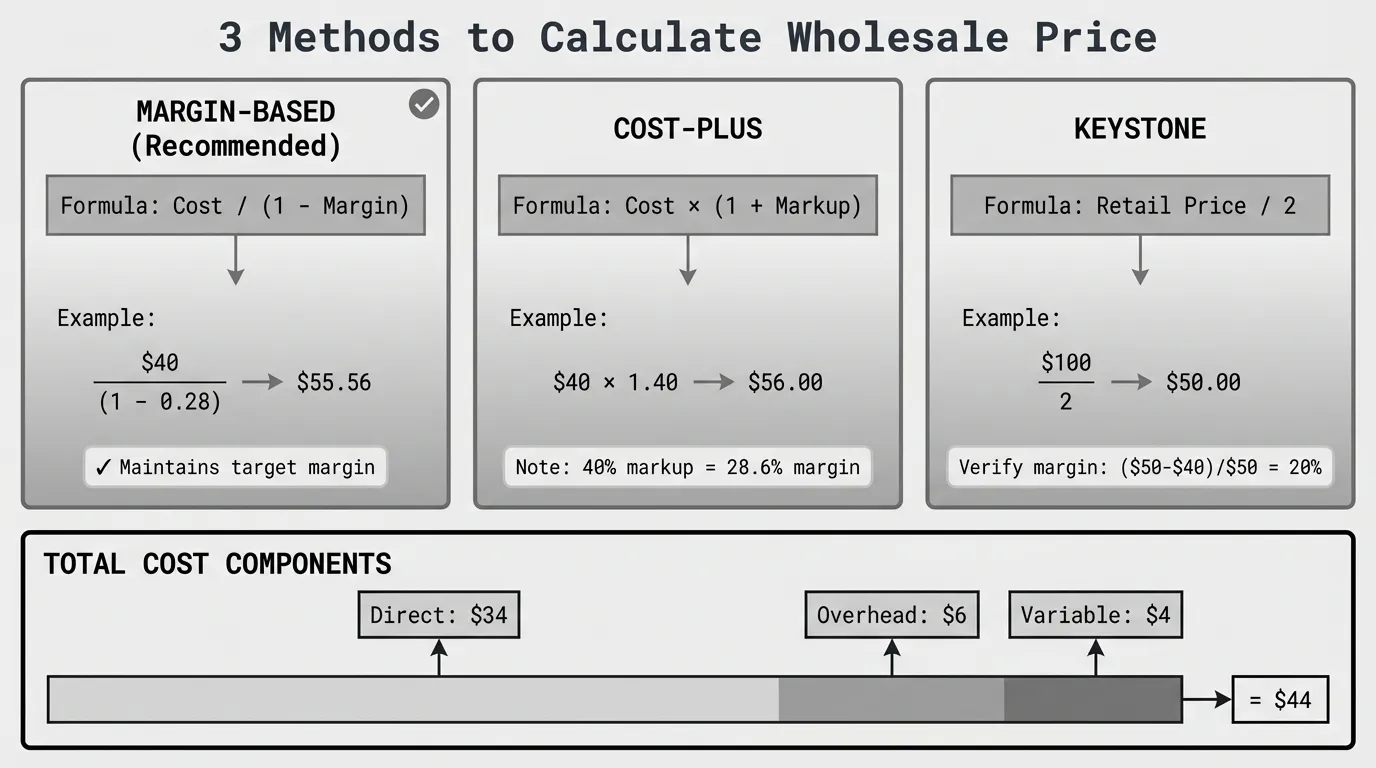
Different pricing methods work for different business situations. The margin-based method maintains consistent profitability, cost-plus is simpler to implement, and keystone pricing works backward from retail prices.
Method 1: Margin-Based Formula (Recommended)
This is the most reliable method because it maintains your target profit margin regardless of cost changes.
Wholesale Price = Total Cost / (1 - Target Profit Margin)
Where:
- Total Cost = All product costs + overhead allocation + fulfillment costs
- Target Profit Margin = Your desired profit as a percentage of price (expressed as decimal)
Example: Your fully-loaded cost is $40 per unit. You want a 28% gross margin.
Wholesale Price = $40 / (1 - 0.28) = $40 / 0.72 = $55.56
Round to $55.50 or $56 depending on your industry's pricing conventions.
Why this works: When supplier costs increase from $40 to $44, the formula automatically adjusts your price to $61.11 to maintain the same 28% margin. Cost-plus formulas don't do this automatically.
Method 2: Cost-Plus Pricing (Markup Method)
The simplest approach: add a standard percentage markup to your costs.
Wholesale Price = Total Cost × (1 + Markup Percentage)
Example: Your total cost is $40 and you want a 40% markup.
Wholesale Price = $40 × 1.40 = $56
Important: A 40% markup yields only a 28.6% gross margin, not 40%. The math works differently. To achieve a 30% margin, you need a 42.9% markup.
Conversion formulas:
Markup = Margin / (1 - Margin)
Margin = Markup / (1 + Markup)
For tools to convert between markup and margin, see our markup to margin calculator.
Method 3: Keystone Pricing (Retail-Based Method)
Work backward from the target retail price. Keystone pricing sets the wholesale price at half the retail price, assuming retailers will double it.
Wholesale Price = Target Retail Price / 2
Example: Your product needs to retail at $100 to be competitive in the market.
Wholesale Price = $100 / 2 = $50
Now verify profitability: If your total cost is $35, the $50 wholesale price gives you a 30% margin. Good. If your cost is $45, the margin is only 10%. You either need to reduce costs or position at a premium retail price.
When to use it: Keystone pricing works best when you know the competitive retail price and retailers use standard 2x markup. Common in fashion, home goods, and consumer products. Less common in industrial distribution where retail prices vary significantly.
For a detailed comparison of wholesale vs retail pricing structures, see our guide on wholesale vs retail price.
Step-by-Step: Calculating Your Wholesale Price
Here's the complete process for calculating wholesale prices accurately.
Step 1: Calculate Your Total Costs
Don't just use your invoice cost. Calculate the fully-loaded cost that includes all the money you spend to get products into sellable inventory.
Direct Costs:
- Product purchase price from manufacturer or supplier
- Inbound freight (divide total freight cost by units received)
- Import duties for international shipments (duty cost / units imported)
- Inspection or testing costs
Example direct costs:
- Product invoice: $30.00
- Freight allocation: $2.50
- Import duties: $1.50
- Subtotal direct cost: $34.00
Overhead Costs:
Overhead exists whether you sell one unit or 10,000. Allocate these costs across your inventory for accurate pricing.
Common overhead allocation methods:
By revenue: If annual overhead is $500,000 and revenue is $2,000,000, overhead is 25% of revenue. Allocate 25% of each product's cost as overhead.
By inventory carrying cost: Standard carrying cost is 20-30% of inventory value annually (financing, insurance, obsolescence, storage). If you hold $34 of inventory for 90 days, carrying cost is approximately $2.50.
By handling time: If warehouse labor costs $100,000 annually for 50,000 picks, each pick costs $2. Allocate $2 per unit.
Example overhead allocation:
- Warehouse/handling: $3.00
- Inventory carrying (20% annual on $34 for 90 days): $1.70
- Admin/technology: $1.30
- Subtotal overhead: $6.00
Variable Costs:
- Pick and pack labor per unit
- Packaging materials
- Outbound freight allocation
- Payment processing (2-3% if credit cards)
Example variable costs:
- Pick/pack labor: $1.50
- Packaging: $0.50
- Outbound freight allocation: $2.00
- Subtotal variable: $4.00
Total Landed Cost: $34.00 + $6.00 + $4.00 = $44.00
According to EMERGE's guide to wholesale price calculation, failing to include all cost layers is the number one pricing mistake. Products appear profitable at invoice cost but destroy margin when true costs are included.
Step 2: Determine Your Target Profit Margin
Set margin targets based on industry benchmarks, product characteristics, and competitive positioning.
Industry benchmark margins:
| Industry Sector | Typical Gross Margin | Why |
|---|---|---|
| Food/Beverage Distribution | 12-20% | Perishability, commodity pricing |
| Electrical Distribution | 22-32% | Mix of commodity wire and automation |
| HVAC Distribution | 23-30% | Brand authorization, technical support |
| Plumbing/Building Materials | 24-32% | Project pricing vs. stock sales |
| Industrial MRO | 28-38% | Technical expertise, breadth |
| Auto Parts Distribution | 28-40% | Speed of delivery, inventory depth |
| Specialty Products | 35-45% | Application engineering, low competition |
Margin variation by product type within your catalog:
- Commodity products (many suppliers): 18-22%
- Standard products (moderate competition): 25-30%
- Specialty products (technical requirements): 35-45%
- Private label or exclusive items: 40-50%
For comprehensive benchmarks, see our analysis of distributor margins by industry.
Step 3: Apply the Calculation Formula
With total cost and target margin established, calculate the wholesale price.
Using the margin-based method (recommended):
Wholesale Price = $44.00 / (1 - 0.28) = $44.00 / 0.72 = $61.11
Round to $61 or $62 depending on pricing conventions in your industry.
Verification:
- Wholesale price: $61.11
- Total cost: $44.00
- Gross profit: $17.11
- Gross margin: $17.11 / $61.11 = 28% ✓
Using the cost-plus method:
If you prefer markup over margin targets, calculate the required markup percentage first.
To achieve 28% margin, you need a 38.9% markup.
Markup = 0.28 / (1 - 0.28) = 0.389 or 38.9%
Wholesale Price = $44.00 × 1.389 = $61.12
Same result, different path.
Step 4: Validate Against Retail Price
Check whether your wholesale price allows retailers adequate margin to reach competitive retail prices.
Typical retail markup multiples:
- Keystone pricing: 2x wholesale (most common)
- Standard retail: 2.2-2.5x wholesale
- Premium retail: 2.5-3x wholesale
If your wholesale price is $61 and retailers use keystone pricing, retail price will be $122.
Validation questions:
- Is $122 competitive for this product category?
- Do similar products retail at $100-140?
- Can retailers justify $122 based on features and positioning?
If the competitive retail price is $90-100, your $61 wholesale price is too high. Retailers can't double it without becoming uncompetitive. Either reduce your margin or find cost reductions. Don't expect retailers to accept wholesale prices that make them uncompetitive at retail.
Step 5: Compare to Competitive Pricing
Check 2-3 major competitors' wholesale pricing for similar products.
Interpretation:
- 10%+ above competition: You may lose volume unless you have clear differentiation (faster delivery, better service, technical support)
- Within ±5% of competition: Acceptable range for standard products
- 10%+ below competition: You might be leaving margin on the table
Adjust price based on your positioning:
- Premium positioning (superior service): +5-10% above market
- Parity positioning (match competitors): ±2% of market
- Penetration positioning (gain share): -5-10% below market
For strategies on competitive positioning, see our guide to competitive pricing.
Step 6: Segment by Product Category
Don't apply the same calculation to every product. Segment your catalog and use different margin targets.
Example segmentation:
| Product Segment | Margin Target | Example Calculation ($44 cost) |
|---|---|---|
| Commodity items | 20% | $44 / (1 - 0.20) = $55 |
| Standard catalog | 28% | $44 / (1 - 0.28) = $61 |
| Specialty products | 38% | $44 / (1 - 0.38) = $71 |
| Private label | 45% | $44 / (1 - 0.45) = $80 |
This approach captures appropriate margin for each product category instead of underpricing specialty items and overpricing commodities.
Real-World Calculation Examples
Here are complete examples showing how to calculate wholesale prices for different product types.
Example 1: Commodity Electrical Product
Product: Standard copper wire from multiple suppliers
Costs:
- Invoice cost: $25.00
- Freight allocation: $1.50
- Direct cost: $26.50
- Overhead allocation (18%): $4.77
- Variable fulfillment: $2.00
- Total cost: $33.27
Pricing decision:
- Highly competitive commodity market
- Multiple suppliers, transparent pricing
- Target margin: 20%
Calculation:
Wholesale Price = $33.27 / (1 - 0.20) = $33.27 / 0.80 = $41.59
Set price at: $41.50 or $42.00
Competitive check: Competitors price at $40-43. Your price of $41.50 is competitive.
Retail validation: Keystone retail of $83 matches market. Acceptable.
Example 2: Specialty Industrial Component
Product: Custom-configured automation controller with technical support
Costs:
- Invoice cost: $180.00
- Freight: $8.00
- Direct cost: $188.00
- Overhead (engineering time): $25.00
- Variable fulfillment: $4.00
- Total cost: $217.00
Pricing decision:
- Limited competition (3 suppliers)
- Technical configuration required
- After-sale support included
- Target margin: 38%
Calculation:
Wholesale Price = $217.00 / (1 - 0.38) = $217.00 / 0.62 = $350.00
Set price at: $350.00 or $349.95
Competitive check: Competitors price at $330-370. Your price of $350 is mid-range.
Retail validation: Retailers sell at 2.2x wholesale = $770. Market price is $700-800. Acceptable.
Example 3: Working Backward from Retail Price
Product: Consumer product with known retail price point
Market reality:
- Competitive retail price: $79.99
- Retailers need 50% gross margin (2x markup)
- This sets maximum wholesale at $40
Your costs:
- Direct cost: $22.00
- Overhead allocation: $5.00
- Variable fulfillment: $2.50
- Total cost: $29.50
Validation:
Margin at $40 wholesale = ($40 - $29.50) / $40 = 26.3%
Decision: A 26.3% margin is acceptable for this product category. Set wholesale price at $40 to enable retail at $80.
Alternative: If your costs were $35, margin would be only 12.5%. Too thin. You'd need to either reduce costs, position at premium retail pricing ($90-100), or skip this product.
Common Calculation Mistakes That Destroy Margin
Even with formulas, distributors make errors that erode profitability.
Mistake 1: Using Invoice Cost Instead of Landed Cost
The error: Pricing from supplier invoice cost ($30) without adding freight ($2.50), duties ($1.50), and overhead ($6).
True cost: $40, not $30.
Impact: If you calculate a 25% margin on $30, you get $40 wholesale price. But your true cost is $40, so margin is 0%. Every sale loses money when fulfillment costs are included.
The fix: Always calculate fully-loaded cost including direct costs, freight, duties, overhead allocation, and variable fulfillment costs. Price from true cost, not invoice cost.
Mistake 2: Confusing Markup and Margin
The error: Targeting "30% margin" but calculating 30% markup.
Math:
- $40 cost × 1.30 markup = $52 wholesale price
- Actual margin = ($52 - $40) / $52 = 23.1%
Impact: You miss your margin targets by 5-7 points across thousands of products. This compounds into significant profit shortfalls.
The fix: Use the margin formula: Cost / (1 - Margin). Don't use the markup formula unless you convert markup to equivalent margin first.
Mistake 3: One Margin for All Products
The error: Applying flat 28% margin to all products regardless of competitive dynamics.
Impact:
- Commodity products are overpriced, you lose volume
- Specialty products are underpriced, you leave margin uncaptured
- Overall profitability suffers
The fix: Segment products into categories (commodity, standard, specialty, exclusive) with appropriate margin targets for each. Apply 18-22% to commodities, 35-45% to specialties.
Mistake 4: Not Updating for Cost Changes
The error: Supplier costs increase 8% but wholesale prices don't adjust for 9 months.
Impact: A product with $40 cost and $56 price (28.6% margin) sees costs rise to $43.20. New margin is 22.9%, a 20% margin erosion. Multiply this across thousands of SKUs and the profit impact is substantial.
The fix: Review and recalculate prices quarterly or when supplier costs move ±5%. Update systematically, not just when you remember.
According to QuickBooks' guide to wholesale price calculation, distributors who update prices quarterly capture 3-5 margin points more than those using annual reviews. The lag between cost increases and price adjustments is where margin disappears.
Mistake 5: Not Validating Retail Feasibility
The error: Your formula says $70 wholesale, so you use it. But competitive retail is $100, and retailers using keystone pricing need wholesale at $50.
Impact: Retailers refuse your pricing because it makes them uncompetive. You either lose the business or grant large discounts that destroy your calculated margins.
The fix: Always validate: If (Wholesale Price × 2) exceeds competitive retail by 15%+, flag for review. Either adjust your price or position at premium retail pricing.
Advanced Calculation: Volume-Based Pricing Tiers
Most distributors offer volume discounts. Here's how to calculate tiered pricing that maintains profitability.
The Structure
Create 3-4 price tiers with decreasing margins for higher volumes.
Example calculation:
- Base cost: $44 per unit
- Tier 1 (1-10 units): 30% margin → $62.86 per unit
- Tier 2 (11-50 units): 26% margin → $59.46 per unit (-5.4%)
- Tier 3 (51-100 units): 22% margin → $56.41 per unit (-10.3%)
- Tier 4 (101+ units): 18% margin → $53.66 per unit (-14.6%)
Formula for each tier:
Tier Price = Total Cost / (1 - Tier Margin %)
Validation: Ensure the margin reduction for each tier is justified by:
- Reduced transaction costs (one order of 100 vs. ten orders of 10)
- Lower fulfillment costs per unit (one pallet pick vs. multiple picks)
- Payment term improvements (large customers often pay faster)
- Strategic value (gaining volume from large account)
Don't give away margin just because customers ask. The discount must reflect real economic benefits from larger orders.
Choosing the Right Calculation Method
Different methods work for different business situations.
Use margin-based formula when:
- You need consistent profitability across varying costs
- Costs change frequently (commodity markets, imports)
- You manage thousands of SKUs systematically
- Financial targets are margin-based, not markup-based
Use cost-plus method when:
- Your costs are stable and predictable
- Industry operates on markup conventions
- Simpler calculation is preferred for speed
- You're comfortable converting markup to margin
Use keystone pricing when:
- You know the target retail price
- Retailers use standard 2x markup
- Retail price is the market anchor, not cost
- You're in consumer product categories
Use competitive-based pricing when:
- Products are highly commoditized
- Prices are transparent and easily compared
- Cost advantage gives you flexibility
- You're entering new markets
Most distributors use a combination: margin-based for baseline prices, competitive validation for final prices, and volume tiers for large accounts.
For comprehensive strategies on wholesale pricing approaches, see our complete guide to wholesale pricing.
The Bottom Line on Calculating Wholesale Price
The formula is straightforward: Total Cost / (1 - Target Margin). The challenge is accurate cost calculation, appropriate margin targets by product category, and systematic price management.
According to WholesaleX's 2026 pricing guide, wholesalers who calculate prices systematically using fully-loaded costs achieve 3-5 margin points more than those using simplistic invoice-cost markup. That margin difference compounds significantly over thousands of transactions.
The National Association of Wholesaler-Distributors reports average gross margins of 25% across wholesale industries, but top-performing distributors achieve 30-35% through disciplined price calculation and segmentation. The difference between average and top performers isn't better negotiating with suppliers—it's better pricing math and execution.
McKinsey research shows that a 1% improvement in pricing drives an 8% increase in operating profit for typical B2B businesses. For wholesalers operating on 20-30% gross margins and 2-5% net margins, better price calculation represents the highest-ROI improvement opportunity available.
The formula tells you what to charge. The real work is calculating accurate costs, segmenting products appropriately, validating retail feasibility, and updating prices systematically as costs change.
Sources
- How to Calculate Wholesale Pricing (2025) - Shopify
- How to Calculate Wholesale Price: Formulas + Examples - QuickBooks
- How to Calculate Wholesale Pricing (2026 Guide) - Qogita
- Step-by-Step Guide to Wholesale Price Calculation - EMERGE
- How to Calculate Wholesale Price Like a Pro - WholesaleX
- Wholesale Pricing Formula – 3 Simple Ways to Price Right - Linnworks
- How to Price Items for Wholesale - Pricefy
Last updated: February 24, 2026
Frequently Asked Questions
Want to analyze your entire product catalog?
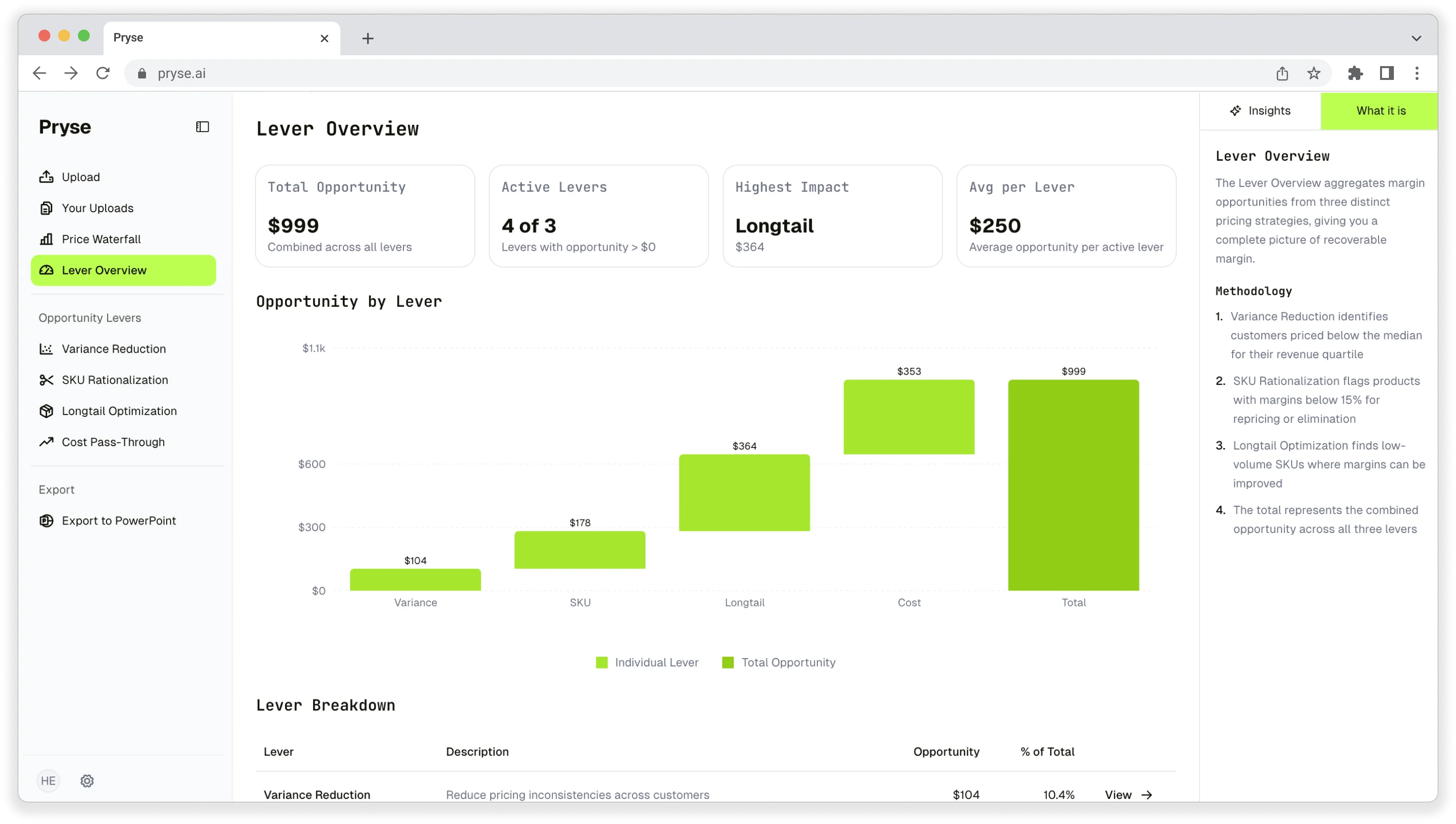
Pryse automatically identifies margin leakage across thousands of SKUs. Upload your data and find hidden profit in 24 hours.
One-time $1,499 diagnostic. No subscription required.