 Pryse
PryseCompetitive Pricing: The Complete Guide for Distributors and Manufacturers
How to build a competitive pricing strategy that protects margin on commodities without giving away profit on specialty products. Covers formulas, examples, and implementation.
Competitive pricing is a strategy that sets prices primarily based on what competitors charge for similar or identical products, rather than on your costs or the value delivered to the customer. You look at the market, pick a position relative to competitors, and price accordingly.
It's the second most common pricing approach in distribution and manufacturing, behind cost-plus. And like cost-plus, it works well for some products and badly for others. The companies that get it right use competitive pricing selectively on the 20-40% of their catalog where competitors actually affect purchase decisions. The companies that get it wrong apply it across the board and watch their margins compress.
I spent six years at McKinsey and Deloitte working on pricing for distributors and manufacturers. The pattern I saw repeatedly: companies would discover a competitor had undercut them on a few high-profile products, panic, and slash prices across hundreds of items. They'd stabilize the accounts they were worried about, but sacrifice margin on thousands of transactions where the competitor wasn't even a factor. According to McKinsey's 2003 article "The Power of Pricing" (McKinsey Quarterly), a 1% price cut requires an 18.7% volume increase to offset the profit impact. That math doesn't work in anyone's favor.
This guide covers what competitive pricing actually is, how to calculate it, the formulas that matter, when it works, when it fails, and how to build a competitive pricing strategy that protects your position on commodities without giving away profit on everything else. For broader context on pricing approaches, see our pricing strategy guide.
What is competitive pricing
Competitive pricing is a market-based pricing strategy where your prices are set in reference to competitor prices rather than your internal costs or the value your product delivers. The underlying assumption: for some products, what competitors charge is the strongest signal of what the market will bear.
There are three positions you can take:
Below-market pricing. You price lower than competitors to win volume. Common in commodity distribution where the product is identical across suppliers. The risk: margins compress, and competitors may match your price, leaving everyone worse off.
Parity pricing. You match competitor prices and differentiate on service, availability, delivery speed, or technical support. This is where most mid-market distributors land on their core products. You're not trying to be the cheapest. You're trying to remove price as an objection.
Above-market pricing. You price higher and justify the premium through differentiation. Faster delivery, better technical support, longer warranties, or bundled services. This works when buyers value those extras enough to pay for them.
The right position depends on the product, the customer segment, and how visible pricing is in that market. A distributor selling PVC fittings needs to be within a few percent of market pricing because every contractor knows what those cost. That same distributor can price specialty chemical compounds 30-40% above competitors because only a handful of suppliers carry them and buyers aren't comparison-shopping.
For a deeper look at the conceptual foundation, see what is competitive pricing.
The competitive pricing formula
You can't manage competitive pricing by gut feel. You need to quantify your position relative to competitors. Three formulas do the work.
Competitive Price Index (CPI)
The CPI tells you where you sit relative to a specific competitor on a specific product or basket of products.
CPI = (Your Price / Competitor's Price) x 100
A CPI of 100 means you're at parity. A CPI of 95 means you're 5% below the competitor. A CPI of 108 means you're 8% above.
Example: You sell a hydraulic fitting for $24.50. Your main competitor charges $23.00.
CPI = ($24.50 / $23.00) x 100 = 106.5
You're 6.5% above market on this item.
Basket CPI (multi-product comparison)
For a more accurate picture, calculate CPI across a basket of comparable products:
Basket CPI = (Sum of Your Prices for Shared Products / Sum of Competitor Prices for Shared Products) x 100
This smooths out individual product noise. Maybe you're 8% above on one item but 3% below on another. The basket CPI gives you the net competitive position.
Price Position Percentage
This variation is simpler to interpret in conversations with sales teams:
Price Position % = ((Your Price - Competitor's Price) / Competitor's Price) x 100
A result of +5% means you're 5% above market. A result of -3% means you're 3% below. Sales reps understand this format immediately.
Price Gap
The price gap measures the absolute dollar difference:
Price Gap = Your Price - Competitor's Price
On a $500 industrial pump, a CPI of 103 is a $15 price gap. On a $15 box of fasteners, a CPI of 103 is a 45-cent gap. The CPI is the same, but the customer's sensitivity to each gap is very different. Dollar gaps matter more on low-ticket items where the percentage translates to pennies.
For worked examples and step-by-step calculations, see our competitive pricing formula guide.
Types of competitive pricing models
How you operationalize competitive pricing depends on your market, data access, and pricing sophistication. There are four common models distributors and manufacturers use.
Market-rate matching. You set your prices to match the prevailing market rate on specific products. Simple to execute, but requires reliable competitive data. Works well on commodity items with published or easily obtainable pricing.
Leader-follower pricing. You identify the market's price leader on each product category and set your prices relative to theirs. If the leader raises prices, you follow. If they drop, you decide whether to match or hold. This is common in distribution where one large national player sets the tone.
Dynamic competitive pricing. You adjust prices in near real-time based on competitor price movements. Requires technology investment (pricing software, automated data collection) and is more common in e-commerce and retail distribution than in traditional B2B.
Segmented competitive pricing. You apply competitive pricing only to the products and customers where it matters and use cost-plus or value-based approaches everywhere else. This is the approach I recommend for mid-market distributors and manufacturers.
For a detailed comparison of these models with implementation requirements, see the competitive pricing model post.
Advantages of competitive pricing
Competitive pricing solves real problems in distribution and manufacturing. Here are the advantages that matter.
Market alignment on visible products. When your prices are within range of competitors on the items customers actively shop, you remove price as a reason to leave. NAW's "Strategic Pricing for Distributors" research found that distributors leave at least two margin points on the table through poor pricing, but that doesn't mean the answer is always raising prices. On commodity items, being out of line with the market costs you customers.
Speed of implementation. You don't need complex cost analysis or value quantification. If you know what competitors charge, you can set prices immediately. For a distributor managing 50,000 SKUs who needs to respond to a competitor's move this week, competitive pricing is the fastest path to a defensible price.
Defensible pricing decisions. When a sales rep asks why they can't give a bigger discount, "we're already 3% below market" is a more compelling answer than "our markup is 28%." Competitive data gives your pricing team and sales force a shared language.
Customer retention on core products. Bain & Company's B2B pricing research found that 85% of companies believe they have significant room for improvement in pricing. On commodity products, much of that improvement comes from staying competitive rather than from raising prices. Losing a $200K account over a 4% price gap on a few SKUs is not a good trade.
Competitive intelligence side benefits. The process of collecting and analyzing competitor prices gives you insight into their strategy, their cost structure, and their target markets. That intelligence informs decisions beyond pricing.
For a complete breakdown with industry-specific context, see competitive pricing advantages and disadvantages.
Disadvantages of competitive pricing
The disadvantages of competitive pricing are significant, and they're the reason I don't recommend it as a standalone strategy.
It ignores your costs. If a competitor has lower acquisition costs, better vendor deals, or a more efficient warehouse operation, matching their price may put you below your cost. Competitive pricing provides no cost floor. McKinsey's "The Power of Pricing" research showed that a 1% price increase yields an 8% improvement in operating profit for the average S&P 1500 company. The inverse holds: a 1% price decrease driven by competitive matching erodes profit at the same rate.
It triggers price wars. When two distributors each use competitive pricing as their primary strategy, the result is predictable. You drop to match them. They drop to undercut you. Margins compress until someone hits their floor. I've watched this play out in electrical distribution, industrial supply, and building materials. Nobody wins.
It treats all products the same. Applying competitive pricing to your entire catalog assumes every product faces the same competitive dynamics. SPARXiQ research across hundreds of distributors shows that 60-80% of SKUs aren't price-sensitive. Those are tail items that customers don't cross-shop. Pricing them competitively means pricing them lower than necessary.
It requires data you may not have. Competitive pricing only works if you know what competitors charge. For many B2B products, pricing isn't public. You're relying on customer feedback (unreliable), sales rep intel (biased), or third-party data (expensive and incomplete). Bad competitive data leads to bad prices.
It commoditizes your differentiation. If you compete on next-day delivery, technical support, or inventory depth, competitive pricing doesn't capture that value. You're telling the market your product is equivalent to the competitor's by pricing the same, even when your offering is better.
When competitive pricing works
Competitive pricing is the right approach for specific products and situations. Here's where it fits.
Commodity products with visible pricing
PVC pipe, standard fasteners, basic electrical components, common chemicals, generic MRO supplies. When the product is identical across suppliers and buyers know it, pricing above market costs you the sale. There's no differentiation to justify a premium.
For these products, your CPI target should be 97-103. Close enough to parity that price doesn't drive decisions. The sale gets won on availability, delivery, and relationships.
Defensive positioning
When a competitor is actively targeting your accounts with aggressive pricing, you need competitive data to respond intelligently. Without it, you either overshoot (cutting prices more than necessary) or undershoot (losing the account because you didn't react).
The right response isn't matching every price. It's identifying which accounts and products are actually at risk and adjusting only those. The Zilliant 2024 Global B2B Benchmark Report (Distribution Edition) found that distributors lose up to 15.7% of annual margin due to inefficient pricing. Broad-brush competitive responses are a big contributor to that inefficiency.
Market entry
When entering a new product category or geographic market, competitive pricing gives you a starting point. You don't have historical transaction data, cost-to-serve benchmarks, or customer willingness-to-pay data. Competitor prices provide a market anchor until you build that knowledge.
Price-transparent markets
Some categories have published pricing, online marketplaces, or industry price sheets that make competitive positioning unavoidable. In these markets, being significantly above the published price requires justification that most sales reps struggle to articulate.
For real-world scenarios across multiple industries, see competitive pricing examples.
When competitive pricing fails
Competitive pricing fails when you apply it to products and situations where competitor prices are irrelevant to the buying decision.
Specialty and differentiated products
If you're the only distributor in the region that stocks a specific corrosion-resistant valve, what your competitor charges for a standard valve is meaningless. The customer needs your product, not theirs. Pricing it competitively against a non-equivalent product leaves money on the table.
This is where value-based pricing belongs. Price based on what the product is worth to the customer, not what a loosely similar competitor product sells for.
Tail SKUs with low competitive visibility
SPARXiQ's research on distributor pricing shows that 60-80% of SKUs face little to no competitive pressure. These are long-tail items that customers order because you have them in stock, not because they've compared your price to three other suppliers. Pricing these items competitively when nobody is comparing prices is pure margin giveaway.
The math is straightforward. If you have 40,000 SKUs and 30% face real competitive pressure, that's 12,000 items where competitive pricing makes sense. On the other 28,000, you're applying competitive discounts to products nobody is shopping. Even a 5% unnecessary discount on those items, at $30M in tail-item revenue, costs $1.5M in margin.
Full-catalog application
The single biggest mistake I've seen in competitive pricing: applying one competitive strategy to every product. A distributor discovers they're 8% above market on their top 50 moving items, panics, and cuts prices 5% across the board. They save a few accounts on those 50 items. They sacrifice margin on 49,950 items where they weren't being shopped.
Low-information markets
Competitive pricing requires competitive data. In markets where pricing is negotiated, opaque, or highly variable (custom manufacturing, engineered products, project-based sales), competitor prices are unreliable signals. Two distributors can quote the same manufacturer's product at wildly different prices based on their vendor programs, volume tiers, and customer relationships.
Services and solutions
If you sell installation, technical support, training, or managed inventory alongside products, competitive pricing on the product component ignores the value of the service bundle. You're comparing your bundle to their widget.
How to run a competitive pricing analysis
A competitive pricing analysis is the foundation of any competitive pricing strategy. Without it, you're guessing at your market position. Here's the abbreviated process. For the full methodology, see competitive pricing analysis.
Step 1: Define your competitive set
Identify 3-5 competitors that your customers actually consider. Not every company in your industry. The ones that show up on bid lists, get mentioned in lost-deal reviews, and compete in your geography and product categories.
Step 2: Select your product basket
Start with 200-500 SKUs. Prioritize high-volume products, high-revenue products, and products where you've lost business on price. These are the items where competitive pricing matters most.
Step 3: Collect competitor prices
Sources of competitive pricing data, ranked by reliability:
| Source | Reliability | Coverage | Cost |
|---|---|---|---|
| Published price lists/catalogs | High | Limited to list prices | Low |
| Distributor websites/e-commerce | High | Growing | Low |
| Customer-shared competitive quotes | Medium | Spotty, often cherry-picked | Free |
| Sales rep intelligence | Low-Medium | Broad but biased | Free |
| Third-party pricing databases | Medium-High | Varies by industry | High |
| Mystery shopping | High | Limited scale | Medium |
The reality for most mid-market distributors: you'll use a mix of all six. No single source is comprehensive.
Step 4: Calculate your position
For each product in your basket, calculate the CPI against each competitor. Then calculate basket-level CPI by product category, by competitor, and overall.
Step 5: Identify outliers
Look for products where your CPI is above 110 (you're significantly above market) or below 90 (you're significantly below). Both are problems. Above 110 on a commodity item means you're losing deals on price. Below 90 means you're giving away margin.
Step 6: Set target positions
Based on your strategy for each product segment:
| Product Segment | Target CPI Range | Strategy |
|---|---|---|
| Commodity / high-visibility | 97-103 | Parity, compete on service |
| Standard / moderate-visibility | 100-108 | Slight premium, justify with availability |
| Specialty / low-visibility | 108-125+ | Value-based, not competitive |
| Defensive (under attack) | 95-100 | Match or undercut selectively |
Competitive pricing strategy for distributors
For distributors, competitive pricing strategy comes down to one principle: be sharp where it matters, and make margin where it doesn't.
The product-customer matrix
Not every product faces the same competitive pressure, and not every customer shops the same way. A matrix approach segments both dimensions:
| Price-Sensitive Customers | Moderate Customers | Loyal / Captive Customers | |
|---|---|---|---|
| Head SKUs (top 20%) | Competitive: CPI 97-102 | Competitive: CPI 100-105 | Slight premium: CPI 103-108 |
| Core SKUs (middle 30%) | Market-aligned: CPI 100-106 | Standard markup: CPI 103-110 | Margin opportunity: CPI 108-115 |
| Tail SKUs (bottom 50%) | Cost-plus floor | Cost-plus + 5-10% | Value-based: CPI 115-130+ |
This matrix means your top-moving items that price-sensitive customers buy stay competitive. Your tail items that loyal customers order without price-shopping carry higher margins to fund the competitive positions where you need them.
Funding the competitive shelf
The math has to work in aggregate. If you cut prices 5% on 20% of your revenue to stay competitive, you need to recover that margin somewhere. The NAW "Strategic Pricing for Distributors" research shows that a 2-margin-point improvement in pricing can improve profitability by 50%, while a 2% increase in sales volume only improves profitability by about 15%.
The recovery comes from tail items and captive customers, where competitive pressure is low and your pricing power is high. This isn't gouging. It's aligning prices with the actual competitive dynamics of each transaction.
Competitive response protocols
When a competitor cuts prices, don't react automatically. Follow a protocol:
- Verify the data. Is the competitive price confirmed from multiple sources?
- Assess scope. Is it one product, a category, or across the board?
- Evaluate impact. How much revenue is at risk? Which accounts?
- Respond selectively. Match on the specific products and accounts at risk, not across your catalog.
- Monitor results. Did the targeted response hold the accounts?
For a worked example of a distributor building a competitive strategy from scratch, see competitive pricing strategy example.
Competitive pricing strategy for manufacturers
Manufacturers face different competitive dynamics than distributors. Your competition often isn't direct (selling the same product) but indirect (selling a product that achieves the same outcome).
OEM and contract pricing
In OEM relationships, competitive pricing means winning the spec. Once your component is designed into the customer's product, switching costs are high and competitive pressure drops. The competitive pricing phase is concentrated in the bid process.
During bidding, competitive intelligence is everything. Know what alternatives the customer is evaluating, their price points, and your differentiation. Price to win the initial contract with room for margin improvement on change orders, engineering revisions, and volume increases after the design lock.
Direct-to-customer manufacturing
For manufacturers selling directly, the competitive dynamic mirrors distribution. Key differences:
- Lead times matter more. A manufacturer quoting 6-week delivery competes on time as much as price. If you can deliver in 3 weeks, that's worth a premium.
- Custom specs limit comparison. When products are customized, true price comparison is harder. Two quotes might look comparable on unit price but differ on tooling charges, setup fees, and minimum order quantities.
- Volume tiers create complexity. Your price at 1,000 units is different from your price at 10,000. Competitors may have different volume break points, making direct CPI comparison misleading.
Channel pricing
If you sell through distributors, your competitive pricing strategy involves both your direct competitors and your channel partners' margins. Price too high at the manufacturer level and your distributors can't compete at street price. Price too low and you compress their margins until they switch to a competing manufacturer's product.
Simon-Kucher's 2024 Global Pricing Study found that only 34% of companies prioritize strategic pricing for long-term growth. Manufacturers who actively manage channel pricing are competing against a large number of competitors who don't.
The hybrid approach: competitive floor with value-based ceiling
The best competitive pricing strategy isn't purely competitive. It's a hybrid that uses competitive data as one input alongside cost floors and value ceilings.
Here's how it works in practice:
Layer 1: Cost-plus floor. Calculate your fully loaded cost for each product and add minimum acceptable margin. This is the absolute floor. No sale goes below this price regardless of what competitors charge. If a competitor prices below your floor, you don't match. You let them have that business or you find ways to reduce your costs. For details on building cost floors, see our cost-plus pricing guide.
Layer 2: Competitive reference. For products with competitive visibility, collect and track competitor prices. Your competitive target CPI sets the range you're willing to operate in for those specific products.
Layer 3: Value-based ceiling. For differentiated products and high-value applications, calculate the economic value to the customer. That's your ceiling. See our value-based pricing guide for the EVC framework.
Price Floor = Fully Loaded Cost x (1 + Minimum Margin %)
Competitive Reference = Market Price x Target CPI / 100
Price Ceiling = Reference Price + (Differentiation Value x Capture Rate)
Actual Price = max(Price Floor, min(Price Ceiling, Competitive Reference))
On commodity products, the competitive reference and the floor are close together. On differentiated products, the ceiling is far above the competitive reference, and you should price closer to the ceiling.
The key insight from the hybrid approach: competitive pricing tells you where you need to be on 20-40% of your catalog. Cost-plus pricing tells you where you can't go below. Value-based pricing tells you where you can go above. Use all three.
Implementation steps
Here's the practical path from wherever you are today to a functioning competitive pricing strategy.
Step 1: Audit your current price position
Pull 12 months of transaction data. Identify your top 500 products by revenue. For each, collect whatever competitive pricing data you have. Calculate your CPI. You probably don't have competitor data on all 500. Start with whatever you have, even if it's 50 products.
Most distributors who do this for the first time find two things: they're above market on some commodity items (explaining lost deals) and well below market on specialty items (explaining thin margins despite strong sales).
Step 2: Segment your catalog by competitive sensitivity
Assign each product to one of three buckets:
- High competitive sensitivity: Customers actively price-shop these items. Price affects the buying decision. Usually 15-25% of SKUs, 40-60% of revenue.
- Moderate competitive sensitivity: Customers have some price awareness but don't shop every order. Usually 20-30% of SKUs.
- Low competitive sensitivity: Customers buy based on availability, specification, or habit. Price rarely drives the decision. Usually 50-65% of SKUs, but only 15-30% of revenue.
Your ERP can help with signals: items with high quote-to-order ratios (customers are shopping), items frequently appearing on competitive bid sheets, and items with high return rates from price-sensitive channels.
Step 3: Set competitive targets by segment
For high-sensitivity products, set a CPI target range (for example, 97-103). For moderate-sensitivity, use cost-plus with a competitive check. For low-sensitivity, use cost-plus or value-based pricing and stop worrying about competitors.
Step 4: Build your competitive intelligence process
Designate someone to own competitive pricing data. Set up a regular cadence for data collection (monthly for high-sensitivity items, quarterly for moderate). Create a standard format for tracking CPI by product and competitor.
Sources to systematize:
- Subscribe to competitor catalogs and price lists
- Set up web alerts for competitor pricing pages
- Debrief sales reps monthly on competitive quotes they've encountered
- Trade show intelligence gathering
- Customer advisory board feedback
Step 5: Create pricing rules in your ERP
Translate your strategy into rules your ERP can enforce:
- Floor prices by product category (minimum margin)
- Target price ranges by competitive segment
- Approval workflows for prices below floor
- Automatic alerts when CPI exceeds target range
Step 6: Train your sales team
Sales reps need to understand the strategy. The message: "We're competitive where it matters. On head items, we match the market. On specialty items, our price reflects the value and service we provide. Here's the data that proves it."
Give them competitive data they can reference in customer conversations. A rep who can say "We benchmarked this product against three competitors and we're within 2% of market" has more confidence than one guessing.
Step 7: Review and adjust quarterly
Competitive positions shift. Competitors change strategies, costs fluctuate, new players enter markets. Quarterly review should cover:
- CPI trends by product segment
- Win/loss rates on competitive bids
- Margin performance by competitive segment
- New competitive data collected
- Price changes needed
Measuring success
Track these metrics monthly to know if your competitive pricing strategy is working.
CPI by product segment. Are you staying within your target range on high-sensitivity products? If you're consistently above target on commodities, you're losing deals. If you're consistently below, you're giving away margin.
Gross margin by competitive segment. High-sensitivity products should have thinner but stable margins. Low-sensitivity products should have higher margins that fund your competitive positions. If margins are uniformly thin across all segments, competitive pricing has bled into products where it doesn't belong.
Win rate on competitive bids. Track the percentage of competitive quotes that convert to orders. If your win rate is below 30% on competitive products, your CPI is too high. If it's above 70%, Bain & Company's pricing research suggests you likely have room to increase prices.
Customer retention on key accounts. The purpose of competitive pricing is keeping customers. If competitive accounts still defect despite market-aligned pricing, the problem isn't price. It's service, availability, or relationship.
Discount frequency below matrix. Deloitte's pricing and profitability research shows that 2-7 margin points of improvement are available through better pricing discipline. If your sales team constantly overrides competitive matrix prices with even deeper discounts, the matrix isn't set correctly or the team doesn't trust it.
Margin recovery on tail items. You should see higher margins on low-sensitivity products after implementation. SPARXiQ's research with distributors consistently shows 2-4 margin points of improvement on affected revenue when companies stop applying competitive pricing to non-competitive products.
What to do next
If you're ready to build a competitive pricing strategy, start here:
-
Pull your top 200 products by revenue. Collect whatever competitive pricing data you can find. Calculate your CPI. This takes a day, not a month.
-
Identify the 20% that are truly price-sensitive. These are the items where competitive pricing applies. Be honest about this. Most companies overestimate how many products face real competitive pressure.
-
Set competitive targets for those products. CPI of 97-103 for commodity items. CPI of 100-108 for standard items. Leave the rest alone.
-
Find your tail-item margin opportunity. Calculate what happens if you increase prices 5-10% on the 50% of SKUs that nobody comparison-shops. On a $30M book of tail-item business, a 5% price improvement is $1.5M in margin.
-
Build a competitive data process. Even something basic: a spreadsheet, monthly updates, one person responsible. You can invest in pricing tools later. Start with the habit.
-
Measure margin by segment. After 90 days, compare margin on competitive products versus non-competitive products. The gap tells you whether your segmentation is working.
McKinsey's "The Power of Pricing" research found that a 1% improvement in price realization generates an 8% increase in operating profit for the average company. For a $50M distributor running 22% gross margin, finding that 1% through better competitive positioning and tail-item repricing adds $400K or more to the bottom line.
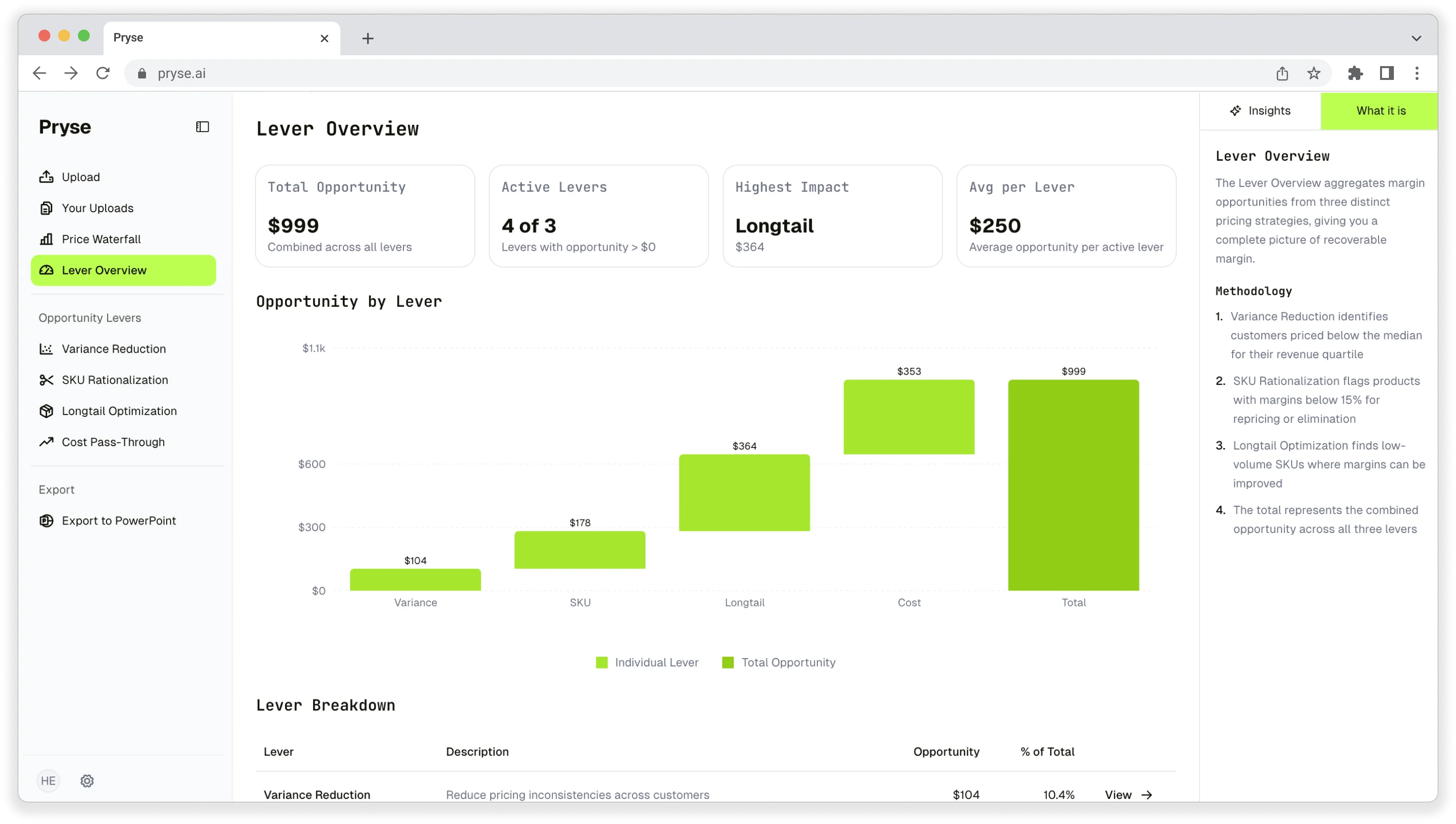
Pryse builds that margin analysis in 24 hours from a CSV upload. Upload your transaction data, see where your competitive pricing is working, where it's costing you, and where the margin opportunity sits. No implementation, no six-month project.
Competitive pricing isn't the problem. Applying it everywhere is. Get selective, and the margins follow.
Last updated: February 14, 2026
Related Articles
Frequently Asked Questions
Want to analyze your entire product catalog?
Pryse automatically identifies margin leakage across thousands of SKUs. Upload your data and find hidden profit in 24 hours.
One-time $1,499 diagnostic. No subscription required.