 Pryse
PryseMargin Leakage: The Complete Guide to Finding and Fixing Hidden Profit Loss
Learn what margin leakage is, what causes it, and how to fix it. Includes formulas, industry examples, benchmarks, and a detection framework for distribution and manufacturing companies.
Margin leakage is the difference between the margin you expect to make on a sale and what you actually collect. It's profit that disappears through pricing gaps, untracked deductions, and operational inefficiencies that nobody is watching.
For mid-market distribution and manufacturing companies, margin leakage typically runs 2-5% of total revenue. On a $50 million business, that's $1 million to $2.5 million in annual profit that vanishes without appearing on any report.
The problem is visibility. Most companies track invoice margin but miss the off-invoice deductions that happen after the sale. Rebates. Freight absorption. Early payment discounts. Credit memos. Each one chips away at the margin you thought you earned.
This guide covers what margin leakage is, what causes it, how to calculate and detect it, and how to fix it. It draws on data from mid-market distributors and manufacturers and includes specific formulas, benchmarks, and examples by industry.
What Is Margin Leakage?
Margin leakage is the unintended loss of profit between your expected margin and your actual realized margin on a transaction.
Think of it like a plumbing system. List price is the water entering the pipe. Invoice price is what comes out the first faucet. But between the invoice and your actual cash collection, there are dozens of small leaks: rebates, credits, freight costs, payment discounts, and other concessions that reduce what you actually keep.
The technical term for what you actually keep is pocket price. It's the revenue remaining after every on-invoice and off-invoice deduction.
Pocket Price = List Price - On-Invoice Discounts - Off-Invoice DeductionsMargin Leakage = Expected Margin - Actual Pocket MarginMcKinsey's research on B2B pricing found that off-invoice leakages alone average 16.3% of list price. When combined with on-invoice discounts, total leakage from list to pocket price can exceed 33%.
Most companies have no idea this is happening because their ERP tracks invoice price, not pocket price. The leakage occurs below the invoice line, in back-end systems, credit memos, and separate rebate calculations that nobody aggregates.
For a detailed breakdown of pocket price mechanics and formulas, see our post on the margin leakage formula.
7 Causes of Margin Leakage
Margin leakage doesn't come from one source. It accumulates across seven categories, each eroding profit through a different mechanism.
1. Unauthorized Discounts and Pricing Overrides
Sales reps override standard pricing to close deals. In many organizations, this happens on more than half of all transactions. NAW (National Association of Wholesalers-Distributors) data shows pricing overrides affect over 50% of transactions at many distributors.
The override itself isn't always the problem. The problem is when overrides happen without guardrails: no price floor, no approval workflow, no tracking of how much margin is given away.
A rep dropping price by 3% on a $10,000 order costs $300. Multiply that across 5,000 transactions per year and it's $1.5 million in leaked margin.
2. Off-Invoice Deductions
These are the costs that don't appear on the invoice but reduce your actual revenue:
| Deduction Type | Typical Range | Visibility |
|---|---|---|
| Volume rebates | 2-8% of purchases | Low — tracked in separate systems |
| Early payment discounts | 1-2% per transaction | Medium — visible but rarely analyzed |
| Freight absorption | 2-5% of order value | Low — buried in logistics costs |
| Co-op advertising | 1-3% of purchases | Low — marketing budget item |
| Credit memos | 0.5-2% of revenue | Very low — processed individually |
Off-invoice deductions are the single largest source of margin leakage in distribution. They're negotiated by different people, tracked in different systems, and almost never totaled against the original sale.
3. Cost-to-Serve Miscalculations
Not all customers and orders cost the same to serve. A customer ordering 50 pallets delivered to one dock costs far less than a customer ordering 12 items shipped to 8 locations with expedited freight.
When companies use average cost-to-serve numbers instead of actual per-customer calculations, they overprice easy customers (losing them to competitors) and underprice expensive ones (subsidizing their complexity at your expense).
Common cost-to-serve items that get missed:
- Small order processing costs
- Custom labeling or packaging
- Technical support and pre-sales engineering
- Returns handling and restocking
- Special delivery requirements
4. Contract Compliance Failures
Contracts specify pricing, volume commitments, and rebate terms. Leakage happens on both sides:
You give more than required. A contract says 5% discount for 100+ units. The customer orders 80 units but still gets 5% because nobody checks.
You don't collect what's owed. The contract includes a volume commitment of $500K annually. The customer does $300K. Nobody triggers the pricing adjustment.
In both cases, the contract exists but isn't enforced. The gap between contract terms and actual execution is pure margin leakage.
5. Product Mix Drift
Your blended margin changes when the mix of products sold shifts toward lower-margin items. This isn't always margin leakage in the traditional sense, but when sales teams aren't measured on margin and default to selling whatever is easiest (often the lowest-priced, lowest-margin products), the effect is the same.
A distributor with a 28% blended gross margin can drift to 24% over two years simply by shifting mix toward commodity products without anyone noticing the trend.
6. Operational Inefficiencies
For manufacturers, this includes scrap, rework, setup inefficiencies, BOM cost drift, and tooling amortization errors. For distributors, it's warehouse handling costs, picking errors, returns processing, and inventory carrying costs on slow-moving stock.
These costs get absorbed into overhead rather than allocated to specific transactions. The result: your margin calculation says 25%, but your actual profitability after operational waste is 21%.
For industry-specific details, see our guides on margin leakage in distribution and margin leakage in manufacturing.
7. Poor Cost Pass-Through
When input costs rise, not all companies pass those increases through to customers. Bain research found that only 55% of B2B companies fully passed through cost increases during recent inflationary periods.
The 45% that didn't fully pass through absorbed the cost increase as margin loss. Over multiple cost increase cycles, this compounds. A company that absorbs 40% of each cost increase will see its gross margin drop by several percentage points within a few years.
For a complete breakdown of all causes with dollar-impact calculations, see our detailed post on causes of margin leakage.
How to Calculate Margin Leakage
Calculating margin leakage requires comparing what you expected to earn on a transaction against what you actually earned. That means you need the pocket price, not just the invoice price.
The Core Formulas
Transaction-level leakage:
Margin Leakage ($) = Expected Margin ($) - Actual Pocket Margin ($)Leakage rate:
Margin Leakage Rate = (Expected Margin - Actual Pocket Margin) / Expected Margin x 100Company-wide leakage estimate:
Total Margin Leakage = Revenue x (Target Margin% - Actual Pocket Margin%)Building a Pocket Price Waterfall
To get the "actual pocket margin" number right, you need to track every deduction from list price. Here's the waterfall structure:
| Step | Line Item | Example |
|---|---|---|
| 1 | List Price | $100.00 |
| 2 | - Standard Discount | -$15.00 |
| 3 | - Negotiated Discount | -$5.00 |
| 4 | = Invoice Price | $80.00 |
| 5 | - Volume Rebate | -$4.00 |
| 6 | - Early Payment Discount | -$1.60 |
| 7 | - Freight Absorption | -$3.20 |
| 8 | - Co-op/Marketing | -$1.60 |
| 9 | - Credit Memo Adjustments | -$0.80 |
| 10 | = Pocket Price | $68.80 |
In this example, invoice margin looks like 20% ($80 on a $100 list). But pocket margin is actually 31.2% below list price. That 11.2-point gap between invoice and pocket is where leakage hides.
A Worked Example
A $45 million electrical distributor tracks invoice gross margin at 24.8%. After building pocket price waterfalls across 12 months of transaction data:
- Average volume rebates paid: 3.2% of invoice
- Freight absorption: 2.1%
- Early payment discounts: 1.4%
- Credit memos and returns: 0.9%
- Co-op advertising credits: 0.6%
Total off-invoice leakage: 8.2% of invoice value
Their actual pocket margin was 16.6%, not the 24.8% they were reporting. The 8.2-point gap represented $3.69 million in annual margin leakage.
Not all of that is recoverable. Some rebates and discounts are intentional and competitive necessities. But this distributor identified $1.2 million in leakage that was either unapproved, miscalculated, or applied to customers who didn't qualify.
For formulas, Excel implementation steps, and additional worked examples, see our margin leakage formula post. For a self-guided calculation approach, see the margin leakage calculator walkthrough.
Margin Leakage Examples by Industry
Margin leakage looks different depending on your industry. The mechanisms vary, but the pattern is consistent: profit disappearing through gaps that nobody is measuring.
Distribution Examples
Electrical distribution. A $67 million distributor found that 23% of their transactions had unauthorized price overrides. Average override depth: 4.7% below standard price. Annual impact: $720K in margin given away without approval.
Industrial supply. A $38 million industrial distributor discovered they were absorbing $400K annually in freight costs that should have been charged to customers. Their freight policy stated $500 minimum for free shipping, but reps waived it on 60% of orders below threshold.
Building materials. A $52 million building materials distributor analyzed their rebate program and found $180K in volume rebates paid to customers who hadn't met their volume commitments. The rebates were auto-calculated based on the prior year's tier, not current-year actual purchases.
Manufacturing Examples
Contract manufacturing. A $90 million manufacturer hadn't updated raw material escalation clauses in three years of contracts. With steel prices up 40%, they were absorbing $2.1 million annually in cost increases on fixed-price agreements.
Custom fabrication. A $28 million fabricator tracked 6.8% scrap rates but the actual rate, when including rework and material waste, was 11.2%. The difference — 4.4 percentage points — represented $320K in leaked margin annually.
Consumer goods manufacturing. A $65 million manufacturer offered identical pricing across retail, wholesale, and direct channels despite vastly different cost-to-serve profiles. Channel-level margin analysis revealed their direct channel ran at 34% margin while wholesale ran at 12% — but wholesale received no volume discount justification for the lower price.
For more real-world scenarios with dollar-impact analysis, see our complete margin leakage examples post.
Margin Leakage in Distribution
Distribution companies face margin leakage at every point in the order-to-cash cycle. The combination of high transaction volumes, complex pricing structures, and extensive off-invoice programs creates multiple leakage vectors.
The 7 Distribution-Specific Sources
- Customer-specific pricing overrides — negotiated prices that drift below profitable levels over years without review
- Rebate program complexity — overlapping manufacturer and customer rebate programs where credits get double-counted or applied incorrectly
- Freight absorption — free shipping thresholds that are routinely waived, or delivery costs that exceed the freight charges collected
- Small order costs — processing $150 orders that cost $45 to pick, pack, and ship, wiping out the gross margin entirely
- Returns and credit memos — liberal return policies where restocking fees aren't charged and returned inventory loses value
- Payment term costs — offering 2% net 10 terms that customers take on day 30, getting the discount without the early payment
- Inventory carrying costs — slow-moving stock tying up capital that isn't factored into product-level margin calculations
Distribution Benchmarks
| Metric | Typical Range | Top Quartile |
|---|---|---|
| Invoice gross margin | 20-30% | 28-35% |
| Pocket margin | 14-22% | 22-28% |
| Invoice-to-pocket gap | 6-10 pts | 3-5 pts |
| Off-invoice leakage as % of revenue | 3-5% | 1-2% |
| Override frequency | 40-60% of transactions | Under 20% |
The invoice-to-pocket gap is the key diagnostic metric. If your gap exceeds 8 points, you have significant leakage worth investigating.
For a deeper analysis by distribution vertical (electrical, industrial, building materials, HVAC), see our margin leakage in distribution post.
Margin Leakage in Manufacturing
Manufacturers face a different leakage profile. In addition to pricing-related leakage (which mirrors distribution), manufacturers lose margin through production processes that aren't captured in standard cost accounting.
The 8 Manufacturing-Specific Sources
- BOM cost drift — standard costs set during product launch drift from actual costs as material prices change, but standard costs aren't updated frequently enough
- Scrap and rework — material waste and defect rework that exceeds budgeted allowances, especially on complex or low-volume products
- Setup and changeover costs — production changeover time that isn't allocated to short-run products, subsidizing their true cost with overhead
- Tooling amortization — tooling costs spread across expected lifetime volumes that don't materialize, leaving unamortized investment
- Contract pricing gaps — long-term contracts without cost escalation clauses that lock in pricing while costs rise
- Channel pricing inconsistency — identical pricing across channels with different cost-to-serve, subsidizing high-cost channels with low-cost ones
- Freight and logistics — shipping costs absorbed by the manufacturer that aren't reflected in customer pricing
- Quality costs — warranty claims, field failures, and customer credits from quality issues that reduce realized margin
Manufacturing Benchmarks
| Metric | Typical Range | Top Quartile |
|---|---|---|
| Gross margin | 25-40% | 35-45% |
| Pocket margin | 18-32% | 30-40% |
| Standard cost variance | 3-8% | Under 2% |
| Scrap rate (all-in) | 4-12% | Under 3% |
| Contract leakage | 2-5% of contract revenue | Under 1% |
For detailed analysis of each manufacturing leakage source with detection methods, see our margin leakage in manufacturing post.
How to Detect Margin Leakage
Margin leakage is invisible in standard financial reports. You won't find it in your P&L or income statement. Detecting it requires transaction-level analysis that most ERP systems don't provide out of the box.
The 4-Step Detection Framework
Step 1: Build a pocket price waterfall.
Map every deduction between list price and actual cash collected. This is the foundational analysis. Without it, you're measuring invoice margin and missing everything that happens afterward.
You need data from multiple systems:
- ERP/order management: invoices, discounts, pricing
- Accounting: credit memos, rebate accruals, payment term deductions
- Logistics: actual freight costs vs. freight charged
- CRM/contracts: negotiated terms, volume commitments
Step 2: Segment and compare.
Calculate pocket margin by:
- Customer (or customer segment)
- Product (or product category)
- Sales rep
- Channel
- Order size
Then look for unexplained variance. If two similar customers buying the same products show a 12-point margin difference, you've found leakage.
Step 3: Flag anomalies.
Build rules to identify transactions that fall outside normal ranges:
- Margins below product-level floor prices
- Discount percentages above approved thresholds
- Transactions with override codes (track frequency by rep)
- Orders where freight cost exceeds freight revenue
- Credit memos exceeding 1% of customer revenue
Step 4: Quantify the opportunity.
For each leakage source identified, calculate:
Annual Leakage Impact = Number of Affected Transactions x Average Leakage per TransactionThen prioritize by size. Not all leakage is worth chasing. Focus on the sources that collectively represent 80% of the total leaked margin.
Red Flags That Signal Margin Leakage
You may have a margin leakage problem if:
- Gross margin has declined steadily over 2+ years without an obvious cause
- Revenue is growing but profit isn't growing at the same rate
- Individual sales reps have margin variance exceeding 5 points on similar products
- Off-invoice deductions (rebates, credits, freight) are growing faster than revenue
- Your customer profitability analysis shows 20%+ of customers are unprofitable
- Contract renewals consistently result in lower pricing without volume increases
How to Fix Margin Leakage
Fixing margin leakage isn't one initiative. It's a set of targeted interventions, each addressing a specific leakage source. The right sequence is to start with the fastest, highest-impact changes and build toward structural fixes.
Quick Wins (Weeks 1-4)
Implement price floors. Set minimum acceptable margins by product category. Configure your ERP or quoting system to flag (or block) transactions below the floor. This single change eliminates the worst pricing outliers immediately.
Audit the top 20 override accounts. Pull your 20 highest-discount customers and review every override from the past 12 months. You'll typically find 3-5 accounts where discounts have crept well beyond anything justified by volume or relationship.
Fix freight policy enforcement. If you have a minimum order for free shipping, enforce it. Train customer service to quote freight charges on sub-threshold orders. This recovers margin immediately on every affected order.
Medium-Term Fixes (Months 1-3)
Restructure discount approval workflows. Define discount tiers with corresponding approval levels. A 5% discount might need a manager. Over 10% needs a VP. Over 15% needs executive approval. Track every override.
Audit rebate programs. Review all active rebate agreements. Confirm that customers are meeting the volume commitments that qualify them for each tier. Claw back or adjust rebates where commitments aren't met.
Implement cost-to-serve pricing. Segment customers by their actual cost to serve and adjust pricing accordingly. Customers placing small, frequent orders with high return rates should pay more than customers placing large, predictable orders.
Structural Changes (Months 3-12)
Build pocket margin reporting. Move from invoice margin to pocket margin as your primary profitability metric. This requires consolidating data from ERP, accounting, and logistics into a single view.
Add cost escalation clauses to contracts. For manufacturing: every contract longer than 12 months should include material and labor cost escalation triggers. For distribution: annual price review clauses tied to supplier cost changes.
Create a margin management cadence. Monthly margin reviews by product category and customer segment. Quarterly deep dives on leakage trends. Annual full margin leakage audits.
For a detailed fix-by-fix implementation guide with timelines and expected impact, see our post on how to fix margin leakage.
Margin Leakage Benchmarks
Benchmarking helps you understand whether your leakage is normal or a crisis. Here are reference points from industry research and our analysis of mid-market companies.
Overall Leakage Benchmarks
| Metric | Below Average | Average | Above Average | Best in Class |
|---|---|---|---|---|
| Total leakage (% of revenue) | 5%+ | 3-5% | 1-3% | Under 1% |
| Invoice-to-pocket gap | 10+ pts | 6-10 pts | 3-6 pts | Under 3 pts |
| Override frequency | 60%+ | 40-60% | 20-40% | Under 20% |
| Unprofitable customers | 30%+ | 20-30% | 10-20% | Under 10% |
By Industry
| Industry | Typical Leakage | Primary Leakage Source |
|---|---|---|
| Electrical distribution | 3-5% | Pricing overrides, rebate complexity |
| Industrial distribution | 2-4% | Freight absorption, small order costs |
| Building materials | 3-6% | Returns, seasonal pricing gaps |
| HVAC distribution | 2-4% | Contract pricing, warranty costs |
| Industrial manufacturing | 2-5% | BOM drift, scrap, contract gaps |
| Custom manufacturing | 3-7% | Setup costs, tooling, material waste |
| Consumer goods mfg | 2-4% | Channel pricing, trade spend |
Key Research Data Points
- McKinsey: Off-invoice leakages average 16.3% of list price in B2B companies
- McKinsey: A 1% improvement in price realization translates to an 8% increase in operating profit
- BCG: 45% of executives identify revenue leakage as a systematic, ongoing problem
- Bain: Only 55% of B2B companies fully pass through cost increases
- NAW: Pricing overrides affect more than 50% of transactions at many distributors
These benchmarks give you a starting point. Your actual leakage profile depends on your industry, pricing complexity, number of SKUs, and current controls. The only way to know is to measure it.
Margin Leakage vs. Related Concepts
Margin leakage gets confused with margin erosion and margin compression. They're related but distinct problems with different causes and fixes.
| Margin Leakage | Margin Erosion | Margin Compression | |
|---|---|---|---|
| Definition | Preventable profit loss from process gaps | Gradual margin decline over time | Narrowing margins from cost pressure |
| Primary cause | Internal pricing and operational failures | Market forces + internal drift | Rising input costs |
| Side of the equation | Revenue side | Both sides | Cost side |
| Visibility | Hidden below invoice line | Visible in trend data | Visible in cost reports |
| Fix | Process controls, price discipline | Strategic repricing, repositioning | Cost management, pass-through |
| Recovery speed | Weeks to months | Months to years | Months to years |
Margin leakage is the most fixable of the three because it's caused by internal gaps you control. A discount policy that isn't enforced, a rebate that's miscalculated, a freight cost that isn't charged — these are process problems with process solutions.
Margin erosion is a broader trend. Margins erode when competitors undercut your pricing, when customers gain bargaining power, or when your cost structure drifts upward without matching revenue growth. It requires strategic response, not just process fixes.
Margin compression is specifically about the cost side squeezing your margins from below. Raw materials go up. Labor costs increase. Freight rates rise. If you can't raise prices proportionally, your margin compresses even though your pricing hasn't changed.
For in-depth comparisons, see:
- Margin erosion vs. margin leakage — complete diagnostic framework
- Margin erosion causes — 10 causes with detection methods
- Margin compression — cost-side analysis and response strategies
What to Do Next
If you suspect margin leakage in your business, here's where to start:
-
Calculate your invoice-to-pocket gap. Pull 6 months of transaction data. Identify every deduction between invoice price and actual collected revenue. If the gap exceeds 6 points, you have material leakage.
-
Segment your margins. Break margins down by customer, product, and channel. Look for unexplained variance between similar accounts. A 10-point margin range on the same product across similar customers is a leakage signal.
-
Audit your top 20 discount accounts. Review every pricing override for your largest customers over the past year. Confirm each discount has a documented business justification.
-
Benchmark against your peers. Use the benchmarks in this guide to gauge whether your leakage is within normal ranges or requires urgent attention.
-
Build a pocket price waterfall. This is the single most useful analysis for margin leakage. It transforms abstract margin loss into specific, addressable line items.
For a step-by-step calculation approach you can follow in Excel, start with our margin leakage calculator walkthrough.
Last updated: January 29, 2026
Related Articles
Frequently Asked Questions
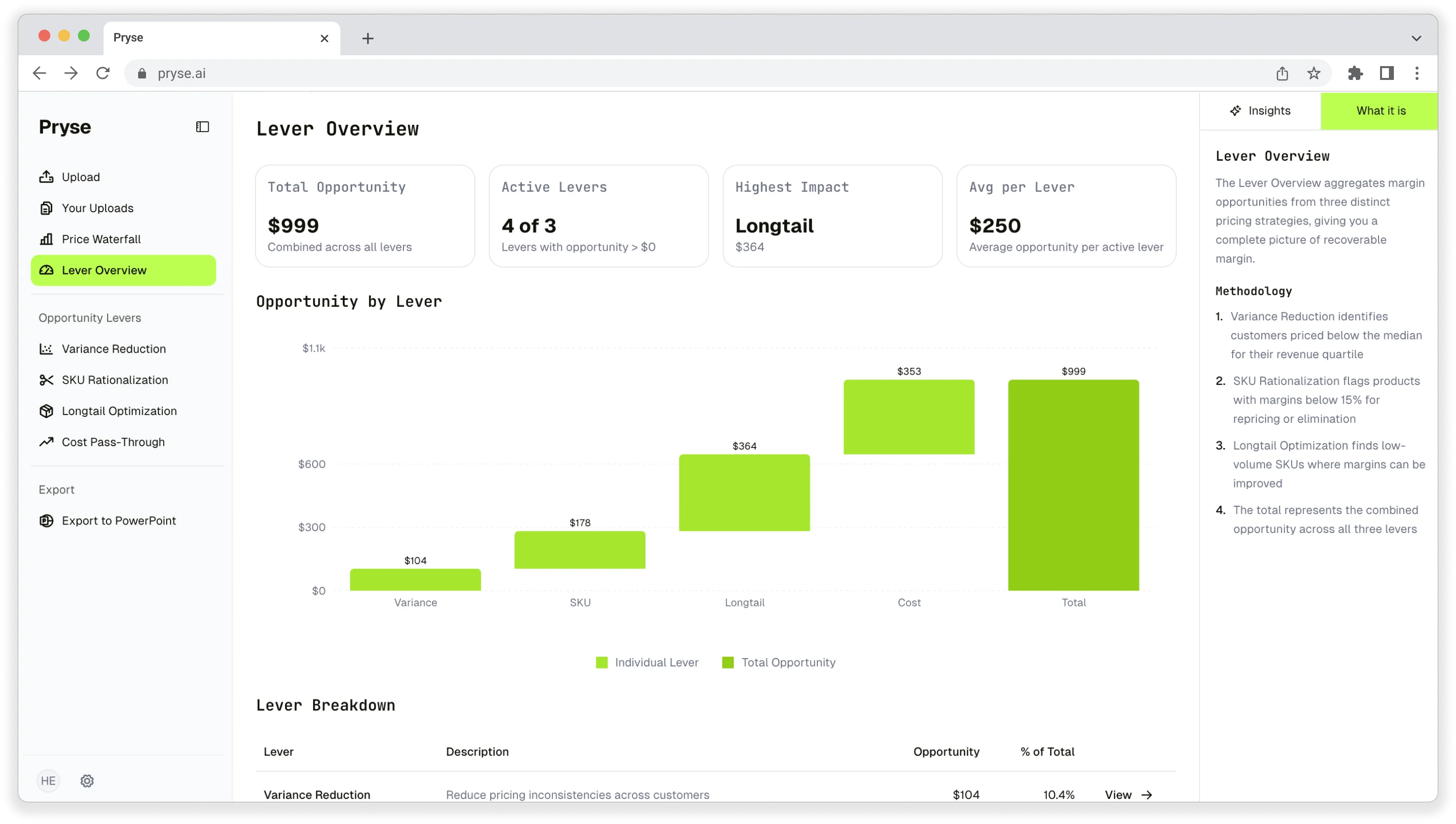
Want to analyze your entire product catalog?
Pryse automatically identifies margin leakage across thousands of SKUs. Upload your data and find hidden profit in 24 hours.
One-time $1,499 diagnostic. No subscription required.