 Pryse
PryseBest Rebate Management Software for 2026: Features, Pricing & Reviews
Compare the best rebate management platforms for distributors and manufacturers. Find the right solution for tracking vendor rebates and channel incentives.
The best rebate management software is Enable for most distributors and manufacturers managing complex B2B rebate programs, offering comprehensive agreement tracking, automated accrual calculations, collaborative deal management, and AI-powered analytics starting at approximately $50K-$100K annually for mid-market deployment.
Choosing rebate management software matters because distributors and manufacturers managing hundreds of rebate agreements with multi-tier structures, retroactive calculations, and channel partner programs can recover 2-3% of rebate value through error elimination and improved compliance. For companies earning $2M-$10M annually in supplier or customer rebates, that margin recovery often exceeds software costs within 6-12 months.
The challenge is that rebate management platforms vary dramatically—from basic accrual calculators at $5K/year to enterprise systems costing $200K+ with AI optimization and fraud detection. Most companies overestimate their need for enterprise features while underestimating implementation complexity and ongoing maintenance costs.
This post compares the 7 best rebate management software platforms for 2026, explains what features actually matter for distributors and manufacturers at different revenue scales, and provides pricing benchmarks to help you choose between spreadsheets, mid-market solutions, and enterprise platforms.
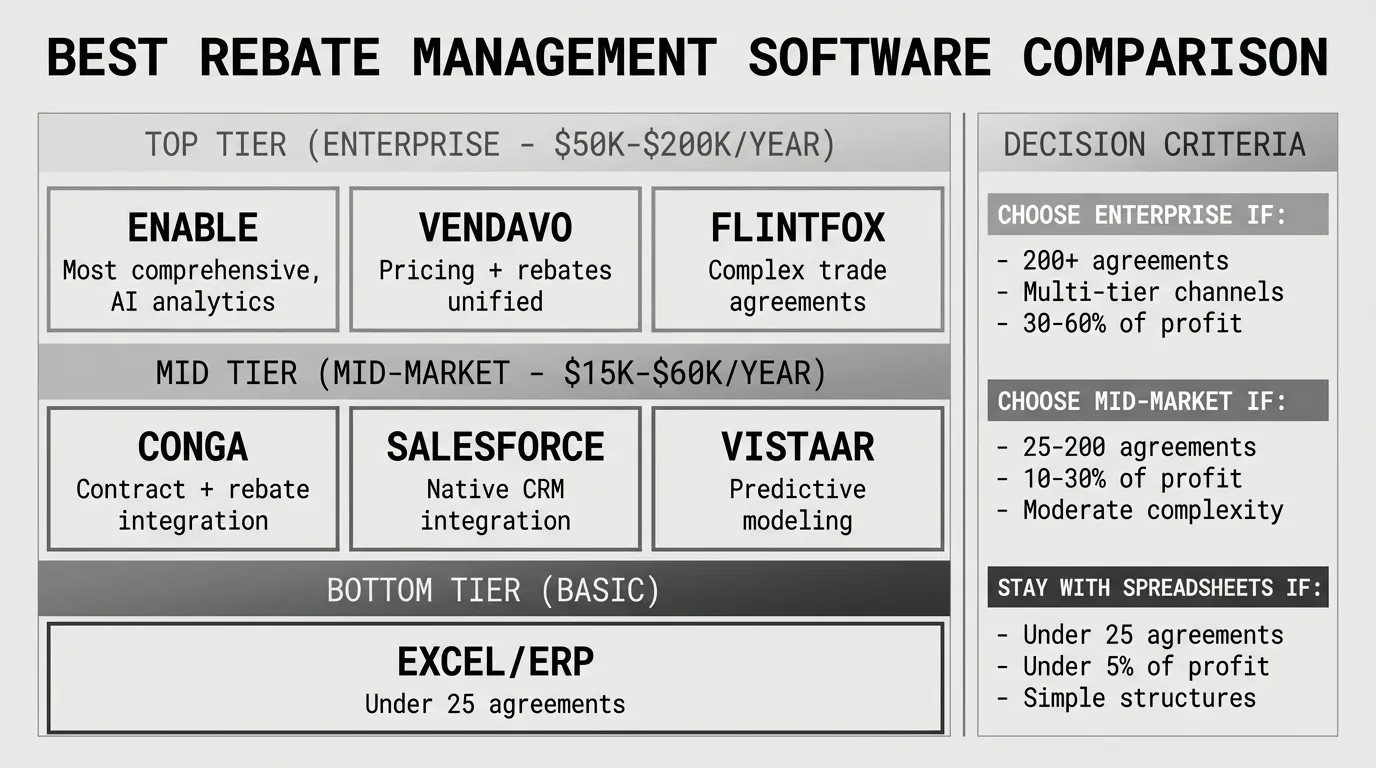
How We Evaluated Rebate Management Software
We compared rebate management platforms based on five criteria relevant to mid-market distributors and manufacturers managing supplier or customer rebate programs.
Evaluation criteria:
-
Agreement complexity handling: Can the platform manage multi-tier volume rebates, retroactive calculations, growth bonuses, product mix incentives, and compliance-based rebates? Simple single-tier trackers don't scale.
-
ERP integration quality: Does it offer live API integration with NetSuite, SAP, D365, and distribution ERPs, or just scheduled CSV imports? Real-time data sync matters for accurate accruals.
-
Multi-tier channel support: Can it track rebates across manufacturer → distributor → dealer chains with separate agreements at each tier? Critical for channel programs.
-
Implementation and support: What's the typical implementation timeline and cost? Is support email-only or dedicated account management? Mid-market companies need reasonable onboarding.
-
Total cost of ownership: Annual subscription, implementation costs, and ongoing maintenance fees. We evaluated pricing relative to company size and rebate program complexity.
We excluded consumer rebate platforms (focused on mail-in rebates and promotions), pure analytics tools without transaction tracking, and rebate modules within broader trade promotion management suites that don't function as standalone systems.
Best Rebate Management Software Compared
Here's our comparison of the 7 best rebate management platforms for distributors and manufacturers in 2026.
| Platform | Best For | Starting Price | Implementation | Key Strength |
|---|---|---|---|---|
| Enable | Most distributors & manufacturers | $50K-$100K/year | 2-4 months | Collaborative rebate management with AI analytics |
| Vendavo | Pricing + rebate optimization | $50K-$150K/year | 3-6 months | Unified pricing and rebate platform |
| Flintfox | Complex trade agreements | $75K-$200K/year | 3-6 months | Real-time pricing and rebate integration |
| Conga | Contract + rebate management | $20K-$60K/year | 1-3 months | Integrated contract lifecycle and rebates |
| PROS | High transaction velocity | $100K-$200K+/year | 4-6 months | AI-powered rebate optimization in CPQ |
| Salesforce | Existing Salesforce users | $30K-$80K/year | 2-3 months | Native Salesforce CRM integration |
| Vistaar | Mid-market manufacturers | $15K-$40K/year | 1-2 months | Predictive modeling for promotions |
All pricing estimates are based on mid-market deployment (100-500 rebate agreements, $50M-$200M revenue). Actual costs vary significantly based on agreement complexity, transaction volume, and customization requirements.
1. Enable — Best Overall Rebate Management Software
Enable is the best rebate management software for most distributors and manufacturers, offering end-to-end automation of B2B rebate programs with collaborative deal management, automated accrual calculations, AI-powered analytics, and channel partner portals.
Why Enable Is Our Top Pick
According to SourceForge's 2026 comparison of rebate management software, Enable sets the standard for comprehensive, streamlined rebate management with an all-in-one platform handling rebate data, tracking, collaboration, and reporting.
Enable stands out because it was purpose-built for collaborative rebate management between trading partners, not adapted from pricing or contract management platforms. Companies using Enable report reducing rebate administration time by approximately 75%, according to Enable's customer impact data.
Key Features
Collaborative rebate management
Enable's core strength is facilitating rebate deal creation, negotiation, and execution between manufacturers and distributors or distributors and dealers. Multiple stakeholders can access deal details, track progress in real-time, and maintain alignment throughout the rebate lifecycle.
Automated accrual and claims
Enable automatically generates, submits, and tracks rebate claims to speed cash collection. Accrual calculations update continuously as transaction data flows from ERP systems, eliminating manual spreadsheet reconciliation.
AI-powered analytics
According to BusinessWire's coverage of Enable's 2024 product release, Enable introduced AI-powered analytics with natural language processing. Users can ask questions in business language and get results a trained analyst would produce, such as "Which rebate agreements have the highest ROI?" or "Show me partners close to crossing tier thresholds."
Forecasting and modeling
Enable provides forecast recommendations considering seasonality and allows you to track, adjust, and model projected rebates. This helps finance teams maintain accurate accrual reserves and sales teams understand rebate program effectiveness.
ERP and CRM integration
Enable integrates directly with NetSuite, SAP, D365, Oracle, and major distribution ERPs for real-time data sync. This eliminates manual data entry and keeps sales, rebate, and customer information aligned across platforms.
Pricing and Implementation
Enable's pricing is not publicly disclosed but based on market research and vendor comparisons, mid-market deployments typically start at $50K-$100K annually depending on revenue size, number of agreements, and transaction volume.
Implementation takes 2-4 months for mid-market companies and includes:
- ERP integration setup and testing
- Agreement template configuration
- User training and workflow design
- Partner portal setup (if applicable)
- Data migration from existing systems
Implementation costs typically range from $25K-$75K, or 0.5-1x annual subscription.
Best For
- Distributors managing 100-1,000+ rebate agreements with suppliers and customers
- Manufacturers with multi-tier channel partner rebate programs
- Companies needing collaborative features for deal negotiation with trading partners
- Mid-market to enterprise businesses ($50M-$1B+ revenue)
- Organizations wanting AI-powered analytics for rebate program optimization
Not Ideal For
- Companies with under 50 simple rebate agreements (overkill)
- Businesses needing combined pricing optimization (Vendavo is better)
- Small companies without dedicated finance resources for implementation
- Organizations requiring deep customization of calculation logic (Flintfox is more flexible)
Where to Learn More
Visit Enable's rebate management platform overview or read G2 reviews from Enable users.
2. Vendavo — Best for Pricing and Rebate Optimization
Vendavo Rebate Management is the best choice for companies needing combined pricing, margin, and rebate optimization in one platform, ideal for manufacturers and distributors managing complex B2B commercial programs.
Why Choose Vendavo
According to SolveXia's guide to best rebate management software, Vendavo is recognized as the best choice for pricing and rebate optimization together. Unlike competitors who rely on partnerships to achieve similar functionality, Vendavo provides a unified solution for the pricing ecosystem.
Vendavo's advantage is that rebate management sits within their broader commercial optimization suite including price optimization, margin analysis, and CPQ. Companies get visibility into how rebates impact pocket price, customer profitability, and overall margin performance—not just rebate accrual tracking in isolation.
Key Features
Integrated pricing and rebate platform
Vendavo combines price optimization, rebate management, and margin waterfall analysis in one platform. This allows you to see how rebates affect true pocket price and customer profitability, enabling better commercial decision-making.
According to Vendavo's product overview, their rebate management system minimizes manual work and accidental errors, allowing teams to analyze and track deals across products, customers, and regions to assess rebate program effectiveness.
Customer and end-user portals
Vendavo provides customer and channel partner portals for information sharing of deals, agreements, and performance tracking. Partners can access rebate program details, track progress toward tier thresholds, and submit claims with supporting documentation.
Comprehensive agreement management
Set up the entire rebate and channel process with agreement templates, eligibility rules, tiered structures, and compliance requirements. Vendavo handles volume rebates, growth incentives, product mix bonuses, and compliance-based rebates in one system.
Multi-tier channel tracking
Vendavo excels at managing rebates across manufacturer → distributor → dealer chains where each tier has different agreements, payment cycles, and reconciliation requirements.
ERP and CRM integration
Vendavo integrates with CPQ, CRM, and ERP systems agnostically, meeting requirements regardless of tech stack or architecture. This flexibility works for companies with complex IT environments.
Pricing and Implementation
Vendavo's pricing is not publicly listed but based on market research, mid-market deployments start at $50K-$150K annually for combined pricing and rebate management. Rebate-only modules may be priced lower.
Implementation takes 3-6 months depending on scope and includes:
- Price and rebate data integration
- Margin waterfall configuration
- User training across sales, finance, and operations
- Partner portal setup
- Custom reporting development
Implementation costs range from $50K-$150K, or 1-2x annual subscription.
Best For
- Companies wanting pricing optimization and rebate management in one platform
- Manufacturers with complex multi-tier channel programs
- Businesses needing price-volume-mix analysis integrated with rebate tracking
- Mid-market to enterprise companies ($100M-$1B+ revenue)
- Organizations already using Vendavo for pricing or margin optimization
Not Ideal For
- Companies needing rebate management only (Enable is more focused)
- Small businesses under $50M revenue (too expensive and complex)
- Organizations wanting quick implementation (3-6 months is typical)
- Companies with simple rebate structures (overkill)
Where to Learn More
Visit Vendavo's rebate management page or compare Vendavo vs competitors.
3. Flintfox — Best for Complex Trade Agreements
Flintfox is the best option for real-time rebate and pricing management, handling intricate rebate scenarios and complex trade agreements with seamless ERP integration.
Why Choose Flintfox
According to SolveXia's rebate software comparison, Flintfox is favored for its ability to handle intricate rebate and pricing scenarios, making it the preferred choice for businesses dealing with complex trade agreements.
Flintfox automates the entire rebate process with a focus on managing sophisticated pricing rules, volume tiers, retroactive calculations, and clawback provisions. It's built for companies where rebate complexity has exceeded what general-purpose platforms can handle.
Key Features
Real-time pricing and rebate integration
Flintfox integrates pricing and rebate calculations in real-time, allowing sales teams to quote accurate prices reflecting current rebate program status. This prevents situations where quoted prices don't account for upcoming tier crossings or retroactive adjustments.
Complex calculation engine
Flintfox handles sophisticated rebate structures including:
- Retroactive tier adjustments across entire purchase history
- Stacking multiple concurrent rebates (volume + growth + product mix)
- Sell-through rebates based on distributor sales to end customers
- Compliance-based rebates requiring non-transactional verification
- Multi-currency and multi-entity rebate programs
Trade revenue management
Beyond rebate tracking, Flintfox provides comprehensive trade revenue management combining pricing, rebates, chargebacks, and promotional allowances in one platform for total trade spend visibility.
ERP integration
Flintfox integrates seamlessly with existing ERP systems for automated transaction data import, accrual posting, and financial reconciliation. Supports NetSuite, SAP, Oracle, and distribution-specific ERPs.
Pricing and Implementation
Flintfox pricing is not publicly disclosed but based on market positioning, enterprise deployments typically start at $75K-$200K annually depending on complexity and transaction volume.
Implementation takes 3-6 months and includes:
- Complex calculation rule programming
- Real-time ERP integration setup
- Multi-tier channel hierarchy configuration
- User training and workflow design
- Custom reporting and analytics setup
Implementation costs range from $75K-$200K, or 1-2x annual subscription.
Best For
- Wholesale distributors with complex multi-tier rebate programs
- Manufacturers managing intricate trade agreements with hundreds of partners
- Companies with sophisticated rebate structures that simpler platforms can't handle
- Large distributors ($200M+ revenue) where rebates contribute 30-60% of profit
- Organizations needing real-time pricing and rebate calculation integration
Not Ideal For
- Small to mid-market companies under $100M revenue (too expensive)
- Businesses with simple single-tier volume rebates (overkill)
- Companies wanting quick deployment (3-6 month implementations)
- Organizations without dedicated rebate management teams
Where to Learn More
Visit Flintfox's rebate management features page.
4. Conga Rebate Management — Best for Contract + Rebate Integration
Conga provides rebate management integrated with contract lifecycle and pricing solutions, offering aligned rebate management for profitable growth with faster implementation than enterprise platforms.
Why Choose Conga
Conga's advantage is rebate management within their broader commercial operations platform including contract lifecycle management, document generation, and revenue operations. Companies already using Conga for contracts can add rebate management without introducing another vendor.
Key Features
Unified commercial platform
Conga combines contract management, pricing, rebate tracking, and document generation in one platform. This eliminates data silos between contract terms and rebate program execution.
Contract-to-rebate workflow
Automatically convert contract rebate terms into active rebate agreements with calculation rules, eliminating manual setup and reducing errors from transcription.
Salesforce integration
Conga integrates natively with Salesforce CRM, making it attractive for companies using Salesforce as their commercial platform. Rebate data flows seamlessly with opportunity, account, and contract information.
Mid-market focus
Conga targets mid-market companies ($20M-$200M revenue) with faster implementation (1-3 months) and lower cost than enterprise platforms, while providing more sophistication than basic rebate trackers.
Pricing and Implementation
Conga's pricing starts at approximately $20K-$60K annually for mid-market deployments depending on contract volume, rebate agreements, and modules included.
Implementation takes 1-3 months and includes contract-rebate integration setup, workflow configuration, Salesforce integration, and user training.
Best For
- Companies needing combined contract lifecycle and rebate management
- Mid-market businesses ($20M-$200M revenue) wanting unified commercial platform
- Organizations using Salesforce CRM extensively
- Companies wanting faster implementation than enterprise rebate platforms
Not Ideal For
- Large enterprises needing dedicated rebate-specific features (Enable is better)
- Companies not using Salesforce (integration advantage is lost)
- Businesses with highly complex multi-tier channel programs
Where to Learn More
Visit Conga's rebate management product page.
5. PROS Rebate Management — Best for AI-Powered Optimization
PROS Rebate Management integrates rebate management with PROS's AI-powered CPQ and dynamic pricing solutions for industries with high transaction velocity.
Why Choose PROS
According to PriceFX's comparison of rebate management software, PROS combines CPQ capabilities with rebate management in an end-to-end omnichannel pricing and selling platform.
PROS excels at real-time rebate calculation during quoting workflows, allowing sales teams to see rebate impact on deal profitability before finalizing quotes.
Key Features
AI-driven rebate optimization
PROS applies artificial intelligence to identify optimal rebate program structures, predict tier crossing likelihood, and recommend agreement modifications to maximize ROI.
CPQ integration
Rebate calculations happen in real-time during quote generation, ensuring sales teams quote accurately considering current rebate program status and upcoming tier thresholds.
High-velocity transaction processing
PROS handles industries with thousands of daily transactions where rebate accruals must update continuously, not in nightly batch processes.
Pricing and Implementation
PROS pricing starts at approximately $100K-$200K+ annually for enterprise deployments. Implementation takes 4-6 months including AI model training, CPQ integration, and workflow design.
Best For
- Companies already using PROS for pricing or CPQ
- Industries with high transaction velocity (distribution, manufacturing)
- Organizations wanting AI-driven rebate program optimization
- Large enterprises ($500M+ revenue)
Not Ideal For
- Mid-market companies under $100M revenue (too expensive)
- Businesses needing standalone rebate management (Enable is better)
- Companies without dedicated implementation resources
Where to Learn More
Read PROS's rebate management platform announcement.
6. Salesforce Rebate Management — Best for Salesforce Users
Salesforce Channel Revenue Management includes rebate management capabilities within the Salesforce ecosystem for manufacturers managing channel partner programs.
Why Choose Salesforce
If you're already using Salesforce CRM extensively for customer and partner management, Salesforce rebate management provides native integration with account, opportunity, and pipeline data.
Key Features
Native Salesforce integration
Rebate data lives within Salesforce alongside customer records, opportunities, and contracts, eliminating data sync issues between systems.
Channel partner focus
Built specifically for manufacturer-to-distributor and distributor-to-dealer channel programs with rebates tied to partner performance, pipeline development, and market development funds.
CPQ integration
Integrates with Salesforce CPQ for deal pricing that accounts for rebate program status and tier thresholds.
Pricing and Implementation
Salesforce Channel Revenue Management pricing starts at approximately $30K-$80K annually for mid-market deployments. Implementation takes 2-3 months including Salesforce configuration and data migration.
Best For
- Manufacturing companies using Salesforce CRM extensively
- Channel partner programs with rebates tied to CRM data
- Mid-market manufacturers ($50M-$500M revenue)
- Companies wanting rebate management within existing Salesforce environment
Not Ideal For
- Distributors (focuses on manufacturer-to-channel programs)
- Companies not using Salesforce (no advantage over alternatives)
- Organizations needing advanced rebate analytics (Enable is stronger)
Where to Learn More
Visit Salesforce's channel revenue management page.
7. Vistaar — Best for Mid-Market Manufacturers
Vistaar's SmartRebate platform provides automated rebate calculations using predictive models for trade promotion and incentive management at mid-market price points.
Why Choose Vistaar
According to PriceFX's rebate software comparison, Vistaar offers both B2B and B2C solutions with a single-module SaaS approach utilizing machine learning and artificial intelligence.
Vistaar targets mid-market companies not ready for enterprise platform cost or complexity, providing promotional rebate management and predictive modeling at accessible price points.
Key Features
Predictive modeling
Vistaar uses machine learning to forecast rebate program outcomes, identify optimal tier structures, and recommend promotional incentive levels.
Trade promotion integration
Combines rebate management with trade promotion planning and execution for consumer goods and manufacturing companies running promotional programs alongside volume rebates.
Mid-market focus
Faster implementation (1-2 months) and lower pricing than enterprise platforms while providing more sophistication than basic rebate trackers.
Pricing and Implementation
Vistaar pricing starts at approximately $15K-$40K annually for mid-market deployments. Implementation takes 1-2 months including integration setup and user training.
Best For
- Mid-market manufacturers ($20M-$200M revenue)
- Consumer goods companies with promotional rebate programs
- Organizations wanting predictive analytics without enterprise cost
- Regional deployments not requiring global multi-currency support
Not Ideal For
- Large enterprises (Enable or Vendavo provide more scale)
- Distributors managing supplier rebates (focuses on manufacturer programs)
- Companies needing complex multi-tier channel tracking
Where to Learn More
Read Vistaar's rebate management software guide.
How to Choose the Right Rebate Management Software
Most companies overestimate their need for enterprise platforms. Start with complexity assessment, not vendor demos.
Decision Framework
Choose spreadsheets (no software) if:
- You manage under 25 active rebate agreements
- Rebate structures are simple (single-tier volume rebates)
- Payments happen annually or semi-annually
- Rebates contribute under 5% of gross profit
- Finance team can handle quarterly manual tracking
Your current approach may be inefficient but isn't creating material financial risk.
Choose mid-market platforms ($15K-$60K/year) if:
- You manage 25-200 active rebate agreements
- Multi-tier volume structures or stacking rebate types
- Quarterly payments requiring regular accrual tracking
- Rebates contribute 10-30% of gross profit
- You've experienced errors, missed claims, or reconciliation issues
- Finance spends 40+ hours per quarter on manual rebate tracking
Recommended platforms: Conga, Vistaar, or Salesforce (if using Salesforce CRM)
Choose enterprise platforms ($50K-$200K+/year) if:
- You manage 200+ active rebate agreements
- Multi-tier channel programs (manufacturer → distributor → dealer)
- Complex calculations (retroactive adjustments, clawbacks, compliance rebates)
- Rebates contribute 30-60% of net profit
- You need predictive analytics and program optimization
- Implementation capacity exists for 3-6 month projects
Recommended platforms: Enable (rebate-focused), Vendavo (pricing + rebates), Flintfox (complex trade), or PROS (CPQ + rebates)
Feature Priorities by Company Size
$10M-$50M revenue (25-100 agreements)
Must-have:
- Agreement setup and tracking
- Automated accrual calculations
- Claims submission and approval
- Basic reporting
Skip:
- Partner portals
- AI analytics
- Fraud detection
$50M-$200M revenue (100-500 agreements)
Must-have:
- Everything above plus:
- Multi-tier channel tracking
- Complex calculation engine
- Live ERP integration
- Advanced reporting
Nice-to-have:
- Partner portal access
- Program optimization analytics
$200M+ revenue (500+ agreements)
Must-have:
- Everything above plus:
- Partner self-service portals
- AI-powered analytics
- Fraud detection
- Dedicated support
Red Flags — You're Not Ready
Don't invest in rebate management software if:
- Transaction data is incomplete or inconsistent
- Rebate agreements aren't documented clearly
- No single source of truth for active rebates
- Finance and sales don't agree on accrual methodology
- You haven't quantified cost of current process errors
Fix these first. Clean data and clear processes beat sophisticated software.
Total Cost of Ownership
Software subscription is only part of total cost.
Subscription Pricing
Mid-market platforms: $15K-$60K annually
- Based on revenue size, number of agreements, or transaction volume
- Implementation: $7.5K-$30K (0.5-1x subscription)
- Timeline: 1-3 months
Enterprise platforms: $50K-$200K+ annually
- Based on complexity, agreements, users, and modules
- Implementation: $50K-$200K+ (1-2x subscription)
- Timeline: 3-6 months
Hidden Ongoing Costs
IT support: $5K-$20K annually for integration maintenance, troubleshooting, and security updates
Agreement management: Finance or operations time maintaining agreement data, updating terms, onboarding partners
Data quality: Ongoing effort cleaning transaction data, resolving mismatches, reconciling discrepancies
Process change: Training sales and finance teams, handling partner questions, maintaining documentation
ROI Reality Check
Companies typically recover 2-3% of rebate value through error elimination and better compliance, according to Vistex's analysis of wholesale distribution rebate programs.
Break-even example:
A $50M distributor earning $2M annually in manufacturer rebates has significant exposure. If manual tracking causes 2.5% leakage through missed claims and calculation errors, that's $50K in lost margin.
If software costs $20K/year + $15K implementation, recovering that $50K pays back the investment in under 9 months.
But ROI assumes:
- Transaction data is accurate and complete
- Rebate agreements are documented clearly
- Finance team adopts new workflows fully
- Implementation stays on schedule and budget
Alternatives to Rebate Management Software
Not every company needs specialized software.
ERP Rebate Modules
NetSuite, SAP Business One, Acumatica, and Dynamics 365 include basic rebate tracking for simple single-tier volume rebates with manual accrual posting.
Works for: Under 25 agreements with straightforward structures
Fails for: Multi-tier rebates, retroactive calculations, or complex channel programs
Excel-Based Tracking
For companies with under 50 rebate agreements, Excel delivers basic tracking at zero software cost.
Works for: Agreement terms tracking, manual accrual calculations, claims logs, basic reporting
Doesn't scale: Automated accrual updates, retroactive calculations, multi-tier coordination, forecasting, audit trails
Excel works until you miss material claims, spend 20+ hours per quarter on tracking, or face partner disputes from calculation discrepancies.
Margin Diagnostics First
Before investing in rebate management software, understand how rebates affect your pocket margin and where you're leaving money on the table.
Pryse provides self-serve margin diagnostics for $1,499. Upload your transaction CSV and receive analysis showing actual pocket margin after rebates, margin variance by customer and product, rebate program ROI, and missed claim opportunities.
Companies often discover $50K-$200K in unclaimed supplier rebates or $30K-$100K in overstated customer rebates. If the diagnostic shows limited complexity, you've saved $15K-$50K annually by confirming spreadsheets work.
Should You Invest in Rebate Management Software?
Use this framework:
Clear yes if:
- Managing 100+ active rebate agreements
- Multi-tier structures or retroactive calculations
- Rebates contribute 20%+ of gross profit
- You've missed material claims or overpaid due to errors
- Finance spends 60+ hours per quarter on manual tracking
- Clean ERP data and documented agreements exist
Clear no if:
- Under 25 agreements with simple structures
- Rebates contribute under 5% of gross profit
- Annual or semi-annual payment cycles
- Current Excel tracking works without errors
- Transaction data incomplete or agreements undocumented
- No dedicated finance resources for implementation
Maybe — improve processes first if:
- 25-100 agreements with moderate complexity
- Rebates contribute 10-20% of gross profit but leakage not quantified
- Spreadsheet tracking time-consuming but not causing errors yet
- Budget allows software but ROI unclear
- Data quality needs improvement
For most mid-market distributors and manufacturers, the right answer is: probably not yet. Document active agreements, improve data quality, quantify errors under current processes, then revisit software when manual tracking demonstrably fails.
Companies getting value from rebate management software built tracking discipline through better processes first, then added software to automate what already worked manually.
Next Steps
Before evaluating rebate management software vendors, understand your current rebate economics and margin performance.
Run a margin diagnostic to see your actual pocket price after all rebates and incentives. For $1,499, Pryse provides 24-hour analysis showing true pocket margin by customer and product after rebates, where margin leakage occurs and how much is recoverable, rebate program effectiveness and ROI, and whether software or improved processes make sense.
Start with diagnostics. Invest in rebate management software once you've confirmed material leakage exists, quantified the recoverable opportunity, and documented rebate terms clearly enough to configure a system.
For broader rebate program strategy beyond software tools, see our complete rebate management guide covering agreement structures, program design, and optimization best practices.
Sources
- SourceForge: Best Rebate Management Software of 2026
- SolveXia: Best Rebate Management Software for 2026
- G2: Best Rebate Management Software User Reviews
- Enable: Rebate Management Software for B2B Growth
- Enable: 5 Features of Customer Rebate Management Software
- BusinessWire: Enable Shapes the Future of Rebate Management with AI Reporting
- Vendavo: Rebate Management Software & Solutions
- Vendavo: Rebate & Channel Manager
- PriceFX: The 6 Best Rebate Management Software in 2023
- Flintfox: Rebate Management Features
- Conga: Aligned Rebate Management for Profitable Growth
- PROS: Rebate Management Platform Innovation
- Vistaar: Rebate Management Software Guide
- Vistex: Wholesale Distribution Rebate Programs
Last updated: February 24, 2026
Frequently Asked Questions
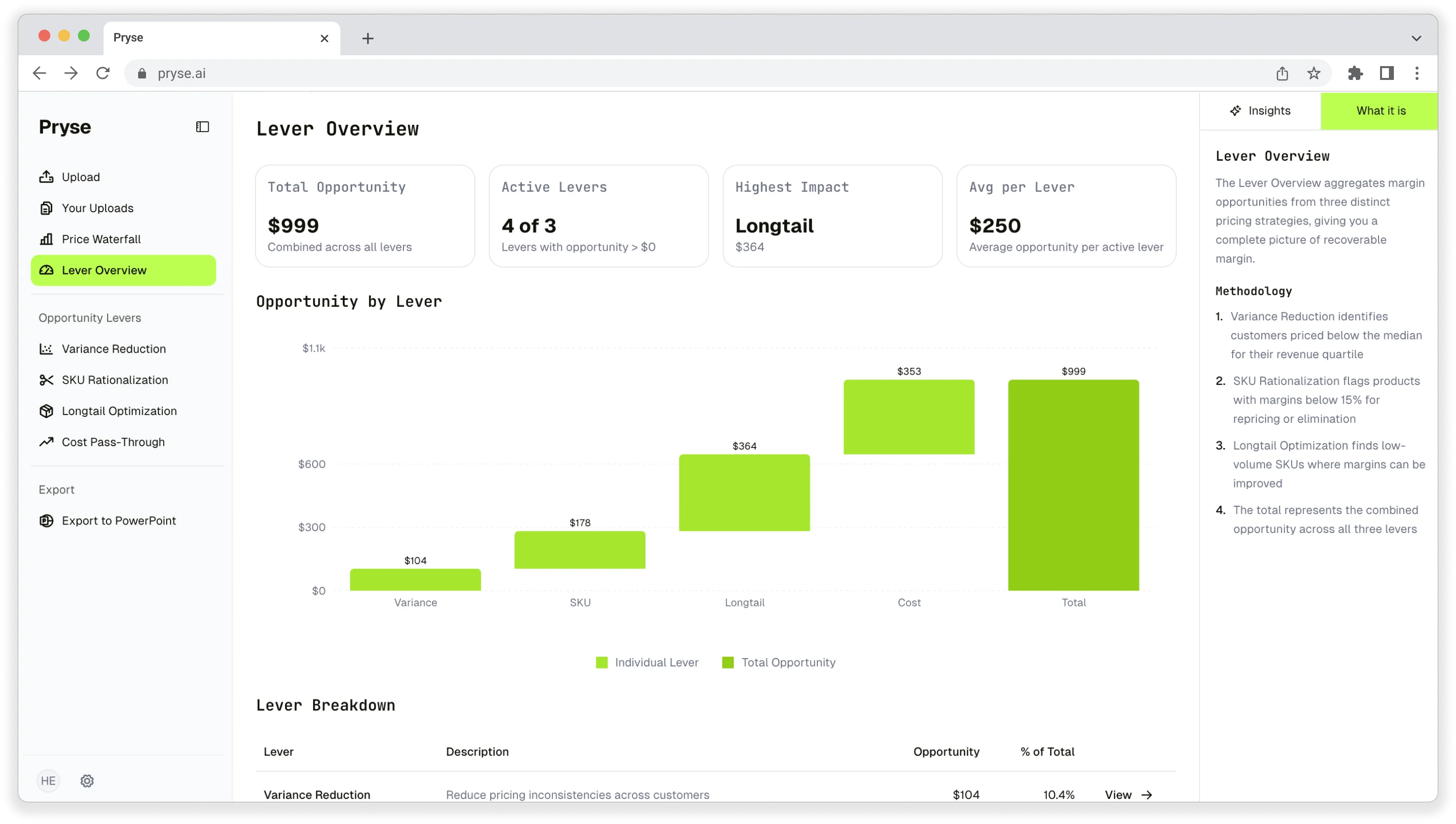
Want to analyze your entire product catalog?
Pryse automatically identifies margin leakage across thousands of SKUs. Upload your data and find hidden profit in 24 hours.
One-time $1,499 diagnostic. No subscription required.