 Pryse
PryseRebate Management Software: Complete Guide to B2B Rebate Platforms
Compare rebate management software for tracking vendor rebates, distributor incentives, and channel partner programs. Find the right solution for your rebate complexity.
Rebate management software automates rebate agreement tracking, accrual calculations, claims processing, and payment reconciliation for B2B trading partners to replace spreadsheets with centralized systems that reduce errors, ensure compliance, and provide visibility into rebate performance and profitability impact.
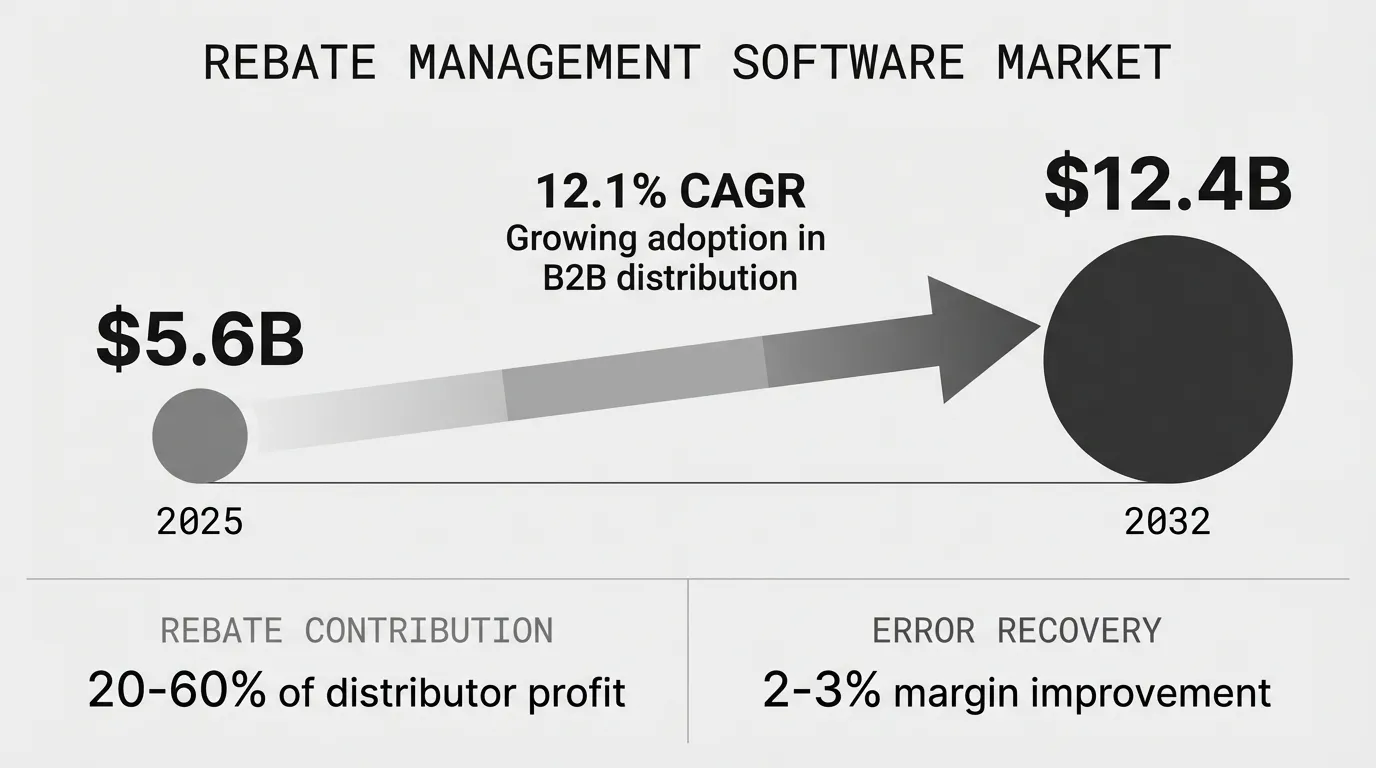
The global rebate management software market size is estimated at $5.6 billion in 2025 and is expected to reach $12.4 billion by 2032, exhibiting a compound annual growth rate of 12.1%, according to market analysis from Growth Market Reports. This growth is driven by manufacturers and distributors shifting from manual spreadsheet tracking to automated platforms as rebate programs become more complex and represent larger portions of profit.
For mid-market distribution and manufacturing companies, rebates often contribute 20-60% of net profit. According to Enable's analysis of distributor economics, rebates can represent a quarter or more of typical distributor profitability, yet most manufacturers report only 2% of rebate programs are as effective as they'd like.
The challenge is understanding when spreadsheet-based rebate tracking becomes too risky, which software capabilities actually matter, and how to choose between vendors at vastly different price points.
This post explains what rebate management software does differently from manual tracking, when it makes sense for your business, what features matter, and how to choose between platforms ranging from $5K to $200K+ annually.
What Rebate Management Software Actually Does
Rebate management software handles the full lifecycle of B2B rebate programs—from agreement setup through calculation, claims processing, payment, and reconciliation. It's the operational backbone for trading partner incentive programs.
Core operational capabilities:
- Agreement management: Store and track rebate agreements with customers or suppliers including terms, eligibility rules, volume tiers, and performance conditions
- Automated accruals: Calculate expected rebate liability or receivable based on actual transaction data pulled from ERP or sales systems
- Claims processing: Submit, validate, and approve rebate claims with audit trails and supporting documentation
- Payment reconciliation: Match payments to agreements, track outstanding balances, and reconcile against accounting systems
- Multi-tier tracking: Manage rebates across manufacturer → distributor → dealer chains where each tier has different agreements
- Compliance and audit: Document agreement terms, track changes, maintain approval histories, and generate compliance reports
Where rebate management differs from pricing software:
Pricing software sets the invoice price upfront. Rebate management tracks off-invoice incentives paid after the sale based on cumulative performance against agreements.
According to Enable's explanation of B2B rebates, rebates are financial incentives paid after an agreed period when specific conditions are met—hitting volume thresholds, achieving growth targets, or promoting specific products. This retroactive nature creates complexity that spreadsheets struggle to handle at scale.
Why B2B Rebates Matter for Distributors and Manufacturers
Rebates are fundamental economics in wholesale distribution and manufacturing channels, not optional marketing tactics.
Rebates as Core Distributor Profit
For distributors, rebates aren't extra margin—they're essential to business viability.
According to the National Association of Wholesaler-Distributors, rebates accelerate profitable growth for distributors by providing financial incentives that improve margins beyond standard product markups. In many industries, rebates represent 20-40% of net profit.
Distribution industry rebate dependence:
- Food distributors: Rebates often contribute 30-60% of bottom line profitability
- Electrical distributors: Volume rebates and growth bonuses represent 15-25% of gross profit
- Building materials: Manufacturer rebates and clawbacks can exceed 20% of distributor margin
- HVAC distribution: Seasonal rebates and promotional incentives significantly impact annual profitability
Some distributors report that rebates now exceed 100% of their base operating profit—meaning without rebates, the business would be unprofitable. This shift occurred as manufacturers consolidated, gained pricing power, and moved margin from upfront discounts to performance-based rebates.
Manufacturer Use of Rebates for Channel Control
Manufacturers use rebates strategically to drive distributor behavior without permanently lowering list prices.
Common manufacturer rebate objectives:
- Volume concentration: Reward distributors who increase purchase volumes, discouraging them from splitting orders across multiple suppliers
- Growth acceleration: Pay bonuses for year-over-year sales growth to gain market share
- Product mix management: Higher rebates on new products or strategic SKUs to drive distributor stocking and promotion
- Loyalty and exclusivity: Rebates contingent on maintaining shelf presence, promotional support, or limiting competitor products
- Inventory management: Incentivize distributors to stock inventory rather than drop-ship, improving availability
According to Vendavo's guide to B2B rebate programs, rebates allow manufacturers to offer differentiated incentives by partner tier, geography, or performance without complicating price lists or creating permanent discounts that erode margin.
The $1 Trillion B2B Rebate Market
Enable, a leading rebate management platform provider, notes in their company overview that more than $1 trillion in rebates are issued annually across global B2B commerce.
This massive rebate economy creates significant management complexity:
- Agreements with hundreds or thousands of trading partners
- Multi-tier incentive structures (volume, growth, mix, compliance)
- Quarterly or annual payment cycles creating accrual tracking challenges
- Retroactive calculations when performance thresholds are crossed
- Contract disputes and reconciliation issues
Manual spreadsheet tracking of high-value, complex rebate programs introduces material financial risk from miscalculation, missed claims, and poor visibility.
Types of B2B Rebates (And What Software Must Track)
Rebate management platforms need to handle multiple rebate structures simultaneously.
1. Volume-Based Rebates
The most common rebate type. Distributors or customers earn higher rebate percentages as cumulative purchase volume increases.
Example structure:
- 0-$100K purchases: 2% rebate
- $100K-$500K purchases: 3.5% rebate
- $500K-$1M purchases: 5% rebate
- $1M+ purchases: 6.5% rebate
Complexity: Rebates are often retroactive. Once a customer crosses $500K in purchases, the 5% rebate may apply to all prior purchases, not just incremental volume. Software must track running totals and calculate retroactive adjustments.
2. Growth Rebates
Incentivize year-over-year sales growth rather than absolute volume.
Example structure:
- 5-10% YoY growth: 1% bonus rebate
- 10-20% YoY growth: 2.5% bonus rebate
- 20%+ YoY growth: 4% bonus rebate
Complexity: Requires comparing current period performance to prior year baseline, handling seasonality, and adjusting for acquisitions or territory changes.
3. Product Mix Rebates
Higher rebates for promoting specific products, categories, or new SKUs.
Example structure:
- Standard SKUs: Base 3% rebate
- New product line: Additional 2% rebate (5% total)
- Strategic category: Additional 1.5% rebate
Complexity: Customers often qualify for multiple overlapping rebates. Software must track SKU-level eligibility and stack incentives correctly.
4. Loyalty and Compliance Rebates
Rebates contingent on non-transactional behaviors like maintaining minimum inventory levels, meeting promotional requirements, or attending training.
Example structure:
- Maintain 30-day inventory: 1% rebate
- Participate in 4 quarterly promotions: 0.5% rebate
- Send sales team to manufacturer training: 0.5% rebate
Complexity: Non-transactional compliance tracking requires manual verification and documentation beyond ERP transaction data.
5. Clawback and Off-Invoice Provisions
Rebates paid on sell-through (products sold by the distributor to end customers) rather than sell-in (purchases by the distributor from the manufacturer).
According to Phocas Software's guide to manufacturer rebates, clawback rebates prevent distributors from over-stocking to hit volume tiers without actually selling products. Manufacturers pay rebates quarterly based on distributor sales reporting, creating reconciliation complexity.
6. Multi-Tier Channel Rebates
Rebates cascade through manufacturer → distributor → dealer chains where each tier has separate agreements.
Example:
- Manufacturer pays distributor 4% volume rebate
- Distributor pays dealer 2% volume rebate
- End customer may receive promotional rebate separate from channel incentives
Complexity: Requires tracking agreements and accruals at each tier with different calculation rules, payment cycles, and reconciliation processes.
Key Features of Rebate Management Software
Not all platforms include these capabilities. Here's what to expect at different price tiers.
Tier 1: Essential Rebate Management Features
Agreement setup and tracking
Store rebate agreements with:
- Partner details and agreement periods
- Rebate calculation rules (volume tiers, percentages, fixed amounts)
- Eligibility criteria and product/SKU applicability
- Payment terms and documentation requirements
Most platforms support templates for common agreement types to speed setup.
Automated accrual calculations
Import transaction data from ERP and automatically calculate:
- Running rebate liability (what you owe partners)
- Running rebate receivable (what partners owe you)
- Progress toward tier thresholds
- Projected year-end rebate amounts
Better platforms flag when partners are close to crossing tier thresholds, allowing proactive communication.
Claims submission and approval
Streamline the rebate claiming process:
- Partners submit claims through portal or email
- System validates claims against agreement terms and transaction data
- Approval workflows route claims based on amount or variance thresholds
- Track claim status and payment schedules
Basic reporting and dashboards
- Rebate liability by partner and agreement
- Claimed vs unclaimed rebates
- Rebate as percentage of revenue or profit
- Top rebate recipients
Tier 2: Advanced Rebate Management Features
Multi-tier channel tracking
Manage rebate programs across manufacturer → distributor → dealer chains:
- Separate agreement structures by tier
- Track claims and payments at each level
- Reconcile upstream and downstream rebate programs
- Prevent double-dipping where partners claim rebates at multiple tiers
According to Flintfox's guide to vendor rebates, multi-tier complexity is common in wholesale distribution where manufacturers incentivize distributors who in turn incentivize dealers, requiring coordinated tracking.
Rebate forecasting and modeling
Project future rebate liability or receivable based on:
- Historical purchase patterns and growth rates
- Current run-rate toward tier thresholds
- Seasonal trends and promotional calendars
- "What if" scenarios testing different agreement structures
Complex calculation engines
Handle sophisticated rebate structures:
- Retroactive tier adjustments when thresholds are crossed
- Stacking multiple concurrent rebates (volume + growth + mix)
- Rebates based on sell-through not sell-in (clawback provisions)
- Rebates calculated on net revenue after returns and allowances
ERP and financial system integration
Platforms import transaction data and post accruals:
- Automated scheduled data imports from ERP (invoices, shipments, returns)
- Field mapping and data transformation rules
- Posting rebate accrual journal entries to accounting systems
- Reconciliation reporting between rebate platform and GL
Tier 3: Enterprise and Analytics Features
Predictive analytics and optimization
Beyond tracking rebates, platforms analyze program effectiveness:
- Which agreements drive the most incremental volume?
- Are tiered structures optimally set or leaving money on the table?
- Partner segmentation by rebate responsiveness
- ROI analysis comparing rebate cost to margin gained
According to Growth Market Reports' analysis of AI-powered rebate management, over 60% of companies integrated artificial intelligence into rebate programs in 2024, leading to a 15% reduction in processing time and improved data analytics capabilities.
Fraud detection and compliance
Identify suspicious claims or agreement violations:
- Claims significantly above historical patterns
- Duplicate claims across multiple agreements
- Purchases clustered near period-end to hit tiers artificially
- Non-compliant behavior (selling below minimum price, stocking competitor products)
Channel partner portals
Self-service portals for distributors or dealers:
- View agreement terms and current performance
- Track progress toward tier thresholds
- Submit claims with supporting documentation
- Download reports and payment histories
Advanced workflow automation
Automate processes beyond basic approvals:
- Auto-approve claims under $X or within Y% of expected value
- Email notifications when partners near tier thresholds
- Scheduled payment runs with ACH or wire integration
- Automatic escalation of disputed claims
How to Choose Rebate Management Software
Most companies overestimate their need for enterprise platforms. Start with complexity assessment, not vendor demos.
Decision Framework
Use spreadsheets if:
- You manage under 25 active rebate agreements
- Rebate structures are simple (single-tier volume rebates)
- Rebate payments happen annually or semi-annually
- Rebates contribute under 5% of gross profit
- You have dedicated finance resources to manage manual tracking
Your current spreadsheet approach may be inefficient but isn't creating material financial risk. Save software investment until complexity justifies it.
Choose mid-market platforms ($5K-$50K/year) if:
- You manage 25-200 active rebate agreements
- Multi-tier volume structures or stacking rebate types (volume + growth)
- Quarterly rebate payments requiring regular accrual tracking
- Rebates contribute 10-30% of gross profit
- You've experienced errors, missed claims, or reconciliation issues with spreadsheets
- Finance team spends 40+ hours per quarter on manual rebate tracking
Mid-market platforms deliver:
- 1-2 month implementation timelines
- CSV-based ERP integration (scheduled data imports)
- Standard workflow automation (claims, approvals, accruals)
- Email or chat support with some implementation help
- 2-3% margin improvement from eliminated errors and missed claims
Choose enterprise platforms ($50K-$200K+/year) if:
- You manage 200+ active rebate agreements across multiple business units
- Multi-tier channel programs (manufacturer → distributor → dealer)
- Complex calculation rules (retroactive adjustments, clawbacks, compliance-based rebates)
- Rebates contribute 30-60% of net profit
- You have dedicated rebate management or channel operations teams
- Implementation capacity exists for 3-6 month projects
- You need predictive analytics and program optimization
Enterprise platforms deliver:
- Live ERP integration with real-time data sync
- Advanced calculation engines handling any rebate structure
- Partner portal access and self-service capabilities
- Dedicated implementation and support teams
- 3-5% margin improvement from optimization plus execution
Red flags—you're not ready for rebate management software if:
- Your transaction data is incomplete (missing costs, inconsistent customer IDs)
- Rebate agreements aren't documented consistently or terms are unclear
- You don't have a single source of truth for what rebates are currently active
- Finance and sales teams don't agree on rebate accrual methodology
- You haven't quantified the cost of errors or missed claims under current process
According to Sikich's best practices for distribution rebates, companies should fix data quality and process documentation before investing in software. Clean agreement data and clear accrual policies beat sophisticated algorithms.
Feature Priorities by Company Size
$10M-$50M revenue (25-100 rebate agreements)
Must-have features:
- Agreement setup and tracking
- Automated accrual calculations based on ERP data imports
- Claims submission and approval workflows
- Basic reporting (liability, claimed vs unclaimed)
Nice-to-have features:
- Forecasting and threshold alerts
- Multi-tier rebate tracking
- ERP integration beyond CSV exports
Skip for now:
- Partner portals and self-service
- AI-powered analytics and optimization
- Fraud detection algorithms
$50M-$200M revenue (100-500 rebate agreements)
Must-have features:
- Everything from the $10M-$50M list
- Multi-tier channel rebate tracking
- Complex calculation engine (retroactive adjustments, stacking)
- Live or near-real-time ERP integration
- Advanced reporting and dashboards
Nice-to-have features:
- Partner portal access
- Rebate program optimization analytics
- Workflow automation and auto-approvals
Skip for now:
- Predictive modeling and simulation
- Advanced fraud detection
$200M+ revenue (500+ rebate agreements)
Must-have features:
- Everything from previous tiers
- Partner self-service portals
- AI-powered analytics and optimization
- Fraud detection and compliance monitoring
- Dedicated implementation and support
- Multi-currency and international rebate tracking
Nice-to-have features:
- Integration with CPQ, CRM, and BI tools
- Custom reporting and data export APIs
- White-label partner portal
Rebate Management Software Costs
Software subscription is only part of total cost of ownership.
Subscription Pricing Models
Flat subscription: $5K-$200K+ annually
Most rebate management platforms use tiered flat pricing based on:
- Annual revenue size
- Number of active rebate agreements
- Transaction volume processed
- Number of users and partners
- Modules included (supplier rebates, customer rebates, analytics)
According to market research on rebate management software pricing, pricing plans range from free trials to over $100 per month depending on the number of users and services needed. Basic systems may start at a few thousand dollars annually for setup and licensing, but enterprise solutions can cost tens or hundreds of thousands of dollars.
Per-agreement or per-partner pricing: Variable monthly cost
Some platforms charge based on:
- Number of active rebate agreements managed
- Number of trading partners in the system
- Transaction volume or rebate dollars processed
This works for companies with predictable agreement counts but can become expensive as rebate programs scale.
Implementation Costs
Budget 0.5-2x annual subscription for implementation depending on complexity:
Mid-market platforms: $2.5K-$25K implementation
- Data extraction and mapping from ERP
- Agreement template configuration
- User training and workflow setup
- CSV integration testing
- Timeline: 1-2 months
Enterprise platforms: $50K-$200K+ implementation
- Live API integration with ERP and accounting systems
- Custom calculation rule programming
- Multi-tier channel hierarchy setup
- Partner portal configuration and white-labeling
- Multi-team training and change management
- Timeline: 3-6 months
Hidden Ongoing Costs
IT support: $5K-$20K annually for integration maintenance, troubleshooting, and security updates
Agreement management: Finance or operations time to maintain agreement data, update terms, and onboard new partners
Data quality: Ongoing effort to clean transaction data, resolve mismatches, and reconcile discrepancies
Process change: Training sales and finance teams on new workflows, handling partner questions about claims and payments
Cost-Benefit Reality Check
Rebate management software ROI comes from recovered margin through error elimination and better compliance.
Typical margin improvements:
According to Vistex's analysis of wholesale distribution rebate programs, revenue leakage from manual rebate processes can be recaptured, typically representing a 2-3% improvement to net margins.
Break-even math:
A $50M distributor earning $2M annually in manufacturer rebates (4% of revenue) has significant exposure. If manual tracking causes 2.5% leakage through missed claims, calculation errors, and poor compliance, that's $50K in lost margin annually.
If rebate management software costs $15K/year + $10K implementation, recovering that $50K pays back the investment in under 6 months.
But that assumes:
- Transaction data from ERP is accurate and complete
- Rebate agreements are documented and terms are clear
- Finance team adopts new workflows and stops maintaining parallel spreadsheets
- Implementation stays on schedule and within budget
Companies that treat rebate management software as a finance project (not a cross-functional process improvement) often fail to capture projected ROI.
Leading Rebate Management Software Vendors
The market splits between enterprise platforms for complex global rebate programs and mid-market solutions for growing regional companies.
Enterprise Rebate Management Platforms
Enable
Enable is recognized as the standout choice for end-to-end automation of B2B rebate programs. According to SourceForge's 2026 comparison of rebate management software, Enable sets the standard for comprehensive, streamlined rebate management.
Strong for:
- Collaborative rebate management with trading partners
- Distributor and manufacturer rebate tracking in one platform
- Growth-focused companies needing sophisticated analytics
- Mid-market to enterprise deployment
Flintfox
Flintfox is noted as the best option for real-time rebate and pricing management. According to SolveXia's guide to best rebate management software, Flintfox automates the entire rebate process with a focus on managing complex trade agreements and integrates seamlessly with existing ERP systems.
Strong for:
- Trade revenue management combining pricing and rebates
- Complex multi-tier distributor programs
- Manufacturing and wholesale distribution
- Real-time pricing and rebate calculation integration
Vendavo
Vendavo Rebate Management is recognized as the best choice for pricing and rebate optimization together. Vendavo is an enterprise-grade solution combining pricing, rebate, and margin optimization tools, ideal for manufacturers and distributors managing complex B2B rebate agreements while improving profitability.
Strong for:
- Companies using Vendavo for pricing optimization
- Global manufacturers with multi-tier channel programs
- Price-volume-mix analysis integrated with rebate tracking
- Large-scale programs with hundreds of agreements
PROS
PROS Rebate Management is PROS's latest platform innovation integrating rebate management with their AI-powered CPQ and dynamic pricing solutions.
Strong for:
- Industries with high transaction velocity
- Companies already using PROS for pricing or CPQ
- Advanced AI-driven rebate optimization
- Real-time rebate calculation in quoting workflows
Mid-Market Rebate Management Solutions
Conga Rebate Management
Conga provides rebate management integrated with contract lifecycle and pricing solutions, offering aligned rebate management for profitable growth.
Strong for:
- Companies needing combined rebate and contract management
- Mid-market businesses wanting unified commercial platform
- Integration with Salesforce CRM
- Faster implementation than enterprise platforms
Vistaar
Vistaar's SmartRebate platform provides automated rebate calculations using predictive models for trade promotion and incentive management.
Strong for:
- Mid-market companies not ready for enterprise cost or complexity
- Consumer goods and manufacturing
- Promotional rebate programs
- Regional deployments
Salesforce Rebate Management
Salesforce Channel Revenue Management includes rebate management capabilities within the Salesforce ecosystem.
Strong for:
- Manufacturing companies already using Salesforce CRM
- Channel partner programs with rebates tied to pipeline and opportunity data
- Integration with CPQ for deal pricing and rebates
- Mid-market deployment
Specialized and Emerging Solutions
SolveXia
According to their guide to rebate management, SolveXia is best for automated rebate management and analytics with strong data integration capabilities.
DealHub
DealHub's rebate management provides rebate program planning, tracking, and optimization within their CPQ platform.
Alternatives to Rebate Management Software
Not every company needs specialized software. Several alternatives deliver margin improvement without subscriptions.
ERP Rebate Modules
Your ERP (NetSuite, SAP Business One, Acumatica, Dynamics 365) may include basic rebate tracking:
- Simple volume-based rebate calculations
- Manual accrual journal entry posting
- Rebate payable and receivable account tracking
When ERP rebate modules work:
You have under 25 rebate agreements with straightforward single-tier volume structures. Quarterly manual accrual calculations are manageable with existing finance resources.
When ERP rebate modules fail:
Multi-tier rebates, retroactive calculations, growth bonuses, or compliance-based incentives. ERPs handle basic accounting well but lack rebate-specific workflow automation, forecasting, and advanced calculations.
Excel-Based Rebate Tracking
For companies with under 50 rebate agreements and simple structures, Excel delivers basic tracking at zero software cost.
What works in Excel:
- Rebate agreement terms and status tracking
- Manual accrual calculations based on transaction data exports
- Claims log and payment tracking
- Basic reporting by partner or period
What doesn't scale in Excel:
- Automated accrual updates as transactions occur
- Retroactive tier calculations when thresholds are crossed
- Multi-tier channel rebate coordination
- Audit trails and compliance documentation
- Forecasting and threshold alerts
Excel works until:
- You miss a material rebate claim due to tracking errors
- Accrual calculations take 20+ hours per quarter
- You can't answer "how much will we owe if we hit the next tier?" questions
- Partner disputes arise from calculation discrepancies
Margin Diagnostics to Quantify Rebate Impact
Before investing in rebate management software, understand how rebates actually affect your pocket margin and where you're leaving money on the table.
Pryse provides self-serve margin diagnostics for $1,499. Upload your transaction CSV and receive analysis showing:
- Actual pocket margin after all rebates and incentives
- Margin variance by customer and product
- Rebate program ROI analysis
- Missed rebate claim opportunities
Companies often discover they're eligible for $50K-$200K in unclaimed supplier rebates or paying $30K-$100K in overstated customer rebates due to calculation errors. If the diagnostic shows limited rebate complexity, you've saved $15K-$50K annually by confirming spreadsheets are adequate.
Should You Invest in Rebate Management Software?
Here's the decision framework:
Clear yes if:
- You manage 100+ active rebate agreements
- Multi-tier structures or retroactive calculations create manual tracking complexity
- Rebates contribute 20%+ of gross profit
- You've missed material rebate claims or overpaid due to calculation errors
- Finance spends 60+ hours per quarter on manual rebate tracking
- You have clean ERP transaction data and documented rebate agreements
Clear no if:
- You manage under 25 rebate agreements with simple structures
- Rebates contribute under 5% of gross profit
- Annual or semi-annual payment cycles limit tracking complexity
- Current Excel tracking works without errors or missed claims
- Transaction data is incomplete or rebate agreements aren't documented
- No dedicated finance resources to implement and maintain software
Maybe—start with process improvement if:
- You're in the 25-100 agreement range with moderate complexity
- Rebates contribute 10-20% of gross profit but you haven't quantified leakage
- Spreadsheet tracking is time-consuming but not causing material errors yet
- Budget allows for software but ROI is unclear
- Data quality and agreement documentation need improvement first
For most mid-market distributors and manufacturers reading this, the right answer is: probably not yet. Start by documenting all active rebate agreements, improving data quality, and quantifying actual errors or missed claims under current processes. Revisit software when manual tracking demonstrably fails.
Companies getting real value from rebate management software didn't start there. They built rebate tracking discipline through better processes and documentation first, then added software to automate what was already working manually.
Next Steps
Before evaluating rebate management software vendors, understand your current rebate economics and margin performance.
Run a margin diagnostic to see your actual pocket price after all rebates and incentives. For $1,499, Pryse provides 24-hour analysis showing:
- True pocket margin by customer and product after rebates
- Where margin leakage occurs and how much is recoverable
- Rebate program effectiveness and ROI
- Whether mid-market software, enterprise platforms, or improved Excel processes make sense
Start with diagnostics. Invest in rebate management software once you've confirmed material leakage exists, quantified the recoverable opportunity, and documented rebate agreement terms clearly enough to configure a system.
For companies ready to explore broader rebate program strategy beyond software tools, see our complete rebate management guide covering agreement structures, program design, and optimization best practices.
Sources
- Growth Market Reports: Global Rebate Management Software Market Research Report 2025-2032
- SourceForge: Best Rebate Management Software of 2026
- SolveXia: Best Rebate Management Software for 2026
- Enable: How Do Distributor Rebates Work?
- Enable: What are B2B Rebates?
- National Association of Wholesaler-Distributors: How Rebates Accelerate Profitable Growth
- Vendavo: How to Setup a B2B Rebate Program
- Vendavo: Best Practices for B2B Price Rebates and Incentives
- Flintfox: The Complete Guide to Vendor Rebates
- Phocas Software: How Manufacturer Rebate Programs Work
- Vistex: 6 Tips to Supercharge Your Wholesale Distribution Rebate Programs
- Sikich: Best Practices for Better Rebates in Distribution
- Vistaar: Rebate Management Software Guide
- DealHub: What is Rebate Management?
Last updated: February 24, 2026
Frequently Asked Questions
Want to analyze your entire product catalog?
Pryse automatically identifies margin leakage across thousands of SKUs. Upload your data and find hidden profit in 24 hours.
One-time $1,499 diagnostic. No subscription required.