 Pryse
PryseRebate Management Companies: Full-Service vs Software-Only Solutions
Compare rebate management companies offering outsourced services vs software-only platforms. Find the right solution for your B2B rebate program complexity.
Rebate management companies fall into two categories: full-service providers who handle rebate program design, claims processing, payment fulfillment, and reporting as an outsourced service, and software-only platforms that provide tools for businesses to manage rebates in-house with their own internal resources.
The choice between outsourced services and software platforms depends on rebate program complexity, claim volume, internal resources, and whether rebates are promotional (seasonal, variable) or structural (ongoing channel partner agreements). Companies managing under 100 rebate agreements with seasonal promotional programs often benefit from outsourced services, while distributors and manufacturers managing hundreds of complex B2B agreements with multi-tier structures need software platforms they operate internally.
According to Enable's company overview, more than $1 trillion in rebates are issued annually across global B2B commerce. This massive rebate economy supports both service providers who operate rebate programs on behalf of clients and software vendors who provide platforms for companies to manage rebates themselves.
The challenge is that "rebate management company" means different things depending on whether you're running consumer promotional rebates (mail-in, digital submission) or B2B distributor rebates (volume tiers, channel partner agreements, quarterly payments). Most companies searching for rebate management help don't realize these are fundamentally different services with different providers, costs, and capabilities.
This post explains the difference between full-service rebate management companies and software-only platforms, compares 10 leading providers across both categories, and provides a decision framework for when to outsource versus use software.
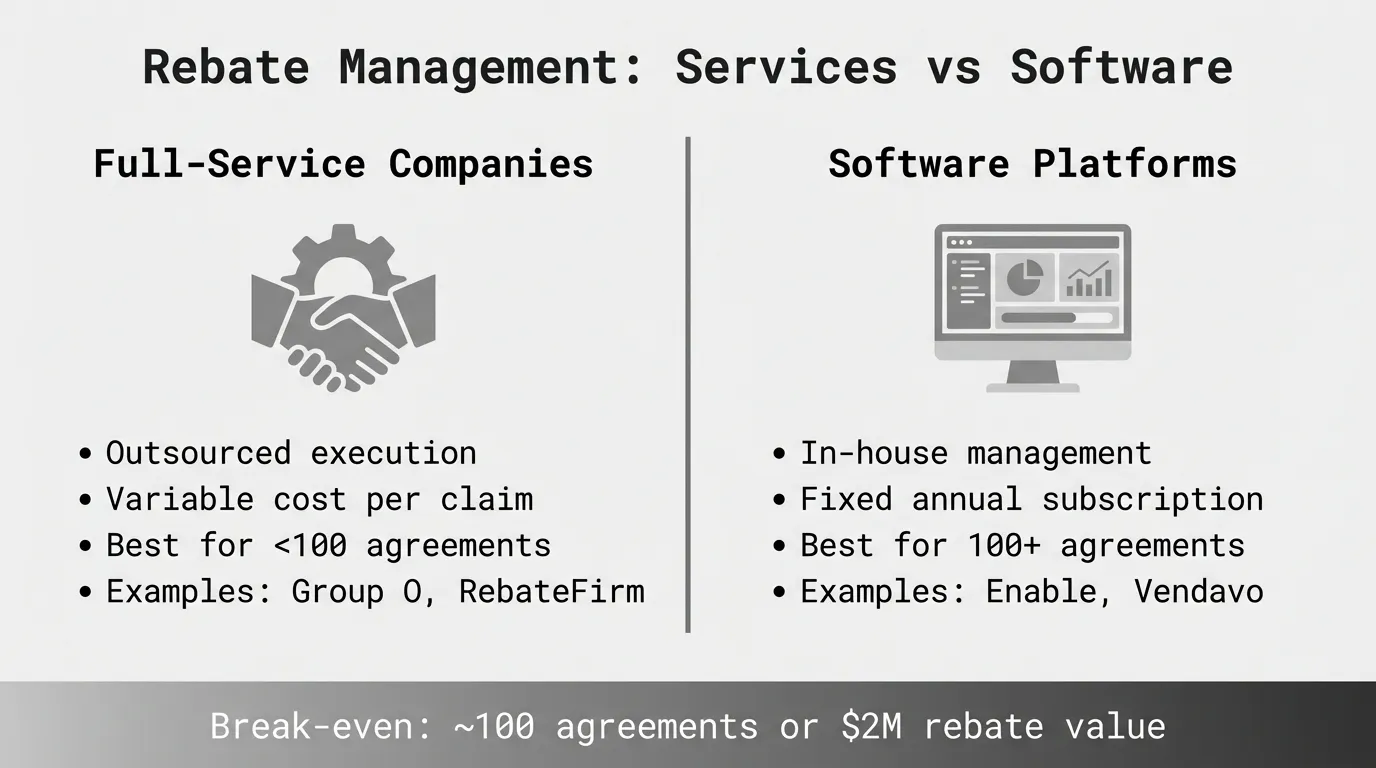
Full-Service Rebate Management Companies vs Software Platforms
The rebate management market splits into two distinct service models.
Full-Service Rebate Management Companies
Full-service companies handle rebate operations as an outsourced business process. You define rebate program terms and provide funding. They manage execution.
What full-service companies do:
- Program design and setup: Configure rebate offers, eligibility rules, claim forms, and promotional materials
- Claims portal and submission: Provide online portals or mobile apps for claimants to submit rebate claims with required documentation
- Validation and fraud detection: Verify purchase receipts, eligibility criteria, and detect duplicate or fraudulent claims
- Payment processing: Issue rebate payments via check, prepaid card, ACH, or digital wallet
- Customer service: Handle claimant inquiries, disputes, and resubmissions
- Reporting and reconciliation: Provide dashboards showing claims processed, payments issued, fraud detected, and program ROI
- Compliance management: Maintain audit trails, tax reporting, and regulatory compliance
Cost structure:
Full-service rebate management costs are typically variable based on claim volume:
- Per-claim fee: $1-$5 per claim processed depending on complexity
- Percentage of rebate value: 3-8% of total rebate dollars managed
- Setup fees: $500-$5,000 for program configuration and portal customization
- Customer service: Included or billed per contact ($2-$8 per inquiry)
Example pricing:
A manufacturer running a promotional rebate program expecting 10,000 claims averaging $50 rebate value ($500K total rebates) would pay approximately:
- Per-claim fees: 10,000 claims × $2 = $20,000
- Percentage fee: $500K × 5% = $25,000
- Setup and service: $5,000
- Total cost: $50,000 (10% of rebate value)
When full-service makes sense:
- Seasonal promotional rebates with variable claim volume
- Under 100 rebate agreements or offers
- No internal resources to manage rebate operations
- Consumer rebates requiring high-touch customer service
- Short-term or trial rebate programs
- Companies wanting to outsource non-core business processes
Software-Only Rebate Management Platforms
Software platforms provide tools for businesses to manage rebates internally with their own teams.
What software platforms provide:
- Agreement management system: Store rebate agreements, terms, eligibility rules, and payment schedules
- Accrual calculation engine: Automatically calculate rebate liability or receivable based on transaction data from ERP
- Claims workflow: Configure claim submission, approval routing, and payment triggers
- ERP integration: Import transaction data and post rebate accrual journal entries
- Reporting and analytics: Dashboards showing rebate performance, program ROI, and optimization recommendations
- Partner portals: Optional self-service portals for distributors or dealers to track rebate status
Cost structure:
Software platforms use annual subscription pricing:
- Mid-market platforms: $5K-$50K annually
- Enterprise platforms: $50K-$200K+ annually
- Implementation: 0.5-2x annual subscription (one-time)
- Ongoing support: Included in subscription or $5K-$20K annually for premium support
Internal resource requirements:
Using rebate management software requires:
- Finance team to manage agreements, accruals, and reconciliation (0.5-2 FTE depending on scale)
- IT support for ERP integration maintenance and troubleshooting (0.1-0.5 FTE)
- Training and change management across sales, operations, and finance teams
When software makes sense:
- Managing 100+ complex rebate agreements with multi-tier structures
- Ongoing B2B distributor or channel partner rebates (not promotional)
- Rebates contribute 20%+ of gross profit or net profit
- Internal finance and IT resources exist to operate software
- Need integrated pricing, margin, and rebate analysis
- Require real-time visibility and forecasting
The Hybrid Model
Some companies use both: software platforms for ongoing B2B distributor rebates managed internally, and outsourced services for seasonal consumer promotional rebates.
A manufacturer might use Enable or Vendavo to manage 200 distributor volume rebate agreements internally (ongoing, structural, high-value), while outsourcing a holiday promotional mail-in rebate campaign to Group O or RebateFirm (seasonal, high-volume, low-touch).
This avoids paying high per-claim fees on structural rebates that run year-round, while avoiding the overhead of managing promotional rebate customer service in-house.
Full-Service Rebate Management Companies
These companies operate rebate programs on your behalf as an outsourced service.
1. Group O
Group O specializes in delivering full-service rebate management solutions designed to streamline operations and maximize program success.
Services:
- Program development and implementation
- State-of-the-art management software (operated by Group O on your behalf)
- Claims verification and fraud detection
- Fulfillment processes (check, prepaid card, digital)
- Customer service and support
- Analytics and reporting
Best for:
- Consumer product manufacturers running promotional rebates
- Retailers executing seasonal rebate campaigns
- Companies wanting white-label rebate programs (branded to your company)
- Mid-market companies ($20M-$500M revenue) without dedicated rebate teams
Typical engagement: Per-claim fees + percentage of rebate value managed. Group O handles end-to-end execution; you provide offer terms and funding.
2. Incentive Insights
Incentive Insights is a partner in consumer insights, data collection, spiffs, rebates, and consumer incentive programs benefiting both B2B and B2C businesses.
Services:
- Rebate program design and consulting
- Claims processing and validation
- Payment fulfillment (multiple methods)
- Customer insights and data collection
- Sales incentive and spiff programs
- Marketing analytics tied to rebate campaigns
Best for:
- Companies wanting rebates integrated with broader incentive programs
- Businesses seeking consumer insights from rebate claim data
- Manufacturers running dealer spiffs alongside consumer rebates
- Organizations wanting strategic consulting, not just operational services
Typical engagement: Custom pricing based on program scope. Incentive Insights positions as strategic partner, not commodity rebate processor.
3. RebateFirm (CheckIssuing)
RebateFirm is a leading rebate processing and management company serving retailers, packaged goods, electronics, telecom, automotive, and pharmaceutical industries.
Services:
- High-volume consumer rebate processing
- Mail-in and digital claim submission
- Payment processing (check issuance specialty)
- Fraud detection and duplicate claim prevention
- Customer service call center
- Compliance and audit reporting
Best for:
- High-volume consumer rebate programs (100K+ claims annually)
- Industries with mail-in rebate traditions (electronics, appliances, telecom)
- Companies prioritizing low per-claim costs at scale
- Simple promotional rebates without complex eligibility rules
Typical engagement: Per-claim fees starting at $1-$2 for high-volume programs. Focus on operational efficiency and cost containment, not strategic consulting.
4. Flatworld Solutions
Flatworld Solutions is a rebate management and processing company with around 20 years of experience offering rebate processing services.
Services:
- Rebate data entry and processing
- Claims validation and verification
- Payment processing and reconciliation
- Customer service (inbound call center)
- Rebate analytics and reporting
- Multi-channel claim submission (mail, online, mobile)
Best for:
- Companies wanting offshore cost arbitrage (Flatworld operates centers in India and Philippines)
- High-volume processing with low per-claim budgets
- Businesses comfortable with offshore data handling
- Programs with straightforward validation rules
Typical engagement: Per-claim fees discounted for volume. Flatworld competes on cost, targeting companies prioritizing price over strategic value-add.
5. Integration, Inc.
Integration, Inc. provides full-spectrum rebate processing services offering full-service management from concept to completion.
Services:
- Rebate program strategy and design
- Claims processing and validation
- Multi-channel fulfillment
- Customer service and dispute resolution
- Data analytics and insights
- Technology platform (cloud-based)
Best for:
- Mid-market companies seeking turnkey rebate solutions
- Businesses wanting program design help, not just processing
- Companies needing flexible technology without buying software
- Organizations wanting domestic (US-based) service delivery
Typical engagement: Custom pricing based on claim volume and service level. Integration positions in the middle market between commodity processors and premium consultancies.
B2B Rebate Management Software Platforms
These companies provide software for businesses to manage rebates in-house.
6. Enable
Enable is the best rebate management software for most distributors and manufacturers, offering end-to-end automation of B2B rebate programs with collaborative deal management and AI-powered analytics.
Enable has raised $291 million in venture capital and focuses exclusively on B2B rebate management for manufacturers, distributors, and retailers.
Platform capabilities:
- Collaborative rebate agreement management between trading partners
- Automated accrual calculations based on real-time ERP transaction data
- AI-powered analytics and optimization recommendations
- Channel partner portals for self-service rebate tracking
- Forecasting and modeling for financial planning
- Integration with NetSuite, SAP, D365, Oracle, and distribution ERPs
Best for:
- Distributors managing 100-1,000+ supplier and customer rebate agreements
- Manufacturers with multi-tier channel partner programs
- Companies needing collaborative features for rebate negotiation
- Mid-market to enterprise ($50M-$1B+ revenue)
- Organizations wanting AI-powered program optimization
Typical cost: $50K-$100K annually for mid-market deployment, plus $25K-$75K implementation. Requires internal finance resources to operate.
7. Vendavo
Vendavo Rebate Management is the best choice for companies needing combined pricing, margin, and rebate optimization in one platform.
Platform capabilities:
- Integrated pricing and rebate management
- Price waterfall analysis showing rebate impact on pocket price
- Customer profitability analysis including rebate costs
- Multi-tier channel partner tracking
- Customer and end-user portals
- Comprehensive agreement management with compliance tracking
Best for:
- Companies wanting pricing optimization and rebate management together
- Manufacturers with complex multi-tier channel programs
- Businesses needing price-volume-mix analysis integrated with rebates
- Mid-market to enterprise ($100M-$1B+ revenue)
- Organizations already using Vendavo for pricing or margin optimization
Typical cost: $50K-$150K annually for combined pricing and rebate management, plus $50K-$150K implementation.
8. Flintfox
Flintfox is the best option for real-time rebate and pricing management, handling intricate rebate scenarios and complex trade agreements.
Platform capabilities:
- Real-time pricing and rebate calculation integration
- Complex calculation engine (retroactive adjustments, stacking, clawbacks)
- Trade revenue management (pricing + rebates + chargebacks)
- Seamless ERP integration for transaction data and accrual posting
- Multi-currency and multi-entity support
Best for:
- Wholesale distributors with highly complex multi-tier rebate programs
- Manufacturers managing sophisticated trade agreements
- Companies where rebate complexity exceeds what general platforms handle
- Large distributors ($200M+ revenue) where rebates contribute 30-60% of profit
- Organizations needing real-time pricing and rebate integration
Typical cost: $75K-$200K annually for enterprise deployment, plus $75K-$200K implementation.
9. Conga Rebate Management
Conga provides rebate management integrated with contract lifecycle and pricing solutions, offering aligned rebate management for profitable growth with faster implementation than enterprise platforms.
Platform capabilities:
- Unified commercial platform (contracts + pricing + rebates)
- Contract-to-rebate workflow automation
- Native Salesforce CRM integration
- Mid-market focused with faster implementation (1-3 months)
- Document generation tied to rebate agreements
Best for:
- Companies needing contract lifecycle and rebate management together
- Mid-market businesses ($20M-$200M revenue)
- Organizations using Salesforce CRM extensively
- Companies wanting faster implementation than enterprise platforms
Typical cost: $20K-$60K annually for mid-market deployment, plus $10K-$30K implementation.
10. FocalCXM
FocalCXM has rich experience in designing rebate systems for global rollouts and created "b2brebates" as their solution to simplify rebate management.
Platform capabilities:
- B2B-specific rebate tracking and management
- Global deployment capabilities
- Integration with ERP and financial systems
- Rebate program design consulting services
- Implementation and support
Best for:
- Companies needing global rebate management across multiple regions
- Businesses wanting design consulting services alongside software
- Mid-market to enterprise B2B companies
- Organizations with international distributor or dealer networks
Typical cost: Custom pricing based on deployment scope and geography.
Rebate Management Consulting Firms
A third category exists: consultants who help design rebate programs, negotiate agreements, and audit for revenue leakage, without providing software or processing services.
Consultport Rebate Management Consultants
Consultport connects companies with independent rebate management consultants who help identify and fix potential revenue leaks caused by poorly negotiated rebate agreements, inaccurate sales data, and incomplete visibility into active rebates.
Services:
- Rebate program strategy and design
- Agreement negotiation with suppliers or customers
- Revenue leakage audits
- Rebate process improvement
- RFP support for selecting software or service providers
Best for:
- Companies wanting independent advice before committing to vendors
- Businesses suspecting significant unclaimed rebates or overpayments
- Organizations designing new rebate programs
- Companies needing expert negotiation support with trading partners
Typical engagement: Project-based fees ranging from $10K for focused audits to $100K+ for comprehensive program redesign. Independent consultants charge $150-$400/hour depending on experience.
Rebate Runner
Rebate Runner specializes in energy efficiency rebate programs and utility incentive management, helping businesses identify and claim rebates for energy-efficient equipment and facility improvements.
Services:
- Utility rebate identification and qualification
- Application preparation and submission
- Energy audit coordination
- Rebate claims tracking and follow-up
- ROI analysis for energy efficiency investments
Best for:
- Manufacturers and distributors investing in facility upgrades
- Companies pursuing energy efficiency rebates from utilities
- Businesses navigating complex utility incentive programs
- Organizations wanting guaranteed rebate claim success
Typical engagement: Percentage of rebate value recovered (typically 15-30% of claimed rebates) or project fees.
When to Outsource vs Use Software vs Hire Consultants
Here's the decision framework based on rebate program characteristics.
Outsource to Full-Service Companies If:
- You manage under 100 rebate agreements or promotional offers
- Rebate programs are seasonal or periodic (not year-round)
- Claim volume is variable and unpredictable
- You lack internal finance resources to manage rebate operations
- Rebates are consumer-facing requiring high-touch customer service
- You want variable costs tied to program activity, not fixed software subscriptions
- Program is short-term or pilot phase
Example scenario:
A $75M building materials manufacturer runs a spring contractor rebate promotion expecting 3,000-8,000 claims over 4 months. Outsourcing to Group O or Integration, Inc. for $3-$5 per claim makes sense. You pay $12K-$40K based on actual participation, avoid hiring temporary staff, and shut down operations after the promotion ends.
Use Software Platforms If:
- You manage 100+ complex rebate agreements with multi-tier structures
- Rebates are ongoing B2B distributor or channel partner agreements
- Rebates contribute 20%+ of gross profit or net profit
- You have internal finance resources (0.5-2 FTE) to operate software
- You need integrated pricing, margin, and rebate analysis
- Require real-time visibility, forecasting, and program optimization
- Agreements include retroactive calculations, growth bonuses, or compliance rebates
Example scenario:
A $180M electrical distributor manages 450 supplier rebate agreements (volume tiers, growth bonuses, product mix incentives) contributing $8M annually to profitability (44% of net profit). Manual Excel tracking causes $200K-$300K in missed claims and calculation errors annually. Investing $60K/year in Enable or Vendavo with 1 FTE to operate delivers $150K-$250K net benefit after costs.
Hire Consultants If:
- You're designing a new rebate program and lack internal expertise
- You suspect significant revenue leakage from existing rebate agreements
- You need independent advice on software or service provider selection
- You're negotiating complex rebate agreements with major trading partners
- You require audit and compliance review of rebate operations
- You want strategic recommendations, not operational execution
Example scenario:
A $120M food distributor suspects they're missing $150K-$300K annually in unclaimed supplier rebates due to poor agreement tracking and manual processes. Hiring a Consultport consultant for $25K to audit rebate agreements, quantify leakage, and recommend process improvements pays back in 2-3 months if they recover even $75K in missed claims.
Cost Comparison: Full-Service vs Software
Here's how costs compare for a $50M distributor managing rebates.
Scenario A: 50 Supplier Rebate Agreements, $2M Annual Rebates
Full-service option:
Assuming 5,000 claims annually (suppliers submit quarterly claims):
- Per-claim fees: 5,000 × $3 = $15,000
- Percentage fee: $2M × 5% = $100,000
- Setup and service: $5,000
- Total annual cost: $120,000 (6% of rebate value)
Internal resources required: 0.2 FTE for oversight and reconciliation
Software option:
Mid-market platform subscription:
- Software: $25,000 annually
- Implementation (year 1 only): $15,000
- Internal resources: 0.5 FTE @ $60K loaded cost = $30,000
- Total annual cost (year 1): $70,000
- Total annual cost (year 2+): $55,000
Savings vs full-service: $50K-$65K annually after year 1
Break-even analysis:
Software breaks even in 6-9 months if you can operate it effectively with 0.5 FTE. But this assumes clean ERP data, documented agreements, and capable finance resources. If implementation drags to 6 months and requires 1 FTE to operate, costs may exceed outsourcing.
Scenario B: 300 Distributor Rebate Agreements, $6M Annual Rebates
Full-service option:
Assuming 15,000 claims annually:
- Per-claim fees: 15,000 × $2.50 = $37,500
- Percentage fee: $6M × 5% = $300,000
- Setup and service: $10,000
- Total annual cost: $347,500 (5.8% of rebate value)
Internal resources: 0.5 FTE for oversight
Software option:
Enterprise platform subscription:
- Software: $75,000 annually
- Implementation (year 1 only): $60,000
- Internal resources: 1.5 FTE @ $60K loaded = $90,000
- Total annual cost (year 1): $225,000
- Total annual cost (year 2+): $165,000
Savings vs full-service: $122,500-$182,500 annually after year 1
Conclusion:
At scale, software platforms deliver significant savings if you have internal resources to operate them. But at under 100 agreements with simple structures, outsourcing often costs less than software plus internal labor.
Red Flags: When Neither Option Works
Don't invest in rebate management companies or software if:
Poor foundational data:
- Transaction data from ERP is incomplete, inconsistent, or unreliable
- Customer and supplier IDs aren't standardized
- Product SKU data doesn't match rebate agreement eligibility rules
- Historical data isn't available to baseline current performance
Undocumented agreements:
- Rebate agreements aren't stored centrally or terms are unclear
- No single source of truth for which rebates are currently active
- Sales and finance teams disagree on rebate calculation methodology
- Agreement terms exist only in email threads or sales rep memories
Organizational misalignment:
- Finance and sales teams have conflicting goals around rebate programs
- No executive sponsor for rebate process improvement
- Teams resistant to changing manual Excel-based workflows
- No budget for implementation or internal resources
Unmeasured problems:
- You haven't quantified cost of current manual processes
- No baseline for errors, missed claims, or calculation discrepancies
- Can't articulate ROI case for software or outsourcing investment
- Don't know if rebates are profitable or just revenue leakage
Fix these foundational issues first. Clean data, documented agreements, organizational alignment, and measured baselines beat sophisticated software or premium outsourced services every time.
Decision Framework
Use this flowchart to decide between full-service companies, software platforms, and consultants.
Start here: What type of rebates do you manage?
Consumer promotional rebates (mail-in, digital submission for retail customers) → Outsource to full-service companies (Group O, RebateFirm, Flatworld) → Unless you process 100K+ claims annually AND have dedicated rebate operations team
B2B distributor/channel partner rebates (volume tiers, quarterly payments, ongoing agreements) → Continue to next question
How many active rebate agreements do you manage?
Under 50 agreements → Start with Excel or ERP rebate modules → Consider outsourced services if finance lacks capacity → Software is overkill unless agreements are highly complex
50-100 agreements → Evaluate mid-market software ($20K-$50K/year) if rebates contribute 15%+ of profit → Otherwise stick with improved Excel processes → Consider consultants to audit for leakage before investing
100-300 agreements → Mid-market software platforms (Conga, Enable) or full-service if lacking internal resources → Software breaks even vs outsourcing if you have 0.5-1 FTE to operate → Prioritize ERP integration and automated accruals
300+ agreements → Enterprise software platforms (Enable, Vendavo, Flintfox) → Outsourcing becomes cost-prohibitive at this scale → Requires 1-2 FTE internal resources plus implementation capacity
Additional considerations:
Rebates as percentage of profit:
- Under 10%: Manual processes may be adequate
- 10-20%: Evaluate software if managing 100+ agreements
- 20-40%: Software investment usually justified
- 40%+: Software is critical; rebates are core to business economics
Internal resources:
- No dedicated finance resources: Outsource or delay until you hire
- 0.5 FTE available: Mid-market software feasible
- 1+ FTE available: Enterprise software or full-service coordination
Data quality:
- Poor ERP data: Fix first, then evaluate solutions
- Clean ERP data: Software implementation will succeed
- No ERP: Full-service companies can operate independently
Next Steps
Before committing to rebate management companies or software platforms, understand your current rebate economics and where margin leakage occurs.
Run a margin diagnostic to see your actual pocket price after all rebates and incentives. For $1,499, Pryse provides 24-hour analysis showing:
- True pocket margin by customer and product after rebates
- Margin leakage sources and recoverable opportunity ($K quantified)
- Rebate program ROI and effectiveness
- Whether outsourcing, software, or improved Excel processes make sense for your scale
Start with diagnostics. Quantify the problem before investing in solutions.
If diagnostics reveal material rebate leakage (2%+ of rebate value), use the decision framework above to choose between full-service companies for operational support and software platforms for internal management.
For broader rebate program strategy beyond vendor selection, see our complete rebate management guide covering agreement structures, program design, and optimization best practices.
Sources
- Enable: About Enable - B2B Rebate Management Company
- Group O: Rebate Management Services
- Incentive Insights: Understanding Rebate Management Services
- RebateFirm: Rebate Processing and Fulfillment Services
- Flatworld Solutions: Rebate Processing Services
- Integration, Inc.: Rebate Processing Services
- FocalCXM: B2B Rebates Solutions
- Consultport: Rebate Management Consultants
- Rebate Runner: Energy Efficiency Management Consultants
- SolveXia: Best Rebate Management Software for 2026
Last updated: February 24, 2026
Frequently Asked Questions
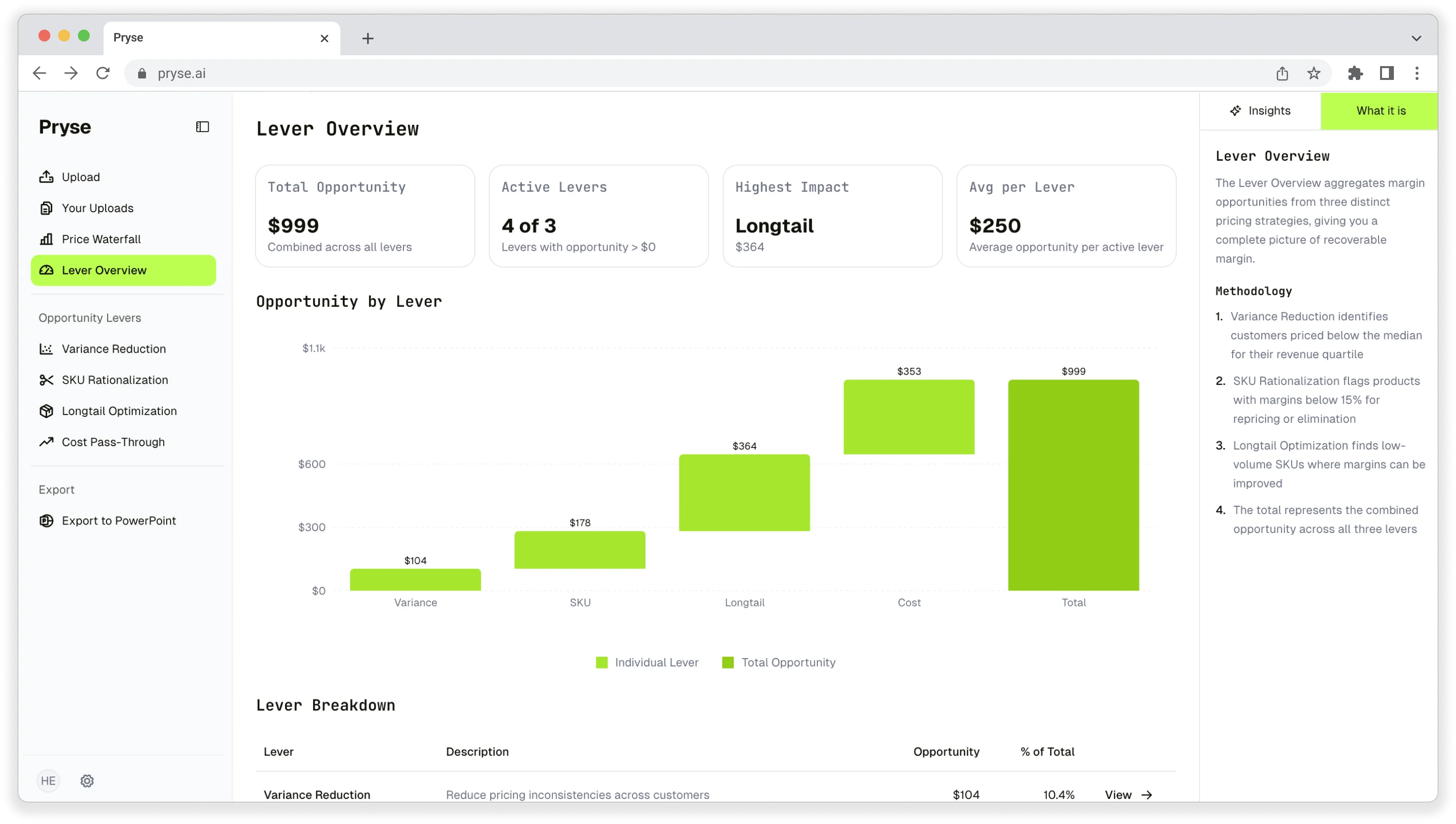
Want to analyze your entire product catalog?
Pryse automatically identifies margin leakage across thousands of SKUs. Upload your data and find hidden profit in 24 hours.
One-time $1,499 diagnostic. No subscription required.