 Pryse
PryseRebate Management in NetSuite: Features, Limitations & Alternatives
Understand NetSuite's Rebates and Trade Promotions SuiteApp capabilities, implementation costs, and when to choose standalone rebate management software instead.
NetSuite offers rebate management through its Rebates and Trade Promotions SuiteApp, which calculates and tracks rebates awarded after sales or purchases, enabling automated accrual calculations, claims processing, and payment reconciliation within your ERP for companies managing basic to moderate rebate complexity.
The app is included with NetSuite subscriptions at no additional licensing cost, making it attractive for distributors and manufacturers already using NetSuite. According to Oracle's NetSuite documentation, the SuiteApp enables calculation and accrual of rebates on sales and purchase transactions created through CSV import, SOAP integration, and REST integration.
However, NetSuite's rebate capabilities have meaningful limitations compared to standalone rebate management platforms. The challenge is understanding when NetSuite's built-in rebate tracking is adequate and when your program complexity justifies investing in specialized rebate management software costing $50K-$200K+ annually.
This post explains what NetSuite's Rebates and Trade Promotions SuiteApp actually does, its limitations for complex rebate programs, implementation costs beyond the "included" license, and when distributors and manufacturers should choose standalone rebate management software instead.
What NetSuite Rebate Management Does
The Rebates and Trade Promotions SuiteApp automates rebate calculation and accrual tracking for both vendor rebates (what suppliers owe you) and customer rebates (what you owe channel partners or customers).
Core Rebate Management Capabilities
Agreement setup and tracking
Create rebate agreements specifying eligible products, customers, or vendors, calculation methods, volume tiers, and agreement periods. According to NetSuite's setup documentation, you can define multiple rebate types including percentage-based, flat amount, fixed cost, and guaranteed profit calculations.
Automated rebate accruals
As qualifying sales or purchase transactions process in NetSuite, the system automatically calculates rebate amounts based on active agreements and posts accrual journal entries. This eliminates manual spreadsheet tracking and ensures financial statements reflect rebate liabilities and receivables accurately.
According to OdeCloud's analysis of NetSuite rebate management, the software automates the calculation of rebates based on predefined rules and conditions, allowing for configuration of complex rebate structures including tiered rebates, cumulative rebates, and product-specific incentives.
Claims submission and processing
NetSuite allows creation of rebate claims against agreements for payment processing. Finance teams can review claims, validate against agreement terms and transaction data, approve payments, and track claim status through resolution.
Financial reconciliation
The app integrates with NetSuite's general ledger for rebate accrual posting, expense tracking, and payment reconciliation. Rebate items can be grouped based on rebate agreement, Class, Department, Location, and custom segments for detailed financial reporting.
Reporting and dashboards
NetSuite provides standard rebate reports showing accrued rebate liabilities and receivables by agreement, partner, product, and time period. Real-time tracking offers transparent visibility into rebate performance and financial impact.
Supported Rebate Types
According to NetSuite's rebate types documentation, the SuiteApp supports several calculation methods:
Percentage-based rebates: Calculate rebates as a percentage of qualifying revenue or spend with support for tiered structures where percentages increase at volume thresholds.
Flat amount rebates: Fixed dollar rebates per unit purchased or sold.
Fixed cost rebates: Rebates calculated based on the difference between actual and target costs.
Guaranteed profit rebates: Ensure trading partners achieve minimum profit margins by rebating the difference between actual and guaranteed margin.
Stacking and best deal logic: The system can stack multiple concurrent rebates or apply best deal logic selecting the most favorable rebate when agreements aren't stackable.
NetSuite Rebate Management Limitations
While NetSuite rebate management works for basic programs, several limitations create problems for companies with moderate to high rebate complexity.
1. Multi-Currency Limitations
According to Oracle's limitations documentation, multi-currency conversion is not supported for the rebate amount you set in the agreement details. This creates significant issues for global manufacturers or distributors managing rebate programs across countries with different currencies.
You must create separate rebate agreements for each currency rather than having one agreement with automatic currency conversion, multiplying administrative overhead.
2. Agreement Complexity Constraints
NetSuite's documentation warns to "avoid adding more than 50 agreement detail lines per rebate agreement" due to potential performance issues. For distributors managing rebates across thousands of SKUs or complex product category hierarchies, this constraint forces agreement fragmentation.
Instead of one comprehensive vendor rebate agreement covering your entire product catalog with different tiers by category, you need multiple smaller agreements, complicating tracking and reconciliation.
3. No Partial Fulfillment Support
Partial fulfillment for SOAP transactions is currently not supported. For companies with backorder-heavy operations where orders ship partially over time, this creates accrual timing issues. Rebates accrue based on invoiced amounts, not shipped quantities, potentially misrepresenting actual rebate liability.
4. Limited Integration Flexibility
While NetSuite rebates integrate with transactions created through CSV import, SOAP, and REST integration, RSM's analysis of NetSuite rebate management notes the module lacks the advanced integration capabilities of standalone platforms.
Companies needing to sync rebate data with external CRM systems, partner portals, or pricing engines often require custom development at $2,500-$5,000 per script.
5. Basic Analytics and Reporting
NetSuite rebate management provides standard reports but lacks the advanced analytics found in specialized platforms:
- No predictive forecasting of rebate liability based on historical patterns and current run-rates
- Limited "what if" scenario modeling to test different agreement structures
- No AI-powered insights identifying which rebate programs drive the most incremental volume
- Basic partner segmentation by rebate performance
- No fraud detection algorithms identifying suspicious claim patterns
According to Enable's announcement as a NetSuite integration partner, many NetSuite customers choose to integrate standalone rebate management platforms to access advanced analytics while maintaining NetSuite as the financial system of record.
6. Multi-Tier Channel Complexity
Managing rebates across manufacturer → distributor → dealer chains with separate agreements at each tier is significantly more complex in NetSuite than in purpose-built rebate platforms.
You must create separate rebate agreements for each tier, manually coordinate claims and payments across tiers, and build custom workflows to prevent double-dipping where partners claim rebates at multiple levels. Standalone rebate platforms like Enable, Vendavo, and Flintfox handle multi-tier rebate cascading natively.
7. Retroactive Calculation Limitations
While NetSuite supports tiered rebate structures, handling truly retroactive calculations where crossing a threshold applies the higher rebate percentage to all prior purchases (not just incremental volume) requires custom scripting.
For example, if a customer crosses from 2% to 3.5% rebate at $100K in purchases, retroactive structures would owe an additional 1.5% on all prior purchases. NetSuite's standard logic applies the new tier to future purchases only, requiring customization to implement true retroactive rebates common in distribution.
NetSuite Rebate Management Costs
The Rebates and Trade Promotions SuiteApp license is included with NetSuite subscriptions at no additional software cost. However, total cost of ownership includes implementation, customization, and ongoing maintenance.
Implementation Costs
According to Protelo's NetSuite pricing guide for 2026, the average NetSuite implementation cost ranges from $30,000 to $150,000+ for mid-market companies. The one-time implementation fee is typically 1.5x to 3x your annual software license cost.
For the Rebates and Trade Promotions SuiteApp specifically, implementation includes:
Configuration and setup: $10K-$40K
- Rebate agreement template creation
- Accrual rule configuration
- Chart of accounts mapping
- User permissions setup
- Workflow design
Data migration: $5K-$20K
- Importing historical rebate agreements from spreadsheets
- Mapping legacy rebate data to NetSuite structure
- Reconciling opening balances for rebate accruals
Training: $3K-$10K
- Finance team training on rebate accrual processes
- Sales team training on rebate agreement setup
- End-user documentation creation
Testing and validation: $5K-$15K
- Accrual calculation testing against historical data
- Claims workflow testing
- Financial reconciliation validation
Total implementation for rebate management typically ranges from $25K-$85K depending on agreement complexity, number of trading partners, and customization requirements.
Customization Costs
According to CrossCountry Consulting's NetSuite pricing guide, custom SuiteScript to force the system to do something unique costs $2,500-$5,000 per script.
Common rebate management customizations include:
- Retroactive tier calculations: $3K-$6K to apply higher rebate percentages to all prior purchases when thresholds are crossed
- Multi-tier coordination: $5K-$10K for workflows coordinating manufacturer, distributor, and dealer rebate agreements
- Advanced approval workflows: $3K-$5K for conditional claim approvals based on variance thresholds or partner tier
- Custom partner portals: $10K-$25K for self-service rebate claim submission and performance tracking
- Complex calculation logic: $5K-$15K for agreement structures NetSuite doesn't support natively
Customization costs for moderate rebate complexity typically add $15K-$40K to implementation budgets.
Ongoing Costs
Maintenance and support: NetSuite support is included with subscription but resolving rebate-specific issues often requires partner assistance at $150-$350 per hour according to implementation partner rates.
System upgrades: NetSuite releases updates twice annually. Testing rebate customizations against new releases and making necessary adjustments costs $2K-$8K annually.
Agreement management: Finance or operations time maintaining rebate agreements, updating terms, and onboarding new trading partners. For companies managing 100+ agreements, this represents 20-40 hours monthly.
When to Use NetSuite Rebate Management
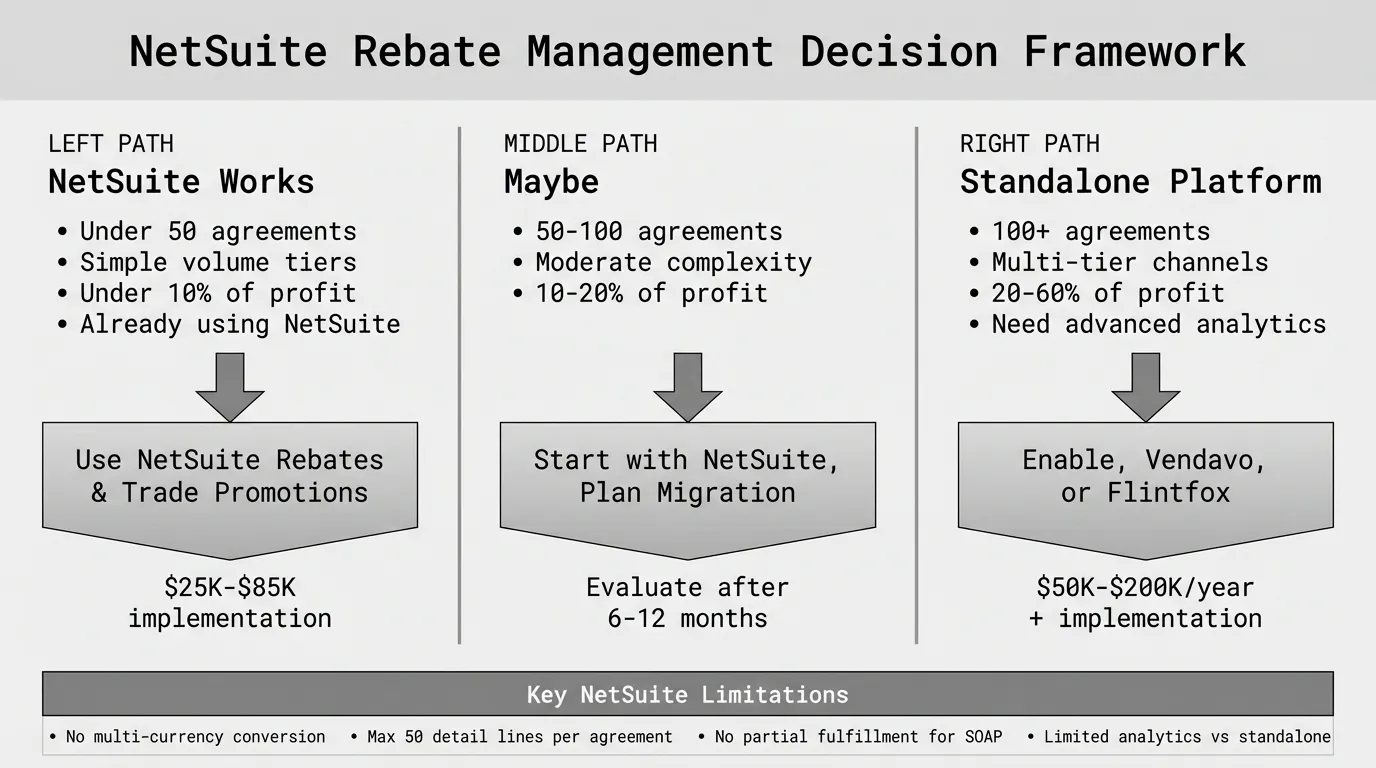
NetSuite's built-in rebate capabilities work well for companies meeting these criteria.
Ideal Use Cases
Simple to moderate rebate complexity
- Managing under 50 active rebate agreements total
- Single-tier volume-based rebate structures
- Rebate payments quarterly or annually (not monthly)
- Standard calculation methods without extensive customization
Already using NetSuite
If you've invested in NetSuite for ERP and financial management, starting with its rebate management capabilities before evaluating standalone platforms makes sense. The integration is seamless, and learning curve is lower for teams already familiar with NetSuite.
Limited rebate program scope
Rebates contribute under 10% of gross profit, minimizing financial risk from calculation errors or process inefficiency. The cost and complexity of standalone rebate management software exceeds the value recovered through improved tracking.
Vendor rebates only
Distributors tracking manufacturer rebates receivable without complex customer rebate programs owed to downstream partners. Vendor rebate tracking is simpler than managing both sides simultaneously.
Clear agreement terms
Rebate agreements with straightforward volume tiers, clear eligibility rules, and minimal exceptions. Complex agreement structures with special provisions, conditional clauses, or frequent mid-term changes strain NetSuite's rebate capabilities.
When NetSuite Rebate Management Works
A $45M electrical distributor manages rebates from 15 key manufacturers representing $1.8M annually in vendor rebates (4% of revenue). Rebate structures are volume-based with 3-4 tiers per manufacturer, paid quarterly.
They implemented NetSuite's Rebates and Trade Promotions SuiteApp in 6 weeks for $28K including configuration, data migration, and training. Finance reconciles rebate accruals monthly and submits claims quarterly, spending approximately 12 hours per quarter on rebate administration.
The SuiteApp eliminated spreadsheet tracking errors that previously caused $15K-$25K annually in missed claims or reconciliation issues. Implementation paid back in under 18 months.
This scenario represents NetSuite rebate management's sweet spot—moderate agreement count, simple structures, vendor rebates only, and rebates contributing a meaningful but not overwhelming portion of profitability.
When to Choose Standalone Rebate Management Software
Several scenarios justify investing in dedicated rebate management platforms costing $50K-$200K+ annually instead of using NetSuite's built-in capabilities.
High Agreement Volume and Complexity
100+ active rebate agreements across both vendor and customer sides create administrative overhead that NetSuite rebate management struggles to handle efficiently.
Multi-tier volume structures with 6+ tiers and retroactive calculations where crossing thresholds applies higher percentages to all prior purchases, not just incremental volume.
Stacking rebate programs where trading partners qualify for multiple concurrent rebates (volume + growth + product mix + compliance) requiring coordination to calculate total rebate due.
According to our complete rebate management software guide, companies managing this complexity typically recover 2-3% of rebate value through error elimination and better compliance when moving from ERP-based tracking to dedicated platforms.
Multi-Tier Channel Programs
Manufacturers managing rebates across manufacturer → distributor → dealer chains where each tier has different agreements, payment cycles, and reconciliation requirements.
NetSuite can track basic multi-tier rebates but requires significant customization for complex channel programs. Standalone platforms like Enable, Vendavo, and Flintfox handle multi-tier rebate cascading, prevent double-dipping, and coordinate claims across tiers natively.
Rebates as Core Profitability
When rebates contribute 20-60% of net profit, as they do for many food distributors, building materials distributors, and HVAC wholesalers, the financial exposure from calculation errors or missed claims justifies dedicated rebate management infrastructure.
A $120M food distributor earns $6.8M annually in manufacturer rebates (5.6% of revenue) representing 40% of their $17M annual profit. A 2% improvement in rebate capture through better tracking and compliance generates $136K in recovered margin annually.
At this scale, investing $75K annually in Enable or Vendavo rebate management plus $60K implementation creates positive ROI within 12 months through error elimination, missed claim recovery, and improved compliance.
Advanced Analytics Requirements
Companies needing predictive forecasting, "what if" scenario modeling, AI-powered program optimization, or fraud detection won't find these capabilities in NetSuite rebate management.
Standalone platforms provide:
- Rebate liability forecasting based on historical patterns and current run-rates
- Agreement structure optimization identifying tier thresholds that maximize incremental volume
- Partner segmentation by rebate responsiveness and ROI
- Anomaly detection flagging suspicious claims or unusual purchase patterns
According to BusinessWire's coverage of Enable's 2024 product release, Enable introduced AI-powered analytics where users ask questions in business language like "Which rebate agreements have the highest ROI?" and receive results a trained analyst would produce.
Partner Portal Requirements
Manufacturers or distributors needing self-service portals where trading partners access agreement terms, track progress toward tier thresholds, submit claims with documentation, and download payment histories require standalone rebate platforms.
NetSuite's partner center can be customized for basic rebate visibility at $10K-$25K, but the experience doesn't match purpose-built rebate management portals from Enable, Vendavo, or Conga.
Integrating Standalone Rebate Software with NetSuite
Many companies use NetSuite as their financial system of record while managing rebate operations in specialized platforms.
Integration Architecture
Enable became an official NetSuite ERP integration partner according to their partnership announcement. This partnership integrates Enable's rebate management solution with NetSuite's system in the cloud.
Typical integration includes:
Transaction data export from NetSuite to rebate platform
- Scheduled daily or hourly exports of sales orders, invoices, purchase orders, and receipts
- API-based real-time sync for high-velocity transaction environments
- Mapping NetSuite transaction data to rebate platform agreement structures
Rebate accrual import from rebate platform to NetSuite
- Monthly or quarterly accrual journal entry creation in NetSuite
- Automated posting to rebate liability and receivable accounts
- Reconciliation reporting between rebate platform and NetSuite GL
Claims and payment tracking
- Rebate claims created in dedicated platform
- Payment information synced to NetSuite for cash application
- Variance tracking between accrued and paid amounts
Agreement master data sync
- Partner and product information maintained in NetSuite
- Synced to rebate platform for agreement setup
- Bidirectional updates when terms change
Implementation Considerations
Integrating standalone rebate management software with NetSuite adds complexity and cost:
Integration development: $15K-$40K for API setup, field mapping, and testing Ongoing sync maintenance: $3K-$8K annually for troubleshooting and updates Dual system training: Teams need competency in both NetSuite and rebate platform Data governance: Establishing which system is the source of truth for specific data elements
However, for companies managing 200+ rebate agreements or where rebates contribute 30%+ of profit, the incremental integration cost is justified by improved rebate program management capabilities.
Alternatives to NetSuite Rebate Management
Beyond NetSuite's built-in capabilities and standalone enterprise platforms, several alternatives exist.
Excel-Based Tracking
For distributors and manufacturers with under 25 simple rebate agreements, Excel provides basic tracking at zero software cost:
What works: Agreement terms tracking, manual accrual calculations based on transaction exports, claims logging, payment tracking
What doesn't scale: Automated accrual updates, retroactive calculations, multi-tier coordination, forecasting, audit trails
Excel works until you miss a material rebate claim, spend 20+ hours per quarter on tracking, or face partner disputes from calculation discrepancies.
NetSuite Customization
Instead of standalone rebate software, some companies extensively customize NetSuite to handle complexity beyond standard rebate management capabilities.
Investment: $25K-$100K in SuiteScript development for advanced calculations, workflow automation, and partner portals
Tradeoff: Avoid ongoing subscription costs of standalone platforms but create technical debt and upgrade complexity. Each NetSuite release requires regression testing and potential rework of customizations.
This approach makes sense for companies with strong NetSuite development capabilities in-house or committed long-term to NetSuite as their commercial platform.
Mid-Market Rebate Platforms
Companies between "NetSuite is adequate" and "we need Enable or Vendavo" can evaluate mid-market rebate management platforms:
Conga Rebate Management: $20K-$60K annually, 1-3 month implementation, integrated with contract lifecycle management
Vistaar SmartRebate: $15K-$40K annually, predictive modeling for trade promotions, mid-market manufacturer focus
Salesforce Rebate Management: $30K-$80K annually, native Salesforce integration, channel partner programs
These platforms provide more rebate-specific capabilities than NetSuite without the cost and complexity of Enable or Vendavo. See our best rebate management software comparison for detailed vendor analysis.
Should You Use NetSuite Rebate Management?
Here's the decision framework:
Use NetSuite rebate management if:
- You manage under 50 active rebate agreements
- Rebate structures are simple single-tier or basic multi-tier volumes
- Rebates contribute under 10% of gross profit
- You already use NetSuite for ERP and financial management
- Finance team has capacity for quarterly manual reconciliation
- No multi-tier channel programs requiring coordinated tracking
Choose standalone rebate management software if:
- You manage 100+ active rebate agreements
- Multi-tier channel programs (manufacturer → distributor → dealer)
- Complex calculations (retroactive adjustments, stacking, clawbacks)
- Rebates contribute 20-60% of net profit
- You need predictive analytics and program optimization
- Partner portal requirements for self-service claim submission
- Finance spends 60+ hours per quarter on manual rebate tracking
Maybe—start with NetSuite, plan for migration if:
- You manage 50-100 agreements with moderate complexity
- Rebates contribute 10-20% of gross profit
- Current Excel tracking is failing but rebate program maturity is unclear
- Budget allows for NetSuite implementation now, standalone platform later
- Want to prove rebate management value before larger software investment
For most mid-market distributors and manufacturers reading this, the answer is: start with NetSuite rebate management if you already have NetSuite. Document all rebate agreements clearly, implement the SuiteApp with minimal customization, and track where the system struggles.
After 6-12 months of using NetSuite rebates, you'll know definitively whether it's adequate or if your program complexity justifies investing in Enable, Vendavo, or another standalone platform.
Next Steps
Before choosing between NetSuite rebate management and standalone platforms, understand your current rebate economics and margin performance.
Run a margin diagnostic to see your actual pocket price after all rebates and incentives. For $1,499, Pryse provides 24-hour analysis showing:
- True pocket margin by customer and product after rebates
- Where margin leakage occurs and how much is recoverable
- Rebate program effectiveness and ROI
- Whether NetSuite rebates, standalone platforms, or improved Excel processes make sense
Start with diagnostics. Implement NetSuite rebate management if complexity is moderate. Invest in standalone rebate software once you've confirmed material leakage exists, quantified the recoverable opportunity, and documented rebate terms clearly.
For broader rebate program strategy beyond software tools, see our complete rebate management guide covering agreement structures, program design, and optimization best practices.
Sources
- Oracle NetSuite: Rebates and Trade Promotions SuiteApp
- Oracle NetSuite: Rebates and Trade Promotions Limitations and Best Practices
- Oracle NetSuite: Setting Up the Rebates and Trade Promotions SuiteApp
- Oracle NetSuite: Rebate Types Used in Rebates and Trade Promotions SuiteApp
- RSM Technology Blog: Managing Vendor Rebates with NetSuite Rebates Management SuiteApp
- OdeCloud Blog: NetSuite Rebate Management
- Enable: Enable Becomes an Official NetSuite ERP Integration Partner
- Protelo: NetSuite Price 2026: Pricing + Implementation Cost
- CrossCountry Consulting: NetSuite Pricing Guide & Cost Estimator (February 2026)
- BusinessWire: Enable Shapes the Future of Rebate Management with AI Reporting (2024)
Last updated: February 24, 2026
Frequently Asked Questions
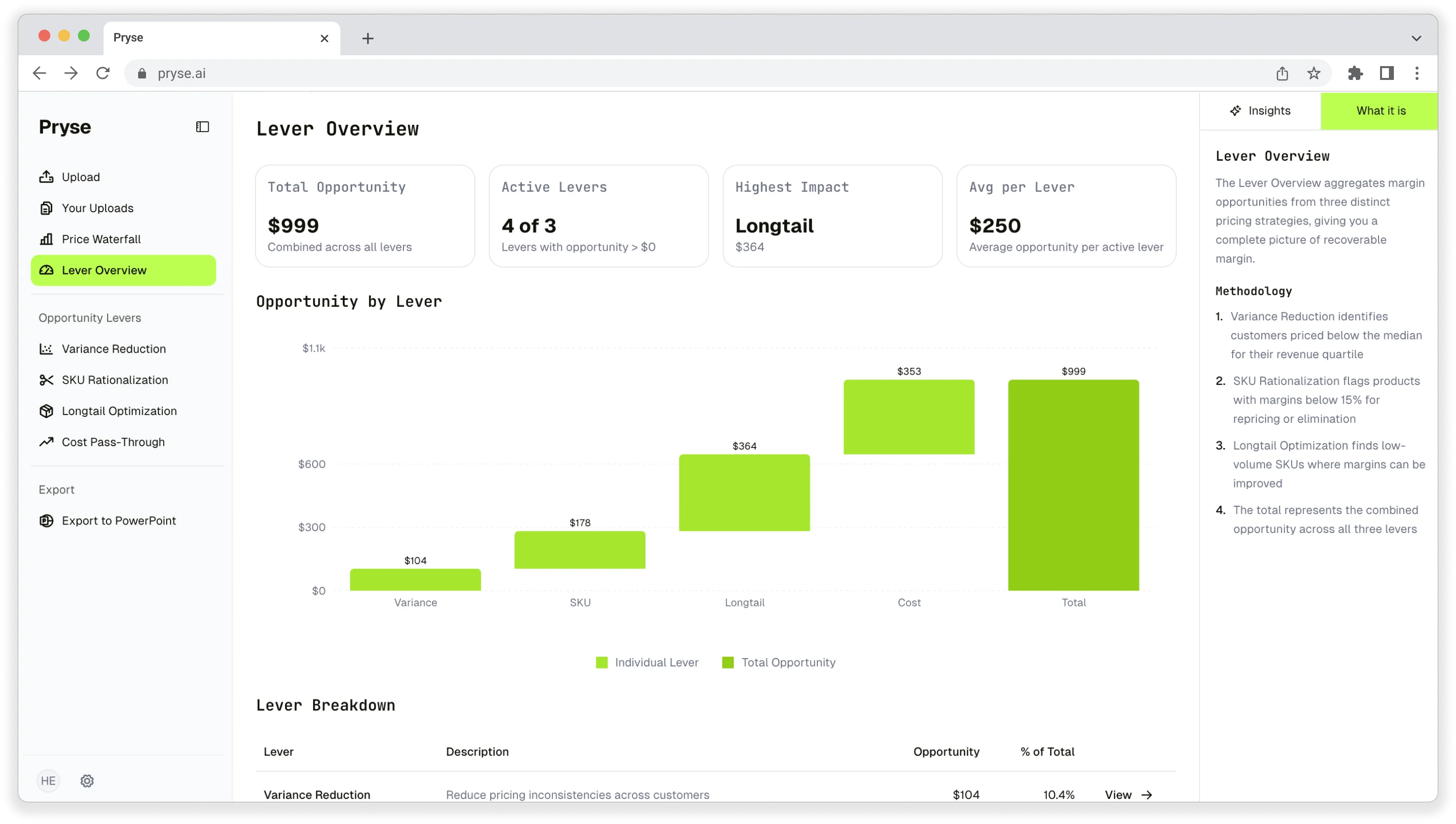
Want to analyze your entire product catalog?
Pryse automatically identifies margin leakage across thousands of SKUs. Upload your data and find hidden profit in 24 hours.
One-time $1,499 diagnostic. No subscription required.