 Pryse
PryseRebate Offers: Complete Guide to B2B Rebate Programs
Understand rebate offers, types, and how manufacturers use them to drive distributor sales. Learn when rebates work better than upfront discounts.
A rebate offer is a financial incentive where manufacturers or suppliers give trading partners a portion of the purchase price back after specific conditions are met, rather than providing an upfront discount. According to Enable's explanation of B2B rebates, rebates are typically financial incentives given to motivate trading partners to perform certain actions such as increasing volume or purchasing add-on items to drive sales and profitability, with partners receiving the rebate at the end of an agreed period instead of an upfront discount.
Rebate offers matter because they've become fundamental economics in wholesale distribution and manufacturing channels. According to Enable's overview of B2B rebate markets, more than $1 trillion in rebates are issued annually across global B2B commerce. For many distributors, manufacturer rebates contribute 20-60% of net profit, making rebates essential to business viability rather than optional marketing tactics.
The challenge for distributors and manufacturers is understanding when rebate offers work better than upfront discounts, what rebate structures drive the intended behavior without creating margin leakage, and how to track and manage rebate programs without spreadsheet chaos.
This post explains what rebate offers are, how they differ from discounts, types of rebate structures commonly used in B2B channels, how rebate offers work from both manufacturer and distributor perspectives, and when rebates make strategic sense versus upfront pricing.
What Is a Rebate Offer?
A rebate offer is a post-purchase financial incentive where buyers pay full price upfront and receive money back from the seller after meeting specified conditions.
According to Vendavo's glossary of B2B rebates, unlike discounts that reduce the purchase price upfront, buyers pay full price for an item and later receive money back directly from the manufacturer. When the manufacturer offers a rebate program to a distributor, this rebate is considered payable from the manufacturer's perspective and receivable for the distributor.
Key Characteristics of Rebate Offers
Performance-contingent
Rebates are earned by meeting conditions like hitting volume targets, achieving growth percentages, maintaining product mix requirements, or fulfilling compliance obligations. No performance, no rebate.
Paid retrospectively
Rather than reducing invoice price, rebates are paid after the qualifying period ends—typically quarterly or annually. This timing difference is crucial to how rebates function strategically.
Calculated on cumulative performance
Rebates usually apply to total purchases over a period, not individual transactions. A distributor might earn a 4% rebate on all purchases once they cross $500K in annual volume.
Often tiered
Higher performance unlocks higher rebate percentages. The first $100K might earn 2%, the next $400K earns 3.5%, and anything above $500K earns 5%. This structure incentivizes volume concentration.
Rebate Offer vs Discount
The difference between rebates and discounts is timing and conditionality.
According to PriceFX's explanation of rebates vs discounts, rebates create a loyalty relationship with customers based on long-term performance rather than transaction-by-transaction price negotiation. Rebates are conditional rewards for meeting targets, while discounts are immediate and typically unconditional.
| Feature | Rebate | Discount |
|---|---|---|
| Timing | Paid after purchase period ends | Reduces price at time of sale |
| Payment method | Check, credit, or cash payout | Lower invoice price |
| Conditionality | Contingent on performance targets | Usually unconditional |
| Visibility | Off-invoice, less visible to end customers | On-invoice, visible to all |
| Reversibility | Can be adjusted or discontinued easily | Hard to remove once established |
| Strategic purpose | Incentivize specific behaviors | Move volume immediately |
Why manufacturers prefer rebates:
Rebates allow manufacturers to incentivize distributor behavior (volume concentration, product mix, growth) without permanently lowering list prices. They can adjust or discontinue rebates more easily than discounts, maintain price integrity for other customers, and tie incentives to ongoing performance rather than one-time transactions.
Why distributors prefer discounts:
Discounts improve cash flow immediately by reducing invoice amounts. Rebates require distributors to finance the full price for months before receiving payment, creating working capital challenges. However, distributors accept rebates when the margin improvement exceeds their cost of capital.
Types of Rebate Offers
Manufacturers structure rebates differently based on strategic goals.
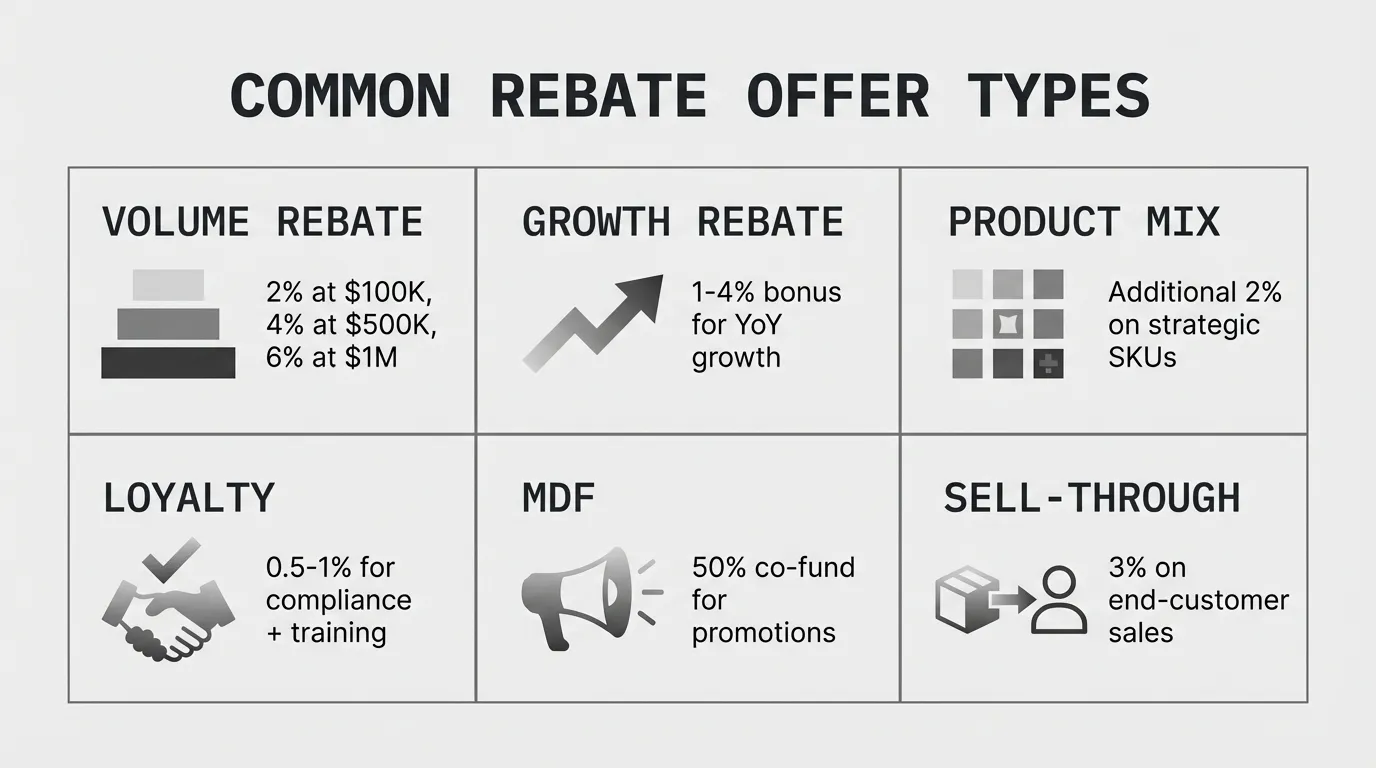
1. Volume or Tiered Rebates
The most common rebate type rewards distributors for reaching cumulative purchase thresholds.
According to Ansira's guide to manufacturing rebates, a manufacturer might offer 2% back on purchases between 5,000 and 10,000 units, 4% on 10,001-25,000 units, and 6% on purchases exceeding 25,000 units. These programs encourage distributors to consolidate their spending with a single supplier to maximize rebate earnings.
Example structure:
- $0-$100K annual purchases: 2% rebate
- $100K-$500K annual purchases: 3.5% rebate
- $500K-$1M annual purchases: 5% rebate
- $1M+ annual purchases: 6.5% rebate
Strategic purpose: Concentrate distributor spending with one manufacturer rather than splitting purchases across multiple suppliers.
Complexity: Rebates are often retroactive. Once a distributor crosses $500K, the 5% rebate may apply to all prior purchases, not just incremental volume. This creates strong incentives to reach the next tier but requires complex tracking.
2. Growth Rebates
Growth rebates reward year-over-year sales increases rather than absolute volume.
Example structure:
- 5-10% YoY growth: 1% bonus rebate
- 10-20% YoY growth: 2.5% bonus rebate
- 20%+ YoY growth: 4% bonus rebate
Strategic purpose: Drive market share gains by incentivizing distributors to prioritize manufacturers showing momentum. Growth rebates benefit smaller manufacturers who can't compete on absolute volume but want to reward distributors for expansion.
Complexity: Requires comparing current period performance to prior year baseline, adjusting for seasonality, acquisitions, or territory changes.
3. Product Mix or Category Focus Rebates
Mix rebates steer distributor attention toward strategic product lines.
According to Ansira's manufacturing rebate guide, a manufacturer launching a new product series might offer an additional 2% rebate on all purchases if the new line represents at least 20% of the distributor's total order volume.
Example structure:
- Standard SKUs: Base 3% rebate
- New product line: Additional 2% rebate (5% total)
- Strategic category: Additional 1.5% rebate
Strategic purpose: Launch new products, increase wallet share in specific categories, or drive distributor inventory stocking for strategic SKUs.
Complexity: Customers often qualify for multiple overlapping rebates. Software must track SKU-level eligibility and stack incentives correctly.
4. Loyalty and Compliance Rebates
Rebates contingent on non-transactional behaviors like maintaining minimum inventory, meeting promotional requirements, or attending training.
Example structure:
- Maintain 30-day inventory of core SKUs: 1% rebate
- Participate in 4 quarterly promotions: 0.5% rebate
- Send sales team to manufacturer training: 0.5% rebate
Strategic purpose: Drive distributor behaviors that increase market presence and selling effectiveness beyond just purchasing volume.
Complexity: Non-transactional compliance tracking requires manual verification and documentation beyond ERP transaction data.
5. Market Development Funds (MDF)
MDF rebates reimburse distributors for marketing activities that generate demand.
According to Ansira's manufacturing rebate guide, unlike traditional rebates tied purely to purchase volume, MDF programs reward distributors for executing joint marketing campaigns, attending trade shows, or conducting product training sessions.
Example structure:
- Co-fund local advertising (50% reimbursement up to $10K)
- Trade show participation (reimbursement for booth costs)
- Product training events (reimbursement for venue and materials)
Strategic purpose: Increase market awareness and end-customer demand by co-investing with distributors in demand generation activities.
Complexity: Requires pre-approval of marketing plans, expense documentation, and reconciliation against approved budgets.
6. Sell-Through or Clawback Rebates
Rebates paid on products sold by the distributor to end customers (sell-through) rather than purchased by the distributor from the manufacturer (sell-in).
According to Phocas Software's guide to manufacturer rebates, clawback rebates prevent distributors from over-stocking to hit volume tiers without actually selling products. Manufacturers pay rebates quarterly based on distributor sales reporting, creating reconciliation complexity.
Example structure:
- 3% rebate on sell-through to end customers (not sell-in purchases)
- Quarterly settlement based on distributor sales reporting
- Clawback of rebates paid on products unsold after 6 months
Strategic purpose: Ensure distributors actively sell products rather than stockpiling inventory to hit purchase volume targets.
Complexity: Requires distributors to report end-customer sales data, creating data sharing challenges and reconciliation complexity.
How Rebate Offers Work
Rebate mechanics differ for manufacturers offering rebates and distributors earning them.
Manufacturer Perspective: Offering Rebates
Step 1: Design rebate program
Manufacturers define rebate structures aligned with strategic goals:
- What behavior to incentivize (volume, growth, mix, loyalty)
- Eligibility criteria (which distributors, products, geographies)
- Performance thresholds and payout percentages
- Payment frequency (quarterly, annually)
- Compliance requirements and documentation
Step 2: Communicate program to distributors
Manufacturers share rebate program details through:
- Formal rebate agreements specifying terms and conditions
- Sales team presentations explaining how to maximize earnings
- Partner portals showing real-time progress toward tiers
- Quarterly business reviews tracking performance
Step 3: Track distributor performance
Throughout the rebate period, manufacturers monitor:
- Running totals of distributor purchases against tier thresholds
- Product mix compliance and growth rates
- Non-transactional requirements (inventory, training, promotions)
According to SolveXia's overview of manufacturer rebates, rebates are usually calculated quarterly or annually, with payouts following shortly after the period closes.
Step 4: Calculate rebate liability
At period end, manufacturers:
- Pull transaction data from ERP systems
- Apply rebate calculation rules based on performance
- Handle retroactive adjustments when tiers are crossed
- Validate compliance with non-purchase requirements
- Generate accrual amounts for financial reporting
Step 5: Process claims and payments
Distributors typically submit rebate claims with supporting documentation. Manufacturers:
- Validate claims against calculated amounts
- Approve payments through finance workflows
- Issue payment as check, credit, or direct deposit
- Reconcile payments against accrual reserves
Distributor Perspective: Earning Rebates
Step 1: Understand rebate program terms
Distributors analyze manufacturer rebate offers to determine:
- Expected rebate earnings based on projected purchases
- Incremental purchases needed to reach next tier
- Profitability impact considering working capital cost
- Competitive rebates from alternative suppliers
Step 2: Make purchase decisions
Rebate programs influence distributor buying:
- Concentration: Consolidate purchases with manufacturers offering best rebates
- Timing: Accelerate orders near period-end to cross tier thresholds
- Product mix: Stock SKUs with higher rebate percentages
- Growth: Prioritize manufacturers offering growth bonuses
Step 3: Track progress during period
Distributors monitor rebate earnings throughout the period:
- Running calculations of expected rebate based on purchases to date
- Proximity to next tier threshold
- Compliance with mix, growth, or loyalty requirements
- Comparison to prior periods and budget projections
Step 4: Submit claims at period end
According to IncentX's explanation of manufacturer rebates, once the agreed-upon conditions are met, the manufacturer pays out the rebate—usually as a credit or cash payment. Distributors typically:
- Compile supporting documentation (invoices, sales reports)
- Complete rebate claim forms specifying calculated amounts
- Submit claims by deadline specified in agreements
- Follow up on claim status and discrepancies
Step 5: Reconcile payments
When rebates are paid, distributors:
- Match payments to claims and validate amounts
- Apply credits to accounts payable or deposit checks
- Reconcile against internal rebate accrual estimates
- Resolve disputes for underpayments or denied claims
Why Manufacturers Use Rebate Offers
Rebates serve strategic purposes that upfront discounts can't achieve.
Drive Volume Concentration
Tiered volume rebates incentivize distributors to concentrate purchases with fewer suppliers rather than spreading orders across multiple manufacturers.
A distributor buying $400K from Manufacturer A and $400K from Manufacturer B might earn 3.5% rebates from both. If they consolidate to $800K from Manufacturer A, they could earn 5.5% on all purchases—a significant margin improvement.
This concentration benefits manufacturers by increasing share of wallet, reducing distributor temptation to source from competitors, and creating switching costs (distributors forfeit accumulated rebate progress if they shift suppliers mid-period).
Incentivize Growth Without Permanent Price Cuts
Growth rebates reward distributors for increasing sales year-over-year without lowering list prices for all customers.
A manufacturer can offer a 2% bonus rebate for 15% YoY growth without changing invoice prices. Distributors who grow earn more, while static distributors receive base rebates only. This maintains price discipline while motivating expansion.
If growth slows, the manufacturer can reduce or eliminate growth rebates without the perception of "raising prices" that comes from removing discounts.
Promote Strategic Products
Mix rebates steer distributor focus toward new products, high-margin SKUs, or strategic categories.
A manufacturer launching a new product line might offer an additional 2% rebate on all purchases if the new line represents 15% of order volume. This incentivizes distributors to stock, promote, and sell the new products without across-the-board price cuts.
Once the product is established, the manufacturer can phase out the bonus rebate.
Maintain List Price Integrity
Rebates are off-invoice, making them less visible to end customers and other channel partners.
If a manufacturer discounts invoice prices 5% for high-volume distributors, smaller distributors will demand equivalent treatment. Rebates allow differentiated incentives based on performance while maintaining published price lists.
According to Enable's guide to manufacturer rebates, rebates help manufacturers maintain price consistency across different customer segments while still rewarding top performers.
Create Switching Costs and Loyalty
Distributors who've purchased $450K from a manufacturer targeting a $500K threshold for 5% rebate have a strong incentive to complete the remaining $50K with that supplier rather than switching to a competitor.
If they switch, they forfeit accumulated progress and may only earn 2-3% instead of 5%. This "sunk cost" effect creates loyalty throughout the rebate period.
Test New Incentive Structures
Rebate programs can be launched, modified, or discontinued more easily than discount structures.
A manufacturer testing whether higher volume incentives drive growth can offer a temporary 6-month volume rebate program. If it drives desired behavior, continue. If not, don't renew for the next period.
Removing upfront discounts triggers customer complaints and perception of price increases. Ending a time-limited rebate program is less controversial.
Why Distributors Participate in Rebate Programs
Despite the working capital cost and administrative complexity, distributors participate in rebate programs because margin improvement exceeds the cost.
Margin Enhancement
Rebates directly improve distributor profitability.
A distributor earning 18% gross margin who receives a 4% manufacturer rebate improves net margin to 22%—a 22% increase in profitability. In industries where distributor EBITDA averages 4-6%, a 4% rebate can represent 50-100% of operating profit.
According to Enable's analysis of distributor economics, for many distributors, manufacturer rebates contribute 20-60% of net profit, making rebates essential to business viability.
Competitive Pricing Flexibility
Rebates allow distributors to match competitor pricing on individual transactions while maintaining overall profitability through back-end incentives.
A distributor can sell at 15% margin (matching competition) knowing they'll earn 4% manufacturer rebate, netting 19% total margin. Without the rebate, matching competitor pricing would be unprofitable.
Vendor Partnership and Support
Manufacturers offering substantial rebates often provide additional support:
- Marketing development funds and co-op advertising
- Product training for sales teams
- Technical support for complex installations
- Priority allocation during supply shortages
- Joint business planning and market insights
Distributors view rebates as recognition of strategic partnership value beyond transactional purchasing.
Working Capital Trade-Offs
Rebates create working capital challenges by requiring distributors to finance full invoice amounts for months before receiving rebate payments.
A distributor purchasing $500K quarterly at 4% rebate receives $20K back at quarter-end. During the quarter, they've financed the full $500K rather than paying $480K upfront with a discount.
If their cost of capital is 8% annually (2% per quarter), financing $20K for 3 months costs $400. The $20K rebate exceeds the $400 financing cost by $19,600, making the rebate economically attractive despite the working capital burden.
Distributors with tight cash flow or high cost of capital may negotiate for upfront discounts instead of rebates, accepting slightly lower percentages for immediate cash flow improvement.
Challenges with Rebate Offers
Rebate programs create operational complexity for both manufacturers and distributors.
Tracking and Calculation Complexity
Multi-tier rebates with retroactive adjustments require sophisticated tracking.
If a distributor crosses a volume threshold mid-period, does the higher rebate percentage apply to all prior purchases or only incremental volume? Different manufacturers structure this differently, creating reconciliation challenges.
Distributors managing rebate agreements with 50+ manufacturers face spreadsheet chaos tracking running totals, tier progress, and expected payouts.
Accrual Accuracy
Manufacturers must maintain accurate rebate liability accruals for financial reporting.
If a manufacturer underestimates rebate accruals, they face surprise charges when distributors submit claims. Overestimating creates excess reserves that distort profitability.
According to IncentiveSmart's guide to sales rebate management, rebate management is the process of validating, calculating, processing, and issuing financial incentives as part of channel partner rewards programs—a process prone to errors without proper systems.
Claim Disputes and Reconciliation
Distributors and manufacturers often disagree on calculated rebate amounts.
Common disputes:
- Which SKUs qualify for mix rebates
- How to treat returns and credits in volume calculations
- Whether non-transactional compliance requirements were met
- Timing of transactions (did they occur before or after period end?)
- Retroactive adjustments and their application
Resolving disputes consumes finance and sales team time, delays payments, and damages manufacturer-distributor relationships.
Administrative Burden
Processing rebate claims requires:
- Compiling supporting documentation (invoices, sales reports, compliance proof)
- Completing claim forms for each manufacturer
- Following up on claim status
- Reconciling payments against internal estimates
- Resolving discrepancies
For distributors managing 100+ rebate agreements, this administrative burden can consume 40-60 hours per quarter of finance team time.
Manufacturers face similar burdens validating claims, processing payments, and reconciling accruals.
Working Capital Impact
Distributors finance the gap between paying full invoice price and receiving rebate payments months later.
In industries with thin margins, this working capital requirement can create cash flow stress, particularly for growing distributors increasing inventory and purchases.
Some distributors factor rebate receivables with finance companies to access cash immediately, paying 1-2% of rebate value for liquidity—reducing the net benefit.
When Rebate Offers Make Sense
Rebates aren't always the best pricing strategy.
Rebates Work Well When:
You want to incentivize specific behaviors
If the goal is volume concentration, product mix changes, or growth acceleration, rebates tied to those metrics drive behavior better than across-the-board discounts.
Price integrity matters
Industries with published price lists, government contracts, or retail price visibility benefit from off-invoice rebates that maintain list price consistency.
Customer performance varies widely
When some customers buy $50K and others buy $5M, tiered rebates allow differentiated incentives without complex individual pricing agreements.
You need flexibility to adjust incentives
Rebates can be modified, paused, or discontinued between periods more easily than unwinding discount structures.
Customers have working capital capacity
Sophisticated, well-capitalized distributors can manage the cash flow timing of rebates without operational stress.
Upfront Discounts Work Better When:
Customers need cash flow relief
Small distributors or those with tight working capital prefer immediate invoice price reductions over delayed rebate payments.
Simplicity is critical
Rebates add tracking, calculation, and administrative complexity. Straightforward discounts require less overhead.
Purchase patterns are unpredictable
If customers buy sporadically or in small quantities, they may never reach rebate thresholds. Upfront discounts provide value regardless of volume.
You want immediate volume impact
Discounts move volume immediately. Rebates require customers to track performance over time before seeing benefits.
Administrative capacity is limited
Small manufacturers or distributors without finance teams to manage rebate programs may find the administrative burden outweighs the strategic benefits.
Managing Rebate Offers Effectively
Whether offering rebates as a manufacturer or earning them as a distributor, operational excellence matters.
For Manufacturers Offering Rebates
Design clear, simple program structures
Avoid overly complex calculation rules. Distributors who can't easily understand how to maximize rebates won't optimize behavior.
Good: "Earn 2% on $0-$250K, 4% on $250K-$750K, 6% on $750K+"
Bad: "Earn base 2% plus 0.5% for each $100K tier, with additional 1% if new products exceed 15% of mix, and 0.5% bonus for YoY growth above 8%, calculated monthly and trued up quarterly with retroactive adjustments"
Communicate progress proactively
Provide distributors with quarterly scorecards showing:
- Current purchases and rebate earnings to date
- Progress toward next tier threshold
- Projected year-end rebate based on run rate
- Gaps in compliance requirements
Distributors who know they're $50K away from crossing into the next tier will make incremental purchases to capture the higher rebate.
Invest in rebate management software
Manufacturers managing rebate programs with 100+ distributors need specialized software to track performance, calculate accruals, process claims, and reconcile payments.
See our rebate management software guide comparing platforms.
Settle claims quickly
Delay between claim submission and payment damages distributor relationships and reduces rebate program effectiveness.
Target 15-30 days from claim submission to payment. Delays beyond 60 days create frustration and reduce willingness to concentrate purchases.
For Distributors Earning Rebates
Track rebates systematically
Don't rely on memory or scattered spreadsheets. Maintain a centralized rebate tracker with:
- All active rebate agreements and terms
- Running calculations of expected rebates based on purchases
- Proximity to tier thresholds
- Claim submission deadlines
- Payment status and reconciliation
Submit claims on time
Many manufacturers impose strict claim deadlines (30-60 days post-period). Missing deadlines forfeits rebate earnings.
Set calendar reminders 2 weeks before claim deadlines to ensure time for documentation and submission.
Challenge underpayments
If calculated rebate amounts don't match payments, submit disputes with supporting documentation.
Manufacturers make calculation errors. Distributors who don't validate payments leave money on the table.
Model rebate impact in purchasing decisions
When choosing between suppliers, factor rebate earnings into total cost analysis.
Supplier A: $100K purchase, 3% rebate = $97K net cost
Supplier B: $98K purchase, 5% rebate = $93.1K net cost
The lower invoice price from Supplier A loses to Supplier B's higher rebate percentage.
Understand working capital costs
If your cost of capital is 12% annually, financing a $20K rebate for 3 months costs $600. If the rebate is worth $20K, the net benefit is $19.4K.
For distributors with tight cash flow or high interest rates, upfront discounts may deliver better value than equivalent rebates.
Next Steps
Before committing to rebate programs or trying to optimize existing rebates, understand your actual margin performance and where rebates fit in your pocket price.
For distributors, run a margin diagnostic to see your true pocket margin after all manufacturer rebates and customer incentives. For $1,499, Pryse provides 24-hour analysis showing:
- Actual pocket margin by customer and product after rebates
- Unclaimed manufacturer rebates you're leaving on the table
- Customer rebates you're overpaying due to calculation errors
- Whether your rebate tracking complexity justifies rebate management software
For manufacturers, margin diagnostics reveal:
- Which distributor rebate programs drive actual volume concentration
- Whether rebate structures create desired behavior or just erode margin
- Rebate program ROI analysis comparing cost to margin gained
- Opportunities to simplify rebate structures without reducing effectiveness
Start with diagnostics. Optimize rebate programs once you've confirmed where margin leakage occurs and how rebates impact your bottom line.
For broader rebate program strategy and best practices, see our complete rebate management guide.
Sources
- Enable: What are B2B Rebates?
- Enable: Everything You Need to Know About Manufacturer Rebates
- Vendavo: What is a Rebate?
- Ansira: Manufacturing Rebates 101
- Phocas Software: How Manufacturer Rebate Programs Work
- SolveXia: Manufacturer Rebates - How They Work and Why They Matter
- IncentX: What are Manufacturer Rebates? Definition + Functionality
- IncentiveSmart: Sales Rebate Management - B2B Supplier Rebates Explained
- PriceFX: Rebates vs Discounts - What's the Difference?
Last updated: February 24, 2026
Frequently Asked Questions
Want to analyze your entire product catalog?
Pryse automatically identifies margin leakage across thousands of SKUs. Upload your data and find hidden profit in 24 hours.
One-time $1,499 diagnostic. No subscription required.