 Pryse
PryseHow to Increase Profit Margin in Service Business: 12 Proven Tactics
Service businesses achieve higher profit margins than product businesses through strategic pricing, operational efficiency, and customer retention. See tactics that work.
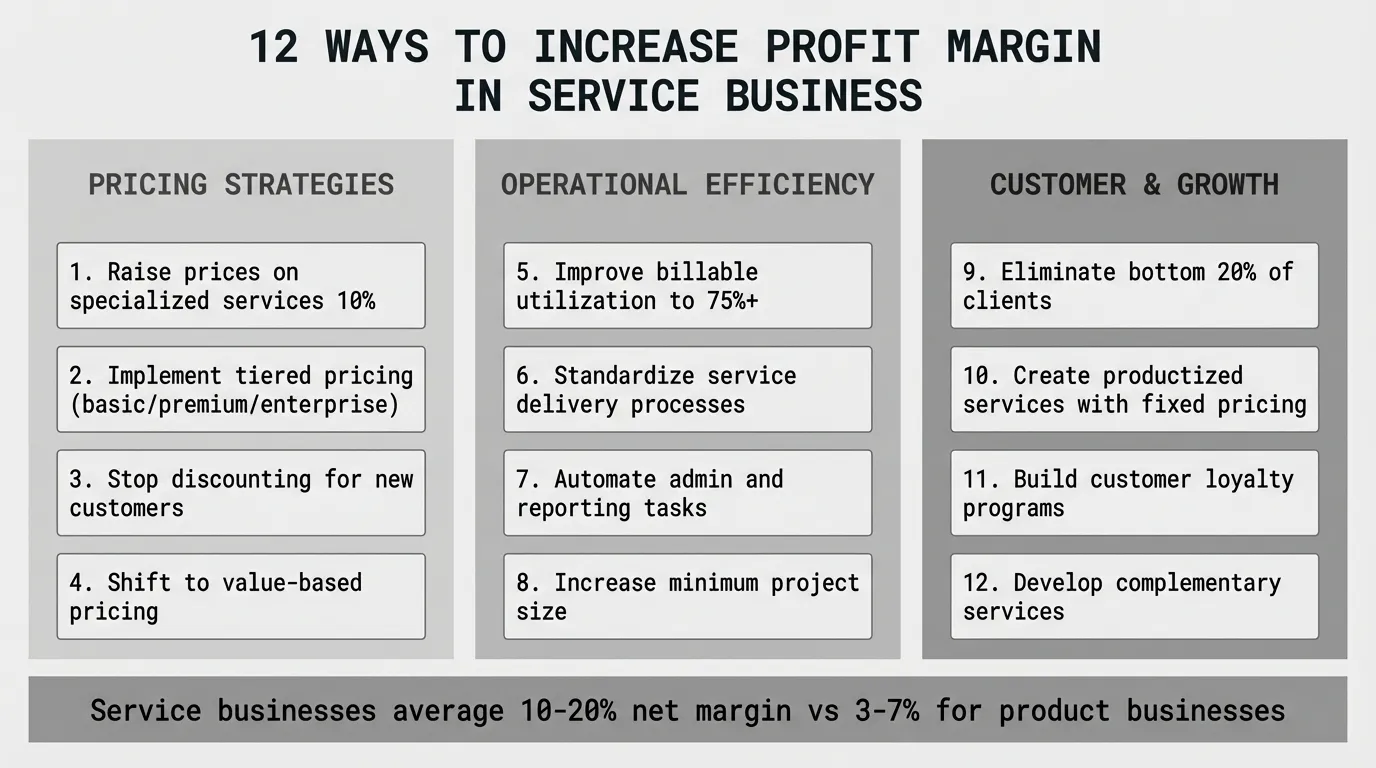
Service businesses typically achieve 10% to 20% net profit margins, significantly higher than product-based businesses that average 3% to 7%. The margin advantage comes from lower cost structures—no inventory, minimal COGS, and scalability through expertise rather than physical goods.
But average performance isn't the goal. The best service businesses consistently achieve 15% to 30% net margins. They do this through strategic pricing, operational discipline, and customer retention focus—not through working harder or selling more hours.
Why Service Businesses Have Margin Advantages
Service businesses start with structural advantages over product businesses:
Lower COGS. Your primary cost is labor, not materials or inventory. A consulting firm's COGS might be 30-40% of revenue (employee salaries and benefits), while a retailer's COGS is 60-70% (product purchase costs). This creates more room for profit.
No inventory carrying costs. You don't tie up cash in inventory, pay for warehousing, or write off obsolete stock. Your "inventory" is your team's expertise and available hours.
Scalability through leverage. Senior consultants can supervise multiple junior staff, creating margin through labor arbitrage. A partner billing at $350/hour while managing associates billing at $150/hour extracts margin from the difference.
Pricing flexibility. Without fixed product costs, you can price based on value delivered rather than cost-plus formulas. A $10K consulting project that takes 40 hours of work produces better margins than a $10K product with $7K in COGS.
According to ERP Software Blog's 2025 analysis of service industry margins, professional services achieve net margins of 10-20%, with specialized expertise or low overhead enabling margins exceeding 25%. This confirms service businesses can achieve 2-3x the margins of product businesses.
But the margin advantage isn't automatic. Service businesses still leak margin through poor pricing, operational inefficiency, and customer churn. Here's how to capture more of it.
The Three Levers That Matter Most
Profit margin in service businesses comes down to three variables:
Net Margin = (Revenue - Labor Costs - Operating Expenses) / Revenue × 100You improve margin by increasing revenue (pricing), decreasing labor costs (efficiency), or decreasing operating expenses (overhead reduction). The highest-impact tactics target all three.
1. Pricing: The Fastest Margin Lever
Raising prices is the fastest way to improve profit margin. A 5% price increase on $500K in annual revenue adds $25K directly to net income. If you're running at 10% net margin ($50K profit), that's a 50% profit increase from a single pricing decision.
Research from Harvard Business School found that value-based pricing—charging based on customer value rather than time or cost—enables premium pricing that significantly improves margins. Instead of billing hourly, price based on the problem you solve or the outcome you deliver.
Where to raise prices first:
Specialized services with few alternatives. If you're one of three firms in your market who can deliver a specific service, you have pricing power. Raise prices by 10-15% on specialized work where customers have limited options.
High-value customers. Customers who pay on time, don't negotiate constantly, and value your expertise will accept 5-10% price increases without leaving. They're not buying on price—they're buying reliability and results.
Value-added services beyond core offerings. Rush delivery, weekend work, customization, and ongoing support should command premium pricing. If you're providing these at no extra charge, you're leaving margin on the table.
New customers. Never discount pricing for new customers "to win the business." If your services are worth $10K to existing clients, they're worth $10K to new ones. Starting at full price sets the right expectation.
2. Efficiency: The Sustainable Margin Lever
Operational efficiency means delivering the same service quality with less time, lower overhead, and better resource utilization. Every hour of billable work you can extract from the same team size increases margin.
Billable utilization rate is the key metric. This measures the percentage of working hours that can be charged to clients versus non-billable activities (admin, sales, training, internal meetings).
Billable Utilization = Billable Hours / Total Available Hours × 100According to ProjectCor's analysis of professional services KPIs, achieving high gross profit margins requires managing costs and optimizing staff utilization. Service businesses need 75-85% utilization to maintain profitability. Below 70% means too much time on non-revenue activities.
A consultant working 40 hours per week for 48 weeks (allowing for vacation) has 1,920 available hours per year. At 75% utilization, that's 1,440 billable hours. At 60% utilization, it's only 1,152 hours—a 288-hour difference. At a $150/hour billing rate, that's $43,200 in lost revenue per person annually.
How to improve utilization:
Standardize service delivery processes. Create templates, checklists, and documented procedures for common services. This reduces rework, eliminates errors, and speeds up delivery. What took 20 hours the first time should take 12 hours the fifth time.
Reduce non-billable time. Track where time goes. If team members spend 30% of their time on internal meetings, reporting, and administrative tasks, streamline or eliminate those activities. Use project management tools to reduce status meetings. Automate time tracking and invoicing.
Batch similar work together. Context switching wastes time. Schedule similar tasks consecutively—client calls on Tuesday mornings, internal meetings Wednesday afternoons, deep work blocks Thursday. This improves focus and throughput.
Delegate appropriately. Senior staff shouldn't do work that junior staff can handle. A $250/hour partner reviewing expense reports destroys margin. Push tasks down to the lowest-cost resource capable of doing them well.
3. Retention: The Compounding Margin Lever
Customer retention is 5x more cost-effective than acquisition. Acquiring new customers costs 5 to 25 times more than retaining existing ones, according to research compiled by Invesp. Yet 44% of businesses still prioritize acquisition over retention in 2025.
The profitability math is clear: Bain & Company research found that increasing customer retention rates by just 5% boosts profits by 25% to 95%. This happens because retained customers have higher purchase success rates (60-70% versus 5-20% for new prospects), require less sales and marketing spend, and often increase their spending over time.
Tactics that improve retention:
Deliver consistent quality. Service businesses live or die on reliability. Meeting deadlines, maintaining quality standards, and communicating proactively builds trust. Customers stay with service providers they trust, even if they're not the cheapest option.
Build personal relationships. B2B service buyers don't switch providers easily. The relationship between your team and their team creates switching costs. Regular check-ins, understanding their business context, and providing proactive advice strengthens retention.
Create recurring revenue models. Monthly retainers, quarterly contracts, and subscription-style engagements provide predictable revenue and increase retention. A customer on a 12-month retainer is far less likely to churn than one buying project-by-project.
Upsell and cross-sell systematically. Existing customers already trust you. Introducing additional services that solve adjacent problems increases their lifetime value while deepening the relationship. A marketing agency that adds email management to its social media services increases revenue per client without acquisition costs.
12 Specific Tactics to Increase Profit Margin
Here are proven tactics organized by impact and effort:
High Impact, Low Effort (Start Here)
1. Raise prices on specialized services by 10%.
Identify services where you have differentiation—specialized expertise, industry-specific knowledge, or technical capability that competitors lack. Announce a 10% price increase for new projects starting next quarter. Most customers will accept it if you communicate value clearly.
Expected impact: 3-5 percentage points added to net margin.
2. Implement tiered pricing (basic, premium, enterprise).
Create three service tiers with different scope and pricing. Most customers will choose the middle tier, but 20-30% will opt for premium. Research shows tiered pricing can increase sales by 30-40% by giving customers permission to spend more.
Expected impact: 15-25% increase in average project value.
3. Stop discounting for new customers.
New customer discounts condition clients to expect discounts forever. Start every relationship at full price. If you must negotiate, offer additional scope rather than price reductions. You can always discount later—raising prices after starting low is nearly impossible.
Expected impact: 5-10% higher margins on new business.
4. Track and improve billable utilization.
Measure billable utilization monthly by person and by team. Set targets of 75%+ for individual contributors and 60%+ for managers (who spend more time on business development and team leadership). Identify what's consuming non-billable time and eliminate it.
Expected impact: 10-20% revenue increase with same team size.
High Impact, Moderate Effort
5. Eliminate or reprice bottom 20% of clients.
Analyze client profitability. Identify the bottom 20% by margin—clients who negotiate constantly, pay slowly, demand excessive revisions, or require disproportionate support. Either raise their prices by 30-50% or stop serving them. The Pareto principle applies: 20% of clients often generate 80% of profit.
Expected impact: 2-4 percentage points added to overall margin.
6. Shift from hourly billing to value-based pricing.
Move away from billing by the hour. Price projects based on value delivered—the ROI your customer achieves, the problem you solve, or the outcome you enable. A consultant who delivers $500K in cost savings should charge based on that value, not on 80 hours of work at $200/hour.
Expected impact: 20-40% higher project margins.
7. Create productized services with fixed pricing.
Package repeatable services as fixed-scope, fixed-price offerings. A "Website SEO Audit" for $2,500 that takes 10 hours to deliver is far more profitable than billing 10 hours at $200/hour ($2,000). Fixed pricing eliminates scope creep and rewards efficiency.
Expected impact: 15-30% margin improvement on productized services.
8. Automate administrative and reporting tasks.
Administrative work—invoicing, time tracking, project status reporting, proposal generation—consumes 10-20% of team time without generating revenue. Modern automation tools reduce labor costs while improving customer experience. The key is selecting solutions with clear ROI.
Expected impact: 5-10 percentage points improvement in utilization rate.
Moderate Impact, Moderate Effort
9. Develop complementary services that leverage existing capabilities.
Identify adjacent services that your existing clients need and that you're capable of delivering. A bookkeeping firm adding payroll services, or a web design agency adding content writing. These require minimal incremental investment but expand revenue per client.
Expected impact: 10-20% increase in revenue per client.
10. Renegotiate supplier and vendor contracts.
Review every recurring expense—software subscriptions, insurance, office space, subcontractors. Even small reductions in cost-per-unit or hourly rates can significantly impact margins over time, especially for high-volume services. Target 10-20% savings on renegotiated contracts.
Expected impact: 1-2 percentage points added to net margin.
11. Implement customer loyalty programs or referral incentives.
Customer loyalty programs increase profit margins in service businesses by driving repeat business and reducing customer acquisition costs. Offer discounts on future projects for referrals or retainer commitments. The acquisition cost saved on a referred customer goes straight to margin.
Expected impact: 5-10% reduction in customer acquisition costs.
12. Increase minimum project size.
Small projects destroy margins through overhead. A $2,000 project requires nearly the same sales effort, contracting, onboarding, and invoicing as a $20,000 project. Set a minimum engagement size (e.g., $5,000) and decline or refer work below that threshold.
Expected impact: 10-15% improvement in project-level margins.
How to Diagnose Where Your Margin Is Leaking
Before implementing improvement tactics, understand where margin is currently leaking. Service businesses lose margin through:
1. Pricing too low relative to value delivered.
If customers rarely question your pricing or negotiate, you're probably underpriced. If competitors with similar capabilities charge 20-30% more, you're definitely underpriced. The absence of pricing resistance usually signals pricing opportunity, not competitive advantage.
2. Poor utilization through excessive non-billable time.
Calculate your team's billable utilization. If it's below 70%, you're losing 10-20 percentage points of potential margin to administrative overhead, internal meetings, and inefficient processes. Track where non-billable time goes for two weeks to identify the waste.
3. Scope creep on fixed-price projects.
Fixed-price projects are profitable when scoped correctly and unprofitable when scope creeps. If you quote 40 hours but deliver 60 hours, your effective hourly rate drops 33%. Use detailed scoping documents, change order processes, and clear boundaries on revisions.
4. Client concentration at below-market rates.
If 40% of revenue comes from one client who negotiated hard five years ago, your overall margin doesn't reflect your true pricing power. Analyze margin by client. Raise prices on large clients who are below market, or accept that you'll need to diversify revenue to improve overall margin.
5. Underpricing specialized expertise.
Generalist services face pricing pressure. Specialized expertise commands premium pricing. If you bill a generalist consultant at $150/hour and a specialist at $175/hour, you're underpricing the specialist. The right spread is often $150/hour versus $250/hour.
The Diagnostic: Gross Margin vs. Net Margin
Your gross margin tells you whether the problem is pricing or efficiency. Your net margin tells you whether the problem is overhead.
Gross Margin = (Revenue - Direct Labor Costs) / Revenue × 100Net Margin = (Revenue - All Costs) / Revenue × 100For a service business:
| Scenario | Gross Margin | Net Margin | Diagnosis |
|---|---|---|---|
| Healthy | 50-70% | 15-25% | Pricing and efficiency are both working |
| Pricing Problem | Below 50% | Below 10% | Rates are too low or utilization is weak |
| Overhead Problem | 50-70% | Below 10% | Operating expenses are too high |
| Efficiency Problem | Below 50% | Below 10% | Too much non-billable time or poor delegation |
According to Precursive's analysis of professional services margins, a gross margin exceeding 50% indicates strong project profitability and effective pricing strategies, with the industry average around 30% for broader professional services. If your gross margin is strong but net margin is weak, don't waste time on pricing analysis—fix your cost structure.
Margin Benchmarks for Service Businesses
How do your margins compare? Here's what service businesses achieve:
| Service Type | Gross Margin | Net Margin | Source |
|---|---|---|---|
| Software/SaaS | 70-85% | 20-30% | Industry reports |
| Consulting/Advisory | 60-75% | 15-25% | Precursive 2025 |
| Accounting/Tax Services | 60-75% | 18-24% | Industry average |
| Legal Services | 55-70% | 15-20% | Industry average |
| Marketing/Advertising | 50-65% | 10-15% | Industry average |
| Design/Creative Services | 50-65% | 12-18% | Industry average |
| IT Services | 45-60% | 12-18% | Industry average |
| General Consulting | 40-60% | 10-20% | Vena Solutions 2026 |
Data compiled from Precursive's 2025 professional services research, Vena Solutions' 2026 industry benchmarks, and ERP Software Blog's service industry analysis.
If you're significantly below these benchmarks, focus on the three levers: pricing, efficiency, and retention. If you're at benchmark but want to reach elite performance (top quartile), focus on specialization and value-based pricing.
Warning Signs You're Leaving Margin on the Table
Most service businesses have 3-5 percentage points of recoverable margin hiding in their operations. It's in:
- Generalist pricing for specialist work. You bill all consultants at the same rate, even though some have 10x the expertise of others.
- No minimum project size. You accept $1,500 projects that consume as much overhead as $15,000 projects.
- Low utilization due to poor project management. Teams spend 40% of time in status meetings, searching for information, or waiting for client feedback.
- Hourly billing that penalizes efficiency. You get faster at delivering value, but your revenue per project drops because you bill by the hour.
- Client concentration at below-market rates. Your largest client negotiated a "partnership" rate in 2019 that's 30% below market, and you've never revisited it.
- No price increases in 2+ years. Your costs went up 15% over two years (salaries, software, rent), but customer pricing stayed flat.
According to McKinsey's 2003 research "The Power of Pricing" published in McKinsey Quarterly, a 1% price improvement drives an 8% increase in operating profit for B2B companies. For service businesses operating at 15% net margin, even a 2-3% margin leak represents a 15-20% reduction in profitability.
The insight is that small margin losses compound dramatically. Fixing them isn't about incremental improvement—it's about business survival.
Where to Start
If you run a service business and want to improve profit margins, here's the 90-day action plan:
Month 1: Diagnose
- Calculate your current gross margin and net margin
- Measure billable utilization by person and by team
- Analyze margin by client—identify top 20% and bottom 20%
- Compare your pricing to competitors for similar services
- Track where non-billable time goes (admin, sales, internal meetings)
Month 2: Quick Wins
- Raise prices 10% on specialized services for new projects
- Implement minimum project size ($5K or higher)
- Stop discounting for new customers
- Eliminate or reprice bottom 10% of clients
- Set utilization targets (75%+ for team members)
Month 3: Sustainable Changes
- Shift one service to value-based pricing as a test
- Create one productized service with fixed pricing
- Automate time tracking and invoicing
- Develop referral incentive program
- Renegotiate top 3 vendor contracts
This sequence addresses the fastest levers first (pricing, client mix) before tackling the harder operational changes. Most service businesses can add 3-5 percentage points to net margin within 90 days through pricing and client optimization alone.
For service businesses managing complex client relationships, multiple service lines, and distributed teams, margin analysis becomes difficult. Excel spreadsheets that should take a day to build take weeks—so the analysis doesn't happen until margins have already declined.
If you need to analyze profitability across clients, services, and time periods, Pryse provides instant visibility into where margin actually goes. Upload your data and see margin leakage in 24 hours, not 6 months.
For broader margin improvement strategies beyond service businesses, see our complete guide to improving profit margins.
Last updated: February 24, 2026
Frequently Asked Questions
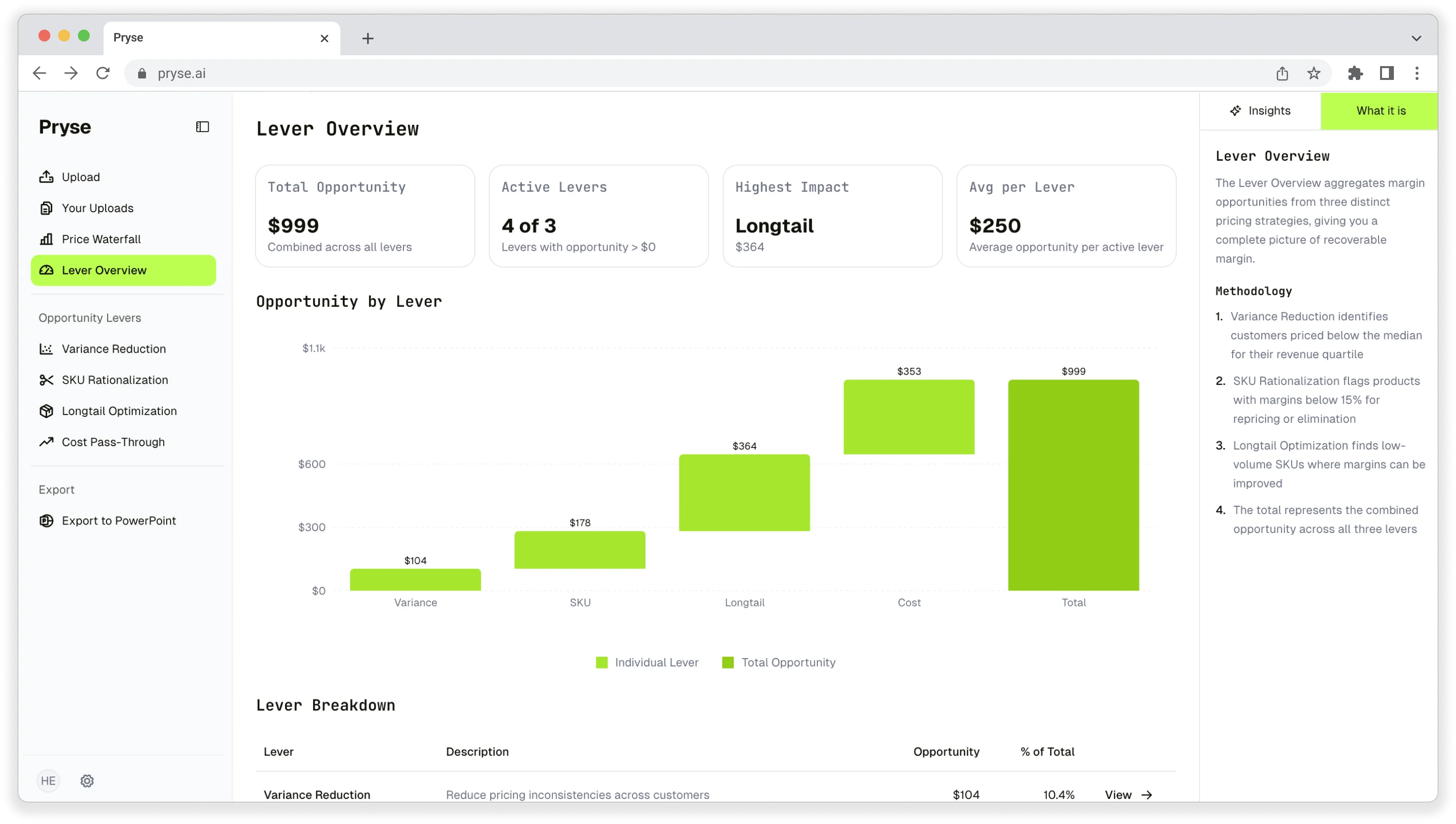
Want to analyze your entire product catalog?
Pryse automatically identifies margin leakage across thousands of SKUs. Upload your data and find hidden profit in 24 hours.
One-time $1,499 diagnostic. No subscription required.