 Pryse
PryseHow to Raise Prices: The Complete Guide to Increasing Prices Without Losing Customers
Learn how to raise prices strategically with proven tactics for B2B and service businesses. Includes communication templates, timing strategies, and retention tactics.
Raising prices is the fastest way to improve profit margins, but most businesses delay price increases far too long because they're afraid of losing customers. That fear is justified—research from the Richmond Fed found that a 1% price increase raises customer attrition from 14% to 21% annually.
But the alternative is worse. McKinsey's research "The Hidden Power of Pricing" found that a 1% price increase has more impact on bottom-line margins than a 1% increase in volume or reduction in costs. For a business operating at 10% net margin, a 5% price increase that doesn't affect volume adds 50% to net profit.
The key is raising prices strategically—with the right timing, communication, and customer segmentation—so you capture the margin improvement without triggering mass churn.
Why Most Businesses Wait Too Long to Raise Prices
Most businesses operate on the same pricing for 18 to 36 months, even when their costs have increased 10% to 20% during that period. They absorb cost increases through margin compression rather than passing them through to customers.
The reasons are predictable:
Fear of customer attrition. The assumption is that if you raise prices, customers will leave. For some customers, that's true. But research from SAGE Journals found that customer tenure matters significantly—longer-tenure customers are far less sensitive to price increases than new customers.
Competitive pressure. If competitors haven't raised prices, raising yours feels risky. But in B2B markets, competitors face the same cost pressures. Often, the first company to raise prices provides air cover for others to follow.
Lack of confidence in value delivered. If you're not sure your product or service justifies a higher price, you won't have the conviction to communicate the increase effectively. This is a positioning problem, not a pricing problem.
No systematic process. Many businesses only raise prices reactively—when costs force them to, or when a major customer accepts a price increase. Without a regular pricing review cycle, increases become ad hoc and delayed.
According to Simon-Kucher's analysis of B2B price increase campaigns in 2024, the most common mistake in B2B pricing is inconsistency. Companies that communicate price increases clearly, consistently across the customer base, and with adequate notice retain 85% to 95% of customers through the increase.
The Cost of Not Raising Prices
Delaying price increases destroys margin faster than most businesses realize. Here's the compounding effect:
A business with $2M in annual revenue and a 10% net margin generates $200K in annual profit. Over three years, their costs increase by 15%—labor costs rise 5% annually, supplier costs rise 8%, software and overhead rise 4%. If they don't raise prices, here's what happens:
| Year | Revenue | Costs | Net Margin | Profit |
|---|---|---|---|---|
| Year 1 | $2.0M | $1.8M | 10% | $200K |
| Year 2 | $2.0M | $1.89M | 5.5% | $110K |
| Year 3 | $2.0M | $1.98M | 1% | $20K |
By Year 3, the business is barely profitable. A 10% price increase in Year 1 would have preserved margin:
| Year | Revenue | Costs | Net Margin | Profit |
|---|---|---|---|---|
| Year 1 | $2.2M | $1.8M | 18.2% | $400K |
| Year 2 | $2.2M | $1.89M | 14.1% | $310K |
| Year 3 | $2.2M | $1.98M | 10% | $220K |
The difference is $200K in cumulative profit over three years. That's the hidden cost of delaying price increases.
When to Raise Prices (Strategic Timing)
Timing determines whether a price increase feels justified or arbitrary. Raise prices at moments when customers expect change or when you've delivered measurable value.
Best Times to Raise Prices
1. Contract renewal dates.
For B2B businesses with annual contracts, renewal is the natural inflection point for pricing adjustments. Customers expect terms to change at renewal. Communicate the new pricing 60 to 90 days before renewal so customers can budget accordingly.
2. After delivering measurable results.
If you've delivered a project that saved a customer $500K, or implemented a system that increased their revenue 20%, you've earned the right to raise prices on the next engagement. The value is proven, the relationship is strong, and the customer sees the ROI.
3. When you've added significant value or features.
New capabilities, expanded service offerings, improved quality, or faster delivery all justify price increases. Tie the increase directly to the improvement: "We've added X, Y, and Z capabilities, which is why pricing is now adjusting to $10,500."
4. During regular annual pricing reviews.
Visdum recommends standardizing annual price increases tied to inflation indices (CPI or RPI) or fixed percentages (3% to 5%). This creates predictability for customers and prevents the need for sudden, large increases. Annual adjustments are easier to push through customer procurement teams than ad hoc increases.
5. When market conditions justify it.
If your entire industry is raising prices due to tariffs, supply chain disruptions, labor shortages, or regulatory changes, customers expect it. Use industry context to frame your increase: "Due to the 15% increase in steel costs industry-wide, our pricing is adjusting by 8%."
Worst Times to Raise Prices
Immediately after a service failure. If you missed a deadline, delivered poor quality, or had a major customer service issue, wait. Fix the problem first, rebuild trust, then raise prices.
During economic downturns. If your customers are cutting budgets and laying off staff, a price increase will accelerate churn. Either delay the increase or structure it as a smaller adjustment with options for customers under financial pressure.
When you're losing customers already. If churn is high, diagnose why before raising prices. If customers are leaving because your service isn't delivering value, a price increase accelerates the exodus.
How Much to Raise Prices
The percentage increase depends on your market position, customer tenure, and competitive context. Use these benchmarks:
| Scenario | Safe Increase | Aggressive Increase | Notes |
|---|---|---|---|
| Annual inflation adjustment | 3-5% | 5-8% | Tied to CPI/RPI, expected by customers |
| After adding features/value | 5-10% | 10-15% | Justified by tangible improvements |
| First increase in 2+ years | 8-12% | 15-20% | Catching up to cost increases |
| Specialized/differentiated service | 10-15% | 15-25% | Low competitive pressure |
| Commodity service | 3-5% | 5-10% | High competitive pressure |
Research from the Richmond Fed's 2023 analysis found that a 1% price increase typically raises customer attrition from 14% to 21% annually. This suggests that if you're currently losing 14% of customers per year, a 10% price increase would push attrition to roughly 28% to 35%.
But here's the nuance: customer tenure significantly affects price sensitivity. Long-tenure customers (3+ years) are far less likely to churn on a price increase than customers who joined within the past year. This means you can segment your increases:
- Long-tenure customers (3+ years): 10% to 15% increase with minimal churn
- Medium-tenure customers (1-3 years): 5% to 10% increase
- New customers (under 1 year): Hold prices flat or raise new customer prices only
This tiered approach preserves your most valuable relationships while capturing margin where you can.
How to Communicate a Price Increase
Communication determines whether customers accept the increase or churn. The worst approach is to bury the increase in contract fine print or mention it casually. The best approach is direct, transparent, and value-focused.
The Communication Framework
1. Lead time: 60 to 90 days minimum.
Best practices from pricing consultants recommend 60 to 90 days notice for B2B price increases. This gives customers time to plan budgets, discuss internally, and decide whether to accept the increase or evaluate alternatives.
For annual contracts, notify at least 90 days before renewal. For month-to-month services, 60 days is acceptable.
2. Communication channel: Email first, then follow up.
Email is the most direct and professional channel for price increase announcements. It ensures customers receive the message, gives them time to process, and allows them to respond with questions.
According to communication best practices, a single email isn't enough. Use a multi-channel approach:
- Day 1: Email announcement to decision-makers
- Day 7: Follow-up email with FAQ
- Day 14: Personal outreach to high-value customers by phone or video call
- Day 30: Reminder email with 60 days until effective date
3. Message structure: Why, what, when.
Your announcement should answer three questions in order:
Why are prices increasing? Provide specific, honest reasons. Vague explanations reduce trust. Good reasons include:
- Labor cost increases (5% annual wage growth)
- Supplier cost increases (materials up 12%)
- Investment in product improvements (new features, faster delivery)
- Inflation adjustments (CPI rose 4.2% this year)
- Market conditions (industry-wide cost pressures)
What is changing? Be specific about the new pricing. Ambiguity creates anxiety.
- Old price: $5,000/month
- New price: $5,500/month (10% increase)
- Effective date: July 1, 2026
When does it take effect? Clear dates remove uncertainty. Include both the announcement date and the effective date.
4. Tone: Confident, not apologetic.
Research on price increase communication found that apologizing for price increases undermines product value. Don't say:
- "We're sorry, but we have to raise prices"
- "Unfortunately, we need to adjust pricing"
- "We hate to do this, but costs have gone up"
Instead, frame it as a business decision tied to value:
- "We're adjusting pricing to reflect the value we deliver"
- "Our pricing is changing to support continued investment in quality"
- "Starting July 1, our pricing will be $5,500/month"
Tentative language signals you're willing to negotiate. Confident language communicates that the decision is final.
Example Price Increase Email (B2B)
Subject: Pricing Update for [Customer Name] – Effective July 1, 2026
Hi [Name],
I wanted to let you know that starting July 1, 2026, our pricing will be adjusting to $5,500 per month (previously $5,000).
Why this change: Over the past 18 months, we've invested significantly in improving delivery speed, adding new reporting capabilities, and expanding our support team to ensure you get faster responses. We've also seen labor costs increase 6% and software infrastructure costs rise 8%. This pricing adjustment reflects those investments and allows us to continue delivering the quality and reliability you expect.
What's changing: Your monthly fee will increase from $5,000 to $5,500, effective July 1, 2026. All other terms remain the same.
Your options:
- Continue at the new rate of $5,500/month starting July 1
- Lock in current pricing through December 31, 2026 by signing a 12-month contract before May 1
- Discuss alternative service tiers if budget is a concern
We value your partnership and want to make this transition smooth. If you have questions or want to discuss your options, I'm available for a call this week.
Thanks, [Your Name]
This email is direct, transparent, and provides options. It doesn't apologize, but it does acknowledge the change and offers alternatives.
Tactics to Minimize Churn During Price Increases
Even with perfect communication, some customers will churn. The goal is to minimize churn while preserving margin. Here are proven tactics:
1. Grandfather Existing Customers, Raise Prices for New Customers
This is the lowest-risk approach. Keep current customers at existing pricing indefinitely, but charge new customers the higher rate. Over time, the customer base shifts to the new pricing without triggering churn.
Pros: Zero churn from existing customers, pricing reflects current costs for new business.
Cons: Creates pricing tiers that can feel unfair, takes years to capture full margin benefit.
This works best for businesses with high customer acquisition (20%+ annual growth) where new customers quickly become a meaningful portion of revenue.
2. Offer Multi-Year Contracts at Current Pricing
Give customers the option to lock in current pricing by committing to a longer contract (12 to 24 months). This preserves short-term revenue, improves retention, and defers the price increase.
Example: "Lock in $5,000/month through December 2027 by signing a 24-month contract before May 1. Otherwise, pricing adjusts to $5,500/month starting July 1."
According to pricing research from PriceFX, offering long-term contracts at current pricing before a price increase accelerates deal closures and increases contract lengths, both of which improve customer lifetime value.
3. Create a Bridge Tier Between Old and New Pricing
If the gap between old and new pricing is large (15%+ increase), create an intermediate tier that offers slightly reduced service at slightly higher pricing than the old rate.
Example:
- Old pricing: $5,000/month (full service)
- Bridge tier: $5,250/month (reduced reporting, slower response times)
- New pricing: $5,500/month (full service)
This gives price-sensitive customers an option that keeps them as customers without reverting to the old price.
4. Segment Customers and Offer Loyalty Discounts
Not all customers are equally price-sensitive. Analyze your customer base by tenure, contract size, and margin. Offer loyalty discounts to long-tenure, high-value customers while implementing the full increase for newer or lower-margin accounts.
Example:
- Customers with 5+ years tenure: 5% increase instead of 10%
- Customers with 3-5 years tenure: 7% increase
- Customers with under 3 years tenure: Full 10% increase
Research from SAGE Journals confirms that customer tenure moderates price sensitivity—long-tenure customers are significantly less likely to churn on price increases.
5. Add Value Simultaneously with the Price Increase
The best way to justify a price increase is to deliver more value at the same time. Launch new features, improve service quality, expand support hours, or add capabilities that customers have requested.
According to SCORE's research on price increases, customers accept price increases more readily when they're tied to tangible improvements. The increase feels earned, not arbitrary.
6. Offer a "Last Chance" at Current Pricing
Create urgency by giving customers a final window to purchase or renew at current pricing before the increase takes effect.
Example: "Place orders before June 15 and we'll honor current pricing. Orders placed after June 15 will be invoiced at the new rate."
This accelerates deal closures, pulls revenue forward, and gives customers a sense of control.
What to Do When Customers Push Back
Even with perfect execution, some customers will push back. Here's how to handle objections:
Objection 1: "Your competitor is cheaper."
Response: Acknowledge the price difference, then redirect to value.
"I understand [Competitor] may be priced lower. The difference is that we provide [specific value you deliver that they don't]—faster turnaround, dedicated account management, better reporting, etc. Our customers tell us they're willing to pay a premium for that reliability."
Don't compete on price. Compete on value. If the customer only cares about price, they're not your ideal customer.
Objection 2: "I need to talk to my boss / procurement."
Response: Facilitate the conversation.
"I understand. Would it help if I provided a one-page summary of the pricing change and the value we deliver? Or I'm happy to join a call with your team to answer questions."
Make it easy for your champion to sell the increase internally.
Objection 3: "Can you hold pricing for another 6 months?"
Response: Offer an alternative that locks in commitment.
"I can hold pricing through December if you're willing to sign a 12-month contract today. Otherwise, the increase takes effect July 1 as planned."
Trading a delay for commitment is a fair exchange.
Objection 4: "I'm going to need to cancel."
Response: Understand why, then offer alternatives.
"I'd hate to lose you. Can you help me understand—is this purely a budget issue, or is there something about the service we should be doing better?"
If it's budget: "Let me see if we can find a middle ground. Would [reduced service tier at lower price] work for you?"
If it's value: "That's good feedback. Let's schedule a call to discuss what we can improve."
According to Bain & Company research, 60% of customers who threaten to cancel during a price increase don't actually cancel if you engage them in conversation and offer alternatives. The threat is often a negotiation tactic, not a final decision.
Industry-Specific Considerations
Price increase strategies vary by industry. Here's how to adapt for common B2B business models:
Distribution and Wholesale
Distributors face margin compression from both suppliers (cost increases) and customers (price pressure). The challenge is passing through supplier cost increases without losing volume.
McKinsey's research on B2B pricing found that distribution companies often struggle with pricing transparency along the supply chain. Customers don't understand why distributor prices went up when they can see manufacturer pricing online.
Tactics for distributors:
- Use surcharges tied to cost inputs. A fuel surcharge, freight surcharge, or commodity surcharge can be positioned as temporary and tied to external factors. When costs normalize, remove the surcharge—but keep base pricing intact.
- Implement contract price escalators. Tie annual price increases to industry indices (Producer Price Index for your category). This shifts the pricing conversation from "why are you raising prices?" to "the index went up 4.2%, so pricing adjusts accordingly."
- Negotiate with suppliers for delayed increases. If you can lock in supplier pricing for 90 days, you can communicate customer price increases before your costs go up, giving you a 90-day margin buffer.
Manufacturing
Manufacturers selling direct to customers or through channels face cost volatility in materials, labor, and freight. Price increases are often reactive to these cost spikes.
Tactics for manufacturers:
- Implement raw material surcharges. For products with high exposure to commodity costs (steel, aluminum, resins), use a floating surcharge tied to spot prices. Customers accept this more readily than base price increases.
- Bundle value-added services. Instead of raising product pricing, bundle in installation, training, vendor-managed inventory, or consignment programs. The total contract value goes up, but the base product price stays flat.
- Tier customers by strategic value. Don't raise prices uniformly. Segment customers by margin, volume, and strategic importance. Implement full increases on low-margin transactional accounts and offer discounts to strategic partners.
Professional Services and SaaS
Service businesses and software companies can raise prices more aggressively because there's no physical product cost benchmark. The constraint is perceived value.
Tactics for services and SaaS:
- Tie increases to feature releases. Launch new capabilities every 6 to 12 months and raise prices for customers who want access. This positions the increase as an upgrade, not a cost pass-through.
- Implement usage-based pricing tiers. If customers are growing (more users, more API calls, more data), their pricing should grow with usage. This feels fair and scales revenue with value delivered.
- Offer grandfathered pricing to existing customers. Keep existing customers at current pricing indefinitely, but charge new customers 15% to 20% more. Over time, the customer base shifts to higher pricing without churn.
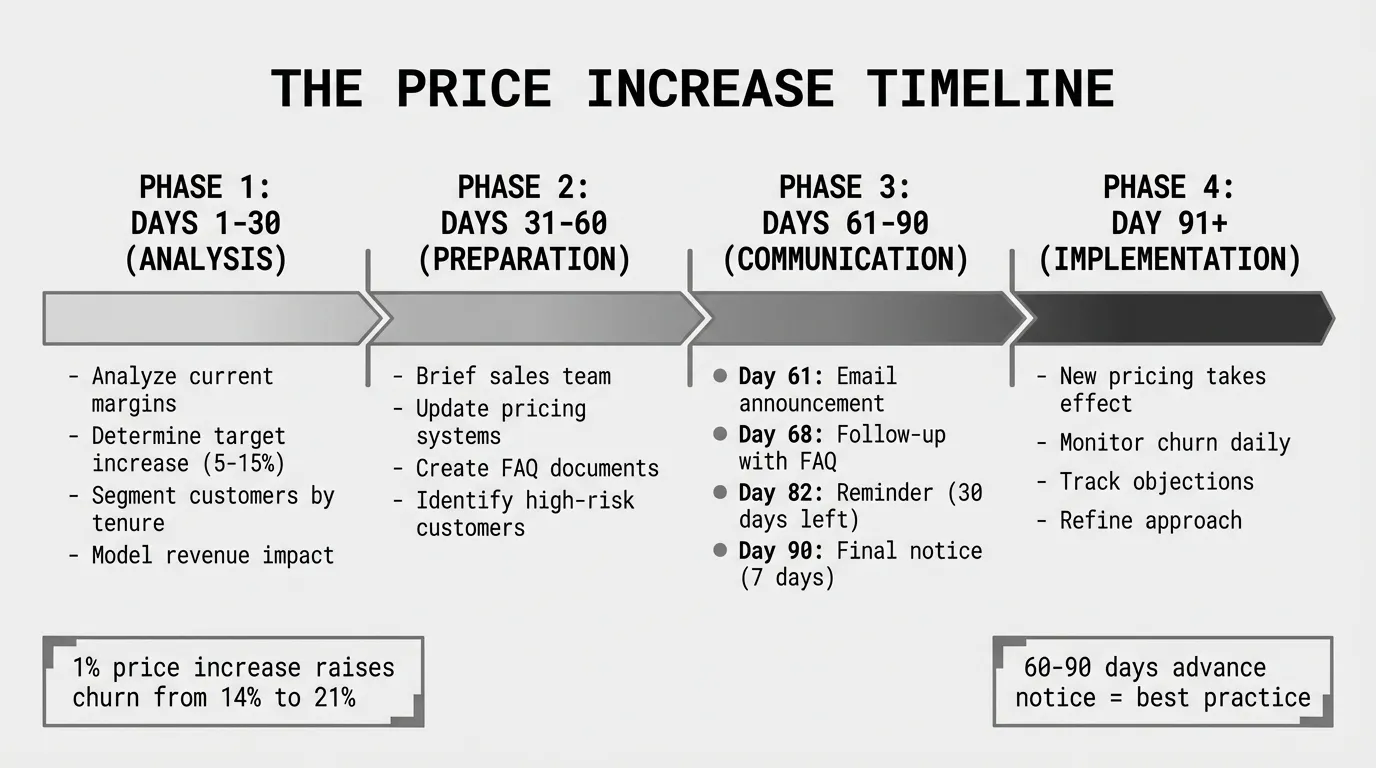
The 90-Day Price Increase Timeline
Here's a step-by-step timeline for implementing a price increase in a B2B business:
Days 1-30: Analysis and Planning
- Analyze current margin by customer, product, and contract
- Determine target price increase (5% to 15% depending on market)
- Segment customers by tenure, contract size, and price sensitivity
- Model the impact: revenue gain vs. expected churn
- Develop pricing tiers and options (multi-year contracts, loyalty discounts, bridge tiers)
- Draft communication templates (email, FAQ, call scripts)
Days 31-60: Internal Preparation
- Brief sales team on pricing change and how to handle objections
- Update CRM, billing systems, and contracts with new pricing
- Prepare customer-facing FAQ and value reinforcement materials
- Identify high-risk customers (price-sensitive, short tenure, low margin) for proactive outreach
- Set up tracking to monitor customer responses and churn
Days 61-90: Customer Communication
- Day 61: Send initial email announcement to all customers
- Day 68: Follow-up email with FAQ
- Day 68-75: Personal outreach to top 20% of customers by revenue (phone or video call)
- Day 82: Reminder email (30 days until effective date)
- Day 90: Final reminder email (7 days until effective date)
Day 91+: Implementation and Monitoring
- New pricing takes effect
- Monitor churn daily for first 30 days
- Track objections and reasons for cancellations
- Refine communication and offers based on feedback
- Conduct win-back campaigns for churned customers after 60 days
This timeline builds in enough notice to meet best practices (60 to 90 days) while creating urgency through reminder emails.
Measuring Success: What Good Looks Like
How do you know if your price increase was successful? Track these metrics:
| Metric | Target | Notes |
|---|---|---|
| Revenue retention rate | 90%+ | Percentage of pre-increase revenue retained after increase |
| Customer retention rate | 85%+ | Percentage of customers who accept the increase |
| Margin improvement | 3-5 points | Net margin improvement after accounting for churn |
| Objection rate | Under 30% | Percentage of customers who push back or negotiate |
| Voluntary churn vs. price-driven churn | Separate tracking | Did churn spike above baseline, or stay consistent? |
If you retain 90% of revenue and 85% of customers through a 10% price increase, you've succeeded. You captured 9% revenue improvement (90% retention × 10% increase) with manageable churn.
If you retain only 70% of customers, you've lost 30% of your base—which likely offsets the revenue gain and destroys margin through lost scale.
Common Mistakes to Avoid
Here are the most common ways businesses sabotage price increases:
1. Apologizing for the increase.
Saying "we're sorry" signals that the price increase is unfair or unjustified. It invites negotiation and undermines confidence in your pricing.
2. Giving no advance notice.
Surprising customers with a price increase creates resentment. Best practices recommend 60 to 90 days notice to give customers time to plan.
3. Raising prices uniformly without segmentation.
Not all customers are equally price-sensitive. Long-tenure, high-value customers can absorb larger increases than new, low-margin accounts. Segment your increases to maximize margin while minimizing churn.
4. Failing to reinforce value.
If customers don't understand what they're paying for, they won't accept price increases. Regularly communicate value delivered—results achieved, problems solved, ROI delivered.
5. Caving immediately when customers push back.
If you drop the price the moment a customer complains, you've trained them to complain every time. Hold firm on pricing unless there's a legitimate case for an exception.
What Happens If You Don't Raise Prices
The alternative to raising prices is margin erosion. Over time, as your costs increase 3% to 5% annually (labor, software, rent, materials), your margin shrinks. Eventually, you're unprofitable.
Here's the math: A business with $2M revenue and 10% net margin earns $200K annually. If costs rise 4% per year but revenue stays flat, net margin drops to 6% in Year 2 and 2% in Year 3. By Year 4, the business is unprofitable.
Raising prices 5% annually preserves margin and funds growth. A 5% price increase on $2M revenue adds $100K to the top line. Even if you lose 10% of customers, you're ahead:
New Revenue = $2M × 1.05 × 0.90 = $1.89M
Old Revenue = $2M
Net Change = -$110K revenue, but +5% margin on retained customers
The margin gain on retained customers offsets the revenue loss from churn, and you've eliminated the lowest-margin, most price-sensitive customers.
According to McKinsey's pricing research, a 1% price increase delivers more profit improvement than a 1% increase in volume or a 1% reduction in costs. Pricing is the highest-leverage margin improvement tool you have.
When Price Increases Fail
Price increases fail when:
-
You're not delivering value. If customers were already questioning whether your product or service is worth the current price, an increase will accelerate churn. Fix the value problem before raising prices.
-
You wait too long and need a massive increase. A 25% price increase after 4 years of no changes triggers far more churn than four 6% annual increases would have. Raise prices regularly in small increments.
-
You don't communicate effectively. Burying the increase in contract fine print, failing to explain why, or giving no advance notice creates customer resentment.
-
You raise prices during a service failure. If you missed deadlines, had quality issues, or delivered poor customer service, a price increase feels tone-deaf. Fix the problem first.
-
You target the wrong customer segment. Your most price-sensitive customers (short tenure, low contract value, high support needs) will churn fastest. Either avoid raising prices on this segment or accept that they'll leave.
The Strategic Alternative: Value-Based Pricing
Instead of raising prices across the board, some businesses shift to value-based pricing—charging based on outcomes delivered rather than cost or time.
A consultant who bills hourly might charge $200/hour for 40 hours ($8,000 total). If that consultant can deliver the same result in 20 hours due to experience and efficiency, they've cut their own revenue in half.
The alternative is outcome-based pricing: Charge $12,000 for the project outcome, regardless of hours required. The faster and more efficiently you deliver, the higher your effective hourly rate.
Harvard Business School research on pricing found that value-based pricing improves margins significantly by decoupling price from cost or time. You charge based on the value the customer receives—the ROI, the problem solved, the outcome achieved.
This is a strategic shift, not a quick fix. But for businesses with differentiated expertise, measurable outcomes, and high-value customers, value-based pricing often yields 20% to 40% higher margins than cost-plus or hourly pricing.
Where to Start
If you need to raise prices, here's the action plan:
Week 1: Analysis
- Calculate current margin by customer, product line, and contract
- Identify which customers are below target margin and by how much
- Determine the target price increase (5% to 15%)
- Model expected churn and revenue impact
- Segment customers by tenure and price sensitivity
Week 2-3: Planning
- Set new pricing tiers (standard increase, loyalty discount, bridge tier)
- Draft customer communication (email, FAQ, call scripts)
- Develop retention offers (multi-year contracts, added value)
- Brief internal teams (sales, account management, support)
- Update systems (CRM, billing, contracts)
Week 4-12: Communication
- Send initial announcement (60-90 days before effective date)
- Proactive outreach to high-value customers
- Follow-up emails with FAQ and reminders
- Field objections and offer alternatives
- Track responses and churn
Week 13+: Implementation
- New pricing takes effect
- Monitor churn and revenue retention
- Conduct win-back campaigns for lost customers
- Refine communication based on what worked
Most businesses can implement a price increase in 90 days with minimal churn if they communicate value, offer alternatives, and segment customers appropriately.
For businesses managing complex pricing across hundreds of customers or SKUs, analyzing where you have pricing power becomes the bottleneck. You know prices should go up, but identifying which customers, which products, and by how much requires margin analysis that most businesses do in Excel—and delay indefinitely.
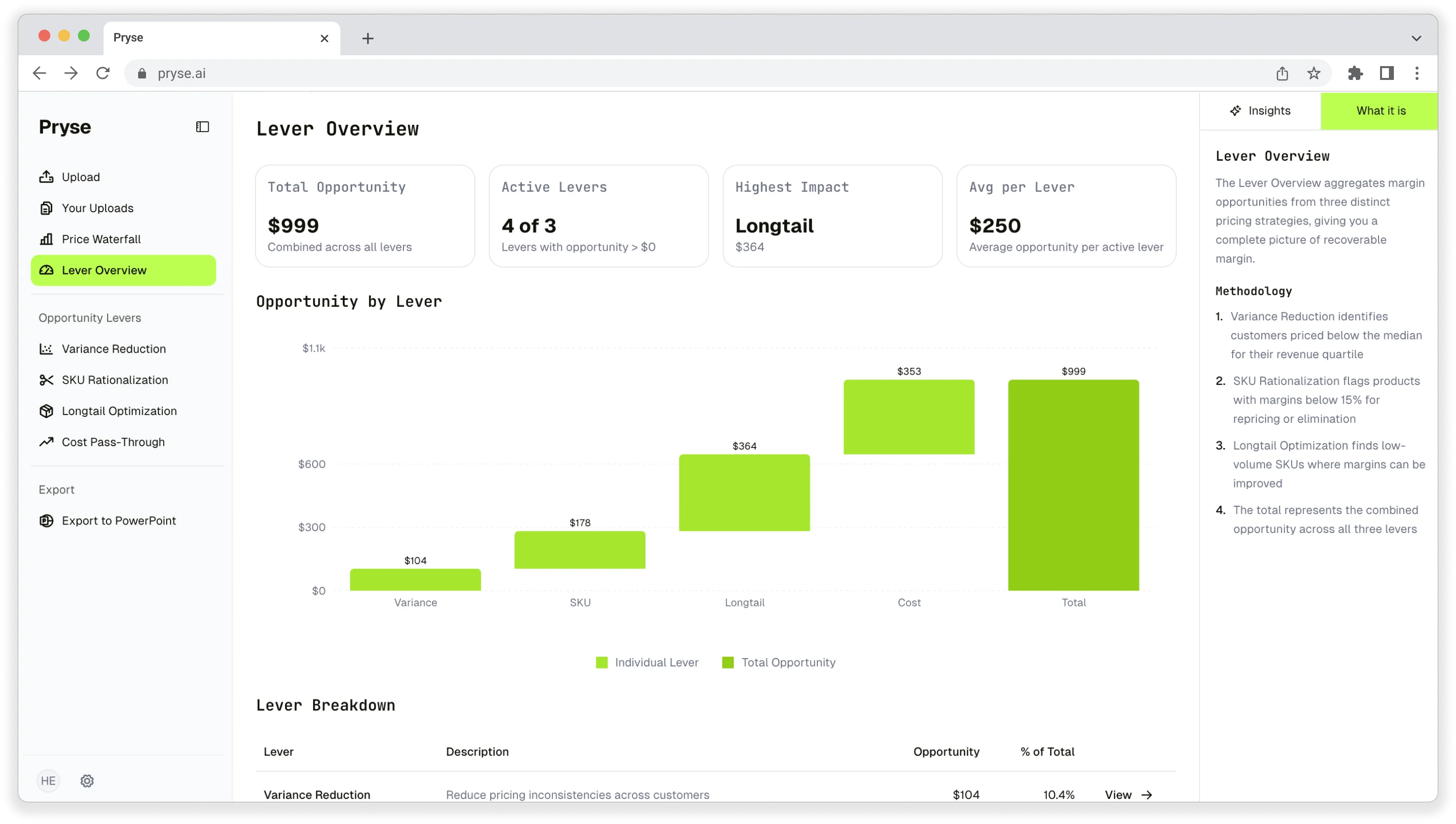
If you need to analyze pricing and margin across your customer base, Pryse provides instant visibility into margin by customer, product, and transaction. Upload your data and see where you have pricing power in 24 hours, not 6 months.
For broader margin improvement strategies beyond price increases, see our complete guide to improving profit margins.
Sources
- SCORE: How to Raise Prices Without Losing Customers
- PriceFX: 8 Strategies for B2B Sales Teams to Manage Price Increases
- Visdum: B2B SaaS Annual Price Increase Strategies
- Simon-Kucher: Our top 5 takeaways from running price increase campaigns for B2B clients in 2024
- Richmond Fed: How Well Do Firms Retain Customers After Price Increases?
- SAGE Journals: The Effect of Service Price Increases on Customer Retention
- Bain & Company: Retaining customers is the real challenge
- McKinsey: The Hidden Power of Pricing
- Orb: Write a price increase letter to customers
- LiveAgent: How to Notify Customer About Price Increase?
- Jobber: Price Increase Letter: Tips & Templates for Service Businesses
- vcita: How to write a price increase notice without losing clients
- Harvard Business School: How to Increase Profit Margin
Last updated: February 24, 2026
Frequently Asked Questions
Want to analyze your entire product catalog?
Pryse automatically identifies margin leakage across thousands of SKUs. Upload your data and find hidden profit in 24 hours.
One-time $1,499 diagnostic. No subscription required.