 Pryse
PryseHow to Raise Prices Without Losing Customers: 7 Proven Tactics
Give 60-90 days notice, frame increases as value adjustments, and offer alternatives like annual contracts. Research shows proper communication retains 85-95% of customers.
The biggest mistake businesses make with price increases isn't raising prices too much. It's waiting too long, then raising them too fast, with too little communication.
Most businesses delay price increases 18 to 36 months while their costs rise 10% to 20%. They absorb cost increases through margin compression until profitability forces their hand. Then they announce a 15% price increase with 30 days notice and watch customers churn.
The alternative is strategic: raise prices 5% to 10% annually with 60 to 90 days notice, clear communication, and customer options. Research from Simon-Kucher on B2B price increase campaigns found that companies with clear, consistent communication and adequate notice retain 85% to 95% of customers through price increases.
The difference between losing 5% of customers and losing 30% comes down to how you communicate, when you raise prices, and what alternatives you offer.
Why Price Increases Fail (And How to Fix It)
Over 60% of consumers blamed price increases for switching providers in 2020, with 34.6% saying they left because they didn't feel treated fairly. That's not a pricing problem. That's a communication problem.
Price increases fail when customers feel blindsided, undervalued, or misled. They succeed when customers understand why prices are changing, see the value they're getting, and have options to manage the transition.
Here are the most common mistakes:
Giving no advance notice. Surprising customers with a price increase creates resentment. Best practices recommend 60 to 90 days notice for B2B price increases. This gives customers time to plan budgets and discuss internally.
Apologizing for the increase. Saying "we're sorry, but we have to raise prices" signals the increase is unfair or unjustified. Research on price increase communication found that apologizing undermines product value. Don't say "unfortunately" or "we hate to do this." Frame it as a business decision tied to value.
Providing vague justifications. "Due to rising costs" doesn't explain anything. Be specific: "Labor costs increased 6%, raw materials rose 12%, and we invested $50K in faster delivery capabilities." Transparency builds trust. Vagueness reduces it.
Raising prices uniformly without segmentation. Not all customers are equally price-sensitive. Long-tenure, high-value customers can absorb larger increases than new, low-margin accounts. Segment your increases to maximize margin while minimizing churn.
Offering no alternatives. If the only option is "accept the increase or leave," price-sensitive customers leave. Offer multi-year contracts at current pricing, bridge tiers between old and new rates, or reduced-service options at lower prices.
The 7 Tactics That Retain Customers Through Price Increases
These tactics come from analyzing B2B price increase campaigns across distribution, manufacturing, and service businesses. They work because they respect customer autonomy, communicate value, and provide options.
1. Give 60-90 Days Advance Notice (Minimum)
According to pricing research, 60 to 90 days notice is the baseline for B2B price increases. This gives customers time to plan budgets, discuss with stakeholders, and decide whether to accept the increase or evaluate alternatives.
For annual contracts, notify at least 90 days before renewal. For month-to-month services, 60 days is acceptable. For distributors with ongoing orders, 90 days lets customers lock in bulk purchases at current pricing before the increase.
Why this works: Customers feel respected when they have time to plan. Surprise price increases feel like bait-and-switch tactics. Advance notice positions the increase as a normal business adjustment, not an emergency cost pass-through.
What to avoid: 30 days notice or less. Research shows customers view less than 60 days as inadequate, especially in B2B where budgets are set quarterly or annually.
2. Frame It as a "Pricing Adjustment," Not a "Price Hike"
Language matters. Compare these two approaches:
Weak: "Unfortunately, we're forced to raise prices due to increased costs."
Strong: "Starting July 1, our pricing will be adjusting to $5,500/month to reflect the value we deliver and support continued investment in quality."
The weak version apologizes, uses passive language ("forced to"), and focuses on your costs. The strong version is confident, uses active language ("will be adjusting"), and focuses on customer value.
According to communication best practices from GoDaddy, tentative language signals you're willing to negotiate. Confident language communicates the decision is final. Don't say "price hike," "price increase," or "unfortunately." Use "pricing adjustment," "pricing update," or simply state the new price.
3. Offer a "Lock in Current Pricing" Window
Give customers a final opportunity to purchase or renew at current pricing before the increase takes effect. This creates urgency, pulls revenue forward, and gives customers a sense of control.
Example: "Place orders before June 15 and we'll honor current pricing. Orders placed after June 15 will be invoiced at the new rate."
For service businesses or SaaS, offer multi-year contracts at current pricing:
Example: "Lock in $5,000/month through December 2027 by signing a 24-month contract before May 1. Otherwise, pricing adjusts to $5,500/month starting July 1."
Research from pricing consultants shows that offering long-term contracts at current pricing before a price increase accelerates deal closures and increases contract lengths. This improves customer lifetime value and cash flow while deferring the revenue impact of the increase.
Why this works: Customers who commit to longer contracts at current pricing are less likely to churn. You've traded short-term margin gain for long-term retention and predictable revenue.
4. Segment Customers by Tenure and Sensitivity
Long-tenure customers accept price increases more readily than new customers. Research from SAGE Journals found that customer tenure significantly moderates price sensitivity—customers with 3+ years tenure are far less likely to churn on a price increase.
This means you can segment increases by customer tenure:
| Customer Segment | Tenure | Safe Increase | Notes |
|---|---|---|---|
| Long-tenure customers | 3+ years | 10-15% | Strong relationship, proven value |
| Medium-tenure customers | 1-3 years | 5-10% | Moderate relationship strength |
| New customers | Under 1 year | Hold flat or 0-5% | Relationship not established |
Alternative approach: Grandfather existing customers at current pricing indefinitely, but charge new customers 10% to 15% more. Over time, the customer base shifts to higher pricing without triggering churn from existing relationships.
This works best for businesses with high customer acquisition (20%+ annual growth) where new customers quickly become a meaningful portion of revenue.
5. Add Value Simultaneously with the Price Increase
The easiest way to justify a price increase is to deliver more value at the same time. Launch new features, improve service quality, expand support hours, or add capabilities customers have requested.
According to SCORE's research, customers accept price increases more readily when they're tied to tangible improvements. The increase feels earned, not arbitrary.
Example: "We're adjusting pricing to $5,500/month starting July 1. Since January, we've added real-time reporting, expanded support hours to 24/7, and reduced delivery times from 5 days to 3 days. The pricing adjustment reflects these improvements."
Why this works: Customers see a clear connection between the price increase and new value. You're not just charging more for the same service—you're charging appropriately for an improved service.
What to avoid: Claiming you've added value when you haven't. If the only change is your cost structure, don't fabricate improvements. Be honest about why prices are changing.
6. Create a Bridge Tier Between Old and New Pricing
If the gap between old and new pricing is large (15%+ increase), create an intermediate tier that offers slightly reduced service at slightly higher pricing than the old rate.
Example:
- Old pricing: $5,000/month (full service)
- Bridge tier: $5,250/month (reduced reporting frequency, slower response times)
- New pricing: $5,500/month (full service)
This gives price-sensitive customers an option that keeps them as customers without reverting to the old price. Most customers will still choose the full-service option, but 10% to 20% will opt for the bridge tier rather than churn.
According to research from Xero on pricing strategies, offering multiple tiers during a price increase reduces churn by giving customers control over their spending. The perception of choice reduces resistance.
7. Proactively Reach Out to Top 20% of Customers
Don't rely solely on email. For your highest-value customers (top 20% by revenue or margin), schedule personal calls or video meetings to discuss the price increase before it's announced broadly.
The conversation flow:
-
Context: "I wanted to give you a heads-up before we send the official announcement. Starting July 1, our pricing is adjusting to $5,500/month."
-
Rationale: "This reflects the investment we've made in [specific improvements] and the rising costs we've absorbed over the past 18 months—labor up 6%, materials up 12%."
-
Value reinforcement: "Since we started working together, we've [delivered specific results, solved specific problems, achieved specific ROI]. We're committed to continuing that level of service."
-
Options: "I wanted to give you some alternatives. You can lock in current pricing through December 2027 by signing a 24-month contract, continue at the new rate, or we can discuss a customized tier if budget is a constraint."
Why this works: High-value customers expect personal communication, not mass emails. Proactive outreach shows you value the relationship and gives them space to voice concerns before making a decision. Research shows that 60% of customers who threaten to cancel don't actually cancel if you engage them in conversation and offer alternatives.
What Good Looks Like: Expected Retention Benchmarks
How do you know if your price increase was successful? Track these metrics:
| Metric | Target | Notes |
|---|---|---|
| Customer retention rate | 85-95% | Percentage of customers who accept the increase |
| Revenue retention rate | 90%+ | Percentage of pre-increase revenue retained |
| Margin improvement | 3-5 points | Net margin improvement after accounting for churn |
| Objection rate | Under 30% | Percentage of customers who push back or negotiate |
According to Simon-Kucher's analysis, companies with clear communication, consistency across the customer base, and adequate notice retain 85% to 95% of customers through price increases.
If you retain 90% of revenue and 85% of customers through a 10% price increase, you've succeeded. You captured 9% revenue improvement (90% retention × 10% increase) with manageable churn.
If you retain only 70% of customers, you've lost 30% of your base—which likely offsets the revenue gain and destroys margin through lost scale.
When to Raise Prices (Strategic Timing)
Timing determines whether a price increase feels justified or arbitrary. Raise prices at moments when customers expect change or when you've delivered measurable value.
Best times to raise prices:
Contract renewal dates. For B2B businesses with annual contracts, renewal is the natural inflection point for pricing adjustments. Customers expect terms to change at renewal.
After delivering measurable results. If you've delivered a project that saved a customer $500K or increased their revenue 20%, you've earned the right to raise prices on the next engagement.
During regular annual pricing reviews. According to pricing best practices, standardizing annual price increases tied to inflation indices (CPI) or fixed percentages (3% to 5%) creates predictability for customers and prevents the need for sudden, large increases.
When market conditions justify it. If your entire industry is raising prices due to tariffs, supply chain disruptions, or labor shortages, customers expect it. Use industry context to frame your increase.
Worst times to raise prices:
Immediately after a service failure. If you missed a deadline, delivered poor quality, or had a major customer service issue, wait. Fix the problem first, rebuild trust, then raise prices.
During economic downturns. If your customers are cutting budgets and laying off staff, a price increase accelerates churn. Either delay the increase or structure it as a smaller adjustment with options for customers under financial pressure.
When you're losing customers already. If churn is high, diagnose why before raising prices. If customers are leaving because your service isn't delivering value, a price increase accelerates the exodus.
How to Handle Customer Objections
Even with perfect execution, some customers will push back. Here's how to handle objections:
Objection 1: "Your competitor is cheaper."
Response: Acknowledge the price difference, then redirect to value.
"I understand [Competitor] may be priced lower. The difference is that we provide [specific value you deliver that they don't]—faster turnaround, dedicated account management, better reporting. Our customers tell us they're willing to pay a premium for that reliability."
Don't compete on price. Compete on value. If the customer only cares about price, they're not your ideal customer.
Objection 2: "Can you hold pricing for another 6 months?"
Response: Offer an alternative that locks in commitment.
"I can hold pricing through December if you're willing to sign a 12-month contract today. Otherwise, the increase takes effect July 1 as planned."
Trading a delay for commitment is a fair exchange.
Objection 3: "I'm going to need to cancel."
Response: Understand why, then offer alternatives.
"I'd hate to lose you. Can you help me understand—is this purely a budget issue, or is there something about the service we should be doing better?"
If it's budget: "Let me see if we can find a middle ground. Would [reduced service tier at lower price] work for you?"
If it's value: "That's good feedback. Let's schedule a call to discuss what we can improve."
Research shows that 60% of customers who threaten to cancel don't actually cancel if you engage them in conversation and offer alternatives. The threat is often a negotiation tactic, not a final decision.
The Cost of Not Raising Prices
Delaying price increases destroys margin faster than most businesses realize. Here's the compounding effect:
A business with $2M in annual revenue and a 10% net margin generates $200K in annual profit. Over three years, their costs increase by 15%—labor costs rise 5% annually, supplier costs rise 8%, software and overhead rise 4%. If they don't raise prices, here's what happens:
| Year | Revenue | Costs | Net Margin | Profit |
|---|---|---|---|---|
| Year 1 | $2.0M | $1.8M | 10% | $200K |
| Year 2 | $2.0M | $1.89M | 5.5% | $110K |
| Year 3 | $2.0M | $1.98M | 1% | $20K |
By Year 3, the business is barely profitable. A 10% price increase in Year 1 would have preserved margin:
| Year | Revenue | Costs | Net Margin | Profit |
|---|---|---|---|---|
| Year 1 | $2.2M | $1.8M | 18.2% | $400K |
| Year 2 | $2.2M | $1.89M | 14.1% | $310K |
| Year 3 | $2.2M | $1.98M | 10% | $220K |
The difference is $200K in cumulative profit over three years. That's the hidden cost of delaying price increases.
According to customer retention research, customer acquisition costs have risen 40% since 2023, making retention even more critical. Losing customers through poorly executed price increases costs far more than the revenue loss—you have to replace them at 5x to 7x the cost of retention.
Industry-Specific Considerations
Distribution and Wholesale
Distributors face margin compression from both suppliers (cost increases) and customers (price pressure). The challenge is passing through supplier cost increases without losing volume.
Tactics for distributors:
Use surcharges tied to cost inputs. A fuel surcharge, freight surcharge, or commodity surcharge can be positioned as temporary and tied to external factors. When costs normalize, remove the surcharge—but keep base pricing intact.
Implement contract price escalators. Tie annual price increases to industry indices (Producer Price Index for your category). This shifts the pricing conversation from "why are you raising prices?" to "the index went up 4.2%, so pricing adjusts accordingly."
Negotiate with suppliers for delayed increases. If you can lock in supplier pricing for 90 days, you can communicate customer price increases before your costs go up, giving you a 90-day margin buffer.
Professional Services and SaaS
Service businesses and software companies can raise prices more aggressively because there's no physical product cost benchmark. The constraint is perceived value.
Tactics for services and SaaS:
Tie increases to feature releases. Launch new capabilities every 6 to 12 months and raise prices for customers who want access. This positions the increase as an upgrade, not a cost pass-through.
Implement usage-based pricing tiers. If customers are growing (more users, more API calls, more data), their pricing should grow with usage. This feels fair and scales revenue with value delivered.
Offer grandfathered pricing to existing customers. Keep existing customers at current pricing indefinitely, but charge new customers 15% to 20% more. Over time, the customer base shifts to higher pricing without churn.
Where to Start: The 90-Day Timeline
Here's a step-by-step timeline for implementing a price increase:
Days 1-30: Analysis and Planning
- Analyze current margin by customer, product, and contract
- Determine target price increase (5% to 15% depending on market)
- Segment customers by tenure, contract size, and price sensitivity
- Model the impact: revenue gain vs. expected churn
- Develop pricing tiers and options (multi-year contracts, bridge tiers)
- Draft communication templates (email, FAQ, call scripts)
Days 31-60: Internal Preparation
- Brief sales team on pricing change and how to handle objections
- Update CRM, billing systems, and contracts with new pricing
- Prepare customer-facing FAQ and value reinforcement materials
- Identify high-risk customers for proactive outreach
- Set up tracking to monitor customer responses and churn
Days 61-90: Customer Communication
- Day 61: Send initial email announcement to all customers
- Day 68: Follow-up email with FAQ
- Day 68-75: Personal outreach to top 20% of customers
- Day 82: Reminder email (30 days until effective date)
- Day 90: Final reminder email (7 days until effective date)
Day 91+: Implementation and Monitoring
- New pricing takes effect
- Monitor churn daily for first 30 days
- Track objections and reasons for cancellations
- Refine communication and offers based on feedback
- Conduct win-back campaigns for churned customers after 60 days
This timeline builds in enough notice to meet best practices (60 to 90 days) while creating urgency through reminder emails.
What Happens If You Don't Raise Prices
The alternative to raising prices is margin erosion. Over time, as your costs increase 3% to 5% annually (labor, software, rent, materials), your margin shrinks. Eventually, you're unprofitable.
Research shows that increasing customer retention by just 5% can boost profits by 25% to 95%. But you can't retain customers if your business isn't profitable enough to invest in quality, service, and improvements.
Raising prices 5% to 10% annually preserves margin and funds growth. Even if you lose 10% of customers, you're ahead:
New Revenue = $2M × 1.05 × 0.90 = $1.89M
Old Revenue = $2M
Net Change = -$110K revenue, but +5% margin on retained customers
The margin gain on retained customers offsets the revenue loss from churn, and you've eliminated the lowest-margin, most price-sensitive customers.
For businesses managing complex pricing across hundreds of customers or SKUs, analyzing where you have pricing power becomes the bottleneck. You know prices should go up, but identifying which customers, which products, and by how much requires margin analysis that most businesses do in Excel—and delay indefinitely.
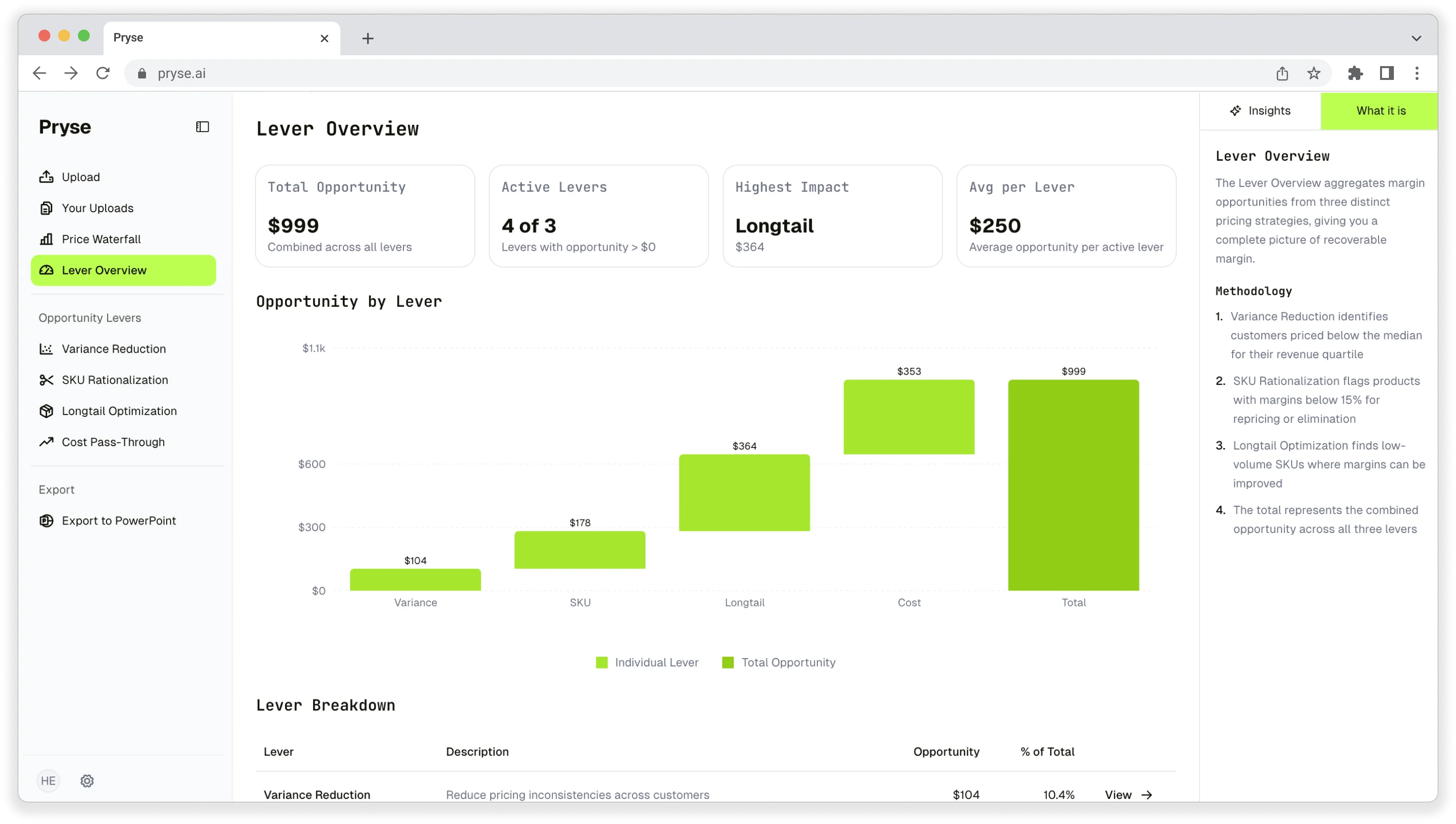
If you need to analyze pricing and margin across your customer base, Pryse provides instant visibility into margin by customer, product, and transaction. Upload your data and see where you have pricing power in 24 hours, not 6 months.
For the complete framework on raising prices including communication templates and industry-specific tactics, see our complete guide to raising prices. For broader margin improvement strategies beyond price increases, see our guide to improving profit margins.
Sources
- SCORE: How to Raise Prices Without Losing Customers
- American Express: 12 Ways to Raise Prices Without Ticking Off Your Customers
- GoDaddy: How to raise prices without losing customers
- NetSuite: How to Increase Prices Without Losing Customers
- Better Marketing: How to Raise Prices Without Losing Customers (or Your Nerve)
- Xero: How to increase your prices without losing customers
- Chargebee: The 58% Rule - How To Raise Prices Without Losing Subscribers
- Marketing LTB: Customer Retention Statistics 2025
- Semrush: 65 Customer Retention Statistics You Need to Know in 2025
- Cropink: 35+ Customer Retention Statistics
- Simon-Kucher: Our top 5 takeaways from running price increase campaigns for B2B clients in 2024
- SAGE Journals: The Effect of Service Price Increases on Customer Retention
Last updated: February 24, 2026
Frequently Asked Questions
Want to analyze your entire product catalog?
Pryse automatically identifies margin leakage across thousands of SKUs. Upload your data and find hidden profit in 24 hours.
One-time $1,499 diagnostic. No subscription required.