 Pryse
PrysePrice Increase Email Example: 7 Copy-Paste Templates for B2B & SaaS (2026)
Copy-paste email templates for announcing price increases to customers. Includes timing, subject lines, and proven tactics to retain 85-95% of customers through increases.
A price increase email is the message you send customers to notify them of upcoming pricing changes. Get it right—clear subject line, new price upfront, specific reasons, adequate notice—and you'll retain 85% to 95% of customers. Get it wrong—vague subject, buried information, apologetic tone—and you'll trigger unnecessary churn.
Research from Simon-Kucher on B2B price increase campaigns found that companies with clear communication and adequate advance notice retain 85% to 95% of customers through price increases. Companies that surprise customers or use vague justifications lose 30% or more.
The difference comes down to how you write the email—what you say in the subject line, how you structure the opening, and which options you offer customers.
This post provides seven copy-paste email templates for common scenarios—SaaS, professional services, B2B wholesale, manufacturing, contractors, e-commerce, and general B2B. Each template follows proven best practices for structure, timing, and tone.
What a Price Increase Email Must Include
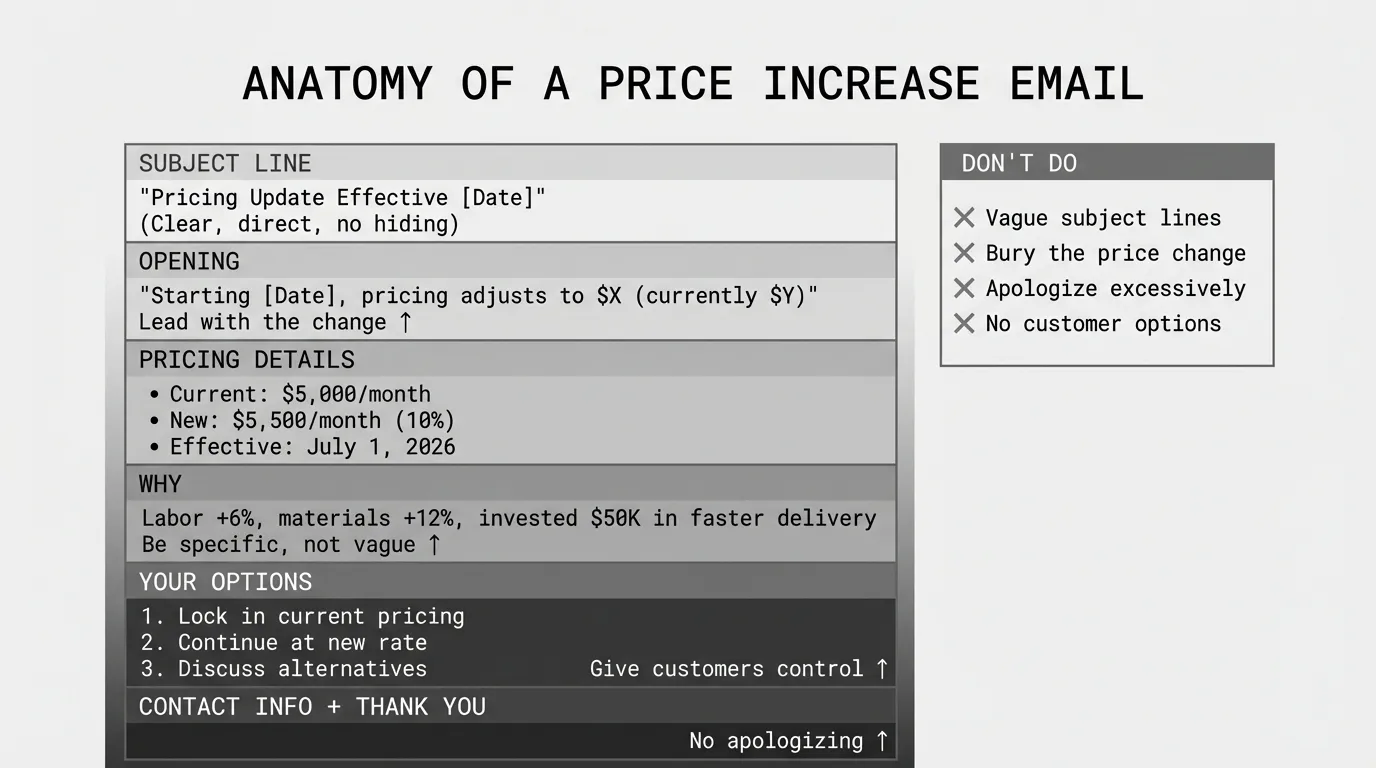
Every effective price increase email follows the same structure:
1. Clear subject line. Use "Pricing Update Effective [Date]" or "[Company Name] Pricing Adjustment – [Date]." According to Flodesk's price increase email guide, getting straight to the point in your subject line builds trust and shows you respect your customer's time. Don't bury the topic in vague subjects like "Important Update" or "Account Changes."
2. Direct opening statement. Lead with the change in the first sentence: "Effective July 1, 2026, our pricing will be adjusting to $5,500/month (currently $5,000/month)." According to Orb's guide on announcing price increases, start by directly informing customers that the price of your product or service will increase to the new price effective a certain date.
3. Specific pricing details. State the current price, new price, and percentage change. If pricing varies by tier or product, provide examples or link to a full pricing sheet.
4. Exact effective date. Not "next quarter" or "soon." Use "Effective July 1, 2026" or "All invoices dated on or after June 15, 2026."
5. Brief, honest explanation. According to LiveAgent's price increase templates, clearly explain the reasons behind the price increase, as customers appreciate honesty and are more likely to accept changes when they understand the rationale. Be specific: "Labor costs increased 6%, materials rose 12%, and we invested $50K in faster delivery that cut lead times from 5 days to 2 days" beats "rising costs industry-wide."
6. Customer options. Offer alternatives: lock in current pricing with a longer contract, continue at the new rate, or choose a reduced-service tier. According to TextExpander's price increase email guide, providing options or alternatives like temporary discounts or extensions at the old price helps customers struggling with the change.
7. Contact information. Make it easy for customers to ask questions. Include a phone number, email, or calendar link.
8. Grateful closing. Thank customers for their business without apologizing for the increase.
What NOT to Include in a Price Increase Email
Before the templates, here's what to avoid:
Apologizing for the increase. According to Orb's price increase guide, as a business, you have every right to raise your prices every once in a while. If you sound too apologetic when announcing your price increase, you are undermining your product's value.
Vague justifications. "Due to rising costs" explains nothing. Be specific: "Steel prices rose 14%, freight costs increased 8%, labor rates went up 5%."
Burying the information. Don't hide the increase in paragraph three after background context. Lead with it in the first sentence.
Tentative language. Don't say "we may need to adjust pricing" or "we're considering an increase." State it definitively: "Pricing is adjusting to $X effective [date]."
Generic subject lines. "Important Update" or "Changes to Your Account" makes customers ignore the email or feel you're hiding something.
Subject Line Examples That Work
Your subject line determines whether customers open the email or ignore it. Use these proven formats:
| Subject Line | Open Rate Impact | When to Use |
|---|---|---|
| Pricing Update Effective July 1, 2026 | High (direct, clear) | Default choice for most businesses |
| [Company Name] Pricing Adjustment – July 2026 | High (professional, specific) | B2B contracts, formal relationships |
| Important: New Pricing Starting [Date] | Medium (clear but generic) | Mass announcements to large lists |
| Your [Product] Subscription – Pricing Update | Medium (personalized) | SaaS, subscription businesses |
| Changes to Your [Service] Pricing | Low (vague, sounds negative) | Avoid—sounds evasive |
| Quick Update About Your Account | Very Low (too vague) | Avoid—looks like spam |
According to Flodesk's email template guide, clear, direct subject lines perform better than vague ones because they build trust and show respect for the customer's time.
Template 1: SaaS and Software Subscriptions
This template works for software companies raising monthly or annual subscription prices.
Subject: [Product Name] Pricing Update – Effective [Date]
Hi [Name],
We're writing to let you know that starting [Date], the price for [Product Name] will be adjusting to $[X]/month (currently $[Y]/month).
Why this change: Since you joined, we've launched [Feature 1], [Feature 2], and [Feature 3], expanded support to 24/7 availability, and improved uptime to 99.97%. This pricing adjustment reflects the increased value we're delivering and allows us to continue investing in the product improvements you've requested.
What's changing:
- Current plan: $[Y]/month
- New plan: $[X]/month ([Z%] increase)
- Effective date: [Date]
Your options:
- Lock in current pricing: Upgrade to an annual plan before [date] and pay $[current monthly rate × 12] for the next 12 months
- Grandfathered pricing: Existing customers can keep current pricing by committing to a 24-month plan
- Continue at new rate: No action needed—billing will automatically adjust on [effective date]
If you have questions or want to discuss your options, reach out to our team at [email] or schedule a call here: [calendar link].
Thanks for being a valued customer, [Your Name] [Company Name]
Why this works: According to Pace Pricing's SaaS price increase guide, start by highlighting the changes and upgrades you've made to your product. This sets the tone and shows commitment to improvement. The template offers multiple retention levers (annual plans, long-term contracts) and makes follow-up easy with a calendar link.
Template 2: B2B Professional Services (Consultants, Agencies, Accountants)
This template works for service businesses raising hourly rates or retainer fees.
Subject: [Your Company] Pricing Update – Effective [Date]
Dear [Name],
I wanted to give you advance notice that starting [Date], our pricing will be adjusting to reflect the value we deliver and continued investment in our team.
New pricing:
- Current rate: $[X]/hour
- New rate: $[Y]/hour ([Z%] increase)
- Effective date: [Date]
Why this change: Since we began working together, we've [specific results delivered: reduced processing time by 40%, saved you $120K in operational costs, improved accuracy to 99.8%]. We've also expanded our team, invested in [new certifications/tools], and increased our availability to [24/7 support, faster turnaround times, etc.].
This pricing adjustment reflects those improvements and the rising costs we've managed: software subscriptions up 12%, professional liability insurance up 8%, and talent costs up 6%.
Your options:
- Lock in current rates: Sign a 12-month retainer agreement by [date] and we'll hold current pricing through [end date]
- Reduced scope: If budget is a constraint, we can discuss a reduced-scope engagement at [lower rate]
- Continue at new rates: Continue working together at the new rate starting [effective date]
I'd be happy to schedule a call this week to discuss which option works best for you.
Thank you for your continued trust in our work, [Your Name] [Title] [Phone Number] [Email]
Why this works: It reinforces specific value delivered with dollar amounts and percentages, ties the increase to both cost pressures and improvements, and offers meaningful alternatives for budget-conscious clients.
Template 3: B2B Wholesale Distribution
This template works for distributors raising prices due to supplier cost increases or freight surcharges.
Subject: Pricing Update for [Customer Name] – Effective [Date]
Dear [Name],
I'm writing to notify you that effective [Date], our pricing will be adjusting by [X%] across all product categories.
Why this change: Over the past [X months], we've seen supplier cost increases of [X%] on [specific products/categories], freight costs rise [X%], and labor costs increase [X%]. We've absorbed these increases for [X months] while maintaining inventory availability and service levels, but we need to adjust pricing to sustain operations.
What's changing:
- Current pricing: [Example SKU or category pricing]
- New pricing: [Example SKU or category pricing]
- Effective date: [Date]
Your options:
- Lock in current pricing: Submit purchase orders before [deadline date] for delivery through [date] at current pricing
- Annual contract: Sign a 12-month agreement by [date] and we'll hold pricing at current rates through [end date]
- Continue at new rates: No action needed—new pricing applies to all orders placed starting [effective date]
We value your partnership and want to make this transition smooth. If you have questions or want to discuss your options, please reach out directly.
Sincerely, [Your Name] [Title] [Phone Number] [Email]
Why this works: It's specific about cost drivers customers can verify independently, offers a "last chance" window to stock up at current pricing, and rewards long-term commitments with pricing stability.
Template 4: Manufacturing and Contract Manufacturers
This template works for manufacturers raising prices on products or custom work.
Subject: Pricing Adjustment – Effective [Date]
Dear [Name],
I'm reaching out to notify you that effective [Date], our pricing on [product line/SKU category] will be adjusting by [X%].
Why this change: Raw material costs have increased [X%] industry-wide due to [tariffs, supply chain disruptions, commodity price increases]. Steel prices rose [X%], resins increased [X%], and freight costs are up [X%]. We've absorbed these increases for the past [X months] while maintaining quality and delivery times, but we need to adjust pricing to sustain operations.
What's changing:
- Previous pricing: [Example part number or SKU with pricing]
- New pricing: [Example part number or SKU with new pricing]
- Effective date: All orders placed on or after [Date]
Your options:
- Lock in current pricing: Submit purchase orders before [deadline date] for delivery through [date] at current pricing
- Annual volume commitment: Commit to [X units] annually by [date] and we'll cap price increases at [X%] through [year]
- Continue at new rates: New pricing applies to all orders placed after [effective date]
We value your business and want to maintain our partnership. If you'd like to discuss your options or have questions, I'm available for a call this week.
Best regards, [Your Name] [Title] [Phone Number] [Email]
Why this works: It ties the increase to specific commodity and freight cost drivers, offers volume commitment incentives, and gives a window to place orders at old pricing.
Template 5: General Contractors and Trades
This template works for contractors raising labor rates or project pricing.
Subject: Updated Pricing – Effective [Date]
Hi [Name],
I wanted to give you advance notice that effective [Date], our pricing will be adjusting to reflect increased labor and material costs.
New pricing:
- Current hourly rate: $[X]/hour
- New hourly rate: $[Y]/hour ([Z%] increase)
- Effective date: [Date]
Why this change: Labor costs in our market have increased [X%] over the past year, liability insurance premiums rose [X%], and material costs are up [X%] on average. We've held pricing flat for [X months/years], but need to adjust to maintain the quality and reliability you've come to expect.
What this means for you:
- Any quotes or proposals issued before [date] will be honored at current pricing
- Work scheduled but not yet started will be invoiced at new rates unless quoted before [date]
- Existing contracts will not be affected—new pricing applies only to future work
If you have upcoming projects you'd like us to quote before the increase, please reach out by [deadline date].
Thanks for your continued trust in our work, [Your Name] [Company Name] [Phone Number]
Why this works: It clearly states which work is affected and which isn't. Honoring existing quotes protects customer trust while setting boundaries for new work.
Template 6: E-Commerce and Retail Businesses
This template works for online retailers or retail businesses raising product prices.
Subject: Pricing Update – Effective [Date]
Dear Valued Customer,
We're writing to let you know that starting [Date], the prices on [product categories] will be adjusting to reflect increased costs from our suppliers.
What's changing:
- [Product category 1]: Increasing by approximately [X%]
- [Product category 2]: Increasing by approximately [Y%]
- Effective date: [Date]
Why this change: Our suppliers have implemented price increases of [X%] to [Y%] due to [raw material costs, freight, labor shortages]. We've negotiated to minimize the impact on our customers, but we need to adjust our pricing to maintain product availability and service quality.
What you can do:
- Stock up now: Orders placed before [deadline date] will be honored at current pricing
- Sign up for our email list: Get advance notice of sales and exclusive member discounts
- Continue shopping: We remain committed to providing the best value and service in the market
If you have questions about how this affects specific products, please contact us at [email] or [phone number].
Thank you for your continued support, [Your Name] [Company Name]
Why this works: It frames the increase as supplier-driven (external, not arbitrary), offers a window to purchase at old pricing, and emphasizes ongoing value.
Template 7: General B2B Email (Adaptable for Any Industry)
This generic template works for any B2B business and can be adapted to specific industries.
Subject: [Company Name] Pricing Update – Effective [Date]
Dear [Name],
I'm writing to inform you that effective [Date], our pricing for [product/service] will be adjusting by [X%].
What's changing:
- Current pricing: $[X]
- New pricing: $[Y] ([Z%] increase)
- Effective date: [Date]
Why this change: [Be specific: "Our supplier costs have increased X%, labor costs rose Y%, and we've invested $Z in improvements including..." OR "We've expanded our team by 30%, launched new features including [list], and improved delivery times by 40%"]
Your options:
- Lock in current pricing: [Action required and deadline, e.g., "Sign a 12-month contract by May 15"]
- Continue at new pricing: No action needed—new pricing takes effect automatically on [effective date]
- Discuss alternatives: If you have budget constraints, we can explore modified service tiers
We value your business and want to ensure this transition is smooth. If you have questions or want to discuss your options, please reach out at [phone] or [email].
Thank you for your continued partnership, [Your Name] [Title] [Company Name] [Phone Number] [Email]
Why this works: It follows the proven structure—clear opening, specific details, honest explanation, customer options—while remaining flexible enough to adapt to any industry.
How Much Advance Notice to Give
According to LiveAgent's price increase templates, businesses should always provide advance notice—ideally at least 30 days—so customers have time to adjust.
| Customer Type | Minimum Notice | Recommended | Timing Strategy |
|---|---|---|---|
| B2B annual contracts | 60 days | 90 days | Email + personal call to top accounts |
| Month-to-month SaaS | 30 days | 60 days | Email announcement + reminder at 30 days |
| Wholesale/distribution | 60 days | 90 days | Email + option to stock up at old pricing |
| High-value accounts (top 20%) | 90 days | 90+ days + personal call | Personal outreach before mass email |
| New customers (under 1 year) | 60 days | Consider grandfathering | Short tenure = higher price sensitivity |
Multi-Email Timeline for Maximum Retention
Don't rely on a single email. Layer communication over 60-90 days:
Day 1 (90 days before effective date): High-value accounts get personal phone calls or video meetings before the mass email.
Day 7 (75 days before): Send initial price increase email to all customers using Templates 1-7.
Day 30 (60 days before): Follow-up email to customers who haven't responded, offering to answer questions.
Day 45 (45 days before): Reminder email with deadline to lock in current pricing. Subject: "Reminder: Pricing Changes on [Date] – Lock in Current Rates by [Deadline]"
Day 75 (15 days before): Final reminder email. Subject: "Final Reminder: New Pricing Effective in 15 Days"
Day 90 (Effective date): Confirmation email that new pricing is now in effect.
According to Flodesk's email guide, announce the price change well in advance—at least 30 days is a good rule of thumb—and follow up to ensure no one misses the announcement.
Common Email Mistakes That Trigger Churn
Mistake 1: Vague or misleading subject line
Weak: "Important Update About Your Account"
Strong: "Pricing Update Effective July 1, 2026"
Mistake 2: Burying the price change
Weak: Three paragraphs of context before mentioning the new price in paragraph four.
Strong: First sentence states the new price and effective date.
Mistake 3: No specific reason
Weak: "Due to rising costs and market conditions, we're adjusting our pricing."
Strong: "Labor costs increased 6%, supplier costs rose 12%, and we invested $50K in faster delivery capabilities that reduced lead times from 5 days to 2 days."
Mistake 4: Apologizing excessively
Weak: "We're really sorry, but unfortunately we have to raise prices. We know this is inconvenient and we apologize."
Strong: "Our pricing is adjusting to $5,500/month starting July 1 to reflect the value we deliver and rising operational costs."
Mistake 5: No options
Weak: "Pricing is increasing 15% next month. Let us know if you have questions."
Strong: "You can lock in current pricing by signing a 12-month contract before May 15, continue at the new rate starting June 1, or discuss a reduced-scope option."
How to Personalize for Top Customers
Templates work for mass communication, but your top 20% of customers by revenue deserve personal outreach before the mass email.
High-Value Customer Sequence
Week 1-2 (90 days before): Personal phone calls or video meetings with top accounts. Script: "Hi [Name], I wanted to give you a heads-up before we send the official announcement next week. Starting [Date], our pricing is adjusting to $[X]. I wanted to discuss your options personally..."
Week 3 (75 days before): Send the email template as written confirmation of what you discussed.
Week 6 (60 days before): Follow-up check-in: "Just following up on our conversation about the pricing adjustment. Do you have any questions or want to discuss the contract option further?"
Week 10 (30 days before): Reminder about deadline to lock in current pricing.
According to Prisync's guide on emailing customers about price changes, acknowledge the customer impact by showing you understand a price increase can be an adjustment for customers with a phrase like, "We recognize that a price change affects your budget..."
When to Send the Email (Strategic Timing)
Timing determines whether a price increase feels justified or arbitrary.
Best times to send:
- Contract renewal dates (natural inflection point)
- After delivering measurable results
- During regular annual pricing reviews
- When industry-wide cost increases are publicized
Worst times to send:
- Immediately after a service failure or quality issue
- During economic downturns when customers are cutting budgets
- When you're already experiencing high churn
- During customer onboarding (first 90 days)
Where to Start
If you need to send a price increase email:
Step 1: Choose the template that fits your business model (Templates 1-7).
Step 2: Customize the placeholders with your specific pricing, dates, and reasons. Be specific about cost increases or value delivered.
Step 3: Segment your customer base. Identify your top 20% by revenue for personal outreach.
Step 4: Call high-value accounts 90 days before the effective date, then send the email as confirmation.
Step 5: Send the mass email to remaining customers 60-90 days before the effective date.
Step 6: Send reminder emails at 45 days and 15 days before the effective date.
Step 7: Monitor responses. Track customer retention rate (target: 85-95%) and revenue retention rate (target: 90%+).
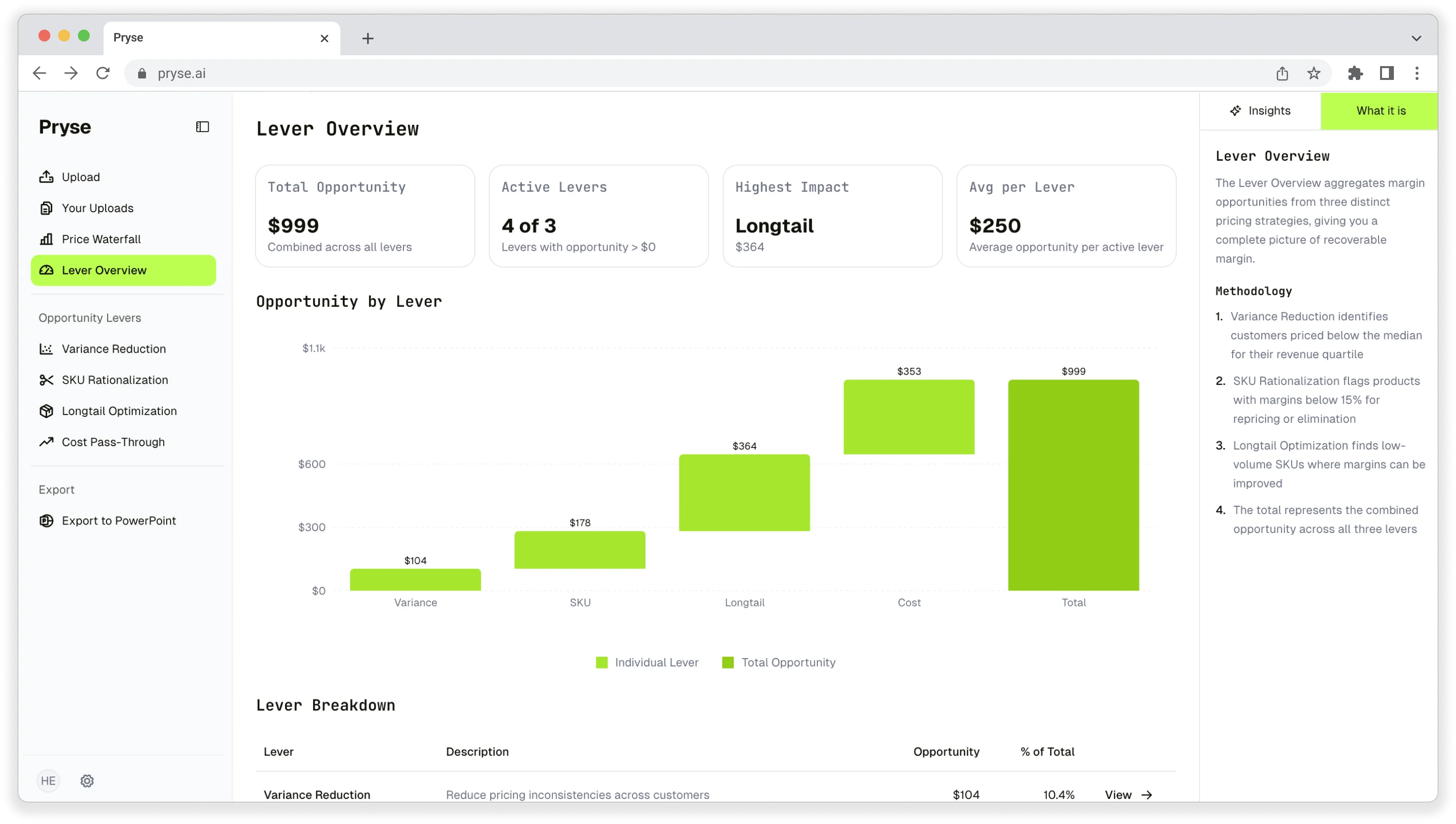
For businesses managing complex pricing across hundreds of customers or SKUs, identifying where you have pricing power is the bottleneck. Which customers can absorb a 10% increase versus 5%? Which products have margin leakage that justifies a 15% adjustment?
If you need to analyze margin by customer, product, or transaction before raising prices, Pryse provides instant visibility into where you have pricing power. Upload your data and see margin leakage in 24 hours.
For formal letter templates with detailed structure, see our price increase letter templates. For multi-channel announcement strategies including phone and in-person scripts, see our price increase announcement guide. For the complete framework on raising prices including retention tactics, see our guide on how to raise prices without losing customers. For broader margin improvement strategies beyond price increases, see our complete guide to improving profit margins.
Sources
- Flodesk: 5 great price increase email templates to copy & paste
- LiveAgent: How to Notify Customer About Price Increase?
- Orb: Write a price increase letter to customers (4 templates + tips)
- TextExpander: How to Write a Price Increase Email | Templates and Examples
- Pace Pricing: Crafting a Winning SaaS Price Increase Email
- Prisync: How to Email Customers About a Price Change
- Simon-Kucher: Our top 5 takeaways from running price increase campaigns for B2B clients in 2024
Last updated: February 24, 2026
Frequently Asked Questions
Want to analyze your entire product catalog?
Pryse automatically identifies margin leakage across thousands of SKUs. Upload your data and find hidden profit in 24 hours.
One-time $1,499 diagnostic. No subscription required.