 Pryse
Pryse13 Dynamic Pricing Tools for Retail, B2B & Hotels (2026)
Compare Pricefx, Vendavo, PROS, Competera, and other dynamic pricing tools. Features, pricing, and which software fits retail, distribution, and manufacturing.
Dynamic pricing tools adjust product prices automatically based on market conditions—competitor pricing, demand signals, inventory levels, and customer behavior. Airlines, hotels, and e-commerce retailers use these tools to update prices hundreds of times daily without manual intervention.
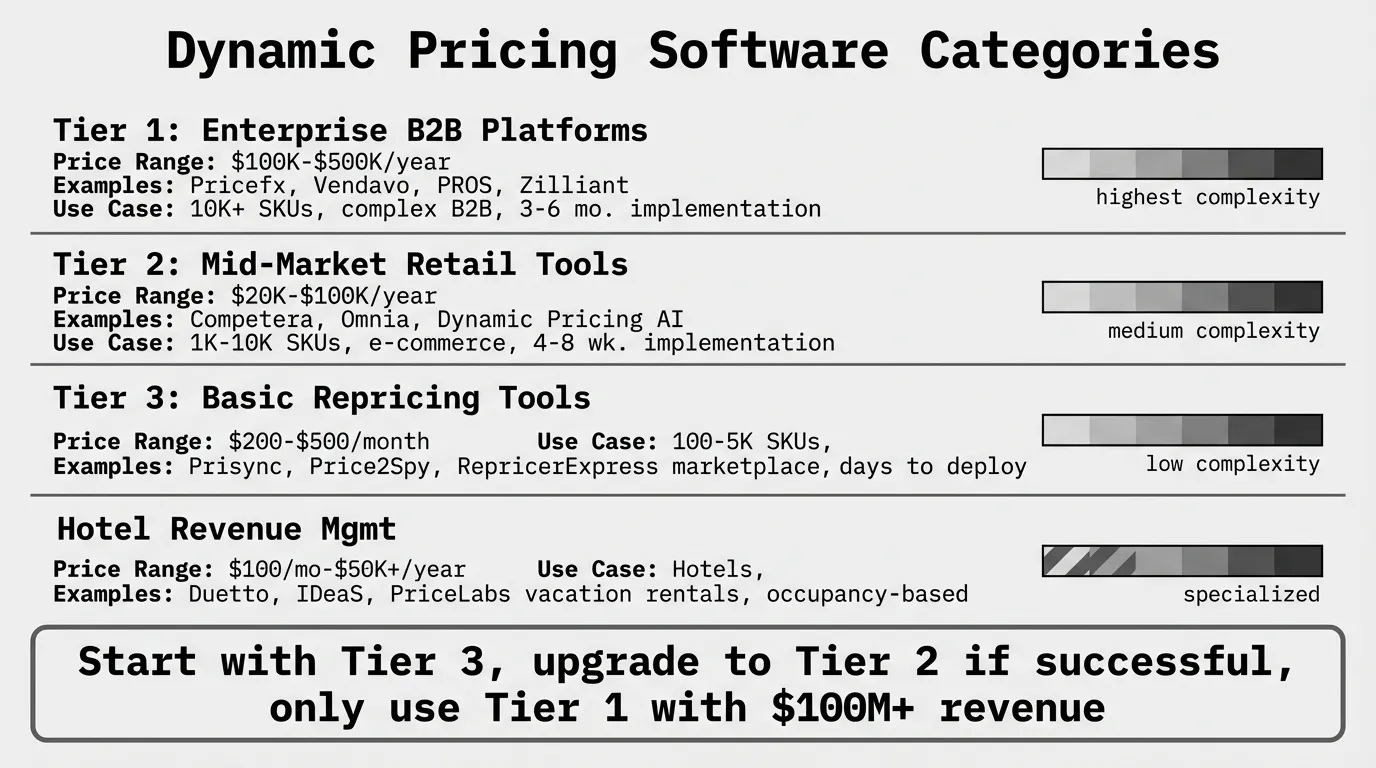
The software market divides into clear categories: enterprise platforms for complex B2B distribution ($100K-$500K annually), mid-market tools for retail and e-commerce ($20K-$100K annually), and basic repricing software for small catalogs ($200-$500/month).
Picking the wrong category wastes money and creates implementation problems. A $50M distributor with 15,000 SKUs and negotiated customer contracts doesn't need Pricefx's $300K/year enterprise platform—they need simpler pricing logic first. A fast-moving e-commerce seller competing on Amazon can't use Vendavo's 6-month implementation cycle—they need repricing that deploys in days.
This post compares 13 dynamic pricing tools across categories, showing features, pricing ranges, ideal use cases, and implementation requirements. If you're researching pricing software, seeing how others chose tools helps you avoid expensive mismatches.
What is Dynamic Pricing Software?
Dynamic pricing software automates price adjustments in response to real-time market conditions using algorithms that analyze competitor pricing, demand signals, inventory levels, costs, and customer behavior.
The mechanism: Software monitors data inputs (competitor prices, sales velocity, inventory), applies pricing rules or machine learning models, calculates optimal prices, and updates prices across e-commerce platforms, ERP systems, or POS terminals without manual intervention.
Common names:
- Price optimization software (emphasizes margin maximization)
- Competitive pricing software (emphasizes competitor monitoring)
- Algorithmic repricing tools (emphasizes automation)
- Revenue management software (hotel/airline terminology)
For a deeper explanation of how dynamic pricing works and when to use it, see our what is dynamic pricing guide. For real-world implementation examples, see our dynamic pricing examples breakdown.
Categories of Dynamic Pricing Tools
Dynamic pricing software falls into distinct categories based on industry focus, catalog size, and implementation complexity.
Enterprise B2B Platforms ($100K-$500K/year)
Built for: Manufacturers, distributors, and industrial B2B companies with complex pricing needs.
Characteristics:
- Support 10,000-100,000+ SKUs
- Handle negotiated contracts, customer-specific pricing, rebates, and multi-tier channels
- Integrate deeply with ERP systems (SAP, Oracle, NetSuite, D365)
- Require 3-6 month implementation with professional services
- Include AI-powered optimization, scenario modeling, and advanced analytics
Who needs this: Companies with $100M+ revenue, complex sales processes, and dedicated pricing teams.
Mid-Market Retail & E-Commerce ($20K-$100K/year)
Built for: Retailers, online sellers, and mid-sized distributors with transactional sales.
Characteristics:
- Support 1,000-10,000 SKUs
- Focus on competitor monitoring and automated repricing
- Integrate with e-commerce platforms (Shopify, BigCommerce, WooCommerce)
- Deploy in 4-8 weeks
- Simpler AI models optimized for margin and competitiveness
Who needs this: E-commerce businesses with $10M-$100M revenue competing on price.
Basic Repricing Tools ($200-$500/month)
Built for: Small e-commerce sellers and Amazon/eBay merchants.
Characteristics:
- Support 100-5,000 SKUs
- Focus on real-time competitor price matching
- Deploy in days via marketplace APIs
- Rule-based repricing (no sophisticated AI)
- Self-service setup and management
Who needs this: Online sellers with under $10M revenue selling commodity products.
Hotel Revenue Management (Varies widely)
Built for: Hotels, vacation rentals, and hospitality operators.
Characteristics:
- Optimize room rates based on occupancy, demand forecasts, and events
- Integrate with property management systems and booking engines
- Specialized for time-limited perishable inventory
- Pricing varies from $100/month for small properties to $50K+ for enterprise hotel chains
Who needs this: Hotels, Airbnb hosts, vacation rental managers.
Enterprise B2B Dynamic Pricing Platforms
These platforms target large manufacturers, distributors, and industrial B2B companies with complex pricing needs.
1. Pricefx
According to Pricefx, Pricefx is a cloud-native pricing platform that enables dynamic pricing strategies through AI-powered optimization, segmentation, and analytics, supporting real-time price adjustments based on market data, customer behavior, and competitive intelligence.
Target industries: Distribution, manufacturing, chemicals, industrial supplies, aftermarket parts.
Key features:
- AI-powered price optimization with elasticity modeling
- Scenario modeling ("what happens if we raise prices 5% on 2,000 SKUs?")
- Customer segmentation and value-based pricing
- Rebate management and contract pricing
- Integration with SAP, Oracle, NetSuite, D365
Pricing: $100K-$300K annually depending on modules and user count. Implementation adds $50K-$150K.
Implementation time: 3-6 months.
Strengths: Strong AI capabilities, comprehensive B2B feature set, flexible pricing rules engine.
Weaknesses: Expensive for mid-market companies, complex implementation, requires dedicated pricing team.
Best for: Distributors with $100M+ revenue, 10,000+ SKUs, and mature pricing processes needing advanced optimization.
2. Vendavo
According to research on B2B pricing software, Vendavo is an enterprise-grade dynamic pricing platform designed for B2B organizations, leveraging AI and advanced analytics to optimize pricing strategies across complex sales environments, providing tools for real-time price optimization, deal management, segmentation, and elasticity modeling.
Target industries: Distribution, manufacturing, chemicals, building materials, industrial services.
Key features:
- Deal pricing guidance for sales teams
- Margin waterfall analysis (list to pocket price)
- Price sensitivity analysis by customer segment
- Competitive intelligence integration
- CPQ (configure-price-quote) integration
Pricing: $150K-$500K annually. Enterprise pricing varies widely based on deal size.
Implementation time: 4-6 months.
Strengths: Deep distribution expertise, strong deal guidance for salespeople, handles complex B2B pricing logic.
Weaknesses: Very expensive, slow implementation, requires organizational change management.
Best for: Large distributors and manufacturers with consultative sales processes, negotiated contracts, and need for sales team pricing guidance.
3. PROS
PROS pricing software is an enterprise-grade AI-powered pricing and revenue management platform tailored for B2B companies, enabling dynamic pricing optimization, CPQ, and sales guidance, leveraging machine learning to analyze vast datasets including customer behavior, market dynamics, and competitive intelligence.
Target industries: Airlines, hotels, manufacturing, distribution, chemicals, logistics.
Key features:
- Real-time price optimization with machine learning
- Dynamic quoting and CPQ
- Revenue management for service-based pricing
- Advanced forecasting and demand modeling
- Integration with CRM and ERP systems
Pricing: $200K-$500K+ annually. PROS targets large enterprises exclusively.
Implementation time: 6-12 months.
Strengths: Most advanced AI and machine learning capabilities, airline-grade revenue management, comprehensive solution.
Weaknesses: Most expensive option, longest implementation, requires significant organizational change and data infrastructure.
Best for: Fortune 500 manufacturers and distributors with complex pricing, dedicated pricing teams, and budgets for best-in-class software.
4. Zilliant
Zilliant software is a cloud-based platform for B2B businesses that automates the pricing and sales processes, enabling organizations to obtain key leads by assisting in the management of inventory, sales, and more, with real-time market pricing gathering information from a variety of sources presenting optimal prices based on industry standards.
Target industries: Distribution, manufacturing, chemicals, building materials.
Key features:
- Price optimization based on customer willingness to pay
- Customer-specific pricing recommendations
- Margin opportunity identification
- Price execution tracking
- Sales guidance for quote approvals
Pricing: $100K-$250K annually.
Implementation time: 3-5 months.
Strengths: Strong B2B distribution focus, good balance of sophistication and usability, sales team adoption features.
Weaknesses: Less comprehensive than PROS or Vendavo, requires clean customer and transaction data.
Best for: Mid-market to large distributors ($50M-$500M revenue) with transactional business models and clean data.
Mid-Market Retail & E-Commerce Tools
These tools target retailers, online sellers, and mid-sized companies needing simpler dynamic pricing without enterprise complexity.
5. Competera
Competera pricing software is an AI-based pricing optimization software for B2B and retail price intelligence.
Target industries: Retail, e-commerce, consumer electronics, fashion, home goods.
Key features:
- AI-powered demand forecasting and price elasticity
- Competitor price monitoring from websites and marketplaces
- Automated repricing based on competitive positioning
- Category-level optimization strategies
- Integration with e-commerce platforms and ERPs
Pricing: $30K-$80K annually depending on catalog size and features.
Implementation time: 4-8 weeks.
Strengths: Strong AI for mid-market pricing, reasonable cost compared to enterprise platforms, good e-commerce integrations.
Weaknesses: Less robust than enterprise platforms for complex B2B scenarios, requires good historical data.
Best for: Retailers and e-commerce businesses with $10M-$100M revenue, 1,000-10,000 SKUs, and straightforward pricing logic.
6. Omnia Retail
According to G2's Winter 2026 rankings, Omnia Retail leads the category in G2's Winter 2026 Grid for Retail Pricing Software, outperforming all solutions in both customer satisfaction and market presence.
Omnia's platform collects direct, real-time pricing data from competitors and marketplaces like Amazon and eBay, and tracks promotions, discounts, and patterns that influence the competitive landscape.
Target industries: Retail, e-commerce, consumer goods.
Key features:
- Real-time competitor price scraping
- Dynamic repricing with business rules
- Marketing automation for pricing strategies
- Integration with Amazon, eBay, and webshops
- Dashboard showing competitive positioning
Pricing: Contact for pricing (estimated $20K-$60K annually based on catalog size).
Implementation time: 2-6 weeks.
Strengths: Excellent user reviews, strong competitor monitoring, flexible repricing rules, good customer support.
Weaknesses: Focused on retail/e-commerce (not B2B distribution), less sophisticated AI than Competera.
Best for: Online retailers with 1,000-5,000 SKUs competing heavily on marketplaces and needing strong competitor intelligence.
7. Dynamic Pricing AI
Dynamic Pricing AI software uses AI-assisting models to find optimal prices and offers 20+ built-in pricing policies.
Target industries: E-commerce, retail, direct-to-consumer brands.
Key features:
- AI-driven price optimization
- 20+ pre-built pricing strategies (competitor-based, margin-based, demand-based)
- Automated repricing based on stock levels
- Integration with Shopify, WooCommerce, Magento
- Real-time reporting and analytics
Pricing: $500-$2,000/month depending on SKU count and features.
Implementation time: 1-2 weeks.
Strengths: Quick setup, affordable for mid-market, flexible pricing policies, good for DTC brands.
Weaknesses: Limited B2B functionality, less enterprise integration capability.
Best for: E-commerce stores with 500-5,000 SKUs needing fast implementation and affordable AI-powered pricing.
Basic Repricing Tools for Small Businesses
These tools work for small e-commerce sellers, Amazon merchants, and businesses with simple pricing needs.
8. Prisync
Prisync dynamic pricing software boosts price positioning by automatically adjusting cost-based and competitor-based price settings, and sets prices automatically to improve profit margins whenever market prices or stock availabilities change.
Target industries: E-commerce, Amazon/eBay sellers, online retailers.
Key features:
- Competitor price tracking from any website
- Automated repricing rules (match, beat by 5%, stay within range)
- Stock availability monitoring
- Email alerts for price changes
- Integration with e-commerce platforms
Pricing: $200-$500/month depending on product count. Free trial available.
Implementation time: 1-3 days.
Strengths: Affordable, easy setup, good for small catalogs, flexible repricing rules.
Weaknesses: No sophisticated AI, limited demand forecasting, basic reporting.
Best for: Small e-commerce sellers with 100-2,000 SKUs needing competitor-based repricing without enterprise cost.
9. Price2Spy
Price2Spy platform provides real-time price monitoring, price change alerts, and comprehensive pricing analytics, and includes a dynamic pricing module that allows automatic adaptation of prices based on market changes.
Target industries: E-commerce, retail, online marketplaces.
Key features:
- Competitor price tracking
- Automated repricing with min/max constraints
- Historical price tracking and reporting
- API for custom integrations
- Multi-currency and multi-country support
Pricing: $250-$600/month based on number of products tracked.
Implementation time: 1-2 days.
Strengths: Reliable price scraping, good historical data, affordable, strong reporting.
Weaknesses: Interface feels dated, limited AI capabilities, manual rule setup.
Best for: E-commerce businesses with 500-3,000 SKUs needing reliable competitor monitoring and simple repricing.
10. RepricerExpress
RepricerExpress targets Amazon, eBay, and Walmart marketplace sellers with real-time repricing.
Target industries: Amazon FBA sellers, eBay merchants, marketplace sellers.
Key features:
- Real-time repricing (every 60 seconds on Amazon)
- Buy Box optimization strategies
- Rule-based repricing (match lowest price, beat by $0.01, stay within margin)
- Bulk listing management
- Integration with Amazon, eBay, Walmart, Shopify
Pricing: $79-$400/month based on product count.
Implementation time: Hours to 1 day.
Strengths: Fast repricing, Buy Box focused, affordable, good for marketplace sellers.
Weaknesses: Limited to marketplace selling, no demand forecasting, basic analytics.
Best for: Amazon and eBay sellers with 100-5,000 SKUs focused on winning the Buy Box.
Hotel Revenue Management Software
These specialized tools optimize pricing for hotels, vacation rentals, and hospitality operators.
11. Duetto
According to hotel pricing research, Duetto is one of the most widely adopted revenue management solutions in the hotel industry, known for its advanced data-driven approach to pricing, with an open pricing model allowing hotels to optimize rates dynamically across different customer segments, channels, and stay dates.
Target industries: Hotels, resorts, hotel chains.
Key features:
- Open pricing model (price each room night independently)
- Demand forecasting based on market data, events, and booking pace
- Channel management integration
- Group pricing optimization
- Real-time pricing updates across all channels
Pricing: Contact for pricing (estimated $15K-$50K+ annually for multi-property hotels).
Implementation time: 4-8 weeks.
Strengths: Industry-leading hotel revenue management, sophisticated forecasting, strong ROI for hotels.
Weaknesses: Expensive for small properties, requires training and change management.
Best for: Hotels with 50+ rooms, hotel chains, resorts needing sophisticated revenue management.
12. IDeaS
IDeaS revenue management is a pioneer in hotel revenue management, offering some of the most sophisticated AI-driven pricing solutions in the industry.
Target industries: Hotels, casinos, resorts, parking operators.
Key features:
- AI-powered revenue optimization
- Total revenue management (rooms, F&B, meeting space, spa)
- Automated rate and inventory recommendations
- Forecasting with machine learning
- Integration with major PMS systems
Pricing: Contact for pricing (estimated $20K-$100K+ annually for large properties).
Implementation time: 8-12 weeks.
Strengths: Most advanced hotel revenue management, total revenue optimization, strong analytics.
Weaknesses: Very expensive, complex implementation, overkill for small properties.
Best for: Large hotels, hotel chains, casinos, and resorts needing total revenue optimization across all revenue streams.
13. PriceLabs
PriceLabs provides dynamic pricing and revenue management tools for Airbnb, Vrbo, Booking.com, and vacation rentals.
Target industries: Vacation rentals, Airbnb hosts, property managers.
Key features:
- Automated dynamic pricing based on demand, events, and competition
- Market data from Airbnb and Vrbo
- Customizable pricing rules and minimum stays
- Integration with 40+ property management systems
- Portfolio-level analytics
Pricing: $20-$100/month per property (volume discounts for large portfolios).
Implementation time: 1-2 days.
Strengths: Affordable, easy setup, good for vacation rentals, strong Airbnb/Vrbo integration.
Weaknesses: Limited to vacation rental market, simpler algorithms than hotel revenue management software.
Best for: Airbnb hosts, vacation rental managers with 1-100 properties.
Key Features Comparison
Different dynamic pricing tools emphasize different capabilities. Understanding which features matter for your business helps narrow choices.
Competitor Price Monitoring
Essential for: Retailers, e-commerce sellers, and businesses competing in transparent markets.
How it works: Software scrapes competitor websites, monitors marketplaces (Amazon, eBay), and tracks price changes. When a competitor drops prices, the system alerts you or automatically adjusts your prices based on rules.
Tools with strong competitor monitoring:
- Omnia Retail (excellent real-time scraping)
- Prisync (flexible competitor selection)
- Price2Spy (reliable historical tracking)
- RepricerExpress (fast Amazon competitor tracking)
Enterprise platforms include competitor monitoring but emphasize optimization over pure competitive matching.
AI-Powered Price Optimization
Essential for: Large catalogs (5,000+ SKUs), businesses with good historical data, companies wanting to maximize margins beyond simple competitor matching.
How it works: Machine learning models analyze historical sales, price elasticity, demand patterns, and competitive dynamics to recommend optimal prices. The system learns which products are price-sensitive and which can support higher margins.
Tools with strong AI:
- PROS (most advanced machine learning)
- Pricefx (strong AI for B2B)
- Competera (good mid-market AI)
- IDeaS (hotel-specific AI forecasting)
Basic repricing tools (Prisync, Price2Spy, RepricerExpress) use rules-based logic, not AI.
ERP and E-Commerce Integration
Essential for: All businesses using dynamic pricing at scale.
How it works: Software connects to your ERP (SAP, Oracle, NetSuite, D365) or e-commerce platform (Shopify, BigCommerce, WooCommerce, Amazon) to pull cost data, inventory levels, and sales history, then push updated prices back automatically.
Integration strength by tier:
- Enterprise platforms (Pricefx, Vendavo, PROS, Zilliant): Deep ERP integration with complex data mapping
- Mid-market tools (Competera, Omnia): Good e-commerce and light ERP integration
- Basic tools (Prisync, RepricerExpress): E-commerce and marketplace APIs only
Margin Floor Constraints
Essential for: All businesses to prevent pricing below cost.
How it works: You set minimum profit margins or floor prices. The repricing algorithm won't drop prices below these constraints regardless of competitor pricing or demand signals.
All reputable dynamic pricing tools include margin constraints. Check that:
- Margins can be set by product, category, or customer segment
- The system blocks price updates that violate constraints
- You receive alerts when competitor prices fall below your floor
Demand Forecasting
Essential for: Businesses with seasonal demand, perishable inventory, or time-limited capacity.
How it works: Software analyzes historical sales patterns, external factors (events, weather, holidays), and booking pace to predict future demand. Prices increase when high demand is forecasted, decrease when low demand is expected.
Tools with strong forecasting:
- Duetto and IDeaS (hotel revenue management)
- PROS (comprehensive demand modeling)
- Competera (retail demand forecasting)
- PriceLabs (vacation rental demand signals)
Scenario Modeling
Essential for: Businesses wanting to test pricing strategies before implementing them.
How it works: You model "what if" scenarios: "What happens to margin if we raise prices 5% on 1,000 SKUs?" The system simulates volume impact based on price elasticity and competitor response.
Tools with scenario modeling:
- Pricefx (strong scenario capabilities)
- Vendavo (deal scenario modeling)
- PROS (advanced simulation)
- Zilliant (margin opportunity scenarios)
Mid-market and basic tools generally lack scenario modeling.
How Much Does Dynamic Pricing Software Cost?
Dynamic pricing software pricing varies dramatically by category and implementation complexity.
Enterprise B2B Platforms ($100K-$500K/year)
Annual software fees:
- Pricefx: $100K-$300K
- Vendavo: $150K-$500K
- PROS: $200K-$500K+
- Zilliant: $100K-$250K
Implementation costs: Add 20-50% of annual fees for implementation, data integration, training, and professional services. A $200K/year platform might cost $50K-$100K to implement.
Hidden costs:
- Ongoing professional services and support
- Dedicated pricing team (2-5 FTEs)
- Data quality improvements to feed the system
- Change management and sales training
Total first-year cost: $200K-$800K including software, implementation, and internal resources.
Mid-Market Tools ($20K-$100K/year)
Annual software fees:
- Competera: $30K-$80K
- Omnia Retail: $20K-$60K
- Dynamic Pricing AI: $6K-$24K ($500-$2,000/month)
Implementation costs: $5K-$20K for setup and integration.
Hidden costs:
- Pricing analyst (0.5-1 FTE)
- E-commerce or ERP integration work
- Data cleanup before deployment
Total first-year cost: $30K-$120K.
Basic Repricing Tools ($2K-$6K/year)
Monthly subscription fees:
- Prisync: $200-$500/month ($2,400-$6,000/year)
- Price2Spy: $250-$600/month ($3,000-$7,200/year)
- RepricerExpress: $79-$400/month ($948-$4,800/year)
- PriceLabs: $20-$100/month per property
Implementation costs: None to minimal. Self-service setup in hours to days.
Hidden costs: Minimal. Part-time monitoring and rule adjustments.
Total first-year cost: $2K-$8K.
Hotel Revenue Management (Varies Widely)
Small properties (under 50 rooms):
- PriceLabs for vacation rentals: $20-$100/month ($240-$1,200/year)
Mid-size hotels (50-200 rooms):
- Duetto or IDeaS: $15K-$50K annually
Large hotels and chains:
- Enterprise revenue management: $50K-$200K+ annually
When Do You Need Dynamic Pricing Software?
Most businesses don't need dynamic pricing software. Here's when investment makes sense.
Clear Yes: Invest in Dynamic Pricing Software If
High transaction volume with price-sensitive customers
E-commerce retailers with 1,000+ daily orders competing on price benefit from automated repricing. Manual price management can't keep up with competitor changes and demand shifts.
Large product catalogs (5,000+ SKUs)
Distributors with 10,000+ SKUs can't manually optimize pricing across the catalog. Dynamic pricing applies consistent logic at scale.
Volatile costs requiring frequent price updates
Commodity distributors (metals, chemicals, lumber) face daily supplier cost changes. Dynamic pricing maintains target margins automatically as costs fluctuate.
Perishable inventory or time-limited capacity
Hotels, vacation rentals, airlines, and event venues lose revenue on unsold inventory. Dynamic pricing discounts before value disappears entirely.
Transparent competitor pricing in your market
When customers easily compare prices across multiple sellers (Amazon, retail, online), automated repricing keeps you competitive without constant monitoring.
Clear No: Don't Invest in Dynamic Pricing Software If
Low transaction volume with negotiated deals
Consultative B2B sales with 50 transactions/month don't benefit from automation. Relationships and negotiations matter more than algorithms.
Stable pricing with infrequent updates
If you review prices quarterly and make modest adjustments, spreadsheets work fine. Don't pay $100K/year for software when manual processes suffice.
Small catalogs under 500 SKUs
Manual pricing management works for small catalogs. Dynamic pricing software adds unnecessary complexity and cost.
Poor data quality
Dynamic pricing requires clean historical data: transaction history, accurate costs, SKU categorization. If your data is messy, fix that first before buying software.
No pricing expertise or resources
Enterprise platforms require dedicated pricing teams. If you don't have pricing analysts, software won't help—it will sit unused.
Maybe: Test Rule-Based Pricing First
Before investing in dynamic pricing software, test simpler approaches:
-
Fix obviously underpriced products: Run margin analysis, identify underpriced SKUs, raise prices on low-margin items. This often recovers 1-2% margin before needing software.
-
Implement cost-plus pricing rules: Set target margins by category, update prices when costs change. Use Excel or business intelligence tools.
-
Track competitor pricing manually: Monitor 50-100 key competitors and products. Adjust prices quarterly based on positioning goals.
-
Measure results for 3-6 months: Track margin improvement, volume impact, and customer feedback from manual optimization.
If manual approaches recover significant margin, scaling with software makes sense. If manual optimization yields little improvement, the problem isn't lack of software—it's pricing strategy.
See our pricing optimization guide for fundamentals that work before automation.
Implementation Requirements by Software Category
Different dynamic pricing tools have different implementation requirements. Understanding what you'll need helps set realistic expectations.
Enterprise Platforms (Pricefx, Vendavo, PROS, Zilliant)
Timeline: 3-6 months from contract signing to go-live.
Required internal resources:
- Project sponsor (VP/Director level)
- Pricing analyst or manager (full-time during implementation)
- IT resources for ERP integration (0.5 FTE)
- Sales operations support for testing and training
- Executive sponsorship for change management
Required data:
- 12-24 months of transaction history
- SKU master data with categorization
- Customer master data with segmentation
- Cost data (COGS by SKU)
- Competitor pricing (if available)
Technical requirements:
- ERP system with API access (SAP, Oracle, NetSuite, D365)
- Data warehouse or business intelligence tools
- Clean data quality (expect 30-50% of implementation time on data issues)
Change management:
- Sales team training on new pricing processes
- Updated discount approval workflows
- New pricing governance and review cadence
Mid-Market Tools (Competera, Omnia, Dynamic Pricing AI)
Timeline: 4-8 weeks from contract to go-live.
Required internal resources:
- Pricing analyst or operations manager (half-time during implementation)
- E-commerce or IT support for integration (0.25 FTE)
Required data:
- 6-12 months of transaction history
- Product catalog with costs
- Competitor list and websites to monitor
Technical requirements:
- E-commerce platform with API (Shopify, BigCommerce, WooCommerce)
- Light ERP integration or CSV exports
- Reasonably clean product data
Change management:
- Pricing policy documentation
- Training for whoever monitors repricing
- Customer communication if prices change frequently
Basic Repricing Tools (Prisync, Price2Spy, RepricerExpress)
Timeline: 1-3 days from signup to first repricing.
Required internal resources:
- E-commerce manager or operations person (few hours for setup)
Required data:
- Product catalog with costs
- List of competitor URLs to monitor
Technical requirements:
- E-commerce platform integration or API access
- No special technical skills required—self-service setup
Change management:
- Minimal. Set repricing rules, monitor results, adjust as needed.
Alternatives to Dynamic Pricing Software
Many businesses jump to dynamic pricing software when simpler solutions would work better and cost less.
Option 1: Rule-Based Pricing in Excel or BI Tools
How it works: Build pricing logic in Excel or Power BI: target margin by category, competitive positioning rules, cost-plus calculations. Update prices weekly or monthly based on cost changes and competitive intelligence.
Cost: $0 beyond existing tools and staff time.
Best for: Companies with under 5,000 SKUs, stable markets, and infrequent pricing updates.
Limitations: Doesn't scale beyond a few thousand SKUs. Manual monitoring of competitors. No AI optimization.
Option 2: Manual Competitor Monitoring
How it works: Track 50-100 key competitors and products manually or with web scraping tools. Review monthly and adjust prices based on competitive positioning strategy.
Cost: $0-$100/month for web scraping tools.
Best for: Businesses competing on a small set of high-volume products with clear competitors.
Limitations: Can't track thousands of competitors across thousands of products. Slow response to competitor changes.
Option 3: Pricing Consultants
How it works: Hire pricing consultants to analyze your pricing, recommend optimization strategies, and implement pricing processes. No software required initially.
Cost: $50K-$300K for a consulting engagement.
Best for: Companies needing pricing strategy development before software investment. Builds internal capability.
Limitations: One-time fix, not ongoing optimization. Still need internal resources to execute recommendations.
See our pricing optimization guide for strategies that work before investing in software.
Option 4: Start With Mid-Market Tools, Not Enterprise
How it works: If you're convinced you need dynamic pricing software, start with mid-market tools ($20K-$100K) rather than jumping to enterprise platforms ($100K-$500K). Learn what works, build internal capability, then upgrade if needed.
Cost: 50-80% less than enterprise platforms.
Best for: Companies unsure if dynamic pricing will work, wanting to test before major investment.
Success path:
- Start with Competera, Omnia, or Dynamic Pricing AI
- Run for 6-12 months
- Measure margin improvement and operational impact
- If successful and you've outgrown the tool, upgrade to Pricefx or Vendavo
- If unsuccessful, you've saved $200K-$400K
How to Choose Dynamic Pricing Software
Use this decision framework to narrow choices based on your situation.
Step 1: Define Your Pricing Problem
Are you solving:
- Competitor price changes we're too slow to match?
- Underpriced products leaving margin on the table?
- Manual pricing processes that don't scale?
- Lack of pricing consistency across thousands of SKUs?
Different problems need different tools. Competitor matching needs repricing software. Underpriced products need margin analysis first, software second.
Step 2: Assess Your Catalog Size and Transaction Volume
Under 500 SKUs, under 1,000 transactions/month: Use Excel or basic tools like Prisync.
500-5,000 SKUs, 1,000-10,000 transactions/month: Use mid-market tools like Competera or Omnia.
5,000-50,000 SKUs, 10,000+ transactions/month: Consider mid-market tools (Competera) or light enterprise platforms (Zilliant).
50,000+ SKUs, enterprise complexity: Need enterprise platforms (Pricefx, Vendavo, PROS).
Step 3: Evaluate Your Business Model
B2C e-commerce or retail: Mid-market tools (Competera, Omnia, Dynamic Pricing AI) or basic repricing (Prisync, Price2Spy).
B2B transactional: Mid-market (Competera, Zilliant) or enterprise if very complex (Pricefx, Vendavo).
B2B consultative sales with negotiations: Enterprise platforms with deal guidance (Vendavo, PROS) or don't use dynamic pricing at all.
Hotels or vacation rentals: Revenue management tools (Duetto, IDeaS, PriceLabs).
Step 4: Check Technical Requirements
Do you have:
- Clean historical transaction data (12+ months)?
- Accurate cost data by SKU?
- ERP system with API access?
- IT resources for integration?
If no to multiple questions: Start with basic tools requiring minimal integration, or fix data quality before buying software.
Step 5: Calculate ROI Threshold
Estimate potential margin improvement: According to B2B pricing research, a 1% realized price improvement translates to 8-11% lift in operating profit for many distributors.
Calculate break-even:
Break-Even Margin Improvement = Software Cost / Annual RevenueExample: $100K software cost / $50M revenue = 0.2% margin improvement needed to break even.
If you can realistically improve margins 0.5-1% with dynamic pricing, the software pays for itself.
Step 6: Start Small, Expand If Successful
Don't: Deploy dynamic pricing across your entire catalog on day one.
Do: Pilot with 100-500 SKUs in low-risk categories. Run for 60-90 days. Measure results. Expand if successful.
Most failed implementations tried to do too much too fast.
Is Dynamic Pricing Software Right for Your Business?
Dynamic pricing software works brilliantly for high-velocity transactional businesses competing on price with large catalogs and volatile markets. It fails for consultative B2B sales with negotiated relationships and stable pricing.
Before investing:
- Fix obvious pricing problems manually (underpriced products, excessive discounting)
- Test rule-based pricing in Excel or BI tools
- Measure margin improvement from manual optimization
- Evaluate whether remaining opportunities justify software cost
- Start with mid-market tools, not enterprise platforms
Most mid-market B2B companies recover 1-2% margin from basic pricing discipline before needing dynamic pricing software. Enterprise platforms make sense after you've maximized simpler approaches.
For businesses that do need dynamic pricing software, match the tool to your situation: basic repricing tools for small e-commerce sellers, mid-market platforms for retailers and online sellers, enterprise solutions for complex B2B distribution and manufacturing.
See our pricing optimization guide for fundamentals that work before automation, and our dynamic pricing strategy guide for implementation details.
Sources
- Top 10 Dynamic Pricing Software Platforms for 2026 - Nected
- Top 10 Best B2B Pricing Software of 2026 - Gitnux
- Top 10 Best Dynamic Pricing Software of 2026 - Gitnux
- Dynamic Pricing Software - Prisync
- Dynamic Pricing & Revenue Management for Vacation Rentals - PriceLabs
- 10 Best Competitive Pricing Tools for B2B and B2C Companies - SYMSON
- Omnia Dynamic Pricing Software - Omnia Retail
- 10 Best Dynamic Pricing Software for Hotels in 2026 - Hotel Tech Report
- 16 Best Competitive Pricing Tools in 2026 [Pros & Cons] - Prisync
- Dynamic Pricing in B2B Manufacturing - Copperberg
- Dynamic Pricing for B2B - Revology Analytics
- Using Dynamic Pricing Optimization in B2B Industries - Zilliant
Last updated: February 24, 2026
Frequently Asked Questions
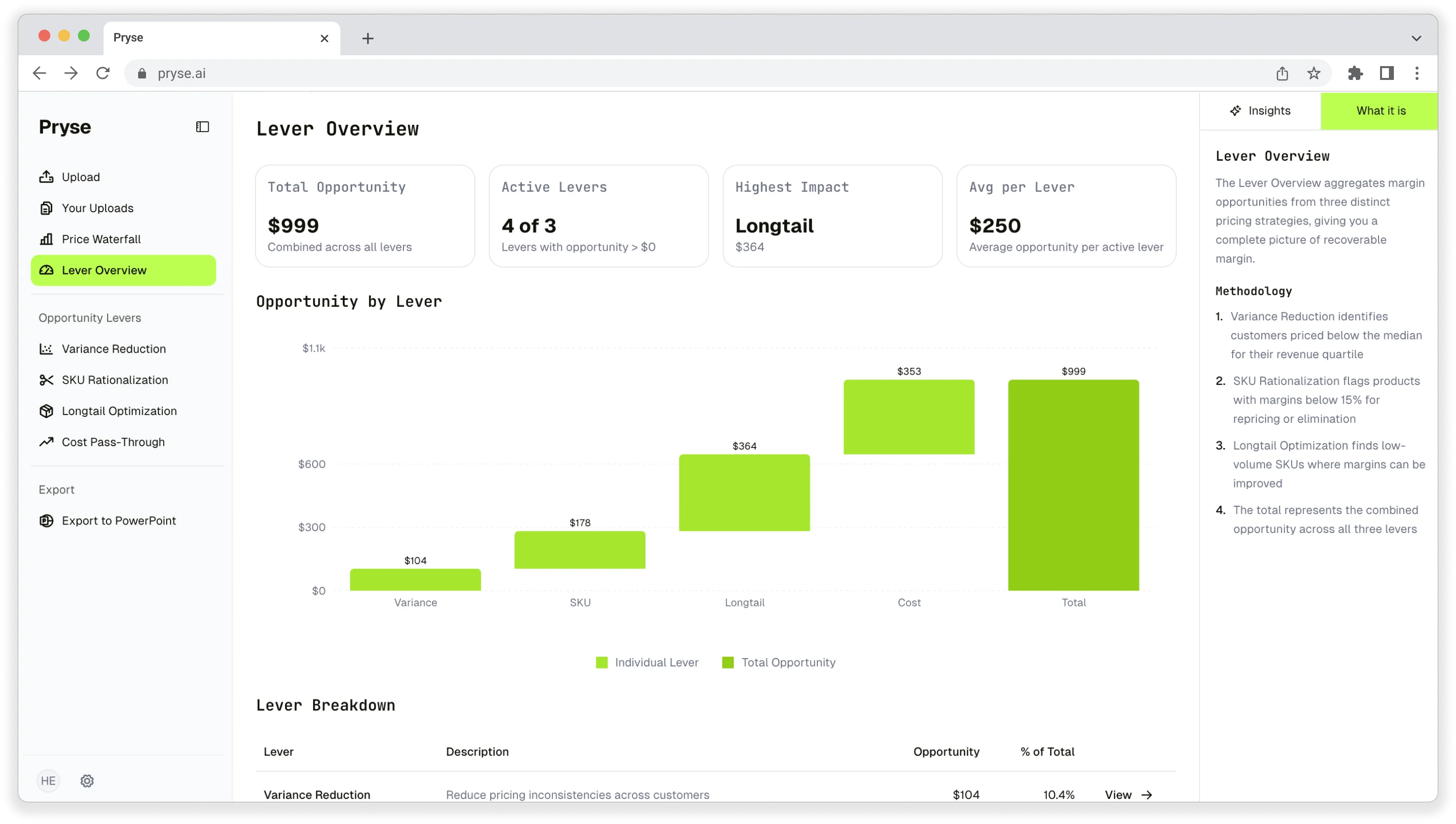
Want to analyze your entire product catalog?
Pryse automatically identifies margin leakage across thousands of SKUs. Upload your data and find hidden profit in 24 hours.
One-time $1,499 diagnostic. No subscription required.