 Pryse
Pryse7 Types of Dynamic Pricing (With Real-World Examples)
Time-based, demand-based, competitive, segmented, and more. Learn which dynamic pricing type fits your business model with examples from airlines, e-commerce, and B2B distributors.
Dynamic pricing isn't a single approach—it's a collection of strategies that change prices based on different variables. Airlines adjust prices based on time until departure. Uber changes prices based on real-time demand. Amazon responds to competitor moves. B2B distributors link prices to commodity cost fluctuations.
Choosing the wrong type of dynamic pricing for your business model causes most implementation failures. Using demand-based surge pricing in B2B relationship sales damages customer trust. Applying time-based pricing to products with unpredictable demand leaves money on the table. Understanding which type fits your industry, customer expectations, and data capabilities determines success or failure.
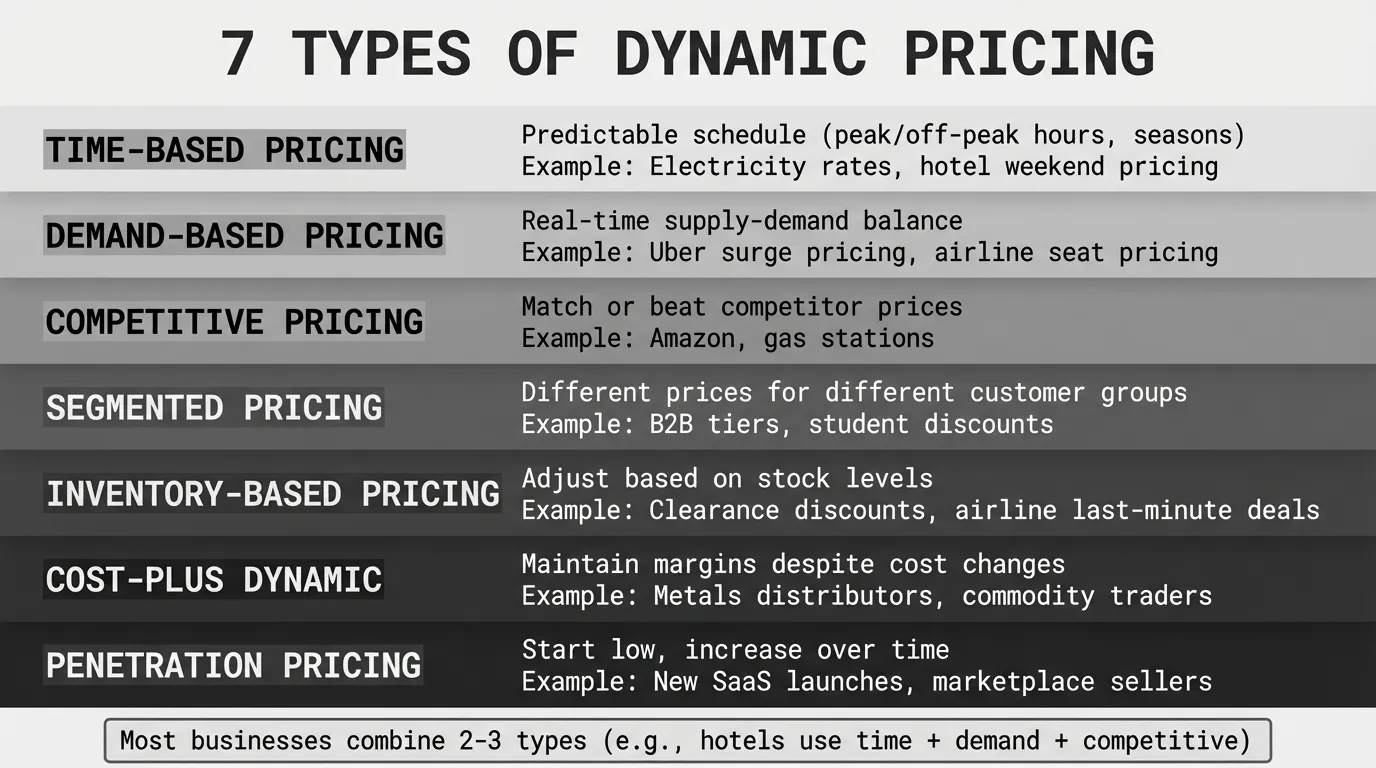
This post explains seven types of dynamic pricing with real-world examples from airlines, e-commerce, hospitality, ride-sharing, and B2B distribution. You'll learn when each type works best, what data each requires, and how to combine multiple approaches.
1. Time-Based Dynamic Pricing
Time-based pricing changes prices on a predictable schedule based on when customers purchase.
How It Works
Prices follow patterns tied to time of day, day of week, or season. Unlike demand-based pricing which responds to unexpected surges, time-based pricing sets prices in advance based on known patterns.
Common time patterns:
- Time of day (electricity rates higher 4-9 PM)
- Day of week (hotel rooms more expensive Friday-Saturday)
- Season (ski resorts more expensive during holidays)
- Proximity to event (concert tickets more expensive closer to show date)
According to Priceva research on time-based pricing, time-of-use pricing for electricity sets prices for specific time periods, typically not changing more often than twice a year, with pre-established prices known to consumers in advance.
Real-World Examples
Electricity utilities: Time-of-use pricing charges residential customers more during peak demand hours (4-9 PM on weekdays) and less during off-peak hours (overnight, weekends). Customers see the rate schedule in advance and can shift usage to save money—run dishwashers overnight, charge EVs after midnight.
California's Pacific Gas & Electric charges $0.31/kWh during peak hours and $0.13/kWh off-peak, a 140% price difference based solely on time of day.
Hotels: Room rates follow weekly patterns. According to demand-based pricing research, hotels increase rates for weekend stays and decrease for midweek stays because business travelers fill rooms Monday-Thursday while leisure travelers book Friday-Sunday.
A Marriott near a convention center might charge $120 Tuesday and $180 Saturday for the same room based purely on the day of week.
Parking: According to dynamic pricing research, parking meters demonstrate time-based pricing, with owners raising prices during busy times and charging less on weekends and after work.
Downtown parking might cost $4/hour during business hours (8 AM-6 PM weekdays) and $1/hour evenings and weekends.
Restaurants: Early-bird pricing offers discounts for dining before peak hours. A restaurant might discount menu items 20% before 6 PM to smooth demand and utilize kitchen capacity during slow hours.
Tourism and activities: Ski resorts, theme parks, and tour operators charge more during peak seasons and less during shoulder seasons. According to FareHarbor, a ski lesson will be more expensive over the holidays than at the end of the season.
Disney World varies admission prices by date, with peak pricing during Christmas, New Year's, and Easter, and lower prices in January and early February.
When Time-Based Pricing Works
Best for:
- Businesses with predictable demand cycles (utilities, public transit)
- Fixed capacity that can't be expanded (parking spaces, restaurant tables)
- Customers who can shift purchase timing if price-sensitive (electricity usage, dining out)
- Industries where customers accept scheduled pricing (transportation, entertainment)
Advantages:
- Simple to implement (set price schedule once, no real-time monitoring)
- Transparent to customers (prices published in advance)
- Helps smooth demand peaks by incentivizing off-peak purchases
- No complex algorithms or data feeds required
Limitations:
- Doesn't respond to unexpected demand changes
- Misses revenue opportunities when actual demand exceeds forecast
- Less effective for products with unpredictable demand patterns
2. Demand-Based Dynamic Pricing (Surge Pricing)
Demand-based pricing responds to real-time supply-demand imbalances.
How It Works
Prices increase when demand exceeds available supply and decrease when supply exceeds demand. The algorithm monitors current demand signals and adjusts prices to balance supply and demand.
Demand signals monitored:
- Current orders or bookings relative to capacity
- Waitlist or queue length (more people waiting = higher demand)
- Search volume or website traffic for products
- Conversion rates (declining conversion suggests prices too high)
- Competitor sell-out patterns
According to DealHub, demand-based pricing is a strategy where prices are adjusted in response to fluctuations in market demand. This approach allows businesses to capitalize on high demand by raising prices and attract more customers during low demand periods by lowering prices.
Real-World Examples
Ride-sharing (Uber, Lyft): Surge pricing examples show ride-sharing companies use dynamic or "surge" pricing to raise prices in busy areas or at popular times, such as after a concert or on a holiday.
When ride demand exceeds available drivers, Uber applies a multiplier (1.5x, 2x, 3x, or higher). A normal $15 ride becomes $45 at 3x surge. Higher prices incentivize more drivers to go online and discourage price-sensitive riders from requesting rides, balancing supply and demand within 10-15 minutes.
Airlines: According to Harvard Business School research, airlines change prices depending on the day of the week, time of day, and days before the flight, factoring in components like seat availability, departure time, and average cancellations.
As seats fill on a flight, remaining seats increase in price. A flight with 80% occupancy three weeks before departure will price remaining seats higher than a flight with 40% occupancy at the same point.
Hotels: Room pricing responds to booking pace and occupancy. If a hotel is 90% booked for Saturday night by Thursday afternoon, Friday bookings will pay premium prices. If only 50% booked, prices drop to fill rooms.
According to Xola research, hotels use dynamic pricing to adjust room costs based on supply and demand needs at a particular moment.
Events and entertainment: Broadway shows, concerts, and sports teams vary ticket prices based on sellout pace. A show selling quickly raises prices for remaining tickets. A show with slow sales discounts to fill seats.
Disney varies theme park admission daily based on expected crowd levels. According to pricing examples, Disney World's admission prices vary by season, with price hikes around Christmas, New Years, and Easter.
When Demand-Based Pricing Works
Best for:
- Fixed capacity with perishable inventory (airline seats, hotel rooms, ride capacity)
- Real-time visibility into demand signals
- Customers who accept that high demand creates higher prices
- Short purchase-to-consumption windows (booking today for tonight)
Advantages:
- Maximizes revenue during unexpected demand spikes
- Prevents inventory waste by filling capacity during low demand
- Self-regulating—high prices reduce demand, low prices stimulate it
- Captures willingness to pay during scarcity
Limitations:
- Can damage customer relationships if perceived as price gouging
- Requires real-time demand monitoring and pricing automation
- Creates price uncertainty that frustrates some customers
- May trigger negative press or regulatory scrutiny during emergencies
3. Competitive Dynamic Pricing
Competitive pricing automatically matches or beats competitor prices.
How It Works
The algorithm monitors competitor prices via web scraping, price feeds, or manual checks. When a competitor changes price, your prices adjust based on positioning rules:
- Match competitor prices within X hours
- Price 5% below lowest competitor
- Stay within 10% of median competitor price
According to Salesforce, competition-based pricing involves analyzing competitor pricing as a baseline and setting prices slightly lower or higher depending on factors such as product quality, target market and marketing strategy.
Real-World Examples
E-commerce (Amazon): Amazon monitors competitor prices from Walmart, Target, Best Buy, and third-party sellers. When competitors drop prices on popular products, Amazon matches within hours to maintain Buy Box position.
A wireless mouse priced at $24.99 on Amazon drops to $22.49 when Walmart lowers their price, then returns to $24.99 when Walmart raises it back.
Gas stations: Gas stations monitor nearby competitors and adjust prices to stay competitive within a few cents per gallon. Stations near highway exits often price 10-20 cents higher than stations a mile away because convenience creates less price sensitivity.
Consumer electronics: Best Buy uses real-time price matching to compete with Amazon. When Amazon drops the price on a TV model, Best Buy automatically matches online to prevent customers from showrooming (viewing in-store, buying online).
E-commerce marketplaces: Third-party sellers on Amazon, eBay, and Walmart Marketplace use repricing software to compete for Buy Box. Algorithms undercut the current Buy Box winner by $0.01 or match if already cheapest.
When Competitive Pricing Works
Best for:
- Commodity products with limited differentiation
- Markets with transparent pricing and easy price comparison
- High transaction volume with low customer loyalty
- E-commerce where customers can compare prices instantly
Advantages:
- Prevents customer loss to cheaper competitors
- Maintains competitive positioning automatically
- Scales across thousands of SKUs without manual monitoring
- Captures sales from price-focused shoppers
Limitations:
- Race-to-the-bottom price wars if all competitors use it
- Assumes competitors price rationally (they often don't)
- Ignores your unique value proposition beyond price
- Can damage margins if not constrained by price floors
4. Segmented Dynamic Pricing
Segmented pricing charges different customer groups different prices based on characteristics or behavior.
How It Works
Customers are divided into segments based on:
- Order volume or purchase frequency
- Customer relationship type (contract vs. spot buyer)
- Geographic location or market
- Industry or use case
- New customer vs. returning customer
Each segment receives different pricing strategies. High-value segments might get stable contract pricing. Low-value transactional segments get dynamic pricing.
According to SYMSON research, segmented-based pricing is the process by which an organization subdivides its broader target audience into several smaller segments, identifying smaller sub-target groups that can be classified according to specific properties, allowing the organization to set an individual price for all these different segments to anticipate differences in willingness to pay.
Real-World Examples
B2B distribution: A distributor segments customers into three tiers:
Tier 1 (Strategic accounts): Annual contracts with fixed pricing negotiated by sales leadership. Prices locked for 12 months. No dynamic pricing.
Tier 2 (Regular customers): Quarterly price reviews based on cost changes. Prices updated every 90 days. Semi-dynamic pricing.
Tier 3 (Spot buyers): Weekly price updates based on current costs, inventory, and competition. Full dynamic pricing.
According to Nected research, segmented pricing enables price variation based on customer segments and is highly effective in regions with different economic conditions or when targeting specific industries more aggressively.
SaaS software: Software companies charge SMBs published list prices while negotiating custom pricing for enterprise customers. The same software might cost $99/month for a 5-person team or $50,000/year for a 500-person enterprise after negotiation.
Airlines: Corporate travelers with negotiated rates get stable pricing. Leisure travelers booking online face dynamic pricing that changes daily.
Student and senior discounts: Museums, theaters, and public transit offer permanent discounts to students and seniors. Same product, different price based on customer segment.
When Segmented Pricing Works
Best for:
- B2B companies with mixed customer types (strategic vs. transactional)
- Businesses serving multiple markets with different willingness to pay
- Companies where customer lifetime value varies significantly
- Products sold through multiple channels with different economics
Advantages:
- Protects strategic relationships while optimizing transactional business
- Captures different willingness to pay across segments
- Prevents one-size-fits-all pricing from leaving money on table
- Aligns pricing strategy with customer relationship strategy
Limitations:
- Requires accurate customer segmentation and data
- More complex operationally (different pricing workflows by segment)
- Risk of customer complaints if segments discover pricing differences
- May violate Robinson-Patman Act in B2B if not justified by cost differences
5. Inventory-Based Dynamic Pricing
Inventory-based pricing adjusts prices based on stock levels and inventory age.
How It Works
The algorithm monitors days-on-hand for each SKU and applies discount schedules:
- Stock > 60 days of supply: 10% discount
- Stock > 90 days: 20% discount
- Stock > 120 days: 30% discount
Or conversely, raises prices on fast-moving items with low stock to maximize margin before running out.
Real-World Examples
Airlines: When flights are undersold as departure nears, airlines discount remaining seats. Conversely, when flights sell out quickly, prices increase for remaining inventory.
The same flight might have seats discounted 40% if only 60% full one week before departure, or priced at 200% of normal if 95% full.
Grocery stores: Produce, dairy, and bakery items get discounted as expiration dates approach. A package of ground beef expiring tomorrow gets marked down 30-50% to sell before it becomes waste.
Apparel and fashion: Seasonal clothing gets progressively discounted as the season ends. Winter coats at full price in October, 20% off in January, 50% off in March, 70% off in April.
E-commerce (Amazon): Amazon increases discounts on slow-moving inventory sitting in warehouses. Products with high days-on-hand get automatic markdowns to clear space for faster-moving products.
B2B distribution: Distributors discount obsolete or slow-moving SKUs to convert aging inventory to cash before it becomes unsalable. A distributor with 180 days of inventory on a discontinued part might discount 40% to clear it out.
When Inventory-Based Pricing Works
Best for:
- Perishable products with shelf life constraints (food, pharmaceuticals)
- Seasonal products that lose value after the season (winter coats, holiday items)
- Products with obsolescence risk (electronics, fashion)
- Businesses with inventory carrying costs that justify discounting
Advantages:
- Prevents inventory write-offs by capturing some value before obsolescence
- Clears warehouse space for faster-moving products
- Self-regulating—low inventory triggers higher prices, high inventory triggers discounts
- Reduces working capital tied up in slow-moving stock
Limitations:
- Customers learn to wait for discounts if patterns are predictable
- Can damage brand perception if excessive discounting
- Requires accurate real-time inventory visibility
- Doesn't work well for made-to-order products without inventory
6. Cost-Plus Dynamic Pricing
Cost-plus dynamic pricing maintains target margins despite cost fluctuations by adjusting prices when costs change.
How It Works
Prices automatically adjust to maintain target margin percentage as costs change:
Price = Current COGS × (1 + Target Margin %)When supplier costs increase 10%, customer prices increase 10%. When costs drop, prices drop (or you can choose to hold prices and expand margins).
Real-World Examples
Metals distribution: Steel and aluminum distributors link prices to commodity indices. When London Metal Exchange spot prices for aluminum increase $0.10/pound, distributor prices increase automatically to maintain 18% target margin.
A distributor might price aluminum at LME spot price + $0.25/lb distribution margin. As spot prices move from $2.50 to $2.75, customer price automatically updates from $2.75 to $3.00.
Fuel distribution: Fuel distributors pass through refinery cost changes. When wholesale gasoline prices increase $0.15/gallon, retail prices increase within 24-48 hours to maintain target margin per gallon.
Chemical distribution: Chemical distributors selling commodity products (solvents, acids, plastics) face volatile raw material costs. Prices adjust weekly or monthly based on supplier price indices to maintain consistent margins.
Food distribution: Produce distributors price based on current market prices from wholesale markets. When tomato prices spike due to weather, distributor prices increase to maintain margin percentage.
When Cost-Plus Dynamic Pricing Works
Best for:
- Commodity products where customers understand cost volatility
- Distribution businesses with transparent cost pass-through
- Industries where supplier costs change frequently
- Markets where competitors also use cost-plus pricing
Advantages:
- Maintains consistent margins despite cost volatility
- Easy for customers to understand (prices track market costs)
- Prevents margin erosion during cost inflation
- Simple to implement with timely cost data
Limitations:
- Ignores customer willingness to pay and competitive dynamics
- Misses revenue opportunities when value exceeds cost
- Requires timely supplier cost data or commodity index feeds
- May lose volume if costs increase faster than competitors
7. Penetration Pricing Dynamic Strategy
Penetration pricing starts with intentionally low prices to gain market share, then gradually increases prices as brand recognition grows.
How It Works
New products or new market entrants price below established competitors to attract customers. Over time (months or years), prices increase toward market rates as:
- Brand awareness builds
- Customer base grows
- Product differentiation becomes clearer
- Network effects create switching costs
This differs from other dynamic pricing types because the price trajectory is predetermined—start low, increase over time—rather than responding to external variables.
Real-World Examples
SaaS companies: New software launches with promotional pricing 50% below long-term target. Early adopters get $50/month pricing. After 6 months, new customers pay $75/month. After 12 months, $99/month (target price).
Early customers often keep discounted pricing (grandfathered), creating two-tier pricing.
Subscription services: Streaming services offer $0.99 first month, then $9.99/month. The low entry price converts trial users, then the real price applies after commitment.
E-commerce marketplaces: New sellers on Amazon price below established competitors to generate initial reviews and sales velocity. After accumulating 50+ reviews and sales history, prices gradually increase to profitable levels.
Mobile apps: Apps launch free or heavily discounted to build user base and climb app store rankings. After reaching top charts, introduce in-app purchases or subscription pricing.
When Penetration Pricing Works
Best for:
- New market entrants competing against established brands
- Products with network effects (value increases with more users)
- Businesses prioritizing market share over early profitability
- Markets with high customer acquisition costs
Advantages:
- Builds initial customer base quickly
- Creates word-of-mouth and viral growth
- Establishes market position before competitors respond
- Generates data on price sensitivity for future optimization
Limitations:
- Delays profitability (sometimes for years)
- Customers acquired by low prices may churn when prices increase
- Difficult to raise prices significantly after setting expectations
- Can start price wars if established competitors match
Combining Multiple Dynamic Pricing Types
Most successful implementations combine multiple types.
Hotel Example: Time + Demand + Competitive
A hotel near a convention center uses:
- Time-based: Higher base rates Friday-Saturday, lower Tuesday-Wednesday
- Demand-based: Prices increase when occupancy exceeds 80%
- Competitive: Monitor nearby hotels and stay within 10% of comparable properties
A room might be:
- $120 on Tuesday (low time-based baseline)
- $180 on Saturday (high time-based baseline)
- $220 on Saturday during a major convention (demand surge)
- $200 instead of $220 if competitor hotels price at $190 (competitive adjustment)
B2B Distributor Example: Segmented + Cost-Plus
A chemical distributor combines:
- Segmented: Three customer tiers with different pricing strategies
- Cost-plus: All tiers adjust for commodity cost changes, but at different frequencies
Tier 1 customers: Annual contract pricing based on forecasted average commodity costs. No intra-year adjustments unless costs move 20%+.
Tier 2 customers: Quarterly pricing updates based on actual commodity index movements. Current cost + 18% target margin.
Tier 3 customers: Weekly pricing based on spot commodity prices. Current cost + 22% margin (higher margin on transactional volume).
E-commerce Example: Competitive + Inventory + Demand
An online retailer uses:
- Competitive: Match Amazon on popular products
- Inventory-based: Discount slow-moving items by 10-40% based on days-on-hand
- Demand-based: Increase prices during holiday peaks when conversion rates stay strong
A product might normally sell for $49.99 (matching Amazon). If inventory exceeds 90 days, discount to $39.99. During Black Friday week, increase to $54.99 if demand stays strong despite higher price.
How to Choose the Right Type for Your Business
Use this framework to select appropriate dynamic pricing types.
Step 1: Understand Your Business Model Constraints
High-relationship B2B sales: Avoid: Demand-based, competitive (frequent changes damage relationships) Consider: Segmented, cost-plus (infrequent updates customers accept)
High-volume transactional sales: Avoid: N/A (few constraints) Consider: Any type, often combinations of competitive + demand + inventory
Perishable or seasonal products: Prioritize: Inventory-based, time-based Consider: Demand-based for unexpected surges
Fixed capacity services: Prioritize: Time-based, demand-based Consider: Segmented for different customer types
Step 2: Assess Your Data Capabilities
Real-time inventory visibility: Enables: Inventory-based pricing Without: Use time-based or scheduled pricing
Competitor price feeds: Enables: Competitive pricing Without: Use cost-plus or value-based approaches
Demand forecasting: Enables: Time-based pricing with accurate schedules Without: Use simpler cost-plus or reactive competitive pricing
Historical transaction data: Enables: Machine learning for demand-based pricing Without: Start with rule-based time pricing
Step 3: Consider Customer Expectations
Will customers accept price changes?
Airlines, hotels, ride-sharing: Yes (customers expect it) B2B distribution, professional services: Maybe (depends on relationship) Luxury retail, healthcare: No (price stability expected)
How often can you change prices?
E-commerce: Multiple times per day B2B transactional: Weekly or monthly B2B contract: Quarterly or annually
Do customers comparison shop?
Yes → Consider competitive pricing No → Focus on value-based or cost-plus
Step 4: Start Simple, Add Complexity
Phase 1 (Months 1-3): Time-based pricing Set price schedules based on known patterns. No real-time monitoring required.
Phase 2 (Months 4-6): Add cost-plus or inventory-based Adjust for cost changes or inventory aging. Still rule-based, minimal complexity.
Phase 3 (Months 7-12): Add competitive monitoring Layer in competitor price tracking for key products.
Phase 4 (Year 2+): Add demand-based or ML optimization Introduce real-time demand response or machine learning after building pricing discipline with simpler approaches.
Types of Dynamic Pricing by Industry
Different industries gravitate toward different types based on business model characteristics.
Airlines
Primary: Time-based (price increases as departure nears), demand-based (prices rise when seats fill) Secondary: Segmented (corporate contracts vs. consumer pricing)
Hotels
Primary: Time-based (weekend vs. weekday), demand-based (occupancy-based pricing) Secondary: Competitive (monitor nearby hotels), segmented (loyalty members)
E-Commerce
Primary: Competitive (match Amazon, Walmart), inventory-based (clear slow movers) Secondary: Demand-based (holiday surge pricing), time-based (flash sales)
Ride-Sharing
Primary: Demand-based (surge pricing when demand exceeds supply) Secondary: Time-based (predictable rush hour pricing)
B2B Distribution
Primary: Segmented (customer tier-based), cost-plus (commodity pass-through) Secondary: Inventory-based (obsolescence discounting) Avoid: Competitive, demand-based (damages relationships)
Utilities
Primary: Time-based (peak vs. off-peak rates) Secondary: Demand-based (real-time pricing in some markets)
Events/Entertainment
Primary: Time-based (opening night vs. closing night), demand-based (sellout pace) Secondary: Segmented (student/senior discounts)
Common Mistakes When Choosing Dynamic Pricing Types
Mistake 1: Choosing Based on Sophistication Instead of Fit
The error: Implementing demand-based AI pricing because it sounds advanced, when simple time-based pricing would work better.
Example: A B2B manufacturer implemented real-time dynamic pricing updated hourly. Sales team couldn't quote confidently. Customers complained about instability. Monthly cost-plus pricing would have worked better.
The fix: Choose based on business model fit, not technological sophistication.
Mistake 2: Mixing Types That Conflict
The error: Using competitive pricing (race to lowest price) with inventory-based pricing (discount aging stock), creating continuous downward spiral.
Example: An e-commerce seller matched competitor prices and discounted slow-moving inventory. Competitor matched the discount. The cycle repeated until both sold at a loss.
The fix: Ensure pricing rules from different types don't conflict. Set floors and priorities.
Mistake 3: Wrong Update Frequency for Industry
The error: Applying e-commerce update frequency (hourly) to B2B contract sales (should be monthly or quarterly).
Example covered earlier: B2B manufacturer updated daily, damaged relationships.
The fix: Match update frequency to customer expectations and industry norms.
Mistake 4: Implementing Demand-Based Pricing Without Surge Communication
The error: Charging surge prices without telling customers why.
Example: A parking lot raised prices 3x during a concert without signage explaining surge pricing. Customers felt scammed and complained to the venue.
The fix: If using demand-based pricing, communicate clearly why prices are higher (high demand, limited supply).
Next Steps: Implementing Your Dynamic Pricing Type
Once you've chosen the right type (or combination), implementation follows these steps:
- Start with a pilot: Test with 100-500 SKUs or one customer segment
- Set conservative constraints: Limit price changes to ±5-10% initially
- Monitor daily: Check for errors, outliers, customer complaints
- Measure against control group: Compare results to non-dynamic-priced products
- Expand gradually: Add more products or segments after 60-90 days of successful results
For detailed implementation guidance including data requirements, software selection, and monitoring, see our dynamic pricing strategy guide.
If you're not ready for dynamic pricing, start with foundational pricing improvements. Most B2B companies recover 1-2% margin by fixing underpriced products and reducing margin leakage before needing sophisticated dynamic pricing.
See our margin analysis guide to identify where you're leaving money on the table with current pricing.
Sources
- 6 Successful Dynamic Pricing Examples To Follow in 2026 - Mailmodo
- Dynamic pricing strategy: Definition, types, benefits & examples - Paddle
- What Is Dynamic Pricing? How It Works, With Examples - Salesforce
- Time-Based Pricing: Definition, Examples & Drawbacks - Priceva
- 5 Examples of Demand-Based Pricing - Xola
- What is Demand-Based Pricing? - FareHarbor
- What Is Demand-Based Pricing? - DealHub
- Segment-Based Pricing Strategy - SYMSON
- Types of Dynamic Pricing and Implementation - Nected
- Dynamic Pricing: What It Is & Why It's Important - Harvard Business School Online
Last updated: February 24, 2026
Frequently Asked Questions
Want to analyze your entire product catalog?
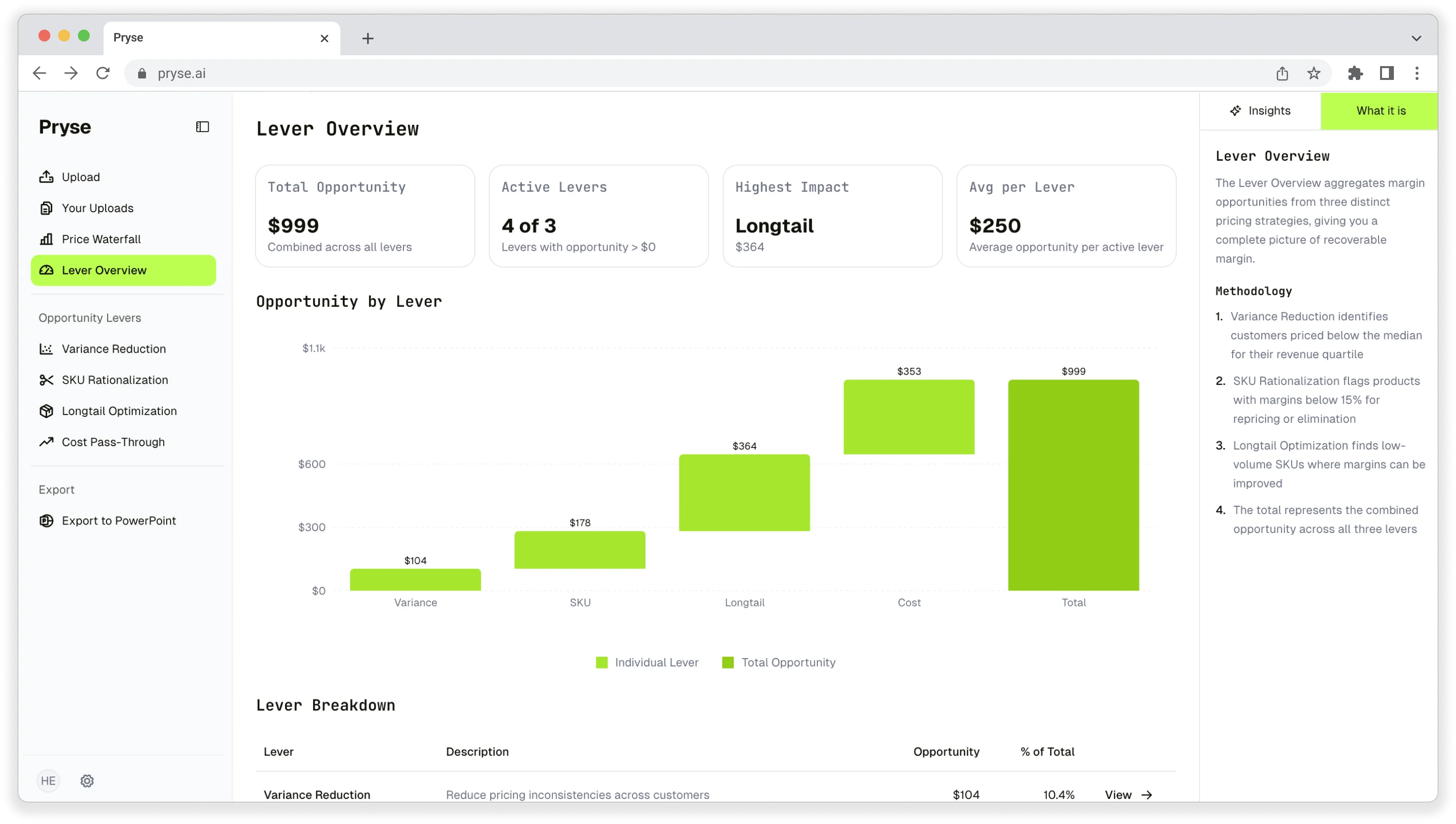
Pryse automatically identifies margin leakage across thousands of SKUs. Upload your data and find hidden profit in 24 hours.
One-time $1,499 diagnostic. No subscription required.