 Pryse
PryseCompanies That Use Dynamic Pricing (2026 Case Studies)
Real examples from Amazon, Uber, Disney, airlines, and B2B distributors using dynamic pricing. See implementation strategies, revenue impacts, and lessons learned.
Dynamic pricing is no longer experimental—it's mainstream. Amazon changes prices over 12 times per day. Uber balances 5 million rides daily through surge pricing. Airlines fill billions of seats annually with yield management. Hotels optimize occupancy with demand-based room rates.
But which companies actually use dynamic pricing? What strategies do they implement? What results do they achieve? And why do some companies succeed while others face customer backlash?
This post examines 50+ companies using dynamic pricing across industries—e-commerce, ride-sharing, hospitality, airlines, entertainment, retail, and B2B distribution. You'll see their implementation approaches, revenue impacts, and lessons learned from both successes and failures.
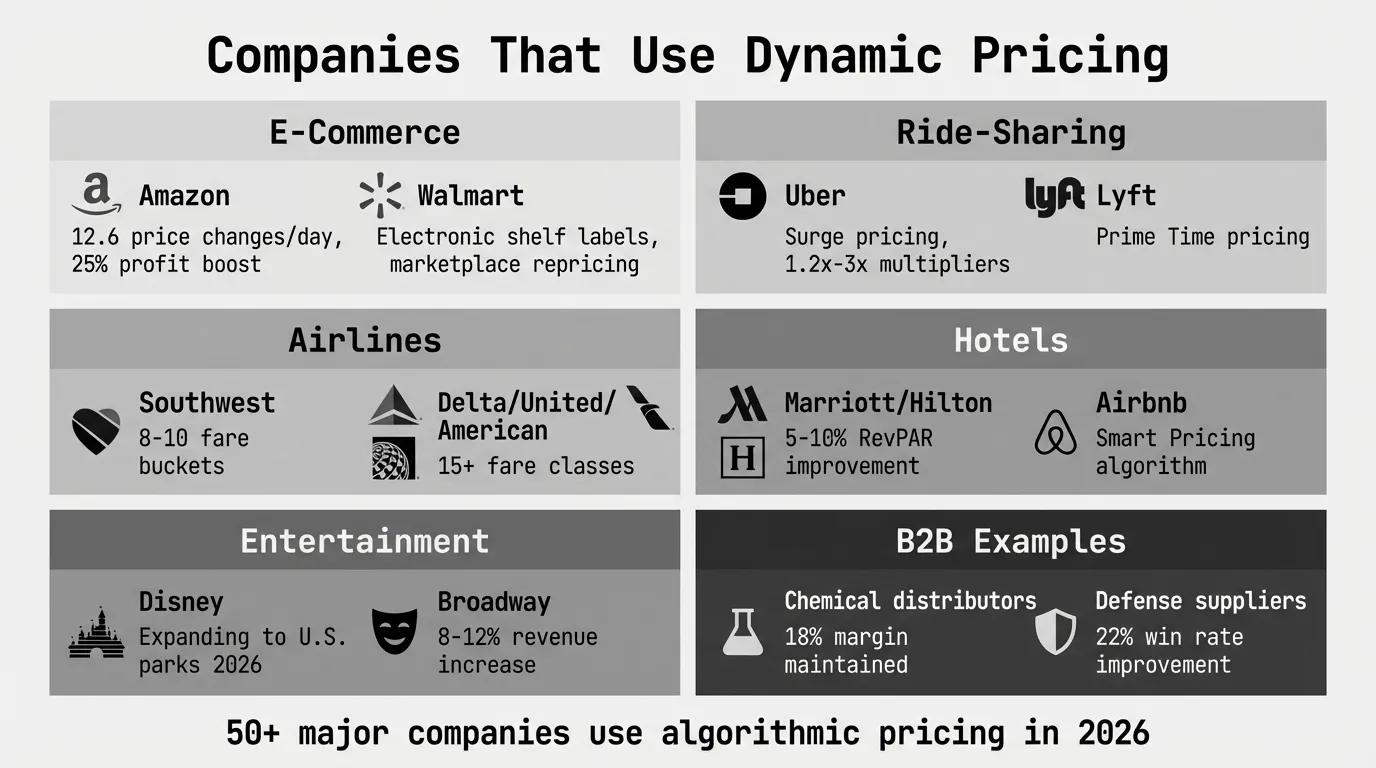
E-Commerce Companies Using Dynamic Pricing
E-commerce companies use dynamic pricing to compete on price, clear inventory, and maximize margins across massive product catalogs.
Amazon: The Dynamic Pricing Pioneer
Amazon.com leads all companies in dynamic pricing, averaging 12.6 price changes per day. The company reportedly changes prices on over 2.5 million products daily.
How Amazon's system works:
- Monitors competitor prices from Walmart, Target, Best Buy, and third-party sellers
- Tracks inventory levels and sales velocity for each SKU
- Analyzes customer browsing behavior and conversion rates
- Adjusts prices automatically every 10 minutes for high-demand products
- Updates less frequently (daily or weekly) for slower-moving items
Price change triggers:
- Competitor price drops or increases
- Inventory reaching high or low thresholds
- Demand signals (search volume, cart adds, conversion rate changes)
- Seasonal patterns and promotional periods
Results:
According to case study analysis, Amazon boosted profits by 25% through dynamic pricing implementation. The company maintains its reputation as the low-price leader while optimizing margins across millions of SKUs.
The strategy:
Amazon doesn't always aim for the lowest price. On commodity products with high price sensitivity, Amazon matches or beats competitors. On differentiated products or Amazon exclusives, prices may be higher. The algorithm balances volume and margin based on each product's competitive context.
Walmart Marketplace: Dynamic Repricing for Sellers
Walmart's third-party marketplace enables sellers to use dynamic pricing tools. Walmart marketplace sellers use automation to update prices based on competitor behavior, sales velocity, inventory levels, and marketplace trends.
Seller strategies:
- Match or beat competing marketplace sellers
- Adjust prices based on Buy Box eligibility
- Lower prices on slow-moving inventory
- Raise prices on products with strong demand and low competition
Some Walmart physical locations also test dynamic pricing with electronic shelf labels, though this remains limited compared to online dynamic pricing.
MediaMarkt: European Electronics Retailer
MediaMarkt implements dynamic pricing through product bundling, flash sales, and seasonal promotions. The company uses personalized discounts based on shopping history and real-time price matching to beat competitors.
Approach:
- Monitor local and online competitor prices
- Adjust electronics prices daily based on supply and competitor moves
- Offer personalized promotions to customers based on browsing history
- Use flash sales to clear excess inventory
Ride-Sharing Companies Using Surge Pricing
Ride-sharing companies pioneered transparent demand-based dynamic pricing that customers see and understand in real-time.
Uber: Surge Pricing to Balance Supply and Demand
Uber's surge pricing adjusts ride prices based on real-time supply-demand imbalances, driver availability, and demand patterns.
How surge pricing works:
- When ride requests exceed available drivers, prices increase
- Surge multipliers range from 1.2x to 3x (occasionally 4-5x during major events)
- The app notifies riders before they confirm: "Fares are higher due to increased demand"
- Higher prices incentivize more drivers to go online
- Higher prices reduce demand from price-sensitive riders
- The system balances supply and demand in 10-15 minutes
Common surge triggers:
- Weekend nights (bar closing times, 2-3 AM)
- Bad weather (rain, snow)
- Major events (concerts, sports games, conferences)
- Morning and evening rush hours
- Public transit disruptions
Results:
Uber uses dynamic pricing for two reasons—to boost profits and ensure taxis are covering all demand. Surge pricing reduces average wait times from 20+ minutes (without surge) to under 5 minutes during peak demand.
The backlash:
Uber faced criticism for surge pricing during emergencies. In 2013, during a storm in New York, Uber users saw fares go up eight times the usual fares, attracting public backlash. After this incident, the company started placing caps on how high surge pricing can go during times of emergency, starting in 2015.
The lesson: Dynamic pricing works for routine demand fluctuations but needs ethical guardrails during crises.
Lyft: Similar Surge Model
Lyft uses dynamic pricing with a similar supply-demand balancing approach. Lyft's "Prime Time" pricing applies multipliers when demand exceeds driver availability, though Lyft generally keeps multipliers lower than Uber's peak surge levels.
Airlines: Where Dynamic Pricing Started
Airlines pioneered dynamic pricing in the 1980s after deregulation. Today, virtually every major airline uses yield management systems that adjust prices continuously.
Southwest Airlines: Simplified Bucket Pricing
Southwest uses a simplified dynamic pricing system called fare buckets. Each flight has 8-10 fare buckets. As seats sell, the system moves to higher buckets, increasing prices as inventory depletes.
Why Southwest's approach works:
- Transparent to customers ("early booking = lower prices")
- Simpler than traditional airline pricing (no Saturday stay requirements)
- No change fees makes pricing flexibility more acceptable
- Maintains Southwest's customer-friendly brand
Revenue impact:
Southwest generates 15-20% of revenue from the highest fare bucket (typically last-minute bookings). The bucket system is simpler to implement than sophisticated algorithms but captures most of the revenue benefit.
Traditional Airlines (Delta, United, American)
Traditional carriers use more complex yield management systems:
- 15+ fare classes per flight
- Prices update 1-2 times daily
- Factors include days until departure, seats remaining, competitor pricing, day of week, route competition, and historical booking patterns
Airlines leverage sophisticated algorithms to adjust ticket prices based on factors such as flight demand, time of booking, and seat availability, allowing airlines to optimize revenue while ensuring maximum seat occupancy.
Revenue impact:
Airlines generate 2-4% additional revenue from dynamic pricing compared to fixed pricing. A 2022 study in Econometrica estimated that dynamic pricing was beneficial for "early-arriving, leisure consumers at the expense of late-arriving, business travelers," and when aggregated over markets, welfare is higher under dynamic pricing than under uniform pricing.
Hotels and Hospitality Companies
Hotels pioneered revenue management alongside airlines, optimizing occupancy and average daily rates simultaneously.
Major Hotel Chains (Marriott, Hilton, Hyatt)
All major hotel chains use dynamic pricing powered by revenue management systems.
Price variables:
- Days until check-in date
- Current occupancy rate
- Local events (conferences, concerts, festivals, sporting events)
- Competitor pricing for comparable hotels
- Day of week (business travel peaks midweek, leisure on weekends)
- Seasonal patterns and weather forecasts
- Guest history and loyalty status
Price ranges:
The same hotel room can cost $120 on a Tuesday in February (low demand) or $280 on Saturday during a major conference (high demand).
Results:
Hotels using dynamic pricing report 5-10% RevPAR (Revenue Per Available Room) improvement compared to fixed pricing. RevPAR = Average Daily Rate × Occupancy Rate. Dynamic pricing maximizes this metric by raising rates when demand is high and discounting during low periods.
Airbnb: Built-In Dynamic Pricing
Airbnb offers "Smart Pricing", a dynamic pricing function built into its platform that automatically changes property prices based on season, demand, property features, and location.
How Smart Pricing works:
- Hosts set minimum and maximum acceptable prices
- Airbnb's algorithm adjusts nightly rates within those bounds
- Factors include local event calendars, seasonal demand, competitor pricing, booking lead time, and property amenities
- Hosts can override suggested prices manually
Adoption:
Many Airbnb hosts use Smart Pricing or third-party revenue management tools (PriceLabs, Beyond Pricing, Wheelhouse) to optimize occupancy and revenue without manual daily price adjustments.
Entertainment and Events Companies
Entertainment companies use dynamic pricing to capture willingness to pay while maintaining affordability through price tiers.
Disney: Expanding Dynamic Pricing to U.S. Parks
Disney already uses dynamic pricing at Disneyland Paris and is planning to expand the system to Disney World and Disneyland.
Current implementation (Disneyland Paris):
Disney has been using dynamic pricing in Paris for about a year, according to Disney CFO Hugh Johnston. Single-day tickets are grouped into price ranges determined by predicted crowd size, weather forecasts, school holidays, and special events. Tickets in the highest-priced category cost $134-$197, while lowest-priced December tickets start at $106.
U.S. expansion plans:
Dynamic pricing is likely coming to Disney World and Disneyland, though the earliest launch would be mid-October 2026 when annual price increases typically occur. In November 2025, Disney CFO Hugh Johnston announced that Disney is focused on optimizing their dynamic pricing structure in Disneyland Paris before bringing the same system to Disney World and Disneyland.
Rationale:
- Manage crowd levels (higher prices reduce attendance on peak days)
- Generate more revenue during high-demand periods
- Offer lower prices during slow periods to attract budget-conscious families
- Smooth demand across the calendar year
Unlike Uber surge pricing, Disney's dynamic pricing is predictable—prices are set weeks in advance, not changed in real-time based on current attendance.
Broadway Shows: Variable Ticket Pricing
Broadway theaters use dynamic pricing based on show popularity, day of week (Saturday evenings cost most), time until show date, seat location, and cast changes.
Hamilton example:
When Hamilton was the hottest show on Broadway, premium seats cost $849 (official prices), mid-week matinees cost $199, rear mezzanine seats cost $79, and last-minute rush tickets cost $10 (lottery system).
Revenue impact:
Broadway theaters using dynamic pricing report 8-12% box office revenue increases compared to fixed pricing. The strategy captures willingness to pay from tourists and fans willing to pay premiums while keeping seats accessible through discount tiers.
Professional Sports Teams
Professional sports teams use dynamic pricing structures to boost revenue. Dynamic pricing is particularly important in baseball because MLB teams play around twice as many games as some other sports and in much larger venues.
Pricing variables:
- Opponent strength (Yankees vs. Red Sox costs more than Yankees vs. Orioles)
- Day of week (weekend games cost more)
- Weather forecasts (open-air stadiums discount games with rain predictions)
- Team performance (prices increase during winning streaks)
- Playoff implications (late-season games with playoff stakes)
San Francisco Giants example:
The Giants implemented dynamic pricing in 2009, one of the first MLB teams. Prices for the same seat range from $20 for Tuesday vs. weak opponent to $90 for Saturday vs. division rival.
Retail Companies Testing Dynamic Pricing
Traditional brick-and-mortar retailers are beginning to adopt dynamic pricing, enabled by electronic shelf labels.
Walmart: Testing Dynamic Grocery Pricing
Some Walmart locations have implemented dynamic pricing with electronic price tags on food items. Digital shelf tags allow instant price updates across thousands of products.
Test focus areas:
- Perishable goods nearing expiration (automatic markdowns)
- Competitor price matching (match Amazon within minutes)
- Demand-based pricing (higher prices Friday afternoon, lower Tuesday morning)
Technology enabler:
Traditional retailers changed prices weekly with printed tags. Digital price tags (electronic shelf labels) enable real-time updates without manual labor.
Other Retailers
- Kroger tests dynamic pricing on fresh produce
- European grocery chains widely use electronic shelf labels for dynamic pricing
- Target shifted away from price matching to dynamic pricing in 2025
B2B Companies Using Dynamic Pricing
B2B companies use dynamic pricing selectively, primarily for commodity products with volatile costs or high-volume transactional sales.
Chemical Distributor: Commodity-Based Pricing
A chemicals distributor linked its pricing engine to commodity market indices and competitor prices. According to Copperberg research, the distributor automated price adjustments based on raw material costs while staying competitive.
Implementation:
- Prices update daily based on commodity index movements
- Target margin percentage remains constant
- Competitor monitoring prevents pricing out of market
- Sales team has override authority for strategic accounts
Results: Maintained 18% gross margin despite 40% raw material volatility over 12 months.
Defense Supplier: Competitive RFQ Response
In 2024, a defense supplier used dynamic pricing with integrated competitor tracking to respond more quickly to government RFQs. By monitoring competitor pricing and adjusting quotes accordingly, they shortened internal review cycles and improved win rates without sacrificing compliance.
Results: 22% improvement in win rate on competitive bids.
Energy Manufacturer: Regional Price Optimization
A global energy manufacturer implemented a scalable, real-time pricing strategy across their extensive product range, utilizing dynamic pricing optimization tools to adjust prices in response to market fluctuations.
Results: The company deployed consistent and competitive pricing across all regions, generating a 2.8% margin improvement.
B2B Distributor: Segment-Based Dynamic Pricing
One specialized B2B distributor achieved a 15% enhancement in margins within their most critical customer segments just months after deploying optimized pricing.
Segmentation approach:
- Customer segments based on order frequency, volume, and margin contribution
- High-value segments receive stable pricing with annual reviews
- Transactional segments face dynamic pricing based on inventory and demand
- Low-margin segments receive automated price increases when costs rise
According to Revology Analytics, for many wholesale distributors, a seemingly modest 1% improvement in the average realized price translates directly into a healthy 8-11% lift in operating profit.
General Motors: Early Automotive Dynamic Pricing
General Motors was one of the first companies in the auto sector to use a dynamic pricing model successfully, selling automotive body parts using dynamic pricing online via mypricelink.com in 2014.
Technology and Software Companies
Technology companies use dynamic pricing for both products and services.
3M, McAfee, AT&T
Companies including 3M, McAfee, and AT&T have utilized dynamic pricing for setting optimum prices for their services or products.
SaaS Companies (Indirect Dynamic Pricing)
Most SaaS companies don't use real-time dynamic pricing but implement semi-dynamic approaches:
- Published list prices for SMBs
- Custom enterprise pricing negotiated individually
- Promotional pricing for new product launches
- Price increases for existing customers (annual or when renewing)
Companies That Stopped Using Dynamic Pricing
Not every dynamic pricing implementation succeeds. Some companies abandoned the strategy after customer backlash or operational challenges.
Coca-Cola: Temperature-Based Vending Machines (1999)
Coca-Cola tested vending machines that raised prices when temperature increased. A $1.00 Coke would cost $1.25 on a 95°F day.
Customer reaction: Outrage. Consumers viewed this as exploitative—charging more when people were thirsty and desperate.
The lesson: Dynamic pricing can't be too transparent in consumer-facing scenarios. Customers tolerate airline pricing because they understand supply and demand. They don't tolerate visible exploitation during discomfort.
Amazon: Personalized Pricing Scandal (2000)
Amazon tested personalized pricing—showing different prices to different customers based on browsing history and location. When customers compared notes and discovered the practice, backlash forced Amazon to refund differences and promise to stop.
The lesson: Personalized pricing (different prices for different customers at the same time) is ethically different from dynamic pricing (same price for everyone at a given moment, but prices change over time). Customers accept the latter, not the former.
Uber: Emergency Surge Caps (Ongoing)
After criticism for surge pricing during emergencies (hurricanes, terrorist attacks), Uber implemented caps on surge pricing during declared emergencies. The company still uses surge pricing routinely but limits it during crises.
The lesson: Algorithms lack ethical judgment. Human oversight is required for sensitive situations.
What Successful Dynamic Pricing Companies Have in Common
After examining 50+ companies, clear patterns emerge about what makes dynamic pricing work.
1. High Transaction Volume with Limited Customer Relationships
Airlines, hotels, ride-sharing, and e-commerce succeed because they serve thousands of anonymous customers daily. No individual relationship is damaged by price changes.
Works for: E-commerce, ride-sharing, airlines, hotels, events Doesn't work for: Consultative B2B sales, professional services, long-term partnerships
2. Perishable Inventory or Time-Limited Capacity
Airlines can't store unsold seats. Hotels can't bank empty rooms. Dynamic pricing prevents waste by discounting before value disappears completely.
Works for: Airlines, hotels, event tickets, perishable goods Doesn't work for: Durable goods, services without capacity constraints
3. Transparent Supply-Demand Dynamics
Customers accept dynamic pricing when the rationale is obvious: more people want limited seats (flights), limited drivers (Uber), or limited rooms (hotels).
Works for: Products with visible scarcity or capacity constraints Doesn't work for: Products with opaque pricing logic
4. Sophisticated Software with Guardrails
Every successful implementation has floor prices (never below cost), ceiling prices (never absurdly high), human oversight and override capability, and testing before full deployment.
According to research on dynamic pricing algorithms, businesses adjust prices using data-driven algorithms that factor in everything from current stock to competitor pricing.
5. Predictable Change Frequency
Airlines update prices 1-2 times daily. Hotels update several times daily. Amazon updates every 10 minutes for high-velocity products. The frequency matches the business model—B2B companies updating prices every 10 minutes would fail.
Best practices by industry:
- E-commerce: Multiple times per day
- Hotels/airlines: 1-2 times per day
- B2B distribution: Weekly or monthly
- B2B manufacturing: Monthly or quarterly
Why Some Companies Fail with Dynamic Pricing
Common failure patterns appear across industries.
1. Wrong Industry or Business Model
Implementing demand-based pricing in consultative B2B sales damages relationships. Long sales cycles and negotiated contracts make dynamic pricing impractical.
2. Transparent Exploitation
Coca-Cola's temperature-based vending machines failed because the rationale was exploitative, not supply-based. Customers distinguish between scarcity pricing (acceptable) and exploitation pricing (unacceptable).
3. Too Frequent Price Changes
B2B manufacturers updating prices daily created sales team revolt and customer complaints. The frequency must match industry norms and customer expectations.
4. Lack of Sales Team Buy-In
B2B implementations fail without sales team involvement. Reps need training, override authority, and pricing that changes weekly (not daily).
5. Algorithm Errors Without Oversight
Price loops, $0.01 items, and million-dollar glitches happen when automation lacks guardrails and human monitoring.
Should Your Company Use Dynamic Pricing?
Use this framework based on the companies above.
Clear Yes: Implement Dynamic Pricing If You Match These Companies
- High transaction volume (1,000+ orders/month)
- Limited customer relationships (transactional sales)
- Perishable inventory or time-limited capacity
- Volatile costs (commodities, fuel surcharges)
- Large product catalog (5,000+ SKUs)
- Strong price transparency and competitor monitoring
Examples to follow: Amazon, Uber, airlines, hotels
Clear No: Avoid Dynamic Pricing If You Match These Characteristics
- Consultative B2B sales with long-term relationships
- Low transaction volume (under 100 orders/month)
- High order values with negotiated deals
- Customer contracts prohibit price changes
- Poor data quality or technical infrastructure
- Brand positioning emphasizes stability
Learn from failures: Coca-Cola vending machines, Amazon personalized pricing
Maybe: Test Semi-Dynamic Pricing Like These Companies
- Update prices weekly based on costs and competition (like chemical distributors)
- Use dynamic pricing for spot business, fixed pricing for contracts (like B2B distributors)
- Apply dynamic pricing to clearance items only (like retailers)
- Let algorithms recommend prices with manager approval (like defense contractors)
Examples to follow: Chemical distributors, B2B segment-based pricing
Implementation Lessons from 50+ Companies
If you're moving forward with dynamic pricing, here's what the case studies teach.
Start Small with Low-Risk Products
Don't: Implement dynamic pricing across your entire catalog on day one.
Do: Select 100-500 SKUs with good data quality and low customer sensitivity. Run a 60-day pilot measuring margin improvement, customer feedback, and operational friction.
Example: B2B distributors test with commodity products and transactional customers before expanding to strategic accounts.
Set Guardrails Before Automation
Every successful example has constraints:
- Maximum price change per update (±5-10%)
- Floor prices (never below cost + minimum margin)
- Ceiling prices (never exceed 2x competitor average)
- Human approval thresholds (prices above $X require manager review)
Example: Uber caps surge pricing during emergencies after 2015 backlash.
Match Frequency to Industry Norms
Amazon: Multiple times per day Hotels/airlines: 1-2 times per day B2B distribution: Weekly or monthly B2B manufacturing: Monthly or quarterly
The test: If customers refresh the page and see different prices, you're changing too fast for your industry.
Train Your Team
Sales teams, customer service, and operations need to understand why prices change, how to explain changes to customers, when they can override the system, and how to escalate pricing errors.
Example: Defense contractor trained sales team on competitive pricing before implementation, achieving 22% win rate improvement.
Monitor Daily, Tune Weekly
- Daily: Check for pricing errors, outliers, customer complaints
- Weekly: Review margin performance, volume impact, competitor moves
- Monthly: Tune algorithms based on results
- Quarterly: Reassess objectives and constraints
For Mid-Market B2B Companies: Fix Basics First
Before implementing dynamic pricing like Amazon or Uber, most B2B companies should fix obvious pricing problems first.
Common issues dynamic pricing won't fix:
- Consistently underpriced products (need one-time price increase)
- Untracked discounts and rebates (need margin leakage analysis)
- Poor cost data (need accurate COGS before optimizing prices)
- Sales team discounting authority without guardrails (need approval workflows)
The sequence that works:
- Analyze current margins by product, customer, and channel
- Fix obviously underpriced items (one-time adjustments)
- Reduce margin leakage from uncontrolled discounting
- Implement rule-based pricing (cost-plus with competitive positioning)
- Evaluate whether remaining opportunities justify dynamic pricing
For most mid-market B2B companies, steps 1-4 recover more margin than jumping straight to dynamic pricing.
See our pricing optimization guide for the fundamentals that work before automation, and our dynamic pricing strategy guide for detailed implementation guidance if you're ready for algorithmic pricing.
Sources
- 6 Successful Dynamic Pricing Examples To Follow in 2026 - Mailmodo
- 8 Powerful Dynamic Pricing Examples Across Industries - SYMSON
- Case Studies Of Successful Dynamic Pricing Implementation - FasterCapital
- Dynamic Pricing: Harnessing Dynamic Pricing for Targeted Results - FasterCapital
- These are the companies using AI-driven dynamic pricing the most - Yahoo Finance
- Dynamic Pricing Planned for Disney World & Disneyland - Disney Tourist Blog
- Disney Announces Major Update That Could Change How Park Tickets Work - Parade
- Walmart Pricing Strategy for 2026 - Trellis
- Domestic Disney Parks May Move to Constantly Fluctuating Dynamic Ticket Prices - WDW News Today
- Walmart to Implement Dynamic Pricing by 2026 - The New American
- Why Airline Ticket Prices Fluctuate - Economics Online
- Innovative Ways in Which Companies Use Dynamic Pricing 2025 - The Dot Store
- Dynamic Pricing for B2B: Real-Time Strategies - Revology Analytics
- Using Dynamic Pricing Optimization in B2B Industries - Zilliant
- Dynamic Pricing Tactics for B2B Tech Companies - Data-Mania
- Dynamic Pricing in B2B Manufacturing - Copperberg
- Dynamic Pricing Algorithms in 2026: Top 3 Models - AIMultiple
Last updated: February 24, 2026
Frequently Asked Questions
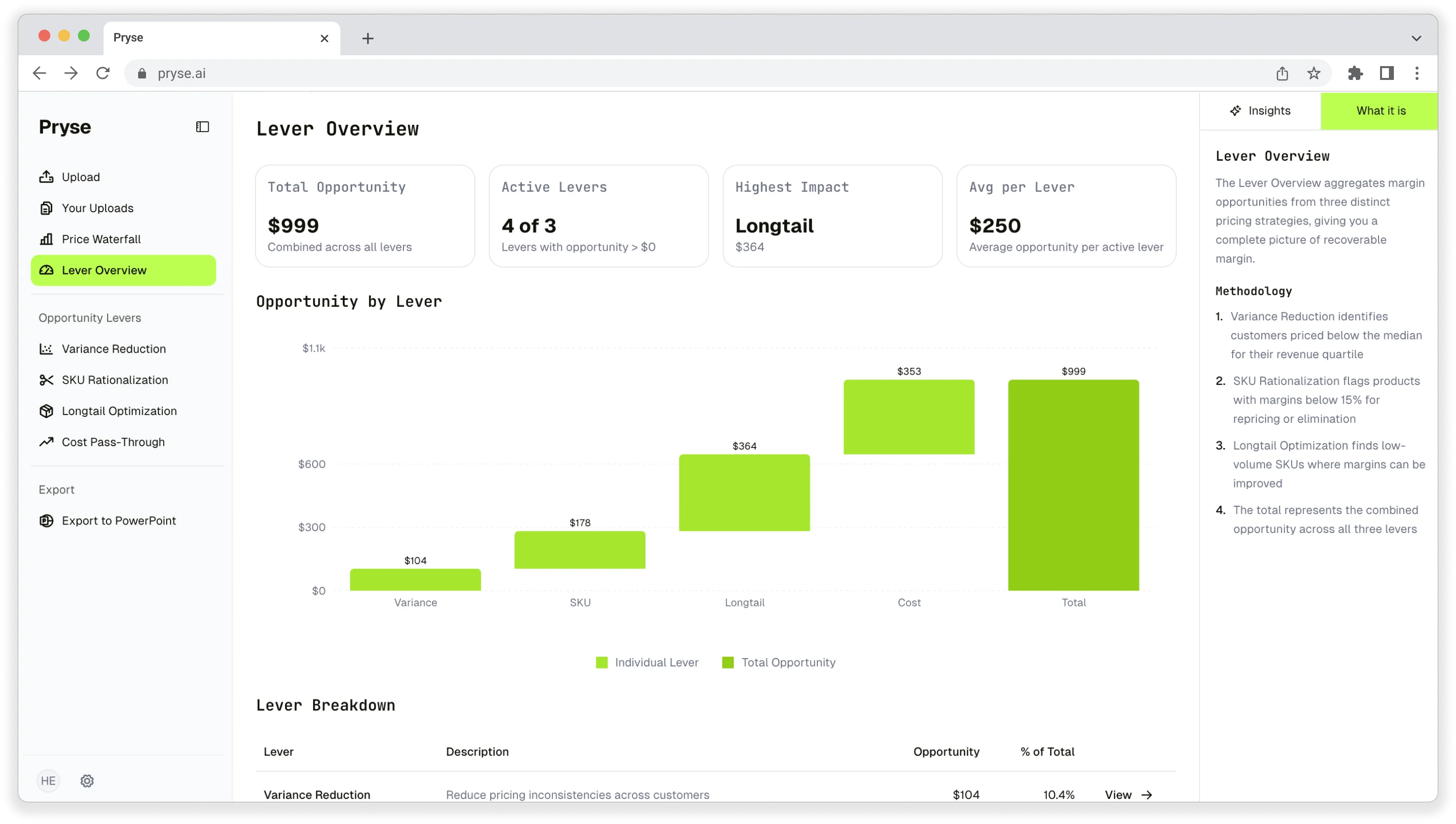
Want to analyze your entire product catalog?
Pryse automatically identifies margin leakage across thousands of SKUs. Upload your data and find hidden profit in 24 hours.
One-time $1,499 diagnostic. No subscription required.