 Pryse
PryseDynamic Pricing in B2B: When It Works (and When It Destroys Relationships)
Dynamic pricing rarely works in B2B distribution and manufacturing. Learn why customer relationships matter more than algorithms—and the 3 scenarios where it makes sense.
Dynamic pricing works brilliantly for airlines, hotels, and Uber. It fails spectacularly for most B2B distributors and manufacturers.
The difference? Relationships. When you're selling 50,000 SKUs to 200 customers you've worked with for 5+ years, automated pricing algorithms that change prices daily destroy the trust those relationships depend on.
According to Simon-Kucher research, historically, B2B prices change once or twice a year, and buyers expect the same prices to be valid in the long term. When a pricing manager at a $60M electrical distributor implemented daily dynamic pricing in 2024, their sales team revolted within 3 weeks. Customer complaints skyrocketed. The system was abandoned after 90 days.
But that doesn't mean dynamic pricing never works in B2B. It works in specific scenarios—commodity products with volatile costs, high-velocity transactional sales, and competitive markets with price transparency. About 15-20% of B2B companies successfully use dynamic pricing by matching the approach to their business model, not copying what works for Uber.
This post explains why most B2B dynamic pricing implementations fail, the 3 scenarios where it succeeds, real examples with margin results, and how to evaluate whether it makes sense for your distribution or manufacturing business—or if you're better off with simpler pricing improvements that don't risk customer relationships.
What Dynamic Pricing Means in B2B
Dynamic pricing adjusts prices automatically based on market conditions—demand, supply, competitor pricing, costs, and inventory levels. The algorithm monitors inputs, calculates optimal prices, and updates systems without human intervention.
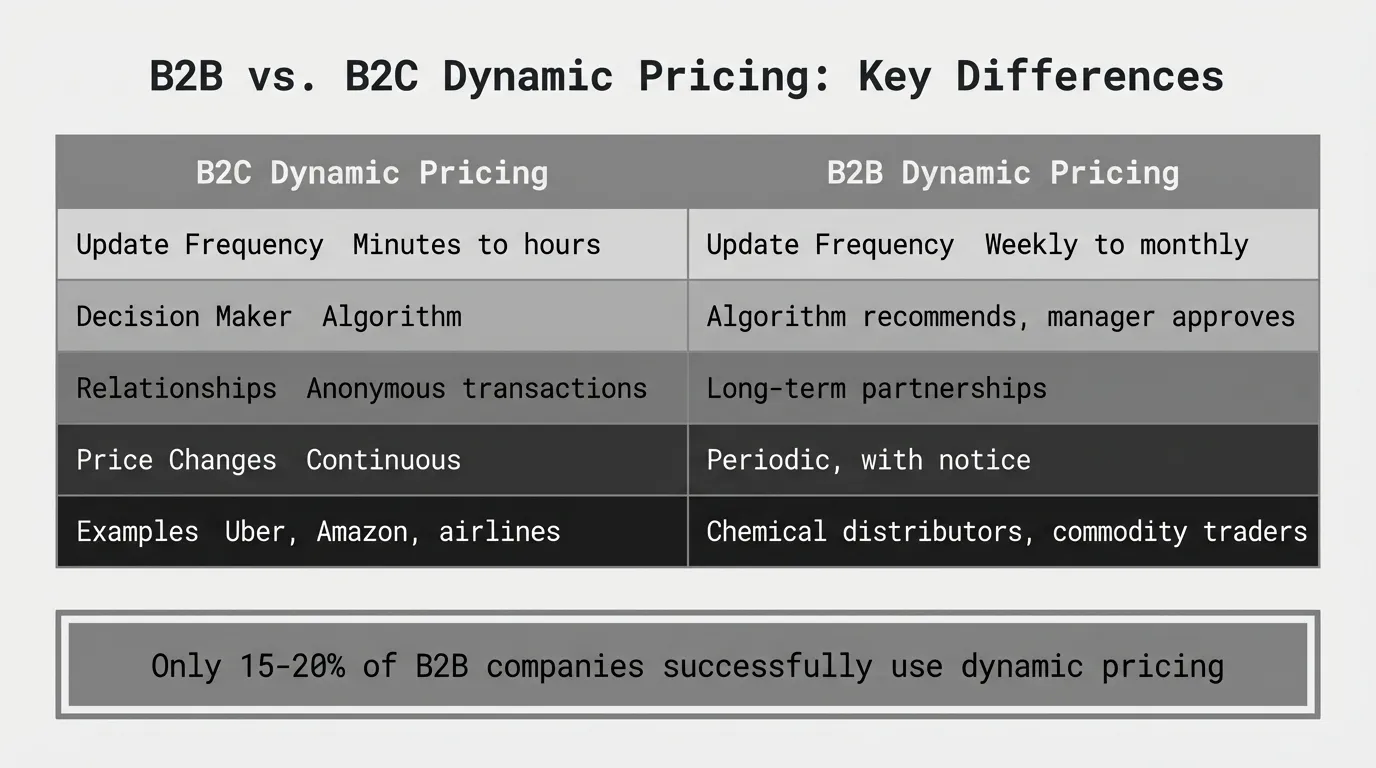
In B2C contexts (airlines, hotels, e-commerce), prices update continuously:
- Uber updates every few minutes during surge demand
- Amazon updates every 10 minutes for high-velocity products
- Airlines update 1-2 times daily based on seats remaining
In B2B contexts, dynamic pricing looks different:
- Weekly or monthly price updates, not hourly
- Algorithms recommend prices; managers approve before publishing
- Different prices for contract customers vs. spot business
- Floor prices based on negotiated agreements
- Override authority for strategic relationships
According to 2026 research on B2B pricing, 54% of manufacturers and distributors use price optimization strategies blending different methods—only a subset of which involves true dynamic pricing.
What B2B dynamic pricing is NOT:
- Not replacing negotiated contracts with algorithms
- Not changing prices daily like consumer e-commerce
- Not removing sales team discretion completely
- Not the same as periodic cost-plus adjustments (if you update prices quarterly based on cost changes, that's not dynamic pricing)
Why Dynamic Pricing Fails in Most B2B Scenarios
B2B sales operate fundamentally differently than consumer transactions. Those differences make dynamic pricing inappropriate for most distribution and manufacturing businesses.
1. Customer Relationships Require Stable Pricing
B2B buyers budget 6-12 months in advance. Purchasing managers negotiate pricing with finance approval, create purchase orders referencing specific prices, and plan inventory based on stable cost assumptions.
According to Copperberg research on B2B dynamic pricing challenges, one of the biggest reasons why dynamic pricing hasn't been adopted in the B2B market is the fear of customer pushback, as prices are constantly changing and clients are likely to resist.
Real scenario: A building materials distributor's customer orders 500 units of product X at $12.50 on Monday. On Thursday, they need 200 more units and discover the price is now $13.75. The customer feels cheated—"Why am I paying more for the same product 3 days later?" Trust erodes, even if the price change is justified by supplier cost increases.
2. Sales Teams View Algorithms as Threats
Sales representatives build relationships over years. They understand customer situations, make judgment calls on pricing for strategic reasons, and own customer satisfaction.
Simon-Kucher research found that sales teams can view AI-driven pricing as a threat to their control or customer relationships.
What happens: A rep quotes a customer based on this week's price list. Before the quote is accepted, dynamic pricing changes the price. The rep looks incompetent or dishonest. Customers blame the rep, not the algorithm.
Sales teams respond by:
- Refusing to use the system
- Creating workarounds (manual overrides on every quote)
- Complaining to management until the system is abandoned
- Leaving for competitors that don't use algorithmic pricing
3. Negotiated Contracts Prohibit Frequent Changes
Many B2B customers have negotiated contracts with fixed pricing for 6-12 months. Volume discounts, rebate programs, and payment term agreements lock in pricing structures.
Dynamic pricing conflicts with these commitments. You can't algorithmically adjust prices that are contractually fixed.
The workaround: Apply dynamic pricing only to spot/transactional business, maintain fixed pricing for contract customers. This creates complexity—tracking which customers get dynamic vs. fixed pricing, managing two price lists, explaining to non-contract customers why prices fluctuate.
4. Implementation Complexity Exceeds Value
B2B pricing has more variables than B2C:
- Customer-specific pricing (negotiated rates)
- Volume discounts and tiered pricing
- Payment terms (net 30, net 60, COD)
- Freight terms (FOB, delivered, customer pickup)
- Service level agreements
- Rebates and off-invoice deductions
According to research on B2B pricing challenges, making price changes too frequently or failing to communicate adjustments effectively can harm customer relationships, and inaccurate or incomplete data can lead to suboptimal pricing decisions.
Building algorithms that handle this complexity costs $100K-$500K annually for enterprise platforms (PROS, Vendavo, PriceFX). Mid-market distributors with $20M-$100M revenue can't justify the investment when simpler approaches (fixing underpriced SKUs, reducing discount leakage) recover 1-2% margin without software.
5. Data Quality Problems Sabotage Algorithms
Dynamic pricing requires clean data:
- 12+ months of transaction history
- Accurate cost data (COGS)
- Real-time inventory levels
- Competitor price feeds
- Customer segment classifications
Most mid-market distributors have:
- Multiple SKU duplicates
- Cost data missing or outdated
- Inventory counts that don't match reality
- No systematic competitor price tracking
Garbage in, garbage out. An algorithm pricing based on bad data makes worse decisions than a pricing manager with judgment and experience.
The 3 Scenarios Where B2B Dynamic Pricing Works
Dynamic pricing isn't universally inappropriate for B2B. It works in specific conditions where customer expectations align with automated pricing.
Scenario 1: Commodity Products with Volatile Costs
When supplier costs change daily or weekly, dynamic pricing maintains target margins without constant manual intervention.
Example: Chemical distributor
According to Copperberg, a chemicals distributor linked its pricing engine to commodity market indices and competitor prices, automating price adjustments based on raw material costs while staying competitive.
How it works:
- Prices update daily based on London Metal Exchange (LME) or commodity index movements
- Formula:
Customer Price = Current Commodity Index Price × (1 + Target Margin %) - Competitor monitoring prevents pricing out of market
- Sales team has override authority for strategic accounts
Results: Maintained 18% gross margin despite 40% raw material volatility over 12 months.
Why customers accept it: They understand commodity pricing fluctuates. They see the same volatility when buying from competitors. The pricing mechanism is transparent and tied to external benchmarks (not arbitrary algorithm decisions).
Industries where this works:
- Metals distribution (steel, aluminum, copper)
- Chemical distribution
- Lumber and building materials
- Energy products (propane, fuel)
Scenario 2: High-Velocity Transactional Sales
E-commerce distributors selling thousands of low-value orders daily can use consumer-like dynamic pricing. Customers don't have personal relationships with sales reps, so automated pricing doesn't damage relationships that don't exist.
Example: Industrial supply e-commerce
A distributor with 50,000 SKUs and 2,000+ daily orders from anonymous customers implemented Amazon-style repricing:
- Prices update multiple times daily based on competitor monitoring
- High-velocity products (top 20% of SKU volume) repriced hourly
- Long-tail SKUs repriced weekly
- Floor prices prevent selling below cost
- Ceiling prices prevent absurd outliers
Results: 3% margin improvement in year one. No customer complaints because customers comparison-shop anyway and expect prices to match market rates.
Why it works: Transactional buyers shop on price and availability. They compare 3-5 suppliers for each order. They don't expect relationship pricing—they expect competitive market pricing. Dynamic repricing keeps you competitive automatically.
Requirements for this to work:
- High order volume (1,000+ orders/month minimum)
- Low average order value (under $500)
- Limited sales rep involvement (self-service website)
- Customers who comparison-shop across multiple suppliers
Scenario 3: Competitive Markets with Price Transparency
When customers can easily compare competitor prices online, dynamic pricing helps you respond without constant manual monitoring.
Example: Defense contractor RFQ response
In 2024, a defense supplier used dynamic pricing with integrated competitor tracking to respond more quickly to government RFQs. By monitoring competitor pricing and adjusting quotes accordingly, they shortened internal review cycles and improved win rates without sacrificing compliance.
How it works:
- Pricing software monitors competitor public quotes and published price lists
- When responding to RFQs, the system recommends competitive positioning (match, undercut 3%, premium with justification)
- Pricing manager approves recommendation before submitting quote
- Historical win/loss data trains the model over time
Results: 22% improvement in win rate on competitive bids.
Why it works: Competitive bidding is inherently price-transparent. Customers receive 5-10 bids and award business based on price (plus quality, delivery, reputation). Dynamic pricing speeds up competitive analysis that would happen manually anyway.
Industries where this works:
- Government contractors responding to RFQs
- Industrial products with published distributor price lists
- Markets with transparent price comparison platforms
Real B2B Dynamic Pricing Results
Here are verified examples with actual margin outcomes.
Energy Manufacturer: Regional Price Optimization
A global energy manufacturer implemented scalable, real-time pricing strategy across their extensive product range, utilizing dynamic pricing optimization tools to adjust prices in response to market fluctuations.
Implementation:
- Regional pricing based on local market conditions
- Competitive positioning varied by region (premium in low-competition areas, competitive in high-competition)
- Customer segments received different pricing logic (strategic accounts: stable; transactional: dynamic)
Results: 2.8% margin improvement, deployed consistently across all regions.
Specialized Distributor: Segment-Based Approach
One specialized B2B distributor achieved 15% margin enhancement within their most critical customer segments just months after deploying optimized pricing.
Segmentation approach:
- Tier 1 customers (top 20% revenue): Fixed pricing with annual reviews, relationship management
- Tier 2 customers (middle 50%): Quarterly price updates based on costs and competition
- Tier 3 customers (bottom 30%): Dynamic pricing with weekly updates, transactional treatment
Results: 15% margin improvement in Tier 3 segment (transactional customers), no customer loss.
Key insight: Applying dynamic pricing only to transactional relationships preserved high-value partnerships while optimizing margins where relationships mattered less.
Metals Distributor: Commodity-Linked Pricing
A $45M metals distributor selling copper, aluminum, and steel products linked customer pricing to LME commodity indices:
Implementation:
- Daily price updates based on LME spot prices
-
Customer Price = (LME Index Price + Freight + Processing Fee) × (1 + Target Margin %) - Transparent pricing formula shared with customers
- Contract customers received monthly average pricing (smoothed volatility)
Results: Maintained 22% gross margin during 18-month period with 60% commodity price swings. Previous fixed pricing resulted in margin compression during cost increases and lost orders during cost decreases.
Customer reaction: Positive. Customers appreciated transparency and predictability of the formula-based approach. They could verify prices against published LME indices.
How B2B Dynamic Pricing Differs from B2C
Understanding these differences helps you implement B2B dynamic pricing appropriately—not copy inappropriate B2C approaches.
| Factor | B2C Dynamic Pricing | B2B Dynamic Pricing |
|---|---|---|
| Update Frequency | Continuous (minutes to hours) | Weekly to monthly |
| Decision Maker | Algorithm decides | Algorithm recommends, manager approves |
| Customer Relationships | Anonymous transactions | Long-term partnerships |
| Price Transparency | Customers expect fluctuations | Customers expect stability |
| Contract Obligations | None (spot pricing) | Fixed-price contracts for 6-12 months |
| Sales Team Involvement | None | Critical for relationship management |
| Pricing Variables | 3-5 (demand, inventory, competition) | 10+ (volume, terms, service level, history) |
| Implementation Cost | $20K-$100K | $100K-$500K+ |
| Margin Improvement | 1-3% | 2-5% (when implemented correctly) |
According to Revology Analytics, for many wholesale distributors, a seemingly modest 1% improvement in the average realized price translates directly into a healthy 8-11% lift in operating profit.
Should Your B2B Company Use Dynamic Pricing?
Use this decision framework to evaluate whether dynamic pricing makes sense for your business.
Clear Yes: Implement Dynamic Pricing If
You check all of these boxes:
- You sell commodity products with volatile supplier costs (metals, chemicals, lumber, energy)
- Customer prices are clearly tied to external benchmarks (LME index, fuel surcharges, published indices)
- Customers understand and accept that prices fluctuate based on market conditions
- You have clean data infrastructure (historical sales, costs, inventory, competitor prices)
- Budget exists for software and implementation ($50K-$500K depending on scale)
OR you check these boxes:
- High transaction volume (1,000+ orders/month)
- Low average order value (under $500)
- Limited customer relationships (e-commerce, self-service)
- Customers comparison-shop across multiple suppliers
- Competitor price monitoring is critical to winning orders
Clear No: Avoid Dynamic Pricing If
You check any of these boxes:
- Sales team builds long-term consultative relationships with customers
- Low transaction volume (under 100 orders/month)
- High average order value (over $10,000)
- Negotiated contracts with fixed pricing for 6-12 months
- Customer contracts prohibit price changes without 30-60 day notice
- Poor data quality (missing costs, duplicate SKUs, inaccurate inventory)
- Limited budget (under $50K for software and implementation)
- Brand positioning emphasizes reliability and stability
Maybe: Consider Semi-Dynamic Pricing If
You're between "yes" and "no":
Semi-dynamic approaches:
- Hybrid model: Dynamic pricing for spot/transactional business, fixed pricing for contract customers
- Periodic updates: Weekly or monthly price adjustments based on costs and competition (not true real-time dynamic pricing)
- Manager approval: Algorithm recommends prices, managers approve before publishing
- Pilot testing: Implement for 100-500 low-risk SKUs for 60-90 days before expanding
This captures some benefits of dynamic pricing while managing relationship and perception risks.
According to 2026 B2B pricing research, 54% of manufacturers and distributors use price optimization strategies blending different methods—suggesting hybrid approaches are more common than pure dynamic pricing.
Integration with ERP Systems
If you decide to implement B2B dynamic pricing, integration with your ERP system is critical—and complex.
How Integration Works
Pricing software (Vendavo, PriceFX, PriceEdge) sits alongside your ERP:
-
Data flows from ERP to pricing engine:
- Transaction history
- Customer master data
- Product costs (COGS)
- Inventory levels
- Contract terms
-
Pricing engine calculates optimal prices based on algorithms, competitor data, and business rules
-
Recommended prices flow back to ERP for quotes, orders, and invoicing
-
Integration happens via APIs (prebuilt connectors for SAP, NetSuite, D365, Acumatica)
According to pricing software research, PriceEdge dynamically updates prices based on new market and cost data and automates price changes across your products and customer agreements, integrating easily to ERP & CRM using prebuilt APIs.
Common Integration Challenges
Challenge 1: ERPs weren't designed for dynamic pricing
Most ERP systems (especially older versions) expect manual price list management. Dynamic pricing requires custom fields, workflows, and approval processes that don't exist out-of-the-box.
Challenge 2: Data quality issues
Pricing algorithms surface data problems that were invisible with manual pricing: duplicate SKUs, missing cost data, incorrect customer assignments. Expect to spend 30-50% of implementation time on data cleanup.
Challenge 3: Sales team adoption
Epicor CPQ research shows that as users configure their desired products, pricing dynamically updates in real-time, shortening sales cycles and eliminating confusion or surprises during the buying process—but only if sales teams trust the system and know how to use it.
Sales teams need training on:
- How prices are calculated
- When to accept algorithm recommendations vs. override
- How to explain price changes to customers
- Escalation process for pricing errors
Without sales team buy-in, the system won't be used.
Implementation Roadmap for B2B Dynamic Pricing
If you've decided dynamic pricing makes sense, here's how to implement it successfully.
Phase 1: Foundation (Months 1-3)
Define objectives and constraints:
- What are you optimizing for? (maximize margin, maximize volume, maintain competitive position)
- Set floor prices (never below cost + minimum margin)
- Set ceiling prices (never exceed 2x market average)
- Define update frequency (daily, weekly, monthly)
Clean and validate data:
- 12+ months transaction history
- Accurate cost data (COGS)
- Customer segmentation
- Competitor price tracking setup
- Inventory data accuracy
Select software:
- Enterprise (10,000+ SKUs, $100K+/yr): PROS, Vendavo, PriceFX
- Mid-market (1,000-10,000 SKUs, $50K-$100K/yr): Zilliant, PriceEdge
- Testing/pilot: Spreadsheet-based rules engine
See our pricing optimization software guide for detailed vendor comparison.
Phase 2: Pilot (Months 4-6)
Start small with low-risk SKUs:
- Select 100-500 products with good data quality
- Choose transactional customers (not strategic accounts)
- Limit price changes to ±5% initially
- Run pilot for 60-90 days
Measure pilot results:
- Margin improvement (compare to control group)
- Volume impact (did sales decrease?)
- Customer feedback (complaints, questions)
- Sales team feedback (usability, trust)
- Operational impact (quote cycle time, order processing)
Criteria for expansion:
- Margin improves 1%+ without volume loss
- Fewer than 5% of customers complain
- Sales team supports expansion
- No major operational issues
Phase 3: Expansion (Months 7-12)
Gradual rollout:
- Expand to 500-1,000 SKUs
- Increase price change range to ±10%
- Add more customer segments (still avoiding top strategic accounts)
- Monitor weekly, tune monthly
Sales team enablement:
- Training on how to explain price changes
- Override authority for strategic situations
- Pricing error escalation process
- Regular feedback sessions
Phase 4: Optimization (Ongoing)
Continuous improvement:
- Daily monitoring for pricing errors
- Weekly performance review (margin, volume, customer feedback)
- Monthly algorithm tuning
- Quarterly strategic review of objectives
Success metrics:
- Margin improvement: 2-5% target
- Customer retention: 95%+ (no loss from pricing issues)
- Sales team satisfaction: 70%+ support dynamic pricing
- Operational efficiency: Quote cycle time reduced 20%+
Common Mistakes That Kill B2B Dynamic Pricing
Learn from these failures to avoid expensive mistakes.
Mistake 1: Copying B2C Frequency
A $60M electrical distributor implemented daily dynamic pricing after reading about Amazon's success. Customer complaints started within days. Sales team revolted within weeks. System abandoned after 90 days.
What went wrong: Daily price changes appropriate for anonymous e-commerce transactions destroy B2B customer trust. Buyers couldn't budget, sales reps couldn't quote confidently, purchasing managers complained to executives.
The fix: B2B prices should update weekly or monthly, not daily. Match update frequency to customer expectations and contract terms.
Mistake 2: Zero Sales Team Involvement
A manufacturing company selected and implemented pricing software without consulting sales. The algorithm removed pricing discretion sales reps had used for 10+ years to manage customer relationships.
Result: Sales team ignored the system and continued using old price lists. Pricing manager had impressive algorithms that nobody used.
The fix: Involve sales team from day one. Give them override authority for strategic situations. Train them on how the system works and why it benefits them (less manual work, faster quotes, competitive intelligence).
Mistake 3: Poor Data Quality
A distributor implemented dynamic pricing with cost data that was 6-12 months outdated. Algorithms priced products below current replacement cost, generating sales volume but negative margins.
The fix: Data cleanup isn't optional. Spend 30-50% of implementation time validating costs, cleaning duplicate SKUs, and establishing data governance processes.
Mistake 4: No Guardrails on Algorithms
A distributor using automated competitor monitoring created price loops. Their algorithm priced 1% below Competitor A. Competitor A's algorithm priced 1% below them. Prices spiraled to $0.01 before someone noticed.
The fix: Set floor prices (cost + minimum margin), ceiling prices (market-reasonable maximums), and maximum change limits (±10% per update). Test algorithms with sandbox data before production deployment.
Mistake 5: Treating All Customers the Same
A manufacturer applied dynamic pricing to all customers equally—strategic accounts and transactional buyers received the same algorithmic treatment.
Result: Strategic accounts felt devalued and shopped competitors. The company lost two major accounts worth $8M combined revenue.
The fix: Segment customers. Apply dynamic pricing to transactional relationships. Maintain fixed or semi-dynamic pricing for strategic accounts with relationship management and annual contract reviews.
Before You Implement Dynamic Pricing: Fix These First
Most B2B companies should fix basic pricing problems before considering dynamic pricing.
Problems dynamic pricing won't solve:
- Consistently underpriced products (need one-time price increase)
- Untracked discounts and rebates (need margin leakage analysis)
- Poor cost data (need accurate COGS)
- Sales team discounting without guardrails (need approval workflows)
- Products priced below cost (need floor price policies)
According to distribution pricing research, many distributors recover 1-2% margin just by fixing underpriced SKUs and reducing excessive discounts—before needing dynamic pricing software.
The sequence that works:
- Run a margin diagnostic to identify where you're losing money
- Fix underpriced products with one-time adjustments
- Reduce margin leakage from uncontrolled discounting
- Implement rule-based pricing (cost-plus with competitive positioning)
- Evaluate whether remaining opportunities justify dynamic pricing
For most mid-market distributors with $20M-$100M revenue, steps 1-4 recover more margin than jumping straight to dynamic pricing. Dynamic pricing makes sense only after you've exhausted simpler improvements.
See our pricing optimization guide for fundamentals that work before automation.
The Verdict: When B2B Dynamic Pricing Makes Sense
Dynamic pricing is not a universal solution for B2B companies. It succeeds in narrow scenarios where customer expectations align with automated pricing.
Use dynamic pricing if:
- You sell commodities with volatile costs tied to external benchmarks
- You operate high-velocity transactional sales with limited relationships
- You compete in transparent markets where customers comparison-shop
Avoid dynamic pricing if:
- You build consultative relationships over years
- Customer contracts require stable pricing
- Sales team discretion is critical to relationship management
- Data quality or budget constraints prevent proper implementation
Most B2B companies should:
- Fix basic pricing problems first (underpriced SKUs, margin leakage)
- Implement rule-based optimization (cost-plus with competitive logic)
- Consider semi-dynamic approaches (weekly updates, manager approval, hybrid models)
- Only pursue full dynamic pricing after exhausting simpler improvements
The companies successfully using B2B dynamic pricing didn't start there. They built pricing discipline with fundamentals first, then added automation to scale what already worked—not to fix problems that required strategic decisions, not algorithms.
Sources
- Dynamic Pricing for B2B: Real-Time Strategies to Optimize Wholesale and Distribution Margins - Revology Analytics
- B2B dynamic pricing - Simon-Kucher
- Using Dynamic Pricing Optimization in B2B Industries: A Comprehensive Guide - Zilliant
- B2B Pricing 2026 Guide: Strategy, Models, Optimization & Real-World Examples - OmniBound AI
- AI and dynamic pricing in B2B industrial companies: Why it's not a match made in heaven - Simon-Kucher
- Dynamic Pricing Tactics for B2B Tech Companies - Data-Mania
- Dynamic Pricing in B2B Manufacturing: The Secret Weapon Your Competitors Are Already Using - Copperberg
- Epicor CPQ Dynamic Pricing Software - KBMax
- PriceEdge for Distributors - PriceEdge
Last updated: February 22, 2026
Frequently Asked Questions
Want to analyze your entire product catalog?
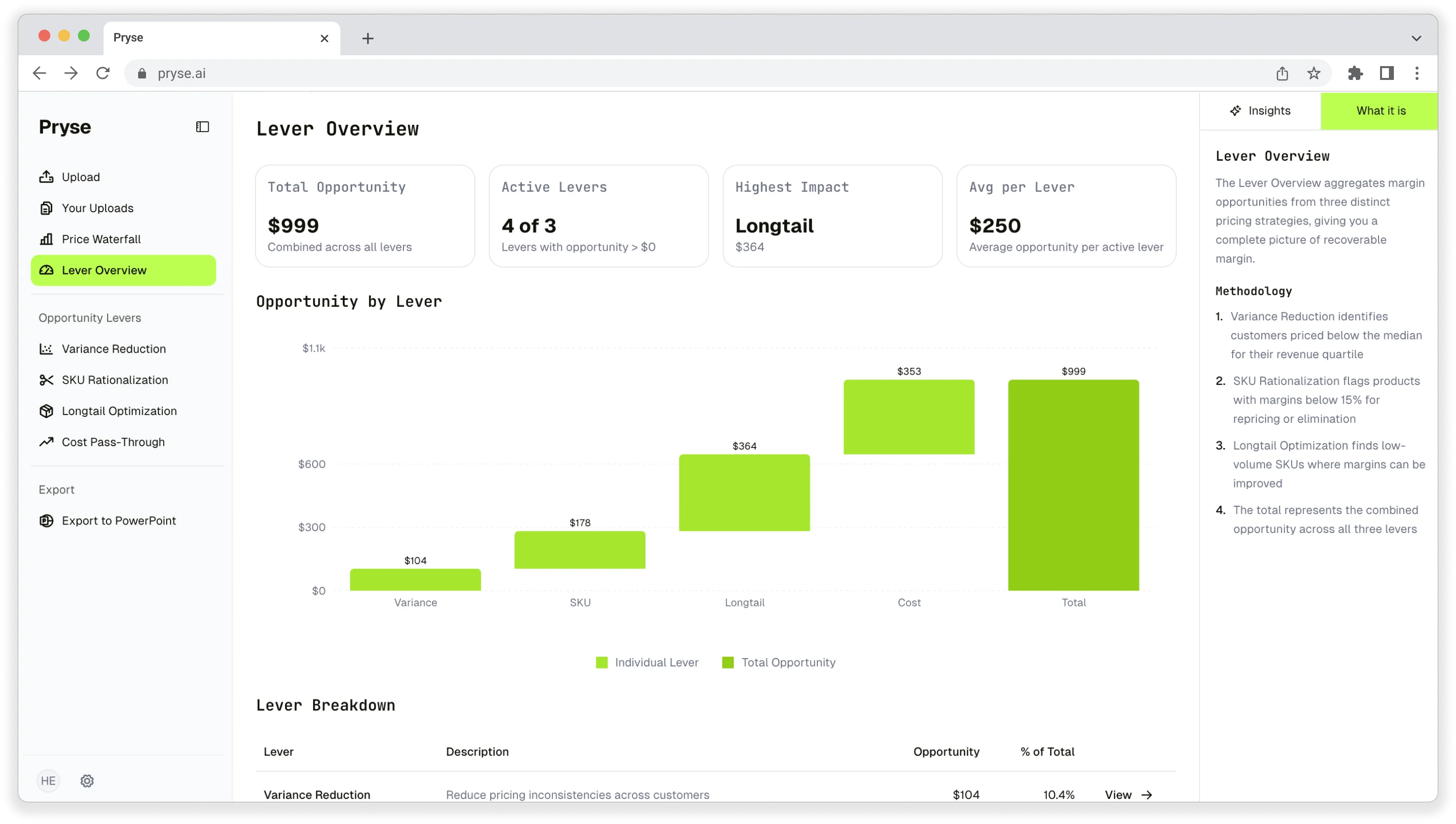
Pryse automatically identifies margin leakage across thousands of SKUs. Upload your data and find hidden profit in 24 hours.
One-time $1,499 diagnostic. No subscription required.