 Pryse
PryseWhat is Dynamic Pricing? Definition, Examples & How It Works
Dynamic pricing adjusts prices in real-time based on demand, supply, and market conditions. Learn when it works for B2B distribution and manufacturing.
Dynamic pricing is a pricing strategy where prices change automatically based on real-time factors like demand, supply, competitor pricing, and inventory levels. Airlines, hotels, ride-sharing services, and retailers use algorithms to adjust prices throughout the day—sometimes hundreds of times.
You've experienced dynamic pricing when booking a flight that costs $200 Tuesday morning and $450 Friday afternoon, or ordering an Uber that quotes $18 normally and $54 during a surge. The same hotel room, concert ticket, or Amazon product changes price based on how many people want it right now.
For consumer-facing businesses like airlines and e-commerce, dynamic pricing is standard practice. For B2B distribution and manufacturing companies, it's more complicated—and often unnecessary. Most distributors change prices quarterly, not hourly, because customer relationships matter more than algorithmic optimization.
This post explains what dynamic pricing actually does, how the algorithms work, real-world examples across industries, advantages and disadvantages, and when B2B companies should (and shouldn't) use it.
Dynamic Pricing Definition
Dynamic pricing adjusts product or service prices automatically in response to market conditions, using algorithms that analyze demand, supply, competitor pricing, inventory levels, time of day, customer behavior, and other variables.
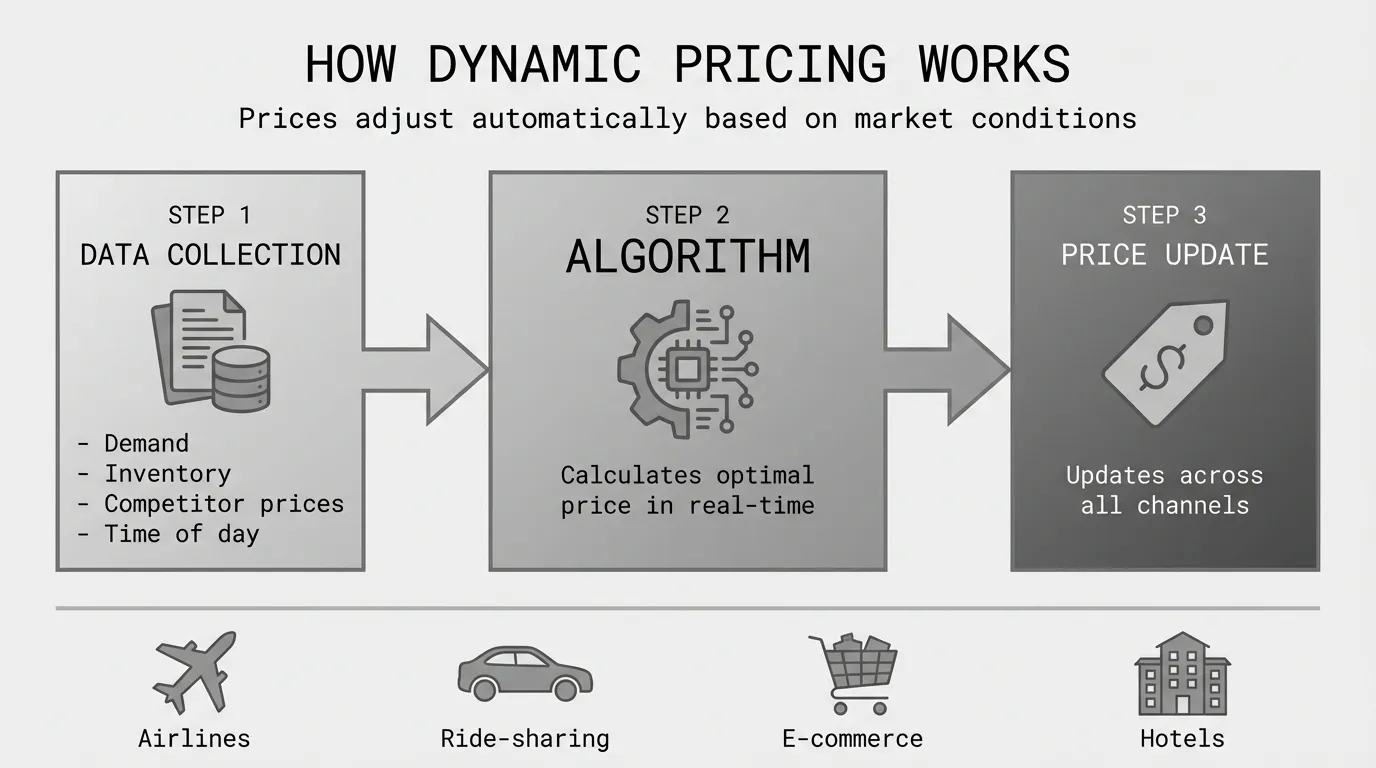
The mechanism is simple: the algorithm monitors inputs (current demand, remaining inventory, competitor prices), applies a pricing rule or machine learning model, and updates prices across sales channels without human intervention.
Common names for dynamic pricing:
- Surge pricing (Uber's term for demand-based price increases)
- Demand pricing (adjusts to demand fluctuations)
- Real-time pricing (updates continuously)
- Algorithmic pricing (emphasizes automation)
- Time-based pricing (varies by time of day, day of week, or season)
What dynamic pricing is not:
- Not personalized pricing: Dynamic pricing applies the same price to all customers at a moment in time. Personalized pricing charges different customers different prices based on willingness to pay or purchase history (less common, often controversial).
- Not price discrimination: While related, dynamic pricing changes prices based on market conditions, not customer characteristics. Price discrimination intentionally charges different customer groups different prices for the same product.
- Not manual price changes: If you review prices quarterly and adjust based on cost changes, that's not dynamic pricing. Dynamic pricing is automated and responds to real-time data.
According to research on dynamic pricing algorithms, businesses adjust their prices dynamically using data-driven algorithms that factor in everything from current stock to how competitors are pricing similar offerings.
How Dynamic Pricing Works
Dynamic pricing algorithms follow a three-step process: collect data, calculate optimal price, update price across systems.
1. Data Collection
The algorithm continuously monitors:
Internal data:
- Current inventory levels and days of supply
- Historical sales volume at different price points
- Cost of goods sold (COGS)
- Profit margin targets
- Sales velocity (how fast products move)
External data:
- Competitor pricing from web scraping or data feeds
- Market demand signals (search volume, click-through rates, abandoned carts)
- Seasonal patterns and promotional calendars
- Economic indicators (commodity prices, exchange rates)
- Event calendars (holidays, conferences, weather events)
Customer behavior data:
- Time spent viewing product pages
- Purchase history and frequency
- Device type and location
- Referral source (direct, search, ad)
2. Price Calculation
Dynamic pricing algorithms work by processing historical sales and price data, pricing points, and current market demand, identifying significant parameters that the price depends on (for example, "school opening" is a parameter that affects stationery sales), and generating a mathematical model based on significant parameters.
Three main approaches:
Rule-based pricing follows logic you define:
- If inventory > 30 days of supply, discount 10%
- If competitor price drops 5%, match within 1 hour
- If search volume increases 50%, raise price 15%
This approach is predictable and explainable but can't handle complex scenarios or learn from outcomes.
Regression models use historical data to predict optimal prices:
Optimal Price = Base Price + (Demand Factor × Coefficient) + (Inventory Factor × Coefficient) + (Competitor Factor × Coefficient)The model learns coefficients from historical data, effectively answering "What price maximized profit when demand was high and inventory was low?"
Machine learning models (reinforcement learning, neural networks) experiment with prices and learn from results. The algorithm tries different prices, observes what happens (sales volume, margin, customer response), and adjusts strategy to maximize your objective (usually revenue or profit).
3. Price Updates
Once the algorithm calculates the new price, it pushes updates to:
- E-commerce website and mobile apps
- Point-of-sale systems (retail stores)
- Sales quote systems (B2B)
- Third-party marketplaces (Amazon, eBay)
- Advertising platforms (Google Ads, Facebook)
Update frequency varies by industry:
- Airlines: Once or twice daily
- Hotels: Multiple times per day
- E-commerce: Hundreds of times per day for high-velocity products
- Ride-sharing: Every few minutes or continuously
- B2B distribution: Weekly or monthly (most don't use real-time dynamic pricing)
According to Walmart's dynamic pricing test, the retailer updates grocery prices with digital shelf tags up to 6 times per minute during trials.
Dynamic Pricing Examples Across Industries
Dynamic pricing started with airlines in the 1980s and spread to hotels, events, ride-sharing, e-commerce, and recently B2B distribution.
Airlines
Airlines pioneered dynamic pricing in the 1980s after deregulation. A single flight might have 15+ fare classes with prices that change daily based on:
- Days until departure (prices rise as departure nears)
- Seats remaining in each fare class
- Day of week and time of day
- Route competition (more competitors = lower prices)
- Historical cancellation rates on similar flights
- Seasonal demand patterns
According to Harvard Business School research on dynamic pricing, airlines use dynamic pricing to factor in different components such as how many seats a flight has, departure time, and average cancellations on similar flights.
The same seat on the same flight can range from $150 (booked 6 months early, midweek departure) to $800 (booked 3 days before Friday departure).
Ride-Sharing (Uber, Lyft)
Uber's surge pricing adjusts ride prices based on demand surges. The algorithm considers supply-demand imbalances, driver availability, and customer demand patterns, ensuring quick rides during peak times.
When ride demand exceeds available drivers:
- Prices increase 1.2x to 3x (occasionally higher during major events or emergencies)
- Higher prices incentivize more drivers to go online
- Higher prices reduce demand by pushing price-sensitive riders to wait
- The system balances supply and demand in 10-15 minutes
Critics argue surge pricing exploits customers during emergencies. Defenders say it ensures rides are available when you need them most—without surge pricing, you'd wait hours or get no ride at all.
E-Commerce (Amazon)
Amazon's dynamic pricing strategy is driven by real-time market data and customer behavior analysis. It includes frequent price changes to stay competitive, matching or beating competitor prices. This strategy also helps manage inventory levels and increase sales during peak periods with time-limited deals and personalized discounts.
Amazon reportedly changes prices on 15-20% of products daily, some products multiple times per day. The algorithm considers:
- Competitor pricing from Target, Walmart, Best Buy, third-party sellers
- Inventory levels (discount slow-moving inventory)
- Product lifecycle stage (new releases vs. clearance)
- Customer browsing and purchase patterns
- Seasonal demand and promotional calendars
A wireless mouse might be $24.99 Monday morning, $22.49 Tuesday (competitor dropped price), $24.99 Wednesday (competitor raised it back), and $19.99 Friday (clearing inventory before new model launches).
Hotels
Hotels use dynamic pricing to enhance consumer confidence in online bookings. By showing how demand, timing, and events affect room rates, customers are more inclined to follow through with bookings, helping reduce cancellations from unexpected costs.
Hotel room pricing changes based on:
- Days until check-in date
- Occupancy rate (percentage of rooms booked)
- Local events (conferences, concerts, festivals)
- Competitor pricing for comparable hotels
- Day of week (business travel peaks midweek, leisure travel peaks weekends)
- Seasonal patterns and weather forecasts
The same hotel room can cost $120 (Tuesday in February) or $380 (Saturday during a major conference).
Retail (Dynamic Pricing with Digital Price Tags)
Traditional retailers historically changed prices weekly with printed tags. Digital price tags allow real-time updates like e-commerce.
Walmart tests grocery dynamic pricing with digital tags, updating prices up to 6 times per minute during trials.
Other retailers using dynamic pricing:
- Target adjusts online prices to match Amazon
- Best Buy matches online competitors in real-time
- Kroger tests digital tags for fresh produce based on expiration dates
Entertainment and Events
Concert tickets, sports events, and theme parks increasingly use dynamic pricing:
- Broadway shows vary ticket prices by show date, time, and seat location
- Disney varies theme park admission by expected crowd levels
- Sports teams price tickets based on opponent strength, day of week, and weather
This shifts revenue from scalpers to the original seller while ensuring tickets remain available at various price points.
Energy and Utilities
Some utilities offer time-of-use pricing where electricity costs more during peak demand hours (typically 4-9 PM) and less during off-peak hours (overnight).
Electric vehicle charging networks price higher during afternoon peaks and lower overnight to shift demand.
Dynamic Pricing in B2B Distribution and Manufacturing
Most B2B companies don't use true real-time dynamic pricing. Instead, they use periodic pricing adjustments based on market conditions—updated weekly or monthly, not continuously.
Why B2B Dynamic Pricing Is Rare
1. Customer relationship complexity
According to Simon-Kucher research, historically, B2B prices change once or twice a year, and buyers expect the same prices to be valid in the long term. B2B buyers expect stable pricing for budgeting and planning. Frequent price changes complicate procurement processes and damage trust.
2. Negotiated deals
Many B2B customers have negotiated contracts with fixed pricing for 6-12 months. Dynamic pricing conflicts with contractual commitments.
3. Sales team resistance
Simon-Kucher found that sales teams can view AI-driven pricing as a threat to their control or customer relationships. Salespeople resist automated pricing that removes their discretion and complicates customer conversations.
4. Implementation complexity
B2B pricing has more variables than B2C: customer size, order volume, payment terms, freight terms, service levels, and negotiated rebates. Dynamic pricing algorithms struggle with this complexity.
Where B2B Dynamic Pricing Works
According to Copperberg, for manufacturers and distributors, dynamic pricing—enabled by AI, machine learning, and big data—offers a way to stay ahead of shifting costs, fluctuating demand, and evolving customer expectations.
Commodity products with volatile costs
Distributors selling steel, copper, lumber, or chemicals face daily supplier price changes. Dynamic pricing updates customer prices based on current replacement cost, maintaining target margins without manual intervention.
A metals distributor might update prices daily based on London Metal Exchange spot prices plus target margin.
High-velocity transactional sales
E-commerce distributors selling thousands of low-value orders daily can use dynamic pricing like retail. Customers don't have personal relationships with sales reps, so automated pricing doesn't damage relationships.
Competitive markets with price transparency
When customers can easily compare competitor prices online, dynamic pricing helps you match or beat competitors automatically without constant manual monitoring.
Excess inventory clearance
Distributors use dynamic discounting to clear slow-moving or obsolete inventory. The algorithm increases discounts as days-on-hand increases.
B2B Dynamic Pricing Results
Revology Analytics reports that for many wholesale distributors, a seemingly modest 1% improvement in the average realized price translates directly into a healthy 8-11% lift in operating profit.
Research from OmniBound AI found that 54% of manufacturers and distributors use price optimization strategies blending different methods, and 45% of manufacturing leaders prioritize revenue growth when adjusting pricing strategies.
Most successful B2B implementations combine dynamic pricing with human oversight—the algorithm recommends prices, but sales managers approve changes before implementation.
Dynamic Pricing Advantages and Benefits
Dynamic pricing delivers real benefits when implemented correctly for the right business model.
Maximize Revenue During High Demand
Dynamic pricing allows businesses to increase revenue by raising prices during high-demand periods and offering discounts during slower times, maximizing profitability throughout the sales cycle.
When demand spikes (holidays, major events, supply shortages), dynamic pricing captures additional willingness to pay automatically. Airlines, hotels, and ride-sharing convert demand surges into revenue without leaving money on the table.
A hotel near a convention center might earn an extra $50,000 during a major conference by raising rates from $150 to $280.
Reduce Waste and Clear Inventory
Perishable products, seasonal items, and slow-moving inventory lose value over time. Dynamic pricing discounts these items before they become worthless.
Airlines discount seats as departure approaches rather than flying with empty seats worth $0. Grocery stores discount produce approaching expiration. Apparel retailers discount last season's styles before they're obsolete.
Respond Faster to Competitor Price Changes
According to SYMSON research, dynamic pricing algorithms help businesses respond to rapidly changing market conditions, maximizing profitability and competitiveness.
Manual price monitoring can't track hundreds of competitors across thousands of products. Dynamic pricing matches or beats competitor prices within hours or minutes, preventing customer loss to cheaper alternatives.
E-commerce retailers lose customers instantly when competitors undercut them. Automated response is the only viable option at scale.
Optimize Margins Across Large Catalogs
Distributors with 20,000+ SKUs can't manually optimize pricing for each product. Dynamic pricing applies optimization algorithms consistently across the entire catalog.
A 1% margin improvement across a $50M distributor's catalog generates $500K in additional gross profit annually.
Improve Demand Forecasting
Dynamic pricing provides real data about price elasticity. When prices increase and volume stays stable, you've learned the product is inelastic—you should raise prices further. When volume drops significantly, you've learned it's elastic.
This pricing intelligence improves future decisions beyond just automated adjustments.
Dynamic Pricing Disadvantages and Challenges
Dynamic pricing creates significant challenges that cause many implementations to fail or damage customer relationships.
Customer Perception of Unfairness
According to research on dynamic pricing disadvantages, consumers may view dynamic pricing as unfair or exploitative, particularly if price changes are frequent and significant, leading to dissatisfaction and eroding trust, potentially harming brand loyalty.
When customers discover they paid more than someone else for the same product, they feel cheated—even if prices changed legitimately based on timing or demand. This damages brand loyalty and generates negative word-of-mouth.
Uber faced customer backlash for surge pricing during emergencies (hurricanes, terrorist attacks). Amazon faced criticism for price changes that seemed random or unfair.
B2B Customer Relationship Damage
According to Copperberg research, one of the biggest reasons why dynamic pricing hasn't been adopted in the B2B market is the fear of customer pushback, as prices are constantly changing and clients are likely to resist.
B2B customers expect stable pricing for budgeting and contract management. Frequent price changes create administrative burden and erode trust in supplier relationships.
A manufacturer who quotes $12.50 on Monday and $13.75 on Thursday for the same product confuses customers and creates procurement friction.
Implementation Costs and Complexity
According to research on dynamic pricing challenges, challenges include ethical concerns, cost of implementation, and customer dissatisfaction.
Dynamic pricing requires:
- Sophisticated software ($20K-$500K annually depending on scale)
- Clean data infrastructure (historical sales, costs, inventory, competitor prices)
- Technical integration with e-commerce, ERP, and POS systems
- Ongoing monitoring and algorithm tuning
- Training for sales, marketing, and customer service teams
Small businesses often lack the data quality, technical capability, and budget to implement dynamic pricing successfully.
Risk of Pricing Errors
Automated pricing can malfunction spectacularly. Examples:
- Amazon third-party sellers creating infinite price loops (seller A sets price 1% below seller B, seller B sets price 1% below seller A, prices spiral to $0 or $millions)
- Algorithms responding to bad data (incorrect inventory counts, wrong competitor prices)
- Rule conflicts creating nonsensical prices
A major retailer once priced a $200 item at $0.01 due to an algorithm error, creating viral social media attention and thousands of unprofitable orders.
Competitive Price Wars
When multiple competitors use dynamic pricing algorithms that monitor each other, race-to-the-bottom price wars can occur automatically.
If your algorithm matches competitor prices, and their algorithm matches yours, and both try to undercut by $0.01, prices drop continuously until profit disappears.
E-commerce sellers experience this regularly on Amazon, where algorithmic repricing creates margin-destroying spirals.
Regulatory and Legal Risks
Some jurisdictions restrict dynamic pricing practices:
- Price gouging laws cap increases during emergencies (hurricanes, pandemics)
- The Robinson-Patman Act in the U.S. restricts price discrimination in B2B contexts
- EU consumer protection laws require price transparency
Companies using dynamic pricing need legal review to ensure compliance with regulations in markets they serve.
When to Use Dynamic Pricing (And When Not To)
Dynamic pricing isn't universally beneficial. It works in specific scenarios and fails in others.
Clear Yes: Use Dynamic Pricing If
High transaction volume with limited customer relationships
E-commerce, retail, ride-sharing, and airlines interact with thousands of anonymous customers daily. Automated pricing doesn't damage relationships because relationships don't exist.
Perishable inventory or time-limited capacity
Airlines can't store unsold seats for later. Hotels can't bank empty rooms. Event venues have fixed capacity. Dynamic pricing prevents waste by discounting before value disappears.
Volatile costs or competitive markets
When supplier costs change daily (commodities, fuel, currency fluctuations), dynamic pricing maintains margins without constant manual adjustments.
Large product catalogs
Distributors with 20,000+ SKUs can't manually optimize pricing across the catalog. Automated optimization is the only scalable approach.
Price transparency and comparison shopping
When customers easily compare competitor prices online, dynamic pricing keeps you competitive without manual monitoring.
Clear No: Avoid Dynamic Pricing If
Consultative B2B sales with long-term relationships
When sales reps build relationships over years and negotiate custom deals, automated pricing damages trust and complicates conversations.
Low transaction volume with high order values
Custom manufacturers selling 50 units per year at $100K each can't use algorithms based on transaction patterns. Each sale is unique.
Brand positioning emphasizes stability and trust
Luxury brands, professional services, and businesses competing on reliability shouldn't use dynamic pricing that suggests opportunism.
Poor data quality or infrastructure
Dynamic pricing requires clean historical data, real-time inventory visibility, and reliable competitor price feeds. Without these, algorithms make bad decisions.
Regulatory restrictions
Industries with price regulations (healthcare, utilities in some markets) face legal constraints on dynamic pricing.
Customer contracts prohibit price changes
If your customers have negotiated fixed-price contracts for 12 months, dynamic pricing violates agreements.
Maybe: Consider Hybrid Approaches
Many companies use "semi-dynamic" pricing:
- Update prices weekly or monthly based on costs and competition (not real-time)
- Use dynamic pricing for spot/transaction business, fixed pricing for contract customers
- Apply dynamic pricing to clearance items only, stable pricing for core products
- Let algorithms recommend prices, but require manager approval before changes
This captures some benefits of dynamic pricing while managing relationship and perception risks.
How to Implement Dynamic Pricing
If you've decided dynamic pricing makes sense, implementation follows a structured process.
1. Define Objectives and Constraints
Clarify what you're optimizing for:
- Maximize revenue?
- Maximize profit margin?
- Maximize market share?
- Clear excess inventory?
Set constraints:
- Maximum price increase per day or week
- Minimum profit margin
- Competitive positioning (never price higher than X competitor)
- Brand guidelines (luxury brand shouldn't discount below X%)
2. Collect and Clean Data
Dynamic pricing requires historical data:
- 12+ months of transaction history (SKU, customer, price, volume, date)
- Cost data (COGS)
- Inventory levels
- Competitor pricing (web scraping, data feeds, manual tracking)
- Market demand signals (search volume, website traffic, conversion rates)
Expect to spend 30-50% of implementation time on data quality issues: duplicate SKUs, missing costs, incorrect categorization.
3. Choose Software and Algorithms
For large catalogs (10,000+ SKUs) or high velocity (1,000+ transactions daily):
Use enterprise platforms: PROS, Vendavo, Pricefx, Competera. Budget $100K-$500K annually plus implementation.
For mid-market businesses (1,000-10,000 SKUs, moderate transaction volume):
Use mid-market tools or pricing consultancies with software components. Budget $20K-$100K annually.
For testing or small catalogs:
Build rule-based pricing in Excel or business intelligence tools. Test with 100-500 SKUs before expanding.
See our pricing optimization software guide for detailed vendor comparison.
4. Start With Low-Risk Pilot
Don't implement dynamic pricing across your entire catalog on day one.
Pilot approach:
- Select 100-500 SKUs with good data quality and low customer sensitivity
- Limit price changes to ±5% initially
- Run for 30-60 days monitoring customer response, sales volume, and margin
- Measure results against control group (SKUs with fixed pricing)
If the pilot succeeds (margin improves, customers don't complain, operations can handle it), gradually expand.
5. Monitor and Adjust
Dynamic pricing isn't "set it and forget it." Plan for:
- Daily monitoring of pricing errors and outliers
- Weekly review of performance metrics (margin, volume, customer feedback)
- Monthly algorithm tuning based on results
- Quarterly review of objectives and constraints
Assign someone ownership—pricing manager, revenue analyst, or sales operations—with authority to pause pricing updates if problems occur.
Dynamic Pricing vs. Other Pricing Strategies
Dynamic pricing is one of many pricing approaches. Understanding alternatives helps you choose the right strategy.
Dynamic Pricing vs. Fixed Pricing
Fixed pricing sets one price that doesn't change frequently (annual or quarterly updates).
Fixed pricing works for:
- Stable markets with predictable costs
- Products with long development cycles (software subscriptions, SaaS)
- B2B relationships where price stability matters
- Businesses lacking data or technology for dynamic pricing
Fixed pricing is simpler to implement, easier for customers to understand, and doesn't require sophisticated software.
Dynamic Pricing vs. Value-Based Pricing
Value-based pricing sets prices based on customer-perceived value rather than costs or competition.
Value-based pricing considers "what would the customer pay for this?" while dynamic pricing asks "what price maximizes profit given current market conditions?"
Many businesses combine both: use value-based pricing to set the price range, then use dynamic pricing to optimize within that range.
See our value-based pricing guide for detailed implementation instructions.
Dynamic Pricing vs. Cost-Plus Pricing
Cost-plus pricing calculates price as cost plus target margin.
Price = COGS × (1 + Target Margin %)Cost-plus pricing is common in distribution and manufacturing. It's predictable and easy to explain but ignores market demand and competitive positioning.
Dynamic pricing often starts with cost-plus as the baseline, then adjusts up or down based on market conditions.
See our cost-plus pricing guide for B2B implementation details.
Is Dynamic Pricing Right for Your Business?
Most mid-market B2B distribution and manufacturing companies don't need true dynamic pricing. They benefit more from better margin analysis, fixing underpriced products, and implementing rule-based optimization.
Before investing in dynamic pricing:
- Run a margin diagnostic to understand your current pricing performance
- Fix obvious problems (underpriced products, excessive discounts, margin leakage)
- Implement basic price optimization (cost-plus with competitive positioning)
- Evaluate whether remaining opportunities justify dynamic pricing investment
The companies generating value from dynamic pricing didn't start there. They built pricing discipline first with simpler approaches, then added automation to scale what already worked.
For most readers, start with pricing optimization fundamentals: analyze margins, identify leakage sources, fix underpriced SKUs, and implement consistent pricing logic. Once you've recovered 1-2% margin through basic improvements, reassess whether dynamic pricing makes sense.
Sources
- 6 Successful Dynamic Pricing Examples To Follow in 2026 - Mailmodo
- Dynamic Pricing Algorithms in 2026: Top 3 Models - AIMultiple
- Dynamic pricing - Wikipedia
- Dynamic Pricing: What It Is & Why It's Important - Harvard Business School Online
- What is Dynamic Pricing? How It Works and Examples - Shopify
- What Is Dynamic Pricing? How It Works, With Examples - Salesforce
- Dynamic pricing strategy: Definition, types, benefits & examples - Paddle
- Dynamic Pricing in B2B Manufacturing - Copperberg
- Dynamic Pricing for B2B - Revology Analytics
- Using Dynamic Pricing Optimization in B2B Industries - Zilliant
- B2B Pricing Guide - OmniB ound AI
- AI and dynamic pricing in B2B industrial companies - Simon-Kucher
- B2B dynamic pricing - Simon-Kucher
- Dynamic Pricing: Building an Advantage in B2B Sales - Bain & Company
- What is Dynamic Pricing? - DealHub
- 4 Business Benefits of Dynamic Pricing - SYMSON
- Dynamic Pricing in B2B: Challenge or Opportunity? - Copperberg
- Dynamic Pricing Strategy: Advantages and Disadvantages - Flintfox
- Dynamic Pricing - Definition, Advantages, Disadvantages & Examples - Feedough
Last updated: February 24, 2026
Frequently Asked Questions
Want to analyze your entire product catalog?
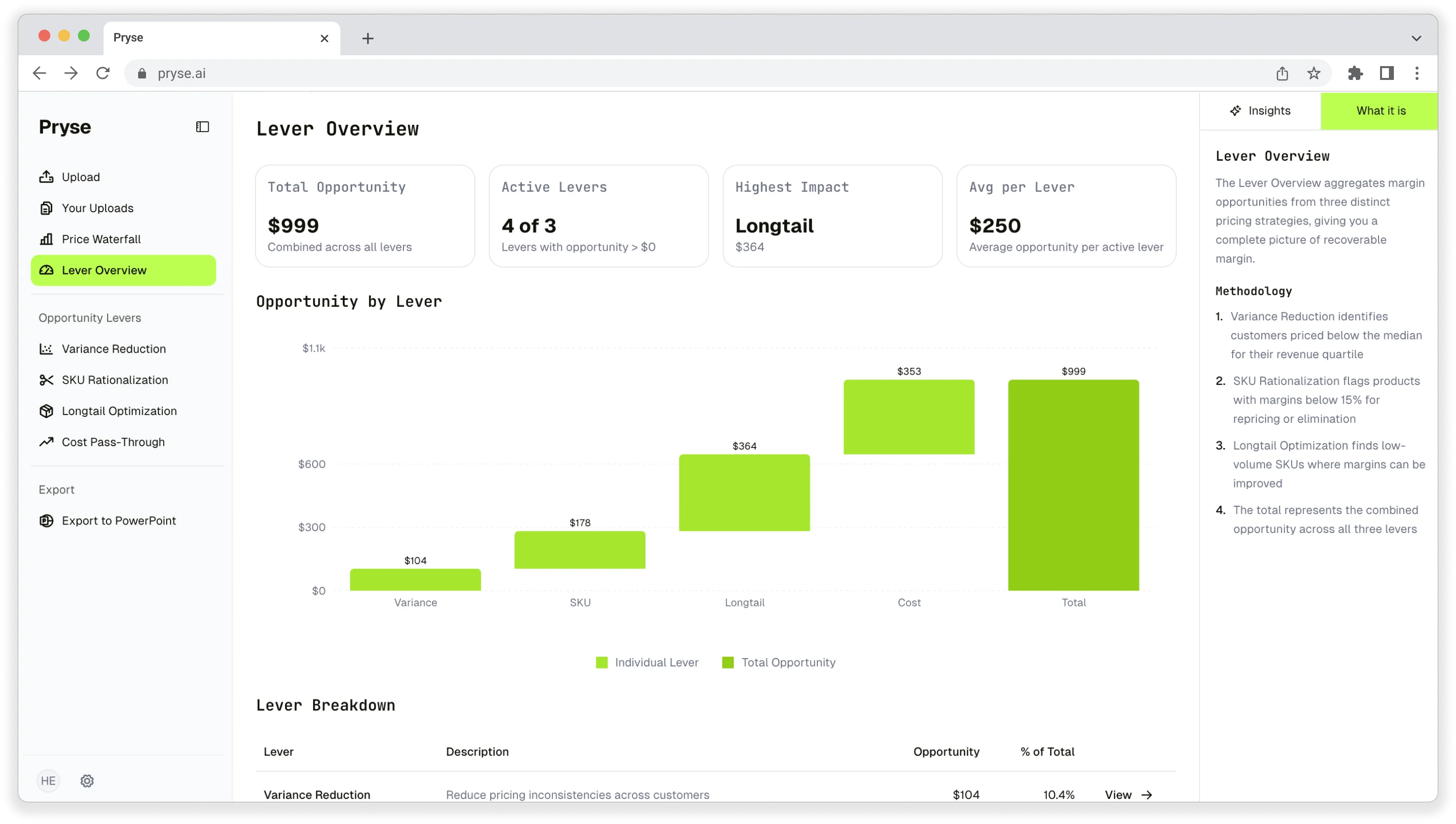
Pryse automatically identifies margin leakage across thousands of SKUs. Upload your data and find hidden profit in 24 hours.
One-time $1,499 diagnostic. No subscription required.