 Pryse
PryseDynamic Pricing Advantages and Disadvantages (2026 Analysis)
Complete analysis of dynamic pricing pros and cons: revenue gains of 25%, implementation costs of $20K-$500K, customer perception risks, and when to use it vs. when to avoid it.
Dynamic pricing adjusts prices automatically based on demand, supply, competition, and inventory—potentially increasing profits 25% on average. Airlines use it to generate billions in additional revenue. E-commerce platforms use it to stay competitive while protecting margins. Hotels use it to maximize occupancy.
But dynamic pricing can also damage customer trust, trigger price wars, and cost $100K-$500K annually to implement. Uber faced backlash for surge pricing during emergencies. Amazon abandoned personalized pricing after customer outrage. B2B manufacturers have seen sales teams revolt when prices changed too frequently.
The difference between success and failure isn't whether dynamic pricing works—it's whether it works for your business model, customer expectations, and operational capabilities. This analysis examines all 7 advantages and 8 disadvantages backed by industry research and real results so you can decide if dynamic pricing makes sense for your business.
What is Dynamic Pricing?
Dynamic pricing automatically adjusts prices in response to real-time market conditions. Instead of setting prices manually and changing them quarterly, algorithms monitor demand, inventory, competitor pricing, and other variables—then update prices hourly, daily, or weekly to optimize for revenue, profit, or market share.
According to Harvard Business School research, dynamic pricing allows businesses to adjust prices in real-time, maximizing revenue by raising prices during peak demand and offering discounts during slower periods to optimize profitability throughout the sales cycle.
Common applications:
- Airlines adjusting ticket prices based on seats remaining and days until departure
- Uber increasing prices during demand surges (bad weather, events, rush hour)
- Amazon repricing products multiple times daily to match competitors
- Hotels raising rates when occupancy is high, lowering when occupancy is low
- Grocery stores discounting produce approaching expiration
- B2B distributors passing through commodity cost changes weekly
What makes it "dynamic": Prices change automatically based on data inputs without manual human repricing. The algorithm does the work.
For a detailed explanation of how dynamic pricing works, see our what is dynamic pricing guide. To see how businesses implement it, see our dynamic pricing strategy guide.
7 Advantages of Dynamic Pricing
When implemented correctly, dynamic pricing delivers measurable financial benefits and operational efficiencies.
1. Increased Revenue and Profit Margins
According to business research, on average, a dynamic pricing strategy increases profits by 25%. This is the primary reason businesses adopt dynamic pricing.
How the math works:
Airlines generate 2-4% additional revenue from dynamic pricing compared to fixed pricing. On a $50M route, that's $1-2M annually just from optimization.
E-commerce retailers see 1-3% margin improvement by repricing based on competitor moves and inventory levels.
B2B distributors report 1-5% price realization gains. According to Revology Analytics, for many wholesale distributors, a 1% improvement in average realized price translates directly into an 8-11% lift in operating profit.
Why it works:
Dynamic pricing captures willingness to pay during high demand (raising prices when customers value products most) and prevents lost sales during low demand (discounting to stimulate purchases that wouldn't happen at full price).
Fixed pricing leaves money on the table in both directions—you undercharge during peaks and overcharge during valleys.
2. Real-Time Market Responsiveness
According to Flintfox, dynamic pricing is extremely agile, which means businesses can adjust prices in real-time. The flexibility offered by a dynamic pricing strategy allows businesses to act on market opportunities or defend themselves from competitive threats with speed and accuracy.
Competitive response:
When a competitor drops their price 10% to win market share, dynamic pricing lets you respond within hours (or minutes) instead of waiting weeks for the next price review meeting.
Gas stations using dynamic pricing can match competitor prices within blocks. Amazon adjusts millions of prices daily to stay competitive without manual intervention.
Cost pass-through:
For commodity distributors facing volatile supplier costs, dynamic pricing maintains target margins by passing cost changes through to customers automatically. A metals distributor linking prices to London Metal Exchange indices captures margin regardless of raw material swings.
Demand capture:
When demand spikes unexpectedly (weather events, news, competitor stockouts), dynamic pricing raises prices to capture the willingness to pay before the moment passes.
3. Optimized Inventory Management
According to research on dynamic pricing benefits, by aligning prices with demand fluctuations, dynamic pricing helps optimize resource allocation and inventory management, reducing stock-outs and excess inventory while maximizing resource deployment.
Clearing slow-moving inventory:
Products sitting on shelves for 60+ days automatically receive progressive discounts. Airlines discount unsold seats as departure nears. Grocery stores markdown produce approaching expiration. Fashion retailers clear seasonal inventory.
This prevents write-offs by converting aging inventory to cash before it becomes worthless. In hotels and travel, dynamic pricing can minimize problems like selling rooms too cheaply, reaching capacity too soon, or ending up with unsold rooms.
Protecting fast-moving inventory:
When popular products have low stock, dynamic pricing raises prices to slow demand and prevent stockouts. This ensures inventory lasts until replenishment and avoids disappointed customers finding products unavailable.
Balancing across locations:
Multi-location businesses can use dynamic pricing to shift demand between warehouses. If Location A has excess inventory and Location B is understocked, lower prices at A and raise them at B.
4. Better Competitive Positioning
According to PriceFX, with real-time access to price patterns, dynamic pricing allows businesses to adjust their pricing plans. Businesses can monitor competitive price changes and better understand supply and demand throughout the industry by employing dynamic pricing.
Market intelligence:
Tracking competitor prices continuously reveals patterns: when they discount, which products they prioritize, how they respond to your moves, and where they're vulnerable.
This intelligence informs strategy beyond just matching prices—it helps you identify opportunities where you can differentiate on value instead of price.
Strategic positioning:
You can choose your competitive stance by product:
- Match competitors on commodity products where customers compare prices
- Price 5% higher on differentiated products where you offer superior value
- Undercut on loss-leaders to drive traffic
- Premium price on exclusive products
Dynamic pricing implements these strategies automatically instead of relying on manual price checks and spreadsheet updates.
5. Rich Data and Customer Insights
According to Wipro research, dynamic pricing generates valuable data and insights into consumer behavior, preferences and market trends. It provides businesses with actionable intelligence to refine pricing strategies, optimize product offerings, and enhance customer engagement.
Price elasticity discovery:
By testing prices systematically, you learn which products show elastic demand (volume drops when prices rise) and which show inelastic demand (volume stays stable despite price changes).
This knowledge guides strategy:
- Elastic products: Focus on volume growth through competitive pricing
- Inelastic products: Raise prices to improve margins without losing volume
Customer segment insights:
Dynamic pricing reveals which customer segments are price-sensitive and which value other factors (delivery speed, service quality, product availability).
This enables segment-based pricing where transactional buyers face dynamic pricing and relationship customers get stable pricing.
Demand forecasting:
Historical pricing experiments improve demand forecasts. You learn how seasonality, promotions, and external events affect sales—making inventory planning more accurate.
6. Reduced Manual Pricing Work
Before automation, pricing managers spent hours updating spreadsheets, checking competitor websites, and publishing new price lists. Dynamic pricing eliminates most of this work.
Time savings:
A distributor with 5,000 SKUs might spend 20 hours weekly on manual repricing. Dynamic pricing reduces this to 2 hours weekly monitoring the algorithm—a 90% time reduction.
Consistency:
Humans make mistakes. Typos, copy-paste errors, and formula bugs create pricing errors. Automated repricing (with proper guardrails) reduces these errors.
Scalability:
Manually repricing 500 SKUs is feasible. Manually repricing 50,000 SKUs is impossible. Dynamic pricing scales to any catalog size without proportional headcount increases.
7. Prevention of Waste and Lost Revenue
Perishable businesses benefit most from dynamic pricing by converting inventory to cash before it expires.
Perishable goods:
Grocery stores using dynamic pricing on produce, meat, and dairy recover revenue that would otherwise become waste. Discounting a $5 item to $3 the day before expiration is better than throwing it away.
According to Zuora, dynamic pricing maximizes revenue and profitability by allowing businesses to adjust prices during peak demand to capture higher margins or stimulate sales in slower periods with strategic discounts.
Time-limited capacity:
Airlines can't bank unsold seats. Hotels can't store empty rooms. Events can't reschedule no-shows. Dynamic pricing ensures these assets generate some revenue instead of zero.
An airline seat that generates $150 (from a deeply discounted last-minute fare) is better than $0 (from flying empty).
8 Disadvantages of Dynamic Pricing
The advantages are real, but so are the risks and challenges. Many implementations fail because businesses underestimate these disadvantages.
1. Customer Perception of Unfairness
According to research on dynamic pricing disadvantages, finding out that someone has paid less for the exact same product or service can be very frustrating. Dynamic pricing can cause customers to feel they're being taken advantage of.
When customers revolt:
Uber faced intense backlash for surge pricing during emergencies (hurricanes, terrorist attacks, hostage situations). Customers viewed this as exploitative—charging more when people were desperate.
Amazon tested personalized pricing in 2000, showing different prices to different customers based on browsing history. When customers compared notes and discovered the practice, Amazon was forced to refund differences and promise to stop.
The fairness distinction:
Customers accept "prices change over time based on supply and demand" (airlines, hotels).
Customers reject "different customers pay different prices at the same time for the same product" (personalized pricing, demographic pricing).
Customers reject "prices increase during emergencies or exploitation" (Uber surge during hurricanes).
Brand damage:
According to business experts, "the biggest drawback to dynamic pricing is potential customer backlash and damage to brand value. When customers see prices changing without any justification or reason, then they can feel taken advantage of."
2. Risk of Price Wars
According to Wipro research, competitors matching or beating dynamic prices can lead to a price war, which can become a race to the bottom, and companies must be cautious to remain profitable.
How price wars start:
Competitor A uses dynamic pricing to undercut Competitor B by 5%. Competitor B responds by undercutting by 10%. Competitor A goes lower. This spiral continues until both are selling below cost or at margins that don't sustain the business.
The Amazon third-party seller problem:
Some sellers create algorithmic price loops where Seller A prices 1% below Seller B, and Seller B prices 1% below Seller A. Prices spiral to $0.01 or millions of dollars before someone notices.
Prevention:
Set price floors (never go below cost + minimum margin) and ceilings (never exceed 2x median market price). These guardrails prevent algorithms from destroying profitability in pursuit of market share or getting caught in competitive spirals.
3. High Implementation Costs
According to implementation research, challenges include the cost of implementation, and effective data organization and AI expertise are crucial.
Software costs:
- Rule-based systems: $0-$20K (spreadsheets or basic software)
- Mid-market platforms: $50K-$100K annually (PROS, Vendavo, Pricefx)
- Enterprise AI-powered solutions: $100K-$500K annually
Implementation costs:
- Data cleaning: 30-50% of project time (fixing duplicate SKUs, missing COGS, inconsistent units)
- System integration: Connecting pricing software to ERP, inventory, e-commerce platforms
- Algorithm configuration: Setting objectives, constraints, pricing rules
- Training: Sales, customer service, and operations teams
- Pilot testing: 60-90 days before full rollout
Ongoing costs:
- Monitoring: Daily oversight to catch pricing errors
- Tuning: Weekly performance reviews and monthly algorithm adjustments
- Competitive data feeds: Web scraping or price intelligence subscriptions
- Technical support: Either internal team or vendor support contracts
For small businesses (under $5M revenue or 1,000 SKUs), these costs often exceed the benefit.
4. Operational Complexity and Resource Requirements
According to U.S. Chamber of Commerce research, continuous data monitoring is required to make informed decisions about dynamic pricing. The task can be resource-intensive for small businesses.
Daily monitoring requirements:
Someone must check daily for:
- Pricing errors (products priced at $0, or 10x normal price)
- Customer complaints about pricing
- Competitor moves requiring response
- Inventory issues triggering incorrect discounts
This is 15-30 minutes daily minimum, even with automation.
Data quality maintenance:
Dynamic pricing requires accurate, real-time data:
- COGS must be current (not 6 months old)
- Inventory levels must update daily or hourly
- Competitor prices must be fresh
- Customer segmentation must be correct
Maintaining this data quality is ongoing work.
Cross-functional coordination:
Pricing affects sales, marketing, operations, and finance. Dynamic pricing requires alignment across these teams—adding meeting overhead and potential conflict when different departments have competing objectives.
5. Customer Discrimination Concerns and Regulatory Risks
According to research on dynamic pricing risks, location-based pricing can be unfair if prices are significantly higher in certain geographical areas, potentially causing hardships for specific populations like low- or fixed-income residents.
Geographic discrimination:
If dynamic pricing charges higher prices in low-income neighborhoods than wealthy neighborhoods, this raises ethical concerns and potential legal issues.
According to regulatory research, some industries have strict regulatory policies that make it challenging to implement dynamic pricing because they perceive it as price discrimination, which might make customers wary.
Protected class concerns:
If pricing algorithms indirectly discriminate against protected classes (race, gender, age, disability), companies face legal liability even if discrimination wasn't intentional.
Regulatory scrutiny:
Industries with regulated pricing (utilities, healthcare, some transportation) face restrictions on dynamic pricing. Even unregulated industries can attract regulatory attention if pricing appears exploitative.
B2B Robinson-Patman Act:
In the U.S., the Robinson-Patman Act prohibits price discrimination between different purchasers if it reduces competition. B2B companies using dynamic pricing must ensure they're not violating this law by charging different prices to competing customers for the same product under the same circumstances.
6. Damage to Brand Reputation and Customer Trust
According to research on customer perception, if customers aren't aware of dynamic pricing implementation, it can be off-putting and perceived as price gouging. Customer trust and loyalty could be impacted.
Trust erosion:
When customers discover dynamic pricing feels like deception ("they were hiding price changes from me"), trust erodes. Once lost, trust is hard to rebuild.
Social media amplification:
Pricing errors or perceived exploitation go viral on social media. A product incorrectly priced at $0.01, or a "surge" during an emergency, creates PR crises that damage brands for months.
Long-term customer value:
According to nexocode research, if dynamic pricing is not done carefully, it can alienate customers and damage relationships with suppliers.
Trading short-term margin gains for long-term customer relationships is often a bad trade, especially in B2B where customer lifetime value can be millions of dollars.
7. B2B Relationship Instability
According to Simon-Kucher research, historically, B2B prices change once or twice a year, and buyers expect the same prices to be valid in the long term.
Why B2B is different:
B2B buyers build relationships with suppliers over years. Pricing stability is part of that trust. Daily price changes signal unreliability.
Sales team resistance:
According to the same research, sales teams can view AI-driven pricing as a threat to their control or customer relationships.
A B2B manufacturer implemented dynamic pricing with daily price updates. Sales reps couldn't quote confidently. Customers complained about instability. The company abandoned the system after 3 months.
Contract conflicts:
Many B2B customers have fixed pricing for 6-12 months. Dynamic pricing conflicts with contractual commitments.
The B2B solution:
Segment customers by relationship type:
- Strategic accounts: Annual contract pricing (no dynamic pricing)
- Regular customers: Quarterly price reviews (semi-dynamic)
- Transactional buyers: Weekly or monthly updates (full dynamic pricing)
This protects relationships while capturing dynamic pricing benefits where appropriate.
8. Risk of Implementation Failure and Pricing Errors
According to Feedough research, in order to successfully implement a dynamic pricing strategy that brings profit, companies have to understand their product, market, and target groups very profoundly. Otherwise, they may end up choosing the wrong variables, and that can make their models estimate inadequate prices, affecting sales.
Common failure modes:
Incorrect objectives: A business maximizes revenue when it should maximize profit margin, leading to volume growth but margin erosion.
Poor data quality: A distributor's COGS data was 18 months old. The algorithm optimized margins based on old costs. When current costs were 30% higher, the company sold at a loss on hundreds of transactions.
Missing guardrails: No price floor or ceiling constraints. Algorithms create price loops or set nonsensical prices ($0.01 or $1 million) that go unnoticed for hours.
Too frequent changes: E-commerce frequency (multiple times per day) applied to B2B relationship sales. Customers refresh the page and see different prices, causing confusion and complaints.
No human oversight: Complete automation without monitoring. Pricing errors go undetected. By the time someone notices, damage is done.
The pilot-first approach:
Start with 100-500 low-risk SKUs, conservative constraints (±5% price changes), and 60-90 day testing. This catches most failure modes before they cause major damage.
See our dynamic pricing strategy implementation guide for how to avoid these pitfalls.
Advantages vs Disadvantages: Summary Comparison
Here's the direct comparison to help evaluate if dynamic pricing fits your business:
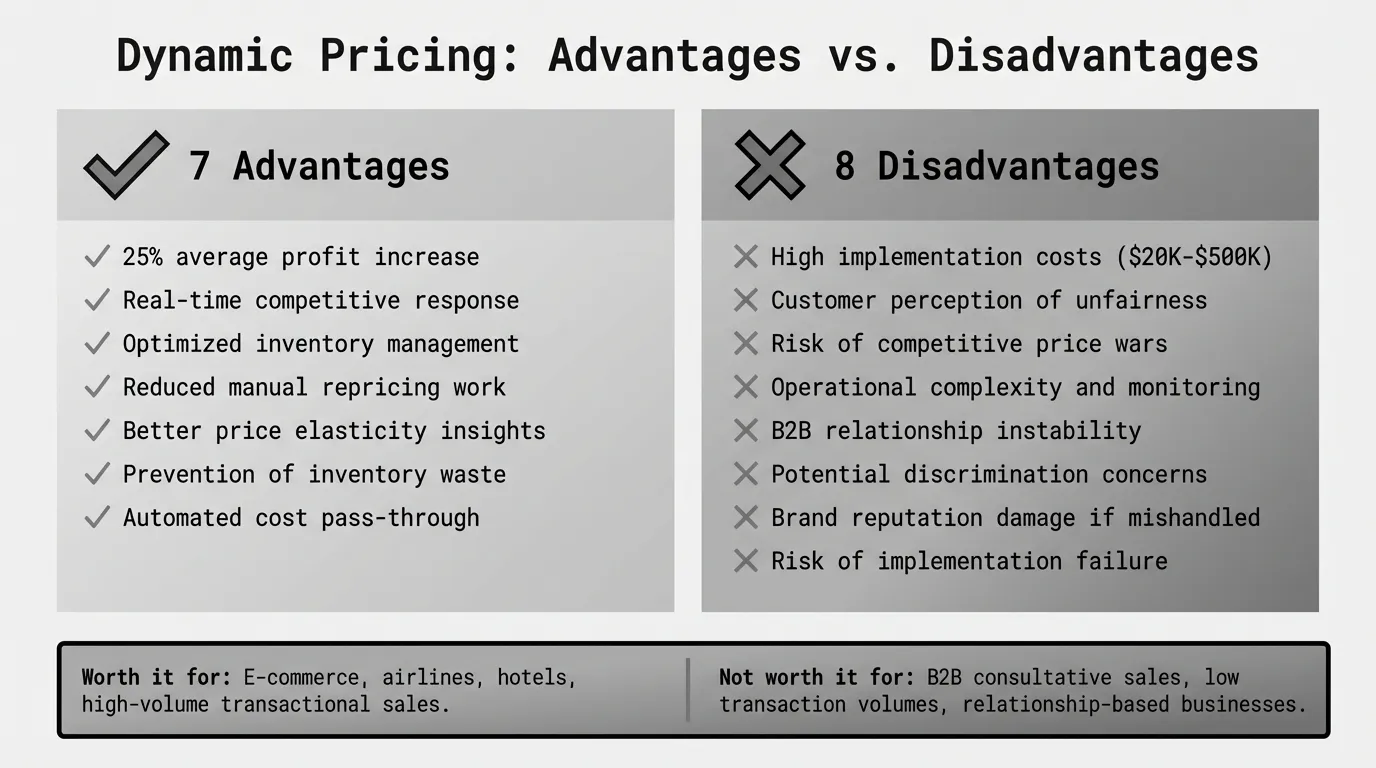
| Advantages | Disadvantages |
|---|---|
| 25% average profit increase | High implementation costs ($20K-$500K) |
| Real-time competitive response | Customer perception of unfairness |
| Optimized inventory management | Risk of competitive price wars |
| Reduced manual repricing work | Operational complexity and monitoring burden |
| Better price elasticity insights | B2B relationship instability from frequent changes |
| Prevention of inventory waste | Potential discrimination and regulatory concerns |
| Automated cost pass-through | Brand reputation damage if mishandled |
| Risk of implementation failure and pricing errors |
When Dynamic Pricing Advantages Outweigh Disadvantages
The decision depends on your business model, industry, and operational capabilities.
Clear Yes: Advantages Outweigh Disadvantages If
Business characteristics:
- High transaction volume (1,000+ orders/month)
- Large product catalog (5,000+ SKUs)
- Volatile costs or competitive markets
- Perishable inventory or time-limited capacity
- Limited customer relationships (transactional sales)
- E-commerce or online sales channels
Operational capabilities:
- Clean historical data (12+ months of transactions with accurate COGS)
- Real-time inventory visibility
- Technical infrastructure for integration
- Internal resources for daily monitoring
- Budget for implementation and ongoing costs
Customer acceptance:
- Industry where dynamic pricing is normal (airlines, hotels, e-commerce)
- Customers understand supply-demand dynamics
- Transparent communication about pricing changes
Examples:
- E-commerce retailers competing on Amazon or similar marketplaces
- Airlines, hotels, and other travel/hospitality businesses
- Event ticket sellers (concerts, sports, Broadway)
- Ride-sharing and transportation
- Grocery stores with perishable goods
- Large distributors with commodity products and high inventory turns
Clear No: Disadvantages Outweigh Advantages If
Business characteristics:
- Low transaction volume (under 100 orders/month)
- Consultative B2B sales with long-term relationships
- High order values with negotiated deals
- Customer contracts prohibit price changes
- Brand positioning emphasizes stability and trust
Operational limitations:
- Poor data quality (missing COGS, inconsistent units, old data)
- No real-time inventory visibility
- Lack of technical infrastructure
- No resources for daily monitoring
- Limited budget (under $20K available)
Customer expectations:
- Industry where dynamic pricing is unusual or rejected
- Customers demand price stability
- Long-term partnerships where trust matters more than optimization
Examples:
- B2B consultative sales (custom manufacturing, engineering services)
- Professional services (legal, consulting, accounting)
- Luxury brands emphasizing stability and exclusivity
- Small businesses with under 1,000 SKUs
- Custom or made-to-order products
- Strategic industrial suppliers with multi-year contracts
Maybe: Test Semi-Dynamic Pricing If
You're between the "yes" and "no" categories:
Hybrid approaches:
- Weekly or monthly price updates (not real-time)
- Dynamic pricing for transactional customers, fixed pricing for strategic accounts
- Dynamic pricing for commodity products, stable pricing for differentiated products
- Algorithm recommendations with human approval before publication
Test with low risk:
- Pilot with 100-500 SKUs for 60-90 days
- Limit price changes to ±5%
- Monitor daily for errors and customer complaints
- Measure against control group
Examples:
- Mid-market B2B distributors with mixed customer types
- Businesses with some commoditized products and some differentiated products
- Companies willing to invest in testing but not ready for full implementation
- Industries where competitors are testing dynamic pricing but it's not yet standard
Real-World Results: Advantages and Disadvantages in Practice
Seeing how advantages and disadvantages play out in real implementations helps calibrate expectations.
Success Stories (Advantages Realized)
Airlines (Revenue Increase):
Airlines generate 2-4% additional revenue from dynamic pricing compared to fixed pricing. On a $50M route, that's $1-2M annually from optimization alone.
E-commerce Retailers (Margin Improvement):
Amazon changes prices on 15-20% of products daily. This maintains competitive positioning while optimizing margins across millions of SKUs. E-commerce retailers typically see 1-3% margin improvement.
B2B Distributors (Profit Lift):
According to Revology Analytics, clients typically achieve gross profit margin gains, often realizing net price realization impacts in the 1-5% range, which flows directly to operating profits—an 8-11% profit lift.
Hotels (Occupancy Optimization):
Hotels using dynamic pricing report 5-10% RevPAR improvement compared to fixed pricing by raising rates when demand is high and discounting during low periods.
Failure Stories (Disadvantages Realized)
Coca-Cola Temperature-Based Vending Machines (Customer Backlash):
Coca-Cola tested vending machines that raised prices when temperature increased. A $1.00 Coke would cost $1.25 on a 95°F day. Customer reaction: outrage. Consumers viewed this as exploitative—charging more when people were thirsty and desperate. Coca-Cola abandoned the test.
Amazon DVD Pricing Discrimination (Trust Damage):
Amazon tested personalized pricing in 2000—showing different prices to different customers based on browsing history and location. When customers compared notes and discovered the practice, backlash forced Amazon to refund differences and promise to stop.
B2B Manufacturer (Sales Team Revolt):
A mid-market manufacturer implemented dynamic pricing for 5,000 SKUs. Sales reps received daily price lists that changed 10-15% from the previous day. Sales team refused to use the system. Customer complaints skyrocketed. The company abandoned dynamic pricing after 3 months because they didn't involve sales in design, provided no training, changed prices too frequently, and gave no override authority.
Uber Emergency Surge Pricing (Brand Damage):
Uber faced intense criticism for surge pricing during emergencies: 4x surge during Sydney hostage crisis (2014), 3x surge during London terrorist attack (2017), surge pricing during Hurricane Harvey evacuations (2017). After backlash, Uber capped surge pricing during emergencies and natural disasters.
Implementation Decision Framework
Use this framework to decide whether to proceed with dynamic pricing:
Step 1: Calculate Potential Benefit
Expected Annual Benefit = (Average Order Value × Annual Orders × Expected Margin Improvement %)Example:
A distributor with $10M annual revenue, $100 average order value, 100,000 orders/year, and 20% current margin considers dynamic pricing:
Expected benefit = ($100 × 100,000 × 2% margin gain) = $200,000/year
If implementation costs $75K annually, net benefit is $125K/year—a positive ROI.
If implementation costs $200K annually, net benefit is $0—not worth it.
Step 2: Assess Risk Tolerance
Rate your business on these dimensions (1-5 scale, 5 = highest risk):
Customer perception risk:
- How price-sensitive are customers? (5 = extremely sensitive)
- How important is trust to your brand? (5 = critical)
- How quickly can negative PR spread? (5 = goes viral instantly)
Implementation risk:
- How clean is your data? (5 = very messy)
- How complex is your pricing? (5 = extremely complex)
- How much technical expertise do you have? (5 = none)
If your total risk score exceeds 20/30, dynamic pricing is high-risk for your business.
Step 3: Choose Your Approach
Based on benefit and risk:
High benefit + low risk: Implement full dynamic pricing with enterprise platform.
High benefit + medium risk: Start with semi-dynamic pricing (weekly updates with human approval) and pilot test before full automation.
High benefit + high risk: Fix foundational pricing problems first (underpriced products, margin leakage), then reassess.
Low benefit + any risk: Don't implement dynamic pricing. The juice isn't worth the squeeze.
Before Implementing: Fix These First
Most businesses should fix foundational pricing problems before implementing dynamic pricing.
Common issues that don't require dynamic pricing:
-
Consistently underpriced products: If certain SKUs are always sold below target margin, you need a one-time price increase, not dynamic pricing.
-
Untracked discounts and rebates: If margin leaks through off-invoice rebates, payment terms, and freight absorption, you need margin leakage analysis, not dynamic pricing.
-
Poor cost data: If your COGS is outdated or inaccurate, fix this before optimizing prices. Garbage data creates garbage prices.
-
Sales team discounting without guardrails: If salespeople discount 20% without approval, you need approval workflows, not algorithms.
-
No pricing strategy: If you don't know whether you're competing on price, value, or service, dynamic pricing can't fix strategic confusion.
The sequence that works:
- Analyze current margins by product, customer, and channel using our margin analysis guide
- Fix obviously underpriced items (one-time adjustments)
- Reduce margin leakage from uncontrolled discounting
- Implement rule-based pricing (cost-plus with competitive positioning)
- Then evaluate whether remaining opportunities justify dynamic pricing
According to pricing research, many distributors recover 1-2% margin just by fixing underpriced SKUs and reducing excessive discounts—before needing dynamic pricing software.
For most mid-market B2B companies, steps 1-4 recover more margin than jumping straight to dynamic pricing.
Final Recommendation: Advantages vs Disadvantages
Dynamic pricing is a powerful tool that delivers measurable results (25% average profit increase, 2-5% margin gains for many implementations) when applied to the right business model.
It works when:
- Transaction volumes justify automation
- Customer expectations allow price flexibility
- Data quality supports accurate pricing
- Operational capabilities exist for monitoring
It fails when:
- Implemented without understanding customer perception risks
- Applied to relationship-based B2B sales
- Launched without proper guardrails and constraints
- Done without sales team buy-in
The honest assessment:
For e-commerce, airlines, hotels, and other high-volume transactional businesses, the advantages clearly outweigh the disadvantages. Implementation pays back quickly.
For B2B consultative sales, professional services, and relationship-based businesses, the disadvantages often outweigh the advantages. Price stability matters more than optimization.
For mid-market B2B distributors, the answer depends on customer mix, product portfolio, and implementation approach. Semi-dynamic pricing (weekly updates with human approval) captures most benefits while minimizing relationship risks.
Start by fixing obvious pricing problems (underpriced products, margin leakage, poor cost data) before investing in sophisticated dynamic pricing. For most businesses, these fixes recover more margin with less risk than automation.
If you do implement dynamic pricing, pilot test with 100-500 low-risk SKUs, set conservative constraints, and monitor daily for 60-90 days before expanding. This approach lets you realize advantages while catching disadvantages before they cause major damage.
See our complete dynamic pricing guide for the full implementation framework.
Sources
- Dynamic Pricing Strategy: Advantages and Disadvantages - Flintfox
- What Is Dynamic Pricing and How Does It Affect E-Commerce - Business.com
- Dynamic Pricing: What It Is & Why It's Important - Harvard Business School Online
- Weighing Benefits and Risks of Dynamic Pricing Strategy in Business - Wipro
- Dynamic Pricing Strategy - Tips & Examples + Pros & Cons - PriceFX
- The pros, cons and misconceptions of dynamic pricing for retailers - Computer Weekly
- A Guide to Dynamic Pricing: Pros, Cons, and Tools to Help - U.S. Chamber of Commerce
- The Pros and Cons of Dynamic Pricing: What You Need to Know - nexocode
- Dynamic Pricing Strategy: The Good and the Bad - Unleashed Software
- Dynamic Pricing - Definition, Advantages, Disadvantages & Examples - Feedough
- Dynamic Pricing: Benefits, best practices and how to implement - Zuora
- Dynamic Pricing Strategy: Benefits, Risks, and When to Use It - Inflow Inventory
- 6 Successful Dynamic Pricing Examples To Follow in 2026 - Mailmodo
- Complete Guide To Amazon Dynamic Pricing Strategy in 2025 - My Amazon Guy
- Dynamic Pricing for B2B: Real-Time Strategies - Revology Analytics
- AI and dynamic pricing in B2B industrial companies - Simon-Kucher
Last updated: February 24, 2026
Frequently Asked Questions
Want to analyze your entire product catalog?
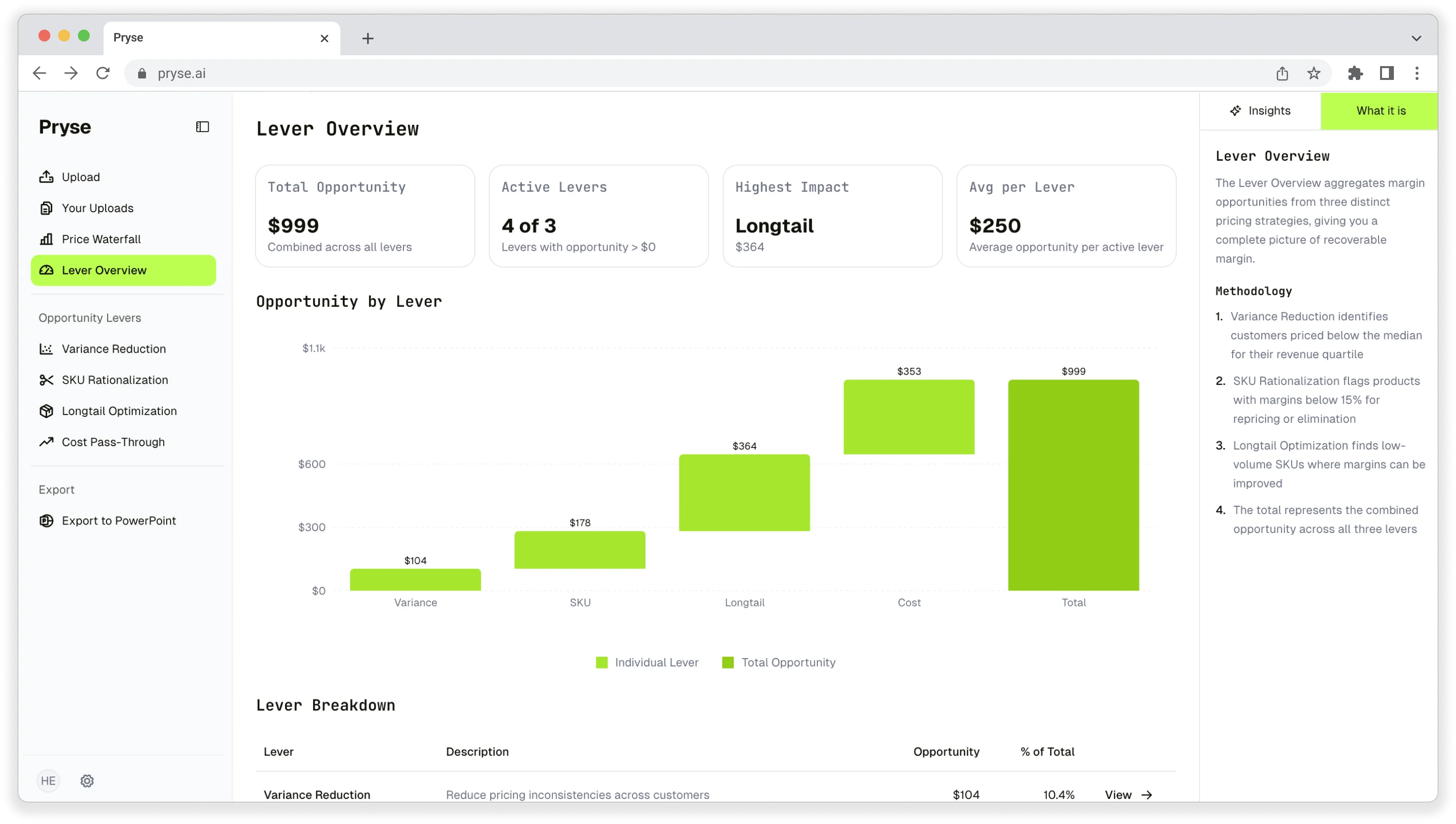
Pryse automatically identifies margin leakage across thousands of SKUs. Upload your data and find hidden profit in 24 hours.
One-time $1,499 diagnostic. No subscription required.