 Pryse
PryseDynamic Pricing: The Complete Guide for B2B Distribution and Manufacturing
Everything you need to know about dynamic pricing: definition, algorithms, strategies, real-time pricing for B2B, advantages and disadvantages, and implementation steps for distributors and manufacturers.
Dynamic pricing is a strategy that adjusts prices automatically in response to real-time market conditions. When demand increases, prices rise. When inventory builds, prices drop. When competitors change their prices, your prices respond. The system continuously recalibrates to optimize revenue, margin, or market share based on current conditions.
For most of business history, this wasn't possible. Prices were set in annual planning cycles, printed in catalogs, and remained static until the next review. Market conditions changed daily, but prices couldn't. Airlines pioneered dynamic pricing in the 1980s with computerized yield management systems. Hotels and rental cars followed. Uber brought it to the mass market with surge pricing in 2009.
Today, dynamic pricing is standard in consumer markets and increasingly common in B2B distribution and manufacturing. According to Copperberg's analysis, 54% of manufacturers and distributors now use price optimization strategies that blend static and dynamic methods. Companies implementing dynamic pricing report revenue growth of 2-5% and margin improvements of 5-10% according to research from Zilliant.
Yet most mid-market distributors and manufacturers still operate with quarterly price reviews and spreadsheet-based pricing. They watch commodity costs fluctuate daily but adjust prices monthly. They see competitors shift pricing but take weeks to respond. The gap between market conditions and their prices represents margin leakage that compounds over time.
This guide covers what dynamic pricing is, how it works, the five types of dynamic pricing, algorithms and tools, when to use it in B2B distribution and manufacturing, implementation steps, advantages and disadvantages, and real examples of companies getting it right and wrong.
What is dynamic pricing
Dynamic pricing is a revenue management strategy where prices change automatically based on current market conditions. Unlike static pricing where a product costs $100 until someone manually changes it, dynamic pricing might set that product at $95 at 8 AM, $103 at 2 PM, and $98 at 6 PM based on demand patterns, inventory levels, and competitive activity.
The formal definition from pricing research: dynamic pricing involves price changes prompted by shifts in four key market demand drivers—People (customer segments), Product configurations, Periods (time), and Places (locations).
Dynamic Price = Base Price × (1 + Market Adjustment Factor)
Where Market Adjustment Factor = f(Demand, Supply, Competition, Time, Costs, Customer)
How dynamic pricing differs from static pricing
Static pricing sets a price and maintains it until manual intervention. A distributor publishes a price list in January. Those prices hold until the next review in April, regardless of what happens in February and March.
Dynamic pricing treats price as a variable that responds to conditions:
| Dimension | Static Pricing | Dynamic Pricing |
|---|---|---|
| Update frequency | Quarterly or annual | Real-time to daily |
| Decision maker | Pricing manager | Algorithm |
| Data inputs | Cost, target margin | Cost + demand + competition + inventory + time |
| Response speed | Weeks to months | Minutes to hours |
| Price consistency | High (same price for weeks) | Variable (changes with conditions) |
| Best for | Stable markets, contract pricing | Volatile markets, spot pricing |
The practical difference shows up in margin capture. A steel distributor using static pricing sets January prices based on December commodity costs. Steel prices jump 8% in February. With static pricing, they absorb that increase until April's price review. With dynamic pricing tied to commodity indices, prices adjust within days and margin is protected.
For a detailed comparison of different pricing approaches, see our pricing strategy guide.
The evolution: from catalogs to algorithms
Dynamic pricing isn't new conceptually. Merchants have negotiated prices based on conditions for thousands of years. A fish seller at closing time charges less than at opening because the product is perishable. What changed is the automation.
Pre-1980s: Manual negotiation. Prices varied by customer and situation, but every variation required human judgment. This worked at low scale but didn't optimize systematically.
1980s-1990s: Airline yield management. American Airlines developed computerized revenue management systems that adjusted ticket prices based on booking patterns, seat availability, and time until departure. Robert Cross, who led the work, estimated it generated $1.4 billion in incremental revenue over three years.
2000s: E-commerce price optimization. Amazon pioneered continuous price testing at scale. Products could have dozens of price changes per day based on competitor prices, conversion rates, and inventory turns.
2009: Surge pricing enters consumer awareness. Uber launched with surge pricing, making real-time dynamic pricing visible to mass-market consumers for the first time. The backlash over New Year's Eve surge pricing taught the industry about communication.
2010s-present: B2B adoption accelerates. Distribution and manufacturing companies begin applying dynamic pricing to commodity products, freight rates, and spot markets. According to PriceFX research, implementation has expanded from early adopters to mainstream B2B companies managing complex catalogs and fluctuating input costs.
2020s: AI-powered pricing. Machine learning models now predict optimal prices across thousands of SKUs simultaneously, accounting for competitor moves, demand elasticity, and market conditions that human analysts couldn't process. See our AI pricing guide for how AI is changing pricing execution.
2026: Regulatory scrutiny increases. New York's Algorithmic Pricing Disclosure Act went into effect in November 2025, requiring retailers using personal data to set individualized prices to disclose "THIS PRICE WAS SET BY AN ALGORITHM USING YOUR PERSONAL DATA." Similar legislation is under consideration in Pennsylvania, Texas, New Mexico, and Maryland according to regulatory tracking from Freshfields.
5 types of dynamic pricing
Dynamic pricing isn't one technique. It's a category containing distinct approaches, each optimizing for different market conditions. For deeper examples of each type, see our types of dynamic pricing post.
1. Time-based dynamic pricing
Time-based pricing adjusts prices based on when a product or service is consumed. The underlying assumption: willingness to pay varies by time period.
How it works: Prices change by hour, day, week, or season based on historical demand patterns for that time period. A hotel charges more on Saturday nights than Monday nights. Movie theaters charge less for matinees than evening shows.
Distribution/manufacturing examples:
- Electricity distributors: Time-of-use pricing where electricity costs 3x more during peak afternoon hours than overnight.
- Contract manufacturers: Premium pricing for rush jobs requiring weekend production vs. standard lead times.
- Parcel shipping: According to Harvard Business Review's 2026 analysis, parcel carriers are shifting from annual rate cards to dynamic pricing where rates fluctuate based on capacity constraints and demand patterns.
Best for: Industries with predictable demand cycles, perishable capacity (manufacturing slots, delivery windows), and customers who can shift timing to capture savings.
2. Demand-based dynamic pricing
Demand-based pricing responds to current demand levels. When demand is high relative to capacity, prices rise. When demand is low, prices fall.
Price = Base Price × (Current Demand / Average Demand)^Elasticity
How it works: Real-time demand signals—website traffic, quote requests, order velocity—trigger price adjustments. High demand increases prices until it equilibrates. Low demand decreases prices to stimulate orders.
Distribution/manufacturing examples:
- Spot market commodities: A chemical distributor adjusts prices on bulk chemicals hourly based on order flow and inventory turns.
- Manufacturing capacity: A machine shop charges 30% more for orders when shop capacity is above 85% utilization.
- Construction materials: A lumber distributor raised prices 15% when regional construction permits spiked during spring building season.
Best for: Products with volatile demand, limited capacity, and buyers who have flexibility in timing purchases.
3. Segment-based dynamic pricing
Segment pricing charges different prices to different customer groups based on characteristics like industry, size, location, or purchase behavior.
How it works: Customer segmentation data feeds pricing rules. An industrial distributor might charge:
- Large accounts ($500K+ annual): List price - 25%
- Mid-market ($100K-$500K): List price - 18%
- Small accounts (under $100K): List price - 10%
- New accounts: List price - 15% (promotional)
Distribution/manufacturing examples:
- Geographic pricing: A building materials distributor charges more in markets with limited competition and less in markets with five competitors.
- Industry-based pricing: A fastener manufacturer charges automotive OEMs less per unit due to volume but industrial MRO buyers more because of smaller lot sizes.
Best for: Markets with distinct customer segments, varying willingness to pay, and defensible rationale for price differences. For more on segmentation approaches, see our B2B pricing strategy guide.
4. Competition-based dynamic pricing
Competition-based dynamic pricing adjusts prices in response to competitor moves. When Competitor A drops their price 5%, you respond with your own adjustment based on positioning.
How it works: Automated web scraping or price monitoring tools track competitor prices. When changes are detected, your algorithm applies a rule:
- Match competitor prices (price parity strategy)
- Undercut by 3-5% (market share strategy)
- Maintain 10% premium (premium positioning)
Distribution/manufacturing examples:
- E-commerce distribution: An electrical distributor uses Competera to track competitor pricing on 500 high-velocity items and adjusts within 4 hours of competitor changes.
- Commodity chemicals: A chemical distributor monitors spot market pricing and adjusts daily to stay within 2% of market rates.
Best for: Transparent markets where customers compare prices across suppliers, commoditized products with limited differentiation, and online/digital sales channels.
For a broader discussion of competitive pricing approaches, see our competitive pricing guide.
5. Cost-based dynamic pricing
Cost-based dynamic pricing adjusts prices when input costs change. Instead of absorbing cost fluctuations until the next quarterly review, prices move with costs in near real-time.
Price = (Current Cost × Target Margin) + Market Adjustment
How it works: Pricing formulas link to commodity indices, supplier price feeds, or freight cost data. When inputs move, prices adjust automatically or trigger alerts for manual review.
Distribution/manufacturing examples:
- Steel distribution: Prices tied to CME steel futures index, updating weekly as the index moves.
- Chemical manufacturing: Prices for downstream products automatically adjust when feedstock costs from suppliers change by more than 3%.
- Freight-intensive distribution: Fuel surcharges that adjust monthly based on Department of Energy diesel price indices.
Best for: Industries with volatile input costs, customers who understand commodity price linkage, and businesses where margin protection matters more than price stability.
This is particularly relevant for managing margin leakage when costs rise faster than price adjustments.
Dynamic pricing algorithms explained
Dynamic pricing algorithms are the computational models that calculate optimal prices. The sophistication ranges from simple if-then rules to machine learning models optimizing across thousands of variables simultaneously. For a deeper technical dive, see our dynamic pricing algorithms post.
Rule-based algorithms
Rule-based algorithms use predefined conditions and actions. They're the simplest form of dynamic pricing and the most common starting point.
Structure:
IF [condition] THEN [price adjustment]

Examples:
IF inventory > 90 days THEN reduce price 10%
IF competitor price < our price THEN match price
IF capacity utilization > 85% THEN increase price 15%
IF demand spike > 30% above normal THEN increase price 20%
Advantages: Transparent, predictable, easy to explain and audit. Sales teams and customers understand the logic.
Disadvantages: Can't account for complex interactions. Doesn't learn from outcomes. Requires manual tuning when conditions change.
Best for: Starting dynamic pricing implementations, commodity products with clear pricing drivers, and organizations that need explainable pricing decisions.
Regression-based algorithms
Regression models predict optimal prices based on statistical relationships between price and demand. You model how demand responds to price changes (price elasticity) and find the price that maximizes revenue or profit.
Demand = β₀ + β₁(Price) + β₂(Competition) + β₃(Season) + β₄(Inventory) + ε
Optimal Price = f(marginal revenue, marginal cost, elasticity)
How it works: Historical transaction data trains a regression model predicting demand at different price points. The algorithm calculates where marginal revenue equals marginal cost and sets price accordingly.
Advantages: Data-driven, accounts for multiple variables simultaneously, produces price-demand curves that inform strategy.
Disadvantages: Requires substantial historical data (typically 12-24 months), assumes relationships are stable, struggles with new products or market shifts.
Best for: Mature products with stable demand patterns, data-rich environments, and businesses optimizing across large catalogs.
Machine learning algorithms
Machine learning models (neural networks, random forests, gradient boosting) find patterns in data that simpler models miss. They optimize for long-term profit, not just immediate revenue, and improve continuously as they observe outcomes.
Common approaches:
- Reinforcement learning: Algorithm learns optimal pricing policies through trial and error, maximizing cumulative reward over time.
- Ensemble methods: Combine multiple pricing models to improve accuracy and reduce overfitting.
- Deep learning: Neural networks that can process unstructured data like product descriptions, images, and customer reviews to inform pricing.
Advantages: Can handle non-linear relationships, adapts to changing conditions, processes vastly more variables than human analysts, finds hidden patterns.
Disadvantages: Black box (hard to explain why a price was set), requires significant data and computational resources, can make unexpected mistakes if training data is biased.
Best for: Large-scale operations (10K+ SKUs), organizations with strong data infrastructure, digital-first channels where you can test prices rapidly.
Major dynamic pricing vendors like Zilliant, PriceFX, and Vendavo use machine learning algorithms to power their B2B pricing platforms.
Competitive response algorithms
These algorithms specifically model and react to competitor behavior. Instead of just tracking competitor prices, they predict competitor responses to your moves and adjust accordingly.
How it works: Game theory models simulate competitor reactions. If you drop price 10%, will Competitor A match? Ignore? Undercut further? The algorithm builds a model of competitor pricing behavior and chooses moves that optimize your position accounting for likely responses.
Best for: Oligopolistic markets with a few large competitors, industries with price leadership dynamics, situations where competitor moves directly impact your volume.
This connects closely to competitive pricing strategy where understanding competitor behavior drives pricing decisions.
When to use dynamic pricing in B2B
Dynamic pricing works in specific B2B contexts and fails in others. The decision depends on market structure, customer expectations, data availability, and strategic priorities.
Use dynamic pricing when:
Commodity input costs fluctuate significantly. Steel, copper, plastics, chemicals, lumber—if your landed costs move 5-15% quarterly, static pricing means you're either absorbing losses when costs rise or overcharging when costs fall. Cost-based dynamic pricing protects margin without constant manual intervention.
Capacity constraints exist. Manufacturing slots, warehouse space, delivery windows, technical labor—if you have finite capacity that fills to different levels, demand-based pricing captures premium value during peak utilization and stimulates demand during slack periods.
Demand varies predictably by time or season. HVAC distributors see demand spike in summer and winter, collapse in shoulder seasons. Time-based pricing charges more when contractors are desperate for same-day delivery in July and offers promotions in October when inventory builds.
You operate in spot markets alongside contracts. A chemical distributor might have 60% of volume on annual contracts and 40% spot market sales. The spot portion can use dynamic pricing to optimize while contracts provide revenue stability.
Competitors adjust prices frequently. In transparent online markets where customers compare three distributors in real-time, being $5 higher means lost sales. Competition-based dynamic pricing keeps you competitive without constant manual monitoring.
You have real-time data on costs and demand. Dynamic pricing requires data infrastructure. If you have ERP integration showing inventory turns, CRM data on quote activity, and cost feeds from suppliers, you can support sophisticated pricing algorithms. Without that data, you're guessing.
According to Copperberg's research on B2B manufacturers, companies that successfully implement dynamic pricing typically see 2-5% revenue growth and 5-10% margin improvement. The impact is largest when multiple conditions above apply simultaneously.
For B2B-specific implementation considerations, see our dynamic pricing in B2B guide.
Avoid dynamic pricing when:
You operate primarily on long-term contracts. If 80% of revenue is locked into 12-36 month contracts with fixed pricing, dynamic pricing has limited application. Focus instead on better contract pricing with escalation clauses.
Customers require price stability and predictability. Some buyers—especially large manufacturers with annual budgets—need stable pricing to plan production costs. Introducing dynamic pricing destroys the predictability they value and may lose the account.
Your industry has strong regulatory constraints. Utilities, healthcare, government contractors—some industries have regulatory oversight that limits pricing flexibility. Dynamic pricing that looks like price discrimination may trigger scrutiny.
You lack the data infrastructure. If your ERP data is a mess, you don't have competitor price visibility, and your demand forecasting is a spreadsheet, you're not ready for algorithmic pricing. Fix data first.
Relationship value exceeds short-term margin optimization. A $2M annual customer who's been with you 15 years expects relationship pricing. Implementing dynamic pricing that raises prices when they're in a bind might optimize the algorithm but destroy the relationship.
Price stability is a competitive advantage. In some markets, customers specifically value vendors who don't change prices constantly. "Same price for 90 days guaranteed" can be a selling point against competitors doing daily repricing.
For more on when different pricing strategies apply, see our comprehensive pricing strategy guide.
Implementing dynamic pricing: step-by-step
Launching dynamic pricing in a B2B distribution or manufacturing environment follows a different path than consumer implementations. The stakes are higher (individual customers represent meaningful revenue), relationships matter more, and pricing complexity is greater.
Step 1: Segment your catalog
Dynamic pricing doesn't need to apply to all 50,000 SKUs on day one. Start with segments where it creates the most value and lowest risk.
Categorize products by:
| Category | Characteristics | Dynamic Pricing Fit |
|---|---|---|
| Commodity/volatile | Input costs fluctuate, low differentiation | HIGH - cost-based or competition-based |
| Spot market | No contracts, transactional sales | HIGH - demand-based or time-based |
| Standard catalog | Moderate differentiation, stable demand | MEDIUM - periodic repricing with rules |
| Specialty/technical | High differentiation, relationship-driven | LOW - value-based pricing, not dynamic |
| Contract/committed | Fixed pricing agreements | LOW - only if contract allows adjustments |
Focus first on the HIGH fit categories. These represent perhaps 20-30% of SKUs but may be 40-50% of revenue in distribution businesses.
Step 2: Define your pricing objectives
What are you optimizing for? Revenue? Margin? Market share? Inventory turns? The objective shapes the algorithm.
Margin optimization: Set prices to maximize gross margin dollars. This means raising prices when possible, accepting volume losses if margin gains outweigh them.
Margin $ = (Price - Cost) × Volume
Revenue optimization: Set prices to maximize total revenue. This often means lower prices and higher volume than margin optimization.
Revenue = Price × Volume
Market share: Price aggressively to capture volume from competitors, accepting margin compression.
Inventory optimization: Price to clear excess inventory and reduce holding costs, or to ration limited inventory during shortages.
Most B2B companies use a hybrid: margin optimization on specialty products, inventory optimization on slow-movers, revenue optimization on high-volume commodities.
Step 3: Choose your algorithm approach
Based on data availability, technical capability, and risk tolerance:
Starter approach: Rule-based pricing
- Start with 10-20 simple rules linking prices to measurable conditions
- Example rules: "If inventory > 120 days, reduce price 8%", "If steel index rises > 5%, increase price 5%"
- Implement in Excel or basic pricing software
- Test on non-contract spot sales first
Intermediate: Regression-based optimization
- Use 12-24 months of transaction history to model price-demand relationships
- Calculate price elasticity by product category and customer segment
- Set prices that optimize defined objective (margin, revenue)
- Requires analytics capability or vendor software
Advanced: Machine learning
- Implement AI-powered pricing platform (Zilliant, PriceFX, Vendavo)
- Algorithm learns from outcomes and improves continuously
- Handles thousands of SKUs simultaneously
- Requires clean data, technical expertise, and ongoing model management
For most mid-market distributors and manufacturers, starting with rule-based pricing and graduating to regression-based optimization makes sense. Machine learning comes later after you've proven value with simpler approaches.
Step 4: Build the data infrastructure
Dynamic pricing quality depends on data quality. Required data flows include:
Cost data:
- Landed cost per SKU updated as supplier invoices arrive
- Freight cost adjustments (fuel surcharges, carrier rate changes)
- Commodity index feeds for products tied to market prices
- Overhead allocation if using fully-loaded costs
Demand data:
- Transaction history (2+ years): product, quantity, price, customer, date
- Quote activity and win/loss rates
- Inventory levels and turns by SKU
- Web traffic and search data (if selling online)
Competitive data:
- Competitor price monitoring (web scraping, manual checks, lost deal intelligence)
- Market price indices for commodities
- Industry benchmark data
Customer data:
- Segmentation (size, industry, geography, volume tier)
- Contract status (contracted pricing vs. spot market)
- Purchase patterns and seasonality
- Price sensitivity indicators (churn risk, discount negotiation behavior)
Most mid-market companies have 60-70% of this data in their ERP and CRM systems. The gaps are typically competitor pricing and advanced demand signals.
Step 5: Test and validate before full rollout
Don't flip the switch on algorithmic pricing across your entire catalog on Monday morning. Test first.
Pilot approach:
- Select 50-100 SKUs representing your target categories (commodity, spot market)
- Run the pricing algorithm to generate recommended prices
- Compare recommended prices to current prices and manual pricing decisions
- Test on new customers or non-contract spot sales first (lowest relationship risk)
- Measure results: Did margin improve? Did volume change as predicted? Customer feedback?
- Refine rules and expand gradually
A/B testing (if your volume supports it):
- Split similar customers into control and test groups
- Control group sees current pricing
- Test group sees algorithm-generated dynamic prices
- Measure margin and volume impact over 30-90 days
- Expand winners, kill losers
Shadow mode:
- Run the algorithm in the background generating recommended prices
- Sales team sees recommendations but makes final calls
- Track adherence and performance
- Builds confidence before full automation
Step 6: Train your sales team
The biggest implementation risk isn't technical. It's sales team resistance.
Sales reps trained to negotiate and use discretion don't like algorithms telling them what price to quote. They see it as loss of control. Some will route around the system, offering "one-time exceptions" that undermine the strategy.
Sales training for dynamic pricing:
- Explain the business case: why margins are eroding under current approach
- Show how dynamic pricing protects competitiveness without constant manual intervention
- Define clear authority levels: which prices are algorithmic (firm), which allow negotiation (with approval)
- Provide tools to explain price changes to customers ("prices adjust weekly based on market conditions")
- Track and reward adherence, not just revenue
According to Revology Analytics research on B2B dynamic pricing implementations, companies with strong sales alignment see 70-80% better outcomes than those treating it purely as a technical project.
Step 7: Communicate with customers
Price changes without context create distrust. Customers who see prices fluctuating unpredictably feel manipulated.
Communication strategies:
- Proactive transparency: "Our pricing on commodity products adjusts based on market indices. Here's the current index value."
- Predictability within variation: "Prices update every Monday based on the previous week's supplier costs."
- Customer control: "Lock in pricing for 90 days by committing to minimum volume."
- Rationale for changes: "Steel costs jumped 12% this month. Our pricing reflects that movement."
The goal is not to hide dynamic pricing but to make it understandable and fair. Research from Wipro on dynamic pricing customer perceptions shows that transparency about pricing rules significantly reduces backlash even when prices increase.
Dynamic pricing tools and software
Building dynamic pricing algorithms from scratch requires data science resources most mid-market companies don't have. Vendor platforms provide pre-built algorithms, integrations, and interfaces that compress implementation from years to months.
Enterprise B2B platforms
Zilliant
- Purpose-built for B2B pricing, especially distribution and manufacturing
- AI-powered price optimization and dynamic pricing
- Integrates with major ERPs (SAP, Oracle, Microsoft Dynamics)
- Best for: Large distributors ($100M+), complex catalogs, companies with data infrastructure
- Typical cost: $100K-$500K+ annually
PriceFX
- Cloud-based pricing platform with dynamic pricing module
- Strong in manufacturing and distribution
- AI/ML pricing algorithms across large SKUs
- Best for: Mid-large enterprises, global manufacturers
- Typical cost: $75K-$300K+ annually
Vendavo
- Distribution and manufacturing focus
- Price waterfall analysis, margin leakage detection, dynamic pricing
- Strong industry templates for specific verticals
- Best for: $50M-$500M distributors and manufacturers
- Typical cost: $100K-$400K+ annually
Mid-market options
Competera
- AI-based competitive pricing, strong on retail and online channels
- Real-time competitor price tracking
- Better for distributors with e-commerce presence
- Typical cost: $30K-$100K annually
Flintfox
- Margin management and rebate tracking with pricing optimization
- Good for distribution companies managing complex rebate structures
- Pricing module includes dynamic adjustments
- Typical cost: $40K-$150K annually
Pricemoov
- Designed for mid-market B2B, simpler implementation
- Rule-based and AI pricing
- Best for: $10M-$100M companies, first pricing software implementation
- Typical cost: $20K-$75K annually
For a comprehensive comparison of pricing software options including dynamic pricing capabilities, see our pricing optimization software and best pricing software guides.
Build vs. buy decision
Building custom dynamic pricing in-house makes sense if:
- You have unique pricing requirements vendor software doesn't address
- You already employ data scientists and pricing analysts
- You have clean, well-integrated data systems
- Your pricing logic is a competitive differentiator worth protecting
Buy vendor software if:
- You're implementing dynamic pricing for the first time
- Your use cases are common (commodity pricing, competition-based, demand-based)
- You lack in-house data science resources
- Time to value matters (vendor platforms deploy in 3-6 months vs. 12-24 months for custom builds)
Most mid-market distributors and manufacturers should buy, not build.
Advantages of dynamic pricing
Dynamic pricing delivers measurable financial and operational benefits when implemented correctly. Based on research from Copperberg, Wipro, Zilliant, and PriceFX, here are the documented advantages:
Advantage 1: Increased revenue
The clearest advantage is revenue growth through better price realization. By charging higher prices when demand is strong and you have leverage, you capture revenue that static pricing leaves on the table.
Magnitude: Companies implementing dynamic pricing typically see 2-5% revenue growth according to Copperberg's analysis of B2B implementations.
Example: A $50M distributor adding 3% revenue through dynamic pricing generates $1.5M additional revenue annually. If gross margin is 25%, that's $375K additional gross profit.
Advantage 2: Improved profit margins
Dynamic pricing optimizes margin by adjusting prices to market conditions rather than blindly applying cost-plus markups. You protect margin when costs rise and capture upside when demand is strong.
Magnitude: Margin improvements of 5-10% are common according to Zilliant research on B2B dynamic pricing implementations.
Example: A company at 4% net margin improving to 4.4% (a 10% margin improvement) increases profitability by $200K on $50M revenue.
Advantage 3: Better inventory management
Time-based and demand-based dynamic pricing can optimize inventory turns by stimulating demand for slow-movers and rationing scarce products.
How it works: Products with 90+ days inventory get price reductions to accelerate sales. Products at risk of stock-out get price increases to slow demand until replenishment arrives.
Impact: Reduced carrying costs, lower obsolescence write-offs, fewer stock-outs causing lost sales.
Advantage 4: Faster response to market changes
Markets change daily. Supplier costs fluctuate. Competitors adjust pricing. New regulations take effect. Dynamic pricing responds in hours or days instead of waiting for quarterly reviews.
Example: A steel distributor with dynamic pricing tied to CME steel indices adjusted prices upward within 48 hours when steel futures jumped 15% in March 2021. Competitors using quarterly reviews absorbed margin losses for 6-8 weeks before catching up.
Advantage 5: Competitive advantage through real-time optimization
In transparent markets where customers compare prices across suppliers, dynamic pricing keeps you competitive without leaving margin on the table. You're not stuck at Monday's price when competitors dropped theirs on Wednesday.
Research finding: According to Flipkart Commerce Cloud analysis, dynamic pricing "generates valuable data and insights into consumer behavior, preferences and market trends, providing businesses with actionable intelligence to refine pricing strategies."
Advantage 6: Optimized capacity utilization
For businesses with fixed capacity (manufacturing lines, warehouse space, delivery fleet), dynamic pricing maximizes utilization by adjusting prices to fill slack capacity and ration constrained capacity.
Example: A contract manufacturer charges 30% premium for orders requiring weekend production runs. This both generates incremental margin on rush jobs and steers routine orders to weekday capacity that would otherwise sit idle.
Disadvantages and risks of dynamic pricing
Dynamic pricing creates risks, especially in B2B where individual customer relationships matter. Research from Wipro, Computer Weekly, and Spektrix documents the main disadvantages:
Disadvantage 1: Customer backlash and relationship damage
The biggest risk is customer perception of unfairness. Buyers who discover they paid more than others, or who see prices fluctuating without clear rationale, feel manipulated.
Research finding: According to Wipro's analysis, "the biggest drawback to dynamic pricing is potential customer backlash and damage to brand value, as customers can feel taken advantage of when prices change without justification."
B2B amplification: In B2B, losing one major account due to pricing mistrust can be material. A $2M customer representing 4% of revenue leaving over dynamic pricing gone wrong erases years of margin gains.
Mitigation: Transparent pricing rules, advance communication, clear connection to market conditions, and stable pricing for strategic accounts.
Disadvantage 2: Price wars and competitive spiral
In markets where competitors all use dynamic pricing, automated algorithms can trigger price wars. Competitor A drops price 3%. Your algorithm responds by matching. Competitor A's algorithm detects your move and drops another 2%. The spiral continues until someone's algorithm hits a floor or someone manually intervenes.
Research finding: "In highly competitive markets, dynamic pricing can be a double-edged sword, leading to price wars. A business may lower the price of its products, which causes its competitor to lower it even further," according to Flipkart Commerce Cloud research.
Real example: In 2011, Amazon and competitor Buy.com got into an algorithmic price war on a book, driving the price down from $23.98 to $0.01 before human intervention stopped it.
Mitigation: Floor prices that algorithms can't breach, human oversight of major price moves, and algorithms that account for competitor response rather than just reacting.
Disadvantage 3: Implementation complexity
Dynamic pricing requires data infrastructure, technical expertise, algorithm development, sales training, and customer communication. The complexity is higher than most companies expect.
Research finding: "Companies must understand their product, market, and target groups profoundly; otherwise, they may choose wrong variables and their models may estimate inadequate prices," according to analysis from Feedough.
Common failure modes:
- Inadequate data causing bad price recommendations
- Algorithms optimizing for wrong objectives
- Sales team routing around the system
- Customer confusion over pricing rationale
- Integration failures between pricing engine and ERP/CRM
Mitigation: Start small, test extensively, invest in data quality, and plan for 6-12 month implementations rather than expecting instant results.
Disadvantage 4: Risk of algorithmic errors
Algorithms make mistakes. A misconfigured rule, bad data input, or edge case the model wasn't trained on can result in prices that destroy margin or lose customers.
Examples of algorithmic pricing errors:
- Amazon priced a book at $23,698,655.93 due to two repricing algorithms competing
- A lumber distributor's cost-based dynamic pricing algorithm didn't cap maximum price; when supplier data glitched showing 10x normal cost, the algorithm quoted $8,400 for a $840 product
Mitigation: Human oversight of major price changes, maximum price deviation limits (e.g., no more than ±20% from baseline), alerts for anomalies, and regular algorithm audits.
Disadvantage 5: Regulatory and legal scrutiny
2026 has brought increased regulatory attention to algorithmic pricing, particularly when personal data is used to set individualized prices. According to Freshfields' legal analysis, "2026 will be a big year for scrutiny of algorithmic pricing models."
New regulations:
- New York's Algorithmic Pricing Disclosure Act (effective November 2025) requires disclosure when personal data sets prices
- Pending legislation in Pennsylvania, Texas, New Mexico, and Maryland
- FTC investigation into AI-driven pricing tools and price discrimination
- Maryland's "Protection From Predatory Pricing Act" targeting surveillance pricing
B2B implications: While most regulation focuses on consumer pricing, B2B companies using customer data (purchase history, volume, segment) to set dynamic prices could face similar scrutiny around price discrimination, especially under Robinson-Patman Act provisions.
Mitigation: Legal review of pricing practices, documentation of pricing rationale, avoiding legally protected characteristics (race, gender, location) as pricing inputs, and transparency with customers.
For balanced perspective on these tradeoffs, see our dynamic pricing advantages and disadvantages analysis.
Real examples: dynamic pricing in B2B
Concrete examples show how dynamic pricing works in practice. These are based on public case studies and implementations documented by vendors and industry publications.
Example 1: Parcel shipping industry transformation
According to Harvard Business Review's January 2026 analysis, the parcel shipping industry is moving from static annual rate cards to continuous dynamic pricing.
What changed: Traditional model: Carriers published rate cards annually. Rates stayed fixed for 12 months regardless of demand, capacity, or seasonal patterns.
Dynamic model: Rates now adjust based on:
- Current demand vs. capacity
- Shipper characteristics (volume, reliability, lane density)
- Seasonal patterns (holiday peak surcharges)
- Service requirements (speed, special handling)
Results: Carriers optimize capacity utilization and capture surge pricing during peak periods. Shippers with flexible timing can access lower rates during slack periods.
Example 2: Steel distribution commodity pricing
A $180M steel distributor implemented cost-based dynamic pricing tied to CME steel futures indices.
Previous approach:
- Quarterly pricing reviews
- Prices set based on average costs from prior quarter
- 8-12 week lag between cost changes and price adjustments
- Margin compression when steel prices rose, excess margin when they fell
Dynamic pricing implementation:
- Tied commodity steel products (60% of revenue) to CME steel index
- Prices update weekly as index moves
- Formula: Price = (Index Value × 1.23) + Processing Fee
- Maintained static pricing on specialty/fabricated products
Results after 18 months:
- Gross margin on commodity steel stabilized at 18-19% vs. previous range of 12-24%
- Eliminated $2.1M in cost absorption during price spike periods
- Customer attrition: 2% (lost price-sensitive accounts)
- Overall gross margin improved 1.8 points
Example 3: Chemical manufacturer capacity pricing
A specialty chemical manufacturer ($95M revenue) implemented demand-based pricing for rush orders and constrained capacity periods.
Previous approach:
- Standard lead time: 6-8 weeks
- Rush orders (2-4 week delivery): 10% premium
- No price differentiation based on capacity utilization
Dynamic pricing for capacity:
- When capacity utilization > 85%: Standard orders get 8-10 week lead time, rush premium increases to 25-30%
- When capacity utilization < 65%: Standard lead time improves to 4-6 weeks, rush premium drops to 5%
- Implemented bidding system for urgent orders during peak capacity
Results:
- Captured $1.2M additional margin annually on rush orders during peak periods
- Improved capacity utilization from 72% to 81% through better demand management
- Large customers accepted dynamic rush pricing when framed as capacity-based
Example 4: Industrial distributor e-commerce competitive pricing
A $60M industrial MRO distributor selling online implemented competition-based dynamic pricing on high-velocity items.
Implementation:
- Monitored competitor pricing on 500 SKUs representing 40% of online revenue
- Algorithm adjusted prices within 4 hours of competitor changes
- Rules: Match competitor on commodities, maintain 8-10% premium on specialty items, never go below cost floor
Results after 12 months:
- Online revenue grew 18% (vs. 7% previous year)
- Conversion rate improved from 2.1% to 2.6%
- Gross margin on dynamic SKUs: 21.2% (vs. 19.8% previous year)
- Customer complaints about price changes: fewer than 0.5% of orders
The key was transparency: product pages showed "Competitive Price - Updates Daily" and linked to a page explaining the pricing approach.
For more examples across industries, see our dynamic pricing examples post and companies that use dynamic pricing.
What to do next
If you're running static pricing with quarterly reviews while markets change daily, here's where to start:
-
Calculate the opportunity. Estimate margin leakage from delayed price adjustments. If commodity costs rose 8% and you absorbed it for two months before repricing, calculate the margin loss. That's your baseline for ROI.
-
Segment your catalog. Identify the 20-30% of products where dynamic pricing creates the most value: commodity products with volatile costs, spot market sales, competitive online products.
-
Start with cost-based rules. The simplest dynamic pricing links product prices to commodity indices or supplier cost feeds. If you buy copper wire, tie pricing to COMEX copper futures. Update weekly or monthly.
-
Build competitive price visibility. For your top 100-200 products, know what competitors charge. Manual checks work at this scale. This enables competition-based adjustments.
-
Test on low-risk segments. New customers, spot market orders, and non-contract sales are lower relationship risk than your $2M strategic accounts. Prove value there before expanding.
-
Track actual pocket price. Dynamic pricing at list price level means nothing if discount erosion wipes out the gains. Build a price waterfall to see what you actually collect after all deductions.
For companies managing 5,000-100,000 SKUs, analyzing pricing performance manually is painful. A single pricing diagnostic can surface where you're leaving margin on the table and identify the products where dynamic pricing would have the most impact.
Pryse runs that diagnostic in 24 hours from a CSV upload. Upload your transaction data, see your price waterfall, identify margin leakage, and quantify the opportunity. No 6-month implementation. No enterprise pricing.
The companies that take pricing seriously outperform. Research from BCG found that companies with mature pricing capabilities achieve 3-8% higher EBITDA margins than their peers. Dynamic pricing is increasingly part of that capability in industries where market conditions change faster than quarterly reviews can address.
Further reading
For more on dynamic pricing and related topics:
- What is Dynamic Pricing? - Plain-English definition with examples
- Dynamic Pricing Strategy - Building a dynamic pricing strategy
- Dynamic Pricing Examples - Real-world case studies across industries
- Dynamic Pricing Algorithms - Technical deep dive on pricing algorithms
- Types of Dynamic Pricing - Detailed breakdown of each pricing type
- Dynamic Pricing in B2B - B2B-specific considerations
- Dynamic Pricing Tools - Software comparison
- Dynamic Pricing Advantages and Disadvantages - Balanced analysis
- Companies That Use Dynamic Pricing - Industry examples
- Pricing Optimization Guide - Broader pricing optimization framework
- Pricing Strategy Guide - Comprehensive pricing framework
- AI Pricing - How AI is transforming pricing execution
Last updated: February 24, 2026
Related Articles
Frequently Asked Questions
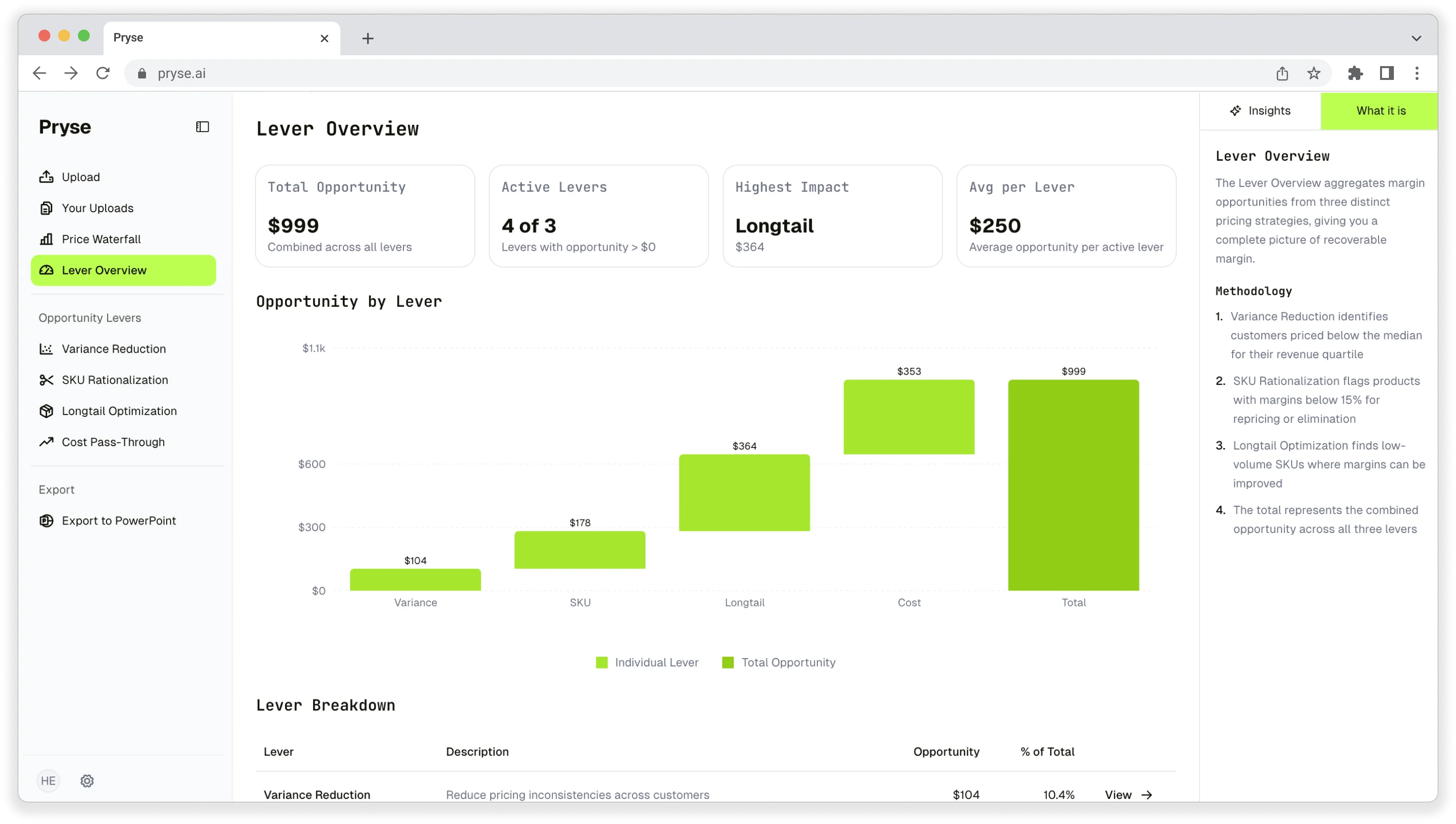
Want to analyze your entire product catalog?
Pryse automatically identifies margin leakage across thousands of SKUs. Upload your data and find hidden profit in 24 hours.
One-time $1,499 diagnostic. No subscription required.