 Pryse
PryseCompetitive Pricing Advantages and Disadvantages: A Practical Guide
Competitive pricing protects market share but can erode margins by 100-400 basis points. Here's when it works, when it backfires, and how to use it wisely.
Competitive pricing is the default strategy in distribution. You check what your competitors charge, set your price in the same ballpark, and hope you win enough bids to hit your revenue targets. It's straightforward, it keeps you in the market, and it's slowly eating your margins.
I've worked with distributors who run their entire pricing function this way. A $75M electrical distributor I spoke with last year had three people whose primary job was monitoring competitor prices on roughly 4,000 SKUs. They'd adjust prices weekly to stay within 2-3% of the lowest competitor. Their win rate on bids was excellent. Their gross margin had dropped 150 basis points over three years, and nobody could explain why.
That's competitive pricing in a nutshell: it protects market share at a cost. The question is whether that cost is worth it, and for which products. For the full picture of how this strategy fits into the broader framework, see our competitive pricing guide.
How competitive pricing works in practice
Before the pros and cons, let's ground this in what competitive pricing actually looks like at a mid-market distributor.
The core idea is simple: price relative to competitors rather than relative to your costs or customer value.
Competitive Price = Competitor Reference Price +/- AdjustmentThat adjustment might be negative (undercut to win share), zero (match to stay competitive), or positive (premium position with justification). The reference price could be one competitor, an average of several, or the lowest in the market.
A typical implementation looks like this:
| Strategy | Price Position | When It's Used |
|---|---|---|
| Price leader (low) | 5-10% below market | Gaining market share, commodity items |
| Price match | Within 1-2% of market | Maintaining share, high-visibility items |
| Price follower (premium) | 3-8% above market | Strong brand, differentiated service |
Most distributors and manufacturers I've talked to don't pick one of these across the board. They match or undercut on the products customers shop hardest (the "A" items) and price more freely on everything else. That instinct is correct. The problem is execution: knowing which items fall into which bucket, and having the discipline not to compete on price where you don't have to.
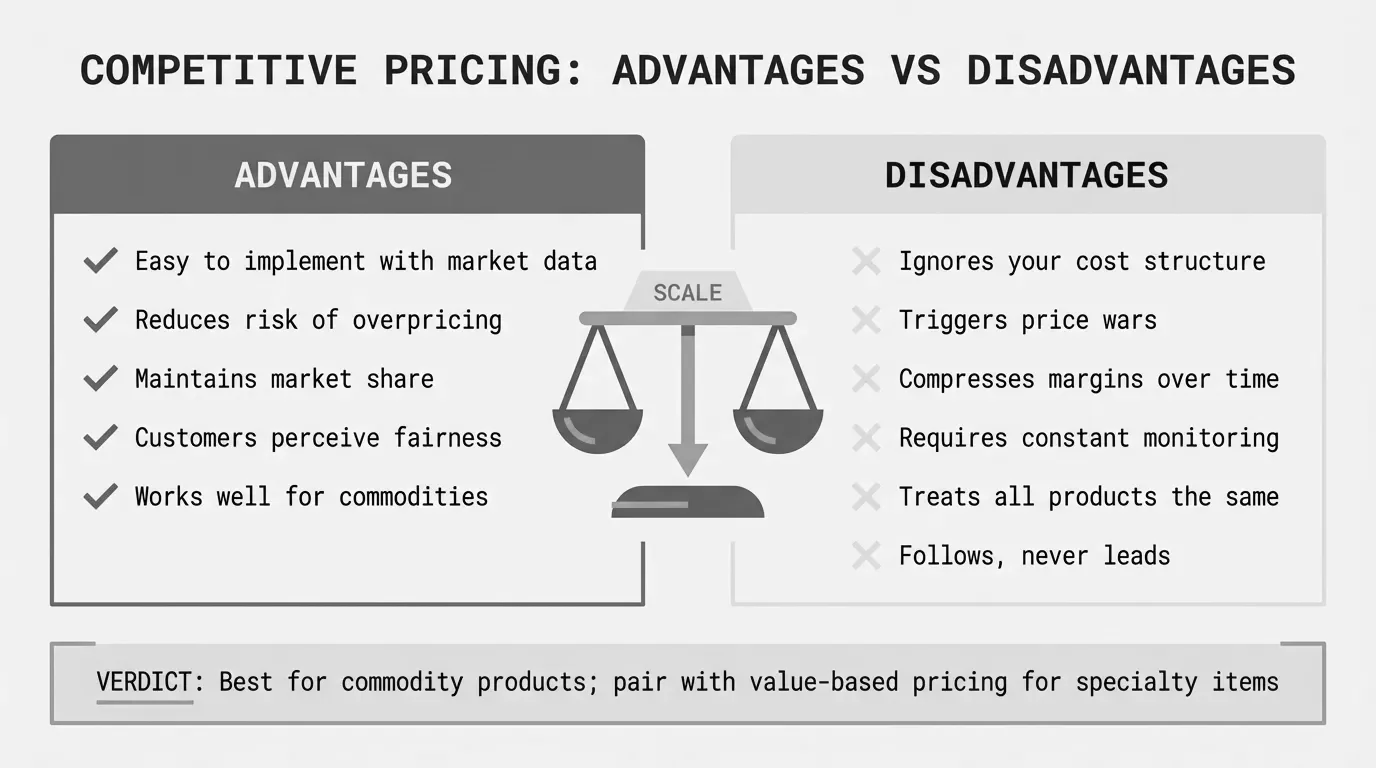
5 advantages of competitive pricing
1. It protects market share on high-visibility products
This is the real reason competitive pricing exists in distribution. When you sell the same SKU as four other distributors and the buyer knows exactly what each one charges, your pricing choices are: stay competitive or lose the order.
For the 15-20% of SKUs that drive 60-80% of revenue, your A items, competitive pricing isn't optional. Customers shop these products aggressively. They'll call three distributors for a quote on a motor drive or a box of connectors. If you're 8% above the field, you don't get the order. Period.
McKinsey's research on distributor pricing found that top-performing distributors use competitive intelligence specifically on these high-visibility items to stay in the consideration set. They don't try to win on price, they try to not lose on price. There's a difference.
2. It's easy to explain to customers
"We're priced competitively" is one of the simplest value propositions in B2B. It requires no ROI calculations, no value engineering, and no multi-slide presentations. Customers understand it immediately.
This matters in distribution where purchasing decisions are often made quickly by procurement teams comparing quotes. If your price is in line with the market and your service is reliable, you make the short list. The sales conversation moves to delivery, availability, and terms rather than getting stuck on price objection.
Simon-Kucher's Global Pricing Study 2025 found that 80% of B2B companies passed cost increases to customers in 2024. Those with competitive pricing could justify increases by pointing to market-wide movement: "Everyone's prices went up, including ours." That's an easier conversation than defending a cost-plus formula or a value-based premium.
3. It reduces the risk of losing business to cheaper alternatives
In a market where 83% of buyers check at least two sources before purchasing, being priced significantly above competitors is a direct risk. Competitive pricing mitigates that risk by keeping your prices within the range buyers expect.
This is especially true for commodity categories. A stainless steel fitting is a stainless steel fitting. When the spec is identical across suppliers, price becomes the primary differentiator. And for distributors operating at 2-4% net margins, losing a major account because you were overpriced on their core purchases can undo an entire quarter.
4. It forces awareness of market dynamics
Companies that monitor competitor prices build an understanding of market trends that purely internal pricing methods miss. You notice when a competitor drops prices (distressed inventory or new entrant), when the market moves up (demand surge), and seasonal patterns in competitive behavior.
That intelligence has value beyond pricing. It feeds procurement, sales strategy, and account management. Companies using cost-plus pricing, by contrast, operate in a bubble. They know their costs but nothing about the market. For a comparison of how internal vs. external methods stack up, see our analysis of cost-plus pricing advantages and disadvantages.
5. It supports penetration into new markets
When entering a new territory or launching a new product line, competitive pricing gives you a rational starting point. You can see what incumbents charge and position accordingly, no months of customer research required.
Pricing 5% below the incumbent signals intent to compete. Pricing at parity with better service signals quality positioning. Either way, you're in the market fast with prices that won't embarrass you. A distributor waiting six months to build a value-based model for a new product line has lost six months of sales.
5 disadvantages of competitive pricing
1. It erodes margins over time
This is the core problem. Competitive pricing is structurally biased downward.
Here's why: when a competitor drops their price, you match them to protect share. When a competitor raises their price, you don't follow immediately because you like the competitive advantage of being lower. The result is a ratchet effect where prices drift down across the market.
McKinsey's research on distributor performance found that gross margins across a global index of distributors contracted by 100 basis points over the past decade despite a stable economy. Much of that erosion came from competitive pricing dynamics: companies matching each other downward on visible products without recovering margin elsewhere.
For a $75M distributor operating at a 25% gross margin, 100 basis points of erosion is $750,000 in annual profit. That's not a rounding error. And McKinsey's 2003 study "The Power of Pricing" showed the inverse: a 1% improvement in pricing generates an 8% increase in operating profits for the average S&P 1500 company. Competitive pricing works against that leverage.
2. It creates price war vulnerability
Competitive pricing doesn't cause price wars by itself. But it creates the conditions. When every competitor watches every other competitor's prices and adjusts accordingly, a single aggressive move can trigger a cascade.
One distributor cuts prices 5% to win a large bid. A competitor sees the move, assumes it's a strategic shift, and matches. A third competitor undercuts both. Within a quarter, the entire market has repriced downward, and nobody has gained share because everyone moved together.
Simon-Kucher's Global Pricing Study 2025 reported that while 86% of companies grew revenue in 2024, volume's importance as a profit driver dropped from 50% in 2021 to 40% in 2025, suggesting that chasing volume through competitive pricing isn't delivering the profit impact it once did.
Price wars are particularly destructive in distribution, where net margins are already thin. The grocery industry provides a cautionary example: net profit margins fell to 1.18% in 2024 as competitive pricing pressure squeezed the entire sector. Industrial distribution isn't immune to the same dynamics.
3. It ignores your actual cost structure
Competitive pricing tells you what the market will bear. It tells you nothing about whether that price covers your costs and generates acceptable margin.
A competitor with lower overhead, better supplier terms, or a different cost-to-serve model can sustain prices you can't. Matching their prices doesn't give you their cost structure. You're adopting their price while carrying your costs.
Consider two distributors selling the same product. Distributor A has a 15% cost-to-serve (warehousing, delivery, sales support). Distributor B has a 10% cost-to-serve because they operate from a lower-cost facility with more automation. If both match at market price, Distributor A makes 5 percentage points less margin on every sale.
This is where competitive pricing collides with reality. Your costs are your costs. Pricing to the market without understanding whether the market price works for your cost structure is flying blind. The competitive pricing model post covers how to build cost guardrails into a competitive approach.
4. It commoditizes your differentiation
When you price based on competitors, you're implicitly telling the market that your product is interchangeable with theirs. That may be true for commodity SKUs. But if you offer faster delivery, better technical support, deeper inventory, or application expertise, competitive pricing erases those advantages by putting you on the same price footing as competitors who offer none of it.
I talked to a fastener distributor who offered same-day delivery, VMI, and on-site technical support. Their prices were within 2% of competitors who shipped in three days with no support. The customers who valued those services would have paid 5-8% more, but competitive pricing made the opportunity invisible.
For products and services where you add measurable value, a value-based pricing approach captures what competitive pricing leaves behind.
5. It demands constant monitoring and response
Competitive pricing isn't a set-it-and-forget-it strategy. It requires ongoing competitor intelligence: monitoring prices, tracking changes, analyzing patterns, and adjusting your own prices in response. For a distributor with 20,000+ SKUs and a dozen competitors, that's a significant operational burden.
Some companies invest in pricing intelligence software. Others dedicate staff to manual competitor checks. Either way, the cost is real. If a competitor changes prices on Monday and you don't respond until Friday, you've lost a week of orders.
Research from 42Signals shows that retailers and distributors using AI-powered pricing intelligence tools see 3-8% revenue uplift and 1-4% margin improvement. But those tools cost money. A $40M distributor spending $50K-$100K per year on competitive intelligence needs to be sure that investment drives margin, not just more competitive price matching.
Advantages vs. disadvantages: summary comparison
| Advantage | Corresponding Disadvantage | Net Impact |
|---|---|---|
| Protects market share | Erodes margins over time | Keeps customers but profits shrink |
| Easy to explain | Creates price war vulnerability | Simple messaging but fragile position |
| Reduces risk of losing business | Ignores your cost structure | Stays competitive but may sell below cost |
| Forces market awareness | Commoditizes your differentiation | Better intelligence but weaker positioning |
| Supports market entry | Demands constant monitoring | Fast launch but ongoing operational cost |
The pattern is clear: competitive pricing is a defensive strategy. It prevents the worst outcome (losing customers) but doesn't produce the best outcome (maximizing margin). It's insurance, not optimization.
When to use competitive pricing
Competitive pricing earns its place under specific conditions:
Commodity SKUs with high price transparency. When you sell the same product as multiple competitors and buyers know what everyone charges, competitive pricing is realistic pricing. Trying to charge a premium on an identical product is wishful thinking.
Your A items (top 15-20% of SKUs by revenue). These are the products customers shop hardest. Competitive pricing on A items protects your core revenue stream. The cost is manageable because you're applying the strategy to a limited number of products, not the entire catalog.
Market entry or new territory expansion. When you lack established relationships in a market, competitive pricing gets you to the table. Evolve the strategy once you've built a customer base.
Industries with published pricing. Some B2B markets have high price visibility through online catalogs or procurement platforms. In these markets, competitive pricing isn't a choice. It's a market condition.
When to avoid competitive pricing
Specialty and long-tail products. The 60-80% of SKUs that customers don't comparison-shop, your B and C items, should not be competitively priced. Nobody is checking what your competitor charges for a low-volume specialty fitting. Pricing these items to the market gives away margin for no competitive benefit.
Products where you add measurable value. If you offer VMI, kitting, technical support, or emergency delivery, your price should reflect that. Competitive pricing on value-added products is a subsidy to your competitors' positioning.
Markets with irrational competitors. If a competitor is pricing below cost to gain share, going through liquidation, or chasing a PE-mandated market-share target, matching their prices is self-destructive. You're optimizing against an opponent who isn't optimizing for profit.
When you don't know your cost-to-serve. Matching market prices without knowing whether they cover your costs is gambling. If the market price is below your fully loaded cost per transaction, competing on price means losing money on every sale.
The practical recommendation: segment your approach
Competitive pricing works. But only for a portion of your catalog. The companies that get this right use a segmented strategy:
| Segment | % of Catalog | Pricing Approach | Expected Impact |
|---|---|---|---|
| A items (high-volume, high-visibility) | 15-20% | Competitive pricing | Protects 60-80% of revenue |
| B items (moderate volume, moderate visibility) | 20-30% | Cost-plus with competitive guardrails | Stable margin with market awareness |
| C items (long-tail, low visibility) | 50-65% | Cost-plus or value-based | Margin recovery of 200-400 basis points |
| Differentiated/proprietary | Varies | Value-based pricing | 5-10% margin improvement potential |
This isn't theoretical. SPARXiQ's analysis of mid-market distributors consistently finds that flat competitive or cost-plus pricing across the full catalog leaves 200-400 basis points on the table, or $200K-$400K per $10M in revenue. A $75M distributor recovering even half of that adds $750K to $1.5M annually.
You compete on price where you must. You capture margin where you can. For real-world examples, see our post on competitive pricing examples.
The bottom line
Competitive pricing protects market share on commodity products. That's its job, and it does it well. But treating it as your only pricing strategy is how you end up with a $75M revenue line and a declining profit margin.
The distributors and manufacturers that perform best use competitive pricing surgically: on A items that drive revenue and visibility, not on the long tail where nobody's checking. They pair it with cost-plus as a floor and value-based pricing on differentiated products.
If you're running competitive pricing across your entire catalog, start by identifying which products actually need it. You'll likely find that 60-80% of your SKUs aren't being comparison-shopped. Those items are where your margin recovery lives.
Pryse shows you where that margin sits. Upload your transaction data and we'll map the gap between your current prices and your pricing power, product by product. No six-month implementation. No $100K platform. Just the visibility you need to price smarter.
Last updated: February 14, 2026
Frequently Asked Questions
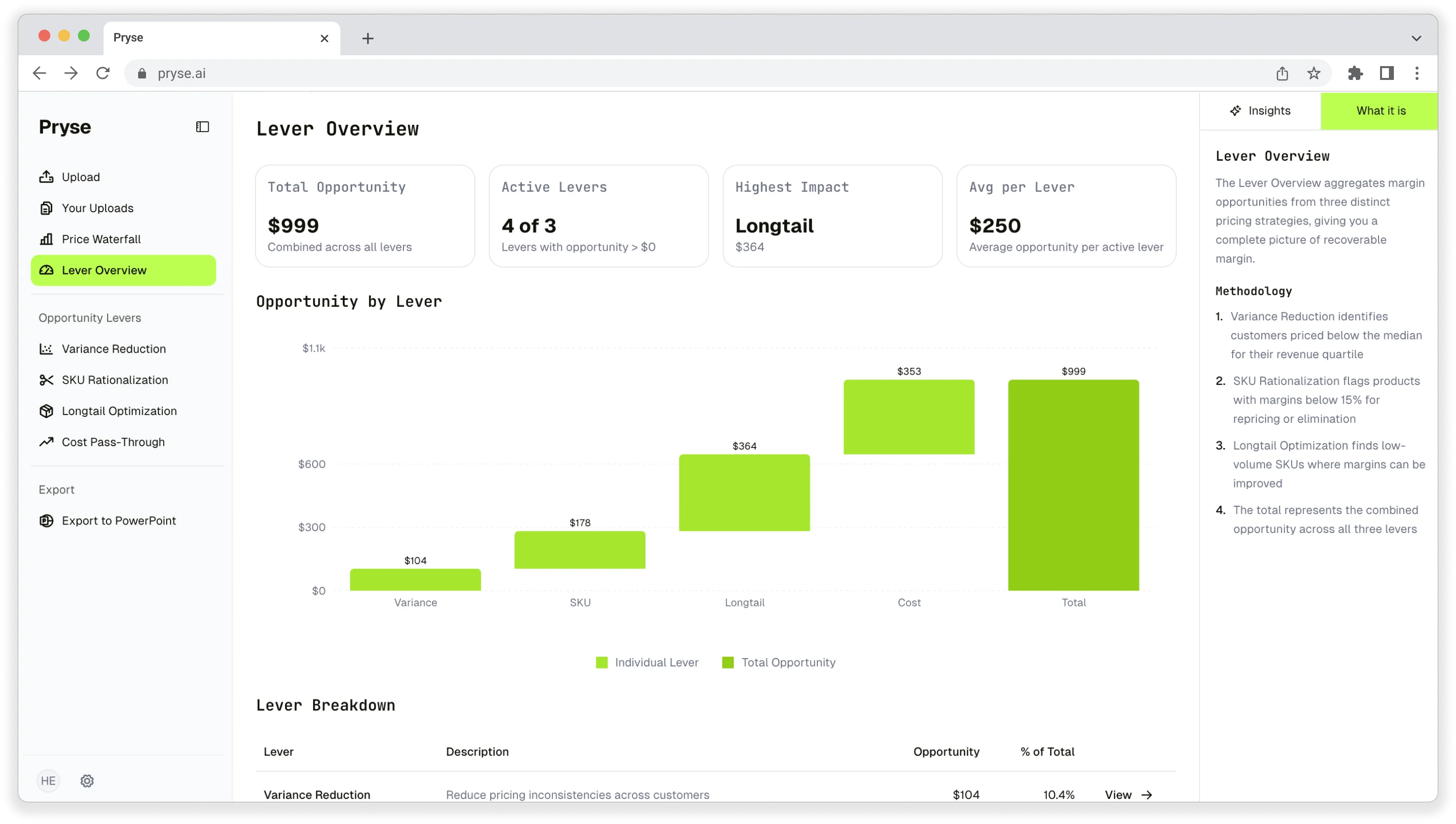
Want to analyze your entire product catalog?
Pryse automatically identifies margin leakage across thousands of SKUs. Upload your data and find hidden profit in 24 hours.
One-time $1,499 diagnostic. No subscription required.