 Pryse
PryseValue-Based Pricing Advantages and Disadvantages: An Honest Assessment
Value-based pricing can boost margins 5-10% but requires market research and sales buy-in. Here's when it works, when it fails, and how to decide.
Value-based pricing sets prices based on customer willingness to pay rather than production costs or competitor prices. When it works, companies capture more margin. When it fails, they spend months on research that doesn't change actual pricing.
The appeal is straightforward: if your product saves a customer $100,000 per year, why charge based on your $10,000 manufacturing cost? Value-based pricing says charge based on the $100,000, not the $10,000. According to McKinsey research, companies that adopt value-based pricing can improve return on sales by 5-10%.
But getting there requires market research, customer segmentation, and organizational change that many mid-market companies aren't equipped to handle. A Copperberg and Vendavo survey found that only 28% of B2B companies use value-based pricing as their primary approach. The rest stick with cost-plus or competitive pricing, often for good reasons.
This post breaks down when value-based pricing works, when it doesn't, and how to decide if the investment is worth it for your business.
For the full framework on this strategy, see our complete guide to value-based pricing.
How value-based pricing works
Before getting into the pros and cons, here's what value-based pricing actually looks like in practice.
The core idea: price based on economic value delivered, not cost incurred.
Example: Industrial equipment
A distributor sells a monitoring device that detects equipment failures before they happen. The device costs $800 to acquire. A cost-plus approach at 35% markup sets the price at $1,080.
But the value calculation looks different. For a manufacturer running three shifts, an unexpected failure means:
- 4 hours of downtime at $2,500/hour = $10,000
- Emergency repair parts at 3x normal cost = $3,000
- Overtime to catch up production = $4,000
- Total avoided cost per incident: $17,000
If the device prevents two incidents per year, it delivers $34,000 in annual value. A value-based price of $3,500-$5,000 captures a portion of that value while still giving the customer a strong ROI. The distributor earns 3-4x more than cost-plus would yield.
The formula:
Value-Based Price = Customer Economic Value x Value Capture RateWhere the value capture rate typically ranges from 10-30% of total customer value, depending on competitive alternatives and switching costs.
That's the theory. The challenge is getting the customer value calculation right and convincing buyers to accept the logic.
5 advantages of value-based pricing
1. Higher profit margins on differentiated products
This is the primary draw. Value-based pricing captures margin that cost-plus leaves on the table.
McKinsey's 2003 article "The Power of Pricing" in The McKinsey Quarterly established that a 1% price improvement generates an 8% increase in operating profits for the average S&P 1500 company. Value-based pricing targets that opportunity systematically.
A $75M distributor recovering just 2% in pricing through value-based adjustments adds $1.5M in annual profit. That's money that cost-plus formulas miss because they don't distinguish between a commodity bolt and a specialty component that prevents production downtime.
ProfitWell's research on SaaS pricing found that companies considering customer willingness to pay see twice the revenue growth and twice the profits compared to those that don't. The pattern holds in distribution and manufacturing, where product differentiation creates pricing power that uniform markups ignore.
2. Prices align with customer outcomes
Value-based pricing forces you to understand what customers actually care about. That understanding improves more than pricing.
When you research customer value, you learn which features matter and which don't. You discover which customers derive the most benefit from your products. You identify segments willing to pay premiums and segments that need stripped-down alternatives.
That intelligence feeds back into product development, marketing, and sales. Simon-Kucher notes that insights from value-based pricing research often support product roadmap decisions because they reveal which capabilities customers will pay for.
For B2B companies, this means pricing conversations become value conversations. Instead of negotiating discounts, sales reps discuss ROI. That shifts the relationship from vendor-customer to partner-collaborator.
3. Competitive differentiation beyond price
Cost-plus and competitive pricing create a race to the bottom. If your price is a function of competitor prices, you're always reacting. If your price is a function of customer value, you're competing on different terms.
A study by IMD business school found that companies with strong value-based pricing capabilities face less price pressure during economic downturns because they've trained customers to evaluate total value, not just purchase price.
When a competitor cuts prices, a value-based pricer responds with ROI calculations, not matching discounts. The customer who bought on value understands why your price is higher. The customer who bought on price was never your target anyway.
4. Willingness-to-pay data improves decision-making
The research required for value-based pricing produces data that outlasts any single pricing decision.
Willingness-to-pay studies reveal price ceilings by segment. Conjoint analysis shows which features drive purchase decisions. Customer interviews surface objections and value perceptions that sales teams can address.
According to McKinsey research cited by Conjointly, companies that employ advanced willingness-to-pay measurement techniques like conjoint analysis achieve 2-7% higher margins than those using simpler approaches. The research pays for itself.
That data also protects against internal guessing. When a product manager wants to add a feature, you can quantify whether customers will pay for it. When sales requests a discount, you can reference willingness-to-pay data for that segment. Decisions become evidence-based rather than opinion-based.
5. Supports premium positioning
Value-based pricing reinforces premium brand positioning. Customers often link high prices with high quality. According to Simon-Kucher's research on pricing psychology, a higher price can increase perceived value because buyers assume price reflects quality.
For B2B companies selling specialized products, this matters. A $5,000 diagnostic tool signals expertise in ways a $1,200 cost-plus price doesn't. The premium price attracts customers who value outcomes over cost savings, and those customers are typically easier to serve and more profitable long-term.
6 disadvantages of value-based pricing
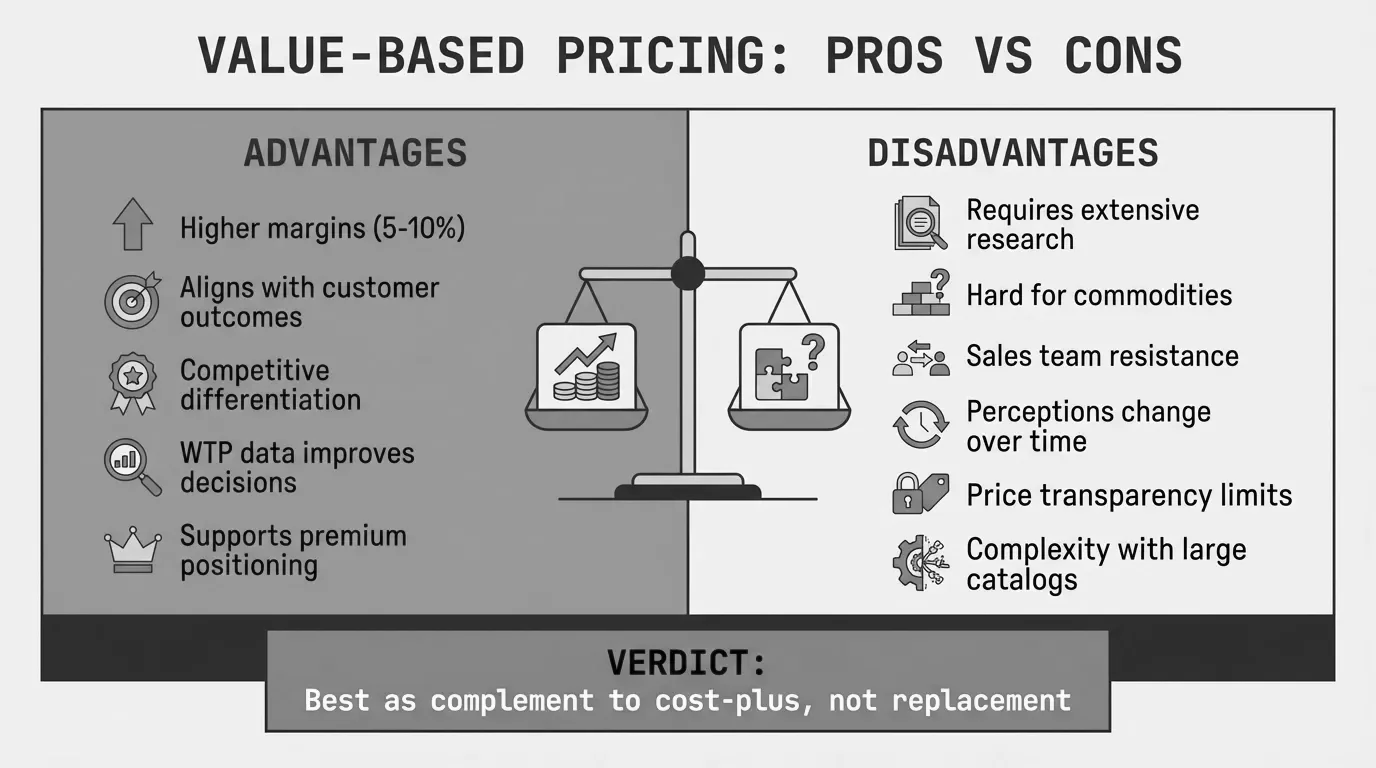
1. Requires extensive market research
Value-based pricing without data is just guessing at higher prices. The research requirement is real.
You need to quantify customer value for each major segment. That means understanding their operations, their pain points, and the economic impact of your solution. For a $50M distributor with 30,000 SKUs serving hundreds of customers, that's a significant research project.
Most B2B companies need 3-6 months to implement value-based pricing properly, according to Software Pricing Partners. The timeline depends on existing customer data quality, value proposition complexity, and SKU count. Companies without this patience end up with "value-based pricing" that's really just cost-plus with higher markups and a new name.
2. Hard to apply to commoditized products
Value-based pricing works when you offer something differentiated. When you sell the same SKU as five competitors, there's no unique value to capture.
A distributor selling standard electrical components faces a problem: customers can get the same product elsewhere. The "value" of the product is identical regardless of supplier. Pricing above market just loses the sale.
For the 60-80% of SKUs in a typical distributor catalog that are commodity or near-commodity items, value-based pricing offers limited upside. The strategy applies to the differentiated portion of your portfolio, not the entire thing.
3. Sales team resistance
Value-based pricing requires sales teams to sell differently. Instead of competing on price, they need to articulate value, quantify ROI, and defend premium prices against cheaper alternatives.
Research by IMD business school identified sales force management deficits as one of the five main obstacles to value-based pricing implementation. Sales teams trained on discount-based selling struggle to transition. If compensation is tied to volume rather than margin, reps will push for lower prices to close faster.
A common failure mode: the company invests in value-based pricing research, sets new prices, and then watches sales reps immediately discount back to old levels because they don't know how to have the value conversation.
Training helps, but the change management required is often underestimated. Porsche Consulting's research on B2B pricing transformation found that successful implementations require alignment across sales, finance, marketing, and product teams. Without that alignment, sales undermines the strategy.
4. Customer perceptions change over time
What customers value today isn't what they'll value next year. A feature that commanded a premium in 2020 may be table stakes by 2025. Value-based pricing requires ongoing research to track shifting perceptions.
This is especially true in B2B markets where technology evolves quickly. The monitoring device that was cutting-edge three years ago now competes with five alternatives. The value premium erodes even if the underlying technology hasn't changed.
Companies using value-based pricing need processes to reassess value regularly. That adds operational overhead that cost-plus doesn't require. A cost-plus price updates automatically when costs change. A value-based price requires active market monitoring to stay calibrated.
5. Difficult in price-transparent markets
Some B2B markets have high price transparency. Customers know exactly what competitors charge because pricing is public or easily obtained through RFQ processes.
In these environments, value-based pricing is constrained by market-based ceilings. You can articulate value all day, but if the customer can get 90% of the value at 70% of the price from a competitor, your value-based premium disappears.
According to Forrester's research on B2B pricing, many product and pricing managers report being overburdened and unsure whether the benefits of value-based pricing justify the time required. In highly competitive, price-transparent markets, they may be right.
6. Implementation complexity with large catalogs
A company with 50,000 SKUs cannot conduct value research on every item. The math doesn't work. Even aggressive sampling leaves thousands of products priced on some other basis.
The practical approach is hybrid: value-based pricing on differentiated products where you have pricing power, competitive pricing on high-visibility items, and cost-plus on the long tail. But managing multiple pricing methodologies adds complexity.
Zilliant's 2024 Global B2B Distribution Benchmark Report found that distribution companies lose up to 15.7% of annual margin through pricing inconsistencies. Layering multiple pricing approaches can make that problem worse if not managed carefully.
Advantages vs. disadvantages: summary comparison
| Advantage | Corresponding Disadvantage | Net Impact |
|---|---|---|
| Higher profit margins | Requires extensive research | 5-10% margin improvement possible but not automatic |
| Aligns with customer outcomes | Perceptions change over time | Better customer relationships but ongoing maintenance |
| Competitive differentiation | Hard with commodities | Works for differentiated products only |
| WTP data improves decisions | Implementation complexity | Research pays off but demands resources |
| Supports premium positioning | Sales team resistance | Brand benefits but requires training |
The pattern: every advantage of value-based pricing requires something in return. Higher margins require research. Customer alignment requires ongoing maintenance. Premium positioning requires sales team buy-in.
When value-based pricing is the right choice
Value-based pricing works best under specific conditions:
Your products are differentiated. If you manufacture proprietary equipment, sell exclusive brands, or offer services competitors can't match, you have value to capture. If you're reselling the same products as everyone else, the strategy has limited application.
Your customers have measurable ROI. Value pricing is easiest when you can quantify the benefit: reduced downtime, labor savings, yield improvements, risk reduction. Abstract benefits like "peace of mind" are harder to price.
Your sales team can sell value. If your reps are trained and compensated to have value conversations, value-based pricing has a foundation. If they're volume-focused discount hunters, expect the strategy to be undermined.
You have resources for research. Value-based pricing isn't a one-time project. It requires ongoing customer research, competitive monitoring, and price optimization. Companies with dedicated pricing functions get more from the approach than those where pricing is a side task.
Your market isn't fully commoditized. In markets where customers can easily compare identical products from multiple suppliers, value-based pricing has limited runway. The value premium exists only where differentiation exists.
When to avoid value-based pricing
You sell primarily commodities. If your catalog is 80% standard parts available from multiple distributors, value-based pricing applies to a small slice of your business. The research investment may not justify the limited application.
Your customer base is highly price-sensitive. Some markets select for price-sensitive buyers. If your customers buy on price regardless of value arguments, sophisticated pricing won't change their behavior. You're optimizing for buyers who don't exist.
You lack customer data infrastructure. Value-based pricing requires transaction data, customer segmentation, and ideally willingness-to-pay research. Companies running on disconnected spreadsheets and tribal knowledge can't execute the strategy effectively.
Your sales team won't change. If sales leadership isn't committed to value-based selling, the research you conduct will gather dust. Pricing strategy doesn't survive first contact with sales reps who need to hit quarterly volume targets.
The blended approach: practical reality
Most successful B2B companies don't choose one pricing approach. They blend strategies based on product and customer characteristics.
A practical framework:
| Product Type | Pricing Approach | Rationale |
|---|---|---|
| Differentiated/proprietary | Value-based | Capture pricing power |
| Competitive A items | Market-based | Stay competitive on visible products |
| Long-tail C items | Cost-plus with margin uplift | Simple approach, hidden from competition |
| New products | Value-based | Set anchors based on value, not cost |
| Commodity SKUs | Competitive/cost-plus | No unique value to capture |
This approach captures most of the value-based upside while limiting research to products where it matters. Cost-plus handles the volume. Value-based captures the margin.
SPARXiQ's analysis of mid-market distributors suggests this blend can recover 200-400 basis points of margin compared to flat cost-plus pricing. That's meaningful improvement without requiring value research on 50,000 SKUs.
Making the decision
Start by answering three questions:
Where do you have pricing power? Identify the 10-20% of your catalog where you offer something competitors can't match. That's where value-based pricing applies.
What's your research capacity? Value-based pricing done well requires customer interviews, willingness-to-pay analysis, and segmentation. Do you have the resources to do this properly, or would you be guessing?
Will your sales team execute? Talk to your top reps. If they're eager to sell on value rather than discount to close, you have a foundation. If they're skeptical or incentivized otherwise, fix that first.
The goal isn't ideological purity. It's margin improvement. If value-based pricing on your top 200 differentiated products adds $500K in annual profit while cost-plus handles the rest, that's a win. You don't need to transform everything.
The bottom line
Value-based pricing can increase margins 5-10% on products where you have pricing power. That's the upside. The downside is the research, organizational change, and ongoing maintenance required to do it well.
For mid-market distributors and manufacturers, the practical path is usually hybrid. Keep cost-plus as your pricing foundation. Layer value-based adjustments on differentiated products where customer research supports higher prices. Track results by segment.
The companies that struggle are the ones that declare "we're value-based now" without the research, training, or tools to execute. They end up with confused pricing that's neither simple nor strategic.
The companies that succeed are the ones that identify specific opportunities where value-based pricing applies, invest in understanding those opportunities, and track whether the investment pays off. That's less dramatic than a pricing transformation but more likely to work.
Pryse helps mid-market companies see where their pricing is working and where it isn't. Upload your transaction data and we'll show you the gaps between your target margins and your actual realized margins, so you can see which products might support value-based pricing and which need different attention.
Last updated: February 4, 2025
Frequently Asked Questions
Want to analyze your entire product catalog?
Pryse automatically identifies margin leakage across thousands of SKUs. Upload your data and find hidden profit in 24 hours.
One-time $1,499 diagnostic. No subscription required.