 Pryse
PryseCost-Plus Pricing Advantages and Disadvantages: An Honest Assessment
Cost-plus pricing guarantees margin on every sale but ignores what customers will pay. Here's when it works, when it fails, and how to decide.
Cost-plus pricing guarantees a margin on every unit sold but sacrifices any connection to what customers will actually pay. That trade-off defines the strategy, and whether it's right for your business depends on your product mix, your competitive position, and how much margin you're willing to leave on the table.
The formula is straightforward:
Selling Price = Total Unit Cost x (1 + Markup %)A $50 item with a 30% markup sells for $65. You make $15 per unit. Simple math, predictable margins, and zero market research required. That's the appeal. But it's also the limitation: that same 30% applies whether the customer has ten alternatives or none.
For the full framework on this strategy, see our complete guide to cost-plus pricing.
How cost-plus pricing works in practice
Before getting into the pros and cons, it helps to ground the discussion in how distributors and manufacturers actually use cost-plus day to day.
A typical mid-market distributor with 20,000 SKUs maintains a markup table in their ERP or a spreadsheet. Product categories get assigned a markup percentage, often tiered by cost bracket:
| Cost Range | Typical Markup | Resulting Margin |
|---|---|---|
| Under $10 | 40-50% | 29-33% |
| $10-$50 | 30-40% | 23-29% |
| $50-$200 | 25-30% | 20-23% |
| Over $200 | 18-25% | 15-20% |
The pricing manager updates cost bases when supplier prices change, the markup percentages carry forward, and new selling prices flow to the ERP. The whole process takes hours, not weeks.
That's cost-plus in its purest form. Now let's look at what it does well and where it breaks down.
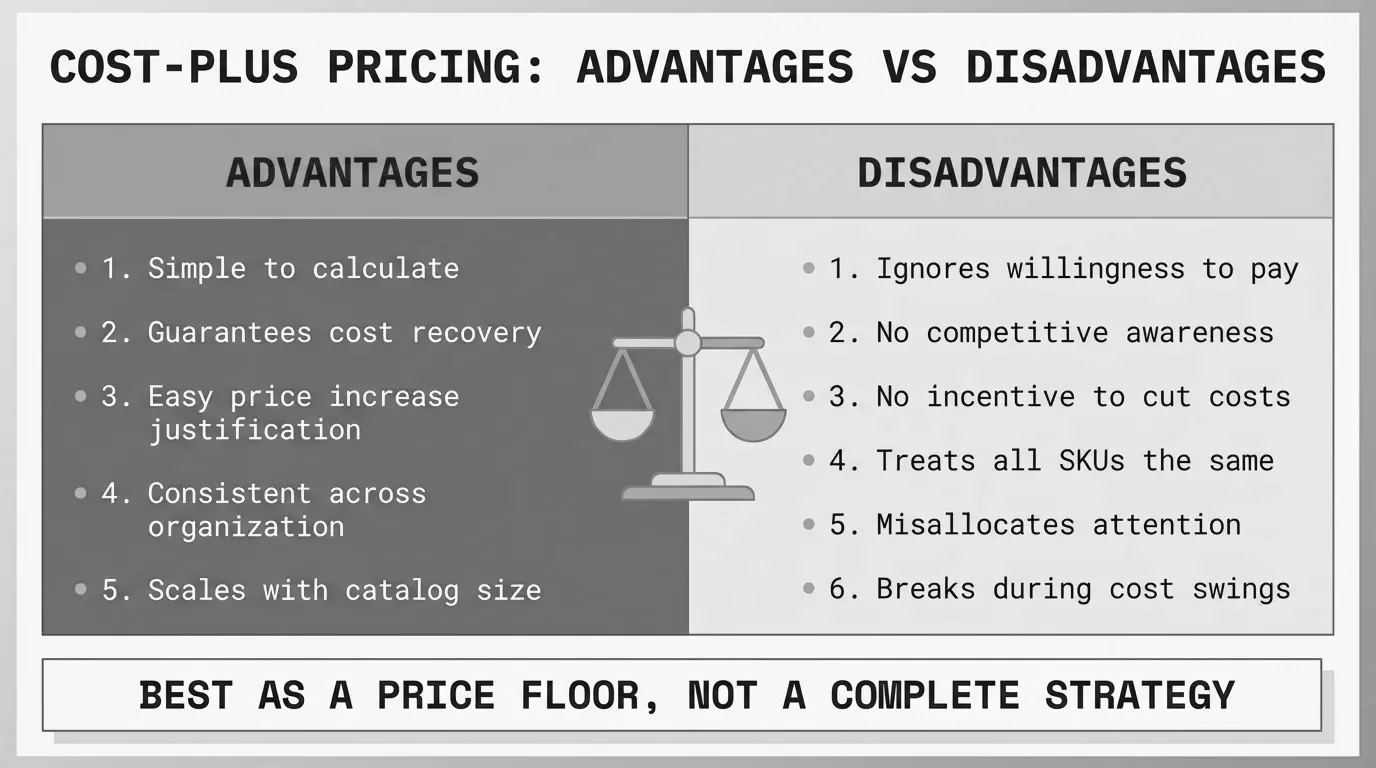
5 advantages of cost-plus pricing
1. It's simple to calculate and maintain
This is the reason cost-plus dominates in distribution and manufacturing. When you're managing 10,000 to 100,000 SKUs, pricing complexity is the enemy. Cost-plus reduces the pricing decision to two inputs: what did this item cost, and what's my target markup?
No customer segmentation. No competitive intelligence subscriptions. No willingness-to-pay surveys. A pricing analyst with access to purchase costs and a markup table can reprice an entire catalog in a day.
For companies running on lean teams where pricing is one of many responsibilities for a finance director or ops manager, that simplicity matters.
2. It guarantees cost recovery on every transaction
Cost-plus pricing makes it structurally difficult to sell below cost, assuming your cost inputs are accurate. Every unit carries a built-in margin.
That protection matters more than it sounds. According to SPARXiQ's analysis of distributor transaction data, the average distributor loses money on 40% of invoice line items when actual cost-to-serve is factored against gross margins. Much of that leakage happens when ad-hoc discounts, competitive matches, and special pricing requests push individual transactions below true cost.
Cost-plus doesn't eliminate those problems, but it gives you a clear floor to work from. When a sales rep requests a discount, the cost-plus price provides an obvious reference point: this is what we need to cover our costs and make our margin.
3. Price increases are easy to justify
When supplier costs rise 8%, you can walk into a customer meeting and show the math: our costs went up, so our prices go up. The markup stays the same. It's transparent, it's logical, and most B2B buyers accept it.
This proved valuable during the 2022-2024 inflation cycle. According to Simon-Kucher's Global Pricing Study 2025, 80% of B2B companies passed cost increases to customers in 2024, and over half used index-based mechanisms that automatically adjusted prices based on cost changes. Cost-plus pricing makes that pass-through natural. You're not arguing about value or market conditions. You're pointing at a number on a supplier invoice.
Compare that to value-based pricing during inflation. If your price is anchored to customer value rather than your cost, justifying an increase requires a different conversation: "The value we deliver hasn't changed, but our costs have." That's a harder sell.
4. It creates pricing consistency across the organization
With cost-plus, every sales rep, every branch, and every region applies the same logic. A customer in Dallas and a customer in Portland get the same starting price for the same product, because the markup formula doesn't vary by geography or relationship.
That consistency reduces the "special deal" problem that plagues distributors. When pricing is subjective, reps negotiate different prices for similar customers, and margin variance goes through the roof. Cost-plus won't eliminate negotiation, but it creates a consistent starting point that makes variance visible and manageable.
5. It scales with catalog size
A company with 500 SKUs can spend time individually pricing each one. A company with 50,000 SKUs cannot. Cost-plus scales linearly: add a new product, assign it to a cost bracket, apply the markup. Done.
For distributors adding new product lines or manufacturers expanding their catalogs, cost-plus removes pricing as a bottleneck. You don't need a pricing committee to debate the right price for every new item. The formula handles it.
6 disadvantages of cost-plus pricing
1. It ignores what customers will actually pay
This is the fundamental problem, and no amount of optimization fixes it.
A 30% markup on a $5 commodity fastener gives you a $6.50 selling price. Your competitor sells it for $6.25. You lose the sale or match the price and erode your margin.
That same 30% on a $200 specialty valve gives you a $260 price. But the valve prevents $2,000 in production downtime if it fails. The customer would happily pay $350. You're leaving $90 on the table because your pricing formula doesn't know what the product is worth to the buyer.
As Utpal Dholakia wrote in his 2018 Harvard Business Review article "When Cost-Plus Pricing Is a Good Idea," the method works best when the markup is deliberately chosen to account for market factors, not just applied as a blanket percentage. The problem is that most companies don't do that. They set the markup once and let it run.
2. It creates no competitive awareness
Cost-plus is entirely inward-looking. It knows your costs. It knows nothing about the market.
If a new competitor enters your territory and prices 15% below you on key products, cost-plus won't tell you. If a competitor exits and you suddenly have pricing power, cost-plus won't tell you that either. You'll keep charging the same markup while the market shifts around you.
In distribution, where customers actively shop prices on high-visibility items (your A products), this blind spot is expensive. You end up overpriced where it hurts and underpriced where nobody's checking.
3. It eliminates the incentive to reduce costs
Here's a counterintuitive problem: if your selling price is a direct function of your cost, then reducing costs also reduces revenue. A procurement team that negotiates a 10% reduction in supplier costs on a product line just lowered your selling prices by 10%.
In a cost-plus model, cost efficiency improvements flow directly to the customer rather than to your bottom line. That creates a strange incentive structure where nobody in the organization benefits from driving costs down, because lower costs mean lower prices, not higher margins.
The fix is to pocket some or all of cost reductions by adjusting markups, but that requires the kind of active price management that pure cost-plus is supposed to eliminate.
4. It treats every customer and every SKU the same
SPARXiQ CEO David Bauders calls this "peanut butter pricing": spreading the same markup across everything like peanut butter on toast. It's the most common pricing pattern in mid-market distribution, and it's the most expensive.
A blanket 28% markup means you're overcharging on the 20% of products that customers actively price-shop, and undercharging on the 60-80% that SPARXiQ's analysis shows are not price-sensitive. The result: you lose competitive bids on visible items and leave margin on the table everywhere else.
SPARXiQ finds that distributors using flat cost-plus markups have 200 to 400 basis points of recoverable margin, or $200,000 to $400,000 per $10 million in revenue. On a $75M book of business, that's $1.5M to $3M in profit sitting uncaptured because the pricing formula can't distinguish between a commodity and a specialty product.
For a deeper analysis of these failure modes, see our post on cost-plus pricing disadvantages.
5. It misallocates pricing attention
When every product gets the same markup treatment, pricing managers spend equal time on items that matter and items that don't. The $3 cable tie gets the same cost-update cadence as the $500 motor drive.
In reality, maybe 20% of your catalog generates 80% of your revenue and competitive exposure. Those items need different pricing attention: competitive monitoring, customer-specific adjustments, promotional strategy. The other 80% of SKUs need less attention but could support higher margins with zero competitive risk.
Cost-plus flattens this distinction. Everything gets the same formula, which means nothing gets the right formula.
6. It breaks during rapid cost changes
Cost-plus works when costs are stable and predictable. When input costs swing 15-20% in a quarter, as happened across manufacturing and distribution during 2022-2023, the model strains.
The problem is lag. Your cost data reflects what you paid last month or last quarter. Your selling prices reflect that cost plus markup. But your next purchase order reflects today's cost, which may be significantly higher. During inflationary periods, you're continuously selling at yesterday's cost-plus while buying at today's prices.
The reverse happens during deflationary periods. Costs drop, your cost-plus prices follow, and you give back margin you didn't need to surrender.
Both scenarios illustrate the same weakness: cost-plus is backward-looking. It prices based on what happened, not what's happening.
Advantages vs. disadvantages: summary comparison
| Advantage | Corresponding Disadvantage | Net Impact |
|---|---|---|
| Simple to calculate | Ignores willingness to pay | Easy to administer but leaves 2-4% margin on the table |
| Guarantees cost recovery | Reduces incentive to cut costs | Protects floor but caps upside |
| Easy to justify increases | No competitive awareness | Smooth customer conversations but blind to market shifts |
| Consistent across org | Treats all SKUs/customers the same | Reduces variance but prevents optimization |
| Scales with catalog size | Misallocates pricing attention | Handles volume but misses the long tail opportunity |
The pattern is clear: every advantage of cost-plus comes with a corresponding limitation. The question isn't whether cost-plus has flaws. It does. The question is whether those flaws matter enough, given your specific situation, to justify the complexity of a different approach.
When cost-plus pricing is the right choice
Cost-plus isn't always wrong. Here are the situations where it earns its place:
You're a new company or entering a new market. When you don't have transaction history, competitive data, or customer segmentation, cost-plus gives you a starting point. You can refine later once you have data. Trying to implement value-based pricing without data is guesswork with a fancier name.
You're in government contracting or regulated industries. Many government and defense contracts require cost-plus pricing with auditable cost structures. In these contexts, cost-plus isn't a choice. It's a requirement.
Your product catalog exceeds 50,000 SKUs and your pricing team is two people. Sophisticated pricing requires resources. If you're a $30M distributor with 60,000 SKUs and a finance director who handles pricing as 20% of their job, cost-plus may be the only realistic option today. The alternative isn't value-based pricing. It's bad value-based pricing.
Your products are genuine commodities. If you sell undifferentiated products where every competitor offers the same item from the same manufacturer, your pricing power is limited. Cost-plus at least ensures you're covering costs and making your margin.
When to evolve beyond cost-plus
For most mid-market distributors and manufacturers, cost-plus should be a starting point, not a permanent strategy. Here's how to tell when you've outgrown it:
Your margin variance is high but you can't explain why. If your blended margin bounces between 22% and 28% quarter to quarter and nobody can pinpoint the cause, your pricing formula isn't capturing the actual dynamics of your business.
You're losing competitive bids on A items. If your win rate on high-volume, high-visibility products is dropping, your cost-plus markup may be above market on the items customers shop hardest.
Your long-tail margins are flat. If your low-volume specialty items carry the same markup as your high-volume commodities, you're almost certainly underpricing them. SPARXiQ's research shows 60-80% of a typical distributor's SKUs are not price-sensitive, and those items can support meaningfully higher margins.
You're growing past $50M in revenue. As McKinsey's 2003 article "The Power of Pricing" in The McKinsey Quarterly showed, a 1% price improvement generates an 8% increase in operating profits for the average company. At $50M in revenue, recovering just 1% in pricing adds $500K to the bottom line. That math makes investing in pricing sophistication worthwhile.
The transition doesn't have to be all-or-nothing. Keep cost-plus as your floor, add competitive data on your A items, and test value-based adjustments on your specialty products. Track the results by segment. That's a cost-plus pricing strategy that captures most of the upside while preserving the simplicity.
For a broader perspective on pricing approaches, see our B2B pricing strategy guide.
The bottom line
Cost-plus pricing is the most widely used pricing method in distribution and manufacturing for good reasons: it's simple, it scales, and it protects your cost base. Those aren't trivial benefits when you're managing tens of thousands of SKUs on thin margins.
But it has a ceiling. Zilliant's 2024 Global B2B Distribution Benchmark Report found that distribution companies lose up to 15.7% of annual margin through pricing inconsistencies and misalignment. Cost-plus contributes to that leakage because it can't distinguish between products where you have pricing power and products where you don't.
The practical move for most companies: keep cost-plus as your pricing foundation, then layer intelligence on top. Start measuring where your realized margins deviate from your target markups. Identify the product-customer combinations where you're leaving the most money. Address those first. You don't need enterprise software to start. You need visibility into what's actually happening between your cost-plus price and your pocket price.
That visibility is what Pryse builds from a CSV upload in 24 hours. No six-month implementation. No $100K platform. Just the data you need to see where cost-plus is working and where it's costing you.
Last updated: February 1, 2026
Frequently Asked Questions
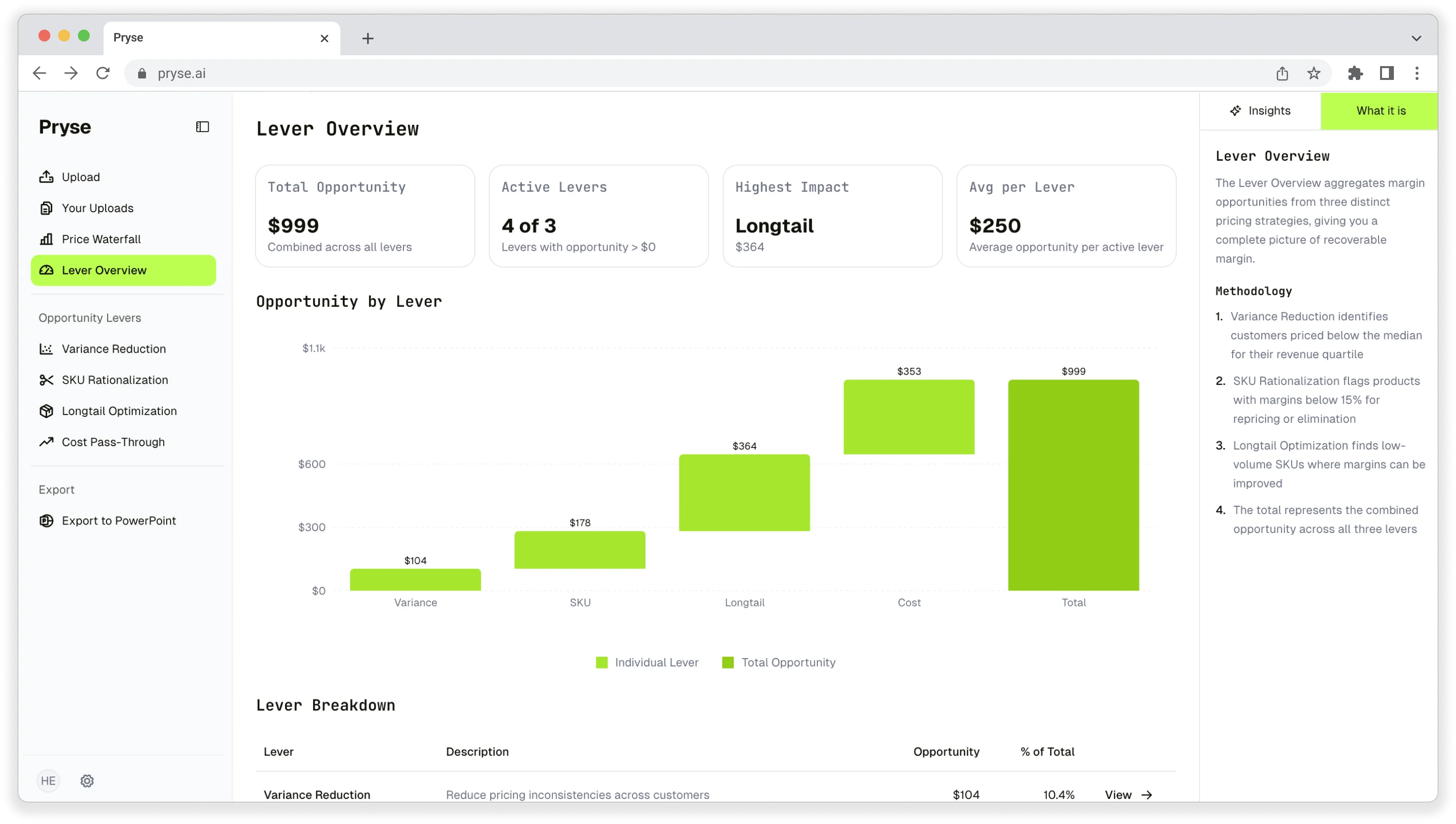
Want to analyze your entire product catalog?
Pryse automatically identifies margin leakage across thousands of SKUs. Upload your data and find hidden profit in 24 hours.
One-time $1,499 diagnostic. No subscription required.