 Pryse
PryseWhat Is Competitive Pricing? Definition, Types, and When It Actually Works
Competitive pricing is setting prices based on what competitors charge. Learn the three types, when it works for distributors and manufacturers, and when it backfires.
Competitive pricing is a pricing strategy where a company sets its prices based on what competitors charge for similar products or services, rather than relying solely on its own costs or the perceived value to the buyer. It uses the market as the primary reference point for price decisions.
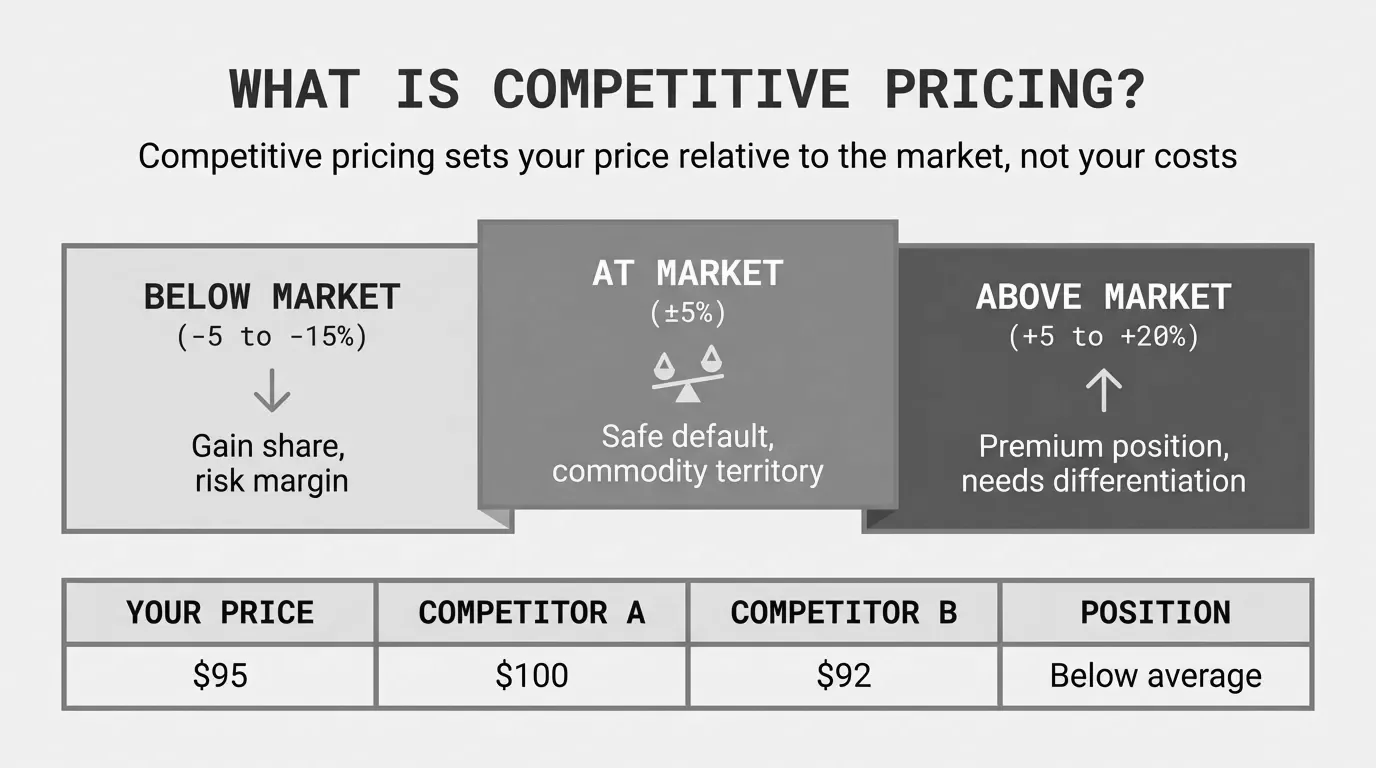
That definition sounds clean, but here's what it looks like in practice: you're a $60M industrial distributor with 18,000 SKUs, and your sales rep just lost a $140K annual account on safety gloves because a competitor undercut you by 6%. Meanwhile, your specialty abrasives are priced 12% below what customers would happily pay, and nobody noticed because nobody's comparing prices on those items. That's competitive pricing (or the lack of it) in action.
I've spent years looking at pricing data from mid-market distributors, and the same pattern keeps showing up. Companies obsess over competitor prices on the 500 SKUs customers actually comparison-shop, while ignoring the 17,500 SKUs where competitive pressure is minimal and margin opportunity is massive. Competitive pricing isn't wrong. It's just wildly overused.
How Competitive Pricing Works
The basic mechanics are straightforward. You identify your competitors, gather their prices for products that overlap with yours, and use those prices as a reference point when setting your own. Your price can sit below, at, or above the competitor's number. That positioning decision is where strategy enters the picture.
Here's what the process typically looks like for a distributor or manufacturer:
- Identify direct competitors in your market and product categories
- Collect competitor prices through public catalogs, customer feedback, sales rep intel, or pricing tools
- Map product overlap between your catalog and theirs
- Set your position (below, at, or above) for each product or category
- Adjust and monitor on a regular cadence (monthly, quarterly, or triggered by market shifts)
The formula, at its simplest:
Your Price = Competitor Reference Price +/- Positioning AdjustmentIf a competitor charges $42 for a standard ball valve and you want to price 5% below them:
Your Price = $42 x (1 - 0.05) = $39.90For more detail on the math, see our competitive pricing formula breakdown.
The Three Types of Competitive Pricing
Not all competitive pricing looks the same. There are three distinct approaches, and each one carries different margin and volume implications. The right choice depends on your product, your market position, and what you're actually trying to accomplish.
1. Below-Competitor Pricing (Undercutting)
You deliberately set prices lower than the competition to win volume. This is the approach most people think of when they hear "competitive pricing," and it's the most dangerous.
When it makes sense:
- Entering a new market and you need to pull customers away from incumbents
- You have genuine cost advantages (better purchasing scale, lower overhead, shorter supply chain)
- The product is a loss leader that drives sales of higher-margin accessories or services
When it backfires:
- When your competitors can match your price cut overnight, triggering a race to the bottom
- When you don't actually have a cost advantage and you're just eating margin
- When you apply it across the entire catalog instead of strategically on selected items
A $45M fastener distributor I've seen data from undercut competitors by 8-12% on standard bolts. Their volume went up 15%. Their gross margin went down 4 points. Net result: they worked harder for less money. That's the undercutting trap.
2. Parity Pricing (Price Matching)
You set your prices roughly equal to competitor prices and differentiate on everything else: service quality, delivery speed, technical support, inventory availability, payment terms.
When it makes sense:
- The product is truly commoditized and customers perceive no difference between suppliers
- You have strong non-price differentiators (next-day delivery, dedicated account managers, technical expertise)
- You want to neutralize price as a buying factor so the conversation shifts to value
When it backfires:
- When your service isn't actually better than the competition's, and now you're just the same price with nothing extra
- When customers don't care about your differentiators and just want the lowest number
For most mid-market distributors, parity pricing on commodity SKUs is the safest starting point. You're not leaving margin on the table by pricing low, and you're not losing deals by pricing high. The battleground moves to service, which is where distributors tend to have real advantages.
3. Above-Competitor Pricing (Premium Positioning)
You price above the market because you offer something the competition doesn't: better product quality, superior service, faster delivery, deeper technical knowledge, or a stronger brand.
When it makes sense:
- You have genuine, measurable differentiation (guaranteed 24-hour delivery, dedicated on-site support, better product specs)
- Customers have high switching costs
- The product is a small part of the customer's total spend, so a 10% premium doesn't trigger scrutiny
When it backfires:
- When your "differentiation" is just marketing language, not something customers actually experience
- When procurement teams get aggressive and run competitive bids regardless of your value-add
- When the market gets commoditized and your premium can no longer be justified
Summary: Which Type Fits Where?
| Type | Best For | Margin Impact | Volume Impact | Risk Level |
|---|---|---|---|---|
| Below competitor | Market entry, loss leaders, cost-advantaged items | Negative | Positive | High |
| Parity | Commodities where you differentiate on service | Neutral | Neutral | Low |
| Above competitor | Specialty products, strong brand, high switching costs | Positive | Slightly negative | Medium |
Most distributors and manufacturers should use all three across different segments of their catalog. A single approach applied uniformly is almost always wrong. For a deeper comparison of these tradeoffs, see our breakdown of competitive pricing advantages and disadvantages.
Where Competitive Pricing Fits Among Other Strategies
Competitive pricing is one of several pricing strategy types. It's worth understanding where it sits relative to the other two major approaches.
Cost-plus pricing starts from the inside out. You calculate your cost, add a markup, and that's your price. It ignores what the market will bear or what competitors charge. It's safe but leaves money on the table when the market price is significantly above your cost-plus number.
Value-based pricing starts from the customer's perspective. You price based on the economic value your product delivers compared to alternatives. It captures more margin but requires a deep understanding of customer economics.
Competitive pricing starts from the market. You anchor to what's already being charged and adjust from there. It's practical and fast, but it lets your competitors' pricing decisions drive yours.
Here's how they compare for the same product:
| Approach | Starting Point | Price for a $50 Cost Valve |
|---|---|---|
| Cost-plus (30% markup) | Your cost | $65 |
| Competitive (market rate) | Competitor prices | $78 |
| Value-based (total cost of ownership) | Customer value | $92 |
That $27 gap between cost-plus and value-based is where most margin leakage lives. Competitive pricing at $78 captures some of it, but not all. The smartest B2B pricing strategies blend all three.
When Competitive Pricing Works for Distributors and Manufacturers
Competitive pricing isn't universally good or bad. It's a tool, and like any tool, it works well in specific situations. Here's where I've seen it produce the best results.
High-transparency commodities
Standard electrical wire. Generic fasteners. Commodity chemicals. Products where buyers can pull up three competitor quotes in ten minutes. For these items, being out of line with the market means losing orders. Competitive pricing keeps you in the game.
Price-sensitive customer segments
Some customers are transactional buyers who make decisions almost entirely on price. Trying to sell them on value-added services is a losing battle. For these accounts, competitive pricing on their core purchases protects the relationship while you capture margin elsewhere.
Market entry situations
If you're expanding into a new geographic territory or product category, competitive pricing gives you a quick way to establish credibility. You anchor to known market prices, undercut slightly to attract initial orders, and then build the relationship.
Products with frequent cost fluctuations
Steel, lumber, copper, resin. When raw material costs swing weekly, your competitors are adjusting just as often. Competitive intelligence helps you stay current without constantly recalculating from scratch.
When Competitive Pricing Fails
And here's where it creates problems. Real ones, measured in margin points and dollars.
Applying it to your entire catalog
This is the single biggest mistake. A $75M distributor does not need competitive pricing on 20,000 SKUs. Most catalogs follow a pattern: 15-25% of SKUs are high-visibility items that customers actively price-shop. The other 75-85% rarely get compared. Pricing the entire catalog competitively means suppressing margins on thousands of items that could support higher prices.
The race-to-the-bottom spiral
When two or three competitors start undercutting each other on the same product line, prices drop fast. Margins evaporate. According to Bain & Company's research on B2B pricing, companies earn an 8% increase in operating profit for every 1% improvement in realized price. That math works both ways. A 1% decline in realized price costs you 8% of operating profit.
Ignoring your own cost structure
Competitor X prices a product at $38. You match it. But your cost is $31 and theirs is $24 because they buy direct from the manufacturer and you go through a secondary distributor. You're making 18% gross margin while they're making 37%. Same selling price, completely different economics. Competitive pricing without cost awareness is flying blind.
No differentiation to back it up
If you price at parity but your delivery takes five days and the competitor delivers in two, you'll lose anyway. Competitive pricing only works as part of a broader go-to-market strategy. Price is one variable. Service, availability, expertise, and relationships are the others.
How to Implement Competitive Pricing the Right Way
If you're going to use competitive pricing (and most distributors should, for part of their catalog), here's a practical approach that avoids the common pitfalls.
Step 1: Segment your catalog
Divide products into three buckets:
- Commodity / high-visibility: Items customers actively compare across suppliers. Standard products, common specifications, easy to substitute. These are your competitive pricing candidates.
- Standard / moderate visibility: Products customers buy regularly but don't aggressively price-shop. A blend of competitive and cost-plus works here.
- Specialty / low visibility: Differentiated products, technical solutions, items with high switching costs. Value-based pricing is the right approach.
Step 2: Build your competitive intelligence
You don't need expensive software to start. Begin with:
- Sales team debriefs: Every lost deal contains pricing data. Track it systematically.
- Customer feedback: When a customer says "your price is too high," ask who they're comparing you to and what price they were quoted.
- Distributor portals and public pricing: Many competitors publish list prices online.
- Industry benchmarks: Trade associations often publish pricing surveys and index data.
Step 3: Set position rules by segment
Don't just match the lowest price. Define your positioning for each segment:
- "On commodity fasteners, we price at parity with Competitor A and 3% below Competitor B."
- "On safety equipment, we price 5% above market because we offer same-day delivery and compliance documentation."
- "On specialty adhesives, we set prices based on value because no one else stocks these regionally."
Step 4: Monitor and adjust
Competitive pricing isn't set-and-forget. Build a cadence:
- Weekly reviews on your top 50 highest-volume commodity SKUs
- Monthly scans of competitor price changes across the broader commodity segment
- Quarterly reassessment of your competitive position by product category
Step 5: Measure what matters
Track realized margin by segment, not just revenue. If your competitive pricing segment is growing in volume but shrinking in gross margin percentage, something's off. The goal is revenue at acceptable margins, not revenue at any cost.
Competitive Pricing in Practice: A Distribution Example
Let's walk through a realistic scenario. A $55M plumbing distributor carries 14,000 SKUs and currently uses flat 28% markup on everything.
After segmenting, they identify:
- 2,100 SKUs (15%) as commodity items: standard copper fittings, PVC pipe, basic valves
- 8,400 SKUs (60%) as standard items: mid-range fixtures, pumps, water heaters
- 3,500 SKUs (25%) as specialty items: commercial-grade equipment, engineered solutions
They apply competitive pricing to the 2,100 commodity SKUs. Here's what changes:
| SKU Category | Old Approach | New Approach | Margin Impact |
|---|---|---|---|
| Commodity (2,100 SKUs) | 28% flat markup | Competitive: parity with market | -1.2 points (from 28% to 26.8%) |
| Standard (8,400 SKUs) | 28% flat markup | Cost-plus with competitive guardrails | +1.8 points (from 28% to 29.8%) |
| Specialty (3,500 SKUs) | 28% flat markup | Value-based | +4.1 points (from 28% to 32.1%) |
The commodity segment dips slightly because some items were overpriced and needed correction. But the standard and specialty segments go up because the flat markup was leaving money on the table. Net result: blended gross margin improves from 28% to 29.9%, adding roughly $1M in annual gross profit. Same customers. Same products. Better pricing.
That's the real power of competitive pricing: not as a standalone strategy, but as one piece of a segmented approach. For real-world examples of how this plays out across different industries, see our examples guide.
The Bottom Line
Competitive pricing is setting your prices based on what the market charges, not just what things cost you. It's the right approach for the 15-30% of your catalog that customers actively comparison-shop. It's the wrong approach for the other 70-85%.
The companies that get this right don't treat competitive pricing as their entire strategy. They use it as one input alongside cost data and customer value analysis. They apply it surgically to the right products and segments. And they track the results at the margin level, not just the revenue line.
If you're a mid-market distributor or manufacturer still running flat markups across your catalog, competitive pricing is a good starting point for improvement, but only if you pair it with segmentation and discipline. Start by identifying which SKUs actually face competitive price pressure. The answer will probably be far fewer than you think.
For a complete walkthrough of how to build a competitive pricing program, see our competitive pricing guide.
Last updated: February 14, 2026
Frequently Asked Questions
Want to analyze your entire product catalog?
Pryse automatically identifies margin leakage across thousands of SKUs. Upload your data and find hidden profit in 24 hours.
One-time $1,499 diagnostic. No subscription required.