 Pryse
PryseValue-Based Pricing: The Complete Guide for B2B Distribution and Manufacturing
How to price based on customer value, not cost. Covers the EVC formula, 5 value-based pricing models, implementation steps, and real examples for distributors and manufacturers.
Value-based pricing is a strategy that sets prices according to the economic value a product delivers to the customer, rather than production costs or competitor prices. The core principle: what something costs you has no bearing on what it's worth to your customer.
For distribution and manufacturing companies, value-based pricing is the difference between leaving money on the table and capturing the margin your products deserve. A specialty component that prevents $50,000 in production downtime can command $5,000 whether it costs you $200 or $2,000 to source. A lubricant that extends equipment life by 40% creates measurable value that has nothing to do with your landed cost per gallon.
Simon-Kucher's 2024 Global Pricing Study found that companies with value-based pricing approaches achieve significantly higher margins than those using cost-plus methods alone. McKinsey's research on B2B pricing consistently shows that a 1% improvement in price realization drives 8-11% improvement in operating profit, more than equivalent gains in volume or cost reduction.
Yet most mid-market distributors and manufacturers still default to cost-plus. They add 30% to everything, treat all customers the same, and wonder why margins erode despite strong sales. The gap between what they charge and what their products are worth represents margin leakage that compounds year after year.
This guide covers what value-based pricing actually means, how to calculate it using the EVC formula, five models that work in B2B, when to use each, implementation steps specific to distribution and manufacturing, and the mistakes that undermine most attempts.
What is value-based pricing
Value-based pricing sets prices based on the customer's perceived or measured value rather than production costs or competitive benchmarks. The price reflects what the product is worth to the buyer, not what it costs the seller.
Value-Based Price = Reference Price + (Differentiation Value x Capture Rate)
Reference price is what the customer would pay for their next best alternative. This might be a competitor's product, a DIY solution, or the cost of doing nothing.
Differentiation value is the additional economic benefit your product delivers beyond that alternative. Measured in dollars: time saved, costs avoided, revenue enabled, risk reduced.
Capture rate is the percentage of differentiation value you price into the product. Typically 10-40%. You leave the rest with the customer as their incentive to buy.
This framework, detailed in our value-based pricing formula guide, shifts the conversation from "what does this cost?" to "what is this worth?" For a deeper look at the conceptual foundation, see our value-based pricing definition breakdown.
A simple example
You sell industrial adhesive to manufacturing plants. The competitor's product costs $28 per unit.
Your adhesive:
- Cures 40% faster, saving 15 minutes of labor per application at $45/hour = $11.25 saved
- Requires no surface prep, saving $3.50 in materials and 10 minutes of labor = $11.00 saved
- Total positive differentiation: $22.25 per use
The maximum price a rational customer should pay is $28 + $22.25 = $50.25. At that price, they break even compared to the alternative. At $40 (a 30% capture rate), they capture $10.25 in value and you capture the premium.
Compare this to cost-plus: if the adhesive costs you $18 and you add 40% markup, you charge $25.20 and leave $25 on the table on every unit sold.
How value-based pricing differs from cost-plus
Cost-plus pricing starts inside your business. You calculate what a product costs, add a target margin, and that's your price. Simple. Predictable. And often wrong.
Value-based pricing starts with the customer. You determine what the product is worth to them, then price to capture a share of that value.
| Dimension | Cost-Plus Pricing | Value-Based Pricing |
|---|---|---|
| Starting point | Your costs | Customer's benefit |
| Formula | Cost x (1 + Markup%) | Reference Price + Differentiation Value |
| Data required | Internal cost data | Customer research, competitive pricing |
| Complexity | Low | High |
| Margin potential | Limited by markup | Limited by customer perception |
| Risk of underpricing | High on differentiated products | Low |
| Best for | Commodities | Differentiated products |
The contrast is stark when you look at real products. A specialty stainless steel valve might cost you 30% more than a brass valve. Cost-plus says add your standard markup to both. But if the stainless steel valve is the only option rated for a customer's corrosive chemical application and prevents a $50,000 equipment failure, the value-based price could be 3-4x the cost-plus price.
Our value-based vs cost-based pricing comparison covers this in detail, including when each approach fits and how to combine them.
Why cost-plus leaves money on the table
Cost-plus pricing creates what pricing consultants call "peanut butter pricing": spreading the same markup across every product regardless of value. You're too high on commodities where customers shop price, and too low on specialty items where they'd pay more.
Research from Bain & Company's 2018 survey of 1,700 B2B companies found that 85% of respondents believed their pricing decisions could improve. The gaps weren't in choosing wrong prices. They were in applying undifferentiated pricing across products that deserved different treatment.
A distributor using 30% markup across 50,000 SKUs is guaranteed to be:
- Overpriced on commodity items where competitors offer 20% markup
- Underpriced on specialty items where customers would accept 50% or more
Value-based pricing addresses this by matching price to value on a product-by-product, customer-by-customer basis.
The Economic Value to Customer (EVC) formula
Economic Value to Customer (EVC) is the framework for calculating value-based prices. Introduced by Thomas Nagle in "The Strategy and Tactics of Pricing," it breaks value into quantifiable components.
EVC = Reference Price + Positive Differentiation Value - Negative Differentiation Value
Reference price
The reference price is what the customer pays for their next best competitive alternative (NBCA). This isn't always a direct competitor. It could be:
- A competitor's equivalent product
- A substitute that solves the same problem differently
- A DIY or in-house solution
- The cost of doing nothing (status quo)
Use the actual price customers pay for the alternative, not list price. If the competitor lists at $100 but customers typically pay $85 after negotiation, your reference is $85.
Positive differentiation value
Positive differentiation is the monetary value your product creates beyond the reference alternative. Common sources in B2B:
| Value Driver | How to Calculate | Example |
|---|---|---|
| Labor savings | Hours saved x Hourly rate | 2 hours/week x $55/hr x 50 weeks = $5,500/year |
| Downtime avoided | Hours of downtime x Hourly production value | 8 hours/year x $1,200/hr = $9,600/year |
| Material reduction | Materials saved x Cost per unit | 15% less waste x $40,000 annual spend = $6,000/year |
| Extended equipment life | Deferred replacement cost x Time value | $80,000 machine x 2 years extended / 10 year life = $16,000 |
| Quality improvement | Defects reduced x Cost per defect | 3% fewer rejects x 50,000 units x $8/unit = $12,000/year |
The key is converting every benefit into dollars. "Better quality" isn't a value driver. "3% fewer rejects saving $12,000 annually" is.
Negative differentiation value
No product is better in every dimension. Negative differentiation accounts for ways your product falls short:
- Missing features the competitor offers
- Longer lead times requiring higher safety stock
- Training requirements for new product adoption
- Higher switching costs or integration effort
- Less favorable payment terms
Subtract these from your positive differentiation to get net differentiation value.
Worked example: Industrial gasket manufacturer
You manufacture custom gaskets for industrial equipment. A target customer currently buys from a competitor.
Step 1: Establish reference price
- Competitor price: $145 per unit
- Customer annual volume: 2,400 units
- Customer's current annual spend: $348,000
Step 2: Calculate positive differentiation Your gaskets offer 30% longer service life:
- Current replacement: every 6 months (2,400 replacements/year)
- With your product: every 8 months (1,800 replacements/year)
- Annual replacement savings: 600 fewer gaskets x $145 = $87,000
Labor savings per replacement:
- 45 minutes per replacement x $65/hour = $48.75 per unit
- Fewer replacements: 600 x $48.75 = $29,250/year
- Per unit on 2,400 volume: $29,250 / 2,400 = $12.19
Step 3: Calculate negative differentiation Your product has longer lead time:
- Customer needs to order 2 weeks earlier
- Additional inventory carrying cost: $2,400/year or $1.00 per unit
Step 4: Calculate EVC
Net differentiation per unit = ($87,000 + $29,250 - $2,400) / 2,400 = $47.44
EVC = $145 + $47.44 = $192.44 per unit
At $192.44, the customer breaks even. Apply a 30% capture rate for a new account:
Value-Based Price = $145 + (0.30 x $47.44) = $159.23
Round to $159. The customer pays $14 more per unit but saves $36.13 in net value. That's a 2.6:1 return on their price premium.
For more calculation methods and examples, see our complete value-based pricing formula guide.
5 types of value-based pricing
Value-based pricing isn't one technique. It's a category with distinct models, each suited to different products and customer situations. Our types of value-based pricing guide covers these in depth.
1. Good-Better-Best pricing
Good-Better-Best (also called tiered or Goldilocks pricing) offers three product tiers at different price points, with each tier delivering progressively more value.
How it works:
- Good: Basic option with core features, lowest price
- Better: Mid-tier with enhanced features, positioned as best value
- Best: Premium option with maximum features, highest price
The psychology is well-documented. When Williams-Sonoma added a $429 bread machine next to their $279 model, sales of the cheaper model nearly doubled. Buyers saw $279 as reasonable compared to $429.
Distribution example:
| Tier | Product | Features | Price | Margin |
|---|---|---|---|---|
| Good | Economy work gloves | Basic cut protection, 3-month lifespan | $8/pair | 22% |
| Better | Standard work gloves | Enhanced grip, 6-month lifespan | $15/pair | 35% |
| Best | Premium work gloves | Maximum dexterity, 12-month lifespan | $28/pair | 48% |
Most customers land on "Better." The economy option validates the middle tier's value. The premium captures buyers who genuinely need maximum performance.
When to use it: Product lines with natural feature differentiation. Customers with varying willingness to pay. Works well for lubricants, safety equipment, cutting tools, and consumables.
2. Outcome-based pricing
Outcome-based pricing ties payment to specific results achieved, not products delivered. The customer pays for outcomes; you bear the risk of delivering them.
How it works: Instead of fixed product prices, you charge based on business results: cost savings realized, revenue increased, or downtime avoided. Payment is contingent on hitting defined targets.
Outcome Price = Base Fee + (Outcome Achieved x Share Rate)
Manufacturing example: Hitachi Rail's "trains-as-a-service" model charges UK rail operators based on completed journeys meeting KPIs: on-time performance, fleet availability, and maintenance efficiency. Hitachi gets paid when trains run. If they don't, Hitachi absorbs the cost.
Distribution example: A chemical distributor selling cutting fluids:
- Traditional: $50/gallon, customer buys 200 gallons/month = $10,000/month
- Outcome-based: $0.05 per part produced using the fluid
If the shop produces 250,000 parts/month, the distributor earns $12,500. If production drops, revenue drops. But if the fluid improves tool life, the distributor captures that upside.
When to use it: When outcomes are measurable, you control variables affecting results, and your product demonstrably outperforms alternatives. According to Gartner research, by 2022 more than 60% of asset manufacturers were offering outcome-based service contracts.
3. Performance-based pricing
Performance-based pricing ties payment to ongoing performance against defined KPIs, rather than binary outcome achievement.
How it works: Establish baseline metrics, define targets, and price based on performance against those targets. Bonuses for exceeding, penalties for missing.
Distribution example:
| Performance Metric | Target | Price Adjustment |
|---|---|---|
| On-time delivery | 98%+ | +$0.50/order |
| Inventory accuracy | 99.5%+ | +$0.25/order |
| Order accuracy | 99.9%+ | +$0.25/order |
| Below targets | Any miss | Base rate only |
Base rate might be $8/order. Hit all three KPIs and the effective rate is $9/order. Miss targets and you're at base.
When to use it: Ongoing relationships with continuous measurement. Multiple metrics matter. Both parties benefit from continuous improvement.
4. Value-in-use pricing
Value-in-use pricing sets price based on the economic value a product creates during use, independent of production cost.
How it works: Quantify the financial benefits during use: labor savings, energy reduction, yield improvement, waste reduction. Price as a percentage of that value.
Value-in-Use Price = (Customer's Economic Value x Capture Rate) + Cost of Alternatives
Distribution example: LED lighting upgrade
A distributor selling LED lighting to a warehouse operator:
Current energy cost: 500 fixtures x 400W x 4,000 hours x $0.12/kWh = $96,000/year
LED energy cost: 500 fixtures x 150W x 4,000 hours x $0.12/kWh = $36,000/year
Annual savings: $60,000
5-year value: $300,000
If the LED upgrade costs $75,000 (25% of 5-year value), it's an easy decision. Cost-plus pricing at $50,000 would leave $25,000 on the table. The customer still buys at $75,000 because the payback is under 18 months.
When to use it: Products delivering measurable operational improvements. Customers with data to verify claims. Competitive products don't deliver equivalent value.
5. Total Cost of Ownership (TCO) pricing
TCO pricing positions price based on lifetime cost, not purchase price. It reframes the decision from "what does this cost?" to "what will this cost me over five years?"
TCO = Acquisition Cost + (Operating Costs x Years) + Maintenance Costs - Residual Value
Distribution example: Fastener for wind turbines
| Cost Element | Standard Bolt | Premium Bolt |
|---|---|---|
| Unit price | $12 | $28 |
| Installation labor | $45 | $45 |
| Expected failures/year | 2.3% | 0.1% |
| Cost per failure | $8,500 | $8,500 |
| 10-year TCO per bolt | $12 + $45 + (10 x 0.023 x $8,500) = $2,012 | $28 + $45 + (10 x 0.001 x $8,500) = $158 |
The premium bolt costs 2.3x more at purchase but 12x less over ten years. TCO pricing makes the decision obvious.
When to use it: Higher upfront cost but lower lifetime cost than alternatives. Operating and maintenance costs are large share of total cost. Customers sophisticated enough to think long-term.
When to use value-based pricing
Value-based pricing isn't for every product. It works in specific situations and fails in others.
Use value-based pricing when:
Your product is differentiated. If you're the only distributor stocking a specific brand, or the only manufacturer with a specific capability, the customer's alternative isn't a cheaper version. It's going without. That changes the value equation.
Benefits are measurable. When you can quantify labor savings, downtime avoided, or throughput improved in dollars, you can justify the price premium. Vague claims of "better quality" don't support value pricing.
Competition is limited. If customers have few alternatives, your cost has little to do with what they'll pay. A specialty valve rated for corrosive chemicals might cost 30% more than brass. If it's the only option, price to value.
The customer can perceive the value. Sophisticated buyers who track operational costs can see the ROI. Transactional buyers making quick decisions won't do the math.
Transaction size justifies the analysis. Value-based pricing takes effort. A $50,000 equipment sale warrants detailed value calculation. A $15 commodity part doesn't.
Our value-based pricing strategy post covers positioning and go-to-market considerations in more detail.
Avoid value-based pricing when:
The product is a commodity. When customers genuinely see your product as identical to alternatives, differentiation value is zero. Price defaults to market rate or below.
Pricing is transparent and competitive. If customers can compare five alternatives in 30 seconds online, internal value calculations don't set the market.
No reference price exists. For new product categories with no established alternatives, there's no anchor. You'll need to establish value through pilots and case studies first.
Customers can't measure value. Some buyers lack the operational data to quantify your benefits. Without measurement, value arguments fall flat.
Low-involvement purchases. A $15 part that gets reordered automatically won't get an EVC analysis. Keep these on cost-plus.
For a balanced view of the tradeoffs, see our value-based pricing advantages and disadvantages analysis.
Implementing value-based pricing in B2B
B2B value-based pricing operates differently from consumer pricing. The differences are structural and require specific adjustments. Our value-based pricing B2B guide covers these dynamics in depth.
The B2B buying committee problem
B2B purchases involve multiple stakeholders. According to research from Gartner, the average B2B purchase now involves 10-11 stakeholders. Each evaluates your offering through a different lens:
| Stakeholder | What They Care About | Value Language |
|---|---|---|
| Operations/Users | Reliability, ease of use | Hours saved, uptime percentage |
| Engineering | Specifications, quality | Technical superiority, defect rates |
| Finance/CFO | ROI, payback period | Dollar savings, NPV calculations |
| Procurement | Price benchmarks | Cost per unit, competitive comparison |
| Executive sponsor | Strategic alignment | Business impact, risk reduction |
Value-based pricing in B2B means building value cases that resonate with each stakeholder. A single ROI number isn't enough when finance, operations, and procurement each need their own version.
Implementation steps
Step 1: Segment your catalog
Not every product warrants value-based pricing. Categorize by differentiation level:
| Category | Products | Pricing Approach |
|---|---|---|
| Commodity | Standard items, transparent pricing | Cost-plus with market validation |
| Standard | Moderate differentiation | Cost-plus with value adjustments |
| Specialty | Unique capabilities, limited alternatives | Full value-based pricing |
| Technical solutions | Expertise required, measurable outcomes | Outcome or performance-based |
Focus value-based pricing on the specialty and solutions categories. Keep cost-plus on commodities where it works.
Step 2: Build value quantification tools
For your specialty products, create calculators that quantify customer value:
- Energy savings calculators
- Downtime avoidance ROI models
- Total cost of ownership comparisons
- Labor savings worksheets
These tools serve two purposes: they help you calculate prices and they help your sales team justify prices to customers.
Step 3: Segment your customers
Different customers get different value from the same product. A bearing that prevents $100,000 in downtime for a 24/7 chemical plant might prevent $10,000 for a seasonal manufacturer. Your pricing should reflect that.
Segment by:
- Industry and application
- Cost-of-failure profile
- Purchase urgency patterns
- Technical sophistication
- Willingness to pay (measured through negotiation behavior)
Step 4: Train your sales team
The biggest barrier to value-based pricing isn't calculation. It's execution. Sales reps trained on cost-plus default to "what discount do you need?" when they should be asking "what's the cost of your current problem?"
Sales training for value-based pricing covers:
- Identifying customer pain points and quantifying impact
- Presenting value cases to multiple stakeholders
- Defending price premiums with ROI evidence
- Knowing when to negotiate and when to walk away
Step 5: Track value capture
Measure whether you're actually capturing value:
- Track realized margins by product category and customer segment
- Compare negotiated prices to initial value-based quotes
- Monitor discount frequency and depth by rep
- Calculate the gap between EVC ceiling and actual price
If you're calculating $150 EVC and consistently closing at $85, you have either a sales execution problem or an EVC calculation that doesn't match customer perception.
See our value-based pricing model post for more on structuring value-based pricing programs.
Common mistakes and how to avoid them
After working with dozens of distributors and manufacturers on pricing, these are the mistakes that undermine value-based pricing most often.
Mistake 1: Calculating value at the product level, not customer level
A gasket's value to an oil refinery running 24/7 differs from its value to a seasonal manufacturer. If you calculate one EVC and apply it everywhere, you're overpricing for some customers and underpricing for others.
Fix: Segment customers by value profile. Calculate differentiation value for each segment. Price accordingly.
Mistake 2: Including non-differentiated benefits
If your competitor's product also saves labor, that's not differentiation value. Only include benefits that exceed the reference alternative.
Fix: Be ruthless about what's actually differentiated. As the Harvard Business Review notes: "Features common with the next best alternative are captured by its price."
Mistake 3: Ignoring negative differentiation
Every honest value calculation includes negatives. Your product might have longer lead times, require special handling, or lack a feature the competitor offers.
Fix: Document negative differentiation and subtract it. Your sales team will encounter these objections anyway. Better to build them into the price than be surprised.
Mistake 4: Using list price as reference
Reference price should be the actual price customers pay for alternatives, including their negotiated discounts. If competitor list is $100 but customers pay $85, your reference is $85.
Fix: Research actual competitive transaction prices, not list prices. Use lost-deal intelligence from your sales team.
Mistake 5: One-time calculation
Customer value changes as their operations evolve. A manufacturer who added a second shift now has double the downtime cost. Your EVC should reflect that.
Fix: Recalculate EVC annually, after major customer operational changes, or when competitive dynamics shift.
Mistake 6: Skipping the customer validation step
EVC is a theory until customers confirm it. If you calculate $150 differentiation value but customers won't pay $50 above reference, your theory was wrong.
Fix: Test value-based prices on new customers before rolling out broadly. Use pilot programs to validate assumptions.
Real examples from distribution and manufacturing
Concrete examples make abstract frameworks actionable. These are based on real engagements with details changed for confidentiality.
Example 1: Industrial valve distributor
A $55M industrial valve distributor used flat 32% markup across everything. Their gross margin was consistent at 24%.
Analysis revealed a pricing mismatch:
- Commodity brass valves (60% of SKUs, 35% of revenue): Overpriced by 8-12% versus online competitors. Losing deals.
- Specialty stainless valves (15% of SKUs, 30% of revenue): Underpriced by 40-60%. Customers in corrosive chemical applications had no alternatives.
- Standard valves (25% of SKUs, 35% of revenue): Priced about right.
The fix applied value-based pricing to specialty valves:
- Calculated EVC for each major application (chemical processing, food service, pharmaceutical)
- Raised specialty valve prices 35-50% with documented value justification
- Lowered commodity valve margins to stay competitive
Results over 12 months:
- Commodity revenue down 8% (expected losses)
- Specialty revenue up 22% despite higher prices
- Standard revenue flat
- Overall gross margin improved from 24% to 29.3%
- Gross profit dollars up 18%
Example 2: MRO distributor with same-day delivery
An MRO distributor offered same-day delivery in a market where competitors shipped in 3-5 days. They charged the same prices as competitors.
Value analysis:
- Same-day delivery prevents production downtime worth $2,000-4,000/hour for most customers
- Average downtime without same-day: 4-8 hours
- Value of same-day delivery: $8,000-32,000 per incident
- Frequency of emergency orders: 15-20% of customer transactions
The distributor was providing massive value and capturing zero of it.
The fix:
- Introduced "production-critical" pricing tier at 25% premium for same-day items
- Positioned premium around guaranteed 4-hour delivery, not just same-day
- Created ROI calculator showing downtime cost vs. premium paid
- Trained sales team on value conversation
Results:
- 72% of same-day orders accepted the premium tier
- Average order value increased 18%
- Zero customer attrition (the value was real)
- Same-day margin improved from 19% to 38%
Example 3: Specialty chemical manufacturer
A $40M specialty chemical manufacturer sold custom formulations at cost-plus 40%. Lead times were 6-8 weeks. Minimum orders were 500 gallons.
The problem: customers choosing these formulations had no alternatives. The chemistry was spec'd into their process. Switching meant reformulating their entire production line at costs of $50,000-200,000.
They were pricing a captive customer base as if alternatives existed.
Value-based approach:
- Identified 23 formulations with switching costs above $75,000
- Calculated EVC including reformulation avoidance and production continuity
- Raised prices 60-120% on these formulations over 18 months
- Added multi-year supply agreements to offset price increases with volume security
Results:
- Lost 2 of 23 customers (chose to reformulate rather than pay)
- Remaining 21 customers renewed at higher prices
- Revenue from these formulations increased 47%
- Gross margin on these SKUs went from 38% to 62%
Value-based pricing and the price waterfall
Value-based pricing sets the target. The price waterfall shows what you actually collect.
List Price (value-based ceiling)
- On-Invoice Discounts
= Invoice Price
- Off-Invoice Deductions (rebates, freight, payment terms)
= Pocket Price
Value Capture = (Pocket Price - Reference Price) / Differentiation Value
A common failure mode: companies calculate value-based prices, publish them as list prices, then erode them through undisciplined discounting. The gap between list price and pocket price averages 28-35% in distribution. That erosion can wipe out value-based pricing gains entirely.
To make value-based pricing work:
- Set floor prices below which no sale happens
- Define discount authority levels
- Track pocket price by product and customer
- Measure actual value capture versus target
For the full framework on managing price erosion, see our pricing strategy guide.
Building a hybrid approach
Pure value-based pricing across 50,000 SKUs isn't practical. Most successful distributors and manufacturers use a hybrid: cost-plus as the floor, value-based as the ceiling, applied differently by product category.
| Product Category | Approach | Typical Result |
|---|---|---|
| Commodity (40% of SKUs) | Cost-plus with market validation | 18-25% margin |
| Standard (40% of SKUs) | Cost-plus with value adjustments | 25-35% margin |
| Specialty (15% of SKUs) | Full value-based pricing | 40-60% margin |
| Technical solutions (5% of SKUs) | Outcome or performance-based | 50-80% margin |
The specialty and solutions categories drive disproportionate profit despite being a minority of SKUs. That's where value-based pricing creates the most impact.
For guidance on setting up this segmented approach, see our value-based pricing benefits post on maximizing returns from value-based pricing.
What to do next
If you're running cost-plus across everything with undifferentiated margins, here's where to start:
-
Identify your top 30 specialty products. Items where you have differentiation, limited competition, or measurable customer value. Start there.
-
Calculate EVC for each. Use the formula: Reference Price + Differentiation Value. Be honest about positive and negative differentiation.
-
Test value-based prices on new customers. Don't disrupt existing relationships immediately. Price new accounts based on value and measure results.
-
Build value documentation. Create ROI calculators, case studies with specific numbers, and TCO comparisons. Your sales team needs ammunition.
-
Track actual value capture. Compare your calculated EVC to the prices you actually realize. If the gap is large, either your calculations are wrong or your sales execution needs work.
-
Build the waterfall. Understand what you're actually collecting after all discounts and deductions. Value-based list prices mean nothing if pocket price erodes 35%.
For companies managing 5,000-100,000 SKUs, running this analysis in Excel is possible but painful. A single pricing diagnostic can surface opportunities invisible in a spreadsheet.
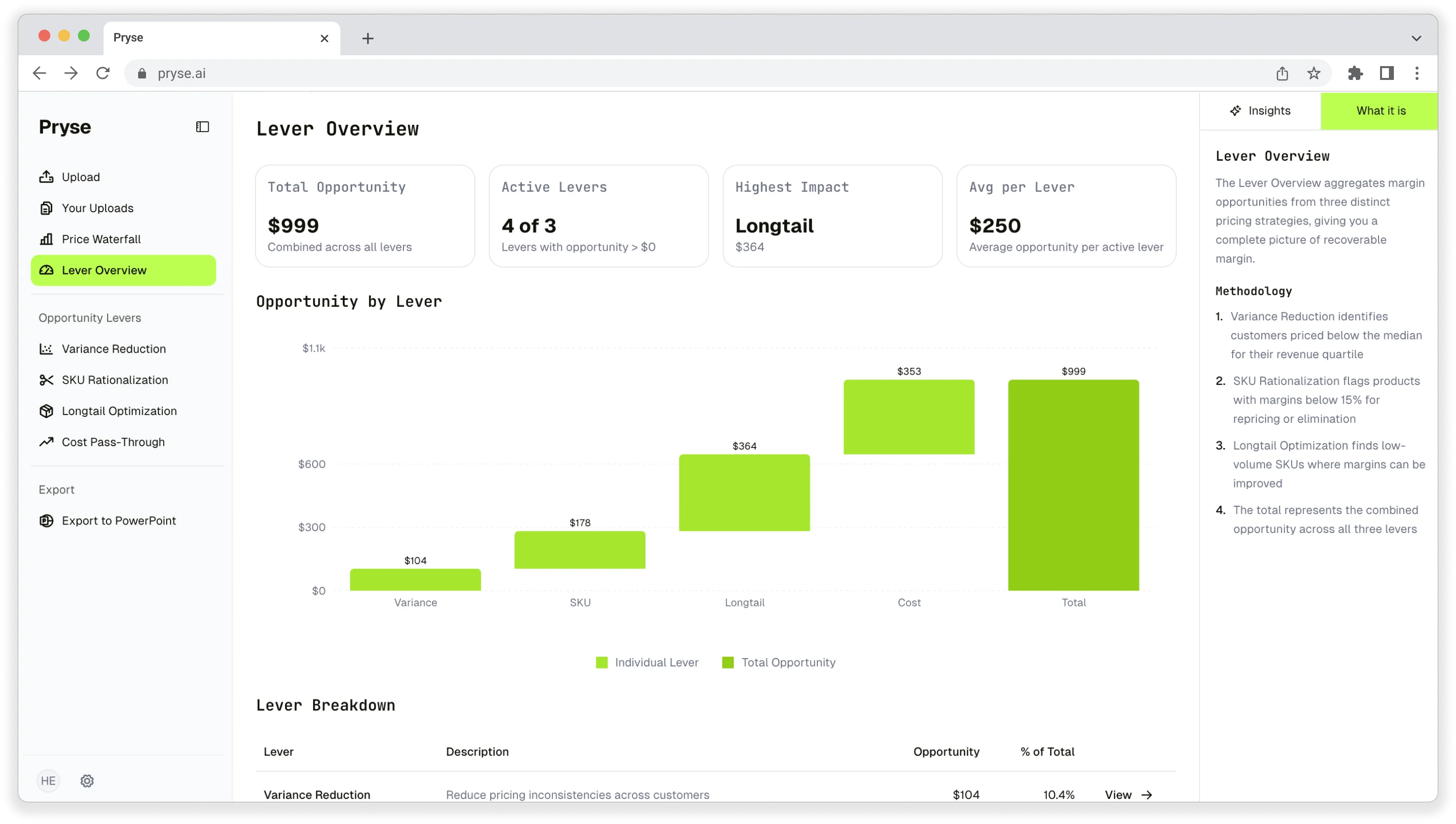
Pryse runs that diagnostic in 24 hours from a CSV upload. Upload your transaction data, see your price waterfall, identify where you're leaving value on the table, and find the margin opportunities hiding in your specialty products. No 6-month implementation. No enterprise pricing.
The companies that take pricing seriously outperform. BCG research found that companies with mature pricing capabilities achieve 3-8% higher EBITDA margins than their peers. The gap isn't about having better products. It's about capturing the value they're already delivering instead of giving it away through undifferentiated cost-plus pricing.
Further reading
For more on value-based pricing and related topics:
- Value-Based Pricing Examples - Case studies from distribution and manufacturing
- Value-Based Pricing Formula - Three calculation methods with worked examples
- Types of Value-Based Pricing - Deep dive on each pricing model
- Value-Based vs Cost-Based Pricing - When to use each approach
- Value-Based Pricing in B2B - B2B-specific implementation
- Pricing Strategy Guide - The complete pricing framework
- Price Waterfall Analysis - Measuring what you actually collect
Last updated: February 1, 2026
Related Articles
Frequently Asked Questions
Want to analyze your entire product catalog?
Pryse automatically identifies margin leakage across thousands of SKUs. Upload your data and find hidden profit in 24 hours.
One-time $1,499 diagnostic. No subscription required.