 Pryse
PryseCost-Plus Pricing: The Complete Guide for Distributors and Manufacturers
How to calculate cost-plus pricing correctly, when it works, when it fails, and how to layer value-based adjustments on top. Includes formulas, examples, and implementation steps.
Cost-plus pricing is a pricing method that calculates selling price by adding a fixed percentage markup to the total cost of producing or acquiring a product. It's the most widely used pricing strategy in distribution and manufacturing, with roughly 75-80% of mid-market companies using some form of cost-based pricing as their primary method.
Selling Price = Total Cost x (1 + Markup %)A product that costs $80 with a 25% markup sells for $100. The math is straightforward. That simplicity is why cost-plus dominates: when you're managing 20,000 SKUs, you need a pricing approach that scales without requiring individual analysis on every item.
But simplicity has a price. After six years of pricing work at McKinsey and Deloitte, I found the same pattern at nearly every distributor and manufacturer: companies default to cost-plus because it's easy, then gradually realize their margins are thinner than they thought. The problem isn't the formula. It's applying it uniformly across every product and customer without considering what each transaction is actually worth.
This guide covers how to calculate cost-plus pricing correctly, when it works, where it fails, and how to evolve beyond flat markups toward a hybrid approach that captures the margin cost-plus leaves behind. For broader context on how cost-plus fits within overall pricing approaches, see our pricing strategy guide.
What is cost-plus pricing
Cost-plus pricing (also called markup pricing or cost-based pricing) sets selling prices by starting with the total cost of a product and adding a predetermined markup percentage to reach the final price.
The formula has two variations depending on whether you're targeting a markup or a margin:
Markup-based formula (standard cost-plus):
Selling Price = Total Cost x (1 + Markup %)Margin-based formula:
Selling Price = Total Cost / (1 - Margin %)These are not the same thing. A 30% markup on a $100 item produces a $130 selling price. A 30% margin on that same item produces a $142.86 selling price. That $12.86 gap, multiplied across thousands of transactions, is real money. For the complete breakdown of this distinction, see our cost-plus pricing formula guide.
Cost-plus pricing answers one question: what's the minimum price I need to charge to cover my costs and make my target profit per unit? It does not answer what the customer is willing to pay, what competitors are charging, or whether the product is worth more or less to different buyers. Those are different questions that cost-plus ignores by design.
For worked examples across distribution and manufacturing, see our cost-plus pricing examples.
The cost-plus pricing formula
Basic cost-plus calculation
The simplest version uses direct cost only:
Direct Cost = Purchase Price (distributor) or Materials + Labor (manufacturer)
Selling Price = Direct Cost x (1 + Markup %)
Distributor example: You buy an industrial valve for $65. Your standard markup is 30%.
Selling Price = $65 x (1 + 0.30)
Selling Price = $65 x 1.30
Selling Price = $84.50
Gross Profit = $19.50
Gross Margin = 23.1%
Note that a 30% markup produces a 23.1% margin, not a 30% margin.
Cost-plus with overhead allocation
For manufacturers and distributors with significant handling costs, the basic formula understates true cost. The full-cost version adds allocated overhead:
Fully Loaded Cost = Direct Costs + Allocated Overhead per Unit
Selling Price = Fully Loaded Cost x (1 + Markup %)
Manufacturer example: A mid-size manufacturer produces custom brackets. Direct materials cost $18. Direct labor is 0.8 hours at $32/hour = $25.60. Factory overhead runs $600,000 annually across 50,000 direct labor hours.
Overhead Rate = $600,000 / 50,000 hours = $12.00 per direct labor hour
Allocated Overhead = $12.00 x 0.8 hours = $9.60
Fully Loaded Cost = $18.00 + $25.60 + $9.60 = $53.20
Selling Price (at 35% markup) = $53.20 x 1.35 = $71.82
Without overhead allocation, you'd price off $43.60 in direct costs and your 35% markup would give you $58.86. That's $12.96 below the fully-loaded price. At 1,000 units per month, that's $155,520 in annual margin you'd never see.
For the complete walkthrough of all six cost-based pricing formulas, see our cost-based pricing formula guide.
Markup vs. margin: the conversion
This confusion costs real money. Here's the reference table:
| Markup % | Margin % | Multiplier |
|---|---|---|
| 15% | 13.0% | 1.15x |
| 20% | 16.7% | 1.20x |
| 25% | 20.0% | 1.25x |
| 30% | 23.1% | 1.30x |
| 35% | 25.9% | 1.35x |
| 40% | 28.6% | 1.40x |
| 50% | 33.3% | 1.50x |
| 75% | 42.9% | 1.75x |
| 100% | 50.0% | 2.00x |
The conversion formulas:
Margin = Markup / (1 + Markup)
Markup = Margin / (1 - Margin)
A distributor targeting "25% margins" who uses 25% markup in their pricing matrix is actually getting 20% margins. Across a $50M book of business, that 5-point gap is $2.5M in gross profit they think they're earning but aren't.
For a quick conversion tool, see our cost-plus pricing calculator. For more detail on the margin formula, see cost-plus margin formula.
Types of cost-based pricing methods
Cost-plus is the most common cost-based method, but it's not the only one. Here are six approaches, all starting from cost:
1. Standard cost-plus pricing
Adds a fixed markup to unit cost. This is what most people mean when they say "cost-plus pricing."
Selling Price = Unit Cost x (1 + Markup %)Best for: Day-to-day catalog pricing across large SKU counts.
2. Full absorption cost pricing
Allocates all manufacturing costs (including fixed overhead) to each unit before adding markup. Required under GAAP for financial reporting.
Full Cost = Direct Materials + Direct Labor + Variable Overhead + (Fixed Overhead / Units)
Selling Price = Full Cost x (1 + Markup %)
Best for: Manufacturers setting long-term product prices.
3. Target-return pricing
Works backward from a desired ROI to determine price.
Price = Unit Cost + (Desired Return x Invested Capital) / Expected Unit SalesBest for: Capital-intensive manufacturing where equipment investments need defined returns.
4. Break-even pricing
Determines the minimum price to cover all costs at a given volume.
Break-Even Price = Variable Cost + (Fixed Costs / Projected Units)Best for: Evaluating new product lines, setting minimum order thresholds.
5. Marginal cost pricing
Prices based only on variable costs, ignoring fixed costs.
Minimum Price = Variable Cost per UnitBest for: Fill-in orders when you have excess capacity. Not sustainable as a primary strategy.
6. Variable cost-plus pricing
Adds a contribution margin to variable costs only.
Selling Price = Variable Cost + Contribution per UnitBest for: Short-term pricing decisions where fixed costs are sunk.
For worked examples of each formula, see our cost-based pricing example guide.
Advantages of cost-plus pricing
Cost-plus dominates distribution and manufacturing for real reasons. Here are the five advantages that make it practical:
1. Simplicity at scale
When you're managing 15,000 to 100,000 SKUs, pricing complexity is the enemy. Cost-plus reduces pricing to two inputs: what did this item cost, and what's my target markup? No customer segmentation. No competitive intelligence subscriptions. No willingness-to-pay surveys.
A pricing analyst with access to purchase costs and a markup table can reprice an entire catalog in a day. For companies where pricing is 20% of someone's job (not their whole job), that simplicity matters.
2. Guaranteed cost recovery
Cost-plus makes it structurally difficult to sell below cost, assuming your cost inputs are accurate. Every unit carries a built-in margin.
According to SPARXiQ's analysis of distributor transaction data, the average distributor loses money on 40% of invoice line items when actual cost-to-serve is factored in. Cost-plus doesn't eliminate those problems, but it gives you a clear floor: this is what we need to cover costs and make our margin.
3. Easy price increase justification
When supplier costs rise 8%, you can show the customer the math: our costs went up, so our prices go up. The markup stays the same. It's transparent, logical, and most B2B buyers accept it.
Simon-Kucher's Global Pricing Study 2025 found that 80% of B2B companies passed cost increases to customers in 2024, and over half used index-based mechanisms that automatically adjusted prices based on cost changes. Cost-plus makes that pass-through natural.
4. Organizational consistency
With cost-plus, every sales rep, every branch, and every region applies the same logic. A customer in Chicago and a customer in Atlanta get the same starting price for the same product.
That consistency reduces the "special deal" problem. When pricing is subjective, reps negotiate different prices for similar customers, and margin variance explodes. Cost-plus creates a consistent starting point that makes variance visible.
5. Scalability
A company with 500 SKUs can price each one individually. A company with 50,000 SKUs cannot. Cost-plus scales linearly: add a new product, assign it to a cost bracket, apply the markup. Done.
For a deeper analysis of when these advantages matter most, see our cost-plus pricing advantages and disadvantages breakdown.
Disadvantages of cost-plus pricing
Every advantage of cost-plus comes with a corresponding limitation. Here are the six drawbacks that erode margin over time:
1. It ignores customer willingness to pay
This is the fundamental problem. Your costs have nothing to do with what the customer will pay.
A 30% markup on a $5 commodity fastener gives you a $6.50 selling price. Your competitor sells it for $6.25. You lose the sale or match the price and erode your margin.
That same 30% on a $200 specialty valve gives you a $260 price. But the valve prevents $2,000 in production downtime if it fails. The customer would happily pay $350. You're leaving $90 on the table because your pricing formula doesn't know what the product is worth to the buyer.
2. It treats all products identically
SPARXiQ CEO David Bauders calls this "peanut butter pricing": spreading the same markup across everything. It's the most common margin destroyer in mid-market distribution.
A blanket 28% markup means you're overcharging on the 20% of products customers actively price-shop, and undercharging on the 60-80% they don't. The result: you lose competitive bids on visible items and leave margin on the table everywhere else.
3. It creates no competitive awareness
Cost-plus is entirely inward-looking. It knows your costs. It knows nothing about the market.
If a new competitor enters your territory and prices 15% below you on key products, cost-plus won't tell you. If a competitor exits and you suddenly have pricing power, cost-plus won't tell you that either.
4. It reduces the incentive to cut costs
If your selling price is a direct function of your cost, then reducing costs also reduces revenue. A procurement team that negotiates a 10% reduction in supplier costs just lowered your selling prices by 10%.
In a pure cost-plus model, cost efficiency improvements flow directly to the customer rather than to your bottom line.
5. It ignores cost-to-serve
Two customers buying the same product at the same markup look identical in the formula. But one orders 50 units on a scheduled PO with net-30 terms. The other orders 3 units at a time, demands same-day delivery, calls twice per order, and pays at net-60. Your real margin on the second customer is 8-12 points lower, and cost-plus can't see it.
6. It breaks during rapid cost changes
Cost-plus works when costs are stable. When input costs swing 15-20% in a quarter, as happened during 2022-2023, the model strains.
Your cost data reflects what you paid last month. Your selling prices reflect that cost plus markup. But your next purchase order reflects today's cost, which may be significantly higher. You're continuously selling at yesterday's cost-plus while buying at today's prices.
For a complete analysis of these drawbacks with examples, see our cost-plus pricing disadvantages guide.
When cost-plus pricing works best
Cost-plus isn't always wrong. Here are the situations where it earns its place:
Commodity products with transparent pricing
When every distributor sells the same product from the same manufacturer, your pricing power is limited. Cost-plus at least ensures you're covering costs and making your margin. The customer is buying availability and service, not unique product value.
Government and defense contracts
The Federal Acquisition Regulation (FAR Part 16) explicitly defines cost-plus contract structures. Many government buyers require cost transparency and set allowable markup ranges. In these contexts, cost-plus isn't a choice. It's a requirement.
New product launches
When you're adding a product line you haven't sold before and have no competitive data, cost-plus gives you a starting point that covers your costs. Refine from there once you have market feedback.
Large catalogs with limited pricing resources
If you're a $40M distributor with 50,000 SKUs and pricing is one of many responsibilities for a finance manager, cost-plus may be the only realistic option today. Sophisticated pricing requires resources. The alternative isn't value-based pricing. It's bad value-based pricing.
Custom and engineered-to-order products
When every job has unique costs (materials, labor hours, tooling), cost-plus is the natural framework. The markup covers your overhead and profit on a per-job basis.
For strategic guidance on when and how to use cost-plus, see our cost-plus pricing strategy guide.
When to avoid cost-plus pricing
Cost-plus should not be your primary approach in these situations:
Specialty and technical products
If you sell something the customer can't easily get elsewhere, cost-plus almost certainly underprices it. The customer's alternative isn't your cost plus a markup. Their alternative is downtime, a project delay, or an expensive workaround.
Tail SKUs (bottom 50% of your catalog)
SPARXiQ's research shows that 60-80% of a typical distributor's SKUs are not price-sensitive. Nobody comparison-shops a $6 specialty fitting. These items can support significantly higher markups than your A-items, but cost-plus treats them identically.
Large accounts with negotiating power
Cost-plus becomes a ceiling, not a floor, when large customers demand cost transparency. If they know your cost and your markup, they'll negotiate the markup down. You end up defending a number instead of defending the value you deliver.
Differentiated services and solutions
If you provide value beyond the physical product (technical expertise, kitting, inventory management, same-day availability), cost-plus on the product ignores all of that. You're giving away the service value for free.
Price-sensitive competitive markets
When competitors are willing to operate at lower margins, your cost-plus price may be above what the market will bear on high-visibility items. You lose competitive bids while maintaining "target margins" that don't exist in reality.
How to improve cost-plus with segmentation
The practical path forward isn't abandoning cost-plus. It's layering intelligence on top of it. Here's how:
Phase 1: Segment your catalog
Split products into tiers based on competitive visibility and differentiation:
- A items (top 20% of revenue): Competitively shopped, price-sensitive. Keep cost-plus tight here, validated against market pricing.
- B items (middle 30%): Moderate visibility. Opportunity for 3-5 points of margin improvement over flat cost-plus.
- C items (bottom 50%): Long-tail items that nobody comparison-shops. Increase markups 10-20 points above your baseline.
This single change is worth 100-200 basis points of margin improvement for most distributors. On $50M in revenue, that's $500K to $1M.
Phase 2: Add customer segmentation
Not every customer deserves the same markup:
| A Products | B Products | C Products | |
|---|---|---|---|
| Strategic customers | Cost-plus (tight) | Cost-plus + 3-5% | Cost-plus + 8-12% |
| Core customers | Cost-plus + 2-3% | Cost-plus + 5-8% | Cost-plus + 10-15% |
| Transactional customers | Cost-plus + 4-6% | Cost-plus + 8-12% | Cost-plus + 15-25% |
This is still cost-plus at its core. You're just applying different markups to different segments instead of one number across the board.
Phase 3: Implement pricing floors
Set minimum acceptable margins by product category. When a sales rep requests a discount, the system checks against the floor. Discounts below the floor require management approval.
The floor should be your true cost-plus price: fully loaded cost including overhead and cost-to-serve, plus a minimum acceptable margin. Every transaction should clear this floor.
The hybrid approach: cost-plus floor with value-based ceiling
The best-performing distributors and manufacturers don't choose between cost-plus and value-based pricing. They use both.
Cost-plus establishes the floor: The minimum price you'll accept on any transaction. Below this, you lose money or don't cover your required return. This price is based on your fully loaded costs plus minimum acceptable margin.
Value-based pricing establishes the ceiling: The maximum the customer would pay based on the value they receive. A replacement part that prevents $10,000 in downtime can command a premium regardless of its cost.
Market and competitive data provide context: Where competitors are priced, how transparent pricing is in the market, and what buyers expect to pay for similar products.
The actual price lands somewhere between floor and ceiling based on:
- Competitive intensity for this product
- Customer segment and relationship value
- Purchase urgency and alternatives available
- Volume and contract terms
Price Floor = Fully Loaded Cost x (1 + Minimum Markup)
Price Ceiling = Customer's Willingness to Pay or Value Delivered
Actual Price = Floor + (Ceiling - Floor) x Pricing Power Factor
This framework lets you maintain the simplicity and cost protection of cost-plus while capturing the margin upside that pure cost-plus leaves behind.
For more on value-based approaches, see our posts on value-based pricing examples and value-based vs cost-based pricing.
Implementation for distributors
If you're a distributor running cost-plus today, here's the practical implementation path:
Step 1: Audit your current state
Pull 12 months of transaction data. For each product-customer combination, calculate:
- List price
- Invoice price (after on-invoice discounts)
- Pocket price (after all deductions)
- Actual margin vs. intended markup
Most companies find a 5-15 percentage point gap between intended and realized margin. That gap is where your margin opportunity lives.
Step 2: Categorize your catalog
Assign every SKU to one of three categories based on competitive visibility:
- High visibility: Products customers actively price-shop
- Moderate visibility: Products with some price awareness
- Low visibility: Products nobody comparison-shops
Your ERP probably can't do this automatically. Start with your top 500 SKUs by revenue and expand from there.
Step 3: Set differentiated markups
Create a markup matrix with different percentages by category:
| Product Category | High Visibility | Moderate | Low Visibility |
|---|---|---|---|
| Commodity | 18-22% | 22-28% | 28-35% |
| Standard | 22-28% | 28-35% | 35-45% |
| Specialty | 28-35% | 35-45% | 45-60%+ |
Load these into your ERP pricing rules.
Step 4: Build guardrails
Set floor prices below which no sale happens without approval. Configure your ERP to flag transactions below floor. Establish approval authority levels: first-line manager can approve 5% below floor, director can approve 10%, VP approval required for anything beyond.
Step 5: Track and adjust
Review realized margins monthly by product category and customer segment. Identify where you're consistently above or below target. Adjust markups quarterly based on competitive feedback and margin performance.
Implementation for manufacturers
Manufacturers face additional complexity in cost-plus pricing due to overhead allocation and volume variability.
Step 1: Get your cost accounting right
Ensure your overhead allocation method reflects how products actually consume resources. Common allocation bases:
- Direct labor hours (labor-intensive operations)
- Machine hours (automated production)
- Material cost (assembly operations)
Review your overhead rate quarterly. If utilization changes significantly, your per-unit costs change with it.
Step 2: Build pricing tiers by product type
| Product Type | Typical Markup | Notes |
|---|---|---|
| Standard catalog | 25-40% | Stable costs, predictable volume |
| Engineered-to-order | 40-60% | Job-specific costing |
| Specialty/technical | 50-80%+ | Value-based premium on top of cost |
| Private label | 20-35% | Volume-based, relationship pricing |
Step 3: Build cost escalation into contracts
For any pricing commitment beyond 90 days, include cost adjustment clauses tied to published indices (steel, copper, labor rates). Simon-Kucher's research shows companies realize only about 28% of announced price increases on average. Automatic escalation clauses improve that realization rate.
Step 4: Monitor capacity utilization
Remember that absorption cost pricing is volume-sensitive. At 80% capacity, your overhead allocation is $X per unit. At 60% capacity, it's $1.33X per unit. If you're pricing off full-capacity costs but running at partial capacity, your margins are thinner than you think.
Measuring success
After implementing segmented cost-plus pricing, track these metrics monthly:
Gross margin by product tier: Are you hitting target margins in each category? If high-visibility items are below target, your markups may still be too aggressive. If low-visibility items are at target, you're probably leaving money on the table.
Discount frequency and depth: How often are sales reps overriding matrix prices? SPARXiQ's research shows that pricing overrides account for 50% or more of transactions at many distributors, and those overrides sacrifice roughly 10 margin points versus matrix values.
Win rate on competitive bids: If your A-item win rate is dropping, your cost-plus markups on those items may be above market.
Average margin by customer tier: Strategic accounts should have tighter margins but higher total profit dollars. Transactional customers should have higher margins. If it's the reverse, your customer segmentation isn't working.
Pocket margin vs. invoice margin: Track the gap between what you invoice and what you collect. That gap represents the off-invoice deductions (freight, payment terms, returns) that erode your cost-plus margins.
For visibility into your price waterfall and margin realization, Pryse builds that analysis in 24 hours from a CSV upload. See where your cost-plus model is working and where it's costing you.
What to do next
If you're running cost-plus pricing today, here's where to start:
-
Calculate your actual pocket margin. Not gross margin from the P&L. Actual pocket margin after all deductions on your top 50 products and top 20 customers. Compare it to your intended markup.
-
Identify the gap. The difference between intended markup and realized margin is your margin opportunity. For most companies, it's 5-15 percentage points.
-
Segment your catalog. Split products into high, moderate, and low competitive visibility. Start with your top 500 SKUs by revenue.
-
Set differentiated markups. Increase markups on low-visibility products by 10-20 points. That's where the easy margin lives.
-
Build a price floor. Determine the absolute minimum margin for each product category. Enforce it.
-
Track results. Measure margin by product tier and customer segment monthly. Adjust quarterly.
McKinsey's research found that a 1% improvement in price realization generates an 8% increase in operating profits for the average company. For a $50M distributor at 20% gross margin, recovering just 1% in pricing adds $500K to the bottom line.
Cost-plus pricing isn't wrong. It's incomplete. Use it as the foundation, layer segmentation on top, and capture the margin you're currently giving away.
Last updated: February 1, 2026
Related Articles
Frequently Asked Questions
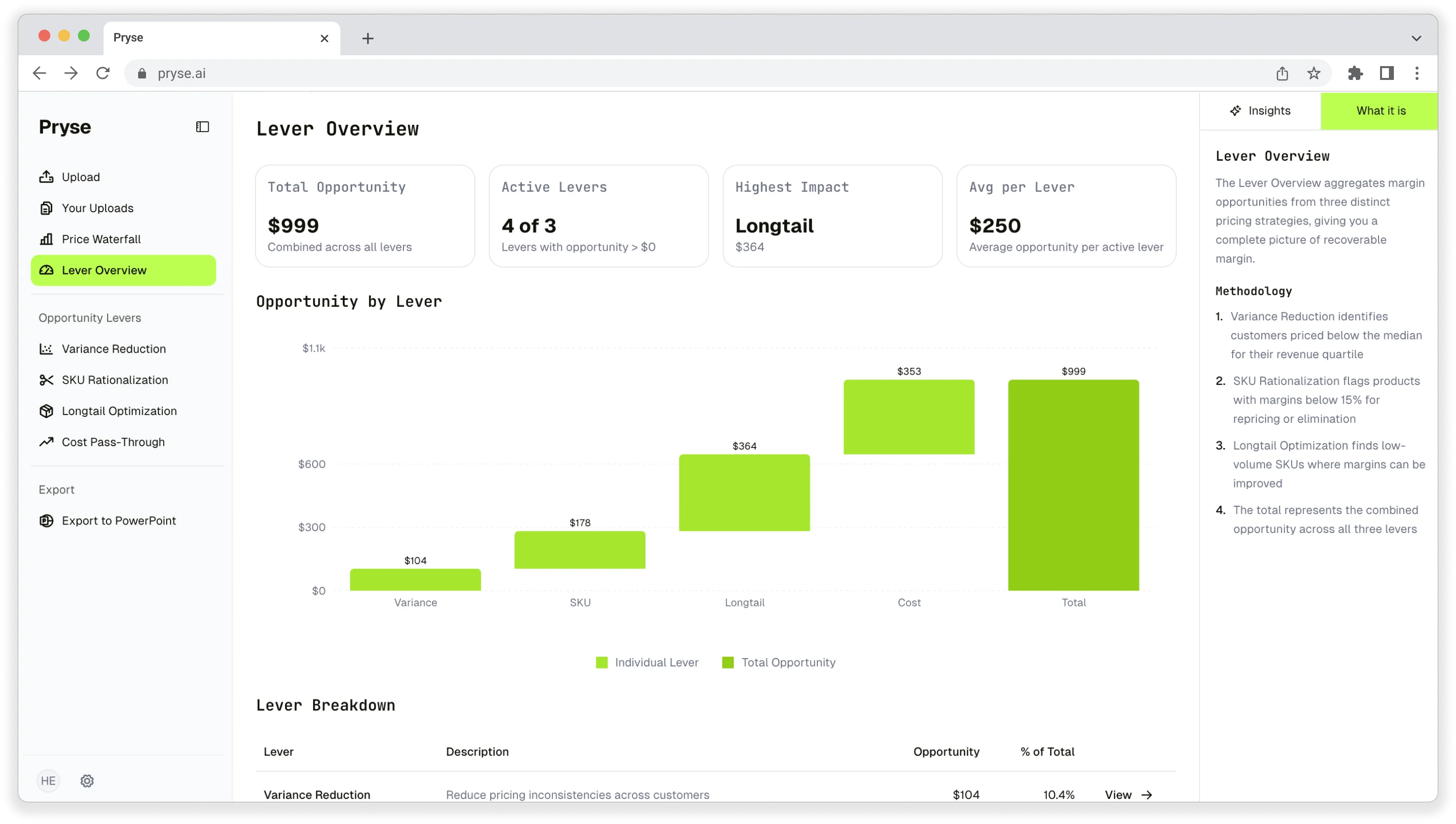
Want to analyze your entire product catalog?
Pryse automatically identifies margin leakage across thousands of SKUs. Upload your data and find hidden profit in 24 hours.
One-time $1,499 diagnostic. No subscription required.