 Pryse
PryseDistribution Pricing: The Complete Guide to Pricing Strategy for Wholesale Distributors
How wholesale distributors set, manage, and optimize pricing. Covers pricing models, margin structures, industry-specific strategies, and where mid-market distributors leak margin.
Distribution pricing is how wholesale distributors set sell prices across thousands of SKUs, hundreds of customers, and multiple pricing tiers. It's the single biggest lever for profitability in distribution -- and the one most mid-market distributors manage with spreadsheets and gut feel.
The math is simple. McKinsey's 2019 article "Pricing: Distributors' most powerful value-creation lever" analyzed 130 global and publicly traded distributors and found that a 1% price increase yields a 22% increase in EBITDA. For a $50M distributor running 4% EBITDA, that 1% pricing improvement is worth $440K in annual profit. No cost-cutting initiative comes close to that return.
Yet most distributors don't manage pricing systematically. SPARXiQ's distribution benchmarking data shows average distributors run 4% EBITDA while elite performers hit 8-12%. The gap isn't product mix or market conditions. It's pricing discipline -- the daily decisions about what to charge which customer for which product.
This guide covers how distribution pricing works, what models distributors use, how margins vary by industry, and where mid-market distributors consistently leave money on the table.
What Is Distribution Pricing?
Distribution pricing is the practice of setting sell prices for products that move from manufacturers through wholesale distributors to dealers, contractors, or end users.
Unlike retail, where one price fits all customers, distribution pricing is inherently customer-specific. A contractor buying $500K per year in electrical supplies gets different pricing than one buying $50K. A hospital system buying surgical supplies on a three-year GPO contract gets different terms than a one-time buyer.
This creates complexity that retail never faces. A typical mid-market distributor manages:
- 10,000-100,000+ SKUs across dozens of suppliers
- Hundreds of customer accounts with different pricing agreements
- Multiple pricing tiers based on volume, relationship, and customer type
- Overlapping rebate programs from manufacturers and buying groups
- Fluctuating costs as suppliers change prices throughout the year
The result is a pricing system that's part structured (matrices, multipliers, contracts) and part improvised (rep overrides, job quotes, competitive responses). The structured part drives consistency. The improvised part creates margin leakage.
For a foundational overview of how pricing flows through the distribution channel, see our post on distribution pricing definition.
How Pricing Flows Through the Distribution Channel
Distribution sits between manufacturers and end users. Each layer in the channel takes a margin.
| Channel Level | Typical Margin | Role |
|---|---|---|
| Manufacturer | 25-45% gross | Product creation, R&D, brand |
| Distributor | 20-30% gross | Inventory, logistics, credit, local service |
| Dealer/Contractor | 15-40% gross | Installation, end-customer relationship |
A product with a $100 manufacturer list price might follow this path:
Manufacturer cost: $55 → Sells to distributor at $70 (36% margin)
Distributor cost: $70 → Sells to contractor at $90 (22% margin)
Contractor cost: $90 → Bills end user $130 (31% margin)
Each level adds value. The manufacturer creates the product. The distributor stocks it locally, extends credit, and delivers it. The dealer or contractor installs it or provides the end-customer relationship.
The distributor's margin is thinner than both manufacturing and retail because the value-add is logistical, not transformational. Distributors don't change the product. They make it available where and when customers need it, extend credit, and handle the complexity of managing thousands of SKUs that no single contractor wants to source directly from dozens of manufacturers.
Distribution Pricing Models
No distributor uses just one pricing model. Most run a combination, applying different approaches to different product categories, customer segments, and competitive situations.
Cost-Plus Pricing
The simplest approach. Take the cost of goods and add a fixed markup percentage.
Sell Price = Cost x (1 + Markup %)A product costing $80 with a 25% markup sells for $100. That's a 20% margin.
Cost-plus works for commodity products where the main variable is purchase cost. It breaks down when:
- Different customers should pay different prices for the same product
- Products carry different service/support requirements
- Competitive pressure demands pricing below standard markup
Most distributors start with cost-plus and layer more sophisticated models on top.
Multiplier / Discount Sheet Pricing
The standard in electrical, HVAC, and plumbing distribution. Manufacturers publish a list price. Distributors buy at a cost multiplier and sell at a sell multiplier.
Cost = List Price x Cost Multiplier
Sell Price = List Price x Sell Multiplier
Gross Margin = (Sell Multiplier - Cost Multiplier) / Sell Multiplier x 100
For example, on a product with a $200 list price:
- Cost multiplier: 0.42 → Distributor pays $84
- Sell multiplier for Tier 1 contractors: 0.65 → Sells for $130
- Sell multiplier for Tier 3 walk-ins: 0.80 → Sells for $160
The distributor earns 35% margin on the Tier 1 sale and 47% on the walk-in sale. Same product, same cost, different pricing based on customer tier.
Multiplier systems are efficient because price updates flow automatically. When the manufacturer changes the list price, every customer's price adjusts through their multiplier. The downside: multiplier-only pricing doesn't account for cost-to-serve differences or competitive dynamics on specific products.
For the mechanics of multiplier math and worked examples, see our distributor margin formula post.
Matrix Pricing
Matrix pricing assigns prices based on the intersection of two dimensions -- typically product category and customer tier.
| Tier 1 (High Volume) | Tier 2 (Medium) | Tier 3 (Low Volume) | |
|---|---|---|---|
| Category A (Commodity) | Cost + 18% | Cost + 22% | Cost + 28% |
| Category B (Standard) | Cost + 22% | Cost + 27% | Cost + 33% |
| Category C (Specialty) | Cost + 30% | Cost + 35% | Cost + 42% |
Matrix pricing adds nuance that flat cost-plus can't. It acknowledges that different products carry different competitive intensity and that different customers warrant different pricing levels.
The challenge is maintenance. A matrix with 10 product categories and 5 customer tiers has 50 cells. Each cell needs periodic review to stay competitive and profitable. Many distributors build a matrix once and never update it, defeating the purpose.
Customer-Specific Pricing
Negotiated pricing for individual accounts. The sales rep or pricing manager sets a price for a specific customer on specific products, typically based on a volume commitment, competitive situation, or strategic importance.
Customer-specific pricing is where most margin leakage happens. Prices get negotiated in year one and never revisited. The customer's volume drops but their pricing doesn't change. Cost increases don't get passed through. Over time, the customer's margin erodes from 22% to 14% and nobody notices because nobody's reviewing it.
NAW data shows pricing overrides affect more than 50% of transactions at many distributors. That's not inherently bad -- customer-specific pricing is a competitive necessity. The problem is when it operates without guardrails: no price floors, no approval workflows, no expiration dates on negotiated deals.
Contract Pricing
Formal agreements with defined terms, volumes, and pricing for a set period. Common in institutional (hospitals, schools, government) and large commercial accounts.
Contract pricing provides revenue predictability but creates risk:
- Fixed prices on rising costs -- if the contract lacks escalation clauses, a 5% cost increase on a 24-month contract wipes out your margin
- Volume commitments not enforced -- the contract says $500K annual purchase commitment, the customer does $300K, and nobody triggers the pricing adjustment
- Automatic renewals at old terms -- contracts roll forward with year-one pricing even when costs, competitive conditions, and customer volume have all changed
Smart distributors build cost escalation triggers, annual price reviews, and volume commitment enforcement into every contract. Most mid-market distributors don't.
Distributor Margin Structures
Distribution margins compress as you move from gross to net. Understanding where the compression happens is the first step to fixing it.
The Three Margin Layers
Gross margin -- what's left after subtracting cost of goods from revenue. This is the distributor's primary pricing metric.
Gross Margin = (Revenue - COGS) / Revenue x 100Operating margin -- gross margin minus operating expenses: warehousing, sales compensation, delivery, G&A.
Operating Margin = (Revenue - COGS - Operating Expenses) / Revenue x 100Net margin -- the bottom line after interest, taxes, and all other costs.
Net Margin = Net Profit / Revenue x 100The typical compression:
| Layer | Average Distributor | Elite Distributor |
|---|---|---|
| Gross margin | 22-28% | 28-35% |
| Operating margin | 3-5% | 8-12% |
| Net margin | 2-4% | 5-8% |
A 25% gross margin becomes 4% operating margin after covering 21% in operating costs. That's the reality of distribution economics. For a detailed breakdown of this compression with worked examples, see our post on distributor profit margin.
Where Operating Costs Go
| Expense Category | Typical % of Revenue |
|---|---|
| Warehouse and facilities | 3-5% |
| Transportation/delivery | 2-4% |
| Sales compensation | 4-6% |
| Administrative/G&A | 3-5% |
| Inventory carrying cost | 2-3% |
| Interest and financing | 1-2% |
These costs are relatively fixed. A distributor running 3% of revenue on warehousing can't easily cut that to 1%. That's why pricing -- the revenue side -- is the highest-leverage profit improvement tool. Cutting costs saves pennies. Better pricing saves dollars.
Margin vs. Markup
Distributors regularly confuse these two numbers, and the confusion costs real money.
| Markup | Equivalent Margin |
|---|---|
| 20% | 16.7% |
| 25% | 20.0% |
| 33% | 25.0% |
| 50% | 33.3% |
When a supplier says "distributors typically mark up 25%," they mean a 20% margin. When your finance team says "we need 25% margin," they mean a 33% markup. This miscommunication can swing pricing by 8-13 percentage points.
Markup % = (Sell Price - Cost) / Cost x 100
Margin % = (Sell Price - Cost) / Sell Price x 100
To convert: Margin = Markup / (100 + Markup) x 100
For step-by-step calculation guides with conversion tables, see our distributor margin calculator and distributor margin formula posts.
Distribution Pricing by Industry
Pricing mechanics and margin levels vary across distribution verticals. The products, customers, and competitive dynamics are different, and pricing strategy needs to match.
Electrical Distribution
Electrical distributors sell wire, conduit, lighting, switchgear, controls, and related products to electrical contractors and industrial facilities.
Pricing model: Multiplier-based off manufacturer list prices. Manufacturers like Eaton, ABB, and Schneider publish list prices and distribute through authorized channels at defined cost multipliers.
Typical margins:
| Metric | Range |
|---|---|
| Gross margin | 20-25% |
| Operating margin | 3-6% |
| Net margin | 2-4% |
Wesco International, the largest electrical distributor, reported 21.6% gross margin for full-year 2024. Smaller independents with better product mix can reach 25-28%.
Pricing challenges: Product-level margins vary wildly. Commodity wire runs 12-18% gross margin. Controls and automation reach 28-35%. A distributor's blended margin depends heavily on product mix -- and sales teams tend to default to selling easy-to-quote commodity products at thin margins rather than pushing higher-margin specialty items.
For a deep dive into electrical pricing mechanics and margin benchmarks by product category, see our guide to electrical distribution pricing.
HVAC Distribution
HVAC distributors supply heating, cooling, and refrigeration equipment and parts to HVAC contractors.
Pricing model: Dual-track. Equipment pricing is cost-plus with thin margins because prices are transparent and contractors comparison-shop. Parts and supplies use matrix pricing with much wider margins because contractors value availability over price on smaller items.
Typical margins:
| Metric | Range |
|---|---|
| Gross margin | 25-35% |
| Operating margin | 5-8% |
| Net margin | 3-6% |
Watsco, the largest HVAC distributor in North America, reported a 28% gross margin in 2025. The industry runs higher than electrical because the equipment/parts mix blends thin equipment margins with fat parts margins.
Pricing challenges: Seasonality drives aggressive behavior. Summer cooling demand pushes 40-50% of annual equipment volume into a few months. Pre-season manufacturer buy-in programs offer 3-8% discounts but tie up working capital. The 2025 A2L refrigerant transition pushed equipment prices up 8-10%, creating a dual-inventory pricing challenge.
For HVAC-specific pricing strategies and margin benchmarks, see our guide to HVAC distribution pricing.
Building Materials Distribution
Building materials distributors supply lumber, roofing, drywall, insulation, and related products to builders and contractors.
Pricing model: Commodity-influenced pricing for lumber and related products, with matrix or cost-plus for manufactured building products. Pricing changes frequently as commodity costs fluctuate.
Typical margins:
| Metric | Range |
|---|---|
| Gross margin | 23-28% |
| Operating margin | 4-7% |
| Net margin | 2-5% |
Pricing challenges: Lumber price volatility is the dominant factor. Prices swung from $350 to over $1,500 per thousand board feet between 2020-2022. Distributors who don't reprice within days of cost changes lose 3-8 margin points on in-stock inventory during rising markets. Delivery costs also run higher than most verticals because products are heavy, bulky, and delivered to job sites.
For building materials pricing tactics and delivery economics, see our guide to building materials pricing.
Food Distribution
Food distribution operates on the thinnest margins in wholesale distribution.
Typical margins:
| Metric | Range |
|---|---|
| Gross margin | 15-20% |
| Operating margin | 2-4% |
| Net margin | 1-3% |
Sysco runs about 18.9% gross margin. US Foods about 17.4%. Performance Food Group about 11.7%. Mid-market broadline food distributors fall in the 15-22% range.
Margins are compressed by cold chain infrastructure costs, spoilage risk, and commodity-level price competition. A single bad week of spoilage on perishable inventory can wipe out a month's profit.
For food distribution margin benchmarks and improvement strategies, see our post on food distributor margins.
Industrial MRO Distribution
Industrial MRO (maintenance, repair, operations) distributors carry the broadest product lines and highest margin potential.
Typical margins:
| Metric | Range |
|---|---|
| Gross margin | 28-35% |
| Operating margin | 5-10% |
| Net margin | 3-7% |
Industrial distribution supports wider margins because product variety is enormous (50,000+ SKUs), customer switching costs are high, and availability matters more than price for many items. A plant running a production line will pay a premium for same-day delivery of a critical part.
The challenge is SKU proliferation and pricing complexity. With 50,000+ products and hundreds of customers, maintaining consistent and profitable pricing requires either excellent systems or a large pricing team. Most mid-market industrial distributors have neither.
The Gap Between Average and Elite Distributors
SPARXiQ's distribution benchmarking data shows a consistent pattern: elite distributors earn 2-3x the profit of average distributors on similar revenue. The difference comes down to four pricing disciplines.
1. Pricing Consistency
Average distributors allow 15-25% pricing variance across customers for the same product with no documented justification. Sales reps give ad hoc discounts to close deals. Legacy prices from 2019 are still active. Different branches charge different rates for the same product.
Elite distributors maintain pricing guardrails. Customer-specific prices have defined justification. Overrides require approval. Every negotiated price has an expiration date and a review trigger.
The impact: SPARXiQ data suggests most distributors leave at least 200 basis points of gross margin on the table through pricing inconsistency. On $50M in revenue, that's $1M.
2. Cost-to-Serve Awareness
Not all customers cost the same to serve. A customer ordering 200 times per year in small quantities with next-day delivery expectations and 60-day payment terms costs 8-12% more to serve than one ordering monthly in full pallets and paying in 30 days.
Average distributors treat all customers identically. Elite distributors know their cost-to-serve by customer segment and price accordingly. That doesn't always mean charging more -- sometimes it means adjusting service levels, setting delivery minimums, or restructuring the relationship to reduce cost.
3. Rebate Optimization
Manufacturer rebates can add 2-5% to effective margin. For some distributors, rebates represent up to 60% of bottom-line profit. That makes rebate capture a pricing function, not just a procurement task.
Programs are complex: volume tiers, growth targets, product-specific rates, special pricing agreements (SPAs), and marketing co-op funds. Average distributors miss tier thresholds by small amounts, fail to claim eligible marketing funds, and don't time purchases to maximize rebate earnings.
Elite distributors manage rebates as a profit center. They track every program, know which suppliers are closest to tier thresholds, and actively push volume to maximize returns.
4. Inventory-Informed Pricing
Inventory carrying costs run 20-30% of inventory value annually when you include capital cost, warehouse space, insurance, obsolescence, and handling. That cost should factor into pricing decisions but rarely does.
A distributor with slow-moving inventory tying up $2M in capital is paying $400K-$600K per year to hold that stock. If those items aren't priced to reflect that carrying cost -- or aren't being actively moved through markdown pricing -- the distributor is subsidizing low-turn products with profits from high-turn ones.
Where Mid-Market Distributors Leak Margin
Based on transaction-level analysis across mid-market distributors, the same pricing leakage patterns appear consistently:
Customer Pricing Inconsistency (1-3% of revenue)
Similar customers paying different prices for the same products. Deals negotiated years ago and never reviewed. Prices that don't reflect current supplier costs. Customer volume declining 40% while their pricing stays at the high-volume tier.
Freight and Delivery Recovery (0.5-2% of revenue)
Absorbing shipping costs on orders that don't warrant free delivery. Fuel surcharges not passed through. Delivery minimums not enforced. For building materials and heavy-product distributors, unrecovered delivery costs can reach 3% of revenue.
Rebate Program Underperformance (0.5-1.5% of revenue)
Missing volume tier thresholds by small amounts. Failing to claim earned co-op or marketing funds. Not timing purchases to maximize rebate earnings. Not tracking SPA (special pricing agreement) credits owed by manufacturers.
Payment Terms Cost (0.3-1% of revenue)
Slow-paying customers not charged for the cost of carrying their receivables. Customers taking early payment discounts on day 30 instead of day 10. Terms of net 60 and net 90 given without price adjustment.
Product Mix Margin Erosion (variable)
Sales teams pushing low-margin products that are easy to sell. High-margin specialty products not actively promoted. No incentive alignment between sales compensation and margin contribution.
For a $50M distributor, these issues commonly add up to $1.5-3M in recoverable margin. That's the difference between 4% EBITDA and 7% EBITDA. Same revenue, same cost structure, different pricing execution.
For the complete framework on detecting and fixing these issues, see our guide to margin leakage.
Building a Distribution Pricing Strategy
If your current pricing approach is "cost-plus with rep overrides," here's how to build something better.
Step 1: Get Visibility
You can't fix what you can't see. Export 12 months of transaction data and analyze margin by:
- Customer (or customer segment)
- Product category
- Sales rep
- Order size
Look for unexplained variance. If two similar customers buying the same products show a 12-point margin difference, you've found a pricing problem.
Step 2: Establish Price Floors
Set minimum acceptable margins by product category. Commodity products might have a 15% floor. Specialty items might have a 25% floor. Configure your ERP or quoting system to flag transactions below the floor.
This single change eliminates the worst pricing outliers immediately. It doesn't optimize pricing -- it just stops the bleeding.
Step 3: Build a Matrix
Create a pricing matrix with product categories on one axis and customer tiers on the other. Define tiers based on annual volume, payment behavior, and cost-to-serve.
The matrix replaces ad hoc negotiation with structured pricing. Reps can still negotiate within the matrix (Tier 2 pricing for a Tier 3 customer who commits to Tier 2 volume), but the matrix provides the starting point and the guardrails.
Step 4: Review Customer-Specific Pricing
Audit every customer-specific price agreement:
- Is the customer meeting their volume commitment?
- Has the price been updated for cost changes?
- Does the margin reflect the customer's actual cost-to-serve?
- When was the last time anyone reviewed this agreement?
Most distributors find that 20-30% of their customer-specific prices are unprofitable or unjustified when measured against current costs and volumes.
Step 5: Manage Freight and Delivery as a Profit Center
Stop absorbing delivery costs blindly. Set minimum order values for free delivery. Charge explicit delivery fees below that threshold. Apply zone-based pricing for longer delivery distances. Track actual delivery cost by customer and fold it into cost-to-serve calculations.
Step 6: Create a Pricing Review Cadence
- Weekly: Review commodity-linked pricing for volatile products
- Monthly: Review margin by product category and flag anomalies
- Quarterly: Review matrix pricing against current costs and competitive conditions
- Annually: Audit all customer-specific pricing agreements
The cadence matters more than the sophistication of the analysis. A simple monthly margin review catches problems that a complex annual audit misses by 11 months.
Distribution Pricing and Technology
Most mid-market distributors ($20M-$200M) manage pricing through a combination of their ERP's built-in pricing module, spreadsheets, and tribal knowledge stored in the heads of experienced sales reps.
Enterprise pricing platforms like PROS, Vendavo, and Zilliant cost $100K-$500K+ per year, require 6-18 months of implementation, and are built for $500M+ companies. That prices out the mid-market entirely.
The result: mid-market distributors are stuck between manual processes that create inconsistency and enterprise tools they can't afford. They know their pricing is leaking margin but don't have a practical way to analyze it systematically.
This is the gap that Pryse was built to fill. Upload your transaction data, get a diagnostic analysis of where your margins are leaking, and quantify the dollar opportunity -- without a $100K software license or an 18-month implementation.
The Bottom Line
Distribution pricing is the highest-leverage profit improvement tool available to mid-market distributors. A 1% improvement in price realization typically drives an 8% increase in operating profit -- more than any cost-cutting or revenue-growth initiative.
The fundamentals:
- Models: Use a combination of cost-plus, matrix, and multiplier pricing, not just one
- Margins: Expect 20-30% gross, 3-8% operating, 2-5% net
- Gap: Elite distributors earn 2-3x the profit of average distributors on similar revenue
- Leakage: Most mid-market distributors leave 2-5% of revenue on the table through pricing inconsistency
- Fix: Start with visibility (analyze your data), then structure (build a matrix), then discipline (create a review cadence)
The difference between average and elite distribution pricing isn't sophisticated algorithms or expensive software. It's the discipline to review pricing regularly, enforce guardrails consistently, and measure margin at the transaction level instead of the P&L level.
For calculating your own margin benchmarks, start with our distributor margin calculator. For understanding where your margins are leaking, see our guide to margin leakage. For industry-specific pricing strategies, see our posts on electrical, HVAC, and building materials distribution pricing.
Last updated: February 22, 2026
Related Articles
Frequently Asked Questions
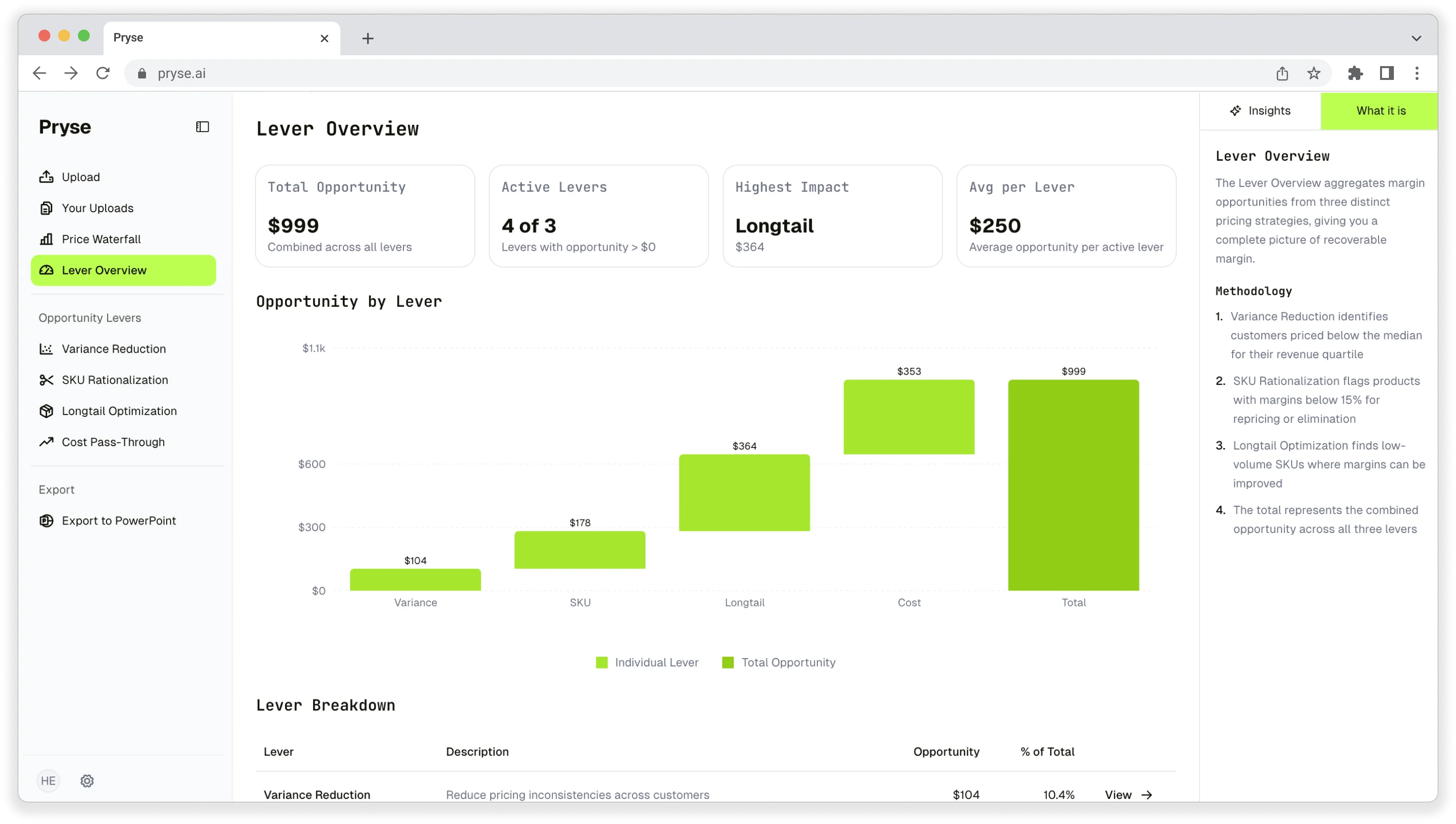
Want to analyze your entire product catalog?
Pryse automatically identifies margin leakage across thousands of SKUs. Upload your data and find hidden profit in 24 hours.
One-time $1,499 diagnostic. No subscription required.