 Pryse
PrysePricing Strategy: The Complete Guide for B2B Companies
How to build a pricing strategy that protects margins and drives growth. Covers 10 pricing models, frameworks, B2B-specific tactics, and common mistakes.
A pricing strategy is a method for determining how much to charge for a product or service. It sits at the intersection of three things: what it costs you, what competitors charge, and what the customer is willing to pay.
For distribution and manufacturing companies, pricing strategy isn't an academic exercise. A 1% improvement in price realization drops directly to the bottom line. On $50 million in revenue at 5% net margin, that 1% improvement increases profit by 40%. McKinsey's research on B2B pricing consistently shows that price is the single largest lever for profit improvement, ahead of volume growth and cost reduction.
I spent six years at McKinsey and Deloitte working with distributors and manufacturers on pricing. The pattern was always the same: companies had a "pricing strategy" that amounted to cost-plus with ad-hoc exceptions. List prices existed but nobody enforced them. Discounts accumulated. And the gap between what they thought they were charging and what they actually collected grew wider every year.
This guide covers the ten pricing strategies that matter for B2B companies, how to develop a pricing strategy from scratch, common mistakes, and the frameworks that actually work in distribution and manufacturing.
What is pricing strategy
Pricing strategy is the systematic approach a company uses to set prices for its products or services. It accounts for production costs, market positioning, competitive dynamics, and customer value perception to determine a price that maximizes revenue, profit, or market share depending on business objectives.
A pricing strategy answers three questions:
- What is the lowest price we can charge? Your cost floor. Below this, you lose money on every transaction.
- What is the highest price the market will bear? Your value ceiling. Above this, customers switch to alternatives.
- Where between floor and ceiling should we price? This is the strategic decision.
Most B2B companies make the mistake of answering only the first question. They calculate cost, add a markup, and call it a strategy. That leaves money on the table every time a customer would have paid more, and it ignores the competitive context entirely.
A pricing strategy differs from a pricing model, which defines the structure of how customers pay (per-unit, subscription, tiered). Strategy is the "why" behind the number. The model is the "how" it gets presented.
10 types of pricing strategies
There are dozens of pricing strategies described in business textbooks. Ten of them actually matter for distribution and manufacturing companies. For a deeper comparison of these with examples, see our post on pricing strategy types.
1. Cost-plus pricing
Cost-plus pricing adds a fixed markup to the cost of goods. If a product costs $60 and you apply a 40% markup, the selling price is $84.
Selling Price = Cost x (1 + Markup Percentage)It's the default in distribution because it's simple, scalable across thousands of SKUs, and guarantees a minimum margin on every transaction. About 70% of the mid-market distributors I've worked with use cost-plus as their primary method.
When it works: Commodity products where cost is the main differentiator. High-SKU environments where individual pricing isn't practical.
When it fails: When customers value the product far above cost (you're leaving money on the table), or when competitors price below your markup (you lose deals you should have won).
2. Value-based pricing
Value-based pricing sets prices based on what the product is worth to the customer rather than what it costs to produce. A replacement part that prevents $50,000 in production downtime can command a premium regardless of its manufacturing cost.
When it works: Differentiated products, technical solutions, situations where you can quantify the value delivered. A specialty fastener that reduces assembly time by 30 minutes per unit creates measurable value.
When it fails: Commodities where identical alternatives exist. Products where the buyer can't perceive or measure the value difference.
For a detailed comparison of these two foundational approaches, see how to price products.
3. Competitive pricing
Competitive pricing sets prices relative to competitors. You price at, above, or below their level based on your positioning and value proposition.
When it works: Markets with transparent pricing where buyers compare options directly. Online marketplaces. Standard products carried by multiple distributors.
When it fails: When you don't actually know competitor pricing (most B2B companies are guessing), or when your product is differentiated enough that direct comparison doesn't apply.
4. Tiered pricing
Tiered pricing offers different price levels based on volume, customer segment, or product bundle. A distributor might offer Bronze (0-$250K annual), Silver ($250K-$750K), and Gold ($750K+) tiers with progressively better pricing.
When it works: Channel pricing where you need to reward volume and loyalty. Customer segmentation where different groups have different willingness to pay.
When it fails: When tiers are too complex for the sales team to explain, or when tier thresholds don't match actual buying patterns.
For implementation details, see our guide on B2B tiered pricing.
5. Dynamic pricing
Dynamic pricing adjusts prices based on real-time market conditions: demand, inventory levels, competitor movements, or time-based factors.
When it works: Perishable goods, e-commerce channels, products with volatile input costs. A steel distributor might adjust daily based on commodity markets.
When it fails: Relationship-driven B2B sales where price stability matters more than optimization. Customers who negotiate annual contracts don't want to see prices move weekly.
6. Penetration pricing
Penetration pricing sets initially low prices to gain market share, with the intent to raise prices later once established.
When it works: Entering new markets or launching products where adoption speed matters more than initial margin. Consumables where the first sale leads to repeat purchases.
When it fails: When "later" never comes and you're stuck with low prices. When competitors match your low prices and the margin never materializes.
7. Price skimming
Price skimming sets high initial prices and gradually lowers them over time. It captures maximum value from early adopters before broadening the market.
When it works: New-to-market products with no direct competition. Technology products where early adopters will pay a premium for first access.
When it fails: When competitors can quickly enter with lower-priced alternatives. In distribution and manufacturing, this is rare outside specialty products.
8. Bundle pricing
Bundle pricing groups products or services together at a combined price lower than buying each separately.
When it works: Products that are naturally used together. When cross-selling increases customer value and retention. A distributor bundling safety equipment into kits instead of selling individual items.
When it fails: When the bundle includes items customers don't want, reducing perceived value. When it cannibalize higher-margin individual sales.
9. Negotiated pricing
Negotiated pricing determines the final price through direct discussion between buyer and seller. Common in B2B transactions above a certain value threshold.
When it works: High-value deals, custom specifications, long-term contracts. Any situation where the transaction size justifies the time investment.
When it fails: When every transaction becomes a negotiation, it destroys pricing consistency. At scale, undisciplined negotiation is the single biggest source of margin leakage. See our negotiated pricing guide for managing this without destroying margins.
10. Contract pricing
Contract pricing locks in prices for a defined period, typically 6-24 months, based on committed volumes or spend levels.
When it works: Long-term relationships where stability benefits both parties. Manufacturer-distributor agreements. Large customer accounts.
When it fails: When contracts don't include escalation clauses and input costs rise. We analyzed a distributor who lost $340K in a single year because they'd locked contract prices before a steel cost spike. See our contract pricing guide for structuring contracts that protect margin.
How to develop a pricing strategy
Building a pricing strategy from scratch follows a six-step process. I've walked 15+ companies through this. The steps are straightforward. The hard part is getting accurate data and making decisions that stick.
Step 1: Understand your cost structure
Before setting any prices, know your true costs. Not just the purchase price or manufacturing cost, but the fully loaded cost including:
- Direct costs (COGS): Purchase price, raw materials, direct labor
- Indirect costs: Warehousing, handling, freight, overhead allocation
- Cost-to-serve: Order processing, delivery, customer service, returns handling
- Off-invoice costs: Rebates, payment terms, promotional allowances
True Cost = COGS + Allocated Overhead + Cost-to-Serve + Off-Invoice Costs
Most companies underestimate true cost by 8-15% because they don't capture off-invoice deductions. A product that appears to cost $60 might actually cost $68 after freight, handling, and payment terms. That changes your markup calculation significantly.
Step 2: Map the competitive landscape
Gather competitive pricing data for your top products. In B2B, this is harder than consumer markets because prices aren't public. Sources include:
- Sales team intelligence from lost deals
- Distributor price lists (for manufacturers)
- Industry benchmarks and surveys
- Customer feedback during negotiations
- Trade publication pricing reports
You don't need exact competitor prices for every SKU. Focus on your top 20% of products by revenue. For those items, know whether you're priced above, at, or below the market.
Step 3: Segment your customers
Different customers have different willingness to pay. A customer buying emergency replacement parts at 2 AM values speed and availability over price. A procurement team running a quarterly RFP optimizes for cost.
Segment customers by:
| Factor | Low Price Sensitivity | High Price Sensitivity |
|---|---|---|
| Purchase urgency | Emergency/unplanned | Planned/budgeted |
| Switching cost | High (spec'd products) | Low (commodities) |
| Purchase volume | Small orders | Large contracts |
| Alternative options | Few/none | Many competitors |
| Decision maker | End user/engineer | Procurement |
Pricing the same product identically across all segments leaves money on the table with low-sensitivity buyers and loses deals with high-sensitivity ones. For more on B2B-specific segmentation, see our B2B pricing strategy post.
Step 4: Set your pricing objectives
Your pricing strategy should align with business objectives. The three main pricing objectives are:
Maximize margin: Price at or near the value ceiling. Appropriate for differentiated products, specialty items, and segments with low price sensitivity. Typical target: maximize gross margin percentage.
Maximize revenue/volume: Price aggressively to capture market share. Appropriate for commodity products where scale creates cost advantages, or when entering new markets. Trade margin for volume.
Maintain/protect: Keep current pricing to preserve relationships and market position. Appropriate when the competitive environment is stable and current margins are acceptable.
Most B2B companies should use all three objectives simultaneously across different product and customer segments. Your specialty products can maximize margin while your commodity lines compete on price.
Step 5: Build the price architecture
Price architecture is the structure that translates strategy into actual numbers. It includes:
List prices: The published starting point. Set list prices at the value ceiling for your primary customer segment. Everyone else gets discounts from list.
Discount schedule: Documented rules for who gets what discount and why. Tier-based discounts, volume discounts, competitive match rules, and approval thresholds. See our guides on dealer pricing strategy and channel pricing strategy for structuring multi-tier discounts.
Escalation clauses: Rules for adjusting prices when costs change. Critical for contract pricing agreements.
Floor prices: The absolute minimum below which no sale should happen. Set at true cost plus minimum acceptable margin.
Exception process: Who can approve below-floor pricing and under what circumstances.
Step 6: Implement and measure
A pricing strategy that lives in a PowerPoint deck doesn't improve margins. Implementation means:
- Loading new prices into your ERP/pricing system
- Training sales teams on the strategy, discount rules, and floor prices
- Setting up guardrails that flag out-of-bounds transactions
- Building a price waterfall to measure what you're actually collecting
- Reviewing results monthly and adjusting
The measurement piece is where most companies fail. They set prices and assume they're being followed. In reality, sales reps negotiate exceptions, customers request special pricing, and the gap between list price and pocket price widens over time.
Pricing strategy for B2B companies
B2B pricing operates differently from consumer pricing. The differences matter for strategy design.
What makes B2B pricing different
Fewer, larger customers. A distributor might have 500 active accounts generating $50M in revenue. Losing one large customer is material. This creates negotiating leverage for buyers that doesn't exist in B2C.
Relationship-driven sales. B2B transactions happen through ongoing relationships, not one-time purchases. A customer you've served for 12 years expects continuity and preferential treatment. Pricing has to account for relationship value.
Complex decision-making. B2B purchases involve multiple stakeholders: the end user who specs the product, the engineer who approves it, the procurement team that negotiates price, and the finance team that approves the PO. Each has different pricing concerns.
Multi-channel complexity. Manufacturers sell through distributors, dealers, direct sales, and sometimes e-commerce. Each channel requires a different pricing approach that doesn't create conflict. See reseller pricing and channel pricing for managing this.
Opaque pricing. B2B prices aren't posted on a website for comparison. This gives sellers more flexibility but also creates inconsistency when different sales reps quote different prices for the same product.
For a detailed comparison of how these dynamics differ from consumer markets, see B2B vs B2C pricing.
The three-lens framework
McKinsey's pricing framework evaluates B2B prices through three lenses. I used this at every client engagement and it consistently revealed margin opportunities.
Lens 1: Industry pricing. How do your prices compare to competitors for similar products? This lens catches situations where you're priced significantly above or below market without justification.
Lens 2: Product/customer value. What is the product worth to this specific customer? A C-channel stud that saves an electrician 15 minutes per installation has quantifiable value above the commodity price. This lens catches underpricing of differentiated products.
Lens 3: Transaction pricing. What are you actually collecting after all discounts, rebates, freight, and payment terms? This is the price waterfall lens. It catches the gap between published prices and pocket price.
Most companies focus only on Lens 1 (competitive pricing) and ignore Lenses 2 and 3. That's where the margin opportunities hide. A full pricing diagnostic applying all three lenses typically finds 2-5% of revenue in recoverable margin.
Common pricing mistakes in B2B
After working with dozens of distributors and manufacturers, these are the five pricing mistakes I see most often:
1. One-size-fits-all markup. Applying 30% markup across all products ignores that some items can support 50% and others need to be at 15% to stay competitive. Product-level margin optimization beats flat markups every time.
2. Not segmenting by customer. Charging the same price to a $2M annual account and a $20K annual account makes no strategic sense. The large account has alternatives and negotiating power. The small account doesn't. Yet many companies use a single price list.
3. Letting cost increases accumulate. Supplier raises prices 3%. You delay passing it through because nobody wants to have the conversation. Six months later, another 2% increase. Now you're absorbing 5% that comes directly from margin. Set a policy: cost increases get passed through within 30-60 days, with exceptions requiring VP approval.
4. No guardrails on discounting. Sales reps offer 5% to close a deal. Then 7%. Then "just this one time" becomes the new baseline. Without clear discount authority levels and floor prices, every negotiation erodes margin. Track discount frequency and depth by rep.
5. Ignoring pocket price. Your price list says $100. Your customer pays $100 on the invoice. But after the 3% early payment discount, 2% volume rebate, 4% freight absorption, and 1.5% return credits, you collect $89.50. If you're managing list price but not pocket price, you're managing the wrong number. McKinsey's research shows off-invoice leakage averages 16.3% of list price.
For more examples of pricing strategies in action, see our pricing strategy examples post.
Pricing strategy examples for distribution and manufacturing
Real examples make the abstract concrete. These are based on companies I've worked with, with details changed for confidentiality.
Example 1: The electrical distributor stuck on cost-plus
A $65M electrical distributor used a flat 28% markup on everything. Their gross margin was consistent at 22%. It felt stable.
The problem surfaced when we ran a customer profitability analysis. Their top 10 customers (40% of revenue) averaged 18% gross margin because they'd negotiated additional discounts over the years. Their bottom 200 customers (15% of revenue) were at 26% gross margin but nobody was investing in growing those relationships.
We restructured around three tiers: commodity wire and conduit at competitive pricing (18-22% margin), standard electrical products at market pricing (25-30%), and specialty items (motor controls, automation components) at value-based pricing (35-45%). Overall gross margin moved from 22% to 26.4% within two quarters. Revenue declined 2% as they lost some price-sensitive commodity business. Gross profit increased 18%.
Example 2: The manufacturer with a channel conflict problem
A $110M building products manufacturer sold through 180 dealers. They had a list price and offered 25% off to all dealers. No tiers, no performance requirements.
Three large dealers (35% of volume) had negotiated additional 5-10% rebates over the years. Twelve mid-size dealers were profitable. The remaining 165 small dealers barely justified the cost to serve them.
The fix: a three-tier dealer pricing strategy based on annual volume, plus a MAP policy to prevent race-to-the-bottom advertising. Gold dealers ($750K+) got 30-33% off list plus performance bonuses. Silver ($250-750K) got 25-28%. Bronze (under $250K) got 20%. Small dealers who couldn't reach Bronze got transition pricing for one year, then exit.
Result: 23 dealers left the network. Total revenue through the dealer channel dropped 4%. Margin dollars increased 12% because the remaining dealers were profitable and motivated.
Example 3: The distributor with a contract pricing problem
A $45M industrial distributor had locked 60% of revenue into annual contracts at fixed prices. When steel prices jumped 18% in one year, their gross margin dropped from 24% to 19%. They'd committed to prices that couldn't absorb cost increases.
The restructure included quarterly price adjustment clauses tied to published commodity indices, minimum volume commitments from customers to earn contract pricing, and a maximum cost absorption cap of 3% per quarter above which prices automatically adjusted.
See our detailed contract pricing guide for implementing escalation clauses.
Pricing strategy frameworks
Two frameworks consistently produce results for mid-market B2B companies.
The price waterfall framework
The price waterfall visualizes every deduction between list price and pocket price. It's the single most useful pricing tool I've encountered.
List Price
- On-Invoice Discounts (standard, promotional, competitive match)
= Invoice Price
- Off-Invoice Deductions (rebates, freight, payment terms, returns)
= Pocket Price
Pocket Margin = (Pocket Price - COGS) / Pocket Price x 100
A typical distribution price waterfall shows 28-35% total erosion from list to pocket. The on-invoice piece (discounts visible on the bill) accounts for about half. The off-invoice piece (rebates, freight absorption, payment terms) accounts for the rest and is where margin leaks hide.
When I build price waterfalls for clients, the most common reaction is surprise. Companies that believe they're operating at 25% margin discover they're at 18% on a pocket basis. The missing 7 points are spread across a dozen off-invoice deductions that nobody was tracking in aggregate.
For a complete guide to building and using price waterfalls, see our price waterfall analysis guide.
The pricing methodology matrix
Your pricing methodology should vary by product and customer segment. Not every product deserves the same approach.
| Product Type | Low Competition | High Competition |
|---|---|---|
| Differentiated/Specialty | Value-based pricing | Value + competitive pricing |
| Standard | Cost-plus with market check | Competitive pricing |
| Commodity | Cost-plus (tight markup) | Market-based pricing |
| Customer Segment | Strategy | Typical Discount Range |
|---|---|---|
| Strategic accounts ($500K+) | Negotiated, relationship-based | 25-35% off list |
| Growth accounts ($100-500K) | Tiered, performance-linked | 20-28% off list |
| Transactional accounts (under $100K) | Standard list with minimal discounts | 10-20% off list |
| New accounts | Introductory, time-limited | 15-22% off list |
This matrix prevents the common mistake of using one approach everywhere. Your specialty products shouldn't be priced at cost-plus, and your commodity products don't warrant value-based analysis.
Building pricing strategy into a business plan
For companies formalizing pricing for the first time, pricing strategy needs to connect to the broader business plan. See our post on pricing strategy in a business plan for the full framework.
The core elements:
Pricing objectives. What are you optimizing for? Margin, share, or revenue? Objectives should be measurable: "Increase gross margin from 24% to 27% within 12 months."
Market positioning. Where do you sit relative to competitors? Premium, parity, or value? Your pricing should match your positioning. A company claiming premium quality but pricing below market sends a confusing signal.
Revenue model. How does pricing translate to revenue? For companies launching new products, see our guide on pricing strategy for new products. For understanding how pricing fits into your broader go-to-market, see pricing strategy in marketing.
Margin targets. What gross margin and pocket margin targets support your business model? Set targets by product category and customer segment, not just company-wide averages.
Review cadence. How often will you evaluate and adjust? At minimum: quarterly reviews, annual strategy refresh, immediate review when costs move more than 3% or competitors make significant changes.
What to do next
If you're running pricing in a spreadsheet with ad-hoc discounts and no systematic strategy, here's where to start:
- Calculate your actual pocket margin. Not gross margin from the P&L. Actual pocket margin after all deductions on your top 50 products and top 20 customers.
- Build a price waterfall for those same products. Find the gap between list price and pocket price. That gap is where your margin opportunities live.
- Segment your products into the matrix above. Identify which ones should be cost-plus, which should be value-based, and which should be market-priced.
- Segment your customers by volume and profitability. Find the accounts where margin is leaking through accumulated discounts and concessions.
- Set floor prices. Determine the absolute minimum price for each product category. Get agreement from sales leadership. Enforce it.
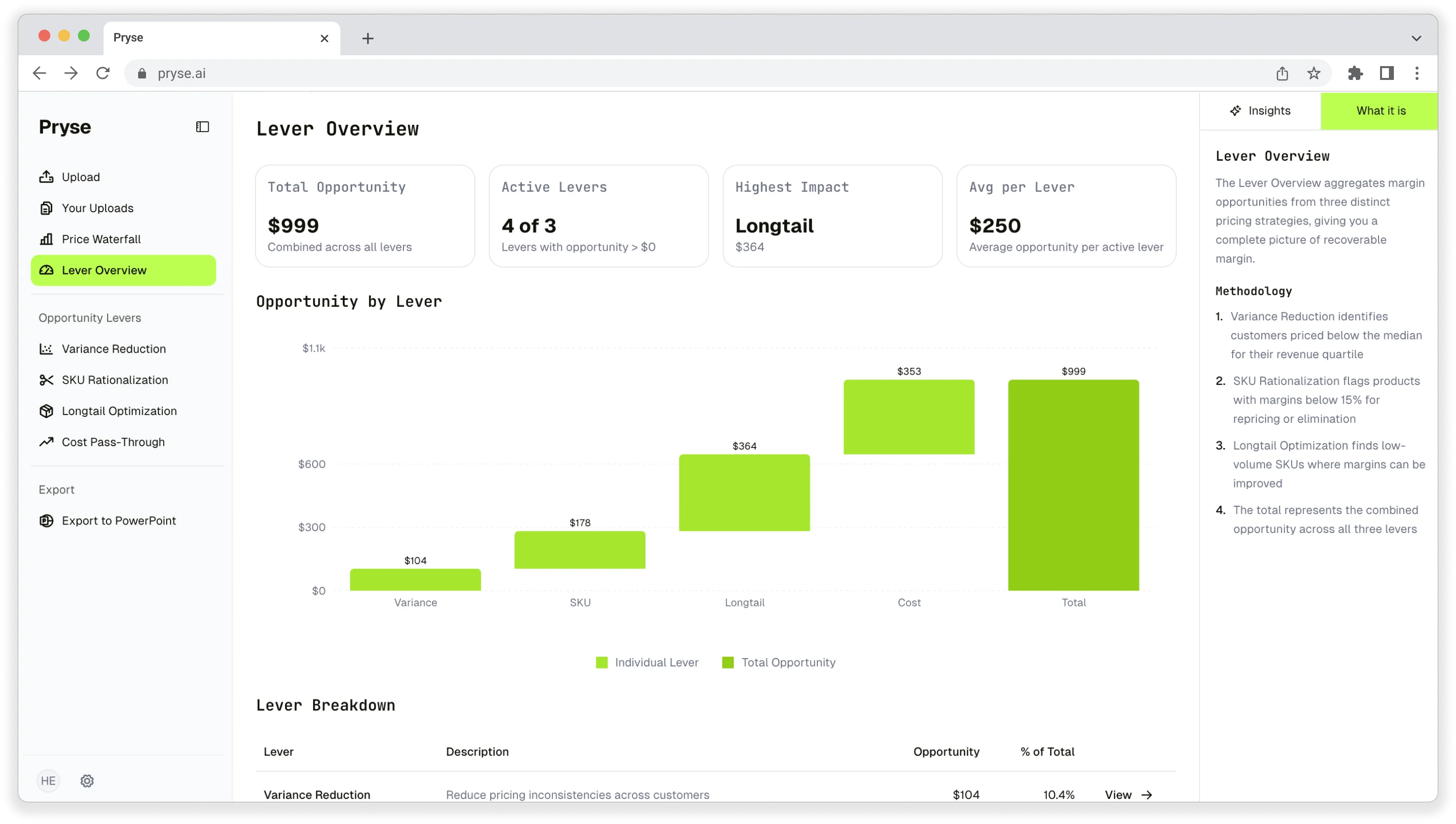
For companies managing 5,000-100,000 SKUs, doing this analysis in Excel is possible but painful. A single pricing diagnostic can surface $200K-$2M in margin opportunities that are invisible in a spreadsheet. Pryse runs that analysis in 24 hours from a CSV upload. No implementation, no 6-month project.
The companies that take pricing seriously outperform. BCG research found that companies with mature pricing capabilities achieve 3-8% higher EBITDA margins than their peers. The gap isn't about having better products or lower costs. It's about capturing the value they're already delivering instead of giving it away through undisciplined pricing.
Last updated: February 1, 2026
Related Articles
Frequently Asked Questions
Want to analyze your entire product catalog?
Pryse automatically identifies margin leakage across thousands of SKUs. Upload your data and find hidden profit in 24 hours.
One-time $1,499 diagnostic. No subscription required.