 Pryse
PryseHVAC Distribution Pricing: How HVAC Distributors Set Prices and Protect Margins
How HVAC distributors price equipment and parts, typical margin ranges by product category, seasonal dynamics, and where mid-market distributors leak margin.
HVAC distribution pricing is the system distributors use to set sell prices on heating, cooling, and refrigeration equipment and parts sold to contractors, with margins varying sharply between product categories, seasons, and customer relationships.
HVAC distribution is a $106 billion industry in the U.S. alone (IBISWorld, 2025). It's also one where the difference between a well-run pricing operation and a sloppy one can mean 3-5 points of gross margin. On $50M in revenue, that's $1.5M-$2.5M in profit sitting in the pricing details.
This post covers how HVAC distributor pricing actually works, what margins you should expect by product category, where mid-market distributors leak margin, and what the top performers do differently.
How HVAC Distributor Pricing Works
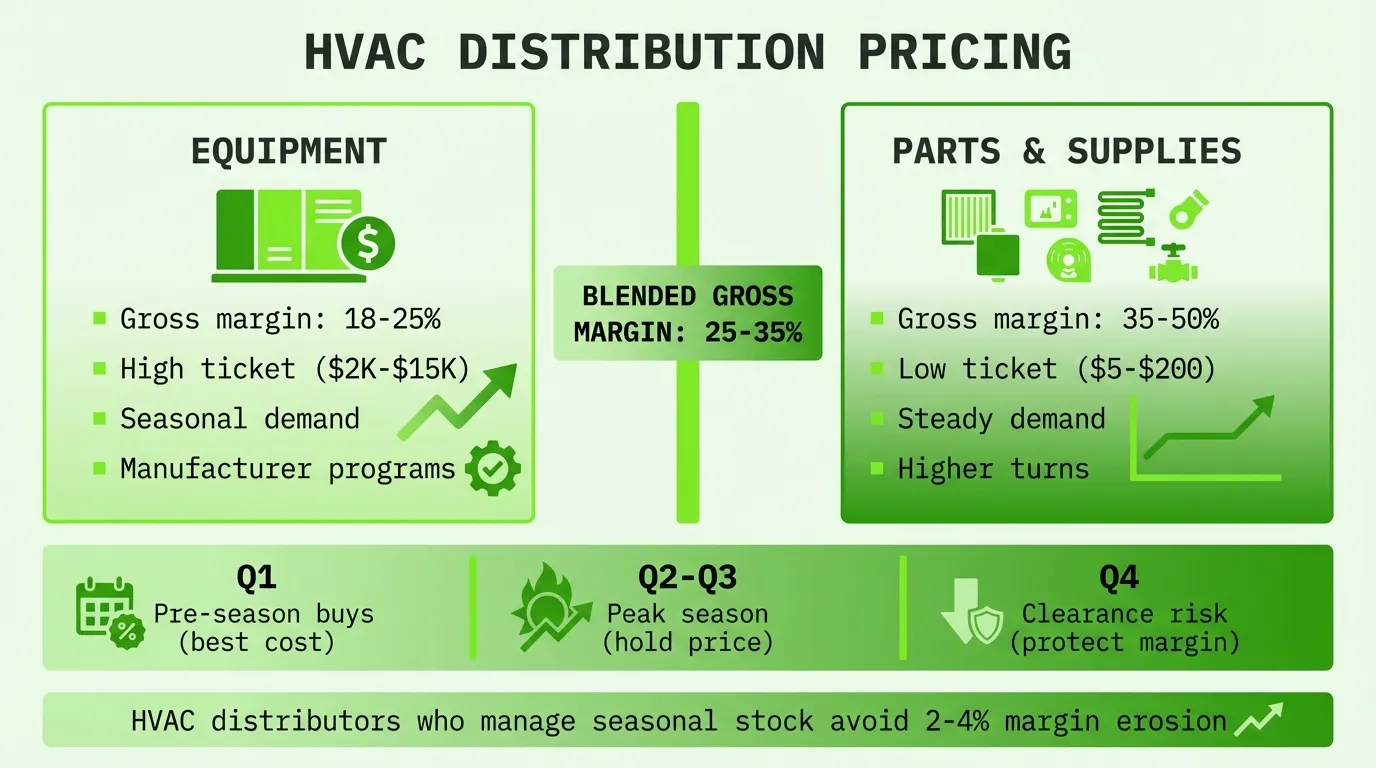
HVAC distribution pricing isn't one system. It's at least three, running in parallel across different product categories with different economics.
Equipment Pricing
Equipment is the big-ticket line: furnaces, air conditioners, heat pumps, rooftop units. A single residential system might be $3,000-$8,000 at distributor cost. Commercial units run well into five figures.
Most distributors price equipment using manufacturer list price minus a multiplier. A contractor buying a Carrier or Trane unit knows roughly what list price is. The distributor's sell price depends on:
- Contractor tier. High-volume contractors get deeper multipliers. A contractor buying 200+ units per year might get list minus 45%. A smaller contractor buying 30 units gets list minus 30%.
- Competitive pressure. In markets with multiple distributors carrying the same brand, pricing compresses. Where you're the only Lennox dealer within 100 miles, there's more room.
- Deal registration. Many manufacturers allow distributors to register specific project opportunities for price protection. This prevents a contractor from shopping the same job across three distributors.
Equipment pricing is relatively transparent. Contractors know what they should be paying. That keeps margins tight.
Parts and Supplies Pricing
Parts and supplies are a different story. Capacitors, contactors, filters, line sets, refrigerant, sheet metal fittings, thermostats, and thousands of other items that contractors need to install and service equipment.
Parts pricing uses matrix pricing more often than cost-plus. Distributors set prices based on cost bands:
| Cost Range | Typical Markup | Resulting Margin |
|---|---|---|
| Under $5 | 200-400% | 67-80% |
| $5-$25 | 100-200% | 50-67% |
| $25-$100 | 60-100% | 38-50% |
| $100-$500 | 40-60% | 29-38% |
| Over $500 | 25-40% | 20-29% |
The logic is straightforward: a contractor won't argue about a $12 capacitor priced at $28. They will argue about a $2,000 compressor priced at $3,400. Small-dollar items carry the margin; big-ticket items carry the volume.
Refrigerant Pricing
Refrigerant deserves its own category because it's become a pricing headache. The 2025 A2L transition forced a shift from R-410A to R-454B across residential equipment, and the supply chain hasn't caught up. R-454B cylinder prices surged from roughly $345 in 2021 to over $2,000 in some peak-season periods (ACHR News, 2025).
Distributors who locked in refrigerant inventory early captured significant margin. Those who bought at spot prices during summer crunches either ate the cost or passed through price shocks that strained contractor relationships.
HVAC Distributor Margin Benchmarks
Here's what the numbers actually look like across product categories. These ranges reflect mid-market HVAC distributors ($20M-$200M in revenue).
Margins by Product Category
| Product Category | Gross Margin Range | Notes |
|---|---|---|
| Residential equipment | 15-22% | Transparent pricing, high competition |
| Commercial equipment | 18-25% | More complex, less price shopping |
| Parts and supplies | 35-50% | Matrix pricing, availability premium |
| Refrigerant | 20-35% | Volatile, supply-dependent |
| Controls and thermostats | 30-45% | Technical sale, less price sensitivity |
| Sheet metal and fittings | 25-35% | Commodity, but convenience-driven |
Blended Company-Level Margins
| Metric | Mid-Market Average | Top Quartile |
|---|---|---|
| Gross margin | 25-28% | 28-33% |
| Operating margin | 5-8% | 8-12% |
| Net margin | 3-6% | 6-10% |
For context, Watsco, the largest HVAC distributor in North America, posted a record 28.0% gross margin for full-year 2025, up 120 basis points year-over-year (Watsco, 2026). That's the benchmark for scale-driven pricing performance in this vertical.
Blended Gross Margin = (Equipment Revenue x Equipment Margin) + (Parts Revenue x Parts Margin) + (Other Revenue x Other Margin) / Total Revenue
The product mix determines everything. A distributor doing 70% equipment and 30% parts will run a thinner blended margin than one doing 50/50. That's why smart distributors actively grow their parts and supplies business. It's not just revenue -- it's margin-accretive revenue.
Seasonal Pricing Dynamics
HVAC distribution is one of the most seasonal verticals in wholesale distribution. Understanding the pricing calendar is essential.
The HVAC Pricing Calendar
| Period | What Happens | Pricing Impact |
|---|---|---|
| Jan-Feb | Manufacturer price increases take effect | New cost basis for the year; pre-increase inventory is margin opportunity |
| Feb-Apr | Pre-season buy programs | 3-8% early-buy discounts on cooling equipment; ties up working capital |
| May-Jun | Cooling season ramp-up | Demand surges; pricing firms; fewer discounts |
| Jul-Aug | Peak demand | Inventory tightens on popular tonnages; availability premium kicks in |
| Sep-Oct | Shoulder season | Pricing normalizes; heating season prep begins |
| Nov-Dec | Heating season peak (northern markets) | Furnace and heat pump demand rises; manufacturers push year-end deals |
Pre-Season Buy Economics
Manufacturer pre-season programs are a defining feature of HVAC distribution pricing. Here's the typical math:
Pre-Season Savings = Units Purchased x Unit Cost x Early-Buy Discount Rate
Carrying Cost = Units Purchased x Unit Cost x Monthly Carrying Rate x Months Held
Net Benefit = Pre-Season Savings - Carrying Cost
A distributor buying $2M in cooling equipment in February at a 5% early-buy discount saves $100,000. But they're carrying that inventory for 3-4 months before it moves. At a 2% monthly carrying cost (including warehouse space, capital cost, and insurance), that's $120,000-$160,000 in carrying costs.
The math only works if you turn the inventory fast once the season hits. Distributors with strong contractor relationships and accurate demand forecasting benefit from pre-season buys. Those who guess wrong end up discounting in September to clear stock, wiping out the early-buy savings.
The Availability Premium
During peak summer months, HVAC distributors who have inventory in stock hold real pricing power. When it's 100 degrees and a contractor needs a 3-ton condenser today, they're not calling four distributors to save $50. They're calling the one who answers the phone and says "it's on the shelf."
This availability premium is worth 2-5 points of margin on peak-season sales. But it requires disciplined inventory investment and forecasting.
Manufacturer Program Structures
Manufacturer programs shape HVAC distributor economics more than most people realize. Understanding these programs is part of understanding HVAC distributor pricing.
Volume Rebate Programs
Most HVAC manufacturers (Carrier, Trane, Lennox, Daikin/Goodman, Rheem, and others) offer tiered volume rebate programs to distributors. A simplified structure looks like this:
| Annual Purchase Volume | Rebate Rate |
|---|---|
| Under $2M | 1-2% |
| $2M-$5M | 2-3% |
| $5M-$10M | 3-4% |
| Over $10M | 4-6% |
These rebates are paid after the fact, based on actual purchases (Enable, 2025). They're not upfront discounts. That means they don't show up in your transaction-level margin calculations unless you accrue them properly.
Effective Gross Margin = Transaction Gross Margin + (Annual Rebate Earned / Annual Revenue from Manufacturer)
For a mid-market distributor buying $8M from a single manufacturer with a 3.5% rebate, that's $280,000 in rebate income. Miss the $5M tier threshold and drop to 2%? That's $160,000 instead. The $120,000 difference is pure profit.
Growth Incentive Programs
Beyond volume tiers, many manufacturers offer growth bonuses: hit 10% year-over-year growth with a brand and earn an additional 1-2% kicker. These programs reward distributors for concentrating purchases and growing share of wallet with a single manufacturer.
The strategic question for mid-market distributors: Do you spread purchases across three brands to offer variety, or concentrate with one brand to hit higher rebate tiers? There's no universal answer, but the rebate math often favors concentration.
Co-Op and Marketing Funds
Manufacturers allocate marketing development funds (MDF) or co-op dollars to distributors, typically 1-3% of purchases. These funds support local advertising, showroom displays, contractor training events, and digital marketing.
Many mid-market distributors leave co-op money unclaimed. HARDI has flagged this as a persistent issue in its benchmarking data (HARDI, 2025). If your manufacturer offers 2% in marketing funds and you're not claiming it, that's margin you've earned but aren't collecting.
Contractor Relationship Pricing
HVAC distribution is a relationship business. Contractors are loyal to their distributor -- until they're not. Managing contractor pricing is where the daily margin battles happen.
Tiered Contractor Programs
Most HVAC distributors segment their contractor customers into tiers based on annual volume:
| Tier | Annual Volume | Typical Discount | Additional Benefits |
|---|---|---|---|
| Platinum/Elite | $500K+ | Best multipliers, 5-10% below standard | Priority allocation, dedicated rep, extended terms |
| Gold | $200K-$500K | Competitive multipliers, 3-5% below standard | Technical support priority, some terms flexibility |
| Silver | $50K-$200K | Standard pricing | Standard support, standard terms |
| Open/Walk-in | Under $50K | List-based pricing | Counter service |
The problem: tiers get established and then never revisited. A contractor who was Platinum three years ago when they were buying $600K might now be buying $300K, but they're still getting Platinum pricing. Nobody had the conversation.
The Loyalty Trap
Contractor loyalty programs (points, rewards, trips) are common in HVAC distribution. The intent is retention. The risk is giving away margin to customers who would've stayed anyway.
If 80% of your loyalty program participants would buy from you regardless (because of location, brand access, or relationship), then the program cost is mostly a margin giveaway. The value is in the 20% who are genuinely on the fence.
Track your loyalty program cost as a line item. If it's running 1-2% of revenue and retention rates aren't meaningfully different from before the program launched, the math doesn't work.
Competitive Bid Dynamics
HVAC contractors regularly bid against each other for installation jobs. When they do, they lean on their distributor for "bid pricing" -- special one-time pricing to win the project.
Bid pricing is necessary. The problem is when it becomes routine. If 30% of your transactions are at "special" pricing, it's not special -- it's your real price, and your list prices are fiction.
Top distributors set clear bid pricing rules: minimum margin floors, approval requirements above a certain discount level, and win-rate tracking to see if the special pricing actually converts.
Where HVAC Distributors Leak Margin
Based on pricing analysis patterns common across mid-market distributors, here are the specific places HVAC distributors lose money they've already earned.
1. Stale Contractor Pricing
Manufacturer costs go up every year. ACHR News tracks HVAC price increases monthly, and January 2026 alone saw increases from dozens of manufacturers, most in the 3-10% range (ACHR News, 2026).
If your contractor price sheets aren't updated within 30-60 days of a cost increase, you're absorbing the difference. A 5% cost increase on a product where you're earning 20% margin cuts your margin to roughly 16%.
Original: Sell $100, Cost $80, Margin = 20%
After 5% cost increase (price unchanged): Sell $100, Cost $84, Margin = 16%
Margin erosion = 4 points on every unit sold at the old price
For a distributor moving $30M in equipment annually, a 60-day lag in passing through a 5% cost increase means roughly $250,000 in lost margin.
2. Parts Margin Bundled Away
When a contractor buys a $5,000 equipment package, the sales rep often throws in parts and supplies at cost or near-cost to sweeten the deal. "I'll include the line set and thermostat."
Those parts might represent $200-$400 in margin that just evaporated. Across 500 equipment deals per year, that's $100,000-$200,000 in parts margin given away.
The fix isn't refusing to bundle. It's tracking the bundled margin separately and setting floors. If you're going to discount parts on an equipment deal, discount them 20% -- not to cost.
3. Emergency and After-Hours Delivery
HVAC contractors work in emergencies. A homeowner's AC dies on a July afternoon, and the contractor needs a compressor by 6 AM tomorrow. The distributor dispatches a driver for a special delivery.
That delivery costs the distributor $75-$150 in real expense (driver time, fuel, vehicle wear). If there's no delivery surcharge or the rep waives it, that cost comes straight out of margin.
High-performing distributors charge for emergency delivery. $50-$100 for same-day or next-morning delivery isn't unreasonable when the contractor is billing the homeowner $300+ for an emergency service call.
4. Rebate Tier Shortfalls
Missing a manufacturer rebate tier by a small amount is one of the most expensive mistakes in HVAC distribution. The tiers are cliffs, not slopes.
If a 3% rebate tier requires $5M in purchases and you end the year at $4.8M, you drop to the 2% tier on the entire amount. That's the difference between a $150,000 rebate and a $96,000 rebate -- a $54,000 swing because of a $200,000 purchasing shortfall.
Smart distributors track rebate tier progress monthly and make purchasing decisions in Q4 with tier thresholds in mind.
5. Customer-Specific Pricing That Never Expires
A contractor negotiated special pricing on compressors three years ago when they were doing a large multifamily project. That project ended, but the special pricing is still in the system. Nobody removed it.
This happens constantly. Special pricing without expiration dates, project pricing that outlives the project, seasonal pricing that runs year-round. A pricing audit at most mid-market distributors will turn up hundreds of these.
How Top HVAC Distributors Protect Margins
The gap between average and top-performing HVAC distributors isn't about selling more. It's about keeping more of what they sell.
Pricing Technology
Watsco credited its record 28% gross margin in 2025 partly to "further scaling of pricing optimization technologies" (Watsco, 2026). The company has invested over $250 million in technology over five years, including pricing tools that help branch managers and counter staff make better pricing decisions in real time.
You don't need Watsco's budget. But you do need to move beyond static price sheets and sales rep gut feel. Even basic analytics that flag pricing outliers -- transactions where margin deviates significantly from the product average -- can recover 1-2% of margin.
Product Mix Management
Top distributors actively manage their revenue mix toward higher-margin categories. That means:
- Growing parts and supplies as a percentage of revenue. Every equipment sale is an opportunity to capture the parts annuity that follows.
- Expanding into controls and connected products. Smart thermostats, indoor air quality products, and building automation components carry better margins than commodity equipment.
- Selling services, not just products. Technical training, system design assistance, and warranty processing add revenue with minimal COGS.
Cost-to-Serve Pricing
Not all contractors cost the same to serve. A contractor who orders once a week in full pallets with 30-day payment terms is cheap to serve. A contractor who orders daily in small quantities, demands same-day delivery, and pays in 60 days costs 8-12% more.
Top distributors price accordingly. That doesn't mean punishing small contractors. It means not giving them the same pricing as your most efficient customers.
Seasonal Inventory Discipline
The best HVAC distributors don't panic-discount in September. They buy pre-season inventory based on data, not optimism. They track sell-through rates weekly during peak season. And they have a clear plan for aging inventory that doesn't involve slashing prices 30%.
Strategies include:
- Negotiating manufacturer return programs for unsold pre-season inventory
- Transferring inventory between branches to match regional demand
- Setting markdown schedules that start shallow and deepen gradually, not all at once
Rebate Program Optimization
Elite distributors treat manufacturer rebates as a managed profit center. They assign someone (or a team) to track every rebate program, monitor tier progress, and make strategic purchasing decisions based on rebate economics.
The payoff is significant. For a distributor purchasing $30M across five manufacturers, the difference between average and optimized rebate capture can be $200,000-$400,000 annually. That's straight to the bottom line.
The A2L Transition: A Pricing Inflection Point
The 2025 regulatory shift from R-410A to A2L refrigerants (primarily R-454B) created a unique pricing moment for HVAC distributors. Equipment prices jumped 8-10% on new A2L-compliant models (ACHR News, 2025). Distributors carrying both legacy and new inventory faced dual pricing challenges.
Those who handled it well:
- Raised prices on remaining R-410A inventory to capture scarcity value instead of discounting to clear
- Passed through A2L equipment price increases promptly instead of absorbing them
- Managed refrigerant inventory strategically as R-454B supply tightened
Those who didn't lost margin both ways: discounting old inventory to move it and delaying price increases on new products to avoid contractor pushback.
The transition is largely behind us now, but it illustrates a broader point. Regulatory and product changes are pricing opportunities if you treat them as such. The default -- absorbing costs and hoping things normalize -- is the most expensive approach.
The Bottom Line
HVAC distribution pricing is built on a split personality: thin margins on equipment, healthier margins on parts, and a seasonal cycle that rewards discipline and punishes guessing.
Mid-market HVAC distributors ($20M-$200M) should target 26-30% blended gross margin. If you're below 25%, the opportunity is in the details: stale pricing, bundled-away parts margin, missing rebate tiers, and delivery costs you're absorbing.
The top performers aren't doing anything exotic. They're updating prices when costs change. They're tracking margin at the transaction level, not just the P&L level. They're treating rebate programs like the six-figure profit centers they are. And they're charging appropriately for the availability and service that contractors actually value.
If you're running an HVAC distribution business on Excel-based pricing, you're almost certainly leaving margin on the table. A systematic look at your transaction data will tell you exactly where.
For more on distributor margin benchmarks across verticals, see distributor margins by industry. For the full framework on finding margin leaks, read our guide to margin leakage. And for a deeper look at distribution pricing strategy, see our distribution pricing guide.
Last updated: Invalid Date
Frequently Asked Questions
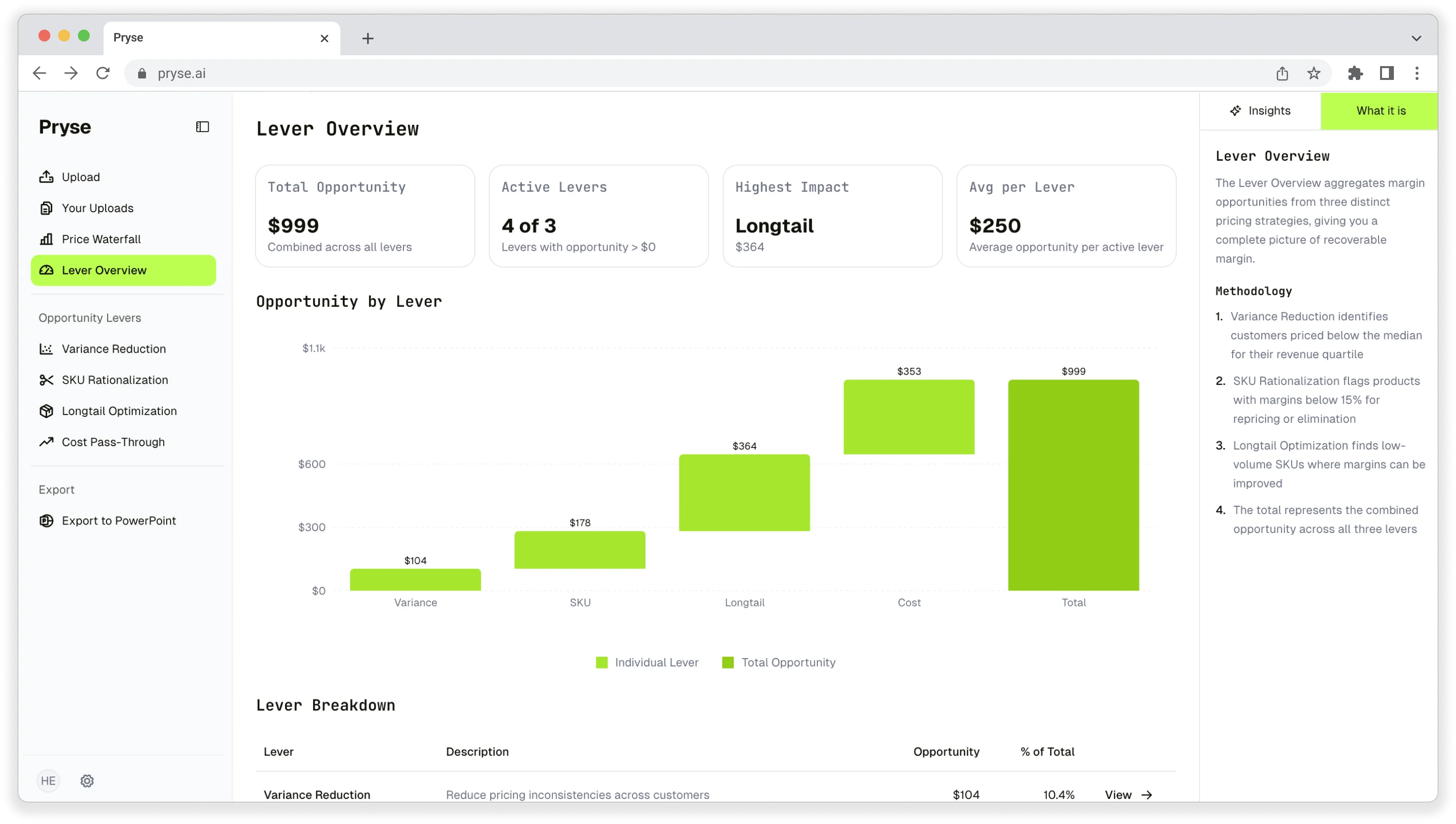
Want to analyze your entire product catalog?
Pryse automatically identifies margin leakage across thousands of SKUs. Upload your data and find hidden profit in 24 hours.
One-time $1,499 diagnostic. No subscription required.