 Pryse
PrysePrice Waterfall Analysis: The Complete Guide to Finding Hidden Margin
Learn how to build and analyze price waterfalls to find margin leakage. Step-by-step guide for distributors and manufacturers with examples and templates.
A price waterfall is a visualization showing how list price erodes to pocket price through sequential deductions: invoice discounts, off-invoice rebates, freight costs, payment terms, and other allowances.
For distribution and manufacturing companies, the price waterfall reveals where profit actually goes. A product with a 30% list margin might deliver only 15% pocket margin after accounting for all the deductions that accumulate across the order-to-cash process.
McKinsey research found that off-invoice price leakages average 16.3% of list price. Combined with on-invoice discounts that can reach 33% of list price, total erosion often exceeds 40%. Most companies don't track this erosion systematically, which is why they can't explain the gap between expected and actual margins.
This guide covers what a price waterfall is, how to build one, what each component means, and how to use waterfall analysis to find and fix margin leakage.
What Is a Price Waterfall?
A price waterfall maps the journey from list price to pocket price by visualizing every deduction along the way. The term comes from the chart's appearance: each price reduction creates a "step down" like water cascading over rocks.
The concept was developed by McKinsey consultants Michael Marn and Robert Rosiello in the 1990s. They observed that companies focused on list prices and invoice prices while ignoring the off-invoice deductions that determined actual profitability.
Here's the core insight: invoice price is not what you actually receive. The invoice shows one number, but after rebates, freight costs, payment terms, returns, and other allowances, the cash that hits your bank account is lower. That final number is your pocket price.
Pocket Price = Invoice Price - Off-Invoice Deductions
A company selling a product at $100 invoice price might receive only $84 in pocket price after accounting for a $5 volume rebate, $4 freight absorption, $3 early payment discount, $2 co-op advertising allowance, and $2 in returns and chargebacks.
The difference between invoice margin and pocket margin can be dramatic:
| Metric | Calculation | Amount |
|---|---|---|
| Invoice Price | $100 | |
| Cost of Goods Sold | $70 | |
| Invoice Margin | ($100 - $70) / $100 | 30% |
| Pocket Price | $100 - $16 deductions | $84 |
| Pocket Margin | ($84 - $70) / $84 | 16.7% |
In this example, the company thinks it's earning 30% margin. The actual margin is 16.7%—nearly half what they expected.
Price Waterfall Components Explained
A complete price waterfall includes both on-invoice and off-invoice deductions. Here's what each component means.
On-Invoice Deductions (List to Invoice Price)
These appear directly on the customer invoice:
List Price (Base Price) The starting point. Your published price before any adjustments. For distributors, this might be the manufacturer's suggested resale price or your own price list.
Standard Discount A baseline discount available to all customers in a tier. "All contractors receive 15% off list" is a standard discount.
Customer-Specific Discount Negotiated pricing for individual accounts. Customer A gets 22% while Customer B gets 18% based on their agreements.
Volume Discount (On-Invoice) Quantity breaks applied at order time. "Orders over 100 units receive an additional 5% off."
Promotional Discount Time-limited price reductions for specific products or campaigns. "20% off all Category A products through March."
Competitive Discount Price matching or one-time adjustments to win a deal. "We'll match Competitor X's price on this order."
After all on-invoice deductions, you have the invoice price—what the customer sees on their bill.
Off-Invoice Deductions (Invoice to Pocket Price)
These don't appear on the invoice but reduce what you actually receive:
Volume Rebates Payments back to customers based on cumulative purchases over a period. "Purchase $500K annually and receive a 3% rebate check." Unlike on-invoice volume discounts, these are calculated after the fact and paid separately.
Growth Rebates Incentives for customers who increase purchases year-over-year. "Grow purchases 10% and earn an additional 1% rebate."
Freight Costs (Absorbed) Shipping costs you pay that aren't recovered from the customer. If you offer "free shipping on orders over $500" and shipping actually costs 4% of order value, that's freight absorption.
Payment Terms Cost The cost of money tied up in accounts receivable. If a customer pays in 60 days and your cost of capital is 8% annually, each dollar of invoice price costs you about 1.3 cents in carrying cost. This adds up across a customer portfolio.
Early Payment Discounts "2/10 Net 30" means customers taking the 2% discount for paying in 10 days reduce your pocket price by 2%.
Co-op Advertising / Marketing Funds Payments to customers for local advertising or promotional support. Often structured as a percentage of purchases.
Chargebacks and Deductions Customer deductions for claimed issues: short shipments, damaged goods, pricing errors, compliance failures. These often arrive as surprise deductions on payment remittances.
Returns and Allowances The cost of goods returned plus any restocking or handling fees you absorb.
Special Services Value-added services provided without charge: technical support, design assistance, dedicated account management, inventory holding.
After all off-invoice deductions, you have the pocket price—the actual cash received for the transaction.
How to Build a Price Waterfall
Building a price waterfall requires connecting data from multiple systems: order management, invoicing, rebate tracking, freight, AR, and returns. Here's the process.
Step 1: Define Your Waterfall Structure
Map out every deduction type that applies to your business. This varies by industry:
Typical Distributor Waterfall:
| Stage | Component |
|---|---|
| List Price | Starting point |
| - Standard Discount | Tier-based pricing |
| - Customer Discount | Negotiated deals |
| - Volume Discount | Quantity breaks |
| - Promo Discount | Campaign pricing |
| = Invoice Price | |
| - Volume Rebates | Annual rebate programs |
| - Freight Absorption | Shipping costs eaten |
| - Payment Terms Cost | AR carrying cost |
| - Early Pay Discount | 2/10 terms taken |
| - Co-op/MDF | Marketing funds |
| - Chargebacks | Customer deductions |
| - Returns | Product returned |
| = Pocket Price | Actual cash received |
Typical Manufacturer Waterfall:
| Stage | Component |
|---|---|
| List Price | Published MSRP |
| - Distributor Discount | Channel margin |
| - OEM Discount | Large account pricing |
| - Contract Pricing | Negotiated deals |
| = Invoice Price | |
| - Channel Rebates | Distributor incentives |
| - End-User Rebates | Consumer rebates |
| - Freight/Logistics | Delivery costs |
| - Warranty Costs | Service obligations |
| - Returns/Credits | Product returns |
| = Pocket Price | Net realized price |
Step 2: Gather Transaction Data
You need invoice-level detail with product, customer, quantity, and all price adjustments. Most ERP systems can export this, though the format varies.
Required data fields:
- Transaction identifier (invoice number)
- Customer identifier
- Product/SKU identifier
- Quantity
- List price
- Invoice price
- Each on-invoice discount amount
Commonly missing data:
- Off-invoice rebates (often in a separate rebate management system)
- Freight costs by transaction (may only have totals)
- Payment terms taken vs offered
- Chargebacks by original invoice
The biggest challenge is connecting off-invoice costs back to original transactions. Your rebate might be calculated quarterly, but which specific invoices did it apply to? This allocation problem is why many companies skip pocket price analysis—it's messy.
Step 3: Calculate Waterfall Values
For each transaction, calculate the cumulative deductions:
Invoice Price = List Price - Sum of On-Invoice Deductions
Pocket Price = Invoice Price - Sum of Off-Invoice Deductions
List-to-Invoice Drop = (List Price - Invoice Price) / List Price x 100
Invoice-to-Pocket Drop = (Invoice Price - Pocket Price) / Invoice Price x 100
Total Waterfall Drop = (List Price - Pocket Price) / List Price x 100
Run these calculations at the transaction level, then aggregate up to customer, product, channel, and company-wide views.
Step 4: Visualize the Waterfall
A waterfall chart shows the step-down from list to pocket price. Each bar represents a deduction category, with the chart "falling" from left to right.
For Excel instructions, see our guide on creating price waterfall charts in Excel.
At minimum, create these views:
- Company-wide waterfall: Average deductions across all transactions
- Customer waterfall: Deductions for specific accounts
- Product waterfall: Deductions for specific SKUs or categories
- Channel waterfall: Deductions by sales channel
Step 5: Calculate Pocket Margin
The point of the waterfall is to calculate true profitability:
Pocket Margin = (Pocket Price - COGS) / Pocket Price x 100
Compare pocket margin to invoice margin to see the impact of off-invoice leakage:
Margin Erosion = Invoice Margin - Pocket Margin
If invoice margin is 28% and pocket margin is 19%, you have 9 percentage points of margin erosion happening off-invoice.
Price Waterfall Examples
Let's walk through two real-world examples showing how waterfalls reveal margin problems.
Example 1: Electrical Distributor
A $45M electrical distributor analyzed their waterfall for a high-volume customer buying $800K annually.
| Component | Amount | % of List |
|---|---|---|
| List Price | $100.00 | 100% |
| Standard Contractor Discount | -$20.00 | -20% |
| Customer-Specific Discount | -$8.00 | -8% |
| Promotional Pricing | -$2.00 | -2% |
| Invoice Price | $70.00 | 70% |
| Annual Volume Rebate | -$3.50 | -3.5% |
| Growth Rebate | -$1.00 | -1% |
| Freight (Free Ship >$500) | -$2.80 | -2.8% |
| Payment Terms (Pays 45 days) | -$0.70 | -0.7% |
| Co-op Advertising | -$1.00 | -1% |
| Chargebacks/Deductions | -$0.50 | -0.5% |
| Pocket Price | $60.50 | 60.5% |
With COGS at $52, here's the margin picture:
| Margin Type | Calculation | Result |
|---|---|---|
| List Margin | ($100 - $52) / $100 | 48% |
| Invoice Margin | ($70 - $52) / $70 | 25.7% |
| Pocket Margin | ($60.50 - $52) / $60.50 | 14.0% |
The distributor thought they were earning 25.7% margin on this customer. Actual pocket margin was 14%—barely covering operating costs. The $9.50 gap between invoice and pocket price on every $100 of list represents $76,000 in hidden leakage on this single account.
Example 2: Industrial Manufacturer
A $75M industrial manufacturer selling through distribution analyzed pocket price by channel.
Direct Sales Channel:
| Component | % of List |
|---|---|
| List Price | 100% |
| Contract Pricing | -18% |
| Invoice Price | 82% |
| Freight (FOB Delivered) | -4% |
| Payment Terms (Net 45) | -1% |
| Pocket Price | 77% |
Distribution Channel:
| Component | % of List |
|---|---|
| List Price | 100% |
| Distributor Discount | -35% |
| Invoice Price | 65% |
| Volume Rebates | -3% |
| Growth Rebates | -1% |
| Marketing Funds (MDF) | -2% |
| Stock Rotation | -1% |
| Pocket Price | 58% |
With identical COGS of 45% of list price:
| Channel | Pocket Price | COGS | Pocket Margin |
|---|---|---|---|
| Direct | 77% | 45% | 41.6% |
| Distribution | 58% | 45% | 22.4% |
The manufacturer knew distribution margins were lower than direct. They didn't realize the gap was nearly 20 percentage points. This analysis led to restructuring distributor agreements and shifting sales focus toward direct channels for certain products.
The Pocket Price Waterfall Explained
The pocket price waterfall is the complete waterfall extending through all off-invoice deductions. The term emphasizes what matters: the money that ends up in your pocket.
McKinsey's original research identified the pocket price waterfall as the reason companies couldn't explain margin variances. Businesses tracked list prices and invoice prices carefully but let off-invoice costs happen without systematic measurement.
Key insight from McKinsey's research: "On average, off-invoice price leakages can add up to 16.3% of the standard list price." This means a company with 25% gross margin at invoice level might only have 8-10% pocket margin after off-invoice leakage.
The Pocket Price Band
Beyond the average pocket price, McKinsey introduced the pocket price band—the distribution of pocket prices across transactions for the same product.
In well-managed pricing, the band is narrow. Everyone buying Product X pays within a tight range (say, $85-$92 pocket price).
In poorly managed pricing, the band is wide. Product X pocket prices range from $65 to $110 depending on customer, time of year, sales rep, and accumulated deals.
A wide pocket price band signals:
- Inconsistent discount approvals
- Legacy pricing that hasn't been updated
- Sales rep discretion without guardrails
- Accumulated deals stacking on each other
Analyzing your pocket price band reveals which customers are paying far less than similar accounts—and which might be paying more than they should.
For a deeper explanation, see our post on the pocket price waterfall.
Price Waterfall Analysis for Distributors
Distribution companies face unique waterfall challenges due to their position between manufacturers and end customers.
Distributor-Specific Waterfall Components
Supplier Rebates (Revenue) Distributors earn rebates from suppliers based on purchase volume. While not part of the customer-facing waterfall, supplier rebates affect true profitability. A product with thin customer margins might be profitable after accounting for 3-4% supplier rebates.
Multi-Tier Customer Pricing Distributors often serve contractors (high volume, low margin), retailers (medium volume, medium margin), and direct consumers (low volume, high margin). Each tier has a different waterfall profile.
Delivery/Logistics Complexity Distributors bear significant freight costs. Will-call pickup, local delivery, common carrier, and drop-ship all have different cost profiles that should show in the waterfall.
Returns and Restocking Distribution returns rates can run 5-15% for some product categories. The cost of handling returns rarely gets allocated back to the transactions that generated them.
Common Distributor Waterfall Problems
Problem: Freight eating margin on small orders
Analysis reveals that orders under $200 have 8% freight cost versus 2% for orders over $1,000. But pricing doesn't adjust for order size.
Fix: Implement minimum order values, small order fees, or shipping thresholds that align freight recovery with freight cost.
Problem: Legacy customer pricing
A 20-year customer still receives pricing negotiated in 2015 despite buying 40% less volume than they did then.
Fix: Annual pricing reviews triggered by volume changes. If a customer's volume drops below the threshold for their discount tier, pricing should adjust.
Problem: Rebate programs exceeding margins
A volume rebate program pays 4% at the $1M tier. But some products in the mix have only 12% pocket margin before rebates—leaving 8% margin to cover operating costs.
Fix: Analyze rebate programs at the product level, not just customer level. Exclude low-margin products from rebate calculations or cap rebates based on product margin.
Distributor Waterfall Benchmarks
| Deduction Type | Low | Typical | High (Problem) |
|---|---|---|---|
| Standard Discount | 10% | 18-25% | 35%+ |
| Customer-Specific | 5% | 8-12% | 20%+ |
| Volume Rebates | 1% | 2-4% | 6%+ |
| Freight Absorption | 1% | 2-4% | 7%+ |
| Payment Terms | 0.5% | 1-2% | 3%+ |
| Total List-to-Pocket | 25% | 35-45% | 55%+ |
Distributors with total leakage above 50% have structural pricing problems requiring systematic correction.
Finding Margin Leakage With Price Waterfalls
The price waterfall doesn't just show where money goes—it shows where to look for recoverable margin.
High-Impact Leakage Sources
Based on waterfall analysis across dozens of mid-market distributors and manufacturers, these deduction categories offer the most recovery opportunity:
1. Freight Absorption (1-3% recovery potential)
Most companies absorb more freight than they realize. The fix isn't eliminating delivery—it's aligning pricing with delivery cost.
- Analyze freight cost by customer, order size, and delivery method
- Implement or raise minimum order values
- Add delivery surcharges for high-cost destinations
- Offer will-call pickup discounts that reflect true savings
2. Payment Terms (0.5-1.5% recovery potential)
Extended payment terms have a real cost. At 8% cost of capital, Net 60 costs 1.3% of invoice value versus Net 30.
- Enforce stated payment terms
- Offer meaningful early payment discounts (2/10 works because it exceeds the cost of capital)
- Charge for extended terms rather than giving them away
- Identify chronic slow-payers and adjust pricing
3. Discount Stacking (1-2% recovery potential)
When multiple discounts apply to the same transaction—standard discount plus promo plus volume break plus competitive match—margins collapse.
- Set maximum total discount caps
- Require approval for stacked discounts exceeding thresholds
- Track discount reason codes to identify stacking patterns
4. Legacy Pricing (1-3% recovery potential)
Customer-specific prices negotiated years ago based on volume commitments that no longer exist represent pure leakage.
- Annual review of all customer-specific pricing
- Automatic triggers when customer volume drops significantly
- Sunset provisions on promotional pricing
5. Untracked Rebates and Allowances (0.5-1% recovery potential)
Co-op advertising, market development funds, and miscellaneous credits often happen without connection to any tracking system.
- Centralize all rebate and allowance approvals
- Require documentation and connect to customer records
- Include all allowances in pocket price calculation
The Waterfall Audit Process
Run this analysis quarterly:
Step 1: Calculate current pocket margin by customer segment
- Top 20 customers by revenue
- Customer tier averages
- Product category averages
Step 2: Compare to invoice margin
- Identify the gap for each segment
- Rank segments by erosion percentage
Step 3: Drill into high-erosion segments
- Which deduction categories drive the gap?
- Are deductions in line with agreements, or are unauthorized deductions happening?
- What's the variance from average within each segment?
Step 4: Prioritize recovery actions
- Rank opportunities by dollar impact
- Identify quick wins (pricing changes) versus structural changes (policy changes)
- Build business cases for major adjustments
Step 5: Track improvement
- Monitor pocket margin trends monthly
- Measure before/after impact of specific changes
- Set targets for margin improvement by segment
Building Price Waterfalls in Excel
Most mid-market companies start with Excel for waterfall analysis. It's accessible, flexible, and handles moderate transaction volumes.
Basic Excel Waterfall Structure
Create a workbook with these tabs:
Tab 1: Transaction Data Raw export from your ERP with columns for:
- Invoice number, date
- Customer ID, name, tier
- Product ID, category
- Quantity, list price, invoice price
- Each discount type as separate columns
Tab 2: Off-Invoice Allocation Connect off-invoice costs to transactions:
- Rebates allocated by customer/period
- Freight costs by shipment
- Payment terms cost calculated from AR aging
Tab 3: Waterfall Calculation For each transaction, calculate:
- List price total (quantity x list price)
- Each deduction amount
- Invoice price total
- Each off-invoice deduction
- Pocket price total
- Pocket margin
Tab 4: Summary Analysis Pivot tables showing:
- Average waterfall by customer tier
- Average waterfall by product category
- Pocket margin distribution (the price band)
- Month-over-month trends
Tab 5: Waterfall Chart Visualize the company-wide average waterfall as a waterfall chart.
For step-by-step Excel instructions, see our guide on building a price waterfall in Excel and our downloadable price waterfall template.
Excel Limitations
Excel works for initial analysis and ongoing monitoring at moderate scale. It struggles when:
- Transaction volume exceeds 50,000 rows per period
- Off-invoice data requires complex allocation logic
- Real-time monitoring is needed
- Multiple users need access to analysis
At that point, dedicated pricing analytics tools automate the data connection and calculation that makes Excel painful.
Price Waterfall Analysis by Industry
Different industries have different waterfall profiles based on their business models and cost structures.
Wholesale Distribution
Typical profile: 35-45% total leakage from list to pocket
Key deductions: Customer discounts (20-30%), rebates (2-5%), freight (2-5%), payment terms (1-2%)
Primary leakage risks: Legacy customer pricing, freight absorption on small orders, rebate programs exceeding product margins
Industrial Manufacturing
Typical profile: 30-40% total leakage from list to pocket
Key deductions: Channel discounts (20-35%), contract pricing (5-15%), freight (3-5%), warranty (1-3%)
Primary leakage risks: Distribution margin pressure, warranty and returns costs, custom engineering absorption
Building Materials Distribution
Typical profile: 25-35% total leakage from list to pocket
Key deductions: Contractor pricing (15-25%), project discounts (5-10%), delivery (3-6%)
Primary leakage risks: Job pricing undercutting standard margins, delivery costs on bulky/heavy goods, returns on custom orders
Food and Beverage Distribution
Typical profile: 20-30% total leakage from list to pocket
Key deductions: Chain account pricing (10-20%), promotional allowances (3-8%), delivery (2-5%), spoilage (1-3%)
Primary leakage risks: Trade promotion spending, short-dated product handling, high-frequency delivery costs
Implementing Price Waterfall Analysis
Getting started with waterfall analysis doesn't require perfect data or expensive tools. Here's a practical implementation path.
Phase 1: Baseline (2-4 weeks)
Goal: Understand your current waterfall at a high level
- Export 3-6 months of invoice data
- Map known discount types to deduction categories
- Calculate list-to-invoice drop by customer and product
- Estimate off-invoice costs even if precise allocation isn't possible
- Create a rough waterfall visualization
Deliverable: A baseline view showing approximate total leakage and major deduction categories
Phase 2: Detail (4-8 weeks)
Goal: Connect off-invoice costs to transactions
- Work with finance to get rebate, freight, and AR data
- Develop allocation logic for off-invoice costs
- Calculate pocket price at the transaction level
- Analyze pocket margin by customer segment and product category
- Identify the pocket price band for major products
Deliverable: True pocket margin analysis with customer and product segmentation
Phase 3: Action (Ongoing)
Goal: Use waterfall insights to improve margin
- Prioritize leakage sources by dollar impact
- Develop correction plans (pricing changes, policy changes, customer renegotiations)
- Implement changes with tracking
- Monitor pocket margin improvement
- Institutionalize quarterly waterfall reviews
Deliverable: Measurable margin improvement and ongoing monitoring process
Common Implementation Mistakes
Mistake: Waiting for perfect data Don't delay analysis because some data is missing. Start with what you have. An 80% accurate waterfall reveals more than no waterfall at all.
Mistake: Analyzing without acting Waterfall analysis that produces a report and sits on a shelf adds no value. Every analysis should identify specific actions with owners and timelines.
Mistake: One-time analysis only A single waterfall snapshot helps, but ongoing monitoring catches problems as they develop rather than after they've compounded.
Mistake: Ignoring the pocket price band Average pocket price hides variation. Two customers with the same average pocket price might have very different waterfall profiles. Look at the distribution, not just the average.
The ROI of Price Waterfall Analysis
According to McKinsey, a 1% improvement in price yields an 8% improvement in operating profit—nearly 50% greater impact than a 1% reduction in variable costs.
For a $50M distributor operating at 5% net margin:
- Current net profit: $2.5M
- 1% price improvement: $500K additional revenue at 100% margin contribution
- New net profit: $3M (20% increase)
Price waterfall analysis typically identifies 2-5% in recoverable margin through a combination of:
- Reducing unauthorized discounts
- Aligning pricing with delivery costs
- Enforcing payment terms
- Eliminating discount stacking
- Updating legacy pricing
A 3% margin recovery on $50M revenue is $1.5M annually—pure profit improvement with minimal investment.
The Bottom Line on Price Waterfall Analysis
Price waterfall analysis answers a question most companies can't answer: what do we actually earn on each transaction?
The gap between invoice margin and pocket margin is real and often substantial. McKinsey's research showing 16%+ off-invoice leakage isn't an outlier—it's typical for companies that haven't systematically managed their waterfall.
For distribution and manufacturing companies in the $20M-$200M range, price waterfall analysis typically reveals:
- Total list-to-pocket erosion of 35-50%
- Off-invoice leakage of 10-20% beyond invoice price
- Wide pocket price bands indicating pricing inconsistency
- Specific customers and products with underwater pocket margins
- 2-5% in recoverable margin through focused corrections
The analysis doesn't require enterprise software. Excel handles the calculation for most mid-market companies. What it requires is connecting data that sits in separate systems and asking questions you haven't asked before.
Start by mapping your waterfall structure. Gather whatever data you can. Calculate the gap between invoice and pocket margin. Find the outliers. Fix the obvious problems first.
A 1% improvement in realized price has more profit impact than almost anything else you can do. Price waterfall analysis shows you exactly where to find that improvement.
Last updated: January 28, 2026
Related Articles
Frequently Asked Questions
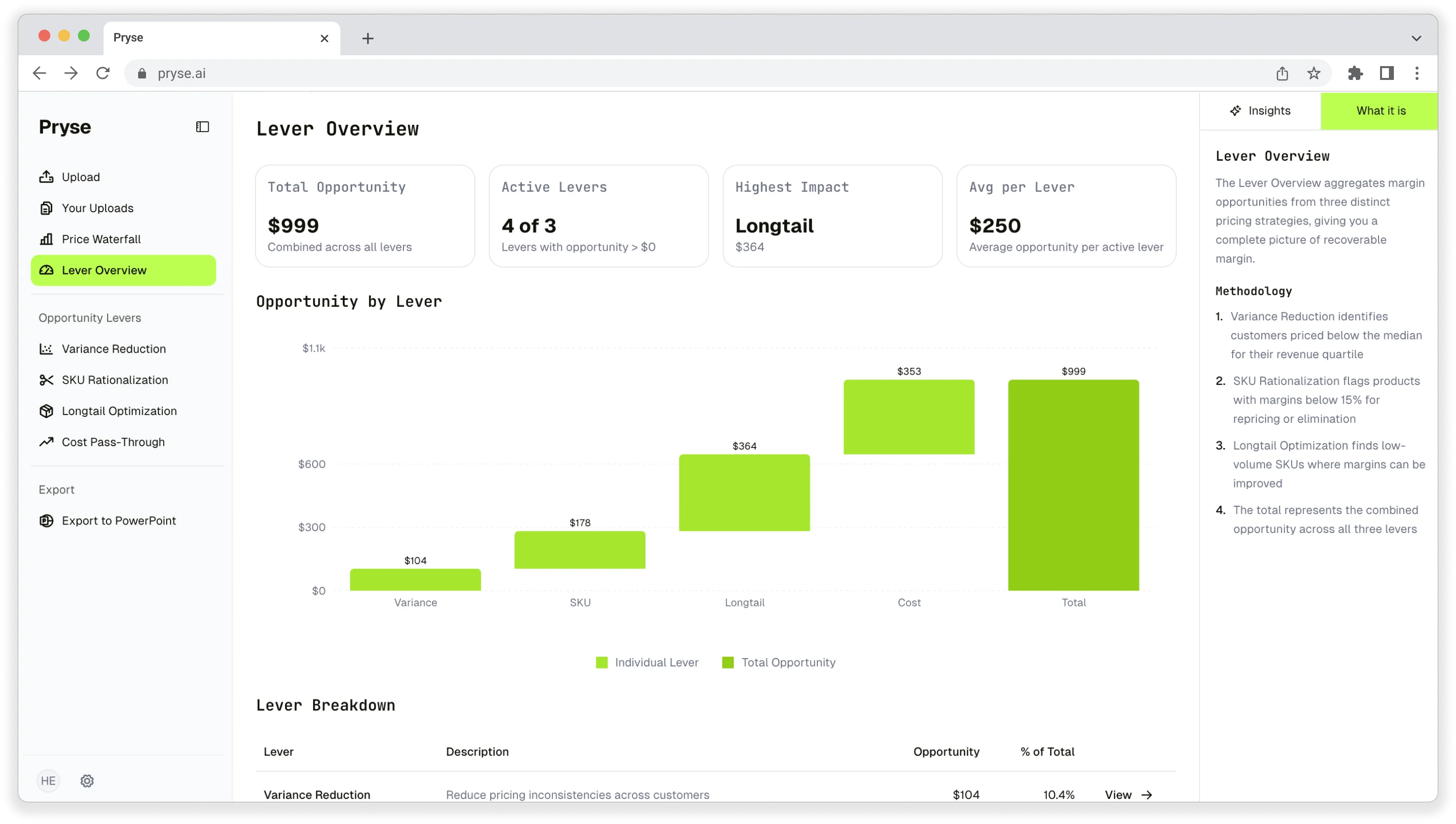
Want to analyze your entire product catalog?
Pryse automatically identifies margin leakage across thousands of SKUs. Upload your data and find hidden profit in 24 hours.
One-time $1,499 diagnostic. No subscription required.