 Pryse
PryseCPQ Price Waterfall: How Configure-Price-Quote Systems Handle Margin Visibility
CPQ systems automate price waterfall tracking with real-time margin visibility, discount controls, and approval workflows. Compare CPQ options for mid-market.
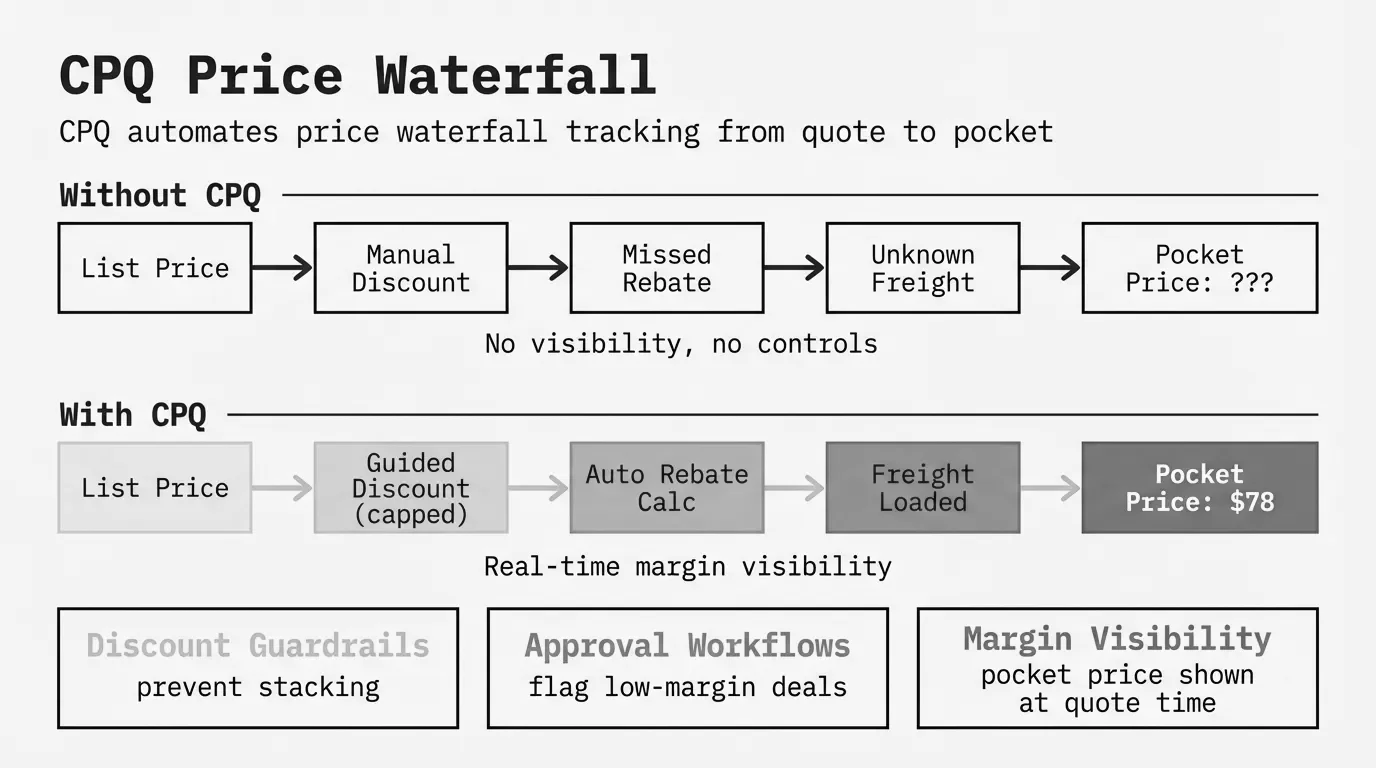
A CPQ price waterfall is the automated calculation sequence that takes a product from list price down to net price during quote creation. The CPQ system applies each pricing element in order: base price, customer-specific adjustments, volume discounts, promotional pricing, and negotiated discounts. At each step, the rep sees margin impact in real time.
The term "waterfall" describes how prices cascade through sequential calculations. Each adjustment flows into the next. Salesforce CPQ documents this as their "Price Waterfall"—a strict sequence where each price field affects subsequent fields. Change the contracted price, and that change cascades through special price, prorated price, and into the net price.
For mid-market distribution and manufacturing companies, CPQ price waterfalls promise something spreadsheets can't deliver: margin visibility at the moment of sale, not six months later when someone finally analyzes the data.
What CPQ Systems Actually Do with Price Waterfalls
CPQ stands for Configure, Price, Quote. The "Price" component is where waterfall logic lives.
When a sales rep builds a quote, the CPQ system:
- Pulls list price from the product master
- Applies customer-specific pricing based on contract or segment
- Calculates volume adjustments using quantity break rules
- Applies promotional pricing if active campaigns exist
- Allows discretionary discounts within defined guardrails
- Calculates net price and margin for the quote line
At each step, the rep sees the running total. A deal that looks profitable at first glance might show 4% margin after all adjustments apply. The rep knows before sending the quote, not after the invoice ships.
Oracle CPQ describes this as "margin analysis in the quoting workflow." Vendavo calls it "real-time pricing guidance." The functionality is similar across platforms: show margin erosion as it happens.
The Waterfall Sequence in Salesforce CPQ
Salesforce CPQ provides the most documented example of how this works. Their price waterfall follows this sequence:
| Step | Price Field | What It Represents |
|---|---|---|
| 1 | List Price | Starting price from price book |
| 2 | Contracted Price | Customer-specific contract pricing |
| 3 | Special Price | Override or promotional pricing |
| 4 | Prorated Price | Time-based adjustments for partial periods |
| 5 | Regular Price | Price after volume tier calculations |
| 6 | Customer Price | Customer-specific discounts applied |
| 7 | Partner Price | Channel partner adjustments |
| 8 | Net Price | Final price after all calculations |
Each price field depends on the one before it. The system enforces the sequence. A rep can't skip steps or apply discounts out of order.
This matters because discount stacking is where margin disappears. When five different discounts apply to one transaction, the cumulative effect is larger than anyone expected. CPQ systems make that cumulative effect visible.
Price Waterfall Visibility: CPQ vs. Excel vs. ERP
Most mid-market companies track pricing in one of three places. Each offers different waterfall visibility.
Excel: Post-Hoc Analysis Only
Excel can build price waterfalls, but only after transactions occur. Someone exports data from the ERP, manually aggregates off-invoice costs from separate systems, and builds the waterfall chart.
The process works for quarterly analysis. It fails for real-time decisions. When a rep is on the phone with a customer negotiating price, nobody's building Excel waterfalls in the background.
For companies with fewer than 5,000 SKUs and straightforward pricing, Excel works for initial discovery. You find margin leakage exists. The question is whether you can prevent it going forward.
ERP: Invoice-Level Only
Standard ERP systems track invoice price, not pocket price. The ERP knows what appeared on the bill. It doesn't know the rebate you'll pay in Q4, the freight you absorbed, or the early payment discount the customer will take.
ERP reporting shows one view of margin. Pocket price waterfall analysis shows another. The gap between them is typically 10-20% of list price—invisible in standard ERP reports.
CPQ: Real-Time, Pre-Transaction
CPQ systems show the waterfall before the transaction happens. The rep sees margin erosion during quote creation, not months later in a finance report.
The real-time visibility changes behavior. A rep seeing 3% margin on a deal before sending the quote might reconsider that last discount request. A rep discovering 3% margin six months later can't do anything about it.
CPQ also captures off-invoice elements that Excel and ERP miss. When rebate programs, freight policies, and payment terms are configured in the CPQ, the system includes them in margin calculations. The waterfall shows true pocket margin, not just invoice margin.
CPQ Features That Protect Waterfall Margin
Price waterfall visibility only matters if you act on it. CPQ systems include features designed to prevent margin erosion, not just report it.
Discount Guardrails and Approval Workflows
CPQ systems enforce maximum discount thresholds. A rep can offer up to 15% without approval. Beyond that, the quote routes to a manager.
This prevents the common scenario where sales gives "just 5% more" five times, resulting in 25% total discount. The CPQ tracks cumulative discounting and triggers approval at defined thresholds.
Approval workflows can be simple (one manager) or complex (different approvers for different discount levels, product categories, or deal sizes). The key is that someone reviews large discounts before they become committed quotes.
Margin Floors
Some CPQ systems allow configuring minimum margin thresholds. A quote can't be finalized if margin falls below the floor. The system blocks the quote until pricing improves or an authorized override occurs.
This is more aggressive than approval workflows. It creates a hard stop rather than a review step. Companies use margin floors on commodity products where any sale below threshold loses money regardless of volume.
Pricing Guidance
Advanced CPQ systems include AI-driven pricing recommendations. Vendavo's platform, for example, suggests optimal pricing based on historical win rates, customer segments, and competitive positioning.
The system might recommend: "Customers in this segment with this order size typically accept 12% discount. Your current quote is at 18%."
This isn't theoretical. It's based on your own transaction data. The guidance shows what similar deals actually closed at, helping reps calibrate expectations.
Deal Scoring
Some CPQ platforms score deals based on margin, win probability, and strategic value. A high-margin deal with a strategic account scores higher than a low-margin deal with a commodity buyer.
Deal scoring helps prioritize. When reps have 30 quotes in flight, knowing which ones matter most focuses effort where margin exists.
CPQ Vendors with Price Waterfall Functionality
The CPQ market includes dozens of vendors. These are the major platforms with explicit price waterfall or margin analysis features.
Salesforce CPQ (Revenue Cloud)
The most widely adopted CPQ with 21% market share. Salesforce CPQ includes native price waterfall calculation, discount approval workflows, and margin analysis.
Pricing: $75-150 per user per month. Billing, e-signature, and advanced features require additional licensing.
Best fit: Companies already using Salesforce CRM who need tight integration between opportunities and quotes.
Note: Salesforce announced they're folding CPQ into Revenue Cloud with reduced standalone support. Existing customers continue, but new implementations should consider the product roadmap.
Oracle CPQ
Enterprise-focused CPQ with sophisticated configuration capabilities. Oracle CPQ serves companies with complex product configurations and global pricing requirements.
Pricing: $240 per user per month. No additional licensing for product modules.
Best fit: Large manufacturers with engineering-intensive products requiring CAD integration or complex approval hierarchies.
Caveat: Steep learning curve. Implementation typically requires professional services.
SAP CPQ
Strong integration with SAP ERP and S/4HANA. SAP CPQ works well for companies already invested in the SAP ecosystem.
Best fit: Manufacturing and industrial companies running SAP for operations who want quoting data to flow back to ERP without middleware.
DealHub
Positions itself as "no-code CPQ" with faster implementation timelines. DealHub claims 2-4 week implementations versus 3-6 months for traditional platforms.
Pricing: Lower than enterprise platforms, though specific pricing requires a sales conversation.
Best fit: Mid-market companies wanting CPQ functionality without enterprise complexity or budget.
Vendavo
Pricing software with CPQ capabilities, focused specifically on price optimization and margin management. Vendavo's AI provides role-specific guidance across the price waterfall.
Best fit: Companies where pricing complexity exceeds configuration complexity. Strong in B2B manufacturing and distribution where list price is just the starting point.
Experlogix
Popular with companies running Microsoft Dynamics, Salesforce, or NetSuite. Experlogix handles complex configurations in ERP-heavy environments.
Best fit: Distributors and manufacturers needing tight alignment between sales quoting and operations.
When CPQ Makes Sense (And When It Doesn't)
CPQ systems solve real problems. They also cost real money and require real implementation effort. The economics don't work for everyone.
CPQ Makes Sense When:
You have complex product configurations. If products require dozens of options, dependencies, and rules to configure correctly, CPQ prevents quote errors. A wrong configuration discovered after manufacturing costs more than CPQ licensing.
You need real-time approval workflows. If margin protection requires manager review before quotes go out, CPQ automates the routing. Manual email chains for approvals don't scale.
Your reps build many quotes. If each rep creates 20+ quotes per week, the time savings compound. Automated pricing calculations and document generation pay back the licensing cost.
You're integrated with CRM already. If you're running Salesforce or Microsoft Dynamics, the CPQ add-on integrates naturally. Data flows without manual export/import.
CPQ May Be Overkill When:
Your products are straightforward. If you sell 500 SKUs with simple pricing rules, you may not need a configuration engine. The "C" in CPQ adds complexity you don't need.
Quote volume is low. If each rep builds 5 quotes per month, the efficiency gains don't justify the cost. A well-structured price list and Excel might suffice.
Budget is under $100K annually. CPQ total cost—licensing plus implementation plus training—typically runs $100K+ in year one for mid-market. If that budget doesn't exist, it doesn't exist.
You primarily need visibility, not automation. If the goal is understanding where margin goes rather than automating quote generation, simpler diagnostic tools provide visibility without the CPQ overhead.
Implementation Reality for Mid-Market Companies
The CPQ pitch is compelling: real-time margin visibility, automated approvals, reduced quote errors. The implementation reality is more complicated.
Time to Value
Traditional CPQ implementations take 3-6 months for mid-market companies. That includes:
- Product catalog configuration
- Pricing rules setup
- Approval workflow design
- CRM/ERP integration
- User training
- Testing and rollout
No-code platforms like DealHub promise faster timelines, but timeline depends on complexity. A simple catalog with straightforward pricing deploys faster than thousands of SKUs with customer-specific contracts.
Integration Requirements
CPQ systems need data from other systems: product catalogs from ERP, customer segments from CRM, cost data from finance. Integration complexity varies by how clean your source data is.
If your ERP has accurate, up-to-date product and pricing data, integration is straightforward. If your "source of truth" is actually five spreadsheets and tribal knowledge, you'll spend months cleaning data before CPQ can use it.
Change Management
CPQ changes how reps work. They quote through the system instead of email and Excel. Discount requests route through workflows instead of calling the sales manager.
Some reps adapt quickly. Others resist. The change management effort often exceeds the technical implementation effort. Budget time for training and adoption, not just configuration.
Ongoing Maintenance
CPQ systems require care. New products need catalog entries. Pricing rules change with the market. Approval workflows adjust as the organization evolves. Someone owns CPQ administration, and that's ongoing cost beyond licensing.
Alternatives to Full CPQ for Waterfall Visibility
Not every company needs CPQ. Some need price waterfall visibility without quote automation. Options exist between Excel and enterprise CPQ.
Pricing Analytics Platforms
Tools focused on price analysis rather than quote generation. These connect to your transaction data and build waterfall views without the configuration engine.
You get visibility into where margin goes. You don't get real-time guidance during quoting. For companies where understanding the problem matters more than automating the solution, analytics platforms cost less and implement faster.
ERP Pricing Modules
NetSuite, SAP Business One, and Microsoft Dynamics include pricing capabilities beyond basic price lists. These won't match dedicated CPQ functionality, but they might provide enough waterfall visibility for straightforward scenarios.
If you're already paying for ERP, check what pricing modules are included or available as add-ons before buying separate CPQ.
Diagnostic Tools
For companies primarily using Excel who want to see their waterfall without implementing CPQ, diagnostic tools provide a middle ground. Upload transaction data, get waterfall visualization and margin leakage quantification.
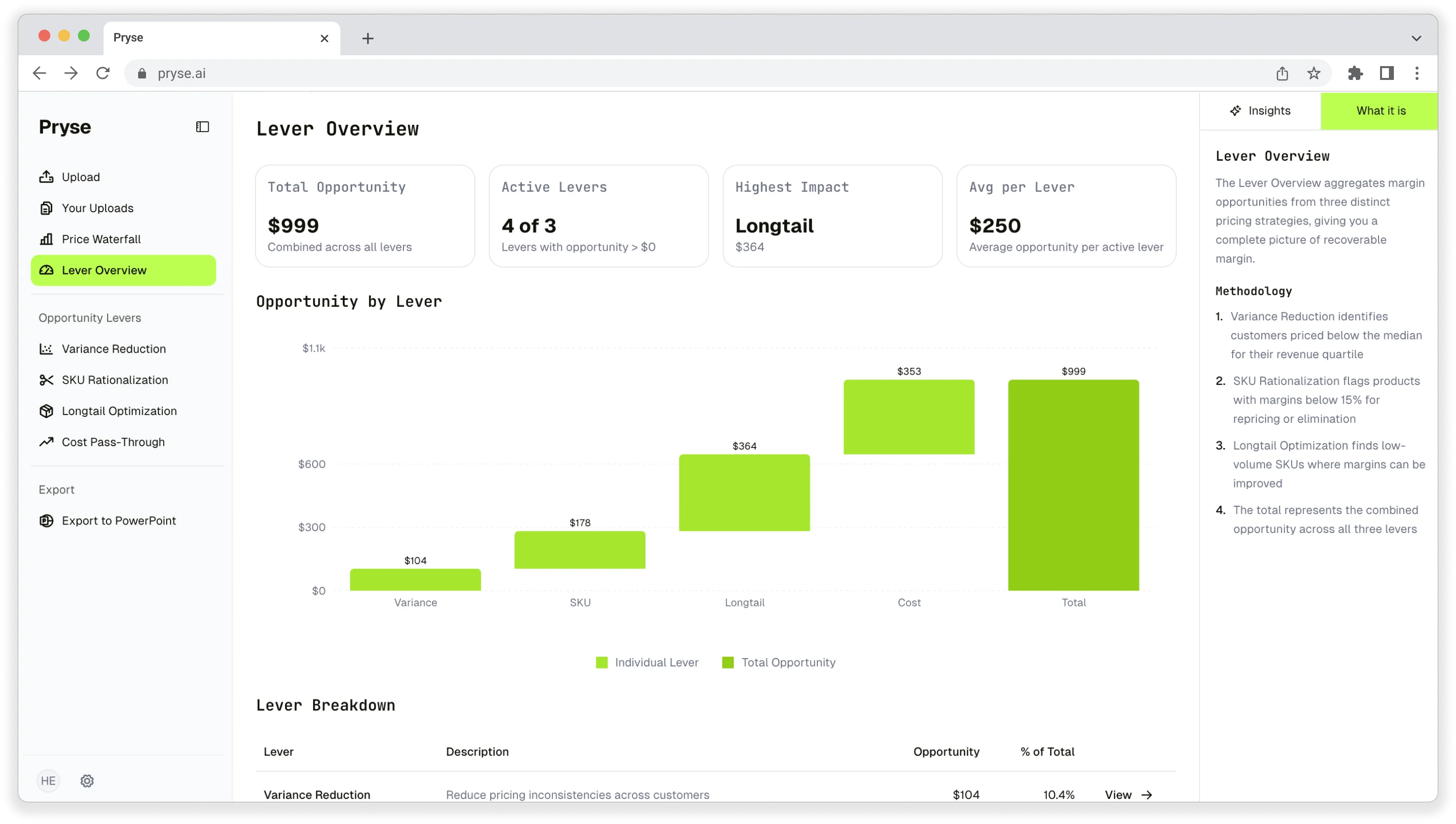
Pryse takes this approach: CSV upload, price waterfall analysis, dollar-value margin leakage identification. No implementation project. No quote automation. Just the visibility to understand where margin goes and what to do about it.
Making the Decision
The right choice depends on what problem you're solving:
"We need to understand where margin goes" — Start with diagnostic analysis. Upload data to a tool that builds the waterfall. See what you're actually dealing with before committing to CPQ.
"We need real-time margin visibility during quoting" — CPQ provides this. Budget appropriately ($100K+ year one) and plan for 3-6 month implementation.
"We need better discount controls" — CPQ approval workflows solve this, but simpler approaches exist. Approval policies enforced manually, deal review meetings, or pricing committees can improve discipline without technology.
"Our quotes take too long and have errors" — CPQ automation addresses quote speed and accuracy. This is the "C" and "Q" of CPQ—configuration and quote generation—more than price waterfall analysis.
For many mid-market companies, the sequence is: diagnose first with simpler tools, then decide if CPQ is worth the investment once you know what you're dealing with.
The price waterfall exists whether you can see it or not. Every transaction flows from list price down through discounts and costs to pocket price. The question is whether you see that erosion in real time, after the quarter closes, or never at all.
For a complete methodology on price waterfall analysis independent of tools, see our guide to price waterfall analysis.
Last updated: January 28, 2026
Frequently Asked Questions
Want to analyze your entire product catalog?
Pryse automatically identifies margin leakage across thousands of SKUs. Upload your data and find hidden profit in 24 hours.
One-time $1,499 diagnostic. No subscription required.