 Pryse
PrysePricing Optimization Software: Complete Buyer's Guide for 2026
Compare pricing optimization platforms from enterprise to mid-market. Find the right tool for your catalog size, budget, and pricing complexity level.
Pricing optimization software automates price analysis and recommendations using historical transaction data, costs, competitor pricing, and market conditions to help companies maximize margins by identifying underpriced products, optimal price points, and margin leakage patterns across thousands of SKUs.
The pricing software market was estimated at $1.2 billion in 2024 and is forecast to grow at 12.5% annually to reach $3.46 billion by 2033, according to Market Size and Trends research. This growth is driven by companies automating manual pricing processes that used to require spreadsheets and guesswork.
For mid-market distribution and manufacturing companies, choosing pricing software means deciding between enterprise platforms built for Fortune 500 scale and simpler tools designed for companies with Excel-based workflows today.
This post compares pricing optimization platforms by feature set, cost, implementation complexity, and when each category makes sense for your business.
What Pricing Optimization Software Actually Does
Pricing optimization software sits between your ERP system and your pricing decisions. It ingests transaction data, analyzes pricing patterns, and recommends price adjustments to improve margins while maintaining competitive positioning.
Core capabilities across all platforms:
- Price analysis: Identifies underpriced products, excessive discounts, and margin leakage by SKU, customer, or product category
- Optimization recommendations: Suggests price adjustments based on historical price-volume relationships, competitor positioning, or margin targets
- Scenario modeling: Tests "what if" pricing changes to predict impact on revenue and margin before implementation
- Reporting and dashboards: Visualizes pricing performance, margin trends, discount patterns, and approval workflows
Where platforms differ significantly:
- AI and machine learning: Enterprise platforms use ML to detect elasticity patterns and predict optimal prices. Mid-market tools use rule-based logic you define.
- Real-time pricing: Some platforms update prices continuously based on market conditions. Others produce quarterly price list recommendations.
- Integration depth: Enterprise tools integrate live with ERPs, CPQ systems, and ecommerce platforms. Mid-market tools often use CSV exports.
- Implementation complexity: Enterprise platforms require 6-18 months for data integration and model training. Self-serve tools deliver insights in days.
The difference between a $500K/year enterprise platform and a $1,499 diagnostic tool isn't just features—it's whether you need continuous optimization across 50,000 SKUs daily or a one-time margin analysis to identify your top 20 opportunities.
Types of Pricing Optimization Software
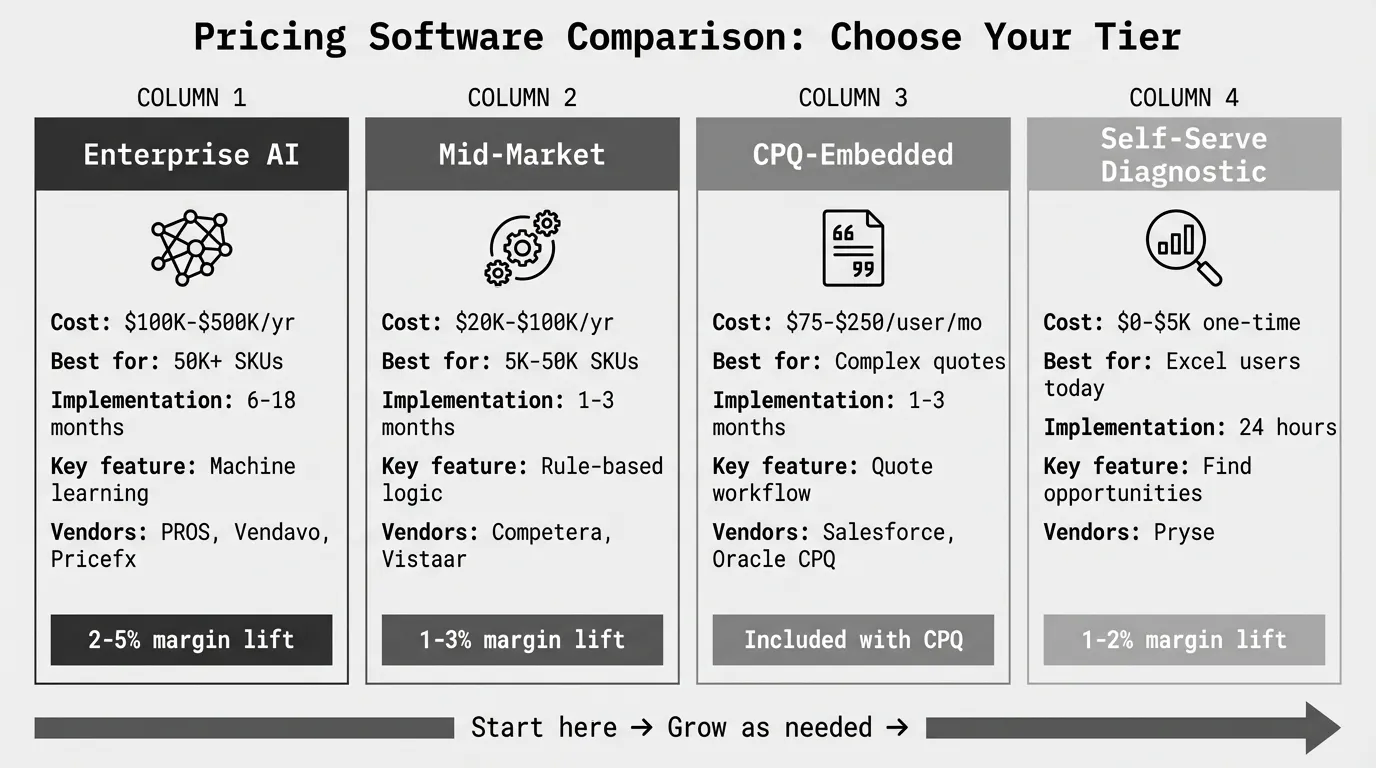
The market splits into four distinct categories based on target customer size, pricing complexity, and implementation model.
Enterprise AI Platforms ($100K-$500K annually)
Best for: Fortune 500 companies, 50,000+ SKUs, complex multi-tier channels, daily pricing changes
Leading vendors: PROS, Vendavo, Pricefx, Zilliant
What you get:
- Machine learning models that detect price elasticity and predict optimal prices automatically
- Real-time pricing that adjusts continuously based on costs, competitors, inventory, and demand
- Deep ERP integration with live data sync to NetSuite, SAP, D365, Oracle
- Advanced analytics including price-volume-mix analysis, customer segmentation, and competitive intelligence
- Dedicated implementation teams and ongoing support
What it costs:
Annual subscriptions range from $100K to $500K depending on SKU count, user count, and modules. Implementation adds 1-3x the annual subscription (typically $300K-$1M) for data integration, model training, and change management.
Implementation timeline: 6-18 months from contract signing to production use.
According to Gartner Peer Insights reviews, enterprise buyers report that while these platforms deliver 2-5% margin improvement, the complexity and cost make them viable only for companies with dedicated pricing teams and millions in recoverable margin.
When it makes sense:
You have a full-time pricing team, clear ROI from 2%+ margin improvement on $100M+ revenue (at least $2M annually), and pricing complexity that requires daily optimization across thousands of customer-SKU combinations.
Mid-Market Platforms ($20K-$100K annually)
Best for: $20M-$500M companies, 5,000-50,000 SKUs, quarterly price reviews
Examples: Competera, Vistaar, regional pricing consultancies with software offerings
What you get:
- Rule-based pricing logic that applies formulas you define (cost-plus, competitive positioning, margin targets)
- Guided workflows for price list creation and review
- Basic analytics showing margin by product, customer, and category
- CSV upload/download workflows instead of live ERP integration
- Email support with some implementation assistance
What it costs:
Annual subscriptions range from $20K to $100K. Implementation typically costs 0.5-1x the annual subscription ($10K-$50K) for setup, training, and initial price list configuration.
Implementation timeline: 1-3 months.
Software Pricing blog analysis notes that mid-market platforms work best for companies outgrowing Excel but not ready for enterprise complexity or cost.
When it makes sense:
You've recovered the "easy" margin from Excel analysis, need systematic price list management across 10,000+ SKUs, and can justify $20K-$100K annually for 1-2% margin improvement on $50M+ revenue.
CPQ-Embedded Pricing (included with CPQ subscription)
Best for: Complex configurable products, quote-driven sales, need for pricing and quoting in one tool
Examples: Salesforce CPQ, Oracle CPQ, ConnectWise CPQ
What you get:
- Quote generation with pricing rules built into configuration workflows
- Discount approval workflows that enforce margin thresholds
- Basic pricing analytics showing win rates, discount patterns, and margin by product
- Deep integration with CRM and quoting workflows
What it costs:
$75-$250 per user per month as part of broader CPQ subscription. Pricing capabilities are typically included, not priced separately.
When it makes sense:
You're already using CPQ for complex product configuration and quotes. The pricing optimization capabilities are more limited than dedicated platforms, but sufficient if your main challenge is quote-to-cash workflow rather than price list optimization.
See our complete CPQ software guide for detailed comparison of CPQ vendors and when CPQ makes sense.
Self-Serve Diagnostic Tools ($0-$5K one-time)
Best for: Companies using Excel today, first-time margin analysis, not ready for subscriptions
Examples: Pryse ($1,499), free margin calculators, Excel templates
What you get:
- Upload transaction CSV, receive margin analysis report within 24 hours
- Identifies top margin leakage sources and quantifies $ opportunity
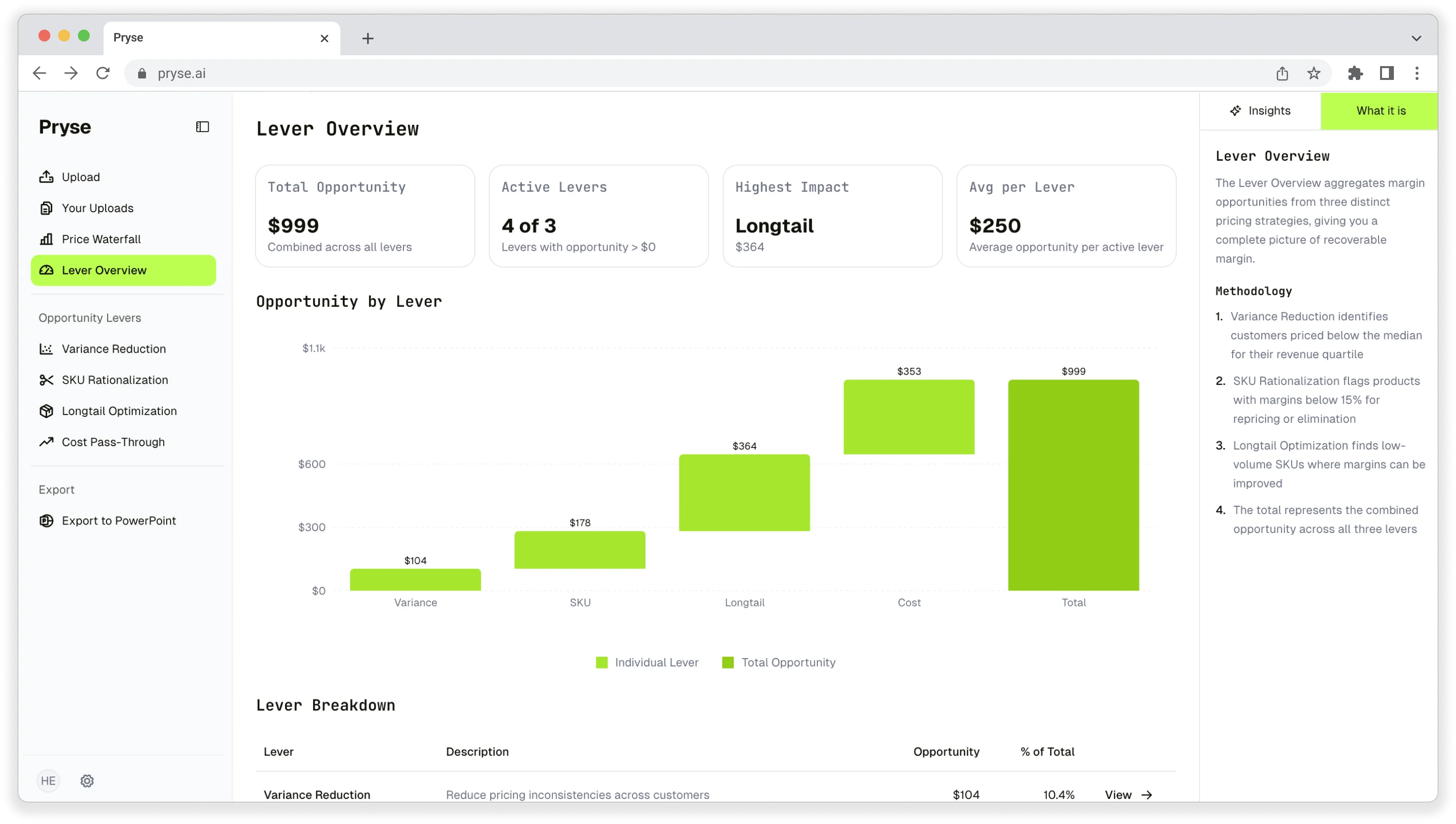
- Visual price waterfall showing list-to-pocket margin erosion
- No ongoing subscription, no implementation, no data integration
What it costs:
Pryse charges $1,499 one-time for a complete diagnostic. Free tools offer basic margin calculations but not comprehensive analysis.
Implementation timeline: Same day. Upload CSV, receive results within 24 hours.
When it makes sense:
You're using Excel today, haven't done systematic margin analysis before, and want to quantify the opportunity before investing in ongoing software. Most companies who run a diagnostic recover 3-10x the cost by fixing the top 5 issues identified.
Key Features Comparison
Not all pricing software includes these capabilities. Here's what to expect at each tier:
| Feature | Enterprise AI | Mid-Market | CPQ-Embedded | Diagnostic |
|---|---|---|---|---|
| Price elasticity modeling | ✓ (ML-based) | ✓ (rule-based) | × | × |
| Competitive intelligence | ✓ (automated) | ✓ (manual) | × | × |
| Real-time pricing | ✓ | × | × | × |
| Customer segmentation | ✓ | ✓ | ✓ | × |
| Margin waterfall analysis | ✓ | ✓ | × | ✓ |
| Discount approval workflows | ✓ | ✓ | ✓ | × |
| What-if scenario modeling | ✓ | ✓ | × | × |
| ERP integration (live) | ✓ | × | × | × |
| Implementation required | 6-18 months | 1-3 months | 1-3 months | None |
| Pricing team needed | Yes | Optional | No | No |
How to Choose Pricing Optimization Software
Start by understanding your pricing complexity, not your aspirations. Most companies overestimate their need for sophisticated software.
Decision Framework
Choose enterprise AI platforms if:
- You have 50,000+ SKUs with frequent price changes
- Your business processes 10,000+ monthly transactions with enough repeat purchases to measure elasticity
- You have a dedicated pricing team (2+ FTEs)
- You can justify $100K+ annually from 2-5% margin improvement on $100M+ revenue
- Implementation capacity exists for 6-18 month projects
Choose mid-market platforms if:
- You have 5,000-50,000 SKUs managed across product categories
- You update price lists quarterly or semi-annually, not daily
- You've already recovered "easy" margin from Excel analysis and need systematic workflows
- Budget allows $20K-$100K annually for 1-2% margin improvement
- You can allocate 1-3 months for implementation and training
Choose CPQ-embedded pricing if:
- You're already using CPQ for complex quotes
- Your pricing challenge is discount control during quoting, not price list optimization
- Quote-to-cash workflow matters more than deep pricing analytics
- Budget exists for CPQ but not separate pricing software
Choose self-serve diagnostics if:
- You're using Excel today and haven't done comprehensive margin analysis
- You need to quantify margin leakage before investing in ongoing subscriptions
- Budget constraints limit options to under $5K
- You want insights in days, not months
Red flag: You're not ready for pricing software if:
- Your transaction data is incomplete or unreliable (missing costs, inconsistent SKU codes, poor customer records)
- You don't have clear pricing strategy or objectives
- You expect software to fix pricing problems caused by poor sales discipline or market positioning
- Leadership won't support price increases regardless of data
According to G2 reviews of pricing software, the most common failure mode is buying sophisticated tools before establishing data quality and organizational readiness. Clean data beats advanced algorithms.
Pricing Software Market Leaders
Around the world in 2026, over 664 companies use pricing optimization software, with 328 from the United States, according to 6sense market analysis. Capterra's 2026 pricing software comparison shows the following market share leaders.
Enterprise Market Leaders
Pricefx (26.87% market share, 208 enterprise customers)
- Cloud-native SaaS platform for B2B pricing management, optimization, and analytics
- Modular architecture allows companies to start with price analysis and add AI optimization later
- Strong in manufacturing and distribution verticals
- 6-12 month implementation for full deployment
PROS Pricing (18.48% market share, 143 enterprise customers)
- AI-powered pricing and revenue management platform
- Strongest in industries with high pricing velocity (airlines, hospitality, industrials)
- Advanced machine learning capabilities for elasticity modeling
- Typically 12-18 month implementations
Vendavo (strong in distribution, specific market share not disclosed)
- Enterprise pricing and CPQ solution for complex B2B deal management
- Built specifically for manufacturers and distributors
- Price-volume-mix analysis and margin waterfalls
- Best for global manufacturers with complex channel pricing
Zilliant (B2B-focused, specific market share not disclosed)
- B2B pricing optimization and sales guidance platform
- Manages complete pricing lifecycle from list prices to customer deals
- Industry focus on chemicals, building materials, distribution
- Strong analytics for large SKU catalogs
Mid-Market and Specialized Players
Competera
- AI-powered pricing platform for retail and ecommerce
- Real-time competitive pricing intelligence
- Strong for commodity distributors with frequent price changes
Vistaar
- SaaS platform for pricing, promotion, and rebate management
- Uses predictive models and machine learning for profitable growth
- Mid-market focus with faster implementation than enterprise platforms
Centric Software
- Launched enhanced pricing and inventory capabilities in 2026
- AI-powered demand forecasting engine
- Targets retail and wholesale distribution
See Gitnux's ranking of top B2B pricing software for detailed vendor comparisons including pricing, features, and customer reviews.
Implementation Considerations
Pricing software success depends on implementation approach, not just vendor selection.
Data Requirements
All platforms require clean historical transaction data. Minimum dataset:
- 6-12 months of transaction history (more is better)
- SKU identifier, description, and category
- Customer identifier and segment
- Invoice price and quantity
- Cost (COGS)
- Transaction date
Nice to have:
- Competitor pricing data
- Inventory levels and lead times
- Customer profitability beyond product margin
- Market or economic indicators
Most companies discover data quality issues during implementation. Budget 20-40% of implementation time for data cleaning and normalization.
Organizational Readiness
Critical success factors:
- Executive sponsorship: Leadership commits to acting on pricing recommendations, not just analyzing them
- Cross-functional alignment: Sales, finance, operations, and IT agree on pricing objectives and constraints
- Change management: Plans exist for communicating price changes to sales teams and customers
- Sales enablement: Reps understand rationale for price changes and have tools to defend them
Companies that treat pricing software as a technology project fail. Companies that treat it as a business transformation with technology enablement succeed.
Integration Architecture
Enterprise platforms integrate live with your ERP system, pulling transaction data continuously and pushing price updates back to master data. This requires IT resources for API configuration, testing, and ongoing maintenance.
Mid-market platforms typically use scheduled CSV exports from your ERP, manual analysis in the pricing platform, and CSV uploads back to ERP for price updates. Less integration complexity but more manual workflow.
Self-serve diagnostics require one-time CSV export from your ERP. No integration needed.
Alternatives to Pricing Software
Not every company needs specialized pricing software. Several alternatives deliver margin improvement without software subscriptions.
Excel-Based Analysis
For companies with under 5,000 SKUs and straightforward pricing, Excel delivers 80% of the insight at 1% of the cost.
What works in Excel:
- Margin analysis by product, customer, and category
- Price waterfall visualization showing list-to-pocket erosion
- Discount pattern analysis
- Underpriced product identification using simple margin thresholds
What doesn't scale in Excel:
- 20,000+ SKU price lists updated quarterly
- Customer-specific pricing across hundreds of customers
- Real-time pricing based on market conditions
- Statistical price elasticity calculations
See our guide on margin analysis in Excel for step-by-step instructions.
Pricing Diagnostics (One-Time)
Before committing to ongoing software subscriptions, run a one-time diagnostic to quantify your margin leakage and prioritize opportunities.
Pryse provides self-serve margin diagnostics for $1,499. Upload your transaction CSV, receive a complete margin analysis within 24 hours showing:
- Price waterfall visualization
- Top margin leakage sources ranked by $ opportunity
- Underpriced products and customers
- Quick-win pricing adjustments
Most companies recover 3-10x the diagnostic cost by implementing the top 5 recommendations. If your opportunities are small, you've saved $100K+ by not investing in ongoing software you don't need.
Pricing Consultants
Hiring pricing consultants costs $50K-$500K for a 3-6 month engagement but delivers strategic recommendations beyond what software provides.
When consultants make sense:
- You need pricing strategy and organizational design, not just analysis
- Your business model is changing and requires pricing restructuring
- You lack internal expertise to interpret software recommendations
Simon-Kucher, McKinsey, Bain, and specialized pricing firms combine strategic guidance with analytical tools. Budget $200K-$500K for mid-market engagements.
Trade-off: Consultants deliver one-time insight. Software provides ongoing optimization. Many companies start with consulting to build strategy, then implement software for execution.
Cost-Benefit Analysis
Pricing software ROI comes from margin improvement, not cost savings.
Typical Margin Improvements
Research shows the following margin uplift ranges by platform type:
- Enterprise AI platforms: 2-5% margin improvement (per PROS customer case studies)
- Mid-market platforms: 1-3% margin improvement
- Self-serve diagnostics: 1-2% margin improvement from top opportunities
- Excel analysis: 0.5-1.5% margin improvement
Break-Even Scenarios
Enterprise platform ($100K-$500K annually + implementation):
Break-even requires $5M-$25M in margin improvement over 3 years at 2-5% lift. This means you need $100M-$500M in annual revenue with recoverable margin problems.
Mid-market platform ($20K-$100K annually):
Break-even requires $1M-$5M in margin improvement over 3 years at 1-3% lift. This means $33M-$167M in annual revenue.
Diagnostic ($1,499 one-time):
Break-even requires recovering $15K-$50K from implementing top recommendations. Any company with $5M+ revenue and pricing problems meets this threshold easily.
Hidden Costs
Software subscription isn't the only cost. Budget for:
- Implementation: 0.5-3x annual subscription for enterprise platforms
- Ongoing IT support: API maintenance, data integration monitoring
- Training: Initial training plus ongoing as team members change
- Change management: Communicating price changes to sales and customers
- Opportunity cost: Leadership and team time during implementation
Companies that budget only for software subscriptions but not implementation and change management typically abandon projects halfway through.
Getting Started
Most companies should start with diagnostics before committing to subscriptions.
Step 1: Run a Margin Diagnostic
Export 12 months of transaction data from your ERP (SKU, customer, price, volume, cost). Run it through a diagnostic tool or Excel analysis to identify:
- Your current margin by product and customer
- Where margin leakage occurs (discounts, rebates, freight)
- How much opportunity exists in your top 20 issues
If you can't recover $50K+ from fixing top issues, you don't need ongoing software yet. Fix the obvious problems first.
Step 2: Quantify Complexity
Count your pricing decision points:
- How many active SKUs?
- How many customers with unique pricing?
- How often do prices change?
- Do you have real-time pricing needs or quarterly updates?
Under 5,000 SKUs with quarterly updates: Excel works fine.
5,000-20,000 SKUs with quarterly updates: Mid-market platform.
20,000+ SKUs with frequent changes: Enterprise platform.
Step 3: Assess Organizational Readiness
Before buying software, confirm:
- Leadership will act on pricing recommendations
- Sales team has guidance on defending price increases
- Data quality is sufficient (or budget exists to fix it)
- 1-2 people can dedicate time to implementation
Software doesn't fix organizational problems. It amplifies what you already do well.
Step 4: Select and Implement
Once you've confirmed the opportunity, complexity justifies investment, and organization is ready:
- Enterprise platforms: Request demos from PROS, Vendavo, Pricefx, and Zilliant. Budget 2-3 months for vendor selection and 6-18 months for implementation.
- Mid-market platforms: Request trials from 2-3 vendors. Budget 1-2 months for selection and 1-3 months for implementation.
- Self-serve diagnostics: Upload CSV to Pryse, receive analysis in 24 hours, implement top recommendations in 30-60 days.
Next Steps
Before evaluating vendors, understand your baseline. Most companies discover they have $100K-$1M in recoverable margin they didn't know about.
Run a margin diagnostic first. This costs $1,499 with Pryse and takes 24 hours from CSV upload to results. You'll learn:
- Your actual margin by product and customer (most companies are surprised)
- Where margin leakage occurs and how much is recoverable
- Whether Excel, mid-market software, or enterprise platforms make sense for your complexity
Start with diagnostics. Invest in software once you've confirmed the opportunity and organizational readiness.
For companies ready to explore pricing optimization strategy beyond software selection, see our complete pricing optimization guide covering frameworks, organizational design, and implementation best practices.
Sources
- Market Size and Trends: Pricing Software & Tools Market Report
- Business Research Insights: Dynamic Pricing Software Market
- Gartner Peer Insights: B2B Profit Optimization Software Reviews 2026
- 6sense: Pricing Optimization Market Analysis
- Capterra: Best Pricing Optimization Software 2026
- G2: Pricing Software User Reviews
- Gitnux: Top 10 Best B2B Pricing Software of 2026
- Software Pricing: B2B Pricing Software Complete Guide
- PROS: How AI-Powered Pricing Improved Gross Margins
Last updated: February 23, 2026
Frequently Asked Questions
Want to analyze your entire product catalog?
Pryse automatically identifies margin leakage across thousands of SKUs. Upload your data and find hidden profit in 24 hours.
One-time $1,499 diagnostic. No subscription required.