 Pryse
PryseIncome Elasticity of Demand: What It Is, Formula & Examples
Income elasticity of demand measures how quantity demanded changes when customer income changes. Learn the formula, types of goods, and how to interpret coefficients.
Income elasticity of demand measures how quantity demanded changes when consumer income changes. It's calculated as the percentage change in quantity demanded divided by the percentage change in income. The coefficient tells you whether a product is a luxury good (elasticity > 1), normal good (0 to 1), or inferior good (negative elasticity).
Income elasticity predicts how demand responds to economic cycles. Luxury goods face collapsing demand during recessions. Necessities stay stable. Inferior goods see increasing demand when incomes fall. Understanding where your product sits on this spectrum helps you forecast demand and adjust pricing strategy.
What Is Income Elasticity of Demand
Income elasticity of demand (YED) is the responsiveness of quantity demanded to changes in consumer income. It measures how much demand shifts when income shifts.
The formula is:
Income Elasticity = (% Change in Quantity Demanded) / (% Change in Income)
Example: Restaurant dining increases by 5% when average income rises by 10%. Income elasticity is 0.5 (5% / 10%). This is a normal good with positive but inelastic income elasticity.
Why it matters: Income elasticity predicts how your product performs during economic expansions and contractions. During recessions, luxury goods lose demand faster than income falls. Inferior goods gain demand. Necessities stay relatively stable.
According to Intelligent Economist's income elasticity guide, the idea of national income is very important to businesses as it helps them decide which sectors they should invest their money in, with investors tending to invest in markets where the income elasticity of demand is greater than negligible.
Income Elasticity Formula
The formula for income elasticity of demand is:
YED = ((Q₂ - Q₁) / Q₁) / ((I₂ - I₁) / I₁)
Where:
Q₁ = Original quantity demanded
Q₂ = New quantity demanded
I₁ = Original income
I₂ = New income
Step-by-step calculation:
- Calculate the percentage change in quantity demanded
- Calculate the percentage change in income
- Divide quantity change by income change
Example calculation:
A customer buys 4 restaurant meals per month at an income of $4,000/month. Income increases to $4,500/month. They now buy 5 restaurant meals per month.
Step 1: Percentage change in quantity = (5 - 4) / 4 = 25%
Step 2: Percentage change in income = ($4,500 - $4,000) / $4,000 = 12.5%
Step 3: Income elasticity = 25% / 12.5% = 2.0
This product has income elasticity of 2.0, making it a luxury good. A 1% income increase causes a 2% increase in quantity demanded.
Types of Goods Based on Income Elasticity
Income elasticity classifies goods into four categories based on how demand responds to income changes.
Normal Goods (YED between 0 and 1)
Normal goods have positive income elasticity less than 1. When income rises, demand rises, but slower than income. These are necessities.
According to Social Science LibreTexts, a necessity is one whose income elasticity is greater than zero but less than unity. Goods like food and fuel have income elasticities less than 1.
Examples:
- Gasoline: Income elasticity ranges from 0.66 to 1.26 in developed economies
- Cereals: Elasticity of 0.62 in Tanzania, 0.47 in Georgia, 0.28 in Slovenia, 0.05 in the United States
- Limited-service restaurants: Elasticity of 0.18
What this means: A 10% income increase causes less than 10% demand increase. These products are stable during economic cycles. People don't buy dramatically more food when they get a raise.
Luxury Goods (YED greater than 1)
Luxury goods have income elasticity above 1. When income rises, demand rises faster than income. These are discretionary, high-end products.
According to Social Science LibreTexts, a luxury good or service is one whose income elasticity equals or exceeds unity. Diamonds are a luxury good that is income elastic. Empirical research indicates that leisure goods and foreign holidays have elasticities very much greater than 1.
Examples:
- New automobiles: Income elasticity of 1.70
- Diamonds and jewelry: Elasticity above 1
- Foreign holidays: Elasticity significantly above 1
- HD TVs and electronics: Elasticity above 1
What this means: A 10% income increase causes more than 10% demand increase. These products are highly sensitive to economic cycles. Demand collapses during recessions and surges during expansions.
Research data: Lindsay's 1996 study on vehicle demand found market price and income elasticities for new vehicle purchases were estimated at -0.87 and 1.70, respectively, based on a survey of new vehicle purchasers in 1989.
Inferior Goods (YED less than 0)
Inferior goods have negative income elasticity. When income rises, demand falls. Consumers switch to higher-quality substitutes when they can afford it.
According to Economics Help's guide on different types of goods, an example of an inferior good is Tesco value bread. When your income rises you buy less Tesco value bread and more high quality, organic bread.
Examples:
- Margarine: Income elasticity of -0.20
- Discount store brands: Negative elasticity
- Laundromats: Negative elasticity as people buy their own washers
- Public transit: Negative elasticity as people buy cars
- Used goods: Negative elasticity as people buy new
What this means: A 10% income increase causes demand to decrease. These products are counter-cyclical. Demand rises during recessions when consumers trade down from premium alternatives.
According to Social Science LibreTexts, margarine has an elasticity of -0.20, exemplifying an inferior good with negative elasticity. Inferior goods are those for which there exist higher-quality, more expensive, substitutes.
Zero Income Elasticity (YED = 0)
Some products have zero income elasticity. Demand doesn't change when income changes. These are rare.
Examples:
- Salt: Income doesn't affect how much you use
- Basic utilities: Consumption is relatively fixed regardless of income
- Prescription medications: Medical need determines demand, not income
What this means: Income shifts don't predict demand changes. These products are completely independent of economic cycles from an income perspective.
Income Elasticity vs Price Elasticity
Income elasticity and price elasticity measure different things. Both help predict demand, but they respond to different variables.
| Aspect | Price Elasticity | Income Elasticity |
|---|---|---|
| Measures | Response to price changes | Response to income changes |
| Formula | % Change in Quantity / % Change in Price | % Change in Quantity / % Change in Income |
| Sign | Usually negative (inverse relationship) | Positive for normal goods, negative for inferior goods |
| Use case | Pricing strategy and revenue optimization | Economic cycle forecasting and market growth prediction |
| Typical range | -0.1 to -3.0 for most products | -0.5 to +2.5 for most products |
Example showing the difference:
Gasoline has low price elasticity (around -0.2 to -0.4 short-term). People need to drive regardless of price changes. But gasoline also has moderate income elasticity (0.66 to 1.26). When the economy grows and income rises, people drive more and buy bigger vehicles.
Price elasticity tells you what happens when you raise price. Income elasticity tells you what happens when the economy grows or contracts.
A product can be:
- Price inelastic but income elastic (prescription medications)
- Price elastic but income inelastic (fast food)
- Both price and income elastic (luxury goods)
- Both price and income inelastic (basic necessities)
Real-World Income Elasticity Examples
Example 1: Automobiles (Luxury Good, YED = 1.70)
New car purchases have income elasticity of 1.70. When average income rises 10%, new car demand rises 17%.
This explains why auto sales collapsed during the 2008 recession. Income fell 3-5%, but car sales dropped 20-30% because of high income elasticity. Conversely, when the economy recovered and incomes rose, auto demand surged.
According to Resources for the Future's research on vehicle demand, new passenger vehicle demand shows significant income sensitivity, with elasticities consistently above 1 across developed markets.
Pricing implications: Auto manufacturers should expand production and raise prices during economic expansions. During recessions, they need to cut production, offer incentives, and wait for the recovery.
Example 2: Restaurant Dining (Normal Good, YED = 0.18-0.50)
Limited-service restaurants (fast food) have income elasticity of 0.18. Full-service restaurants have higher income elasticity around 0.50-0.80.
According to U.S. Bureau of Labor Statistics research on restaurant demand, the expenditure elasticity for foods from limited-service restaurants is 0.18, meaning that a 1-percent increase in total expenditures on all food and nonfood items increases demand for limited-service meals and snacks by 0.18 percent.
What this means: Fast food is relatively recession-resistant. Demand drops slightly when incomes fall, but not dramatically. Fine dining faces larger demand swings because it's more discretionary.
Pricing implications: Fast-food chains can maintain stable pricing through economic cycles. Full-service restaurants should prepare for volume drops during recessions and volume surges during expansions.
Example 3: Margarine (Inferior Good, YED = -0.20)
Margarine has income elasticity of -0.20. When income rises 10%, margarine demand falls 2%. Consumers switch to butter when they can afford it.
What this means: Margarine is counter-cyclical. Sales increase slightly during recessions as consumers trade down from butter. Sales decrease during economic growth as consumers upgrade.
Pricing implications: Margarine manufacturers should expect volume pressure during economic expansions. They compete on price and can't raise prices without losing customers to butter.
Example 4: Cereals (Normal Good, YED varies by market)
Cereal income elasticity varies dramatically by country:
- Tanzania: 0.62
- Georgia: 0.47
- Slovenia: 0.28
- United States: 0.05
In developing markets, cereal is still a significant budget item that increases with income. In developed markets like the U.S., cereal purchases barely respond to income changes because most people already buy what they need.
Pricing implications: Cereal manufacturers should expect volume growth in developing markets as incomes rise. In developed markets, growth comes from population and market share, not income growth.
Example 5: Gasoline (Normal Good, YED = 0.66-1.26)
Gasoline income elasticity ranges from 0.66 to 1.26 across developed economies. When income rises, people drive more, take longer trips, and buy larger vehicles.
But this is long-term elasticity. Short-term income changes don't immediately affect gas consumption because driving patterns are habitual.
According to ScienceDirect research on fuel price elasticities, for car usage in Sweden, the preferred income elasticity is 0.2, while the preferred long-run fuel price elasticity is -0.53.
Pricing implications: Gas stations can't use income elasticity for pricing strategy because they're price takers. But oil companies and policymakers use it to forecast long-term demand growth.
How to Use Income Elasticity for Pricing Strategy
Income elasticity helps you forecast demand and adjust pricing based on economic conditions.
For Luxury Goods (YED > 1)
During economic expansions:
- Demand will grow faster than income
- Customers are less price sensitive
- You can raise prices without losing volume
- Expand product offerings and premium tiers
During recessions:
- Demand will collapse faster than income falls
- Customers become more price sensitive
- Discounting and promotions become necessary
- Consider launching mid-tier products to retain customers trading down
Example: An auto dealer knows that during recessions, luxury car demand will drop 15-20% even if local income only drops 8-10%. They should cut inventory, offer financing incentives, and prepare for 18-24 months of low sales.
For Normal Goods (YED 0 to 1)
During economic expansions:
- Demand will grow, but slower than income
- Volume increases are modest
- Pricing power is moderate
- Focus on market share and efficiency
During recessions:
- Demand will fall, but slower than income
- Volume decreases are modest
- You can maintain pricing better than luxury goods
- Emphasize value and reliability
Example: A restaurant chain knows that demand will drop 3-5% during a recession even if income drops 8%. They can maintain pricing and focus on cost control instead of chasing volume with discounts.
For Inferior Goods (YED < 0)
During economic expansions:
- Demand will decrease as customers trade up
- You'll lose volume despite economic growth
- Don't raise prices—customers are already leaving
- Focus on defending market share
During recessions:
- Demand will increase as customers trade down
- Volume growth comes from the downturn
- You can raise prices moderately
- Expand distribution to capture new customers
Example: A discount grocery chain knows that during recessions, customers will trade down from premium brands to their private label products. They should increase inventory, maintain stock, and capture new customers who will stick with them even after the recovery.
Common Mistakes When Using Income Elasticity
Mistake 1: Assuming elasticity is static
Income elasticity changes over time and across markets. Cereals have elasticity of 0.62 in Tanzania and 0.05 in the United States. The same product behaves differently depending on income levels and market maturity.
Don't apply elasticity coefficients from one market to another without validation.
Mistake 2: Confusing income elasticity with price elasticity
Income elasticity tells you how demand responds to economic cycles. Price elasticity tells you how demand responds to your pricing decisions. You need both.
A product can be income elastic (luxury good, sensitive to recessions) but price inelastic (customers pay whatever you charge when they do buy).
Mistake 3: Ignoring segment differences
Income elasticity varies by customer segment. High-income customers have different income elasticity than low-income customers for the same product.
Example: Business class airline tickets have near-zero income elasticity for corporate travelers (company pays regardless). Economy tickets for leisure travel have income elasticity above 1.
Calculate elasticity by segment, not just overall.
Mistake 4: Using short-term data to measure long-term elasticity
Income changes take time to affect purchasing behavior. A salary increase doesn't immediately change car buying, restaurant frequency, or vacation spending.
Allow 6-12 months of data after income changes to measure true income elasticity. Short-term measurements underestimate the effect.
Mistake 5: Treating all necessities as income inelastic
Not all necessities have low income elasticity. Food has moderate income elasticity because people buy higher-quality food when income rises. They don't eat more pounds of food, but they trade up from discount brands to premium brands.
The quantity purchased might be inelastic, but the spending on the category can be income elastic.
Income Elasticity for B2B Products
B2B income elasticity is harder to measure than consumer income elasticity. Business purchasing responds to company revenue and profitability, not household income.
B2B patterns:
Capital equipment: High income elasticity. When business revenue grows, companies invest in new equipment. During recessions, capital spending freezes. Elasticity can be 2.0 or higher.
MRO supplies: Low income elasticity. Companies need maintenance supplies regardless of revenue. Elasticity close to 0 or slightly positive.
Raw materials: Moderate income elasticity. Tied to production volume, which correlates with economic growth. Elasticity around 0.8-1.2.
Professional services: High income elasticity. Consulting, marketing, and advisory services get cut first during recessions and expanded during growth. Elasticity above 1.
Example: An industrial distributor sells both commodity fasteners (low income elasticity, near 0) and specialized tooling (high income elasticity, around 1.5). During recessions, fastener sales stay stable but tooling sales collapse. The distributor should forecast demand by product category, not overall.
Next Steps
Income elasticity predicts how your product performs during economic cycles. Luxury goods face collapsing demand during recessions. Necessities stay stable. Inferior goods see counter-cyclical growth.
The coefficient tells you what to expect, but you still need to decide how to respond. Should you maintain price and accept lower volume? Cut price to defend volume? Launch new tiers to capture customers trading down?
For more on how elasticity affects pricing strategy, see our Price Elasticity Guide. To understand the related concept of how price changes affect demand, see our posts on Price Elasticity Formula and Price Elasticity Examples.
To measure price sensitivity across your product catalog, see our guide on Price Elasticity Calculator. For other elasticity concepts, see Cross-Price Elasticity and Price Elasticity of Supply.
If you want to identify pricing opportunities across thousands of SKUs without manually calculating elasticity, Pryse's margin diagnostic analyzes your transaction data to find margin leakage and pricing inconsistencies.
Sources
- Income Elasticity of Demand - Intelligent Economist
- The income elasticity of demand - Social Science LibreTexts
- Different types of goods - Inferior, Normal, Luxury - Economics Help
- Market Price and Income Elasticities of New Vehicle Demands - Lindsay Research
- Restaurant Demand Elasticities - U.S. Bureau of Labor Statistics
- New Passenger Vehicle Demand Elasticities - Resources for the Future
- Income and fuel price elasticities of car use - ScienceDirect
- Income Elasticity of Demand Calculator - Omni Calculator
Last updated: February 24, 2026
Frequently Asked Questions
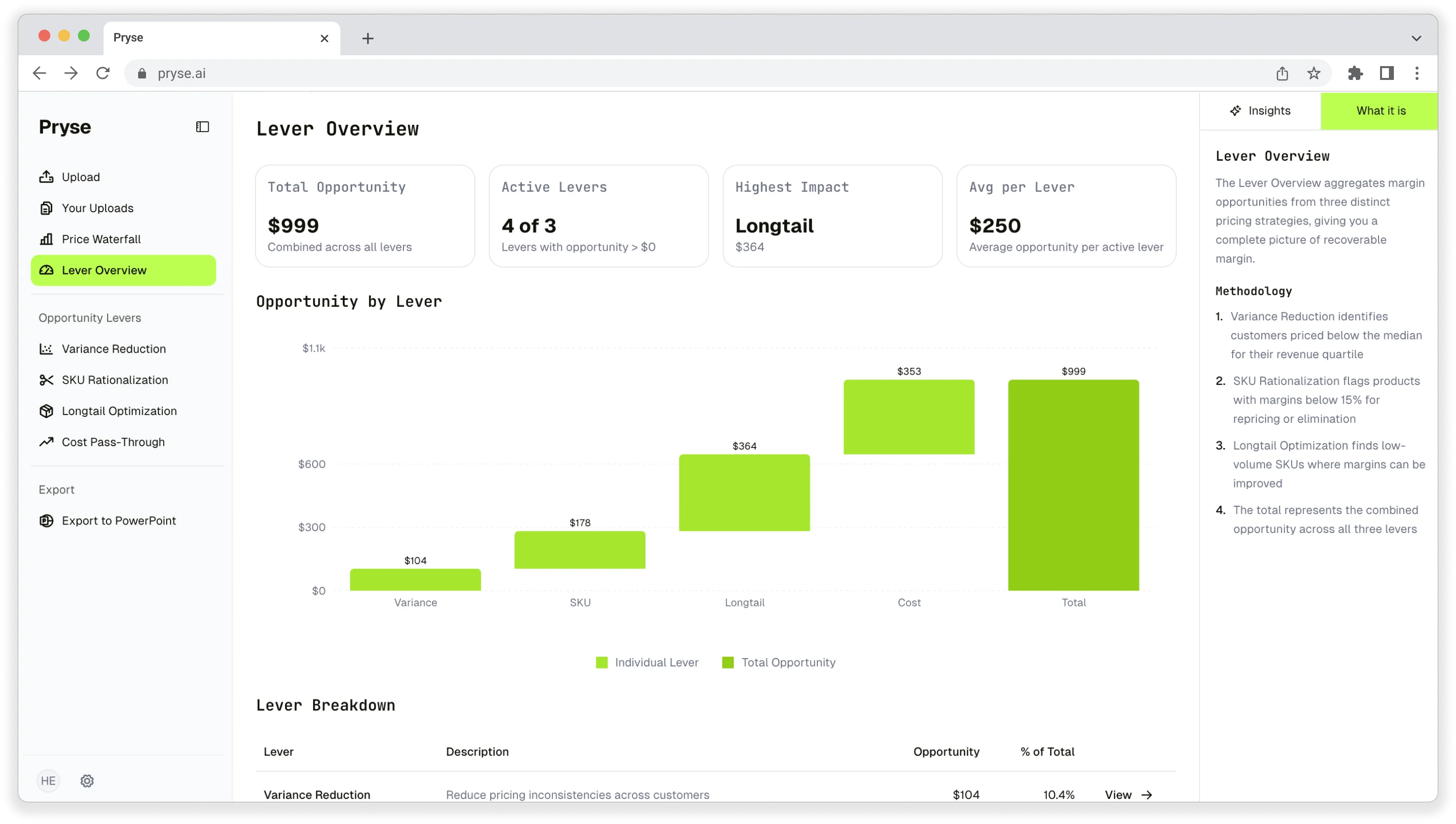
Want to analyze your entire product catalog?
Pryse automatically identifies margin leakage across thousands of SKUs. Upload your data and find hidden profit in 24 hours.
One-time $1,499 diagnostic. No subscription required.