 Pryse
PrysePrice Sensitivity: What It Is, How to Measure It, and How to Use It
Learn what price sensitivity means, how to measure it with Van Westendorp and elasticity methods, and how B2B companies use it to optimize pricing strategy.
Price sensitivity describes how much a customer's behavior changes in response to pricing. More specifically, it refers to the extent to which purchase decisions are influenced by changes in the price of a product or service. Highly price-sensitive customers shift demand significantly when prices change. Customers with low price sensitivity buy based on other factors like quality, brand, or features, with price playing a smaller role.
Understanding price sensitivity helps you set prices that maximize revenue without losing volume. The hard part is measuring it accurately and using it to make better pricing decisions.
Price Sensitivity vs Price Elasticity
The terms are related but not identical.
Price sensitivity is the general concept of how responsive customers are to price changes. It's qualitative. You can say customers are "highly price sensitive" or "not very price sensitive" without quantifying it.
Price elasticity is the specific measurement. It quantifies sensitivity with a coefficient calculated as the percentage change in quantity demanded divided by the percentage change in price. A coefficient of -1.5 means a 10% price increase causes a 15% drop in quantity demanded.
Price elasticity is one way to measure price sensitivity, but sensitivity is the broader concept. You can describe price sensitivity without calculating elasticity. See our guide on the Price Elasticity Formula for how to calculate the specific coefficient.
Why Price Sensitivity Matters for Pricing Strategy
According to PandaDoc's pricing guide, price sensitivity is a core concept of pricing analytics and a key variable in how businesses ultimately set prices, forecast demand, and position products in competitive markets.
Without understanding price sensitivity, you're guessing. You raise price 5% and hope customers don't leave. You cut price to win volume and hope it doesn't destroy margin. Price sensitivity data removes the guesswork.
What you can do with price sensitivity data:
- Identify which products can handle price increases without losing volume
- Segment customers by sensitivity and price discriminate accordingly
- Set promotional discounts that drive volume without training customers to wait for sales
- Forecast revenue impact of price changes before implementing them
- Optimize pricing across product portfolios to maximize total profit
- Avoid overestimating how much customers care about price
That last point matters more than most companies realize. According to research cited by Zilliant, many companies overestimate customer price sensitivity, particularly in B2B where sales teams often attribute specific losses to price even when other factors are key drivers.
Your sales team says customers are extremely price sensitive. Transaction data often shows they're not. Measurement reveals the truth.
Factors That Influence Price Sensitivity
Not all products and customers have the same price sensitivity. According to Salesforce's price sensitivity guide, consumer price sensitivity varies between customers within a target market. What will make more price-sensitive customers walk away from a deal won't bother buyers who can justify those costs based on brand reputation, quality, and other factors.
Product characteristics that increase price sensitivity:
- Many substitutes available (commodity products, standard MRO supplies)
- Product is not essential or mission-critical
- Purchase can be delayed without consequences
- High price transparency (customers know market rates)
- Low switching costs (easy to change suppliers)
- Weak brand differentiation
- Product represents a large portion of budget
Product characteristics that decrease price sensitivity:
- Few or no substitutes (specialty or proprietary items)
- Essential or mission-critical products
- Time-sensitive needs (can't delay)
- Limited price transparency (customers don't know alternatives)
- High switching costs (integration, training, certifications)
- Strong brand loyalty or reputation
- Small portion of total spend ("rounding error" purchases)
Market conditions that increase price sensitivity:
- Economic downturns (budgets tighten)
- Increased competition
- Customer consolidation (larger buyers with more leverage)
- Industry overcapacity
- Transparent online pricing
Market conditions that decrease price sensitivity:
- Economic booms (customers prioritize availability over price)
- Supply constraints or product scarcity
- Rising switching costs (ecosystem lock-in)
- Regulatory requirements (limits substitutes)
How to Measure Price Sensitivity
There are several methods for measuring price sensitivity. The right approach depends on your business model, data availability, and how precisely you need to measure.
Method 1: Price Elasticity from Transaction Data
This is the most accurate method for companies with sufficient historical data. You calculate how quantity demanded changed when price changed, controlling for other variables.
The basic formula:
Price Elasticity of Demand = (% Change in Quantity Demanded) / (% Change in Price)
If the coefficient is between 0 and -1, demand is inelastic (low price sensitivity). If the coefficient is less than -1 (like -1.8), demand is elastic (high price sensitivity).
What you need:
- 12-24 months of transaction data
- Columns for: Date, Customer, Product, Quantity Sold, Price per Unit
- Enough price variation to measure response
Advantages:
- Based on actual customer behavior, not stated preferences
- Quantifies exact sensitivity with a coefficient
- Can segment by customer type, product category, or region
Disadvantages:
- Requires substantial transaction history
- Can't predict sensitivity for new products
- Hard to isolate price effect from other variables (competitors, seasonality, market conditions)
See our detailed guide on How to Calculate Price Elasticity for step-by-step instructions using Excel or transaction data.
Method 2: Van Westendorp Price Sensitivity Meter
The Van Westendorp method asks customers four questions to identify an acceptable price range. It's one of the most common and effective ways to conduct pricing research, according to SurveyMonkey's pricing guide.
The four questions:
- At what price would you consider this product too expensive to consider purchasing it?
- At what price would you consider this product starting to get expensive, but you would still consider buying it?
- At what price would you consider this product to be a bargain—a great buy for the money?
- At what price would you consider this product too cheap that you would question its quality?
You plot the cumulative responses and find where lines intersect:
- Point of Marginal Cheapness (PMC): Where "too cheap" and "expensive" lines cross—below this price, more people think it's too cheap than expensive
- Point of Marginal Expensiveness (PME): Where "too expensive" and "bargain" lines cross—above this price, more people think it's too expensive than a bargain
- Optimal Price Point (OPP): Where "too cheap" and "too expensive" lines cross—equal numbers think it's too cheap and too expensive
- Indifference Price Point (IPP): Where "expensive" and "bargain" lines cross—equal numbers think it's expensive and a bargain
The range between PMC and PME represents the acceptable price range. The OPP is often used as the starting point for pricing.
What you need:
- 200-400 survey respondents per customer segment for stable results
- Can work with 100 respondents for directional guidance
Advantages:
- Works for new products with no transaction history
- Fast and relatively inexpensive to implement
- Provides a psychologically anchored price range
- Easy to explain to stakeholders
Disadvantages:
- Based on stated preferences, not actual behavior (what people say vs what they do)
- Doesn't account for competitive context or substitutes
- Can be biased by how you describe the product
- Less useful for complex B2B situations with multi-stakeholder buying
According to B2B International, the Van Westendorp method was developed by Dutch economist Peter van Westendorp in 1976 and achieves 82-87% accuracy in predicting optimal price points in validation studies.
Method 3: Conjoint Analysis
Conjoint analysis presents customers with different product configurations (features, brand, price) and asks them to choose. By varying price systematically, you can isolate how much price influences choice relative to other factors.
What you need:
- Survey platform that supports conjoint studies
- 200-500 respondents per segment
- Clear feature and price variation
Advantages:
- Measures willingness to pay for specific features
- Shows trade-offs customers make (price vs quality, price vs brand)
- Can simulate competitive scenarios
Disadvantages:
- More complex and expensive than Van Westendorp
- Requires careful study design to avoid bias
- Still based on stated preferences
Method 4: A/B Price Testing
You test different prices with different customer segments or at different times and measure conversion rates, order value, and revenue.
What you need:
- Ability to segment customers or randomize pricing
- Sufficient traffic/volume for statistical significance
- Tracking for conversion, revenue, and margin
Advantages:
- Based on actual behavior, not surveys
- Can test multiple price points simultaneously
- Works for both new and existing products
Disadvantages:
- Can upset customers if they discover different prices
- Requires sufficient volume for significance
- May train customers to wait for lower prices
Method 5: Customer Interviews and Surveys
Qualitative research can reveal why customers are price sensitive and what drives their purchasing decisions.
Useful questions:
- How do you evaluate suppliers when making purchasing decisions?
- How important is price compared to delivery, quality, and service?
- At what price premium would you consider switching suppliers?
- What would justify paying more for this product?
Advantages:
- Uncovers the "why" behind sensitivity
- Can identify non-price factors that reduce sensitivity
- Works for early-stage products
Disadvantages:
- Small sample sizes
- Stated preferences may not match behavior
- Time-intensive to conduct and analyze
Price Sensitivity in B2B vs B2C
Price sensitivity works differently in B2B markets than consumer markets.
B2C price sensitivity:
- Relatively consistent within demographic segments
- Driven primarily by product attributes, brand, and income
- Purchase decisions are individual or household-level
- Easier to measure with large sample surveys
B2B price sensitivity:
- Varies dramatically by customer segment and relationship
- Driven by switching costs, integration, and total cost of ownership
- Multi-stakeholder buying processes complicate sensitivity
- Harder to measure due to smaller sample sizes and longer sales cycles
According to research from Oliver Wyman, the criteria related to product, customer, and order type that drive price perception and sensitivity should be clearly identified in B2B manufacturing contexts. Price strategy is a comprehensive variable of production planning.
Examples of B2B segment variation:
A distributor sells the same bearing to three different customer types:
-
Large OEM manufacturer with integrated production: Price sensitivity is low (-0.3 coefficient). Switching requires re-engineering, testing, and supply chain integration. A 10% price increase barely affects volume.
-
Mid-size job shop with project-based work: Price sensitivity is moderate (-1.0 coefficient). They shop around but value reliability and delivery speed. Price matters but isn't the only factor.
-
Small maintenance contractor buying spot quantities: Price sensitivity is high (-2.5 coefficient). They have no loyalty, buy from whoever is cheapest, and switch for 2-3% savings.
Same product. Three different elasticity coefficients. If you average them and get -1.3, you've lost valuable information. You need segment-level sensitivity, not portfolio averages.
Common Mistakes When Measuring Price Sensitivity
Mistake 1: Trusting sales team opinions instead of data
Sales teams consistently overestimate price sensitivity. They hear "your price is too high" and conclude customers are extremely price sensitive. But according to Zilliant's research, many companies overestimate customer price sensitivity, particularly in B2B where sales teams often attribute specific losses to price even when other factors are key drivers.
Measure with data, not anecdotes.
Mistake 2: Using list price instead of pocket price
If your list price is $100 but average pocket price after discounts is $78, and you test a list price increase to $110 but pocket price only moves to $81, you didn't change price by 10%. You changed it by 3.8%. Measure sensitivity based on the price customers actually pay.
Mistake 3: Confusing correlation with causation
Volume dropped 12% after a 5% price increase. But maybe a competitor launched a better product, your lead times increased, or the customer's industry slowed. Isolate the price effect from other variables before concluding demand is elastic.
Mistake 4: Treating sensitivity as static
Price sensitivity changes over time. According to Upside's 2026 consumer sentiment analysis, price sensitivity is one of the major forces driving shoppers in 2026, driven by persistent inflation and a soft labor market causing shoppers to delay spending or look for deals.
Economic conditions affect sensitivity. Your 2022 data might not apply in 2026.
Mistake 5: Averaging across segments
An average elasticity of -1.2 tells you nothing if segment A has elasticity of -2.5 and segment B has -0.4. Price both segments the same way and you'll overprice segment A and underprice segment B. Segment-level measurement is essential.
Mistake 6: Over-relying on surveys
What customers say they'll do and what they actually do are different. The Van Westendorp method is useful for directional guidance, but validate with transaction data or price tests when possible.
How to Use Price Sensitivity Data in Your Pricing Strategy
Measuring sensitivity is useful. Acting on it is where the value is.
If customers are highly price sensitive (elastic demand):
Don't chase margin with price increases. You'll lose volume faster than you gain margin. A distributor raised price 6% on commodity fasteners and lost 18% volume. Revenue dropped 13%. Price sensitivity was too high to support the increase.
Compete on total cost of ownership. Price-sensitive customers still value service, delivery speed, technical support, and ease of doing business. Reduce their operational costs and you can charge slightly more without losing them.
Use promotional pricing strategically. If sensitivity is high, discounts drive volume. But be careful—regular promotions train customers to wait for sales. Use promotions to clear inventory, win new customers, or respond to competitive threats, not as a permanent strategy.
Watch competitor pricing closely. In elastic markets, small price gaps drive large volume shifts. Monitor market prices and respond quickly.
Focus on cost reduction. If you can't raise price without losing volume, improve profitability by reducing costs. Negotiate better supplier terms. Optimize logistics. Automate processes.
If customers are less price sensitive (inelastic demand):
Test price increases. Start with 3-5% increases on a segment and measure response. If volume holds, you've found pricing power. Expand the increase to other segments.
Focus on margin expansion. You don't need to defend every dollar of volume. Let price-sensitive customers leave if they're not profitable. Protect high-margin customers.
Pass through cost increases promptly. Customers with inelastic demand will accept cost pass-throughs, especially if communicated clearly with justification.
Invest in differentiation. Low price sensitivity often comes from unique value. Double down on whatever makes you different—technical expertise, custom formulations, integrated systems, industry specialization.
Segment aggressively. Customers with low sensitivity will pay more. Use contract terms, service levels, order minimums, and payment terms to extract value from inelastic segments without offering the same pricing to elastic segments.
If sensitivity varies by segment:
Price discriminate legally. Offer different service levels, payment terms, order minimums, and contract lengths that naturally segment customers by price sensitivity. High-touch service for premium pricing. Self-serve portals for price-conscious customers.
Protect pricing on inelastic segments. Don't let discount requests from large price-sensitive accounts erode margins on small, less-sensitive accounts. Segment pricing and hold the line.
Use customer lifetime value (CLV), not just deal size. A 2024 study published in Cogent Business & Management found that orchestrating price sensitivity factors can boost customer lifetime value specifically in high-end settings. Don't sacrifice long-term CLV to win a price-sensitive one-time deal.
Real-World Example: Distribution Pricing by Segment
An electrical distributor analyzed transaction data across 800 customers and found three distinct sensitivity segments:
Segment 1: National contractors (15% of customers, 45% of revenue)
- Price elasticity: -1.8 (elastic)
- Purchase pattern: Bid-based projects, high price transparency
- Strategy: Competitive pricing, fast quotes, volume discounts
- Margin target: 12-15%
Segment 2: Regional contractors and facilities (60% of customers, 40% of revenue)
- Price elasticity: -0.9 (unit elastic)
- Purchase pattern: Mix of planned and emergency purchases
- Strategy: Consistent pricing, value-added services, technical support
- Margin target: 18-22%
Segment 3: Small maintenance and repair (25% of customers, 15% of revenue)
- Price elasticity: -0.4 (inelastic)
- Purchase pattern: Emergency purchases, need it now, low order value
- Strategy: Premium pricing, fast delivery, local stock availability
- Margin target: 28-35%
The distributor implemented segment-based pricing, raising prices 8% on Segment 3 with minimal volume loss, holding prices steady on Segment 1, and selectively increasing 3-4% on Segment 2. Overall margin improved 2.1 percentage points with only 3% volume decline on price-sensitive segments.
Tools and Software for Measuring Price Sensitivity
Transaction data analysis:
- Excel (for basic elasticity calculations)
- Pryse margin diagnostic (analyzes pricing data to find margin leakage and pricing opportunities)
- Tableau or Power BI (for visualizing price-volume relationships)
Survey and research platforms:
- SurveyMonkey, Qualtrics, Typeform (for Van Westendorp surveys)
- Conjoint.ly (for conjoint analysis)
- Wynter (for B2B pricing research)
Enterprise pricing optimization:
- Zilliant, Vendavo, PROS, PriceFX (calculate elasticity and optimize pricing at scale)
- These tools cost $100K+/year and target large enterprises
Most mid-market distribution and manufacturing companies don't need enterprise software. Transaction data analysis in Excel combined with occasional Van Westendorp surveys provides sufficient insight to make better pricing decisions.
When Price Sensitivity Doesn't Matter (Much)
There are situations where measuring price sensitivity has limited value.
Regulated pricing: If regulators set prices or approve rate increases, customer sensitivity is irrelevant. You can't act on the data.
Capacity constraints: If you're sold out, sensitivity doesn't matter. You could raise price 15% and volume would stay flat because you're supply-limited.
Contractual pricing: If 80% of volume is locked into 12-month contracts, short-term sensitivity measurements don't help. You can't change price until contracts renew.
Custom/negotiated pricing: If every deal is negotiated based on customer-specific factors, portfolio-level elasticity averages don't apply. You need deal-level analysis.
Next Steps
Price sensitivity determines whether you can raise prices profitably or whether price increases will destroy more revenue than they create. The measurement methods above work for both new and existing products. The interpretation requires understanding your market, customers, and competitive position.
For more on the quantitative side of price sensitivity, see our guides on Price Elasticity Formula, Price Elasticity Calculator, and Price Elasticity Examples.
For the complete overview of how price sensitivity fits into pricing strategy, see our Price Elasticity Guide.
If you want to identify pricing opportunities across thousands of SKUs without manually calculating elasticity for each one, Pryse's margin diagnostic analyzes your transaction data to find margin leakage and pricing inconsistencies that signal where you have pricing power.
Sources
- What is price sensitivity? | PandaDoc
- What Is Price Sensitivity? | Salesforce
- How To Use The Van Westendorp Price Sensitivity Meter | SurveyMonkey
- What Is the Van Westendorp Pricing Model? | B2B International
- Price Elasticity in B2B: The Real Meaning of Optimization | Zilliant
- Surprising Opportunities In B2B Pricing | Oliver Wyman
- Consumer economic sentiment in 2026 | Upside
- Examining the impact of price sensitivity on customer lifetime value | Cogent Business & Management
Last updated: February 24, 2026
Frequently Asked Questions
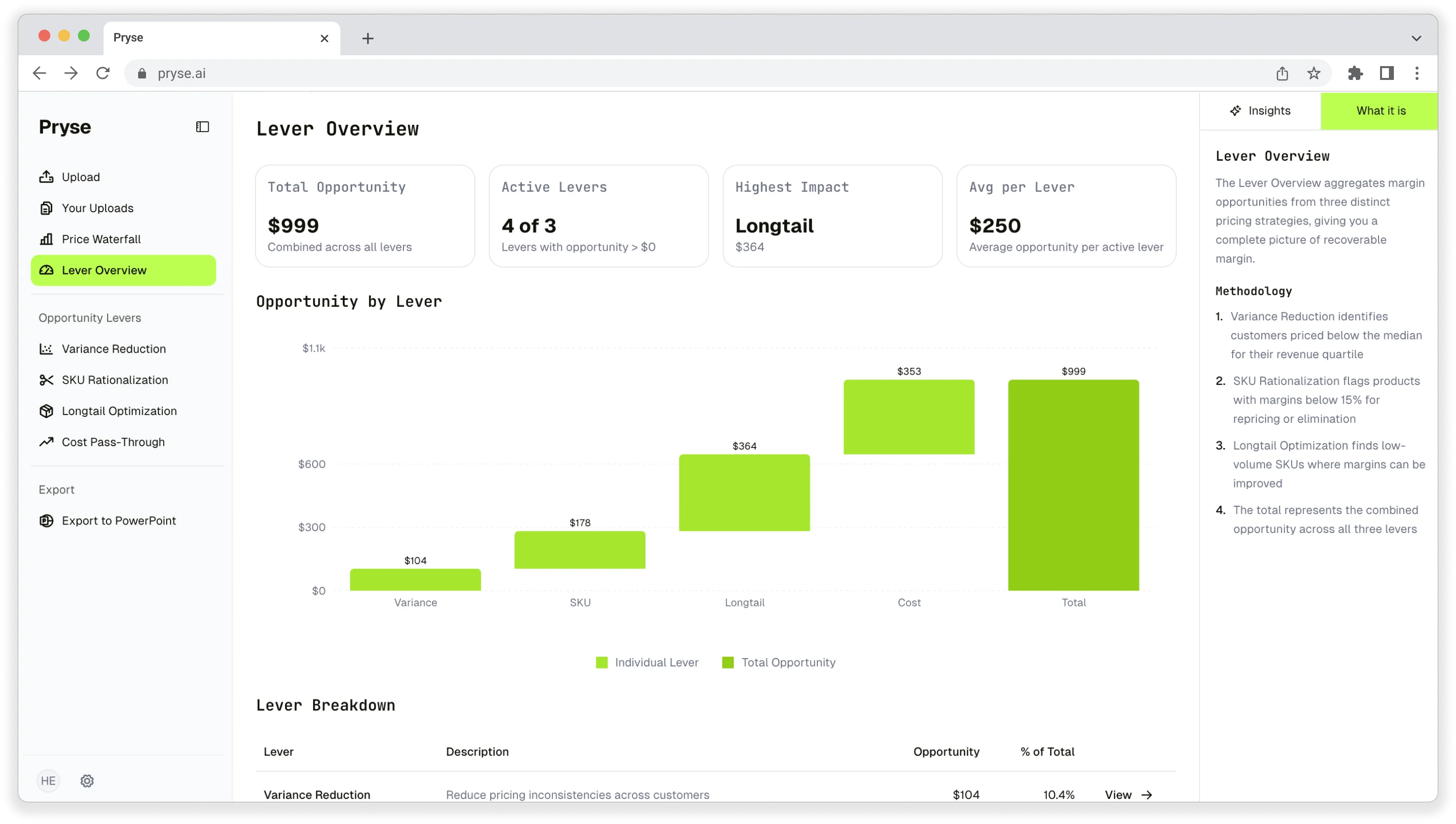
Want to analyze your entire product catalog?
Pryse automatically identifies margin leakage across thousands of SKUs. Upload your data and find hidden profit in 24 hours.
One-time $1,499 diagnostic. No subscription required.