 Pryse
PryseCost-Plus Margin Formula: How to Calculate (and Stop Confusing Markup with Margin)
The cost-plus margin formula explained with worked examples, a markup-to-margin conversion table, and the math distributors need to stop leaking profit.
The cost-plus margin formula calculates the selling price of a product by adding a percentage markup to the total cost, then determines the resulting profit margin as a percentage of revenue. It's the most common pricing method in distribution and manufacturing, and also the one most frequently miscalculated.
Here are the two formulas you need:
Selling Price = Cost × (1 + Markup%)
Margin% = (Selling Price - Cost) / Selling Price × 100
These look simple. They are simple. But the gap between "markup percentage" and "margin percentage" has cost more distributors more money than almost any other math error in the business. Let's walk through exactly how the formulas work, how to convert between markup and margin, and where the mistakes happen.
The core formulas
From cost to selling price
Start with what you paid for the product and add your markup:
Selling Price = Cost × (1 + Markup%)A $60 item with a 40% markup:
$60 × (1 + 0.40) = $60 × 1.40 = $84.00From selling price to margin
Now calculate what percentage of that $84 is profit:
Margin% = ($84.00 - $60.00) / $84.00 × 100 = 28.6%You applied a 40% markup, but your margin is 28.6%. Not 40%. This is where the confusion starts, and where money disappears.
From target margin to required markup
If your pricing manager says "I need 30% margin on this line," you can't just add 30% to cost. You need to work backwards:
Required Markup% = Target Margin% / (1 - Target Margin%)For a 30% target margin:
0.30 / (1 - 0.30) = 0.30 / 0.70 = 42.9% markupOr to calculate the selling price directly from a target margin:
Selling Price = Cost / (1 - Target Margin%)That same $60 item at a 30% target margin:
$60 / (1 - 0.30) = $60 / 0.70 = $85.71Markup-to-margin conversion table
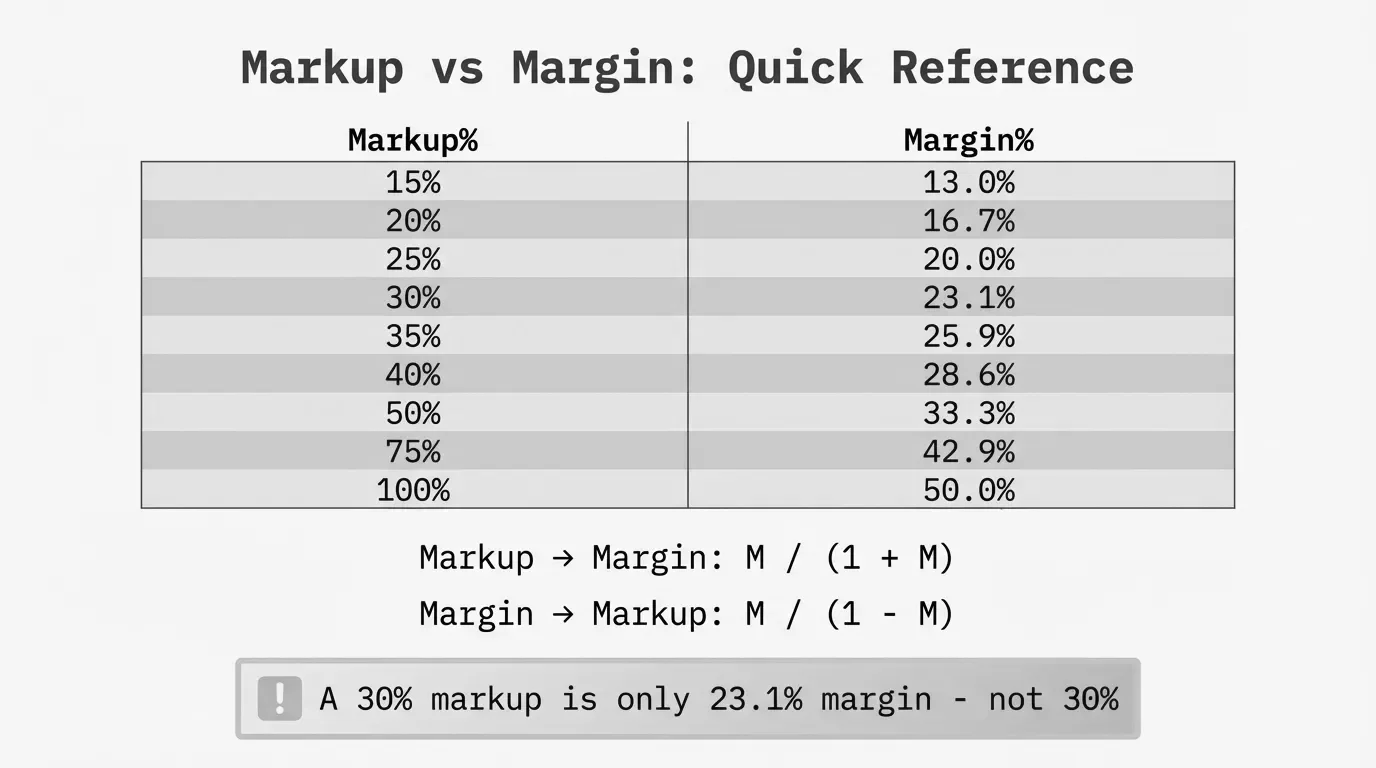
This is the reference table your pricing team should have pinned to their wall. Markup is always higher than the resulting margin, and the gap widens as percentages increase.
| Markup% | Margin% | Multiplier |
|---|---|---|
| 10% | 9.1% | 1.10 |
| 15% | 13.0% | 1.15 |
| 20% | 16.7% | 1.20 |
| 25% | 20.0% | 1.25 |
| 30% | 23.1% | 1.30 |
| 35% | 25.9% | 1.35 |
| 40% | 28.6% | 1.40 |
| 45% | 31.0% | 1.45 |
| 50% | 33.3% | 1.50 |
| 60% | 37.5% | 1.60 |
| 75% | 42.9% | 1.75 |
| 100% | 50.0% | 2.00 |
The multiplier column is what you multiply cost by to get your selling price. A 1.40 multiplier means a 40% markup, which yields a 28.6% margin.
For quick conversions on any value, see our markup-to-margin calculator.
Worked example: distribution scenario
A mid-size electrical distributor buys conduit fittings at $12.50 per unit. Their pricing manager sets a "35% margin" target in the ERP. Here's what happens depending on how that target gets interpreted.
If the ERP applies 35% as a markup:
$12.50 × 1.35 = $16.88 selling priceActual margin: ($16.88 - $12.50) / $16.88 = 25.9%
If the ERP applies 35% as a margin (correct):
$12.50 / (1 - 0.35) = $19.23 selling priceActual margin: ($19.23 - $12.50) / $19.23 = 35.0%
The difference per unit is $2.35. Small on one fitting. Now multiply it across the catalog.
If this distributor sells 200,000 conduit fittings a year, that one misinterpretation costs $470,000 in gross profit on a single product line. Across 15,000 SKUs with the same error baked into the pricing matrix, the annual impact runs into the millions.
The markup/margin confusion problem
This isn't a hypothetical risk. As GrowthForce documented in "The Unseen Cost of Mixing Up Markup and Margin," the terms refer to the same dollar amount but produce different percentages. A product that costs $70 and sells for $100 has both a $30 profit, a 42.9% markup, and a 30% margin. Same dollars, different percentages.
The confusion compounds because markup and margin percentages don't move at the same rate. A 50% markup gives you a 33.3% margin. Double the markup to 100% and your margin only reaches 50%, not 100%. The relationship isn't linear, which is why a conversion table matters.
Here's the practical danger for distributors: when a sales rep hears "we need 30% on this deal" and applies 30% as a markup, the company earns a 23.1% margin instead of the 30% they planned. That 6.9-point shortfall applied across a $50M book of business means roughly $3.45M in missing gross profit.
According to McKinsey's 2003 article "The Power of Pricing" in The McKinsey Quarterly (Marn, Roegner, and Zawada), a 1% price improvement generates an 8% increase in operating profits for the average S&P 1500 company. A margin shortfall of nearly 7 points isn't a rounding error. It's a structural problem.
How this compounds across 10K+ SKUs
Most distributors with 10,000-100,000 SKUs don't manually price each item. They set markup rules by product category in their ERP and let the system calculate prices. That means a single misconfigured formula replicates across thousands of line items.
The math is straightforward. Say you run $75M through a catalog with an average target margin of 28%. If your ERP is applying 28% as markup instead of margin, your actual average margin is 21.9%. That 6.1-point gap translates to $4.6M in gross profit you planned for but never collected.
The fix is equally straightforward: audit your ERP pricing formulas. Check whether "margin" fields are calculating as
For a deeper dive into gross margin calculation, including how to account for off-invoice deductions, see our dedicated walkthrough.
Getting the formula right in your ERP
Most ERP systems (NetSuite, SAP Business One, Acumatica, D365) let you define pricing rules using either markup or margin. The problem is that the field label doesn't always match what the formula does.
Three things to verify:
-
Check the actual calculation. Pull a sample product, enter a known cost, and see what price the system generates. Work backwards to confirm whether it used markup or margin math.
-
Standardize terminology. Pick one term across your organization and stick with it. If your target is a 30% gross margin, every pricing sheet, every ERP field, and every conversation with sales should say "30% margin," not "30%."
-
Train sales reps on the conversion. Print the markup-to-margin table above. Distribute it. When a rep quotes a deal, they should know that offering a "25% discount" on a 30% markup product doesn't leave 5% profit. It leaves negative margin.
For the full framework on cost-plus pricing, including when to move beyond it, see our cost-plus pricing guide. And for the broader formula behind cost-plus price calculation, see our post on the cost-plus pricing formula.
Last updated: February 1, 2026
Frequently Asked Questions
Want to analyze your entire product catalog?
Pryse automatically identifies margin leakage across thousands of SKUs. Upload your data and find hidden profit in 24 hours.
One-time $1,499 diagnostic. No subscription required.