 Pryse
PryseDynamic Pricing: What It Actually Means for B2B Companies
Dynamic pricing means adjusting prices based on real-time market conditions. Learn what it means in B2B, how it differs from B2C, and when it makes sense.
Dynamic pricing means one thing: prices change based on conditions. When a hotel room costs $150 on Tuesday and $300 on Saturday, that's dynamic pricing. When Uber charges more during rush hour, that's dynamic pricing. When your commodity costs jump 8% and you update customer pricing the same week, that's also dynamic pricing.
The concept is simple. The confusion comes from people treating "dynamic pricing" as a single strategy when it actually covers a spectrum of approaches — from airline-style minute-by-minute algorithmic adjustments to quarterly B2B price list updates driven by cost changes.
For B2B distributors and manufacturers, the question isn't "should we use dynamic pricing?" It's "which type of dynamic pricing fits our business, our customers, and our market?" Because the version Amazon uses (changing prices 12.6 times per day on average) isn't the version that works for a $60M industrial distributor with 200 relationship-based accounts.
This post breaks down what dynamic pricing actually means, the different forms it takes, and how B2B companies should think about it — without the hype that dynamic pricing software vendors sell.
The Dynamic Pricing Spectrum
Dynamic pricing isn't binary. It exists on a spectrum from fully manual to fully automated, and from slow-updating to real-time. Most B2B companies fall somewhere in the middle.
| Type | Update Frequency | Trigger | Example |
|---|---|---|---|
| Fixed pricing | Annual | Calendar | Annual price list update |
| Cost-responsive | Monthly/quarterly | Cost changes | Price follows commodity index |
| Market-responsive | Weekly/monthly | Market conditions | Adjust to competitor moves |
| Demand-responsive | Daily/weekly | Demand signals | Price up during shortage |
| Algorithmic | Hourly/continuous | Multiple inputs | AI-driven real-time pricing |
Most distributors operate at the "fixed" or "cost-responsive" level. They update prices annually or when costs change materially, but they don't actively adjust based on market conditions, demand signals, or competitive positioning between those updates.
Moving from fixed pricing to cost-responsive pricing is usually the highest-impact change for B2B companies. The jump from cost-responsive to algorithmic — which is what most people imagine when they hear "dynamic pricing" — is far less impactful for most B2B businesses and carries significant relationship risks.
What Dynamic Pricing Means in B2C vs. B2B
The dynamic pricing conversation is dominated by B2C examples because that's where the most visible and dramatic implementations exist. But the B2B context is fundamentally different.
B2C dynamic pricing:
- Anonymous transactions — the customer is a data point
- Price changes affect all buyers simultaneously
- High transaction volume (thousands per day)
- No personal relationship between buyer and seller
- Customers accept price variation (airline tickets, hotel rooms)
B2B dynamic pricing:
- Relationship-based transactions — the customer has a name and a rep
- Price changes can be customer-specific
- Lower transaction volume (dozens to hundreds per day)
- Long-term partnerships and negotiated agreements
- Customers expect price stability for budgeting and planning
Simon-Kucher's research on B2B industrial companies highlights this gap: B2B customers historically expect prices to remain stable long-term, and frequent algorithmic changes can damage the trust that underlies these relationships.
This doesn't mean dynamic pricing has no place in B2B. It means the B2C version — continuous algorithmic adjustments — rarely translates directly. B2B dynamic pricing is more deliberate, less frequent, and must account for relationship dynamics that don't exist in consumer markets.
The Three Forms of B2B Dynamic Pricing
When B2B companies successfully implement dynamic pricing, it usually takes one of three forms.
Form 1: Cost-Index Pricing
Prices are tied to a published commodity index or input cost. When the index moves, prices move with it — usually with a defined lag (weekly, monthly) and a formula the customer can verify.
Where it works: Chemical distribution, metals, building materials, fuel, and any product category where input costs are volatile and publicly traded.
Why customers accept it: The pricing is transparent and tied to objective data. Both buyer and seller can see the index. There's no suspicion of arbitrary price manipulation because the formula is agreed upon in advance.
Example: A metals distributor ties steel pricing to the CRU hot-rolled coil index. When the index rises 4% in a month, customer prices adjust by the same percentage the following week. This happens automatically without negotiation because the mechanism was agreed to at contract signing.
Form 2: Market-Responsive Pricing
Prices adjust based on competitive positioning and market conditions, typically on a monthly or quarterly cycle. The company monitors competitor pricing, customer win/loss data, and market demand signals to determine adjustments.
Where it works: Product categories with moderate competition and price transparency — where customers occasionally compare prices but don't shop every purchase.
Why it works: The update frequency (monthly or quarterly) is slow enough that customers don't feel whipsawed by constant changes, but fast enough to prevent prolonged overpricing or underpricing.
Example: An electrical distributor reviews competitive pricing data monthly for their top 500 SKUs. Products where they're more than 5% above the nearest competitor get targeted adjustments. Products where they're significantly below get selective increases. The rest stay unchanged.
Form 3: Demand-Responsive Pricing
Prices adjust based on demand signals and inventory levels. When demand spikes or supply tightens, prices increase. When inventory builds or demand softens, prices decrease.
Where it works: Time-sensitive products, seasonal items, products with supply constraints, and markets with clear demand cycles.
Why it's risky: B2B customers see demand-responsive pricing as opportunistic — "they're raising prices because they know I'm desperate." During the post-2020 supply chain disruptions, distributors that raised prices aggressively during shortages damaged relationships that took years to build. Customers have long memories.
Why "Dynamic Pricing" Often Means Something Simpler
When a B2B company says they've implemented "dynamic pricing," they usually mean one of these:
-
They update prices more frequently. Moving from annual to quarterly price reviews. This is good practice but isn't really "dynamic" in the algorithmic sense.
-
They've added cost-pass-through automation. Prices update automatically when cost inputs change. This removes lag but follows simple formulas, not optimization algorithms.
-
They've implemented customer-tier pricing. Different price levels for different customer segments based on volume, loyalty, or strategic value. This is segmented pricing, not dynamic pricing.
-
They've bought pricing software. The software analyzes data and recommends prices, which a human reviews and approves before implementation. This is optimization, not dynamic pricing in the automated sense.
All four of these are improvements over static annual pricing. None of them are the AI-driven, real-time algorithmic pricing that the term "dynamic pricing" usually implies. And that's fine — because for most B2B companies, these simpler approaches deliver better ROI with less risk.
Should Your B2B Company Use Dynamic Pricing?
Answer these five questions to determine which form (if any) makes sense for your business.
1. How volatile are your input costs? If costs change monthly or more frequently, cost-index or cost-responsive pricing prevents margin erosion. If costs are stable (changing annually), you don't need dynamic pricing for this reason.
2. How price-transparent is your market? If customers can easily check competitor prices online, market-responsive pricing keeps you competitive. If pricing is opaque (most B2B), the urgency is lower.
3. What percentage of revenue comes from contracts? If 70%+ of revenue is under fixed-price contracts, dynamic pricing only applies to the remaining 30%. The investment may not be justified.
4. How relationship-dependent is your business? If your top 20 accounts represent 60% of revenue and those relationships depend on pricing predictability, aggressive dynamic pricing creates more risk than reward. Consider it only for transactional segments.
5. Do you know where your current margin leakage is? If you haven't quantified your pricing inconsistencies, fixing those through basic optimization will deliver more margin than dynamic pricing. A pricing diagnostic gives you this visibility for a fraction of the cost of dynamic pricing software.
The Practical Starting Point
For most mid-market distributors and manufacturers, the highest-value move isn't implementing dynamic pricing. It's understanding your current pricing — where you're inconsistent, where you're underpriced, where discounts are eroding margins.
That analysis tells you two things: how much margin opportunity exists (usually 1-3% of revenue) and which product segments might benefit from more dynamic pricing approaches.
Start with the data. The right pricing strategy — whether it's dynamic, semi-dynamic, or just better-managed fixed pricing — will be obvious once you see where the money is.
Last updated: March 12, 2026
Frequently Asked Questions
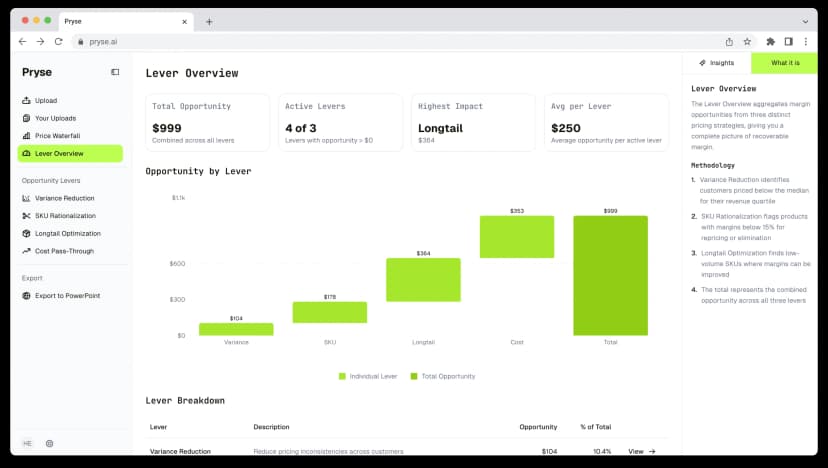
Want to analyze your entire product catalog?
Pryse automatically identifies margin leakage across thousands of SKUs. Upload your data and find hidden profit in 24 hours.
$999/year. Cancel anytime.