 Pryse
PryseDynamic Pricing in Retail: How It Works and What B2B Can Learn
Retailers use dynamic pricing to adjust prices in real time. Learn how it works in retail, the technology behind it, and what B2B distributors can apply.
Retail dynamic pricing is the most visible form of algorithmic pricing in the economy. Amazon changes prices over 12 times per day on average. Walmart adjusts online prices continuously to match competitors. European grocers are rolling out electronic shelf labels that update in-store prices multiple times per day based on demand, inventory, and time of day.
According to Statista research, retailers that used AI or machine learning for pricing grew sales by 14.2% from 2023 to 2024, compared to 6.9% for those that didn't. The performance gap is widening as retail pricing technology matures.
For B2B distributors and manufacturers watching this trend, the question isn't "should we copy Amazon?" It's "what can we learn from retail dynamic pricing that applies to our business?" Because some of the underlying principles translate directly, even if the execution looks very different.
This post examines how retail dynamic pricing actually works, the technology that powers it, what results retailers see, and which strategies B2B companies can adapt to their own pricing challenges.
How Retail Dynamic Pricing Works
Every retail dynamic pricing system follows the same core loop, whether it's Amazon repricing millions of SKUs or a regional grocery chain managing 30,000 items.
Data Collection
The system ingests multiple data streams continuously:
- Competitor prices: Scraped from competitor websites, marketplace listings, and price comparison sites. Amazon monitors dozens of competitors for each product.
- Demand signals: Search volume, page views, cart additions, conversion rates, and purchase velocity by product.
- Inventory levels: Current stock, inbound shipments, warehouse capacity, and days of supply.
- Cost data: Supplier costs, shipping costs, fulfillment costs, and promotional funding.
- External signals: Seasonality patterns, weather, local events, and economic indicators.
Price Calculation
The pricing engine processes these inputs through algorithms that range from simple rules to sophisticated machine learning models.
Rule-based approaches (used by most retailers):
- Match the lowest competitor price minus 1%
- Increase price by 5% when inventory drops below 2 weeks of supply
- Decrease price by 10% when inventory exceeds 8 weeks of supply
- Apply time-based markdowns: -15% on day 60, -30% on day 90
ML-based approaches (used by large retailers):
- Predict price elasticity for each product based on historical price-volume relationships
- Calculate the price that maximizes total margin (or revenue, or market share, depending on the objective)
- Adjust continuously as new data flows in
- Balance individual product optimization against portfolio effects (loss leaders that drive basket size)
Price Execution
Online retailers update prices instantly in their e-commerce platforms. Physical retailers face a harder challenge — changing in-store prices.
Electronic shelf labels (ESL) are changing that. About 30% of large European retailers already use ESL systems that update in-store prices digitally. Walmart has been expanding ESL deployment across U.S. stores. The technology enables physical stores to update prices as frequently as online stores, closing the gap between digital and in-store pricing.
What Retailers Optimize For
Not all retailers optimize for the same thing. The pricing objective shapes every decision the algorithm makes.
Revenue maximizers prioritize top-line growth. Amazon often prices popular products at or near cost to drive traffic, then makes margin on long-tail products where comparison shopping is less common.
Margin maximizers focus on gross profit dollars. Specialty retailers with less price competition can optimize individual product margins without worrying about losing traffic to competitors.
Market share players price aggressively to gain or defend share. Walmart's "everyday low price" strategy uses dynamic pricing not to maximize per-item margin but to ensure they're always competitive on the products customers care about most.
Inventory optimizers adjust prices based on stock levels. Fashion retailers mark down products approaching end-of-season. Grocery chains reduce prices on products approaching sell-by dates. The goal is minimizing waste and carrying costs.
Most sophisticated retailers balance multiple objectives simultaneously. A grocery chain might price-match competitors on the 200 "known value items" that customers compare (margin optimization sacrificed for traffic), optimize margins on 5,000 mid-tier products (where customers don't compare), and aggressively mark down products with excess inventory (inventory optimization).
The Technology Stack Behind Retail Dynamic Pricing
Retail dynamic pricing runs on a stack of interconnected technologies.
Competitor intelligence platforms scrape and normalize competitor pricing data. Tools like Competera, Prisync, and Price2Spy monitor thousands of competitors and products, providing real-time competitive positioning data.
Demand forecasting engines predict future demand based on historical patterns, promotional calendars, seasonality, and external signals. Machine learning models from companies like Blue Yonder, Relex, and 7Learnings generate SKU-level demand forecasts that feed into pricing decisions.
Pricing optimization engines calculate optimal prices. Revionics (now Aptos), DemandTec (now Acoustic), and dunnhumby build retail-specific pricing engines that balance competitive positioning, margin targets, and inventory constraints.
Electronic shelf labels from SES-imagotag, Pricer, and Hanshow enable physical price changes. Modern ESL systems update prices wirelessly within minutes and can display promotions, QR codes, and stock information alongside prices.
Integration middleware connects pricing engines to execution systems — e-commerce platforms, POS systems, ERP, and supply chain management tools. This is often the most complex and expensive part of the stack.
What B2B Can Learn From Retail Dynamic Pricing
B2B companies can't copy retail dynamic pricing directly. But several principles translate well.
Lesson 1: Segment Products by Price Sensitivity
Retailers obsess over which products customers compare prices on and which they don't. They price aggressively on "known value items" (KVIs) — the 3-5% of products that shape price perception — and recover margin on everything else.
B2B application: Identify your "traffic drivers" — the commodity products your customers price-shop across competitors. Price these at or near market. Then identify your specialty items where customers don't comparison-shop, and ensure you're capturing full margin on those. Most distributors overprice their commodities and underprice their specialties, which is the exact opposite of what retailers do.
Lesson 2: Use Inventory Levels as a Pricing Signal
Retailers lower prices to clear excess inventory and raise prices when stock runs low. This seems obvious, but most B2B companies don't connect inventory data to pricing decisions at all.
B2B application: If you're sitting on 18 months of inventory on slow-moving SKUs, the carrying cost is eroding your margin silently. A targeted price reduction to move that inventory and free up working capital may be better economics than holding it at full margin and selling one unit per quarter.
Conversely, if a product is backordered or in tight supply, consider whether your current pricing captures the supply-demand reality. You don't need to surge-price your customers — but making sure you're not selling scarce inventory at bottom-tier pricing is reasonable.
Lesson 3: Monitor Competitive Pricing Systematically
Retailers track competitor prices daily or hourly. Most B2B companies check competitor pricing sporadically — when a customer complains or when a rep shares intel from the field.
B2B application: Build a systematic competitive monitoring process for your top 200-500 SKUs by revenue. Even quarterly monitoring is a major improvement over ad-hoc intelligence. Sources include: customer-provided competitive quotes, sales team intel, distributor buy-sell group data, and public online pricing where available.
Lesson 4: Measure Price Elasticity, Don't Guess
Retailers calculate price elasticity from millions of transactions. They know that a 5% price increase on paper towels loses 7% volume but a 5% increase on a specific brand of organic olive oil loses only 1%.
B2B application: You have the data to estimate price sensitivity, even if it's rougher than retail. Look at periods where your prices changed (cost pass-throughs, rep discounting patterns, annual increases) and measure what happened to volume. This tells you where you have pricing power and where you don't — information that should drive your pricing strategy.
Lesson 5: Automate Where It Makes Sense
Retailers automate pricing because they manage hundreds of thousands of SKUs with thin margins where small per-unit improvements scale massively. Manual pricing at that scale is impossible.
B2B application: You probably don't need real-time automation, but automating cost-pass-through calculations, margin floor alerts, and competitive pricing reports saves your pricing team hours of manual work. Start with the repetitive calculations that currently live in someone's spreadsheet.
What B2B Should Not Copy From Retail
Some retail dynamic pricing practices are destructive in B2B contexts.
Don't change prices daily or weekly for relationship accounts. Your top customers budget based on your pricing. Frequent changes create friction, confusion, and distrust. Retail customers expect price variability. B2B customers don't.
Don't use personalized pricing without transparency. Retailers sometimes show different prices to different online visitors based on browsing history or device type. In B2B, customer-specific pricing must be defensible and consistent. If Customer A finds out they're paying more than Customer B for the same product with similar volume, you have a trust problem.
Don't optimize individual transactions at the expense of lifetime value. A retailer can extract maximum margin from an anonymous online buyer with no relationship cost. In B2B, pricing a single order too aggressively can jeopardize a $2M annual relationship.
Don't assume technology solves pricing problems. Retailers invest millions in pricing technology because their scale demands it. A $75M distributor with 15,000 SKUs can capture most of the same insights with a diagnostic tool and quarterly pricing reviews.
The Right Starting Point for B2B
The biggest lesson from retail dynamic pricing isn't about technology or algorithms. It's about using data to make pricing decisions instead of defaulting to gut feel and cost-plus formulas.
Retailers know exactly which products are overpriced, which are underpriced, and how much margin they're leaving on the table. Most B2B companies don't have that visibility. Getting it doesn't require a million-dollar pricing platform. It requires analyzing your transaction data to understand your pricing patterns — where the inconsistencies are, where the margin gaps hide, and which fixes deliver the biggest payback.
That analysis is the foundation everything else builds on. Whether you eventually implement semi-dynamic pricing for commodity products, tighten discount management for your sales team, or simply rationalize your price lists across customer tiers — it all starts with understanding what your data says about your current pricing.
Last updated: March 12, 2026
Frequently Asked Questions
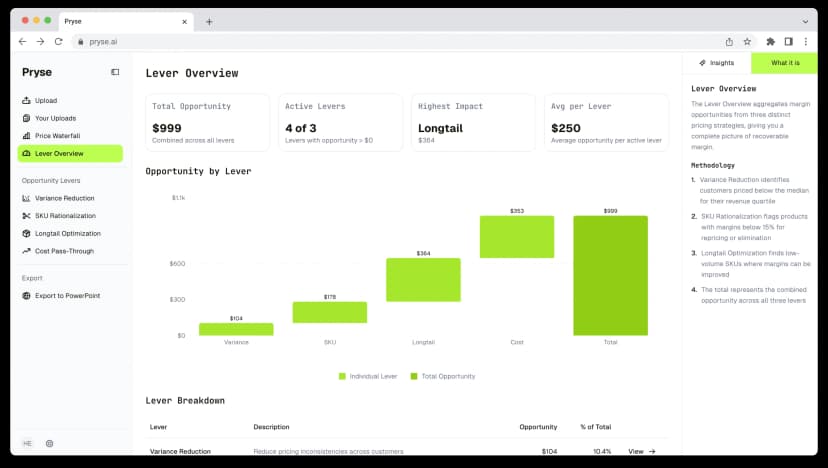
Want to analyze your entire product catalog?
Pryse automatically identifies margin leakage across thousands of SKUs. Upload your data and find hidden profit in 24 hours.
$999/year. Cancel anytime.