 Pryse
PryseAI Dynamic Pricing: Hype vs. Reality for Distribution Companies
AI-driven dynamic pricing promises automated margin optimization. Here's what it actually delivers for distributors, what it costs, and when it makes sense.
Every pricing software vendor in 2026 claims their platform uses AI. They promise that machine learning algorithms will analyze your data, find hidden patterns, and automatically set optimal prices that maximize your margin. The pitch is compelling: replace human pricing decisions with AI that never sleeps, never has a bad day, and processes more data than any pricing analyst could handle.
The reality for most mid-market distributors is more nuanced. AI dynamic pricing is real technology that delivers real results — but only under specific conditions, at significant cost, and after a long implementation runway. For many distribution companies, simpler approaches deliver faster payback with less risk.
Simon-Kucher's research on B2B industrial companies summarizes the gap well: the broader adoption of AI-driven dynamic pricing in B2B remains limited due to several specific conditions and key challenges. Customers expect stable pricing, sales teams resist algorithmic decisions, and the complexity of B2B pricing structures makes AI optimization harder than vendors suggest.
This post separates the hype from reality: what AI dynamic pricing actually does, when it makes sense, when it doesn't, and what most distributors should do instead.
What AI Dynamic Pricing Actually Is
Strip away the marketing language and AI dynamic pricing is a specific technology with specific capabilities.
Traditional rule-based pricing follows formulas you define:
- Cost × 1.35 = price (cost-plus)
- Competitor price - 2% = price (competitive matching)
- If volume > 1,000 units, apply 5% discount (tier-based)
The rules never change unless a human changes them. They don't learn from outcomes. They can't identify patterns across 50,000 SKU-customer combinations.
AI-based pricing learns from your data:
- Analyzes millions of historical transactions to identify price-volume relationships
- Calculates price elasticity for each product-customer-channel combination
- Predicts how volume will respond to specific price changes
- Recommends prices that maximize your chosen objective (margin, revenue, market share)
- Improves over time as it processes more transactions and observes outcomes
The machine learning models used most commonly in pricing are gradient boosting machines, neural networks, and ensemble methods. They process features like transaction history, seasonality patterns, customer purchasing behavior, competitive positioning, and cost trends to predict optimal price points.
The Hype: What Vendors Promise
AI pricing vendors make bold claims. Here are the common ones and what the evidence actually supports.
Claim: "2-5 Percentage Point EBITDA Improvement"
Research from Master of Code cites that AI-based pricing tools can boost EBITDA by 2 to 5 percentage points for B2B and B2C companies.
The reality: Those numbers come from enterprise implementations at large companies with massive data sets, dedicated pricing teams, and 12-18 month implementation periods. Mid-market distributors ($20M-$200M revenue) typically see 1-2% margin improvement in year one, growing to 2-3% as models mature. Still significant — a 1.5% improvement for a $75M distributor is over $1M annually — but short of the headline numbers.
Claim: "The AI Finds Patterns Humans Can't See"
This is mostly true, but with caveats. ML models can identify non-obvious correlations in large datasets — like the fact that a specific customer segment is less price-sensitive on Thursday orders versus Monday orders, or that products ordered in combination with certain other products tolerate higher margins.
The reality: These micro-patterns matter at scale (100,000+ SKUs, millions of transactions). For a distributor with 10,000 SKUs, the patterns that drive the most margin improvement are usually visible through basic analysis: inconsistent pricing, excessive discounting, cost increases not passed through, and underpriced specialty products. You don't need AI to find a product line selling at 15% margin when the category average is 32%.
Claim: "Fully Automated Pricing"
No serious B2B implementation is fully automated. Every vendor that works with distributors includes human review and approval in their workflow. The AI recommends; humans decide.
The reality: Even the most advanced implementations use AI as a recommendation engine, not an autonomous pricing agent. Sales leaders review and approve recommendations. Exception handling requires human judgment. Strategic account pricing always involves people. The "AI" part is the analysis and recommendation — not the execution.
The Reality: Where AI Pricing Delivers
AI dynamic pricing produces meaningful results in specific situations.
Situation 1: Large Catalogs With Complex Pricing
When you have 20,000+ active SKUs, multiple customer tiers, regional pricing, channel-specific margins, and volume-based discounts, the number of price points to manage explodes. A catalog of 25,000 SKUs sold to 500 customers across 3 channels creates 37.5 million potential price points. No human team can optimize that manually.
AI excels here because it processes the full matrix simultaneously, identifying which of those 37.5 million combinations are suboptimal and by how much.
Situation 2: High Transaction Volume With Pattern Diversity
AI models need data to learn. If you process 50,000+ transactions per month with meaningful price and volume variation, the models have enough signal to identify reliable price-volume relationships. If you process 5,000 transactions per month with stable pricing, there's not enough variation for the model to learn from.
Situation 3: Commodity Products With Cost Volatility
Products where input costs change frequently benefit from AI's ability to calculate optimal pass-through rates. Rather than applying a blanket cost-plus-30% when steel prices jump 8%, the AI can recommend different pass-through rates by product and customer based on historical price sensitivity.
Situation 4: Competitive Markets With Price Transparency
When competitors actively adjust prices and customers compare, AI helps you respond faster and more precisely than manual processes allow. Instead of reacting to competitive intel days or weeks later, the system processes competitor data and recommends responses within hours.
Where AI Pricing Falls Short in Distribution
Challenge 1: Data Quality Issues
AI models require clean, consistent data. Most mid-market distributors have data problems: inconsistent cost allocation, missing customer codes, duplicate SKUs, rebates not reflected in transaction prices, and incomplete competitive intelligence.
The dirty secret of AI pricing implementations is that 40-60% of the project timeline is spent on data preparation — cleaning, normalizing, and enriching the data before any model training begins. If your ERP data is messy, AI doesn't magically fix it. Garbage in, garbage out applies regardless of how sophisticated the algorithm is.
Challenge 2: Relationship-Based Sales Don't Fit Models
AI models optimize for measurable outcomes: margin dollars, revenue, volume. They can't model the relationship value of a pricing decision. When your largest customer's VP of procurement calls your sales VP and says "we've been partners for 15 years — work with us on this pricing," no algorithm can evaluate that context.
For distributors where 20-30% of revenue comes from strategic accounts with deep personal relationships, AI pricing applies to the transactional tail of the business, not the relationship-driven core.
Challenge 3: Sales Team Resistance
Giving a pricing algorithm authority over what reps can quote is a change management challenge, not a technology challenge. Reps who've set their own prices for years resist algorithmic guidance. They cherry-pick recommendations they agree with and ignore ones they don't.
According to Simon-Kucher, the idea of an AI "blackbox" making automatic price changes is uncomfortable for many B2B organizations. Companies prefer to stay in the driver's seat regarding pricing decisions.
Successful implementations spend as much effort on change management and sales team training as on the technology itself.
Challenge 4: The Cold Start Problem
AI pricing models need 6-12 months of consistent data ingestion before they produce reliable recommendations. During that period, you're paying for the platform but relying on the same manual pricing processes you had before.
For new products, new customers, and new market segments, the AI has no history to learn from. It falls back to rule-based pricing for these situations — which means you need good rules anyway.
The Decision Framework
Use this to determine if AI dynamic pricing is right for your business today.
AI pricing probably makes sense if you have:
- 20,000+ active SKUs
- 50,000+ monthly transactions
- Clean, consistent ERP data
- A dedicated pricing analyst or team
- Budget for $150K-$400K first-year investment
- Products with volatile costs or competitive pricing
- Patience for a 6-12 month implementation
Simpler optimization makes more sense if you have:
- Under 20,000 active SKUs
- Under 50,000 monthly transactions
- Data quality issues in your ERP
- No dedicated pricing team
- Budget under $100K
- Stable costs and limited price competition
- Need for quick results (under 3 months)
What Most Distributors Should Do Instead
For the majority of mid-market distributors ($20M-$200M revenue, 5,000-50,000 SKUs), the highest-ROI pricing action isn't AI. It's fixing what's already broken.
Step 1: Run a pricing diagnostic ($999/year, 24 hours). Upload your transaction data and see exactly where margin leakage exists — which SKUs, customers, and patterns are eroding your margins. This gives you a fact base instead of guesses.
Step 2: Fix the obvious problems (internal effort, 1-3 months). The diagnostic will reveal products selling at margins 10-20 points below segment averages, reps consistently discounting below targets, cost increases not passed through, and pricing inconsistencies across similar customers. Fixing these delivers 1-2% margin improvement without any AI.
Step 3: Implement segment-based pricing (mid-market tool, $30K-$80K/year). Set different pricing strategies for commodity, core, specialty, and tail products. This is where most of the remaining margin improvement lives.
Step 4: Evaluate AI pricing based on results. If steps 1-3 capture $500K in margin improvement and you still see significant untapped opportunity, AI pricing may be worth the investment. If those steps capture the bulk of the opportunity, you've solved the problem without the complexity and cost of AI.
This sequence typically delivers 2-3% margin improvement over 12 months at a fraction of the cost and timeline of an AI platform. And it builds the data quality, process maturity, and organizational readiness that make AI pricing successful if you decide to invest later.
The Bottom Line
AI dynamic pricing is real, and it works. But it works best for large companies with massive catalogs, high transaction volumes, clean data, and dedicated pricing teams. For mid-market distributors, the technology is often a $300K answer to a $30K question.
The margin improvement most distributors need isn't hidden in complex algorithmic patterns. It's sitting in plain sight: inconsistent pricing, unchecked discounting, unmonitored cost changes, and underpriced specialty products. Find those problems first. The data will tell you whether AI is the right next step or whether better-managed fundamentals are all you need.
Last updated: March 12, 2026
Frequently Asked Questions
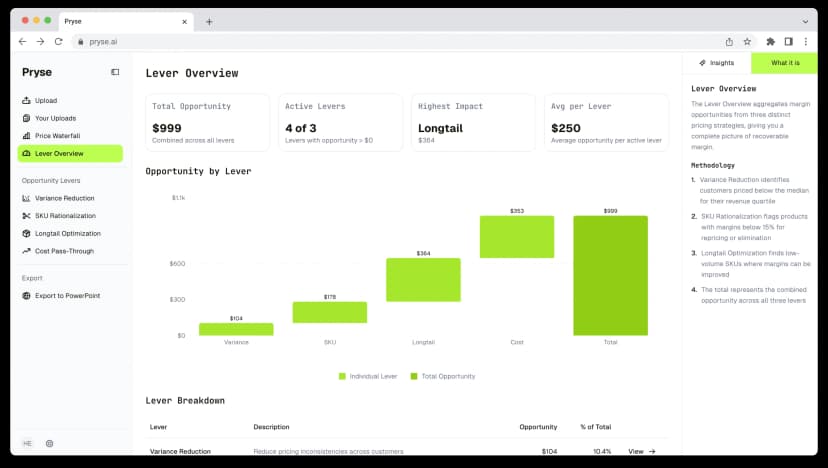
Want to analyze your entire product catalog?
Pryse automatically identifies margin leakage across thousands of SKUs. Upload your data and find hidden profit in 24 hours.
$999/year. Cancel anytime.