 Pryse
PryseTypes of Value-Based Pricing: 5 Models for B2B Distribution and Manufacturing
Learn the five types of value-based pricing used in B2B: Good-Better-Best, outcome-based, performance-based, value-in-use, and TCO pricing. Includes examples for distributors and manufacturers.
Value-based pricing is a strategy where price reflects the economic value a product or service delivers to the buyer, rather than the cost to produce it. For B2B distribution and manufacturing, this means pricing based on what your product is worth to the customer's operations, not what it costs you to source or make.
But "value-based pricing" isn't one thing. It's a category with at least five distinct models, each suited to different products, customers, and competitive situations.
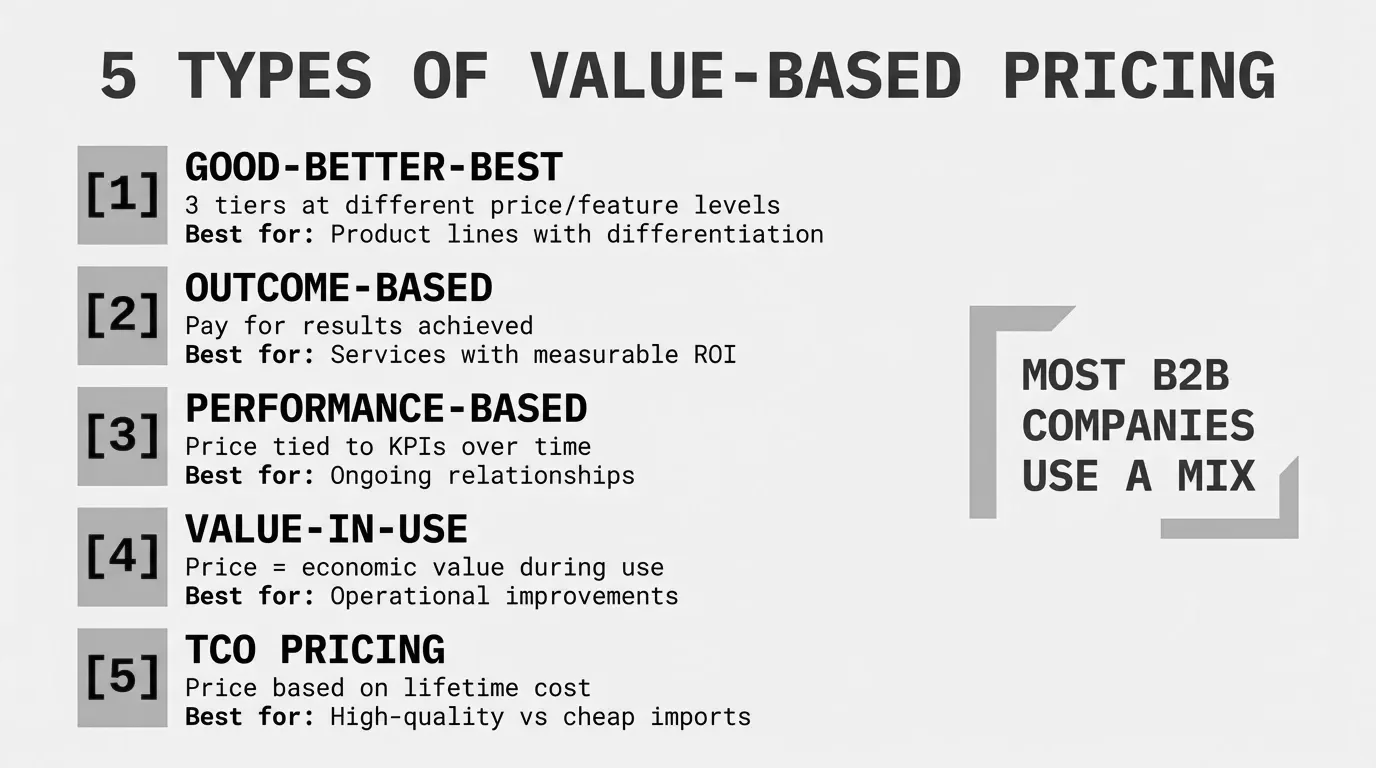
This guide covers the five types of value-based pricing used in B2B distribution and manufacturing: Good-Better-Best, outcome-based, performance-based, value-in-use, and total cost of ownership pricing. For each, I'll explain how it works, when to use it, and where it fits in a distribution or manufacturing context.
Why Value-Based Pricing Matters in B2B
Most mid-market distributors and manufacturers price based on cost-plus: take your cost, add a target margin, and that's your price. It's simple. It's also leaving money on the table.
According to Simon-Kucher's Global Pricing Study 2025, companies that move beyond cost-plus to value-based approaches achieve higher margins without proportional volume loss. Their research on B2B companies found that businesses aligning prices with customer value outperform those using cost-driven methods.
Here's the math that matters: McKinsey research shows that a 1% price improvement typically drives an 8-11% increase in operating profit, depending on industry cost structure. For a $50M distributor running 4% operating margin, a 1% price improvement adds $400K to the bottom line. That's more impactful than equivalent gains in volume or cost reduction.
The challenge is that "price based on value" is vague advice. Value to whom? Measured how? That's where understanding the specific types of value-based pricing becomes useful.
1. Good-Better-Best Pricing
Good-Better-Best pricing (also called Goldilocks pricing) offers three tiers of a product or service at different price points, with each tier delivering progressively more value.
How it works:
- Good: Basic option with core features, lowest price, accessible to price-sensitive buyers
- Better: Mid-tier with enhanced features, moderate price, positioned as the best value
- Best: Premium option with maximum features, highest price, for buyers prioritizing performance
The psychology is straightforward. When Williams-Sonoma added a $429 bread machine next to their existing $279 model, the cheaper model's sales nearly doubled. Buyers saw $279 as reasonable compared to $429. This anchoring effect is well-documented in pricing research.
When to use it:
Good-Better-Best works when your product line has natural feature differentiation and your customers have varying willingness to pay. It's common in:
- Lubricants and chemicals (standard, synthetic, high-performance)
- Safety equipment (basic compliance, enhanced comfort, premium protection)
- Cutting tools (economy, standard, precision)
Distribution example:
An industrial safety distributor offers three tiers of work gloves:
| Tier | Product | Features | Price |
|---|---|---|---|
| Good | Economy gloves | Basic cut protection, 3-month lifespan | $8/pair |
| Better | Standard gloves | Enhanced grip, 6-month lifespan | $15/pair |
| Best | Premium gloves | Maximum dexterity, 12-month lifespan | $28/pair |
Most customers land on "Better." The economy option validates the middle tier's value. The premium option captures buyers who genuinely need maximum performance.
Setting the tiers:
One approach from pricing consultants: set the "Better" price about 10% above your average sales price, "Good" about 25% below average, and "Best" no more than 50% above. Adjust based on your actual cost structure and margin targets.
2. Outcome-Based Pricing
Outcome-based pricing ties payment to specific results achieved, not products delivered. The customer pays for outcomes, and you bear the risk of delivering them.
How it works:
Instead of selling a product at a fixed price, you charge based on the business result: cost savings realized, revenue increased, downtime avoided, or efficiency gained. Payment is contingent on hitting defined targets.
When to use it:
Outcome-based pricing works when:
- You can measure outcomes objectively
- You control enough variables to influence results
- The outcome has clear financial value to the customer
- Your product demonstrably outperforms alternatives
According to Gartner research cited by Copperberg, by 2022 more than 60% of asset manufacturers were offering outcome-based service contracts, up from less than 15% in 2018. The model is spreading from services into products.
Manufacturing example:
Hitachi Rail's "trains-as-a-service" model is the textbook example. Hitachi owns and maintains trains. UK rail operators pay based on completed journeys meeting KPIs: on-time performance, fleet availability, onboard temperature, maintenance efficiency. Hitachi gets paid when trains run on time. If they don't, Hitachi absorbs the cost.
Distribution example:
A chemical distributor selling cutting fluids to a machine shop:
- Traditional: $50/gallon, customer buys 200 gallons/month = $10,000/month
- Outcome-based: $0.05 per part produced using the fluid
If the shop makes 250,000 parts/month, the distributor gets $12,500/month. If production drops, revenue drops. But if the fluid improves tool life or reduces scrap, the customer wins and the distributor captures some of that value.
The formula:
Outcome Price = Base Fee + (Outcome Achieved × Share Rate)
For example: $2,000/month base + ($0.02 × units produced). This balances risk between parties.
3. Performance-Based Pricing
Performance-based pricing ties payment to ongoing performance against defined KPIs, rather than binary outcome achievement. It's continuous rather than pass/fail.
How it works:
You establish baseline metrics, define target improvements, and price based on performance against those targets. Payment scales with results. Bonuses for exceeding targets, penalties for missing them.
When to use it:
Performance-based pricing fits when:
- Performance can be tracked continuously
- Multiple metrics matter, not just one outcome
- The relationship is ongoing (not a one-time transaction)
- Both parties benefit from continuous improvement
Manufacturing example:
Siemens Energy's "opex-only" machinery contracts charge based on operating performance: uptime percentage, energy efficiency, throughput rate. Instead of paying $2M upfront for a turbine, the customer pays $X per megawatt-hour generated, with rates tied to efficiency metrics.
Distribution example:
A logistics distributor serving manufacturers:
| Performance Metric | Target | Price Adjustment |
|---|---|---|
| On-time delivery | 98%+ | +$0.50/order |
| Inventory accuracy | 99.5%+ | +$0.25/order |
| Order accuracy | 99.9%+ | +$0.25/order |
| Below targets | Any miss | Base rate only |
The base delivery rate might be $8/order. Hit all three KPIs and the effective rate is $9/order. Miss targets and you're stuck at base. This creates alignment: the distributor gets paid more for performing better.
Difference from outcome-based:
Outcome-based asks: "Did you hit the target?" Performance-based asks: "How well did you perform?" Outcome-based is binary. Performance-based is a spectrum.
4. Value-in-Use Pricing
Value-in-use pricing sets price based on the economic value a product creates during use, independent of production cost. It requires calculating what the product is actually worth to the buyer's operations.
How it works:
You quantify the financial benefits your product delivers: labor savings, energy reduction, yield improvement, waste reduction, or extended equipment life. Then you price as a percentage of that value, typically 10-30%.
When to use it:
Value-in-use pricing works when:
- Your product delivers measurable operational improvements
- Customers have the data to verify claims
- Competitive products don't deliver equivalent value
- You can segment customers by how much value they receive
Industrial example:
SKF, the ball bearing manufacturer, built a "Documented Solutions Program" to quantify value-in-use for customers. Their higher-cost bearings deliver longer product life, lower failure rates, and inventory savings. A bearing that costs 40% more but lasts 3x longer and eliminates two unplanned shutdowns per year is worth more than a cheap bearing. SKF prices by customer segment based on cost-of-failure: high-downtime-cost plants pay more because they get more value.
Distribution example:
An electrical distributor selling LED lighting upgrades to a warehouse operator:
Value calculation:
Current energy cost: 500 fixtures × 400W × 4,000 hours × $0.12/kWh = $96,000/year
LED energy cost: 500 fixtures × 150W × 4,000 hours × $0.12/kWh = $36,000/year
Annual savings: $60,000
5-year value: $300,000
If the LED upgrade costs $75,000 (25% of 5-year value), it's an easy decision. If the distributor tried to price at cost-plus ($50,000), they'd leave $25,000 on the table. The customer would still buy at $75,000 because the payback is under 18 months.
The value-in-use formula:
Value-in-Use Price = (Customer's Economic Value × Capture Rate) + Cost of Alternatives
Capture rate is typically 10-30% of the value you create. Go higher than 30% and customers feel squeezed. Go below 10% and you're underpricing.
5. Total Cost of Ownership (TCO) Pricing
TCO pricing positions price based on lifetime cost, not purchase price. It reframes the buying decision from "what does this cost?" to "what will this cost me over five years?"
How it works:
Total cost of ownership includes:
- Acquisition cost (purchase price, installation, training)
- Operating costs (energy, consumables, labor)
- Maintenance costs (scheduled service, repairs, spare parts)
- Downtime costs (lost production, expediting)
- Disposal/replacement costs (at end of life)
TCO = Acquisition Cost + (Operating Costs × Years) + Maintenance Costs - Residual Value
When to use it:
TCO pricing works when:
- Your product has higher upfront cost but lower lifetime cost
- Competitors compete on sticker price alone
- Operating and maintenance costs are a large share of total cost
- Customers are sophisticated enough to think long-term
According to Gartner research, companies that focus only on purchase price see total costs rise by 15-20% once hidden expenses surface. TCO framing helps buyers see the full picture.
Manufacturing example:
Graco, the industrial equipment manufacturer, publishes TCO calculators for their pumps. A Graco pump might cost $15,000 versus a competitor at $8,000. But the Graco pump runs for 8,000 hours before overhaul while the competitor needs service at 3,000 hours. Factor in downtime costs of $500/hour for a production line, and the "expensive" pump is $40,000 cheaper over five years.
Distribution example:
A fastener distributor selling high-strength bolts to a wind turbine manufacturer:
| Cost Element | Standard Bolt | Premium Bolt |
|---|---|---|
| Unit price | $12 | $28 |
| Installation labor | $45 | $45 |
| Expected failures/year | 2.3% | 0.1% |
| Cost per failure | $8,500 | $8,500 |
| 10-year TCO per bolt | $12 + $45 + (10 × 0.023 × $8,500) = $2,012 | $28 + $45 + (10 × 0.001 × $8,500) = $158 |
The premium bolt costs 2.3x more at purchase but 12x less over ten years. TCO pricing makes the decision obvious.
Choosing the Right Model
Each value-based pricing type fits different situations:
| Pricing Type | Best For | Requires |
|---|---|---|
| Good-Better-Best | Product lines with feature differentiation | Clear tier definitions, production capability |
| Outcome-based | Services and solutions with measurable results | Outcome tracking, risk tolerance |
| Performance-based | Ongoing relationships with KPIs | Continuous measurement, contract flexibility |
| Value-in-use | Products delivering operational improvements | Value quantification tools, customer data |
| TCO pricing | High-quality products competing on lifetime cost | TCO calculators, proof of reliability |
Most distributors and manufacturers use a mix. You might use Good-Better-Best for commodity products, value-in-use for specialty items, and TCO pricing when competing against cheaper imports.
Implementation Requirements
Value-based pricing sounds good in theory. In practice, it requires:
1. Customer value data. You need to know what your products are actually worth to customers. This means tracking outcomes, gathering usage data, and having conversations about ROI.
2. Segment-specific pricing. Not all customers get the same value. A bearing that prevents $100K downtime for one customer might prevent $10K for another. Your pricing should reflect that.
3. Sales training. Your reps need to sell value, not price. If they default to "what discount do you need?" you'll never capture the value premium.
4. Margin visibility. To know if value-based pricing is working, you need to track margins at the customer and product level. Most mid-market companies can't do this easily because data is scattered across ERPs, spreadsheets, and sales rep memory.
Where to Start
If your pricing today is pure cost-plus, here's a practical starting point:
-
Identify your highest-value products. Which SKUs deliver measurable operational benefits? Start there.
-
Quantify customer value for those products. Build simple calculators: energy savings, downtime avoided, labor reduced.
-
Test value-based pricing on new customers. Don't disrupt existing relationships. Price new accounts based on value and measure results.
-
Track margin by customer segment. Are high-value customers paying more? Or are you giving away value through undifferentiated pricing?
The gap between what you charge and what your product is worth represents margin leakage. For distributors, this gap typically runs 2-7% of revenue. Closing it through value-based pricing is one of the highest-leverage moves you can make.
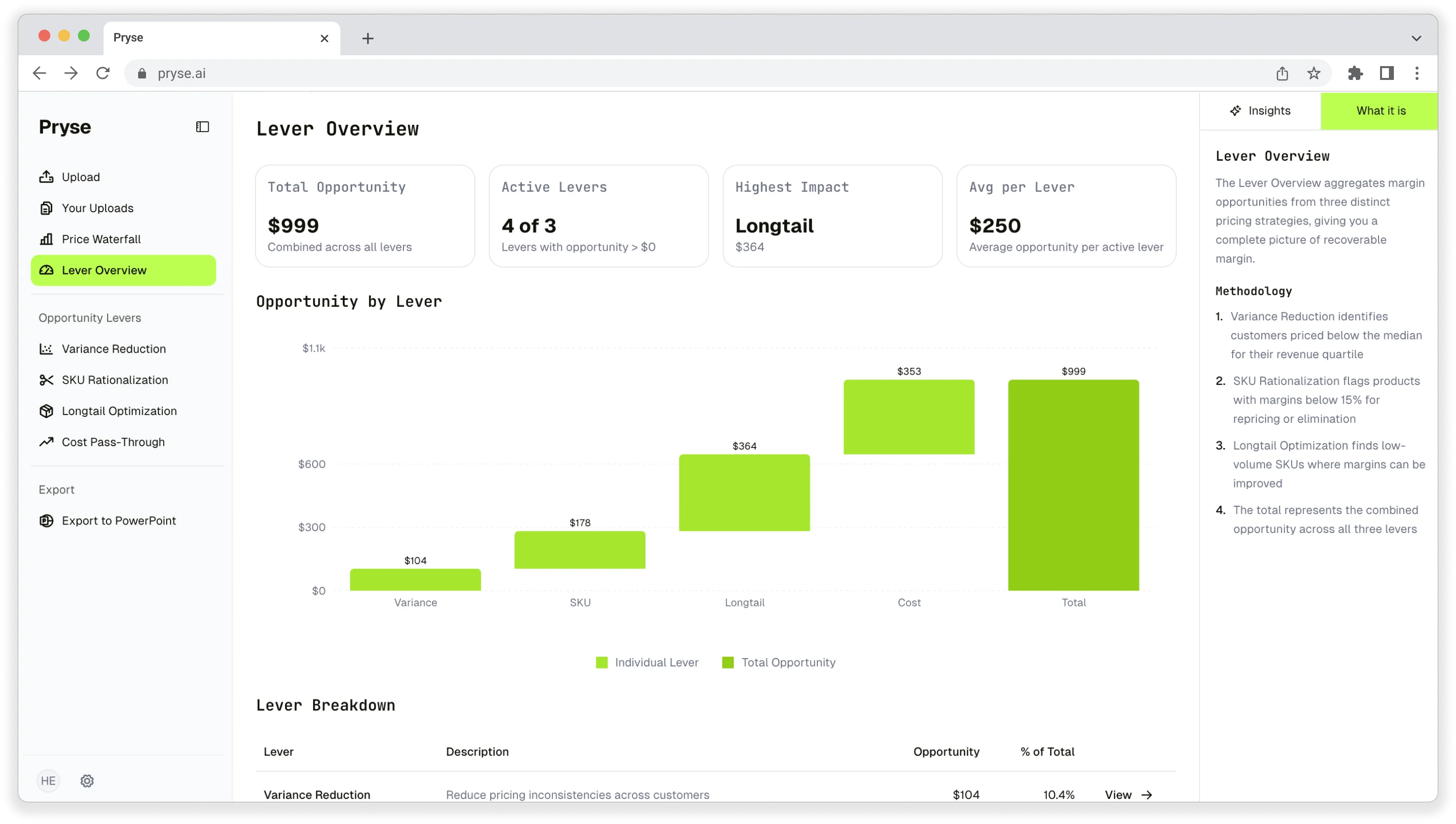
That's the problem Pryse helps solve. Upload your transaction data and see where you're leaving value on the table, which customers are underpaying for high-value products, and where your pricing doesn't match the value you deliver.
Last updated: Invalid Date
Frequently Asked Questions
Want to analyze your entire product catalog?
Pryse automatically identifies margin leakage across thousands of SKUs. Upload your data and find hidden profit in 24 hours.
One-time $1,499 diagnostic. No subscription required.