 Pryse
PryseValue-Based Pricing Formula: 3 Calculation Methods with Worked Examples
Learn how to calculate value-based prices using the EVE formula, reference price method, and willingness-to-pay analysis. Includes B2B distribution examples.
The value-based pricing formula calculates what to charge based on customer value rather than your costs. The core formula is:
Value-Based Price = Reference Price + Differentiation ValueReference price is what the customer's next best alternative costs. Differentiation value is the dollar amount your product saves or earns them beyond that alternative. This shifts pricing from "cost plus markup" to "value delivered."
According to McKinsey's 2003 analysis of S&P 1500 companies published in "The Power of Pricing" (McKinsey Quarterly), a 1% price increase generates an 8% increase in operating profits. Value-based pricing captures that 1% by pricing to customer value, not internal costs. For a $75M distributor at 5% operating margin, recovering 1% through better value capture adds $600K to the bottom line.
This guide covers three calculation methods with worked examples for B2B distribution and manufacturing.
Method 1: The Economic Value Estimation (EVE) Formula
Economic Value Estimation (EVE) is the framework introduced by Thomas Nagle in "The Strategy and Tactics of Pricing" (first published 1987, now in its sixth edition). It breaks value-based pricing into quantifiable components.
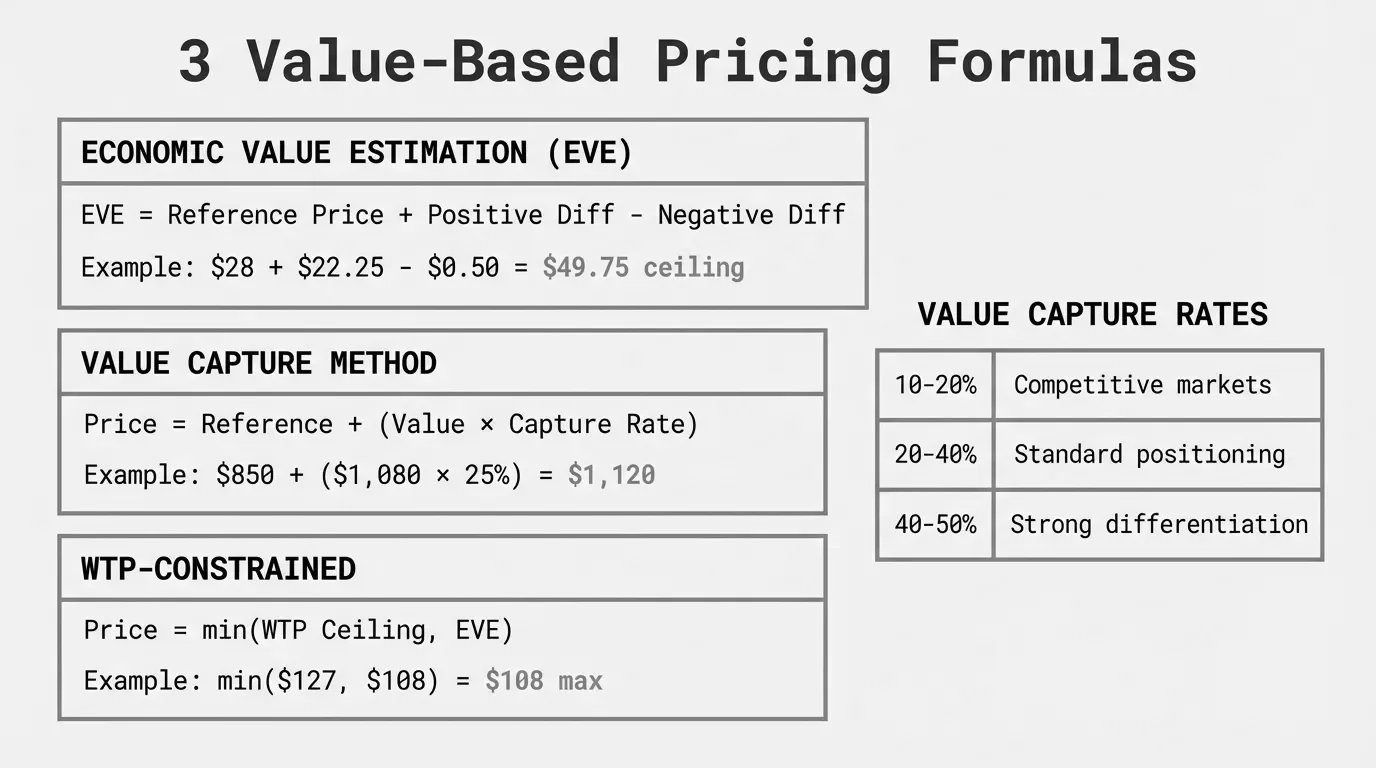
EVE = Reference Price + Positive Differentiation Value - Negative Differentiation Value
Reference price is what the customer pays for the next best competitive alternative (NBCA). In some cases, the reference is a DIY solution, doing nothing, or an in-house workaround.
Positive differentiation value is the monetary value your product creates beyond the reference, measured in cost savings, time savings, revenue gains, or risk reduction.
Negative differentiation value accounts for any ways your product falls short of the alternative, such as missing features or higher switching costs.
Worked Example: Industrial Adhesive
You sell a specialty adhesive to manufacturing plants. The next best alternative is a competitor product priced at $28 per unit.
Your adhesive:
- Cures 40% faster, saving 15 minutes of labor per application at $45/hour = $11.25 per use
- Requires no surface prep, saving $3.50 in materials and 10 minutes of labor = $11.00 per use
- Comes in smaller containers, so customers buy more frequently (adds $0.50 in ordering cost = negative differentiation)
EVE = $28 + ($11.25 + $11.00) - $0.50 = $49.75 per unit
The maximum price this customer should rationally pay is $49.75. At that price, they break even compared to the alternative. At $40, they capture $9.75 in value, giving them a reason to switch.
When to Use EVE
EVE works best when you can quantify specific, measurable benefits. It's the standard approach for:
- Technical products with performance advantages
- Products that reduce labor, materials, or downtime
- B2B situations where buyers make rational economic decisions
- Sales conversations where you need to justify a premium
The weakness: EVE requires data on competitor prices and customer operations that you may not have.
Method 2: Reference Price + Value Capture Rate
This formula, outlined in the Harvard Business Review article "A Quick Guide to Value-Based Pricing" (August 2016), adds a practical constraint: you rarely capture 100% of differentiation value.
Value-Based Price = Reference Price + (Value Capture Rate x Monetized Differentiation Value)
The value capture rate is the percentage of differentiation value you price into the product. Typical ranges:
| Competitive Position | Value Capture Rate |
|---|---|
| Market penetration / highly competitive | 10-20% |
| Standard positioning | 20-40% |
| Strong differentiation / low competition | 40-50% |
Worked Example: MRO Distribution with Same-Day Delivery
You're an industrial distributor competing against a national player. The competitor's price for a motor is $850 with 3-5 day delivery.
Your differentiation:
- Same-day delivery prevents production downtime worth $2,400/day to the customer
- Average downtime without same-day: 1.5 days = $3,600 in potential cost
- Probability the customer needs same-day: 30% of orders
Expected differentiation value: $3,600 x 30% = $1,080
The market is competitive (multiple distributors serve this account), so you use a 25% capture rate:
Value-Based Price = $850 + (0.25 x $1,080) = $1,120
You can price 32% above the competitor and still deliver net value. At $1,120, the customer pays $270 more but gets $810 in expected value (the remaining 75% of differentiation).
Choosing the Right Capture Rate
Higher capture rates work when:
- Few competitors offer similar differentiation
- Switching costs are high
- Your brand has established trust
- The customer has limited alternatives
Lower capture rates make sense when:
- You're entering a new market or account
- Competitors can replicate your advantage quickly
- The customer has strong alternatives
- You're prioritizing volume over margin
Simon-Kucher's 2024 Global Pricing Study found that only 48% of companies actually realized their intended price increases after accounting for discounts and rebates. Starting with a realistic capture rate beats setting a high price and eroding it through discounts.
Method 3: Willingness-to-Pay Ceiling
This method sets the upper bound before calculating price. The formula combines WTP research with value calculation:
Value-Based Price = min(WTP Ceiling, Reference Price + Differentiation Value)
Even if your calculated EVE is $100, if customers won't pay more than $80, your practical ceiling is $80.
The Van Westendorp Method for B2B
Dutch economist Peter Van Westendorp developed a survey method in 1976 that's still the standard for measuring price sensitivity. It asks four questions:
- At what price would you consider this product so cheap you'd question its quality?
- At what price would you consider this product a bargain?
- At what price does this product start to seem expensive?
- At what price is this product too expensive to consider?
Plot the cumulative responses for each question. The intersections reveal:
| Intersection | What It Tells You |
|---|---|
| "Too cheap" and "Too expensive" curves | Optimal Price Point (OPP) |
| "Bargain" and "Expensive" curves | Indifference Price Point |
| Range between OPP and where "Too expensive" rises sharply | Acceptable price range |
Worked Example: Specialty Chemical Distributor
A chemical distributor surveyed 45 customers about a new rust inhibitor. Results:
- Optimal Price Point: $89/gallon
- Indifference Price Point: $94/gallon
- Acceptable range: $82-$108/gallon
- "Too expensive" threshold: $115/gallon
Their EVE calculation showed $127/gallon based on labor savings and corrosion prevention. But the WTP ceiling is $108 before significant customer resistance.
Value-Based Price = min($127, $108) = $108 maximum
They priced at $99, capturing value while staying in the "acceptable" range. At that price, 78% of surveyed customers said they'd consider purchasing.
When Calculated Value Exceeds WTP
This happens more often than you'd expect. Common causes:
- Customers don't believe your claims. Your analysis says the product saves $500/year, but the customer hasn't experienced it yet.
- Intangible switching costs. The new product requires training, process changes, or vendor qualification that customers don't want to manage.
- Budget constraints. The buyer agrees on value but doesn't have authority or budget to pay full price.
- Reference price anchoring. Customers judge "fair" prices based on what they've paid historically, not economic value.
When this happens, either adjust your price to WTP, or invest in value communication to shift customer perception.
Putting It Together: A Complete Calculation
Here's how to apply all three methods to one pricing decision.
Situation: You manufacture custom gaskets for industrial equipment. A target customer currently buys from a competitor.
Step 1: Establish Reference Price
Competitor price for comparable gasket: $145 per unit Customer annual volume: 2,400 units Customer's current annual spend: $348,000
Step 2: Calculate Differentiation Value
Your gaskets offer:
- 30% longer service life (reduces replacement frequency)
- Current replacement: every 6 months
- With your product: every 8 months
- Annual replacements drop from 2 to 1.5 (saves 1,200 gaskets over 4 years)
- Labor savings: 45 minutes per replacement x $65/hour = $48.75 per unit
Positive differentiation:
- Replacement savings: 1,200 gaskets / 4 years x $145 = $43,500/year
- Labor savings: 2,400 x 0.5 fewer changes x $48.75 = $58,500/year
- Total: $102,000/year across 2,400 units = $42.50 per gasket
Negative differentiation:
- Longer lead time: Customer needs to order 2 weeks earlier, adding $2,400/year in inventory carrying cost = $1.00 per gasket
Net differentiation: $42.50 - $1.00 = $41.50 per gasket
Step 3: Calculate EVE Ceiling
EVE = $145 + $41.50 = $186.50 per unit
Step 4: Apply Value Capture Rate
You're entering a new account (lower leverage), but you have a 2-year warranty the competitor doesn't match. Use 30% capture rate:
Value-Based Price = $145 + (0.30 x $41.50) = $157.45
Step 5: Validate Against WTP
Customer interviews suggest the procurement team has authority up to $165 without executive approval. Your $157.45 sits below this threshold.
Final price: $157 per unit (rounded for simplicity)
At this price, the customer:
- Pays $12 more per unit ($28,800/year more)
- Saves $73,200/year ($102,000 value - $28,800 price premium)
- Gets 2.5:1 return on the premium paid
Common Calculation Mistakes
Mistake 1: Calculating Value at the Product Level, Not Customer Level
A gasket's value to an oil refinery running 24/7 differs from its value to a seasonal manufacturer. Segment customers and calculate differentiation value for each segment.
Mistake 2: Including Non-Differentiated Benefits
If your competitor's product also saves labor, that's not differentiation value. Only include benefits that exceed the reference alternative. As the HBR article notes: "Features common with the next best alternative are captured by its price."
Mistake 3: Ignoring Negative Differentiation
Every honest value calculation includes negatives. Maybe your product requires special handling, has longer lead times, or lacks a feature the competitor offers. Subtract these from your differentiation value.
Mistake 4: Using List Price as Reference
Reference price should be the actual price customers pay for alternatives, including their negotiated discounts. If competitor list is $100 but the customer pays $85, your reference is $85.
Mistake 5: One-Time Calculation
Customer value changes as their operations evolve. Recalculate EVE annually, after major operational changes, or when competitive dynamics shift.
When Value-Based Pricing Doesn't Work
Not every product supports value-based pricing:
Commodities with no differentiation. If customers genuinely see your product as identical to alternatives, differentiation value is zero. Price defaults to reference price or below.
New categories without reference prices. If no alternative exists, there's no reference to anchor from. You'll need to establish value through pilot programs and case studies first.
Customers who can't measure value. Some buyers lack the operational data to quantify your benefits. Without measurement, value arguments fall flat.
Low-involvement purchases. A $15 part that gets reordered automatically won't get an EVE analysis from the customer. Transactional pricing fits better.
For products that fit value-based pricing, the formula shifts your conversation from defending your costs to quantifying customer outcomes. That's where the margin upside lives.
For the complete approach to value-based pricing strategy, see our Value-Based Pricing Guide.
Last updated: Invalid Date
Frequently Asked Questions
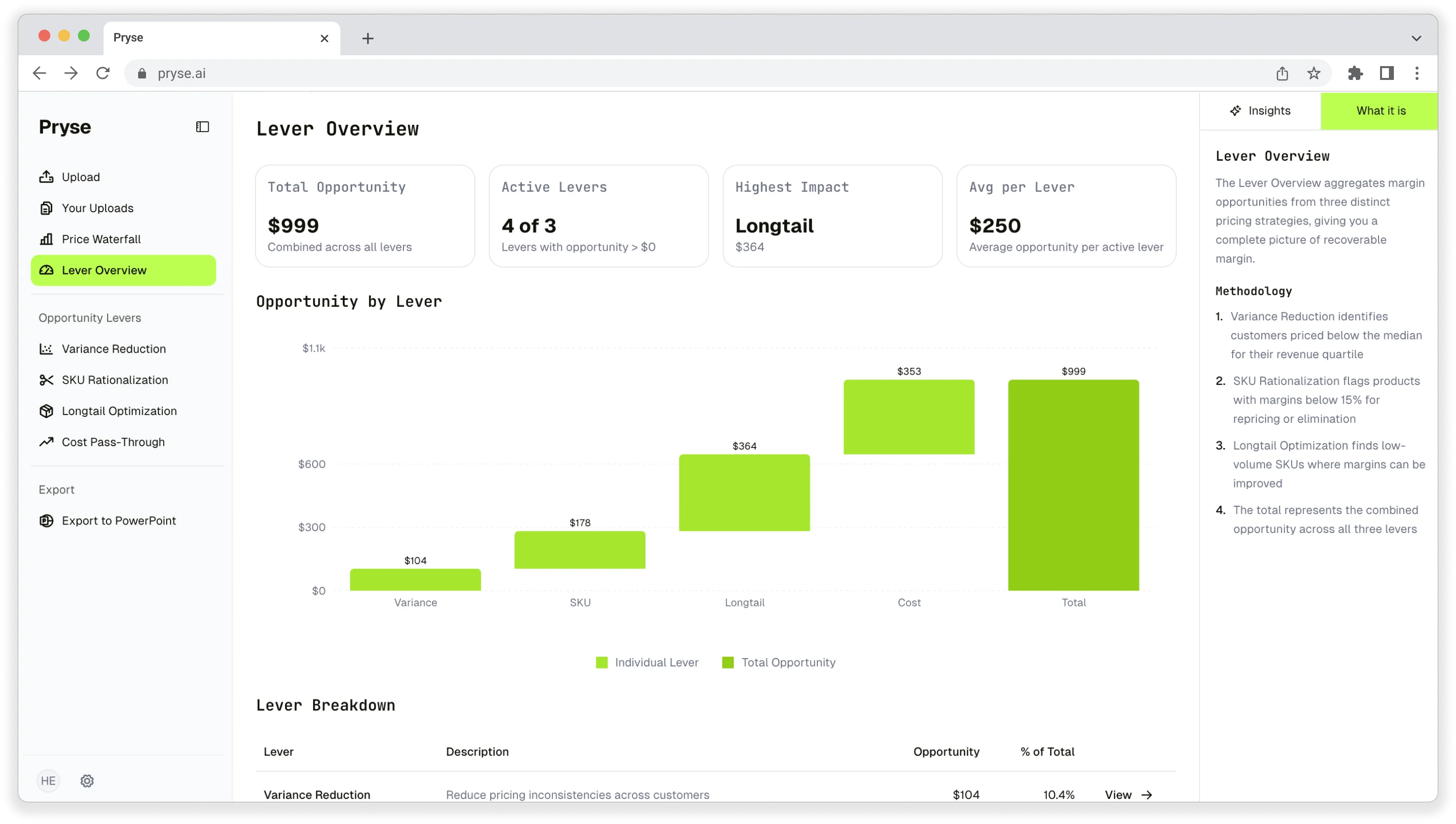
Want to analyze your entire product catalog?
Pryse automatically identifies margin leakage across thousands of SKUs. Upload your data and find hidden profit in 24 hours.
One-time $1,499 diagnostic. No subscription required.