 Pryse
PryseValue-Based Pricing Strategy: How to Price on Customer Value, Not Costs
A practical guide to implementing value-based pricing strategy in B2B distribution and manufacturing. Includes formulas, calculation examples, and a step-by-step framework.
A value-based pricing strategy sets prices based on the economic benefit a product delivers to the customer, not what it costs to produce or what competitors charge. When your $50 part saves a customer $500 in avoided downtime, you can charge $150 instead of the $65 that cost-plus math would suggest.
Most mid-market distributors and manufacturers don't do this. They run flat markups across their catalogs and leave money on the table for every specialty item they sell. McKinsey's research indicates that companies adopting value-based pricing can improve return on sales by 5 to 10 percent. For a $75M distributor running 22% gross margins, that's $825K to $1.65M in additional annual profit.
This post covers how value-based pricing actually works in B2B environments, when to use it, and how to implement it without a six-month consulting project.
How value-based pricing differs from cost-plus
Cost-plus pricing starts with your costs and adds a margin. The formula is simple:
Selling Price = Cost of Goods x (1 + Markup %)
Example: $42 cost x 1.30 = $54.60 selling price
The problem: your cost structure has nothing to do with what the customer is willing to pay. A $12 specialty gasket with a 30% markup sells for $15.60. But if that gasket prevents $300 in production line downtime, the customer would pay $50 without blinking. You just gave away $34.40 because you priced to your costs instead of their situation.
Value-based pricing flips the logic. It starts with the customer's economics:
Economic Value to Customer (EVC) = Reference Price + Differentiation Value
Example: $35 alternative + $65 in savings from your product = $100 EVC
You then price at some percentage of EVC, typically 50-70%, to share the value with the customer. In this example, pricing at 60% of EVC means $60 instead of the $15.60 that cost-plus would have produced.
Simon-Kucher's research across B2B platforms found that as many as 70% of a company's revenue base is price insensitive. These customers respond to a price increase by simply paying it. The factors driving their purchase decisions are value drivers like reliability, convenience, or unique product features, not price alone.
When value-based pricing works (and when it fails)
Value-based pricing requires two conditions: differentiation and measurable value. Without both, it falls apart.
Where it works:
- Specialty and engineered products. A custom-machined part that replaces a three-piece assembly. A chemical formulation optimized for the customer's specific process.
- Products that solve measurable problems. Reduced downtime. Lower scrap rates. Faster installation times. If you can put a dollar figure on the problem, you can price to the solution.
- Value-added services. Kitting, assembly, technical support, expedited delivery. These are where the real margin lives for many distributors.
- Limited substitutes. When the customer can't easily switch to a competitor, you have pricing power.
Where it fails:
- Commodity products. If the customer has five interchangeable options at lower prices, value-based pricing becomes wishful thinking.
- Price-transparent categories. Items where every customer knows the market price within 2%.
- Undifferentiated offerings. Same product, same service level, same lead time as competitors. No differentiation means no value premium.
The practical reality: most distributors should use value-based pricing for 15-25% of their catalog (the specialty tier) and cost-plus or competitive pricing for the rest. Trying to apply value-based pricing to commodities wastes time and frustrates sales teams.
The EVC calculation: a practical example
Let's work through a real scenario. An HVAC distributor sells a premium air handling unit motor for $1,800. Their competitor sells a standard motor for $1,200. The distributor's motor offers three measurable advantages:
- Energy efficiency: $240/year lower electricity costs
- Longer service life: 12 years vs 8 years (saves $400 in replacement labor over time)
- Reduced downtime: 4 fewer hours of HVAC outage per year at $75/hour = $300/year
Over 8 years (the comparison period), the total differentiation value:
Energy savings: $240 x 8 years = $1,920
Replacement avoidance: $400
Downtime reduction: $300 x 8 years = $2,400
Total differentiation value = $4,720
The EVC calculation:
EVC = Reference Price + Differentiation Value
EVC = $1,200 + $4,720 = $5,920
At 50% value capture, the value-based price would be $2,960 above the reference, meaning $4,160 total. Even at 30% value capture, the price is $2,616, significantly higher than the current $1,800.
The distributor is leaving $816 to $2,360 on every motor sold by not quantifying and pricing to value.
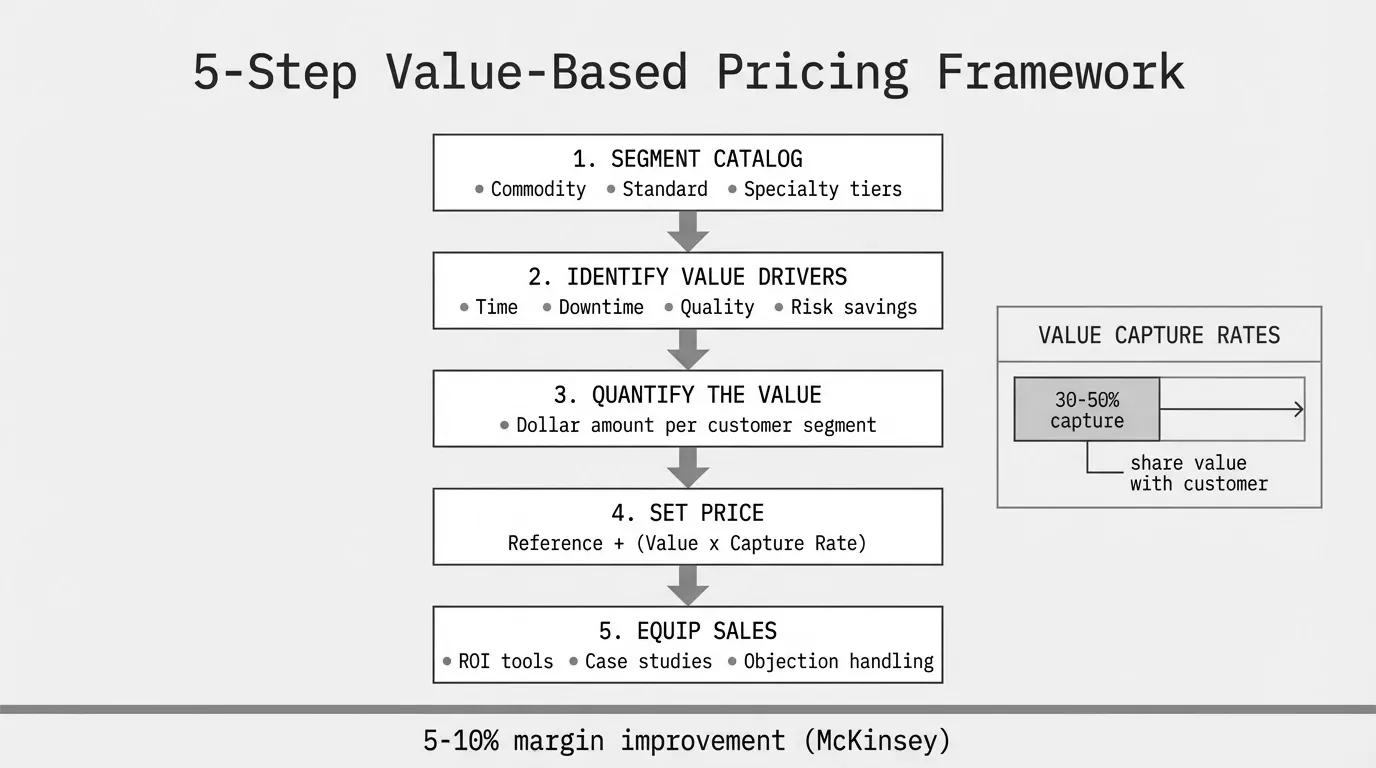
The five-step implementation framework
Implementing value-based pricing doesn't require enterprise software or a consulting engagement. Here's a practical framework for mid-market companies.
Step 1: Segment your catalog
Not everything in your catalog warrants value-based pricing. Start by dividing products into three tiers:
| Tier | Characteristics | Pricing Approach |
|---|---|---|
| Commodity | Price-shopped, many substitutes, thin differentiation | Competitive + cost-plus floor |
| Standard | Moderate differentiation, some substitutes | Cost-plus with competitive reference |
| Specialty | Unique value, limited substitutes, measurable outcomes | Value-based |
Focus your value-based efforts on the specialty tier. This is typically 10-25% of SKUs but often 30-40% of gross profit dollars.
Step 2: Identify value drivers by segment
For each specialty product or product family, answer: What measurable problem does this solve for the customer?
Common value drivers in distribution and manufacturing:
- Time savings: Faster installation, reduced labor hours
- Downtime avoidance: Production continuity, equipment reliability
- Quality improvements: Lower scrap rates, fewer defects, reduced rework
- Risk reduction: Compliance, safety, warranty protection
- Inventory efficiency: Longer shelf life, consolidated suppliers
Talk to customers. Not through surveys, but actual conversations. Simon-Kucher recommends talking to 5-10 customers per segment, asking what outcomes they measure and what prices feel too low, fair, and too high.
Step 3: Quantify the value
Convert each value driver to dollars. This requires customer-specific data, but you can start with industry benchmarks and refine.
Example quantification for a premium industrial bearing:
| Value Driver | Customer Metric | Dollar Value |
|---|---|---|
| Extended service life | 2 years longer x $200/replacement | $400 |
| Reduced lubrication | 4 fewer lubrications/year x $50 | $200/year |
| Lower failure rate | 1 fewer failure/3 years x $800 downtime | $267/year |
Annual value: $667. Over a 5-year comparison period: $3,335 in differentiation value.
Step 4: Set the price
Determine your value capture percentage. This depends on:
- Competitive intensity: More competitors = lower capture rate
- Switching costs: Higher switching costs = higher capture rate
- Customer relationship: Strategic accounts may warrant lower capture to build volume
A common starting point: 40-50% value capture for B2B products with moderate competition.
Value-Based Price = Reference Price + (Differentiation Value x Capture %)
Example: $85 reference + ($335 value x 0.45) = $235.75
Compare this to your cost-plus price. If the value-based price is significantly higher, you've found margin opportunity. If it's lower, either your differentiation is weak or you're in a commodity category.
Step 5: Equip sales to defend the price
Value-based pricing fails when sales teams can't articulate the value. Bain's research on B2B pricing found that the most common error is failing to gather concrete evidence of customer outcomes before setting prices. Without documented proof of value, sales reps struggle to justify higher prices during negotiations.
Build value documentation for each specialty product:
- ROI calculator or one-pager showing the economic math
- Case study or reference from a customer who experienced the value
- Comparison table against the next-best alternative
- Objection responses for common pushback ("Your competitor is cheaper")
Sales training should focus on discovery questions that surface customer pain points, not just product features. "What does an hour of production downtime cost you?" leads somewhere. "Let me tell you about our premium motor" does not.
Common mistakes and how to avoid them
Mistake 1: Applying value-based pricing to commodities
A $3 pipe fitting with six interchangeable competitors is not a value-based pricing candidate. You'll waste time building ROI calculators that customers ignore while they buy from whoever's cheapest.
Fix: Be honest about which products are truly differentiated. If your sales team can't articulate a measurable advantage over alternatives, it's not a value-based pricing candidate.
Mistake 2: Using theoretical value instead of documented value
"Our product probably saves customers time" is not value quantification. Neither is "Industry sources suggest significant benefits."
Fix: Gather specific data. Interview customers. Track outcomes. Build case studies with real numbers. Hinterhuber's research found that 79% of managers cite difficulty assessing differentiated value as the primary obstacle to value-based pricing. The fix is doing the research, not skipping it.
Mistake 3: Setting prices without customer input
Pricing a product at 60% of calculated EVC sounds rational, but if customers perceive the value at 30% of your calculation, you'll lose deals and wonder why.
Fix: Test prices. Use the Van Westendorp method (asking customers what prices seem too cheap, acceptable, expensive, and too expensive). Start conversations with "What would this solution be worth to you if it delivered X outcome?"
Mistake 4: Treating value-based pricing as a one-time exercise
Customer needs change. Competitors introduce alternatives. Input costs shift. The value calculation from 2022 may not hold in 2025.
Fix: Review value-based prices annually. Track win rates by margin band. If you're losing deals at value-based prices, either the value proposition has weakened or it wasn't as strong as you thought.
Measuring success
Track these metrics to know if your value-based pricing strategy is working:
-
Gross margin by product tier. Specialty products should earn meaningfully higher margins than commodities. If they're converging, your value pricing isn't holding.
-
Win rate at target prices. Are you winning deals at value-based prices, or only when you discount back to cost-plus levels?
-
Price override rate. What percentage of specialty product transactions involve a sales rep overriding the system price? If it's above 30%, your value documentation isn't convincing enough or your prices are too aggressive.
-
Customer retention at higher prices. Are value-based prices causing churn, or are customers staying because the value is real?
-
Revenue mix shift. Is your specialty tier growing as a percentage of revenue? If customers are buying your value-priced products, the pricing is working.
McKinsey's 2003 article "The Power of Pricing" (McKinsey Quarterly) found that a 1% improvement in realized price drives an 8% increase in operating profit. Value-based pricing is often the fastest path to that 1% improvement, because it captures margin that was always available but never claimed.
Getting started this month
If you're running flat markups today, here's a 30-day path to value-based pricing:
Week 1: Export 12 months of transaction data. Identify your top 50 specialty products by margin dollars. These are your value-based pricing candidates.
Week 2: For each candidate, write down the measurable problem it solves. If you can't articulate one, it's not a value-based candidate. Narrow the list to 20-25 products with clear value stories.
Week 3: Talk to 3-5 customers per product. Ask what outcomes they measure, what they'd pay for guaranteed outcomes, and what alternatives they considered. Build rough EVC calculations.
Week 4: Set value-based prices for the top 10 products. Build one-page value documentation for sales. Train the team on how to use it.
Then iterate. Expand the list. Refine the value calculations. Track results and adjust.
Value-based pricing isn't a pricing model you install. It's a discipline of continuously understanding what your products are worth to customers and pricing accordingly. The companies that do it well, according to McKinsey, capture 5-10% more margin than those that price to cost alone.
Pryse helps mid-market distributors and manufacturers see where their current pricing leaves money on the table. Upload your transaction data and get a price waterfall analysis showing the gap between list price and pocket price, the first step toward understanding where value-based pricing can recover margin.
For the complete framework on value-based pricing, see our Value-Based Pricing Guide.
Last updated: Invalid Date
Frequently Asked Questions
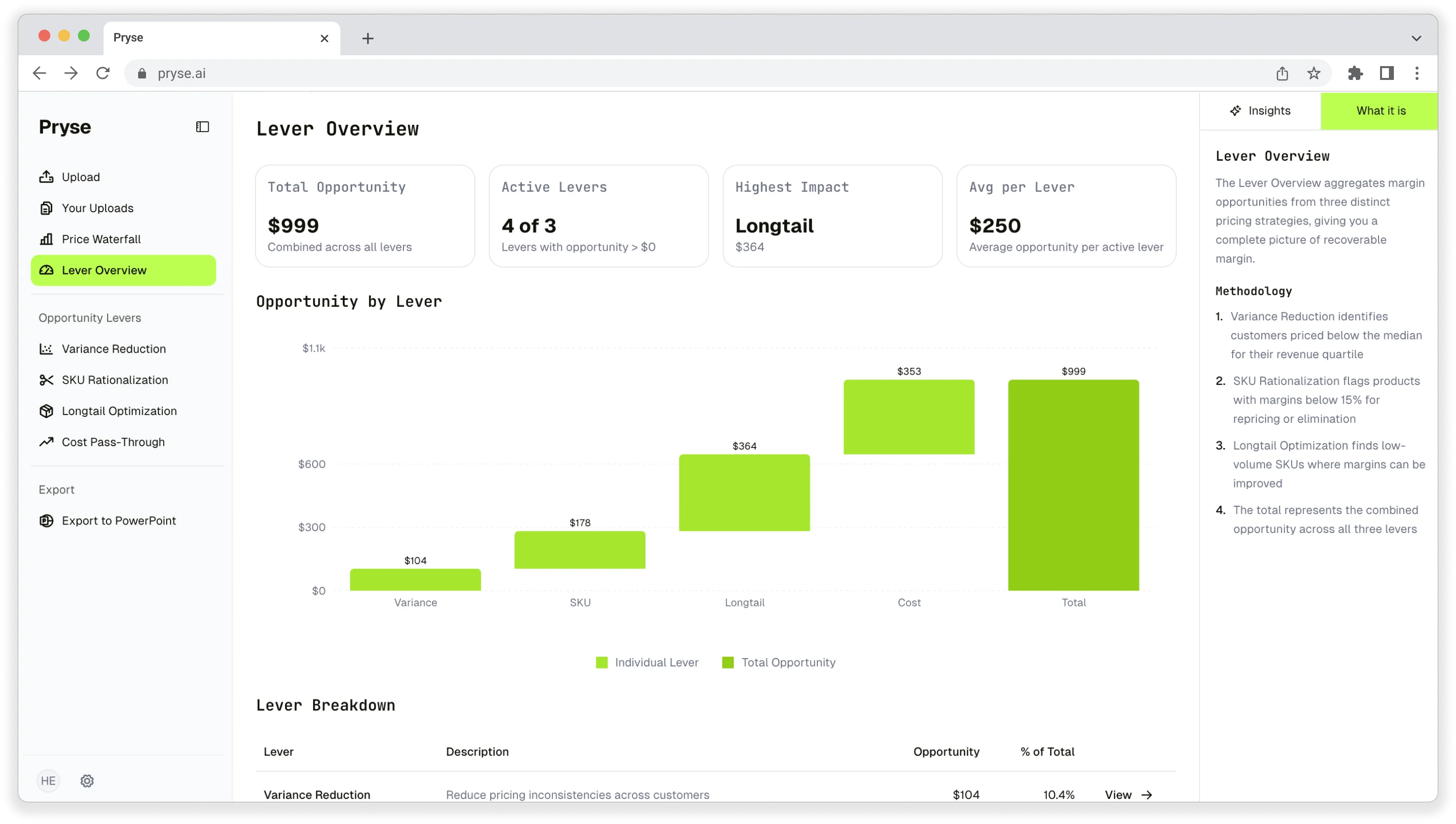
Want to analyze your entire product catalog?
Pryse automatically identifies margin leakage across thousands of SKUs. Upload your data and find hidden profit in 24 hours.
One-time $1,499 diagnostic. No subscription required.