 Pryse
Pryse7 Value-Based Pricing Examples in B2B (With Real Numbers)
Real value-based pricing examples from distribution and manufacturing. See how industrial companies price on customer value instead of cost, with formulas and dollar figures.
Value-based pricing examples show how B2B companies set prices based on measurable customer outcomes instead of cost-plus markups. A bearing that costs $45 to manufacture but prevents $2,800 in annual downtime can justify a $180 price tag, not the $58.50 that cost-plus math would suggest.
Most "value-based pricing examples" articles give you Apple and Starbucks. That's not helpful if you're a $60M industrial distributor trying to figure out why your specialty products earn the same margins as your commodities.
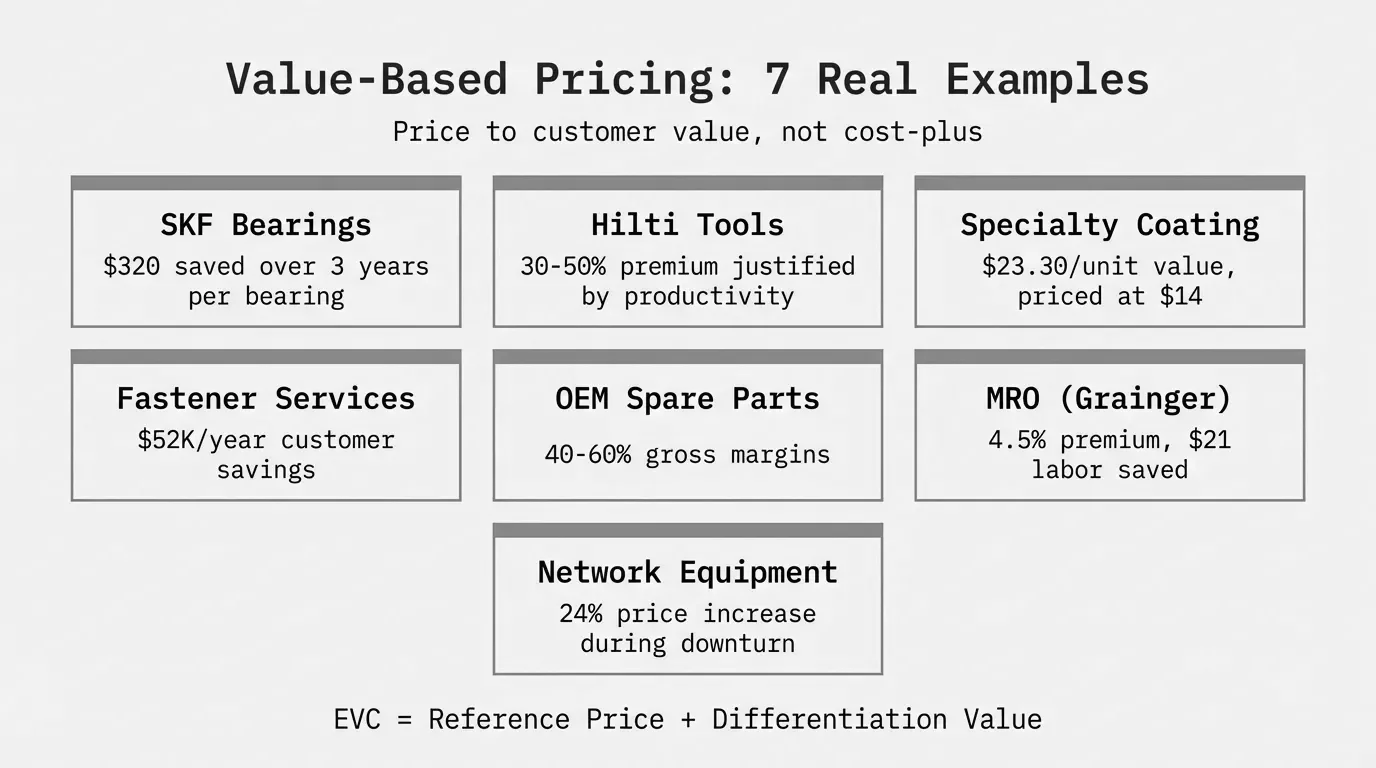
This article covers seven real value-based pricing examples from distribution and manufacturing, with actual dollar figures and the calculations behind them.
What is value-based pricing?
Value-based pricing is a pricing strategy that sets prices based on the quantifiable economic benefit a product delivers to the customer, rather than what it costs to produce or what competitors charge.
The core formula is Economic Value to Customer (EVC):
EVC = Reference Price + Differentiation Value
Reference price is what the customer would pay for the next-best alternative. Differentiation value is the additional economic benefit your product delivers: reduced downtime, lower labor costs, fewer defects, longer equipment life, or any other measurable outcome.
Most companies then price at 30-50% of that calculated value, sharing the benefit with the customer while capturing margin they'd miss under cost-plus pricing.
McKinsey's research indicates that companies adopting value-based pricing can improve return on sales by 5 to 10 percent. For a $50M distributor running 4% net margins, capturing even the low end of that range adds $250,000 to annual profit.
Example 1: SKF ball bearings (manufacturing)
SKF, headquartered in Sweden, is the world's largest ball-bearing manufacturer. They sell bearings that cost more than competitors, but they've built an entire sales methodology around proving why the premium is justified.
The situation: An industrial customer needs bearings for a production line. Standard bearings from a competitor cost $85 each with an expected 18-month service life. SKF's premium bearings cost $140 each but last 36 months and require less frequent lubrication.
The value calculation:
| Factor | Standard Bearing | SKF Bearing |
|---|---|---|
| Unit price | $85 | $140 |
| Service life | 18 months | 36 months |
| Bearings needed over 3 years | 2 | 1 |
| Total bearing cost (3 years) | $170 | $140 |
| Replacement labor ($200/swap) | $400 | $200 |
| Lubrication cost (3 years) | $180 | $90 |
| Total 3-year cost | $750 | $430 |
The SKF bearing costs 65% more upfront but saves $320 over three years. That's the differentiation value.
Why it works: SKF built a web-based tool called the "Documented Solutions Program" that walks customers through this calculation for their specific application. According to SKF's public documentation, the tool demonstrates customer benefits including longer product life, lower cost of failure, and inventory savings. Prices vary by customer segment based on how much a bearing failure would cost in that customer's industrial process.
A bearing failure in a steel mill that halts a $50,000/hour production line justifies a bigger premium than the same bearing in a low-volume packaging operation.
Example 2: Hilti construction tools (premium equipment)
Hilti, the Liechtenstein-based construction tool manufacturer, sells rotary hammers, concrete saws, and fastening systems at prices often 30-50% higher than competitors like DeWalt or Milwaukee.
The situation: A concrete drilling contractor considers a Hilti rotary hammer at $1,200 versus a competitor at $800.
The value calculation:
| Factor | Competitor | Hilti |
|---|---|---|
| Tool price | $800 | $1,200 |
| Estimated life (professional use) | 2 years | 4 years |
| Annual tool cost | $400 | $300 |
| Drilling speed (holes/hour) | 45 | 58 |
| Labor cost at $65/hour | Higher | Lower |
| Service/repair downtime | ~8 hours/year | ~3 hours/year |
According to Hilti's public marketing materials, their tools are "designed to reduce the vibration transmitted back into the hand" with "three completely separate lubrication chambers to protect key parts of the mechanism." A professional contractor drilling 8 hours a day notices the productivity difference.
Why it works: Hilti uses direct sales. Every customer gets a dedicated account manager who demonstrates tools on-site. As Harald Prantner, head of Hilti's Creative Agency, stated in an interview with Dassault Systemes' Compass Magazine: "A professional, within a few seconds of working with our tools, will see the benefits. So the more we have the chance to demonstrate our tools in real life, the more customers we will convince."
Hilti also pioneered fleet management in construction tools starting in 2000, allowing customers to lease tools for a fixed monthly payment that includes maintenance and replacement. According to Strategyzer's analysis of Hilti's business model, this "resulted in customer loyalty levels five times higher than under the dominant business model Hilti had formerly employed."
Example 3: Specialty chemical coating (manufacturing)
A specialty chemical manufacturer sells a rust-prevention coating to heavy equipment OEMs. This example is based on a composite of actual value-based pricing implementations I've worked on in manufacturing.
The situation: The customer currently uses a standard coating at $3.20 per unit. The specialty coating costs $8.50 per unit but applies faster and performs better.
The value calculation:
| Factor | Standard Coating | Specialty Coating |
|---|---|---|
| Material cost per unit | $3.20 | $8.50 |
| Application time | 45 min | 15 min |
| Labor cost at $50/hr | $37.50 | $12.50 |
| Warranty claims per 1,000 units | 23 at $180 each | 3 at $180 each |
| Warranty cost per unit | $4.14 | $0.54 |
| Total cost per unit | $44.84 | $21.54 |
The specialty coating costs 2.7x more per unit but saves $23.30 per unit in labor and warranty costs.
The pricing decision: A cost-plus approach would price the $8.50 product at $11.50 (35% markup). The value-based price? The manufacturer charges $14.00 per unit, capturing roughly 23% of the $23.30 value created. The customer still saves $19.80 per unit compared to the "cheap" alternative.
Value-Based Price = Cost + (Value Created x Capture Rate)
$14.00 = $8.50 + ($23.30 x 0.23)
At $14.00 versus $11.50 cost-plus, the manufacturer earns $2.50 more per unit. On 200,000 units annually, that's $500,000 in additional margin from a single product line.
Example 4: Industrial fastener distributor (value-added services)
An industrial fastener distributor competes against dozens of suppliers selling identical hex bolts and screws. The products themselves are commodities. The value isn't in the bolt.
The situation: A manufacturing plant buys 2 million fasteners annually. They can purchase from any of 15 distributors at roughly the same price per unit.
The value-added services:
| Service | Customer's Internal Cost | Distributor's Price | Customer Savings |
|---|---|---|---|
| Vendor-managed inventory (VMI) | $45,000/year (staff time) | $18,000/year | $27,000 |
| Kitting/assembly | $32,000/year | $22,000/year | $10,000 |
| Quality documentation | $8,000/year | Included | $8,000 |
| Emergency expediting | $12,000/year | $5,000/year | $7,000 |
| Total | $97,000/year | $45,000/year | $52,000/year |
The fastener prices are competitive with the market. The margin comes from services priced at roughly 45% of the value they create for the customer.
Why it works: According to an Industrial Distribution article on building a value-based pricing culture, the key is tying goals to "your value triangle: suppliers, customers and products." The distributor isn't trying to charge more for commodity bolts. They're pricing the services that eliminate the customer's internal costs.
One fastener distributor, Field Fastener, describes their approach as "year-over-year cost savings by evaluating the total cost of assembly," including labor, inventory carrying costs, and overhead.
Example 5: Aftermarket spare parts (equipment manufacturer)
Aftermarket parts are where value-based pricing shows the biggest contrast to cost-plus. The same bolt that sells for $0.40 in a hardware store can sell for $4.00 as a "genuine OEM replacement part."
The situation: A construction equipment owner needs a hydraulic seal. The OEM genuine part costs $85. An aftermarket alternative costs $32.
The value calculation from the customer's perspective:
| Factor | Aftermarket Part | OEM Part |
|---|---|---|
| Part cost | $32 | $85 |
| Expected life | 8 months | 18 months |
| Annual part cost | $48 | $56.67 |
| Replacement labor ($150/swap) | $225 | $100 |
| Risk of equipment damage | Higher | Lower |
| Warranty implications | May void | Protected |
McKinsey's research on industrial aftermarket services found that "average EBIT margin for aftermarket services was 25 percent, compared to 10 percent for new equipment." The parts themselves often have gross margins of 40-60%.
Why customers pay: According to a Syncron analysis of spare parts pricing strategies, proprietary or custom parts, such as "custom motors, integrated circuits, electronic assemblies" and components protected by patents, "must be purchased from the OEM or their designated agents."
For non-proprietary parts, value-based pricing depends on convenience, warranty protection, and risk aversion. A $50,000 piece of equipment sitting idle costs more per hour than the premium on a genuine part.
One industrial machinery player, according to McKinsey's 2019 article "Industrial aftermarket services: Growing the core," improved EBIT margin by 2 percentage points in one year by repricing 100,000 spare parts SKUs using value-based segmentation.
Example 6: MRO distributor premium service tier (Grainger model)
W.W. Grainger generates $17.2 billion in annual revenue selling maintenance, repair, and operating supplies. They're rarely the cheapest option. They charge a premium for availability, delivery speed, and procurement simplification.
The pricing structure: According to Modern Distribution Management's 2024 interview with Grainger's CFO, the company maintains a "value-added services" premium of 3-5% over standard market rates while achieving gross margins around 36%.
The value proposition:
| Factor | Low-Cost Competitor | Grainger |
|---|---|---|
| Price per widget | $10.00 | $10.45 |
| Availability | 85% in stock | 99% in stock |
| Delivery time | 3-5 days | Next day/same day |
| Search/procurement time | 45 min | 8 min |
| Invoice consolidation | No | Yes |
The 4.5% price premium on a $10 widget is $0.45. But if a maintenance tech earning $35/hour saves 37 minutes of search and procurement time, that's $21.58 in labor savings. The procurement department saves time consolidating invoices. The plant avoids downtime from stockouts.
Why it works: Grainger's CEO D.G. Macpherson addressed the pricing philosophy directly at an investor conference: "We don't need to have the lowest price, we just need to be in the ballpark." The value is in what Grainger calls "KeepStock," inventory management systems that maintain supplies at customer locations so production never stops waiting for parts.
Example 7: Network equipment manufacturer (documented McKinsey case)
McKinsey has published a specific case study of a network equipment manufacturer that implemented value-based pricing during an industry downturn.
The situation: The manufacturer introduced an innovative product when competitors were cutting prices. Rather than matching the price cuts, they quantified the value their product delivered.
The result: According to McKinsey's research published in their Growth, Marketing and Sales insights, the company "was able to increase the product's price by over 24 percent, effectively capturing the true value delivered to its customers."
During a downturn. When competitors were discounting.
Why it works: The manufacturer invested in documenting the measurable outcomes their product delivered. When customers could see the math, the price conversation changed from "your competitor is cheaper" to "what's the ROI on the premium?"
How to apply these examples to your business
These examples share common patterns:
1. Quantify the customer's alternative
Every value-based price starts with a reference point. What would the customer pay for the next-best option? If you don't know, you're guessing.
Reference Price = Price of customer's next-best alternative
2. Identify measurable value drivers
Not "our product is better quality." Instead: "Our product reduces warranty claims by 87%, saving $3,600 per 1,000 units." The value drivers that matter:
- Labor savings (time x hourly rate)
- Downtime avoidance (hours x production value)
- Quality improvements (defect rate x cost per defect)
- Service life extension (replacement cost x frequency difference)
- Risk reduction (probability x cost of failure)
3. Build the total cost of ownership comparison
Purchase price is one line item. Value-based pricing requires the full picture:
Total Cost = Purchase Price + Labor + Maintenance + Downtime + Risk
4. Price at 30-50% of value created
If your product saves the customer $1,000 annually over the alternative, pricing $300-$500 above the alternative is defensible. The customer keeps 50-70% of the savings. You capture margin you'd miss under cost-plus.
5. Document and train
Value-based pricing fails when sales teams can't explain the value. Build ROI calculators, comparison sheets, and case studies. Then train your team to use them.
When value-based pricing doesn't work
Not every product is a value-based pricing candidate:
- Commodity items with many substitutes. If the customer can buy the same thing from five competitors at lower prices, value-based pricing becomes wishful thinking.
- Price-transparent categories. When everyone knows the market price within 2%, premiums don't hold.
- Undifferentiated offerings. Same product, same service, same lead time as competitors. No differentiation means no value premium.
Most distributors should use value-based pricing for 15-25% of their catalog (specialty items) and cost-plus or competitive pricing for the rest.
Measuring if value-based pricing is working
Track these metrics:
-
Gross margin by product tier. Specialty products should earn meaningfully higher margins than commodities.
-
Win rate at value-based prices. Are you closing deals at the higher prices, or discounting back to cost-plus?
-
Customer retention. Are value-priced accounts staying, or defecting to cheaper alternatives?
-
Price override rate. If sales reps override value-based prices more than 30% of the time, either the prices are wrong or the value documentation isn't convincing.
McKinsey's 2003 article "The Power of Pricing" in the McKinsey Quarterly found that a 1% improvement in realized price drives an 8% increase in operating profit. Value-based pricing, applied correctly to the right products, is often the fastest path to that 1%.
Getting started with value-based pricing
Start with your highest-margin specialty products. Pick 10-20 items where you have clear differentiation and can document measurable customer outcomes. Build the EVC calculation, set value-based prices, and train your sales team to defend them.
Then measure what happens. If win rates hold and margins improve, expand the approach. If customers push back, either the value documentation needs work or you've overestimated your differentiation.
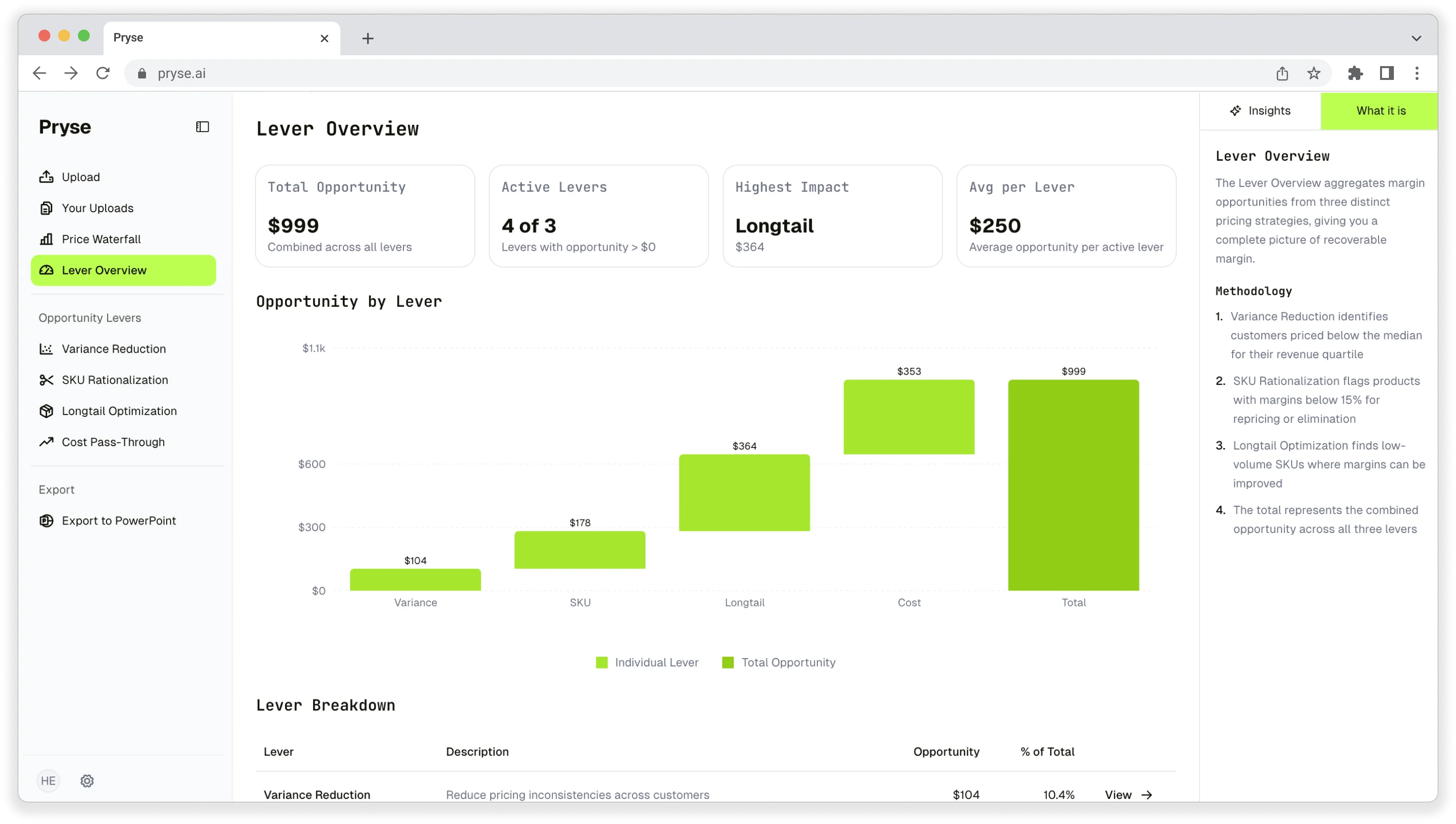
Pryse helps distributors and manufacturers see where current pricing leaves money on the table. Upload your transaction data and get a margin analysis showing which products and customers are underpriced relative to the value you deliver.
For the complete framework on implementing value-based pricing, see our Value-Based Pricing Guide. For a deeper dive into the strategy behind value pricing, read Value-Based Pricing Strategy.
Last updated: Invalid Date
Frequently Asked Questions
Want to analyze your entire product catalog?
Pryse automatically identifies margin leakage across thousands of SKUs. Upload your data and find hidden profit in 24 hours.
One-time $1,499 diagnostic. No subscription required.