 Pryse
PryseValue-Based Pricing vs Cost-Based Pricing: When to Use Each (and When to Combine Them)
A practical comparison of value-based and cost-based pricing for distributors and manufacturers. Learn which approach fits your products, when to use each, and how to combine them.
Cost-based pricing and value-based pricing sit on opposite ends of the pricing spectrum. One starts with your costs and adds a markup. The other starts with your customer's gains and works backward. Most distributors and manufacturers use cost-based pricing by default. Many of them are leaving significant margin on the table as a result.
Value-based pricing is the approach that sets prices based on what the product is worth to the customer, not what it costs to produce or acquire. Cost-based pricing is a strategy that determines selling prices by calculating total costs and adding a fixed percentage markup.
Neither is universally right. The question is which fits your products, your customers, and your competitive position. Often, the answer is both, applied to different parts of your business.
This comparison covers what each approach actually means, when each works, where each fails, and how to build a hybrid strategy that captures more margin without alienating customers.
The core difference
The fundamental difference between these two approaches is where you start.
Cost-based pricing starts inside your business:
Selling Price = Total Cost per Unit x (1 + Markup %)
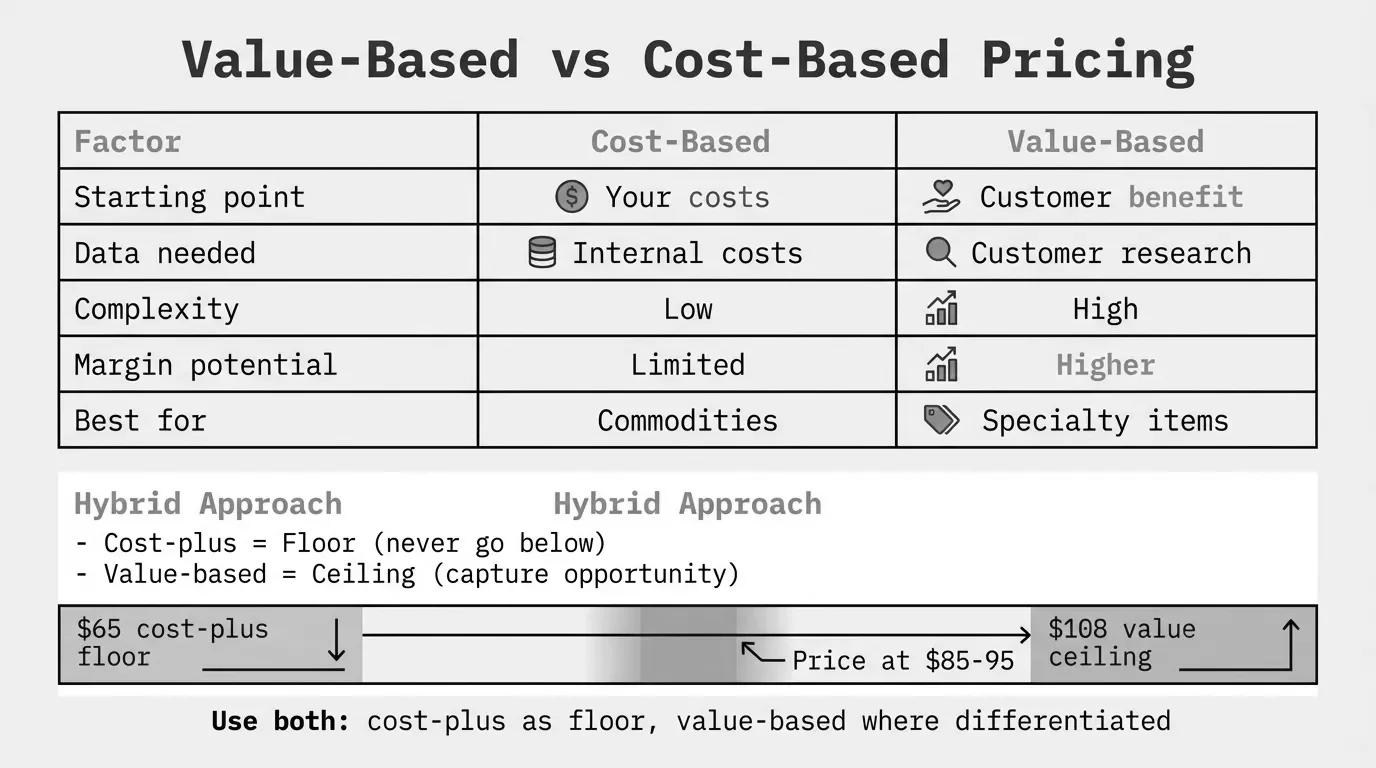
You calculate what a product costs you (landed cost for distributors, manufacturing cost for producers), add a percentage, and that's your price. A $50 product with a 30% markup sells for $65. Simple. Predictable. Defensible.
Value-based pricing starts with the customer:
Selling Price = Customer's Economic Benefit x Capture Percentage
You determine what the product is worth to the buyer, measured in time saved, revenue gained, problems avoided, or risk reduced. Then you price to capture a share of that value. If a $50 product saves a customer $1,000 in downtime, you might price it at $200 and still leave them with $800 of captured benefit.
According to Stripe's pricing guide, cost-based pricing is "inward-focused, only taking into consideration internal cost concerns" while value-based pricing is "customer-centric" and prices based on "time saved, revenue earned, convenience gained, or risk avoided."
The difference can be dramatic. Consider a specialty industrial valve that costs you $80 to stock. A 35% cost-plus markup puts it at $108. But if that valve is the only one rated for a customer's corrosive chemical application and prevents a $50,000 equipment failure, a value-based price of $250-400 might be perfectly reasonable. The customer is still getting massive ROI.
Side-by-side comparison
| Factor | Cost-Based Pricing | Value-Based Pricing |
|---|---|---|
| Starting point | Your costs | Customer's benefit |
| Formula | Cost + Markup % | Value delivered x Capture % |
| Data required | Internal cost data | Customer research, willingness-to-pay data |
| Implementation complexity | Low | High |
| Scales across large catalogs | Yes | Difficult without software |
| Margin potential | Limited by markup | Limited by customer perception |
| Risk of underpricing | High on differentiated products | Low |
| Risk of overpricing | Low (anchored to cost) | Higher without market data |
| Best for | Commodities, transparent markets | Differentiated products, specialty items |
| ERP support | Native in most systems | Requires additional tools |
When cost-based pricing works
Cost-based pricing isn't wrong. It's the right approach in several situations.
Commodity products with transparent pricing. When customers can check five competitors in 30 seconds, your internal costs don't set the market. A 35% markup on a standard fastener might overprice you. A 15% markup might be right for the market. Cost-plus gives you a starting point, but competitive reality sets the final number.
Government and defense contracts. Many government procurement processes require cost transparency and standardized markups. The U.S. Federal Acquisition Regulation defines specific cost-plus contract structures. Here, value-based pricing isn't an option. Your costs are auditable and your markup is negotiated or regulated.
New product launches without market data. When you introduce a new line, you often don't know what customers will pay. Cost-plus gives you a defensible starting price while you learn. Launch, observe, adjust.
Custom and engineered-to-order products. When every job has unique costs (materials, labor hours, tooling), cost-plus is the natural framework. You quote based on what this specific job will cost you, plus your standard margin.
High-volume, low-differentiation manufacturing. If you're producing 500,000 identical widgets, your cost efficiency IS your competitive advantage. Cost-plus pricing aligned with manufacturing efficiency works because the value you provide is the low price itself.
According to NetSuite's cost-plus guide, cost-plus is "popular with retailers, including grocery and apparel stores, as well as small mom-and-pop shops, large government contractors and manufacturers that sell products in bulk at relatively predictable fixed costs."
When value-based pricing works
Value-based pricing captures margin that cost-plus leaves behind.
Differentiated products. When you're the only distributor stocking a specific brand, or the only manufacturer with a specific capability, the customer's alternative isn't a cheaper version of your product. It's going without. That changes the value equation entirely.
Technical products solving specific problems. PriceFX's distribution pricing analysis offers a good example: power tools with paddle switches versus trigger switches. Paddle switches are longer-lasting, associated with professional use. The distributor can charge higher margins on paddle-switch tools because professionals value durability and will pay for it.
Products with limited competition. If customers have few alternatives, your cost has little to do with what they'll pay. A specialty stainless steel valve for corrosive chemical applications might cost you 30% more than a brass valve. But if it's the only option for the application, you can price based on the value of avoiding equipment failure, not the cost of the metal.
Services with measurable economic value. Same-day delivery, technical support, kitting, or custom packaging all have economic value to customers. If same-day delivery prevents a $10,000 production line shutdown, charging $150 for expedited shipping captures a fraction of that value.
Research from Simon-Kucher on B2B companies found that "companies that employ value-based pricing tend to outperform those relying on traditional methods" when markets become competitive, because "customers pay more for solutions that solve real problems and deliver measurable ROI."
The pros and cons, honestly assessed
Cost-based pricing advantages
Simple to calculate. Sum your costs, add a percentage. A pricing manager can update 10,000 SKUs in an afternoon. No customer research required.
Predictable margins. As long as costs remain stable, your gross margin is locked in. Finance can forecast accurately.
Prevents selling below cost. Every transaction covers its costs plus profit. No surprises when you tally the numbers.
Easy to explain. Customers understand cost-plus. Procurement managers can see the logic. Negotiations are straightforward.
Scales across large catalogs. A distributor with 50,000 SKUs can't do individual value analysis on each item. Cost-plus applies universally.
Cost-based pricing disadvantages
Ignores customer willingness to pay. Your costs have nothing to do with what customers value. A 30% markup might be aggressive on a commodity and leaving $100 on the table on a specialty item.
Creates "peanut butter pricing." As SPARXiQ research documented, spreading the same markup across every product means you're too high on items customers shop and too low on items they don't.
Limits profit potential. You're capping prices based on cost, not impact. If your $50 product saves customers $5,000, you're leaving $4,885 of value uncaptured.
Ignores competition. A cost-plus price might be 20% above or below the market. Without checking, you're either losing deals or losing margin.
Value-based pricing advantages
Higher margins on differentiated products. Pricing based on customer value, not your costs, unlocks margin you can't access with cost-plus. McKinsey found that companies adopting value-based approaches can improve return on sales by 5-10%.
Customer-aligned positioning. Understanding customer value improves your marketing, sales conversations, and product development. You're selling outcomes, not products.
Flexible to market conditions. Value-based pricing adapts to demand, competition, and customer segment. Cost-plus is static unless costs change.
Defensible pricing. When customers push back, you can justify the price based on the value they receive, not your internal costs.
Value-based pricing disadvantages
Hard to calculate. Determining customer willingness to pay requires research: surveys, conjoint analysis, sales feedback, or trial-and-error. There's no formula you can run in Excel.
Doesn't scale easily. As WrangleWorks noted, "A typical distributor could have hundreds of suppliers sending product content and pricing for tens of thousands of items. VBP simply cannot be implemented at the scale required by industrial companies with large numbers of products" without automation.
Requires customer knowledge. If you don't understand what customers value, you'll guess wrong. Overpricing loses deals. Underpricing wastes the approach.
Can alienate customers if misapplied. Charging a premium on a commodity because you think it's differentiated will push customers to competitors.
Real examples from distribution and manufacturing
Industrial valves. A $40 brass valve and a $55 stainless steel valve might seem like a simple cost-plus calculation. But stainless steel valves go into high-end applications: corrosive chemicals, healthcare, food service. The customer buying the stainless steel valve is solving a $10,000 problem. The brass valve buyer is solving a $200 problem. Value-based pricing says the stainless steel valve should carry a 50-80% markup while the brass valve might only support 25%.
Power tool distributor. Two drill variants: one with trigger switch, one with paddle switch. The paddle switch version is associated with professional use, lasts longer. Cost difference: maybe $8. Value difference: professionals will pay $40 more because they trust the tool won't fail on a job site. That's $32 of captured value from a $8 cost difference.
Specialty chemical manufacturer. Custom formulations with 6-8 week lead times. Cost-plus pricing: $2.50/lb cost, 40% markup, $3.50/lb selling price. But the customer chose this formulation because it's the only one that meets their spec. The alternative is reformulating their entire process. Value-based price: $5.50/lb, and the customer signs a 3-year contract because they don't want to risk supply disruption.
Can you combine them? The hybrid approach
Here's the practical reality: most successful B2B companies don't choose one or the other. They use cost-based pricing as a floor and value-based pricing as a ceiling.
Impact Pricing describes this hybrid approach: "Start with figuring out the minimum viable price. What do you need to charge to cover your costs and hit a sustainable profit margin? That baseline ensures you're not pricing below what it takes to stay in business. Next, determine the highest price the market could support, based on the real value your product delivers."
Step 1: Establish your cost floor. Calculate total landed cost or manufacturing cost for each product. Add a minimum acceptable markup (say, 15-20%) that covers overhead and provides baseline profit. This is your floor. You never price below this.
Step 2: Identify the value ceiling. For each product category, estimate what customers would pay based on alternatives, differentiation, and economic value. This is your ceiling. You price up to this level but not beyond.
Step 3: Segment your catalog. Not every product gets the same treatment:
| Product Type | Pricing Approach | Example Markup |
|---|---|---|
| Commodities (high visibility, easy comparison) | Cost-plus, market-validated | 18-25% |
| Standard products (moderate competition) | Cost-plus with slight value adjustment | 25-35% |
| Specialty items (limited alternatives) | Value-based with cost floor | 40-70% |
| Technical solutions (you provide expertise) | Full value-based | 50-100%+ |
Step 4: Apply customer segmentation. Strategic accounts buying $2M annually get tighter pricing than one-time buyers. This isn't about "discounting"; it's about allocating value capture across your relationship.
According to Bain & Company's 2018 survey of over 1,700 B2B companies, 85% of respondents believed their pricing decisions could improve. The biggest gaps weren't in having wrong prices. They were in "price and discount structure, sales incentives, use of tools and tracking." In other words, execution of a blended strategy matters more than choosing one pure approach.
How to decide which approach fits your business
Start with these questions:
How much of your catalog is truly differentiated? If 80% of your products are commodities that customers can source elsewhere, pure value-based pricing across the board will fail. Focus value-based approaches on the 20% where you have leverage.
Do you know what customers value? Value-based pricing without customer insight is just guessing at higher prices. If you don't have willingness-to-pay data, start with cost-plus and build the customer knowledge over time.
Can your sales team execute it? A sophisticated pricing strategy that sales reps ignore is worthless. If your team is used to cost-plus and discount authority, introducing value-based pricing requires training, tools, and changed incentives.
What's your competitive position? If you're competing on price, cost-plus aligned with efficiency is the strategy. If you're competing on value (expertise, availability, service), you need pricing that reflects that differentiation.
How much margin are you leaving on the table? Pull your transaction data. Look at the variance in realized margins. If you're getting 40% on some transactions and 12% on others with no clear pattern, you probably have pricing discipline problems more than pricing strategy problems.
The bottom line on each approach
Cost-based pricing is the right default for most of your catalog. It's simple, it scales, and it prevents selling below cost. The mistake is using it exclusively across every product and every customer.
Value-based pricing captures margin that cost-plus can't reach. It works on differentiated products where customers have limited alternatives and the economic value is measurable. The mistake is trying to apply it to commodities or without understanding customer willingness to pay.
The hybrid approach is what actually works in B2B distribution and manufacturing. Use cost-plus as your floor. Apply value-based adjustments on products where you have differentiation. Segment by customer value. Review regularly.
For the complete framework on value-based pricing, see our value-based pricing guide. For cost-plus mechanics, see our cost-plus pricing strategy breakdown.
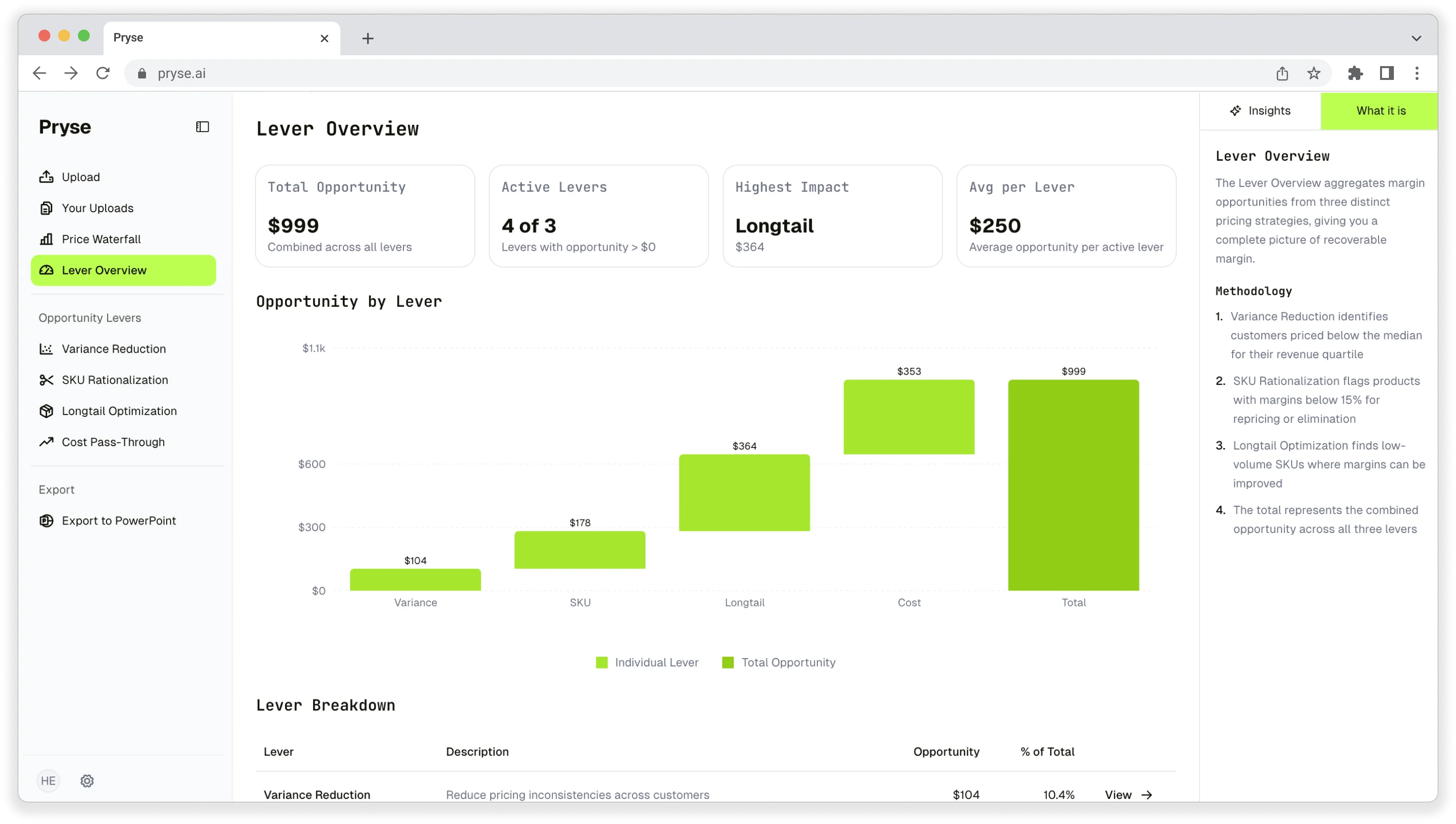
Pryse helps distributors and manufacturers see where their pricing strategy breaks down. Upload your transaction data, see your price waterfall, and identify whether you're leaving margin on commodities, specialty items, or both.
Last updated: February 4, 2025
Frequently Asked Questions
Want to analyze your entire product catalog?
Pryse automatically identifies margin leakage across thousands of SKUs. Upload your data and find hidden profit in 24 hours.
One-time $1,499 diagnostic. No subscription required.