 Pryse
PryseValue-Based Pricing Definition: What It Means and How It Works in B2B
Value-based pricing sets prices based on what customers will pay, not what products cost. Learn the definition, formula, and when it works for distributors and manufacturers.
Value-based pricing is a pricing strategy where prices are set according to the perceived or economic value a product or service delivers to customers, not based on production costs or competitor prices.
That's the textbook answer. Here's what it actually means: instead of asking "what did this cost me to make?" you ask "what is this worth to the buyer?" The difference between those two questions can represent millions in profit or margin left on the table.
According to McKinsey research, companies that shift from cost-plus to value-based pricing can improve return on sales by 5-10%. For a $75M distributor running 4% operating margins, that's $375K to $750K in additional annual profit.
For the full framework on implementing value-based strategies, see our Value-Based Pricing Guide.
The Definition in Practice
The concept sounds simple. Execution is harder.
Value-based pricing means determining what a customer would pay based on the benefits they receive, then pricing somewhere below that ceiling. The customer still gets a deal (they're paying less than the product is worth to them), and you capture more margin than cost-plus would allow.
Harvard Business School Professor Felix Oberholzer-Gee defines customer value as "the difference between their appreciation of a product or a service and what they have to pay for it." Your job in value-based pricing is to understand that appreciation and set prices accordingly.
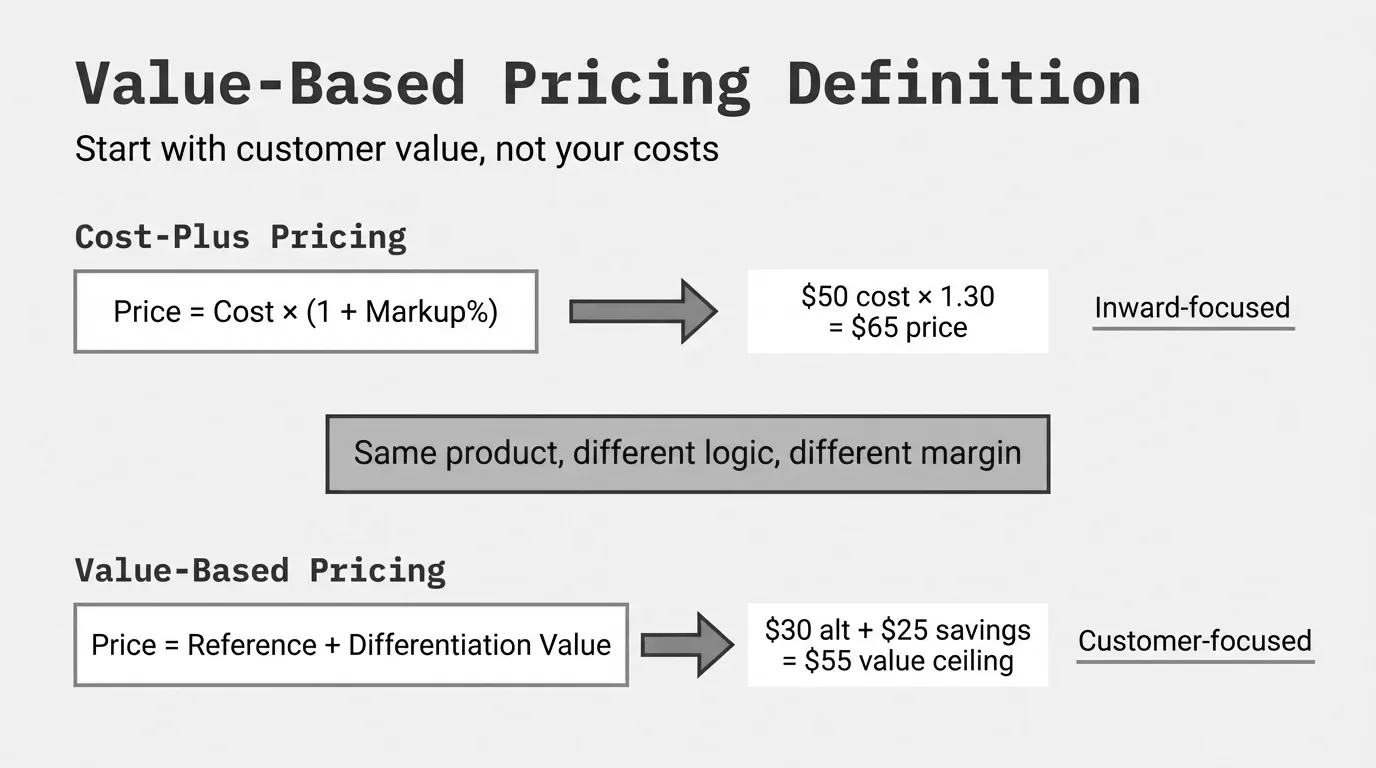
The key distinction: cost-plus pricing is inward-focused (what does it cost me?). Value-based pricing is outward-focused (what does it do for them?).
How Value-Based Pricing Differs from Cost-Plus
With cost-plus, you calculate costs and add a markup:
Selling Price = Cost × (1 + Markup %)
Example: $50 cost × 1.30 markup = $65 price
With value-based pricing, you calculate customer value and capture a portion:
Value-Based Price = Reference Alternative Price + Differentiation Value
Example: $30 competitor + $25 labor savings = $55 maximum price
Consider a specialty adhesive. Your cost is $18. Cost-plus at 60% markup gives you $28.80. But if the next-best alternative costs the customer $30 in product plus $25 in additional labor (slower application time), the customer's true cost with the competitor is $55. You could price at $45, deliver $10 in savings to the customer, and capture $16.20 more per unit than cost-plus would suggest.
That's not theoretical. A case study cited by Bain & Company documented a network equipment manufacturer that used value-based pricing during an industry downturn and increased prices by 24% because the product's value to customers justified it.
The Economic Value to Customer (EVC) Formula
The standard framework for calculating value-based prices is Economic Value to Customer (EVC). John L. Forbis and Nitin T. Mehta introduced this methodology in 1979, and it remains the foundation of B2B value pricing.
EVC = Reference Value + Differentiation Value
Reference Value = Price of next best alternative (what the customer would otherwise pay)
Differentiation Value = Monetary benefit your product provides above the alternative
The EVC tells you the maximum a rational customer would pay. Your actual price should be lower, splitting the value between you and the customer. If you capture 100% of the differentiation value, customers have no reason to choose you over the alternative.
Here's a practical example from MIT's pricing course materials. A new flowerpot reduces fertilizer costs by $15 per pot and water costs by $5 per pot compared to standard pots priced at $20:
| Component | Value |
|---|---|
| Reference value (standard pot) | $20 |
| Fertilizer savings | +$15 |
| Water savings | +$5 |
| Total EVC | $40 |
If the company prices at $30, they capture $10 of the $20 differentiation value (50%) while giving customers $10 in net savings. Both sides win.
When Value-Based Pricing Works in Distribution and Manufacturing
Value-based pricing isn't universal. It works in specific situations:
Differentiated products with few substitutes. If you're selling a specialty chemical that competitors don't carry, or a configured assembly that would take weeks to source elsewhere, customers can't easily switch. That's where value pricing applies.
Technical services that solve specific problems. Kitting, assembly, custom fabrication, emergency delivery. These services have quantifiable value. A $500 emergency delivery fee is worth it if it saves a $50,000 production line shutdown.
Products where total cost of ownership matters. A pump that costs 20% more but lasts twice as long and uses 30% less energy has a lower total cost of ownership. B2B buyers who do the math will pay the premium.
Situations where you eliminate customer pain. Consolidating five orders into one, maintaining inventory so the customer doesn't have to, providing technical support that reduces their engineering time. These have economic value beyond the physical product.
Where value-based pricing fails:
Commodities. Fasteners, wire, basic pipe fittings. If identical products are available from five distributors and price is the only differentiator, the customer's "value" is simply the lowest price. Cost-plus with competitive awareness makes more sense here.
Highly transparent markets. Online marketplaces where customers compare prices in seconds. Value-based pricing requires customers to consider total value, not just unit price. If they're filtering by price, you're competing on price.
New products without proof. If you can't demonstrate the value differential with data or case studies, you're asking customers to pay a premium on faith. Most won't.
Real Examples of Value-Based Pricing
Companies that execute value-based pricing well:
Apple prices iPhones and MacBooks based on perceived value, not component costs. According to Paddle's analysis, Apple achieves 38-45% profit margins because customers value the ecosystem, design, and integration, not just the hardware specs.
Starbucks charges 38% more than competitors for coffee, according to the same analysis. They're selling the experience of a "third place" between home and work, not just caffeine. Their gross margins on beverages run 65-70%, compared to the industry average of 45%.
Management consulting firms price based on project impact, not hours worked. A pricing project that recovers $12M in margin doesn't get billed at $300/hour. It gets billed based on a share of the value created.
In distribution and manufacturing:
Specialty chemical distributors price application expertise and technical support into their margins. They're not just selling chemicals. They're selling formulation advice, regulatory compliance knowledge, and problem-solving.
Industrial MRO distributors charge premiums for same-day delivery on critical spare parts. The alternative for the customer isn't paying less. It's $10,000/hour in production downtime while waiting for standard shipping.
The Disadvantages of Value-Based Pricing
Value-based pricing isn't automatically better. It has real drawbacks:
Research costs. According to Professor Andreas Hinterhuber's research, 79% of managers cite the difficulty of assessing customer value as the main obstacle to value-based pricing. You need to understand each segment's willingness to pay, and that takes time and data.
Sales team capability. Value-based pricing requires sales reps to articulate value, not just quote prices. Many B2B sales teams are trained to compete on price. Shifting to value conversations requires different skills and incentives.
Customer pushback. Procurement departments are paid to negotiate lower prices. Even if your product delivers superior value, you'll face buyers who want to benchmark you against cheaper alternatives without considering total value.
Inconsistent application. If different reps quote wildly different prices for the same product based on their assessment of customer value, you create confusion and erode trust. Value-based pricing needs structure and guardrails.
How to Start with Value-Based Pricing
You don't have to overhaul your entire pricing strategy. Start with products where you have clear differentiation:
-
Identify 10-20 SKUs where you have unique value. Products with no direct substitutes, technical expertise required, or quantifiable customer benefits.
-
Calculate the EVC for each. What does the next-best alternative cost the customer (including all costs, not just purchase price)? What additional value do you provide?
-
Price to capture 30-50% of the differentiation value. Leave real savings for the customer while improving your margins.
-
Train sales on value articulation. They need to be able to explain why the product is worth more, not just quote the higher price.
-
Track results. Win rates, average selling prices, and margin by product. Adjust based on what you learn.
For most distributors and manufacturers, value-based pricing won't replace cost-plus across the entire catalog. It supplements cost-plus for products where you have genuine differentiation. The result is a blended approach: cost-plus as the floor for commodities, competitive data as a reference for standard products, and value-based pricing where you deliver unique value.
According to a Bain & Company global survey of 1,700+ B2B business leaders, 85% believe their pricing decisions need improvement. Building pricing capabilities, including value-based approaches where appropriate, can add 200-600 basis points to your bottom line.
That's the real definition of value-based pricing: not a formula, but a mindset. Start with what the customer gains, not what the product costs. The math follows from there.
For implementation guidance, see our complete Value-Based Pricing Guide. For related pricing strategies, explore our posts on cost-plus pricing and B2B pricing strategy.
Last updated: Invalid Date
Frequently Asked Questions
Want to analyze your entire product catalog?
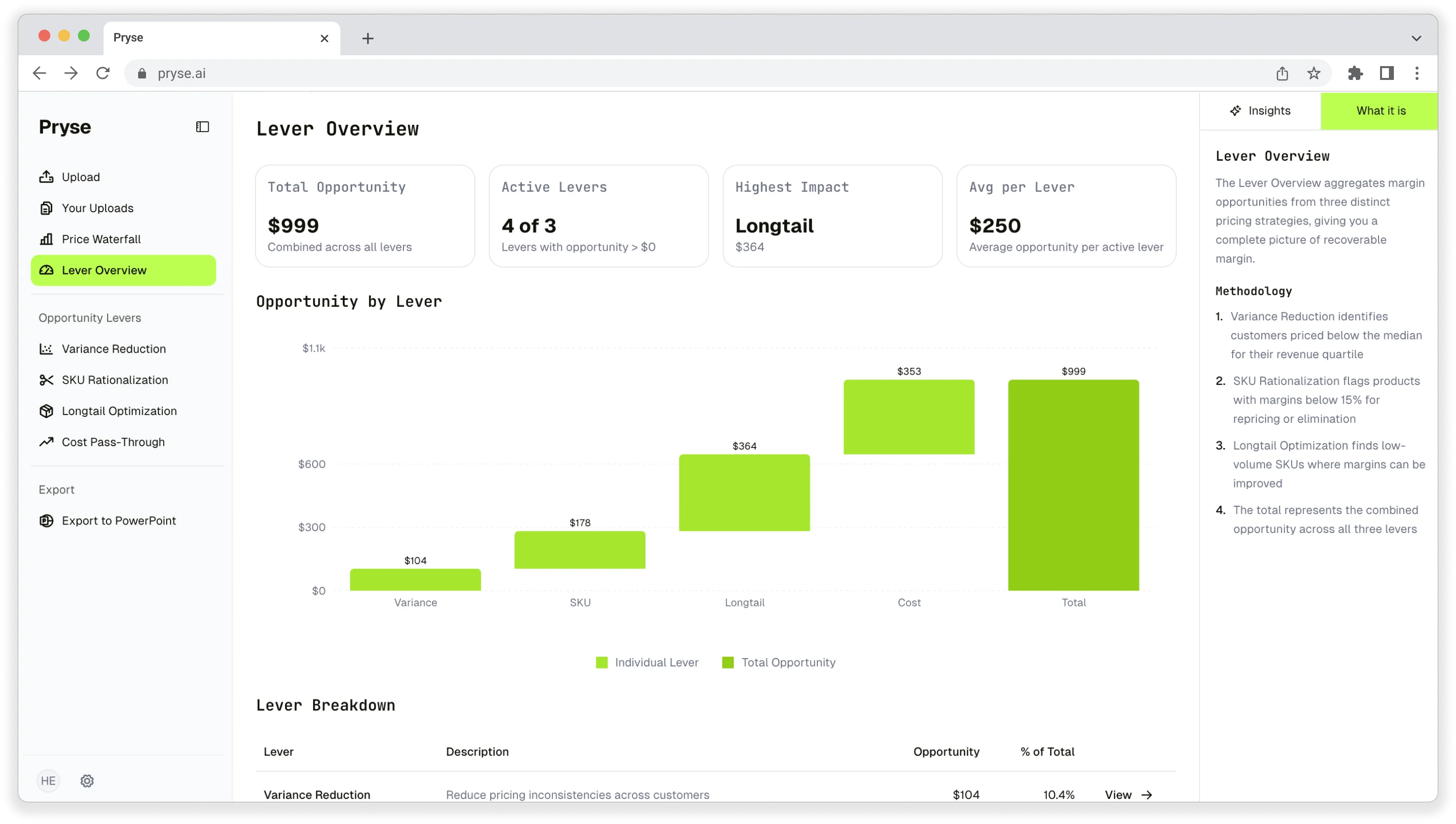
Pryse automatically identifies margin leakage across thousands of SKUs. Upload your data and find hidden profit in 24 hours.
One-time $1,499 diagnostic. No subscription required.