 Pryse
PryseValue-Based Pricing in B2B: Why It Works Differently Than B2C
Value-based pricing in B2B requires quantifying ROI for multiple stakeholders, longer sales cycles, and procurement hurdles. Learn the B2B-specific framework for distributors and manufacturers.
Value-based pricing in B2B sets prices according to the economic value a product delivers to a business customer, measured in terms that procurement can quantify: cost savings, productivity gains, downtime avoided, or revenue enabled.
The concept is simple. The execution is different from B2C in almost every way.
When Apple prices an iPhone based on perceived value, they're selling to an individual who makes a quick emotional decision. When you price a specialty pump to a manufacturer, you're selling to a buying committee of 10-11 stakeholders who need documented ROI to justify the purchase. The sales cycle runs 6-12 months instead of 6 minutes. Procurement wants three competing bids. Finance needs payback period calculations.
This post covers how value-based pricing actually works in B2B environments, specifically for distributors and manufacturers selling to other businesses.
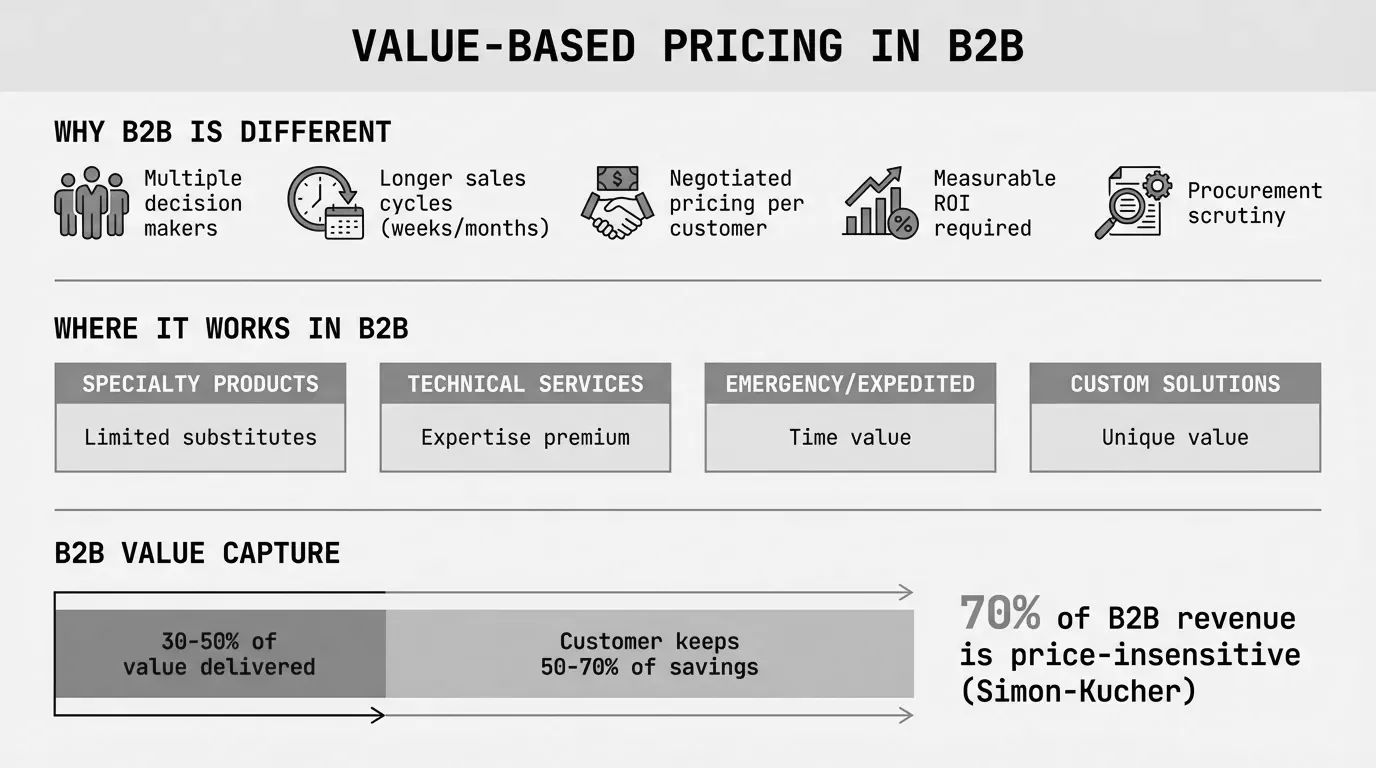
Why B2B value-based pricing is fundamentally different
B2C value-based pricing leans heavily on perception. Customers pay premiums for brands, convenience, and emotional satisfaction. A Starbucks coffee costs 38% more than competitors not because of measurable caffeine delivery, but because of the experience and brand.
B2B value is mostly math.
According to Simon-Kucher's research on B2B pricing, approximately 80% of B2B value is logic (quantifiable business outcomes) and 20% is behavioral factors. That ratio flips in B2C.
In practical terms, this means B2B value-based pricing requires you to:
- Quantify economic outcomes. Not "our product is better" but "our product saves $47,000 annually in reduced maintenance labor."
- Document ROI for multiple stakeholders. The engineer cares about reliability. Finance cares about payback period. Operations cares about uptime. You need value stories for each.
- Survive procurement scrutiny. B2B purchasing professionals are trained to commoditize your offering and drive price down. Your value case needs to hold up under professional interrogation.
McKinsey's research indicates that companies adopting value-based pricing can improve return on sales by 5 to 10 percent. But capturing that improvement in B2B requires addressing these structural differences, not just calculating a higher price.
The B2B buying committee problem
B2B buying committees have nearly doubled in size over the past decade. According to research from Gartner and others, the average B2B purchase now involves 10-11 stakeholders, up from 6.8 in 2017. For enterprise deals, committees can exceed 15-20 people.
Each stakeholder evaluates your offering through a different lens:
| Stakeholder | What They Care About | Value Language |
|---|---|---|
| Operations/Users | Reliability, ease of use, downtime | Hours saved, uptime percentage |
| Engineering | Specifications, quality, integration | Technical superiority, defect rates |
| Finance/CFO | ROI, payback period, total cost | Dollar savings, NPV calculations |
| Procurement | Price benchmarks, supplier risk | Cost per unit, competitive comparison |
| Executive sponsor | Strategic alignment, risk | Business impact, competitive advantage |
Value-based pricing in B2B means building a value case that resonates with each of these stakeholders. A single ROI number isn't enough when finance, operations, and procurement each need their own version of the story.
According to Gartner's research on B2B buying, 80% of deals fail not because of external sales problems but because internal consensus-building breaks down. Your value documentation needs to help your champion sell the purchase internally, not just justify your price to the person you're talking to.
Quantifying value for B2B customers
The Economic Value to Customer (EVC) framework applies to B2B, but the value drivers are different from consumer products.
EVC = Reference Price + Differentiation Value
In B2B distribution and manufacturing, differentiation value comes from six categories:
1. Cost reduction Products that lower operating expenses. A lubricant that extends equipment life by 40% saves maintenance labor and replacement parts.
2. Revenue enhancement Products that increase customer output or sales. A faster production component that increases line throughput by 8%.
3. Working capital optimization Products that reduce inventory requirements or improve cash flow. Longer shelf life products that cut safety stock by 30%.
4. Capital expenditure avoidance Products that defer or eliminate equipment purchases. A retrofit solution that extends machine life by 5 years instead of requiring replacement.
5. Risk reduction Products that prevent costly failures or compliance issues. A safety component that reduces recordable incidents.
6. Time savings Products that reduce labor hours or speed up processes. A pre-assembled kit that cuts installation time from 6 hours to 2 hours.
For each value driver, the calculation follows this pattern:
Value Driver = Customer's Financial Metric x Impact of Your Product
Example: $85/hour labor rate x 4 hours saved = $340 per installation
A practical example for an industrial distributor selling premium bearings:
| Value Driver | Calculation | Annual Value |
|---|---|---|
| Extended service life | 2 extra years x $180 replacement | $360 (amortized) |
| Reduced maintenance | 6 fewer lubrications x $45 labor | $270 |
| Downtime avoidance | 2 fewer failures x $1,200 downtime cost | $2,400 |
| Total differentiation value | $3,030/year |
If the reference product costs $85 and your premium bearing creates $3,030 in annual value, the EVC over a 3-year comparison period is:
EVC = $85 + ($3,030 x 3 years) = $9,175
Even capturing just 25% of that value means pricing at $2,358 instead of the $125 that cost-plus might suggest.
Handling procurement and RFPs
Procurement's job is to drive your price down. They're trained to commoditize offerings, benchmark against competitors, and squeeze supplier margins. According to Simon-Kucher research, B2B firms are losing margin as procurement departments become more sophisticated at running competitive bid processes.
Value-based pricing survives procurement when you have documented evidence, not claims.
What doesn't work:
- "Our product is higher quality"
- "Customers report significant savings"
- "Industry-leading reliability"
What works:
- "Our product reduced maintenance costs by $47,000 annually at [Customer Name], documented in this case study"
- "Total cost of ownership over 5 years is $12,400 lower than Alternative A, as shown in this comparison"
- "Payback period is 4.7 months based on your stated downtime costs of $2,800/hour"
Simon-Kucher's research found that companies positioning price adjustments as "value upgrades" (with documented evidence) experience 40% less negative feedback than those presenting straight price increases.
Surviving the RFP process
The most common reason buyers issue an RFP is to find a better price from vendors. When your offering enters a competitive bid, procurement's default is to treat all options as interchangeable and select the lowest price.
To defend value-based prices in RFPs:
1. Shape the RFP before it's written. According to research from RAIN Group, sellers who collaborate with buyers before formal procurement begins have a significant advantage. If you can influence the evaluation criteria to include total cost of ownership or documented reliability metrics, you change the game.
2. Differentiate in your response. Most sellers sound identical in RFP responses, forcing buyers to default to price. Include specific outcome data, named customer references, and quantified value that competitors can't match.
3. Request presentation time. Online bids and procurement automation make it harder to present your value case in person. Push for the opportunity to explain total value, not just submit pricing. Without that conversation, you're competing purely on price.
4. Provide ROI tools. Give procurement the ammunition to justify your higher price internally. Payback calculators, TCO comparisons, and case studies help them defend the selection to their stakeholders.
The long sales cycle challenge
B2B sales cycles average 6-12 months, and complex deals can take years. Nearly two-thirds of B2B leads take at least three months to decide, and 20% wait over a year before purchasing.
This extended timeline creates specific challenges for value-based pricing:
Value perceptions shift. The ROI case you built in month 2 may not resonate the same way in month 8 when new stakeholders enter the process or business conditions change.
Champions change roles. Your internal advocate who understood the value may get promoted, leave, or lose influence. The value case needs to stand on documented evidence that survives personnel changes.
Competitors have time to respond. A 9-month cycle gives competitors opportunity to match your differentiation or undercut your price with a "good enough" alternative.
Maintaining value through long cycles
Companies that successfully execute value-based pricing in long B2B sales cycles:
Update value calculations throughout the process. If input costs change, if the customer's situation changes, or if new data becomes available, refresh the ROI analysis. Stale numbers lose credibility.
Multi-thread relationships. Don't rely on a single champion. Build relationships with 3-5 stakeholders who each understand the value from their perspective. According to sales research, companies that introduced multi-threaded outreach cut deal cycles from 9 months to 5 months.
Create content for internal consensus. Gartner's finding that 80% of B2B deals fail due to internal consensus problems means your sales materials need to help buyers sell internally. One-pagers for finance, technical specs for engineering, case studies for operations.
Set expectations on value realization. Show a timeline for when the customer will see returns. A 4-month payback period is more compelling when mapped against a 6-month implementation timeline.
Value-based pricing for distributors and manufacturers
For mid-market distributors ($20M-$200M revenue), value-based pricing applies to specific segments:
Where it works:
- Specialty products with limited substitutes
- Technical services (kitting, assembly, custom fabrication)
- Emergency/expedited orders where downtime cost is high
- Value-added solutions that solve specific customer problems
Where it doesn't work:
- Commodity products with transparent market pricing
- High-volume, low-margin items where customers shop on price
- Products where competitors offer identical alternatives
A practical approach: use value-based pricing for 15-25% of your catalog (the specialty tier) while running competitive or cost-plus pricing on the rest. This captures the margin opportunity without forcing sales teams to justify value on commodity items where they can't win that argument.
According to Vendavo research, 54% of manufacturers and distributors use price optimization strategies. But there's a gap: 85% of B2B companies identify pricing as a top priority for digital transformation, yet only 28% have deployed dedicated pricing solutions.
Getting value-based pricing right in B2B
The companies that execute value-based pricing successfully in B2B share common practices:
1. They invest in customer research. Simon-Kucher recommends cross-functional workshops to build unified definitions of value across product, marketing, sales, and customer service teams. Answers to "What is value?" and "How do we quantify it?" are specific to each B2B company.
2. They document outcomes obsessively. Every customer success becomes a case study. Every efficiency gain gets quantified. This evidence library becomes the foundation for all value conversations.
3. They train sales on value articulation. Sales teams accustomed to competing on price need different skills. Discovery questions that surface customer pain points matter more than product feature presentations.
4. They segment their approach. Not everything gets value-based pricing. They're clear about which products warrant the investment and which don't.
5. They track what works. Win rates at value-based prices, price override frequency, customer retention at premium prices. The data tells them whether the value case is holding.
McKinsey's research on pricing power found that a 1% improvement in realized price drives an 8% increase in operating profit. For B2B companies, value-based pricing is often the fastest path to that 1%, capturing margin that cost-plus approaches systematically miss.
The difference between B2B and B2C isn't just longer sales cycles and bigger committees. It's the nature of value itself. B2B value lives in spreadsheets, ROI calculations, and documented outcomes. Master that math, and you can price to value even in the most competitive procurement environments.
For the complete framework on implementing value-based pricing, see our Value-Based Pricing Guide. For calculation methods, see our posts on the value-based pricing formula and EVC calculations.
Last updated: Invalid Date
Frequently Asked Questions
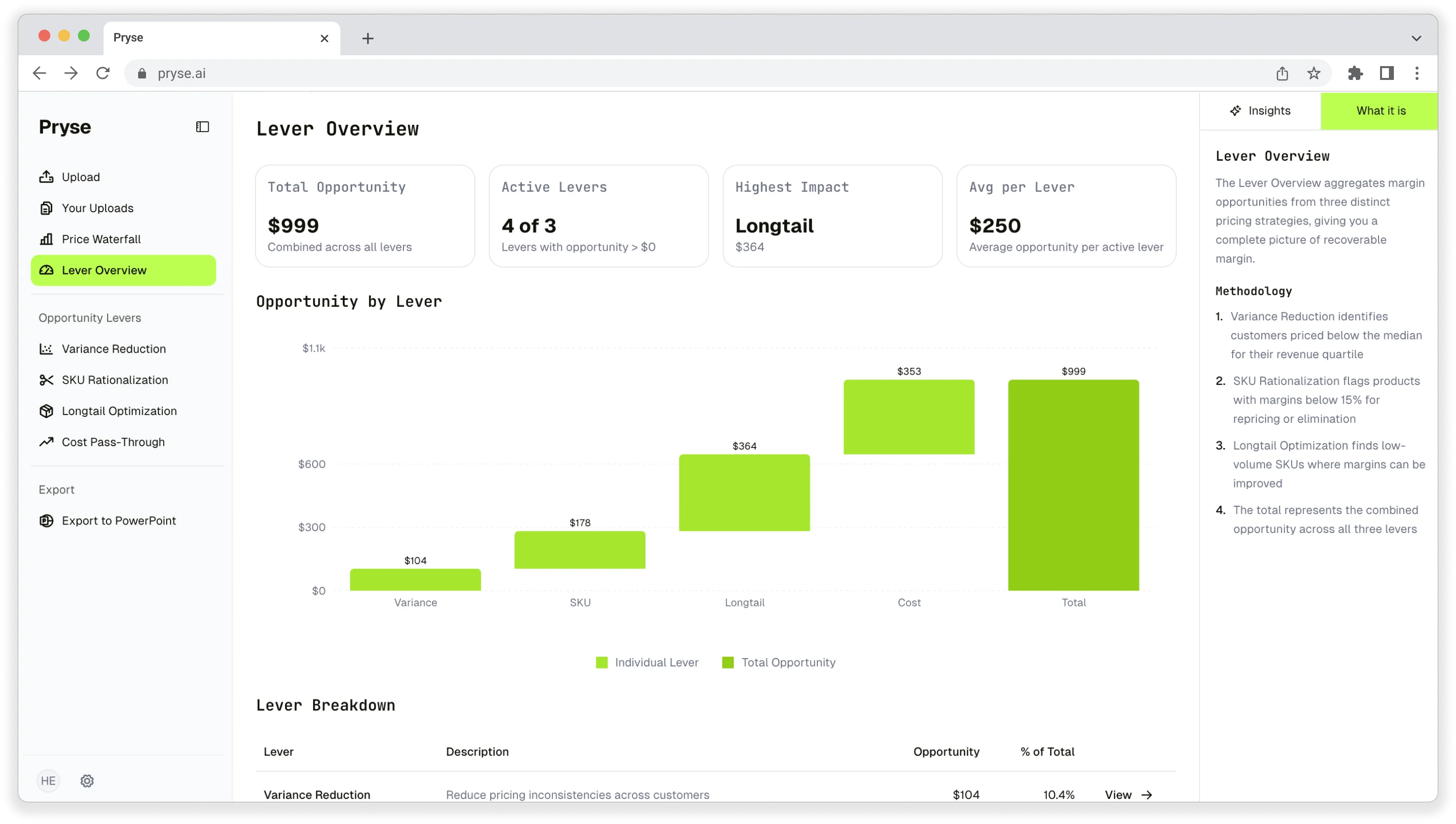
Want to analyze your entire product catalog?
Pryse automatically identifies margin leakage across thousands of SKUs. Upload your data and find hidden profit in 24 hours.
One-time $1,499 diagnostic. No subscription required.