 Pryse
Pryse7 Value-Based Pricing Benefits That Boost Margins and Loyalty
Value-based pricing delivers 5-10% higher revenue and stronger customer relationships. Data-backed breakdown of the benefits for B2B distributors and manufacturers.
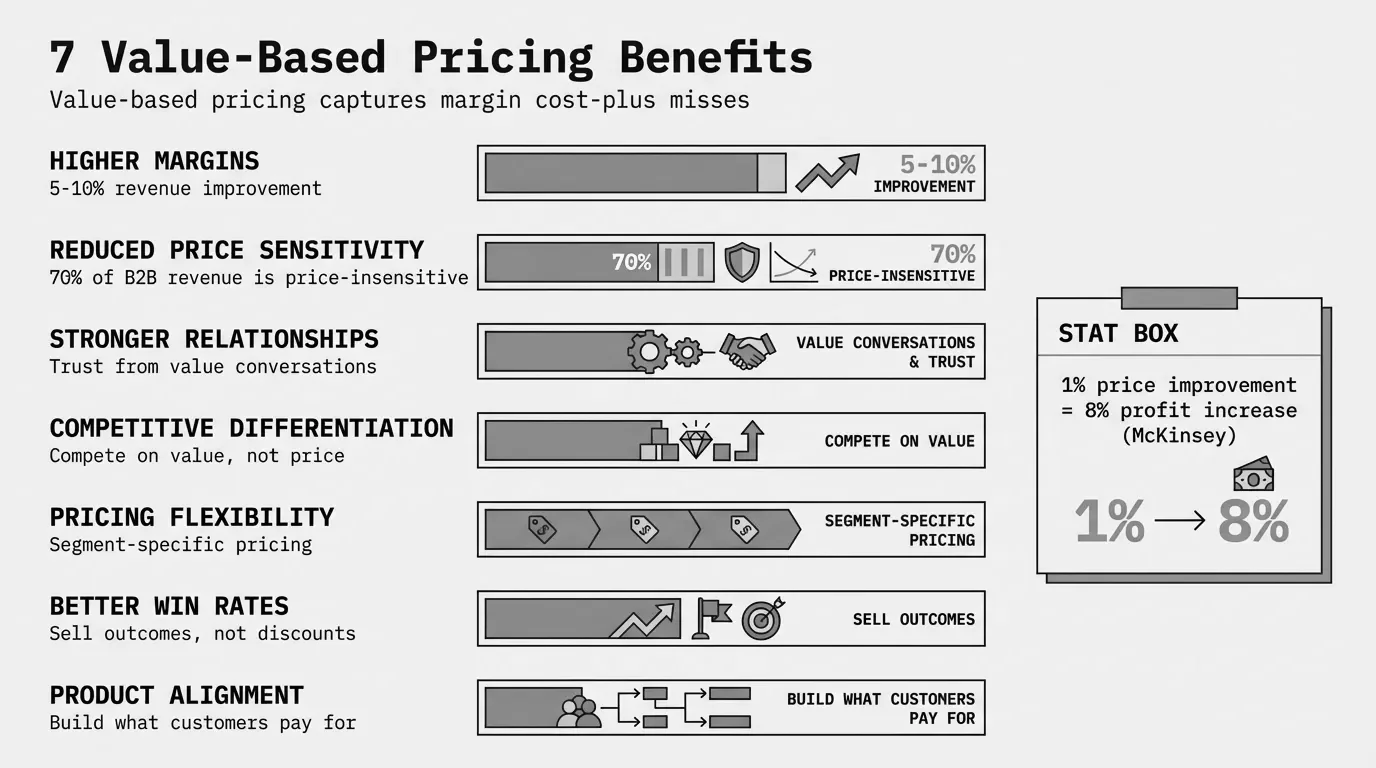
Value-based pricing sets prices based on what customers are willing to pay for the outcomes they receive, rather than what it costs to produce or deliver. The benefits are measurable: McKinsey research shows companies using value-based approaches achieve 5-10% higher revenue and improved return on sales compared to cost-based methods.
For distributors and manufacturers, value-based pricing represents a shift from "what's our cost plus markup" to "what problem does this solve and what's that worth." A replacement part that prevents $50,000 in production downtime has value far exceeding its $200 manufacturing cost. Cost-plus pricing ignores that gap. Value-based pricing captures it.
This article covers the seven concrete benefits of value-based pricing, backed by research and specific to B2B distribution and manufacturing contexts.
1. Higher profit margins without losing customers
The most direct benefit of value-based pricing is margin improvement. When you price based on customer value rather than internal costs, you capture more of the value you create.
McKinsey's research on B2B pricing found that companies adopting value-based pricing can improve return on sales by 5-10%. Their case studies show specific examples: a network equipment manufacturer increased prices 24% on an innovative product by demonstrating its value during an industry downturn, when cost-plus logic would have pushed prices down.
The math works in your favor because pricing right is the fastest profit lever available. McKinsey's 2003 article "The Power of Pricing" in The McKinsey Quarterly analyzed S&P 1500 companies and found that a 1% price improvement generates an 8% increase in operating profits, assuming volume stays stable. That's nearly 50% greater impact than a 1% reduction in variable costs.
Operating Profit Impact of 1% Price Increase = 8%
Operating Profit Impact of 1% Cost Reduction = 5.5%
Operating Profit Impact of 1% Volume Increase = 2.5%
For a $50M distributor running at 5% net margin, capturing just 1% more on pricing adds $500K to the bottom line. That's the same profit impact as growing revenue by 20%.
The margin improvement comes without losing customers because you're pricing to what they value, not what they'll tolerate. A customer paying $300 for a component that prevents a $10,000 production delay isn't overpaying. They're getting a 33:1 return.
2. Reduced price sensitivity among buyers
Value-based pricing shifts customer focus from price to outcomes. When buyers understand what they're getting, price comparisons become less relevant.
Simon-Kucher's research on B2B pricing found that as much as 70% of a B2B platform's revenue base can be price-insensitive. These customers would respond to a price increase by simply paying it. The research also found that less than 20% of the revenue base exhibits extreme price sensitivity.
The explanation is straightforward: procurement teams evaluate total cost of ownership, not just unit price. A component priced 15% higher but with 99.9% reliability versus 97% reliability often costs less over time when you factor in downtime, replacement labor, and production delays.
Simon-Kucher also found that the most important factors in a B2B buying decision are value drivers like ease of use, convenience, and unique product features. Price ranks in the middle and rarely drives purchasing decisions alone.
BCG's consumer research reinforced this finding from a different angle. They found hardly any correlation between "value consciousness" as an attitude and actual purchasing behavior. Customers who said they preferred lower prices didn't consistently buy the cheapest option. They bought what delivered perceived value.
For distributors and manufacturers, this means your specialty products, technical services, and value-added capabilities can command premiums. Customers aren't as price-sensitive as sales reps often assume. They're value-sensitive.
3. Stronger customer relationships built on understanding
Value-based pricing requires understanding what customers actually care about. That understanding improves relationships beyond pricing.
Bain & Company's research on B2B elements of value identified 40 distinct factors that B2B buyers consider, spanning functional, ease of business, individual, and inspirational categories. Their surveys showed that customers willingly pay premium prices for products that deliver on the factors they value most. Even in commoditized industries, companies can charge premiums for features and enhancements customers deem important.
The relationship benefit works like this: to price based on value, you need to have conversations about what value means to each customer. What problems are they solving? What does downtime cost them? How do they measure success? Those conversations build trust and insight that pay off beyond the pricing decision.
Bain's research also found that subjective concerns, like whether a product can enhance the buyer's reputation or reduce anxiety, play a larger role than expected in B2B purchases. Recognizing both rational and emotional factors helps avoid the commodity trap where price is the only differentiator.
NetSuite's analysis of value-based pricing noted that the work involved in understanding customer wants and needs can foster closer connections, increase trust, and inspire greater loyalty. The insight gathered during the pricing process improves marketing, sales, and customer support.
For a $75M industrial distributor, this might mean discovering that a segment of customers values emergency delivery above all else. That insight shapes not just pricing but inventory positioning, service hours, and sales training. The pricing conversation opens the door.
4. Competitive differentiation beyond price wars
Cost-plus pricing creates commodity positioning. If your price is cost + 28% and your competitor's price is cost + 27%, the conversation becomes a race to the bottom on markup.
Value-based pricing shifts the competition to value delivered. Instead of arguing about whose markup is lower, you're demonstrating whose solution solves the problem better.
A practical example from distribution: two distributors carry the same brand of industrial bearings. Distributor A sells at cost-plus 25%. Distributor B charges cost-plus 35% but provides on-site inventory analysis, failure prediction, and emergency 4-hour delivery. Distributor B's price is 10 points higher, but maintenance managers at customer plants prefer working with them because unplanned downtime costs $8,000 per hour. The $50 per bearing premium is irrelevant against that risk.
Bain's pricing research found that companies with strong value propositions can command premiums even as customers continually push for lower prices. Chemicals companies and process manufacturers command premiums by providing features and services clients deem most critical. They're not competing on who has the lowest cost base.
This differentiation compounds over time. The competitor stuck on cost-plus has to keep cutting markup to compete. The company selling value can invest those margins into better service, better people, and better capabilities that justify continuing premiums.
5. Improved pricing flexibility across segments
Value-based pricing naturally supports different prices for different customer segments because different customers perceive different value from the same product.
A Harvard Business Review analysis stressed that value-based pricing should only apply to a single segment, or in B2B, potentially a single customer. Perceived value fluctuates based on customer characteristics. A replacement motor for a 24/7 production line is worth more than the same motor for a backup system that runs twice a year.
This flexibility shows up in the data. Simon-Kucher's 2024 research found that 55% of companies that didn't differentiate price increases reported increases under 5%, while only 32% of companies that did differentiate their pricing saw such limited increases. Differentiation means capturing more margin where value exists.
For distributors managing 20,000+ SKUs across hundreds of customers, value-based segmentation identifies where pricing power exists:
| Customer Segment | Value Driver | Pricing Power |
|---|---|---|
| Emergency/breakdown | Speed, availability | High |
| OEM production | Consistency, lead time | Medium-high |
| Project-based | Total cost, terms | Medium |
| Price-shoppers | Unit price | Low |
Cost-plus treats all four segments the same. Value-based pricing charges the emergency customer a premium for 2 AM availability while staying competitive for the price-shopper on standard orders. Same product, different value, different price.
6. Better sales conversations and win rates
Value-based pricing gives sales teams something to talk about besides price.
A Copperberg and Vendavo study found that value-based pricing was the most common pricing model among B2B pricing professionals at 28%, ahead of cost-plus and competitor-based approaches. The adoption reflects that sales teams close more deals when they can articulate value rather than defend price.
The conversation shifts from "our price is $X" to "this component saves you $Y in downtime annually." The second conversation is easier to win because it puts buyer and seller on the same side: both want to maximize value.
Simon-Kucher research found that 85% of best-in-class pricing companies prepare typical customer objections and responses in advance. That preparation is more natural in value-based selling because objections center on "is it worth it" rather than "why is your cost so high." The first question has concrete answers.
For B2B sales, Harvard Business School research shows that demonstrating clear return on investment dramatically increases willingness to pay. Showing how your solution saves time, reduces costs, or generates revenue changes the buying equation. The price becomes an investment with a return rather than an expense to minimize.
This plays out in practice. A specialty fastener distributor trained reps to quantify labor savings for customers: "This assembly reduces install time by 20 minutes per unit. At your labor rate and volume, that's $45,000 annually." Customers who heard the value case accepted a 22% higher price than those who just saw the quote. Same product, different conversation, different margin.
7. Alignment between price and product development
Value-based pricing creates feedback loops that improve products and services.
When you price based on customer value, you learn what customers value. That learning shapes product decisions, inventory investments, and service development. You invest in capabilities that command premiums and deprioritize features that don't drive willingness to pay.
NetSuite's analysis noted that the focus on customer value can fuel development of more innovative and successful products and services. Instead of building what's cheapest to make, you build what customers will pay for.
This alignment shows up in investment decisions:
Cost-plus thinking: "Should we offer same-day delivery? It costs $15 more per order, so we'd need to charge $20 more to keep our markup."
Value-based thinking: "Same-day delivery prevents an average of 4 hours of production downtime for our emergency customers. At $2,000 per hour downtime cost, same-day is worth $8,000 to them. We could charge $200 and capture a fraction of the value while covering our costs 10x over."
The value-based analysis surfaces opportunities the cost-plus analysis misses entirely.
For manufacturers, value-based pricing identifies which R&D investments have pricing power. A feature that costs $10 to add but creates $100 in customer value justifies a $50 price increase. A feature that costs $10 and creates $10 in value doesn't justify any premium. Without the value lens, both look the same.
Quantifying the benefits for your business
The benefits above are real, but they vary by company. Here's how to estimate the opportunity for your specific situation.
Margin improvement potential: SPARXiQ's research on distributors found 200-400 basis points of recoverable margin from pricing optimization, primarily on the 60-80% of SKUs that aren't actively price-shopped. On a $50M book, that's $1M-$2M annually.
Price increase acceptance: Simon-Kucher data shows 70% of B2B revenue comes from price-insensitive customers. If you haven't raised prices on specialty items in two years, a value-based review would likely identify significant opportunity.
Customer retention value: A 5% improvement in customer retention increases profits by 25-95%, according to research cited in Harvard Business Review. Value-based pricing builds the relationships that drive retention.
Competitive wins: If you're losing bids on differentiated products to lower-priced competitors, you're likely not communicating value effectively. Value-based pricing fixes the message and the price simultaneously.
Annual Margin Opportunity = Revenue x Basis Point Recovery / 10,000
Example: $50,000,000 x 300 / 10,000 = $1,500,000
The question isn't whether value-based pricing has benefits. The research is clear that it does. The question is whether your products, customers, and capabilities support value-based approaches.
When value-based pricing works best
Value-based pricing delivers the strongest benefits when:
Your products solve measurable problems. If you can quantify the cost of downtime, quality defects, or labor hours that your product prevents, you can price to value.
You have differentiated offerings. Specialty products, technical expertise, and service capabilities create value that commodity competitors can't match.
Customers vary in their needs and budgets. Segmentation enables different prices for different value perceptions.
Your sales team can have consultative conversations. Value-based pricing requires understanding customer situations, not just quoting from a price list.
Most mid-market distributors and manufacturers have some products that fit these criteria and others that don't. The smart approach is to apply value-based methods where they work while keeping cost-plus or competitive pricing on commodities.
For a complete framework on implementing this strategy, see our value-based pricing guide.
Moving from cost-plus to value-based
The transition doesn't require abandoning cost-plus overnight. Start by identifying products where you have pricing power: specialty items, proprietary products, technical services, and emergency support. Test value-based prices on those first. Measure the results.
A practical first step: pull your transaction data and identify the products with the highest margin variance. High variance often signals where value-based pricing already happens informally, with some reps capturing value and others defaulting to cost-plus. Formalizing the value approach captures that upside consistently.
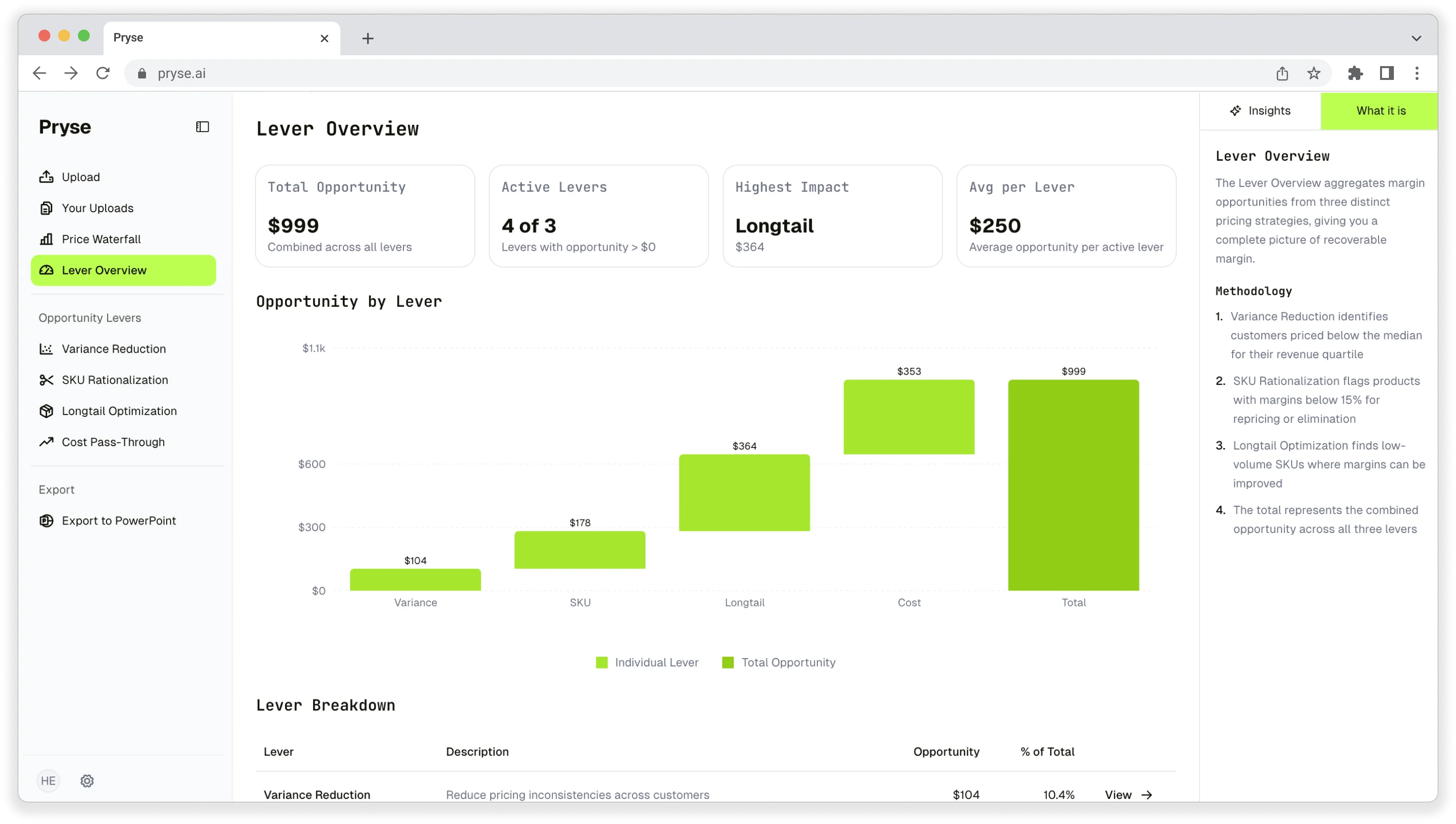
Pryse runs this analysis from a CSV upload in 24 hours. We identify the product-customer combinations where your current pricing leaves margin on the table. No six-month implementation. Just visibility into where value-based pricing can improve your margins.
Last updated: February 4, 2025
Frequently Asked Questions
Want to analyze your entire product catalog?
Pryse automatically identifies margin leakage across thousands of SKUs. Upload your data and find hidden profit in 24 hours.
One-time $1,499 diagnostic. No subscription required.