 Pryse
PryseAI Pricing: How Machine Learning Is Changing B2B Pricing
Machine learning transforms pricing from guesswork to science. See how distributors and manufacturers use AI to recover 2-5% margin without pricing software.
AI pricing uses machine learning algorithms to analyze transaction data, competitor pricing, and market conditions to recommend optimal prices automatically. It automates pattern detection across thousands of SKUs and customer combinations that would take humans months to analyze manually.
For mid-market distribution and manufacturing companies, AI pricing sits on a spectrum from "clear waste of money" to "obvious competitive advantage" depending on business complexity, data quality, and implementation approach.
This post explains what AI pricing actually does, when it delivers measurable ROI for distributors and manufacturers, what margin improvement to expect, and whether you need machine learning or simpler rule-based optimization.
What Is AI Pricing (And What It's Not)
AI pricing applies machine learning algorithms to predict optimal prices based on patterns in historical data. The algorithms analyze how prices, volumes, margins, competitors, and market conditions interact to identify pricing opportunities humans would miss.
The core mechanism: machine learning models ingest transaction history and learn relationships like "when we price Product X at $85 for Customer Type A during Q4, we sell 120% more volume than at $95 with only 8% margin decline, so $85 is optimal."
What AI pricing does:
- Analyzes price-volume relationships across thousands of SKU-customer combinations
- Detects elasticity patterns (how volume changes when price changes)
- Identifies underpriced products where customers would pay more without volume loss
- Flags margin leakage from excessive discounting on specific deals
- Recommends price adjustments based on cost changes, competitor moves, or demand shifts
- Continuously learns from new transaction data to refine recommendations
What AI pricing is not:
- A silver bullet that fixes pricing problems without clean data or clear strategy
- A replacement for understanding your customers and market positioning
- Necessarily better than rule-based pricing for companies with straightforward pricing logic
- Immune to garbage-in-garbage-out (poor data produces useless recommendations)
- Free of implementation costs, integration work, or change management challenges
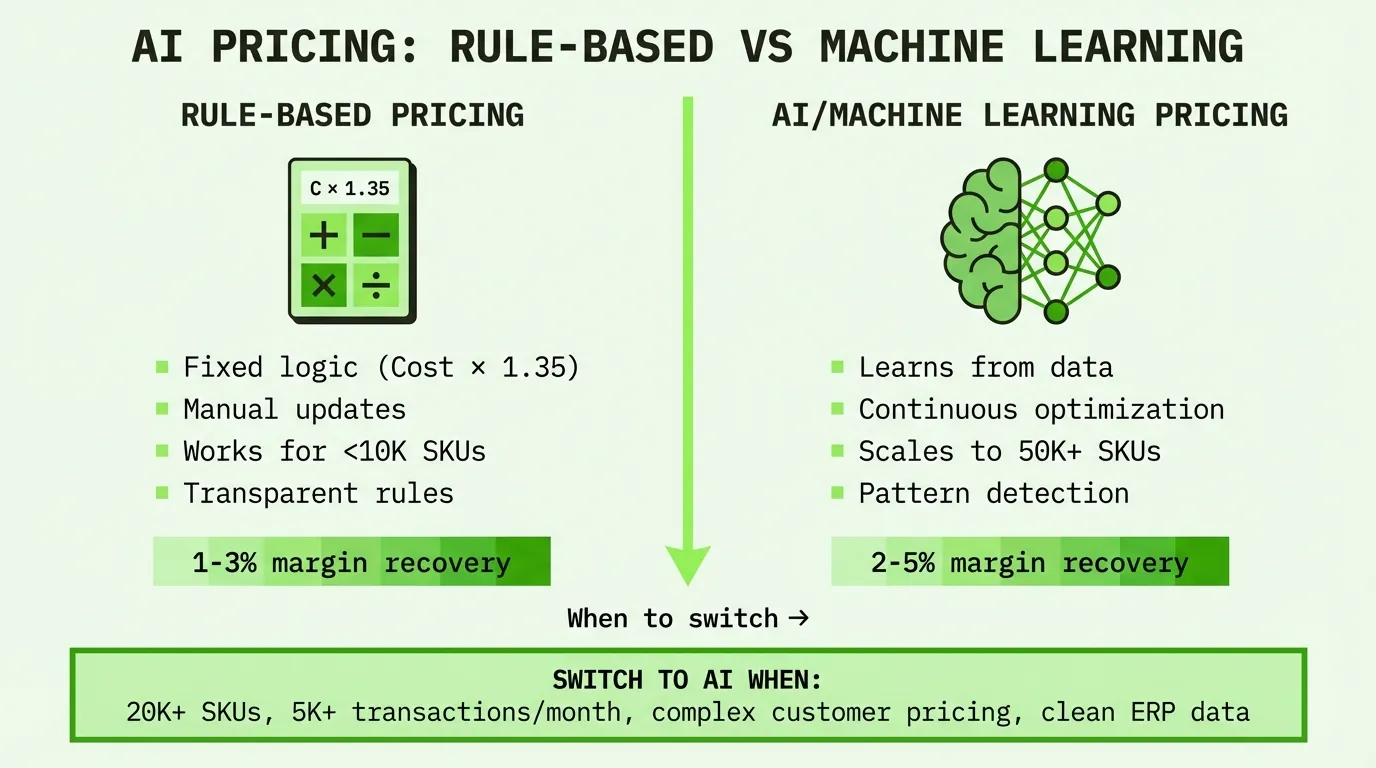
The difference between AI pricing and traditional pricing optimization comes down to how recommendations are generated. Rule-based systems follow logic you define ("price at 28% margin above cost"). AI systems learn patterns from data without explicit programming.
How AI Pricing Works: The Technical View
Machine learning pricing models typically use one of three approaches:
1. Price Elasticity Models
These models measure how demand responds to price changes. The algorithm analyzes historical transactions to calculate price elasticity for each SKU-customer segment combination.
Price Elasticity = % Change in Quantity Demanded / % Change in PriceIf a 5% price increase causes a 3% volume decline, elasticity is -0.6 (inelastic—you should raise prices). If volume drops 8%, elasticity is -1.6 (elastic—price increases hurt revenue).
AI elasticity models account for factors rule-based systems can't handle at scale:
- Seasonality effects on price sensitivity
- Competitive pricing impacts
- Customer-specific elasticity differences
- Cross-product cannibalization (raising price on Product A shifts volume to Product B)
A distributor might discover that industrial customers are inelastic (elasticity -0.4) on safety products but elastic (elasticity -1.8) on commodity fasteners, suggesting different pricing strategies by product category.
2. Regression and Forecasting Models
These models predict optimal prices by analyzing multiple variables simultaneously: cost, competitor pricing, inventory levels, customer segment, order size, time of year, and dozens of other factors.
The algorithm identifies which variables matter most for each product and customer combination, then recommends prices that maximize your objective (usually gross margin or profit).
For example, the model might learn that Customer Type A cares primarily about availability (low price sensitivity), while Customer Type B shops on price (high sensitivity). Same product, different optimal prices.
3. Reinforcement Learning
Advanced AI pricing systems use reinforcement learning, which treats pricing as an experiment. The system proposes price changes, observes what happens (did the customer buy? Did they negotiate? Did volume change?), and adjusts its strategy based on results.
This approach works for high-velocity transactional businesses (thousands of daily transactions) but usually fails in B2B environments with longer sales cycles and consultative selling.
When AI Pricing Delivers Clear ROI
AI pricing delivers measurable margin improvement in specific scenarios. It's not universal.
High-Complexity Scenarios (AI wins)
Large SKU catalogs (20,000+ SKUs)
A distributor with 50,000 active SKUs selling to 800 customers creates 40 million potential SKU-customer pricing combinations. No human can optimize that manually.
Research from Intuilize found that AI helps distributors optimize prices by analyzing massive datasets to identify pricing patterns, customer behavior, and market trends, enabling data-driven decisions that maximize profitability.
High transaction volume
AI models need data density to learn patterns. If you process 5,000+ transactions monthly with enough repeat purchases to measure price-volume relationships, AI can detect elasticity patterns.
A manufacturer with 200 transactions per month across 3,000 SKUs has sparse data—most SKUs have 1-2 sales monthly. AI can't learn from that. Rule-based pricing works better.
Customer-specific pricing complexity
When every major customer has negotiated pricing with different discount structures, rebate agreements, and payment terms, AI can identify which deals are profitable and which are destroying margin.
According to PROS, a high-tech manufacturer achieved a 3% annualized margin uplift (approximately $25 million in margin improvement) using AI-powered pricing to optimize customer-specific deals across thousands of SKUs.
Real-time pricing needs
Commodity distributors facing daily supplier price changes benefit from AI that automatically adjusts customer pricing based on cost fluctuations while maintaining target margins.
Low-Complexity Scenarios (Rule-based wins)
Small catalogs with stable pricing
A manufacturer with 800 SKUs, 60 customers, and annual price list updates doesn't need machine learning. Excel analysis identifies underpriced products in a few hours.
Straightforward cost-plus models
If your pricing logic is "COGS × 1.35 = list price, then negotiate discounts with sales approval," rules handle that better than AI.
Sparse transaction data
Without enough historical transactions per SKU-customer combination, AI models can't detect meaningful patterns. You're better off with simpler analytics.
Consultative B2B sales with low volume
A custom equipment manufacturer selling 40 units per year through engineered solutions can't use AI pricing. Each sale is unique. Pricing depends on project complexity, not historical patterns.
AI Pricing Results: What Margin Improvement to Expect
Research and case studies show consistent patterns in AI pricing ROI for distributors and manufacturers.
Distributor Results
ProfitOptics reported that a Fortune 150 distributor recovered $50 million in annual gross margin using systematic pricing optimization that incorporated AI-driven insights to identify margin recovery opportunities across customer and product segments.
A plumbing and HVAC distributor achieved a 1.2% increase in gross profits by using pricing analytics to identify optimal price-change opportunities and fix underpriced SKU-customer combinations.
Manufacturer Results
Wilbur-Ellis, a specialty chemical and ingredient distributor, achieved a 2% margin uplift after implementing AI-powered real-time pricing across over 6,000 SKUs.
AI solutions from vendors like PROS enable margin improvements of 1-3% for customers optimizing pricing decisions through machine learning analysis of transaction patterns.
Implementation Timeline
Margin recovery follows a predictable curve:
| Timeline | What Happens | Typical Margin Lift |
|---|---|---|
| Months 1-3 | Data integration, model training, validation | 0% (setup phase) |
| Months 4-6 | Pilot pricing changes on low-risk SKUs | 0.5-1% on pilot segment |
| Months 7-12 | Rollout across full catalog, sales training | 1-2% across business |
| Year 2+ | Continuous optimization, model refinement | 2-5% sustained improvement |
Companies that rush implementation without proper data quality checks, sales team buy-in, and customer communication see worse results and higher customer churn.
The AI Pricing Stack: Software and Tools
The AI pricing software market divides into enterprise platforms and mid-market solutions.
Enterprise Platforms ($100K-$500K/year)
PROS
PROS offers AI-powered dynamic pricing and CPQ (configure-price-quote) for manufacturers and distributors. Strong for complex B2B pricing with customer-specific agreements.
Zilliant
Zilliant's price management software helps B2B companies make smarter pricing decisions using AI to analyze customer behavior, competitive positioning, and margin opportunities. Widely used in distribution and manufacturing.
Vendavo
Vendavo is a pricing optimization platform tailored for large enterprises, especially in manufacturing and distribution, seeking to improve profitability and pricing efficiency through AI-driven recommendations.
Pricefx
Pricefx offers cloud-based pricing software with AI features including list price optimization, product recommendations, and negotiation guidance. Flexible implementation for mid-market to enterprise.
Mid-Market Solutions ($20K-$100K/year)
Competera
Competera provides competitive pricing intelligence and optimization for retailers and e-commerce distributors, with AI-driven demand forecasting and elasticity analysis.
Intuilize
Intuilize focuses on distribution pricing optimization with AI models designed for companies selling 5,000-50,000 SKUs through complex customer agreements.
Distro
Distro's AutoBid automates RFQ processing for distributors, using AI to generate quotes faster with pricing based on real-time ERP data, margin targets, and competitive positioning.
Cost Reality
Nearly half (49%) of AI vendors employ hybrid pricing models, combining subscription fees with usage-based charges, according to research on AI pricing models. 65% of IT leaders report unexpected charges from consumption-based AI pricing.
Enterprise implementations typically cost 3-5x the advertised subscription price when accounting for:
- Data integration with ERP systems
- Custom configuration and model training
- Sales team training and change management
- Ongoing support and model refinement
For companies with real-time operational requirements (manufacturing, supply chain), infrastructure costs run 25-40% higher for AI systems that must process continuous data streams and maintain 24/7 uptime.
Do You Need AI or Just Better Data Analysis?
Most mid-market distributors and manufacturers should start with Excel-based pricing analysis before investing in AI software.
Start With Rule-Based Optimization If:
- You have under 10,000 active SKUs
- Pricing changes happen quarterly or less frequently
- Transaction data is sparse (under 1,000 transactions/month)
- You haven't done basic margin analysis to identify underpriced products
- Sales relies heavily on consultative selling and customer relationships
A $50M distributor with 5,000 SKUs can export ERP transaction data to Excel, calculate realized margins by SKU and customer, identify margin outliers, and implement targeted price adjustments. This typically recovers 1-3% margin in 60-90 days without software costs.
See our guide on pricing optimization for step-by-step instructions on rule-based analysis.
Move to AI Pricing When:
- You've exhausted manual optimization (margins are consistent, outliers are fixed)
- You have 20,000+ SKUs with frequent price changes
- Transaction volume exceeds 5,000/month with enough repeat purchases to measure elasticity
- Competitor pricing changes weekly and you need automated response
- Customer-specific pricing complexity makes manual optimization impossible
- You have clean ERP data with 12+ months of transaction history
The ROI calculation: if a 2% margin improvement on $50M revenue generates $1M in additional gross profit, AI software costing $100K/year with $150K implementation pays back in under 6 months.
Implementation: How to Actually Use AI Pricing
AI pricing fails when companies treat it as a "turn it on and watch margins improve" solution. Successful implementations follow a structured approach.
1. Data Preparation (Months 1-2)
Extract and clean historical transaction data:
- SKU-level transactions with date, customer, price, volume, COGS
- Customer segmentation (size, industry, region, account type)
- Competitor pricing data (if available)
- Product attributes (category, brand, lifecycle stage)
Most companies discover their ERP data has quality problems: duplicate SKUs, missing cost data, incorrect customer assignments. Fix these before feeding data to AI models.
2. Model Training and Validation (Month 2-3)
The AI vendor trains pricing models on your data and validates recommendations against a holdout dataset. You should test whether the model's price recommendations make business sense.
Red flags during validation:
- Model recommends 40% price increases on commodity products (unrealistic)
- Price suggestions ignore competitive positioning (you're pricing 20% above market on undifferentiated SKUs)
- Elasticity estimates seem wrong based on sales team experience
Adjust model parameters, add business constraints, and retrain until recommendations align with market reality.
3. Pilot Implementation (Months 4-6)
Test AI pricing on a low-risk segment:
- Pick 500-1,000 SKUs with good transaction history
- Select customers who are price-insensitive or where relationships are strong
- Implement recommended price changes gradually (max 3-5% adjustments)
- Track volume, margin, and customer feedback closely
If customers defect or salespeople revolt, you've moved too fast or communicated poorly.
4. Sales Team Enablement (Ongoing)
Sales needs to understand and trust AI recommendations. Provide:
- Explanation of why each price changed (cost increase, below-market positioning, margin recovery)
- Authority to override AI recommendations with approval process
- Customer talking points for price increase conversations
- Data showing that optimized pricing improves overall customer profitability
According to Simon-Kucher research, B2B companies struggle with dynamic pricing because salespeople resist frequent price changes that complicate customer conversations. Successful implementations combine AI insights with human judgment.
5. Continuous Monitoring (Months 6+)
AI pricing models degrade without ongoing monitoring:
- Market conditions change (AI trained on 2024 data may fail in 2026 downturn)
- Product lifecycles shift (mature products become commoditized)
- Competitor strategies evolve (new entrant undercuts your positioning)
Plan for quarterly model reviews, monthly performance tracking, and annual retraining with updated data.
AI Pricing Risks and Mistakes
Companies waste money on AI pricing by:
Expecting AI to fix strategy problems
If your pricing strategy is confused (are you competing on cost leadership or value differentiation?), AI will amplify the confusion. Fix strategy first, optimize execution second.
Ignoring data quality
Garbage data produces garbage recommendations. If your ERP has duplicate SKUs, missing cost data, or incorrect customer assignments, clean it before buying AI software.
Moving too fast
A 15% overnight price increase recommended by AI might be mathematically optimal but commercially disastrous. Implement changes gradually with customer communication.
Trusting black-box recommendations
If you can't explain why a price changed to your sales team and customers, don't implement it. Successful AI pricing combines algorithmic recommendations with human review.
Underestimating implementation costs
AI pricing software subscriptions are 20-30% of total cost. Data integration, change management, training, and ongoing model refinement often cost 3-5x the subscription price.
Forgetting customer relationships
B2B pricing depends on trust. Frequent unexplained price changes damage relationships. Balance AI optimization with relationship management.
The Future: Where AI Pricing Is Headed
Current AI pricing systems are retrospective—they analyze what happened to recommend future prices. The next generation is predictive and autonomous.
Emerging Capabilities
Agentic AI for pricing
According to BCG research, agentic AI (autonomous systems that make decisions without human approval) already accounts for 17% of total AI value in 2025 and is expected to reach 29% by 2028. Applied to pricing, this means systems that adjust prices automatically based on market conditions without human review.
Real-time competitor monitoring
AI systems that continuously scrape competitor pricing and adjust your prices automatically to maintain competitive positioning. Already common in e-commerce, emerging in B2B distribution.
Customer-level personalization at scale
Instead of segment-level pricing (industrial customers vs. construction customers), AI will recommend SKU-customer-specific prices based on individual buying patterns, price sensitivity, and lifetime value.
Integration with broader revenue optimization
AI pricing will integrate with demand forecasting, inventory optimization, and sales territory planning to maximize total business profitability, not just pricing margin.
Implications for Mid-Market Companies
The gap between AI leaders and laggards is widening. BCG found that AI leaders outpace laggards with double the revenue growth and 40% more cost savings.
But remember: 60% of companies generate no material value from AI investments despite spending millions, according to the same research. Success requires disciplined implementation, not just technology adoption.
For distributors and manufacturers, the strategic question isn't "should we use AI pricing?" but "what's the right level of automation for our business model and customer relationships?"
Companies selling commodity products through transactional e-commerce can automate aggressively. Companies selling engineered solutions through consultative sales should use AI for analysis and recommendations, not autonomous pricing.
Should You Invest in AI Pricing?
Here's the decision framework:
Clear yes if:
- You have 20,000+ SKUs with high transaction volume
- Customer-specific pricing complexity makes manual optimization impossible
- Margins are eroding and you can't identify why through basic analysis
- You have 12+ months of clean transaction data in your ERP
- You've exhausted rule-based optimization and need advanced analytics
Clear no if:
- You have under 5,000 SKUs with straightforward cost-plus pricing
- Transaction volume is low (under 1,000/month)
- You haven't done basic Excel margin analysis yet
- Your ERP data quality is poor
- Sales cycles are long and consultative with low repeat-purchase patterns
Maybe—start with proof of concept if:
- You're in the 5,000-20,000 SKU range with moderate transaction volume
- You've done manual optimization but suspect more margin is available
- You have budget for a 6-month pilot without betting the business on results
- Your team has capacity to support implementation and change management
For most mid-market distributors and manufacturers reading this, the answer is: not yet. Start with basic pricing analytics, fix obvious margin leakage, implement rule-based optimization, and revisit AI when you've maxed out simpler approaches.
The companies generating real value from AI pricing didn't start there. They built pricing discipline first, then added technology to scale what was already working.
Sources
- The AI pricing and monetization playbook - Bessemer Venture Partners
- AI Pricing: What's the True AI Cost for Businesses in 2026? - Zylo
- AI and dynamic pricing in B2B industrial companies - Simon-Kucher
- Machine Learning for B2B Pricing - Wipro
- How a High-Tech Manufacturer Improved Gross Margins with AI-powered Pricing - PROS
- Expanding Your Margin Through Pricing Optimization - ProfitOptics
- How AI Helps Distributors Optimize Prices for Maximum Return - Intuilize
- AI-Driven Pricing and Revenue Optimization for B2B - Zilliant
- Distro – AI Sales Automation for Distributors
- AI Software Cost: 2025 Enterprise Pricing Benchmarks - USM Systems
- AI Leaders Outpace Laggards with Double the Revenue Growth and 40% More Cost Savings - BCG
Last updated: February 23, 2026
Frequently Asked Questions
Want to analyze your entire product catalog?
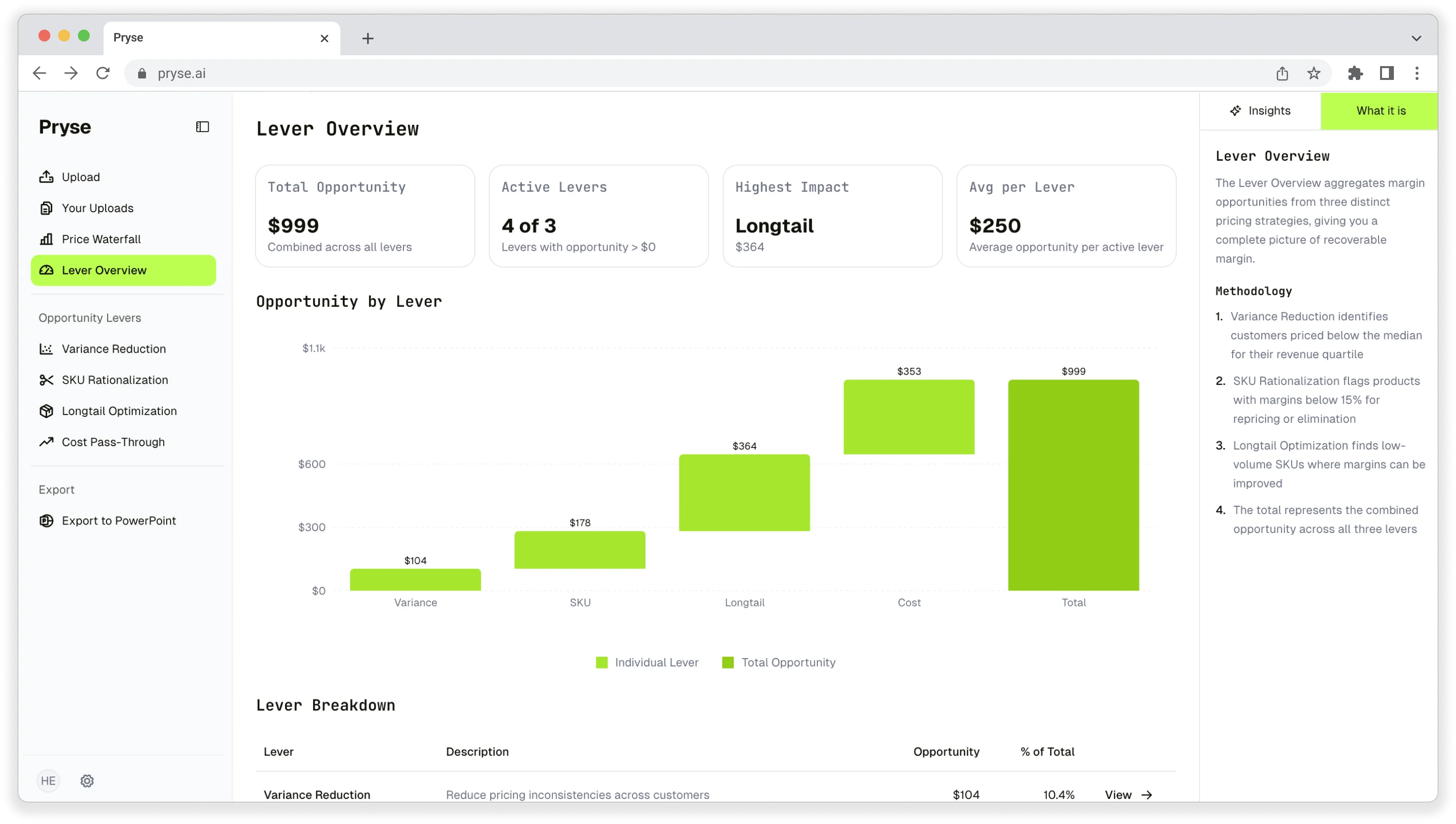
Pryse automatically identifies margin leakage across thousands of SKUs. Upload your data and find hidden profit in 24 hours.
One-time $1,499 diagnostic. No subscription required.